At a glance
A leaner week, but a coherent one: the dominant thread is the gap between AI ambition and AI value in the SOC. The 2026 SANS SOC Survey (444 practitioners and 69 CISOs) names enterprise-wide visibility — not staffing or automation — as the top barrier to SOC effectiveness, cited by 24% of cyber leaders. The SOC-CMM 2026 Maturity Report sharpens the point: AI adoption is surging (co-pilots up 145%, agents up 118% year over year), yet only 10% of SOCs say they are getting excellent value from it. The diagnosis in both is structural: first-wave point-AI bolted onto fragmented stacks never fixes the handoffs between detection, investigation, and remediation, and a SOC that cannot see across its estate cannot detect across it either.
Against that backdrop, two vendors push at the workflow itself. Elastic moved investigation upstream of triage — agentic diagnostics that auto-run the moment an alert fires, surfaced inside Claude, Cursor, and VS Code via MCP. Ridge Security’s RidgeBot 7.0 added end-to-end Active Directory domain-compromise simulation, the validation counterpart that asks whether your AD detections actually fire. Together they frame the week’s tooling story: investigation that starts earlier, and validation that proves the detections were worth building.
Then the operational reality check: Microsoft shipped its largest-ever Patch Tuesday — 200-plus CVEs, 33 rated Critical, and multiple publicly disclosed or exploited zero-days, including a Defender elevation-of-privilege flaw. For SOC and vuln-management teams the work this week is triage and deployment cadence: separate the actively exploited from the merely critical, and get the zero-days out the door first.
Underneath it all, a foundational shift worth filing: Agent Threat Rules, an open Sigma/YARA-style detection format for AI-agent threats, shipping 400-plus rules for prompt injection, agent manipulation, skill compromise, and context exfiltration. As agents move into the SOC, the detection-engineering discipline is starting to grow rules for the agents themselves.
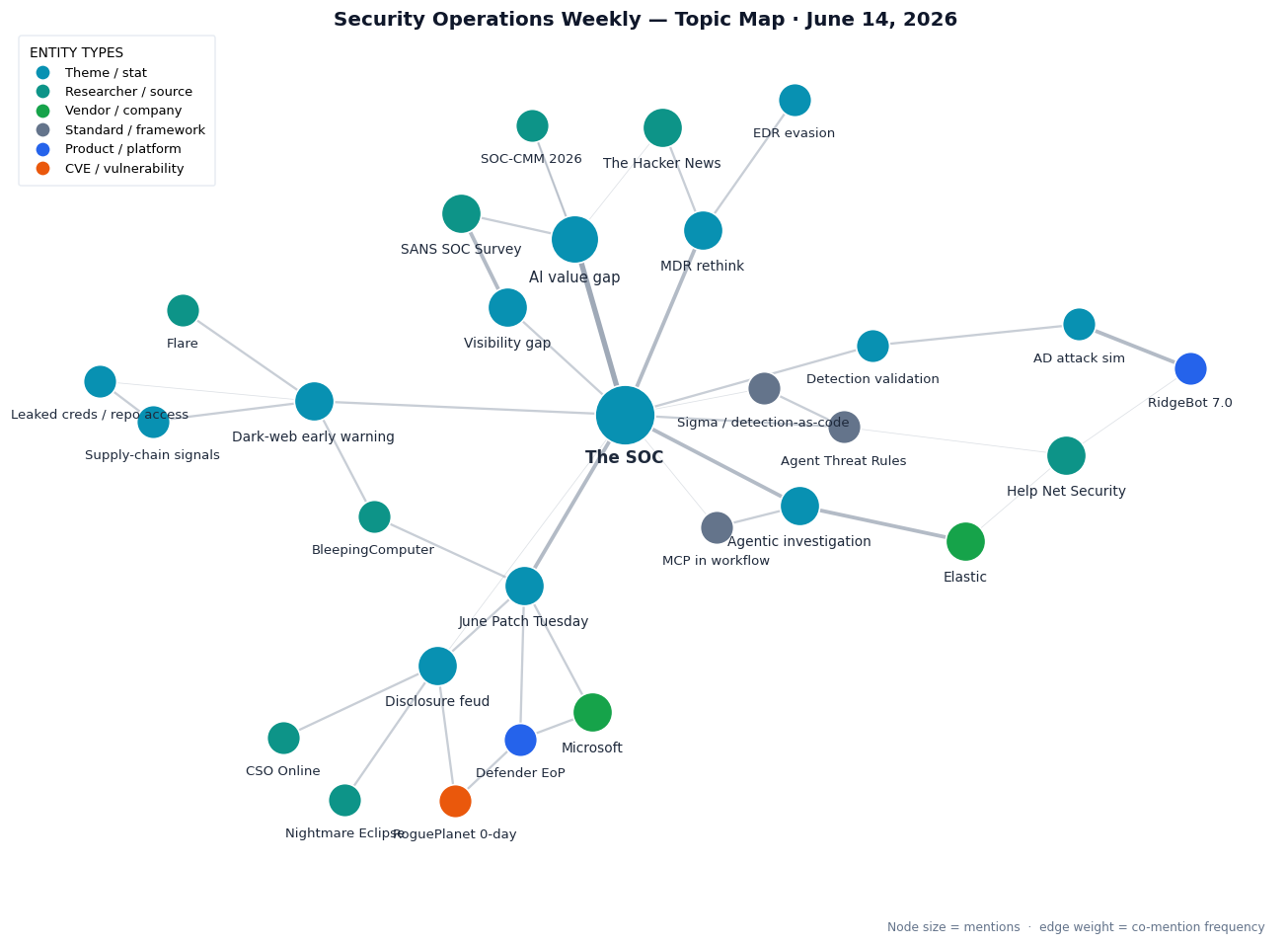
This week’s stories
SOC strategy & AI value
Two benchmark reports converge on the same finding: AI adoption is up sharply, but visibility gaps and fragmented stacks are throttling the value the SOC actually gets out of it.
- 2026 SANS SOC Survey: 24% of cyber leaders cite lack of enterprise-wide visibility as the top barrier to SOC effectiveness
- Rethinking MDR as attackers and defenders embrace AI
- Only 10% of SOCs say they’re getting excellent value from AI
SOC tooling & validation
Investigation moves upstream of triage, and automated validation asks the harder question: do the detections actually fire?
- Elastic brings AI-driven incident investigation to Kubernetes and observability tools
- RidgeBot 7.0 automates Active Directory attack simulations for security validation
Patch operations
The largest Patch Tuesday on record lands as a triage-and-cadence problem for SOC and vuln-management teams — and a researcher feud drops an unpatched Defender zero-day into the same cycle.
- Microsoft June 2026 Patch Tuesday fixes 200+ flaws, multiple zero-days
- Microsoft feud escalates as researcher drops new Windows zero-day (RoguePlanet)
Threat intelligence & early warning
Supply-chain compromises leave an underground paper trail — the signals show up in dark-web markets before they surface as public incidents.
- Early warning signs of supply-chain attacks live in the dark web
Foundational: detection engineering for AI agents
An open detection-rule format for AI-agent threats — the operational angle is building and deploying the detections.
- Agent Threat Rules: an open detection-rule format for AI-agent threats
The detail
1. 2026 SANS SOC Survey: 24% of cyber leaders cite lack of enterprise-wide visibility as the top barrier to SOC effectiveness
The annual SANS SOC Survey — this year drawing on 444 SOC practitioners and 69 CISOs — finds that lack of enterprise-wide visibility, not staffing shortfalls or automation gaps, is the top barrier to SOC effectiveness, cited by 24% of cyber leaders. It is the benchmark report SOC leads use to gauge how their peers are building, staffing, and modernizing, and this year’s headline reframes the modernization conversation. Visibility gaps map directly onto detection coverage and tooling decisions: a SOC that can’t see across its estate can’t detect across it. Use the finding to pressure-test your own coverage map before the next round of tooling spend.
2. Rethinking MDR as attackers and defenders embrace AI
The piece argues that the traditional MDR model — humans working an alert queue — is structurally failing as AI-assisted attackers learn to exploit low-severity blind spots. The most striking data point: more than half of confirmed compromised endpoints had already been marked “mitigated” by the EDR vendor. That is a coverage-gap problem dressed up as a closed ticket, and it speaks directly to EDR-evasion realities and the places where SOAR underdelivered. For SOC leaders the takeaway is to stop treating “mitigated” as ground truth and to revisit how low-severity signal is triaged, correlated, and escalated before an AI-assisted attacker stitches it into a full intrusion.
3. Only 10% of SOCs say they’re getting excellent value from AI
Reading the SOC-CMM 2026 Maturity Report (roughly 200 SOCs), the article documents surging AI adoption — co-pilots up 145% and agents up 118% year over year — against a stark value gap: only 10% of SOCs report getting excellent value. The blame lands on architecture, not ambition. First-wave point-AI bolted onto fragmented stacks never fixes the handoffs between detection, investigation, and remediation, so the gains stay local while the friction stays systemic. It is hard benchmark data paired with a critique SOC leads can actually use: before adding another co-pilot, fix the handoffs the existing ones can’t.
4. Elastic brings AI-driven incident investigation to Kubernetes and observability tools
Elastic launched an agentic investigation workflow plus MCP-based skills that auto-run diagnostics the moment an alert fires, and surfaces the same investigation inside Claude, Cursor, and VS Code through an MCP app. The framing is “investigation starts before triage” — instead of an analyst opening a ticket and beginning to gather context, the context is already gathered when they arrive. The MCP-in-the-analyst-workflow angle matters too: investigation moves to where engineers already work rather than forcing a context switch into a separate console. Worth a pilot to see whether the auto-run diagnostics genuinely compress mean-time-to-context, or just relocate where the analyst reads the same data.
5. RidgeBot 7.0 automates Active Directory attack simulations for security validation
Ridge Security’s automated validation platform added end-to-end Windows Active Directory domain-compromise simulation, mapping attack paths and prioritizing exploitable risk. This is the purple-team and detection-validation counterpart to the week’s investigation tooling: it tests whether your AD detections actually fire when an attacker walks the path, rather than assuming the rules you authored work in production. For detection engineers, the value is in closing the loop — author content, then validate it against a simulated domain compromise and prioritize remediation by what is genuinely exploitable. AD remains the crown-jewel pivot in most intrusions, so automated, repeatable validation of those detections is well-aimed.
6. Microsoft June 2026 Patch Tuesday fixes 200+ flaws, multiple zero-days
Microsoft’s largest-ever Patch Tuesday addressed 200-plus CVEs, 33 of them rated Critical, and resolved multiple publicly disclosed or exploited zero-days — including a Defender elevation-of-privilege flaw. For SOC and vuln-management teams this is a triage-and-cadence problem before it is a patching one: separate the actively exploited zero-days from the merely critical, and push the exploited items to the front of the deployment queue. The Defender EoP is the kind of flaw that turns a foothold into full control, so it warrants priority attention and a check that your own security tooling isn’t the soft spot. Set the deployment cadence deliberately this cycle — the volume rewards a prioritized rollout over a blanket one.
7. Microsoft feud escalates as researcher drops new Windows zero-day
A day after the record June Patch Tuesday, researcher “Nightmare Eclipse” published proof-of-concept exploit code for an unpatched Windows Defender flaw dubbed RoguePlanet — a race-condition bug that can spawn a SYSTEM-level shell on fully updated Windows 11 and Windows 10. The exploit reportedly hinges on getting a victim to open a malicious .vhd(x) on a remote SMB server, causing Defender to overwrite its own files and execute attacker code, and it was dropped on a new “MSNightmare” GitHub repo after Microsoft removed the researcher’s earlier repositories and revoked MSRC access. Microsoft has condemned the uncoordinated disclosures and threatened legal action; analyst Kevin Beaumont called the response “a dumpster fire of their own making.” For SOC teams the operational reality is what matters: prior Eclipse drops were folded into real-world attacks within days, so treat this as an early-warning feed — hunt for suspicious remote .vhd/.vhdx mounts over SMB, watch for Defender self-tampering, and don’t wait on a vendor patch that may be weeks out. (The underlying RoguePlanet flaw is also covered in this week’s Malware bulletin from the vulnerability-and-IR angle; this item is the disclosure-and-operations view.)
8. Early warning signs of supply-chain attacks live in the dark web
Flare’s research makes a case SOC threat-intel teams can act on: the earliest signals of a software supply-chain attack usually surface in underground forums before any public incident report, and they rarely carry an obvious label. A post advertising GitHub access, a private repository, source code, API keys, OAuth tokens, cloud credentials, or CI/CD data is a supply-chain lead when of the access touches a trusted build-or-deploy relationship. The piece walks through recent examples — the Vercel OAuth/SaaS incident, the Sportradar/Trivy compromise tied to the TeamPCP campaign, the Shai-Hulud npm worm, and the LiteLLM PyPI compromise — to show how ordinary-looking access sales become footholds. The defender takeaway is concrete: extend supply-chain monitoring beyond CVE and package alerts to watch for exposed developer credentials, repo access, registry tokens, OAuth grants, and vendor leaks, and ask not just “was data leaked?” but “could this access affect how trusted software is built, deployed, or updated?” (Sponsored/contributed content, but the monitoring framework is broadly useful.)
9. Agent Threat Rules: an open detection-rule format for AI-agent threats
Agent Threat Rules is an open detection-rule format modeled on Sigma and YARA, shipping 400-plus rules covering prompt injection, agent manipulation, skill compromise, and context exfiltration. As AI agents move into the SOC and the broader enterprise, this is the detection-engineering discipline beginning to grow rules for the agents themselves — a shared, portable format rather than a vendor silo. The operational angle is building and deploying detections: treat the rule set as a starting library, map its coverage against the agent surfaces you actually run, and pipe the relevant rules into your existing detection pipeline. A foundational read for any team standing up agent telemetry and wondering what to alert on first.
On our watch list
- Closing the AI-value gap. With only 10% of SOCs reporting excellent value from AI and the diagnosis pointing at fragmented stacks and broken handoffs, watch whether the next wave of tooling targets the seams between detection, investigation, and remediation rather than adding another standalone co-pilot. That is the metric that will move the SOC-CMM numbers.
- Visibility as the modernization lever. The SANS finding that enterprise-wide visibility — not staffing or automation — is the top barrier should reframe tooling spend. Pressure-test your coverage map before the next purchase; a visibility gap is a detection gap by another name.
- “Mitigated” as ground truth. The MDR rethink’s claim that more than half of confirmed compromised endpoints were already marked “mitigated” by the EDR vendor deserves a same-quarter look at how your team treats closed/mitigated states. Build hunt content that revisits “mitigated” endpoints rather than trusting the label.
- Detections for the agents themselves. With Agent Threat Rules shipping 400-plus open rules for prompt injection, agent manipulation, skill compromise, and context exfiltration, the first wave of agent-focused detection content now has a portable home. Start baselining agent telemetry now so those rules have a healthy floor to land on.