|
AI & ML in Security · Issue June 21, 2026
AI & ML in Security
June 21, 2026 · Weekly Edition · AI security + new AI capabilities & approaches
|
At a glance
This week’s dominant story is export-control geopolitics colliding with AI model access. Anthropic confirmed it has taken its most capable models offline globally to comply with new US export controls — a move Al Jazeera framed as the clearest signal yet that frontier AI is now treated as a strategic export like advanced semiconductors. The question of what governments can and cannot do with AI is further complicated by Microsoft’s MXC OS-level sandbox, which now lets agents run with granular, OS-enforced permissions rather than trusting them on the network, and by a widening CVE surge: AI-assisted vulnerability discovery is on track to push 2026 toward 66,000 CVEs, per FIRST’s forecast.
On the offensive side, the in-window articles demonstrate that AI is now operationally useful to real attackers at multiple layers. A documented case shows a low-skilled attacker using Claude and Codex to breach 14 companies. The AutoJack technique — where a single web page hijacks an AI agent and triggers host-level RCE — appears in two forms: a conceptual write-up from The Hacker News and a deep Microsoft technical analysis, together representing the sharpest published documentation of single-page AI-agent exploitation to date. Meanwhile, Varonis disclosed a one-click M365 Copilot flaw capable of stealing emails and MFA codes, and HAMLOCK introduced a hardware-level neural-network backdoor that survives model updates. The OWASP AI Security Landscape Q2 2026 and the emerging Agent Threat Rules open detection format give defenders a practical response surface to work from.
The new-capabilities cluster is unusually rich this week. Anthropic shipped a major Claude Design overhaul with design-system imports and a fix for runaway token burn. Databricks is tackling AI agent skills-sharing with an open-sharing protocol, and Mastercard launched a protocol for agent-to-agent micropayments. A pair of architectural critiques from The New Stack and CIO.com argue that agentic architecture is still poorly understood even by teams deploying it, while a Help Net Security survey finds most production agentic AI projects have stalled over data-pipeline problems — a reality check that the capability curve and the production maturity curve are still far apart. The MCP authorization gap, loop engineering as a development paradigm, and the growing cost of AI debt round out the practitioner reading.
|
Topic map — how this week’s research clusters
This week in one frame: export-control collisions with AI model availability, AI-assisted attacker capability (AutoJack, M365 Copilot flaw, HAMLOCK hardware backdoor, low-skill-attacker case study), an expanding CVE landscape driven by AI-assisted discovery, and a new-capabilities wave spanning Claude Design, agent payments, MCP authorization, and agentic architecture debates.
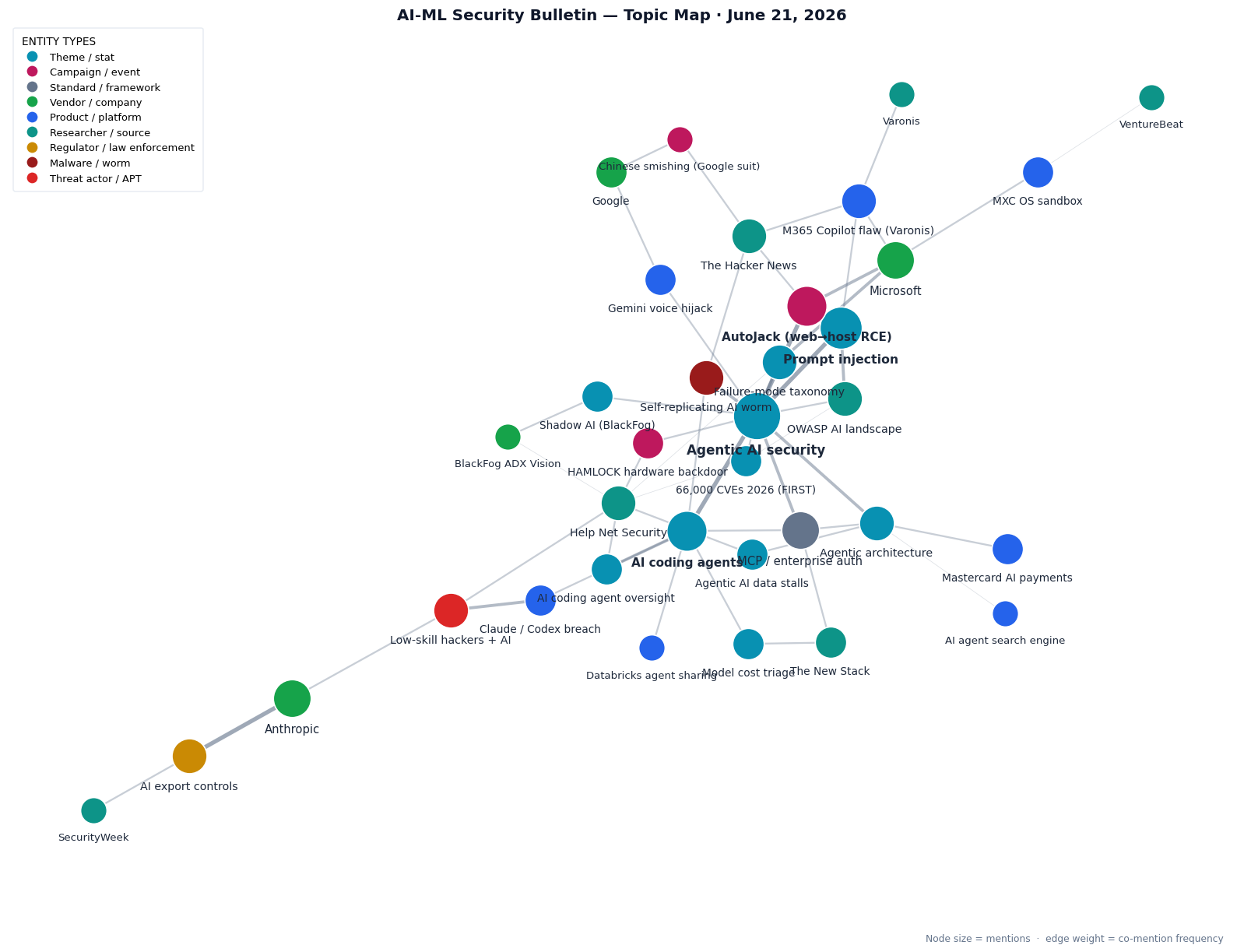
Weighted entity-relationship map for the June 21, 2026 issue. Node size reflects mention frequency; edge thickness reflects co-mention strength across the week’s articles.
|
Article index
AI security: prompt injection & agent threats
From a documented low-skill-attacker campaign to hardware backdoors, one-click Copilot exploits, AutoJack single-page RCE, shadow-AI visibility gaps, and the growing CVE surface AI-assisted discovery is creating.
AI security policy & export controls
The US government’s move to restrict Anthropic’s models globally — the mechanics and the precedent it sets for how frontier AI is governed as a strategic export.
Agentic AI in defense & operations (foundational)
Detection frameworks, OS-level sandboxing, MCP authorization gaps, the self-replicating AI worm prototype, open detection-rule formats for agent threats, and Cisco’s agentic defense platform.
New AI capabilities & approaches
Claude Design overhaul, loop engineering, agent payments, agentic architecture puzzles, skills-sharing for agents, AI-agent search, production stalls over data pipelines, and AI debt — the capability and practitioner curve this week.
|
Detailed write-ups
1. Low-skilled attacker used Claude/Codex to breach 14 companies
Help Net Security · June 17, 2026
A documented case confirms what threat researchers have been projecting for months: an attacker with limited prior tradecraft used Claude and OpenAI’s Codex to orchestrate intrusions into 14 organizations. The case is significant because it isn’t hypothetical — it is an operational incident with named tools and a real victim count. The attacker appears to have used the models primarily for reconnaissance assistance, payload generation, and scripting post-compromise steps that would previously have required deeper technical skill. For defenders, the instructive detail is not just that AI lowers the skill floor; it is that the agentic orchestration of multiple tools in sequence — rather than any single capability — is what enabled the scale. This mirrors Anthropic’s own findings from earlier mapping exercises: agentic orchestration is the better risk indicator.
Read the article →
2. One-click M365 Copilot flaw could steal emails and MFA codes
The Hacker News · June 15, 2026
Varonis disclosed a vulnerability in Microsoft 365 Copilot that allows a single-click exploit to exfiltrate emails and multi-factor authentication codes from a victim’s mailbox. The attack chains a prompt injection embedded in a malicious email with Copilot’s ability to access adjacent mailbox data and relay it externally. The finding illustrates how AI assistants that have been granted broad read permissions over enterprise data become a high-value injection target: the assistant’s trust level and data access effectively amplify the blast radius of a single injected instruction. Any organization running M365 Copilot should review what mailbox and calendar permissions it has been granted and whether least-privilege scoping has been applied at the Copilot configuration layer.
Read the article →
3. HAMLOCK: hardware neural-network backdoor that survives model updates
Help Net Security · June 15, 2026
HAMLOCK is a hardware-layer backdoor technique that embeds malicious behavior directly in the neural-network processing circuitry rather than in model weights or software. The key property is persistence: because the backdoor lives below the firmware and model layers, standard software-side mitigations such as retraining, fine-tuning, or model replacement do not remove it. Researchers demonstrated that the backdoor activates on specific trigger inputs while behaving normally on all others, making detection difficult via standard evaluation benchmarks. For architects deploying AI in high-assurance environments or procuring hardware accelerators from third-party vendors, HAMLOCK is a warning that the AI trust chain now needs to extend down to the hardware supply chain — not just the model and software stack.
Read the article →
4. AutoJack: a web page hijacks an AI agent for host RCE
The Hacker News · June 19, 2026
AutoJack is a single-page attack: a crafted web page embeds hidden prompt-injection instructions that are consumed by an AI agent browsing on behalf of a user, redirecting the agent to execute attacker-controlled shell commands on the host running it. The attack requires no user interaction beyond the agent visiting the page. The Hacker News write-up covers the conceptual mechanics and the class of agents vulnerable; Microsoft’s separate technical analysis (see item 15 in foundational reading this week) provides the full exploit chain. Together they make AutoJack one of the best-documented single-session AI-agent exploitation chains published to date — and a direct challenge to any team that has built AI agents with unsandboxed host access based on the assumption that web content is passive.
Read the article →
5. AI vuln discovery pushing 2026 CVEs toward 66,000
Help Net Security · June 15, 2026
FIRST’s mid-year CVE forecast projects that AI-assisted vulnerability discovery is on course to push the 2026 total toward 66,000 — a rate that would shatter every prior annual record and leave patch prioritization programs dependent on static CVSS scores increasingly inadequate. The article argues that the growth is not purely an artifact of better reporting: AI tools are genuinely finding classes of vulnerability that previously required rare human expertise and weeks of manual analysis. For security architects, the operational implication is direct: the patch backlog is growing faster than most organizations’ current triage capacity, and the programs that will handle it are those that have already automated their vulnerability-management workflows.
Read the article →
6. BlackFog brings shadow-AI visibility to macOS endpoints
Help Net Security · June 19, 2026
BlackFog’s ADX Vision extends to macOS, adding a detection layer specifically focused on shadow AI — unapproved AI tools and models running or communicating from endpoints without IT knowledge. The release matters because macOS has been a persistent gap in enterprise AI-governance tooling: most data-exfiltration and DLP products were built around Windows assumptions. For teams trying to enforce AI-use policies, knowing which models are actually running and where they are sending data is a prerequisite to any meaningful governance program, and this fills a meaningful coverage hole for organizations with significant macOS fleets.
Read the article →
7. Oversight when AI agents write a lab’s own code
Help Net Security · June 18, 2026
Researchers examined what happens when AI coding agents are given write access to the same codebase they are helping to maintain — including safety-critical code in a research environment. The study surfaces a core governance question: when an agent can modify the code governing its own behavior or the tools it uses, what does meaningful human oversight actually look like in practice? The findings point toward structured review gates, incremental change constraints, and explicit separation of the agent’s operational environment from the code it can modify. A practical read for engineering leads deploying AI coding assistants against internal tooling or infrastructure codebases.
Read the article →
8. Anthropic takes latest AI models offline to comply with export controls
SecurityWeek · June 15–19, 2026
Anthropic confirmed it has suspended global access to its most capable models in response to new US export-control requirements. The move is a first for a frontier AI lab — an explicit regulatory-compliance action that restricts model availability on the same legal basis as advanced semiconductor exports. For security architects and teams that have integrated Anthropic’s models into production workflows, the immediate operational question is business-continuity planning when model availability depends on geopolitical status. More broadly, the decision signals that frontier AI is now firmly in the same regulatory tier as dual-use hardware, with all the compliance complexity that implies for multi-national AI deployments.
Read the article →
9. US asks Anthropic to block global model access — why it matters
Al Jazeera · June 14, 2026
Al Jazeera provides the international policy context for the Anthropic export-control action: the US request is being read outside Washington as an assertion that advanced AI models are a strategic asset to be controlled rather than a global public resource. The piece draws parallels to semiconductor export restrictions and examines the likely geopolitical downstream effects — accelerated investment in domestic model development in excluded regions and increasing fragmentation of the global AI tooling landscape. A useful companion to the SecurityWeek item for understanding the strategic frame rather than just the compliance mechanics.
Read the article →
10. Prompt injection still drives most agentic AI security failures in production (OWASP)
Help Net Security · June 11, 2026 · Foundational reading
OWASP’s data on production agentic AI failures finds prompt injection the dominant root cause, mapping to the majority of the top-ten failure categories. The analysis draws on real CVEs and breach reports rather than lab scenarios, giving it practical authority. For engineering teams, the core takeaway is that prompt injection should be the default threat assumption for any agent that reads external content — not an edge case addressed after core functionality is built. This remains the most grounded, evidence-based framing of the agentic AI security problem currently available in the public literature.
Read the article →
11. Agent Threat Rules: an open detection-rule format for AI-agent threats
Help Net Security · June 3, 2026 · Foundational reading
Agent Threat Rules is an open, community-driven detection-rule format designed specifically for AI-agent threats — covering prompt injection attempts, tool-misuse patterns, unauthorized data access, and agent exfiltration behaviors. The project’s premise is that existing detection languages such as SIGMA and YARA were not designed with agentic AI workflows in mind, and that a shared rule vocabulary is a prerequisite for the kind of community threat intelligence sharing that made endpoint detection engineering effective. For security teams standing up agent monitoring, this is an early but important building block: adopting a standard format now means rules can be shared and reused across tooling rather than locked inside proprietary platforms.
Read the article →
12. Microsoft launches MXC OS-level sandbox for AI agents
VentureBeat · June 2, 2026 · Foundational reading
Microsoft’s MXC is an OS-level sandboxing environment for AI agents, built in partnership with OpenAI and NVIDIA. Rather than relying on network-policy guardrails or application-layer controls, MXC enforces permissions at the operating system level — constraining what a running agent can read, write, execute, and communicate. The approach directly addresses a core weakness in current agent deployments: agents run with the same OS permissions as the user who launched them, making any prompt-injection or tool-misuse exploit an immediate OS-level event. For security architects, MXC represents the kind of infrastructure-level answer to agent trust that application-layer controls cannot provide, and its adoption by OpenAI and NVIDIA signals it may become a baseline expectation for enterprise agent runtimes.
Read the article →
13. MCP gets its missing enterprise authorization layer
The New Stack · June 2026 · Foundational reading
The Model Context Protocol has spread rapidly as the de facto standard for wiring AI agents to external tools and data sources, but its authorization model was minimal by design — any connected agent could invoke any registered tool. This piece covers work to add a structured enterprise authorization layer to MCP: scoped permissions, identity-bound tokens, and audit trails that enterprise security and compliance teams actually require. For organizations that have deployed MCP-connected agents and quietly noticed the absence of granular access controls, this is the most directly actionable near-term development in the MCP ecosystem.
Read the article →
14. Self-replicating AI worm on open-weight models
The Hacker News · June 9, 2026 · Foundational reading
Researchers built a self-replicating worm that carries a small open-weight LLM as its reasoning engine, using it to assess each target host and adapt its propagation strategy on the fly without calling back to any external API. The result is a fully autonomous attack loop that runs on commodity hardware and is opaque to API-layer monitoring. The research is a direct empirical challenge to threat models that assume frontier-model access is a prerequisite for autonomous offensive AI: the capability is available on consumer hardware with no guardrails, and the attack surface it creates is in environments that have no visibility into locally-running model activity.
Read the article →
15. Microsoft: taxonomy of failure modes in agentic AI (v2.0)
Microsoft Security · June 4, 2026 · Foundational reading
Microsoft’s v2.0 taxonomy, drawn from a full year of red-team engagements against agentic systems, adds seven new failure categories including supply-chain compromise, excessive agency, feedback-loop poisoning, and autonomy escalation. The taxonomy is a first-party, operationally-grounded checklist that engineers can map onto their own agent designs. It pairs directly with the OWASP prompt-injection data in this issue: the taxonomy describes how agents fail, while the OWASP evidence-base ranks which failures are most consequential in production. Reading both together gives a more complete threat model than either document provides alone.
Read the article →
16. Cisco Cloud Control: agentic platform to operate and defend critical IT infrastructure
Cisco · June 2, 2026 · Foundational reading
Cisco unveiled Cloud Control, an agentic platform designed to autonomously operate and defend enterprise IT infrastructure. The platform aims to close the gap between agentic AI capabilities for network management and security operations, putting both in the same orchestration layer. The timing is notable — it comes alongside Cisco’s acquisition of WideField Security to extend Splunk’s agentic SOC capabilities. Together these moves position Cisco as a full-stack vendor for autonomous infrastructure defense, which raises both capability questions (how well do these agents actually perform?) and governance questions (who audits their decisions when they act on live infrastructure?).
Read the article →
17. OWASP AI Security Solutions Landscape Q2 2026
OWASP · June 2026 · Foundational reading
OWASP’s quarterly map of the AI security tooling landscape, covering solutions for AI and agentic red teaming, prompt-injection defense, model security testing, and agent monitoring. Updated for Q2 2026, it is a practical reference for security architects trying to assemble a toolchain from the rapidly expanding but loosely organized set of AI security products and open-source projects. The landscape gives teams a starting point for procurement and gap analysis without requiring independent discovery of every relevant vendor and project.
Read the article →
18. AI red-teaming agents change how LLMs get tested
Help Net Security · May 21, 2026 · Foundational reading
This survey covers the shift toward agent-orchestrated red teaming using frameworks such as PyRIT, Garak, and Promptfoo, where automated agents generate, mutate, and prune attack paths faster than human teams can. The central observation is that the methodology for testing AI systems is itself becoming agentic, and that teams standardizing on manual evaluation workflows are already falling behind what automated agents can explore. For security teams responsible for AI testing programs, the practical question is which evaluation tooling to standardize on as agent-driven testing becomes the baseline expectation rather than a research capability.
Read the article →
19. Gemini voice assistant hijacked via notifications
SecurityWeek · June 4, 2026 · Foundational reading
Researchers demonstrated a technique that hijacks Google’s Gemini voice assistant by injecting malicious instructions through notification messages that the assistant reads aloud or processes as context. Because voice assistants treat notification content as trusted ambient input, the attack requires no user interaction beyond the assistant’s normal background operation. It extends the prompt-injection surface into the ambient-computing layer: any channel that feeds content to a persistent, always-listening AI assistant is a potential injection vector, and notification streams are an unusually high-trust, low-monitored one.
Read the article →
20. Google sues Chinese smishing network using Gemini
The Hacker News · June 12, 2026 · Foundational reading
Google filed suit against a China-nexus smishing network that used Gemini to generate and personalize phishing SMS messages at scale. The case is the first major public legal action naming a frontier AI model as the direct tool in a large-scale phishing campaign, and Google’s decision to litigate rather than just terminate accounts signals the start of a legal deterrence strategy for AI misuse. For the security community, it is also a data point: large-scale personalized phishing is operationally feasible with commercially available LLMs, and the volume and personalization quality are qualitatively different from template-based SMS campaigns.
Read the article →
21. Anthropic ships major Claude Design overhaul
VentureBeat · June 2026 · Foundational reading · New capability
Anthropic shipped a significant update to Claude’s design tooling: design-system imports that let the model ingest component libraries directly, code round-trips that keep generated UI in sync with design edits, and a fix for the token-burning problem where the model would re-render unchanged components on each pass. The token-burn fix is practically significant for teams running Claude in cost-sensitive production loops — runaway token consumption on UI generation tasks had been a meaningful deployment friction point. The design-system import capability moves Claude closer to being a first-class tool in professional design and front-end engineering workflows rather than a general-purpose code generator.
Read the article →
22. Loop engineering: Claude Code lead ditched prompting, now writes loops
The New Stack · June 2026 · New approach
The lead developer behind Claude Code describes a shift in how advanced practitioners are using AI coding agents: rather than writing detailed prompts, they write evaluation loops that run the agent repeatedly against a test suite, scoring outputs and iterating until the result passes. The approach — dubbed loop engineering — moves the human’s role from prompt author to loop architect, and it produces more reliable results for complex tasks than any single well-crafted prompt. It is a genuine paradigm shift in the human-AI coding workflow, and the companion Medium piece (“Loop Engineering Is NOT What Everybody Thinks”) is recommended reading alongside it for the practical correction of common misunderstandings.
Read the article →
23. Why agentic architecture is still so puzzling
CIO · June 18, 2026 · Approach & architecture
CIO.com surveys practitioners who are building or deploying agentic systems and finds that architectural confusion remains widespread even among experienced teams: unclear boundaries between agents, fragile handoffs between steps, and difficulty reasoning about failure modes across a multi-agent chain. The piece argues that current frameworks provide primitives without architectural patterns, leaving engineers to discover best practices through iteration rather than design. A useful sanity check for teams frustrated by production agentic systems that are harder to reason about than the demos suggested, and a reminder that the architectural discipline around agents is still forming.
Read the article →
24. Databricks wants to kill the “email me a file” problem for AI agent skills
The New Stack · June 2026 · New capability
Databricks introduced an open-sharing protocol for AI agent skills: rather than packaging and emailing model artifacts or re-implementing the same skill in each deployment, teams can publish skills to a shared registry and agents can discover and invoke them across organizational boundaries. The protocol is part of a broader push to make agent skills composable and shareable without requiring custom integration work. For platform and ML engineering teams, it addresses a genuine operational gap — the difficulty of reusing agent capabilities across projects without duplicating work or introducing version drift in privately maintained copies.
Read the article →
25. Mastercard launches protocol for AI agent-to-agent micropayments
Reuters / Yahoo Finance · June 2026 · New capability
Mastercard announced a payment protocol enabling AI agents to transact with each other directly — sending micropayments for services, data, or computation without requiring human approval on each transaction. The protocol provides identity verification and settlement infrastructure designed for the agent-to-agent interaction layer rather than for human-facing payment flows. From a security standpoint, the announcement opens a new attack surface: if agents can authorize payments autonomously, a compromised or prompt-injected agent can exfiltrate real financial value without triggering the human-review checkpoints that protect conventional payment flows. Financial controls and agent governance programs need to develop together.
Read the article →
26. AI agents are getting their own search engine
ZDNet · June 2026 · New capability
A new search infrastructure layer is emerging specifically optimized for agent queries: structured, machine-readable results that agents can consume without scraping web pages designed for human readers. Current web search was built assuming a human decides what to do with results; agent-native search returns structured data with explicit provenance and confidence signals that downstream reasoning steps can use reliably. The capability development matters for security because agent-native search changes the trust and injection surface: search results become machine-trusted inputs to agentic reasoning chains, and poisoning those results becomes a first-class attack vector.
Read the article →
27. Most agentic AI projects in production have stalled over data problems
Help Net Security · June 18, 2026 · Adoption & approach
A new survey finds that the majority of organizations that moved agentic AI projects into production hit a wall at the data layer: inconsistent formats, missing provenance, access-control mismatches, and pipeline latency that makes agent responses unreliable or wrong. The finding is a meaningful corrective to the pace of capability announcements: deploying an agent framework is straightforward; connecting it to enterprise data in a way that produces trustworthy outputs at production quality is not. For teams planning agentic deployments, the implication is that data-pipeline investment should precede or match agent-framework investment — not trail it.
Read the article →
28. Claude Fable cost $9 in one coding test, GPT-5.5 cost $1.50: model triage is the new AI skill
The New Stack · June 2026 · New approach
As frontier AI costs diverge dramatically across tasks — the same coding task costing six times as much on one model as another — the practical skill of routing tasks to the right model for the right price becomes a first-order engineering concern. The piece argues that model triage — knowing which model is sufficient for a given task, not just which is most capable — is now a core competency for any team running AI in production at scale. For cost-conscious engineering leads, this is a useful framing: the economics of production AI are now driven as much by routing discipline as by model selection.
Read the article →
29. Beyond the stack trace: why AI requires a new debugging paradigm
The New Stack · June 2026 · New approach
AI system failures don’t produce a stack trace pointing to a specific line of code. They produce incorrect, inconsistent, or subtly wrong outputs whose root cause may be a data distribution shift, a prompt framing issue, or an emergent interaction between components. The piece argues that AI engineering requires a new debugging vocabulary — covering prompt auditing, trace logging across reasoning steps, regression suites for model behavior, and the skill of diagnosing probabilistic failures rather than deterministic ones. A practical orientation for engineers accustomed to conventional debugging who are finding that their existing mental models don’t transfer cleanly to AI systems.
Read the article →
30. 7 sources of AI debt and how to avoid them
CIO · June 2026 · Approach & management
A structured taxonomy of AI debt — the accumulated technical, operational, and governance liabilities that organizations acquire as they move fast on AI deployment: undocumented prompt dependencies, evaluation shortcuts, un-versioned models, governance bypasses, and tightly coupled AI components that become brittle over time. The piece draws directly on the concept of technical debt but maps it to the specific failure modes of AI systems, where the liability often compounds invisibly until a model update or data shift triggers a production failure. A useful planning reference for engineering leads who want to avoid building systems whose maintenance costs outpace their value.
Read the article →
|
On our watch list
- AutoJack in the wild. Whether the single-page AI-agent RCE technique moves from proof-of-concept into active exploitation campaigns, and how agent framework vendors respond at the sandboxing layer — particularly whether Microsoft’s MXC model propagates to competing runtimes.
- Export controls and AI fragmentation. How other frontier labs respond to the Anthropic model-restriction precedent, whether other countries accelerate domestic model programs in response, and what new compliance requirements land on enterprises running multi-vendor AI stacks across jurisdictions.
- Agent payment security. Whether Mastercard’s agent-micropayment protocol and similar emerging standards include security controls adequate to prevent prompt-injected agents from initiating unauthorized transactions — and who bears liability when they do.
- MCP authorization maturity. Whether the enterprise authorization layer for MCP lands in the core specification or fragments across vendor-specific extensions, and how quickly the security community produces standard detection coverage for MCP tool-misuse patterns.
|
|
AI & ML in Security · a Newshunter publication
Weekly news items are from the previous seven days. Foundational reading is refreshed each week.
Unsubscribe · View in browser
*|LIST:ADDRESS|*
Curated by Paul Davis · Security Radar LLC
Newsletter design, layout, and editorial curation © 2026 Security Radar LLC. All rights reserved.
Article titles and summaries are excerpted for review and commentary; all linked articles remain the copyright of their respective publishers and authors.
|
|