At a glance
This week’s brief has a theme that sits at the intersection of pressure and accountability. Most CISOs are being asked to bury bad news — a new survey finds the majority have faced explicit pressure to suppress or soften unfavorable security findings before they reach leadership or the board. That is not an isolated finding; it sits alongside data showing over two-thirds of security professionals believe the job is objectively getting harder, and that sensitive enterprise data uploads to AI models have doubled in a year. Accenture’s $4.1 billion OT push — acquiring Dragos, runZero, and NetRise in a single move — is the marquee structural signal: at that price point, OT/ICS security is no longer a specialty niche but a mainstream board-level risk category. For CISOs managing industrial or critical-infrastructure exposure, the market has just revalued your threat surface. Meanwhile, automated GRC systems are showing their limits in the field, and both Connecticut’s new AI subscription-disclosure law and the EU Cybersecurity Act 2.0 debate underscore that the regulatory perimeter around AI is hardening on both sides of the Atlantic.
The foundational reading this week is unusually rich because user additions have brought in material that directly extends the current-events thread. The shadow AI and mobile AI governance problem is bigger than most visibility tools can see. Regulators are now creating hard liability triggers around AI disclosure — Connecticut being the first US state to require companies to tell subscribers exactly what AI can and cannot do with their data. AI is also reshaping workforce economics in a way the board needs to understand: PwC’s Global Jobs Barometer finds AI is bifurcating the labor market cleanly, creating a two-tier job market between workers who can use AI and those who cannot. The enterprise pricing model for IT is simultaneously under its own structural pressure, with analysts calling the next 18 months the “Great Enterprise Pricing Reset” as AI shifts from line-item purchase to capability tax built into every platform.
Several foundational pieces carry forward from prior weeks with continued relevance: the South Korea Coupang fine — a record $409 million data-breach penalty — resets the financial ceiling for regulatory exposure; JLR’s CISO enforced in-person password resets after an attack in a case study that is genuinely instructive about post-incident credential assurance; and the CISA BOD 26-04 risk-based patching directive continues to work through its private-sector implications. Board communication remains a live craft question: research showing that CISO–board sessions average only 30 minutes per quarter has practical consequences for how those 30 minutes are structured and what goes into them. The AI governance and agent-identity pieces from the prior two weeks remain in foundational because the capability and governance gap they document is not closing.
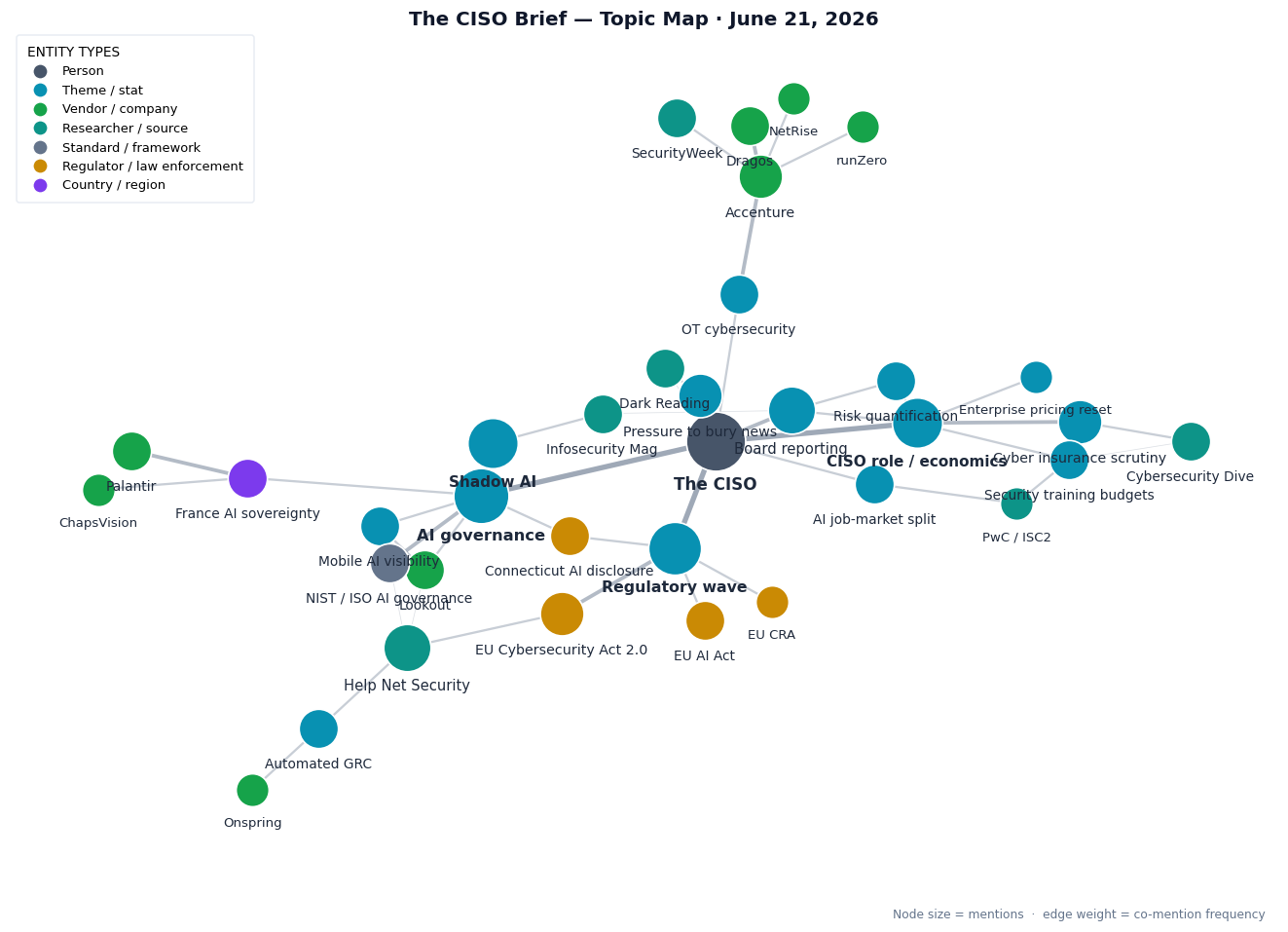
This week’s topic map — pressure on CISOs to suppress bad news, OT security consolidation (Accenture/Dragos/runZero), AI data exposure and shadow AI governance, the US/EU regulatory tightening on AI, and the workforce and pricing economics reshaping the CISO seat.
Article index
Cluster 1 — The CISO seat under pressure
Most CISOs are being asked to hide bad news. The broader numbers confirm the job is harder and the stakes are higher — AI data exposure doubling, security complexity accelerating — while a blockbuster OT acquisition signals that the risk perimeter just expanded significantly.
- 1. Accenture to acquire Dragos, runZero, and NetRise in $4.1B OT push — SecurityWeek
- 2. Most CISOs report pressure to bury bad security news — Dark Reading
- 3. Over two-thirds of security pros say cyber is getting harder — Infosecurity Magazine
- 4. Sensitive enterprise data uploads to AI models double in a year — Infosecurity Magazine
Cluster 2 — AI governance & regulatory tightening
Automated GRC is hitting its limits while regulators move faster. Connecticut is the first US state to mandate AI subscription-limits disclosure; the EU Cybersecurity Act 2.0 debate raises hard questions about what good regulation actually looks like in practice. The shadow AI and mobile AI governance pieces show why visibility is the prerequisite for any of this to work.
- 5. Onspring CISO on where automated GRC systems fall short — Help Net Security
- 6. EU Cybersecurity Act 2.0: When good regulation goes bad — Help Net Security
- 7. Connecticut requires AI companies to disclose subscription limits — PYMNTS
Cluster 3 — Foundational: AI governance & agent identity
These five pieces from recent weeks form the working library on AI governance — covering the shadow AI problem structurally, the mobile visibility gap, frameworks for governing AI agents, the financial-sector governance data, and the workforce AI accountability gap that CIOs are reporting.
- 8. Organizations can’t see much of their mobile AI activity (Lookout) — Help Net Security
- 9. Shadow AI is exposing the same governance failures we’ve ignored for years — Infosecurity Magazine
- 10. Why your most AI-savvy employees are driving shadow AI — CIO.com
- 11. CIOs plagued by a growing AI accountability gap — CIO.com
- 12. How to use NIST and ISO frameworks to govern AI agents — Help Net Security
- 13. Agentic AI surges in financial sector even as many firms fail to manage security risks — Cybersecurity Dive
Cluster 4 — Foundational: regulatory & compliance landscape
The regulatory stack is growing on both sides of the Atlantic. CISA’s BOD 26-04 rewrites federal patching; France is moving to replace Palantir with a domestic AI provider; the compliance-evidence-vs-real-control gap remains open; and two-thirds of the open-source community is still unaware of the EU CRA. The South Korea Coupang fine sets a new ceiling for breach-penalty exposure.
- 14. South Korea hits Coupang with record $409M data-breach fine — The Record
- 15. CISA rewrites federal patching for AI era (BOD 26-04) — Dark Reading
- 16. Spotless compliance evidence can still hide a broken control — Help Net Security
- 17. France to ditch Palantir’s AI data tools for a domestic provider — The Guardian
Cluster 5 — Foundational: board reporting, risk appetite & role economics
The CISO seat keeps being repriced as a business function. Board sessions average just 30 minutes per quarter, which makes the structure of those minutes consequential. Risk quantification and the financial-statement framing are the tools most likely to use that time well. Insurance economics, workforce investment, and AI’s bifurcation of the labor market are reshaping the cost side of the equation.
- 18. 30 min/quarter: CISO–board conversations falling short — CSO Online
- 19. CISO role changes as cyber-risk appetites in the C-suite grow — TechTarget
- 20. Lost in translation: cybersecurity board reporting for CISOs — TechTarget
- 21. How to get boards to prioritize cyber-risk quantification — Infosecurity Magazine
- 22. Cyber insurance policyholders facing heavier scrutiny in underwriting, claims — Cybersecurity Dive
- 23. Enterprises report increasing budgets for security training in AI and other critical topics — Cybersecurity Dive
- 24. AI is splitting the job market in two (PwC Global Jobs Barometer) — Bloomberg
- 25. IT hurtles toward the ‘Great Enterprise Pricing Reset’ — CIO.com
Cluster 6 — Foundational: context & historical record
Background pieces with longer shelf life: the JLR CISO post-incident credential case study, the EU compliance overload from the inside, the 20 leaders who built the CISO role, and KPMG’s 2026 priorities report anchored on non-human identities.
- 26. JLR CISO enforced in-person password resets after cyberattack — Infosecurity Magazine
- 27. EU organizations buckle under rising compliance pressure — Help Net Security
- 28. 20 leaders who built the CISO era — Dark Reading
Detailed write-ups
1. Accenture to acquire Dragos, runZero, and NetRise in $4.1B OT cybersecurity push
SecurityWeek · June 19, 2026
Accenture’s simultaneous acquisition of Dragos, runZero, and NetRise in a single $4.1 billion transaction is the kind of structural signal that deserves a moment in board reporting. Dragos is the dominant OT/ICS threat-detection platform; runZero is the network asset discovery layer that tells you what is actually connected; NetRise provides firmware and software supply-chain analysis at the device level. Assembled together under a consulting and services umbrella, the combination gives Accenture the capability to tell a critical-infrastructure customer what it has, what is talking to what, and whether anything in the firmware stack is compromised — end to end. For CISOs managing manufacturing, utilities, healthcare, or any environment with significant OT exposure, this consolidation revalues your risk surface. The OT security market is no longer specialty; it is mainstream, and the price tag confirms it.
Read the article
2. Most CISOs report pressure to bury bad security news
Dark Reading · June 15, 2026
A survey finding that most CISOs have faced explicit pressure to suppress or soften unfavorable security findings before they reach leadership is not entirely surprising — but having it quantified is important. The pressure to bury bad news is structurally corrosive: it creates a gap between what the board believes it knows and what the security organization actually knows, which is precisely the gap that surfaces as a liability when an incident occurs. For a CISO, the practical response is to establish, in advance and in writing, a reporting protocol that names who receives what information and under what conditions — removing the ambiguity that makes suppression requests possible. The legal exposure created by documented suppression requests, and by a pattern of sanitized reporting, is the career and personal-liability dimension every leader should think through before the conversation happens.
Read the article
3. Over two-thirds of security pros say cyber is getting harder
Infosecurity Magazine · June 16, 2026
A survey finding that more than two-thirds of security practitioners say the job is getting harder is worth reading for what it says about the gap between leadership sentiment and practitioner reality. The drivers are predictable — AI-enabled attacks, expanding attack surface, talent and budget constraints — but the aggregated data gives CISOs a peer-benchmarked number to carry into resource conversations. When the majority of the profession is reporting increased difficulty, a CISO arguing for additional investment is not making an isolated claim; they are reporting a systemic condition the data confirms. Read alongside the pressure-to-bury-bad-news finding above, and the picture is of a function being asked to do more with less while simultaneously being discouraged from surfacing the evidence of the gap.
Read the article
4. Sensitive enterprise data uploads to AI models double in a year
Infosecurity Magazine · June 17, 2026
The doubling of sensitive data uploads to AI models in a single year is the concrete operationalization of the shadow AI governance problem. It is not a theoretical exposure: employees are actively moving confidential, regulated, or proprietary data into AI tools because the tools are productive and the friction to governance is low. For a CISO, the number quantifies what the visibility gap in mobile and desktop AI activity actually costs — not in breach terms yet, but in the uncontrolled data transfer that precedes one. The regulatory dimension is directly material: if the data includes personal information subject to GDPR, HIPAA, or state privacy laws, an upload to a third-party AI service is a data-processing event that may require a data-processing agreement and disclosure. Most organizations are running this exposure blind.
Read the article
5. Onspring CISO on where automated GRC systems fall short
Help Net Security · June 15, 2026
A practitioner interview from Onspring’s own CISO is useful precisely because it comes from inside a GRC automation vendor — the candor about where the tools fall short carries more weight than an analyst critique. The core observation: automation handles evidence collection and workflow well, but it cannot replace human judgment about whether a control is actually working versus merely producing evidence of operation. For CISOs running continuous compliance programs, this is the nuance that gets missed when automation success is measured by coverage and speed rather than by control efficacy. The piece also addresses the integration challenge — GRC platforms that do not talk cleanly to SIEM, CMDB, and cloud-config tools create audit artifacts that reflect the tool’s view of the environment, not the environment itself. A grounding read before any GRC platform evaluation or renewal.
Read the article
6. EU Cybersecurity Act 2.0: When good regulation goes bad
Help Net Security · June 16, 2026
The EU Cybersecurity Act 2.0 debate is an important inflection point for security leaders with EU-facing operations. The argument in this piece is pointed: well-intentioned regulation can produce perverse outcomes when implementation timelines outrun organizational readiness, enforcement authority is fragmented across member states, and the compliance burden falls disproportionately on smaller actors while large incumbents can absorb it. For CISOs, the practical signal is that EU regulatory compliance is increasingly a strategic planning function rather than a legal one — the organizations navigating it best are those treating it as a multi-year program with dedicated resources rather than a series of last-minute certifications. Read alongside the Connecticut AI disclosure story and the EU Cybersecurity Act piece for a picture of how fast the regulatory perimeter around AI and data is closing.
Read the article
7. Connecticut requires AI companies to disclose subscription limits
PYMNTS · June 17, 2026
Connecticut has become the first US state to require AI companies to tell subscribers explicitly what AI can and cannot do with their data — a disclosure mandate with direct procurement and vendor-management implications for CISOs. The law’s logic is straightforward: if an AI subscription includes terms that constrain how data is handled, retained, or shared, users are entitled to know those limits before signing. For security leaders, this creates a new due-diligence checkpoint in vendor contracting — every AI tool procurement now carries a disclosure-compliance question about what the vendor represents regarding data limits. It also sets a legislative template that other states are likely to adopt. Track this the same way privacy teams tracked the CCPA wave: Connecticut is the leading indicator, not the ceiling.
Read the article
8. Organizations can’t see much of their mobile AI activity
Help Net Security · June 11, 2026
A Lookout report finds enterprises lack visibility into most of their mobile AI activity even as 97% of leaders call AI governance mission-critical — and 63% investigated a data-leakage incident in the past year where generative AI was a contributing factor. For a CISO, that pairing converts AI governance from a policy aspiration into an audit accountability problem with a hole in the middle: you cannot govern, or report to a board on, activity you cannot see. The practical first step is instrumentation — egress visibility and inventory on mobile AI use — before any control framework can be meaningful. Without it, the AI governance program is running on assumptions rather than facts, and the next incident report will reveal which assumptions were wrong.
Read the article
9. Shadow AI is exposing the same governance failures we’ve ignored for years
Infosecurity Magazine · June 10, 2026
This opinion piece is the strategic counterweight to the week’s data on AI data exposure and visibility gaps. Its argument: restriction-heavy AI governance is repeating the compliance mistakes of prior decades, and programs built on blanket prohibition will be routed around the same way shadow IT was. Durable governance has to be built around real employee workflows and a risk-based model — meeting people where the work actually happens. For leaders drafting a 2026 AI governance charter, this is the framing check: the goal is a defensible path to “yes,” not a longer list of “no.” Pair it with the NIST/ISO framework-mapping piece below for the how-to that complements the why.
Read the article
10. Why your most AI-savvy employees are driving shadow AI
CIO.com · Date to confirm
A counterintuitive finding worth sharing with your leadership team: the employees most likely to be running shadow AI are not the naive ones — they are the AI-literate ones who have found tools that make them meaningfully more productive and are willing to accept the risk trade-off on the organization’s behalf. That framing has important governance implications. Blanket bans tend to hit compliant employees; they do not reach the confident power users who are doing the most with AI. A governance approach calibrated to this reality targets the tools and the data flows rather than the users, and builds a sanctioned path to the capabilities that are driving the unsanctioned behavior. The CIOs most successfully managing this are the ones who asked “what do they actually need” before writing the policy.
Read the article
11. CIOs plagued by a growing AI accountability gap
CIO.com · Date to confirm
The accountability gap for AI — the distance between who owns the AI tool and who is accountable for its outputs — is emerging as a structural governance problem at the CIO and CISO level. When an AI system makes a consequential decision, produces a damaging output, or contributes to a breach, the question of who was responsible often has no clean answer: the tool owner, the vendor, the model provider, and the business unit that deployed it all have partial ownership and full deniability. This piece documents the organizational patterns that are creating the gap and the governance structures that close it. For CISOs, the AI accountability gap is also a security accountability gap — if no one owns the AI decision, no one owns the security posture around it either.
Read the article
12. How to use NIST and ISO frameworks to govern AI agents
Help Net Security · June 12, 2026
Token Security’s CTO offers the practical playbook for AI agent governance: map the NIST AI RMF and ISO/IEC 42001 onto autonomous agents by treating each agent as a machine identity — with an owner, a defined scope, and lifecycle controls. That reframing makes agent governance tractable because it plugs into identity and access disciplines security teams already run, rather than inventing a parallel regime from scratch. For CISOs whose organizations are deploying agents faster than they are governing them, this gives a recognized-framework spine to build against and to show an auditor. Pair it with the financial-sector agent data (article 13) for the quantified evidence of how wide the ownership gap has already become at speed.
Read the article
13. Agentic AI surges in financial sector even as many firms fail to manage security risks
Cybersecurity Dive · June 12, 2026
A Cloud Security Alliance report quantifies the agent governance gap in financial services: 62% of firms have deployed AI agents, 93% have granted them autonomy, yet one-fifth have already suffered an AI-tool security incident — and 21% do not know whether they were breached through a misconfigured AI. That last figure is the one to put in front of a board: it is not a story about attacks, it is a story about not knowing. The data makes the case that agent autonomy without ownership, defined scope, and monitoring is a breach you may simply never detect, and it pairs directly with the NIST/ISO framework piece above as the “why this matters now” evidence for an agent-governance investment.
Read the article
14. South Korea hits Coupang with record $409M data-breach fine
The Record · June 11–12, 2026
South Korea’s Personal Information Protection Commission has levied a record $409 million fine against Coupang — the country’s largest e-commerce platform — for a data breach that exposed customer information. The penalty resets the financial ceiling for breach-related regulatory exposure in the Asia-Pacific regulatory environment and is a marker for global compliance programs. For CISOs with any Asia-Pacific customer data footprint, the Coupang fine is the number to put in a board-level risk quantification: the floor for a major consumer-data breach in a stringent jurisdiction is now nine figures. The fine also reinforces the principle that breach penalties scale with organizational scale and delay in notification — both factors that are within a security program’s operational control.
Read the article
15. CISA rewrites federal patching requirements for the AI threat era (BOD 26-04)
Dark Reading · June 10, 2026
Dark Reading’s coverage of CISA’s Binding Operational Directive 26-04 provides the strategic context that the Help Net Security version covers operationally. The directive shifts federal agencies to risk-based vulnerability management, deprioritizing CVSS severity scores in favor of exploitability and exposure — a policy acknowledgment that AI-assisted attack tooling has made exploitability a faster-moving variable than CVSS scores were designed to track. For the private sector, BOD 26-04 is relevant not because it applies directly but because federal directives become the external benchmark boards and auditors reference. The question “are we aligned to BOD 26-04?” is now a reasonable board question, and having a prepared answer that explains why your patching prioritization is risk-based is worth drafting before it is asked.
Read the article
16. Spotless compliance evidence can still hide a broken control
Help Net Security · June 4, 2026
Secureframe’s compliance head delivers a warning that belongs in every audit-readiness conversation: organizations that pass on paper still fail real CMMC and FedRAMP 20x assessments, because clean evidence can sit on top of a control that does not actually work. The move toward continuous monitoring is reshaping compliance work away from point-in-time evidence collection toward ongoing assurance that a control is operating. For boards and CISOs, the takeaway is to stop treating a passed audit as proof of resilience and start asking what the control does between assessments. The gap between evidence of operation and evidence of effectiveness is exactly where real assessors look first, and it is exactly where the compliance theater that looks spotless on a dashboard breaks down under scrutiny.
Read the article
17. France to ditch Palantir’s AI data tools for a domestic provider
The Guardian · June 16, 2026
France’s decision to replace Palantir’s AI data analytics tools with ChapsVision, a domestic provider, is a significant AI sovereignty signal from one of Europe’s largest governments. The move reflects a broader European policy trend toward reducing dependence on US-headquartered AI infrastructure for sensitive government data processing — a consideration that the EU AI Act and NIS2 are accelerating. For CISOs in highly regulated industries or government-adjacent supply chains, this is the kind of geopolitical procurement shift that has downstream effects: EU government customers may increasingly require that AI tools processing their data be hosted and governed inside the EU by EU-domiciled providers. Sovereignty requirements are becoming a contract term, not just a policy preference.
Read the article
18. 30 minutes per quarter: why CISO–board conversations are falling short
CSO Online · Date unconfirmed
Research finding that CISO–board interactions average just 30 minutes per quarter reframes every other piece of board-communication advice in this issue. If 30 minutes is the real time budget, the question is not just what format to use but what single thing a CISO must land in that window to move a decision or shift a posture. The structural problem is that 30 minutes is enough to present a dashboard but not enough to build understanding, which means CISOs who rely on in-session communication are chronically under-resourced for the task. The board-communication leaders in this space treat the 30-minute meeting as the culmination of an ongoing written communication cadence — briefings, pre-reads, and one-pagers that do the education work before the clock starts.
Read the article
19. CISO role changes as cyber-risk appetites in the C-suite grow
TechTarget · June 8, 2026
From Gartner’s 2026 Security & Risk Management Summit: 71% of board members now accept greater cyber-risk to hit business goals, and Gartner predicts business acumen will be the primary differentiator of high-performing CISOs by 2028. The two signals together describe a role moving from risk veto to risk advisor — where the CISO’s value is framing security as a deliberate business trade-off the board can own rather than a technical constraint it must accept. For leaders building their own development plan, this is the clearest signal yet: the technical floor is assumed; the differentiator going forward is the ability to translate, price, and negotiate risk in the language of the business, including in contexts where the board has already decided to take more of it.
Read the article
20. Lost in translation: cybersecurity board reporting for CISOs
TechTarget · June 3, 2026
Gartner analysts offer a board-communication framework worth adopting: structure cyber reports the way the board already reads financial statements — a balance sheet, an income statement, and a cash-flow view of risk. The urgency behind the advice: 93% of directors see cyber-risk as a threat to shareholder value. The framework’s appeal is that it meets the board in its own native format rather than asking directors to learn a security vocabulary. For any CISO whose board packs still lean on heatmaps and CVE counts, this is a ready-made template to retrofit before the next reporting cycle. It pairs naturally with the risk-quantification playbook in the next item and with the 30-minutes-per-quarter constraint above — the financial-statement format works precisely because it conveys more in less time.
Read the article
21. How to get boards to prioritize cyber-risk quantification
Infosecurity Magazine · June 3, 2026
Security leaders from BP and NatWest explain how cyber-risk quantification and dollar-value framing won them board buy-in — a peer playbook rather than a vendor pitch. The piece is the practical complement to the financial-statement reporting framework above: where one supplies the format, this supplies the method for filling it with numbers a board will trust and act on. The credibility comes from the organizations attached: two large regulated enterprises that had to make risk quantification work under real audit and regulatory scrutiny. For a CISO trying to move the board conversation off severity ratings and onto financial exposure, this is the read to study before pitching the approach internally — and to cite when asked whether anyone serious actually does it.
Read the article
22. Cyber insurance policyholders facing heavier scrutiny in underwriting, claims
Cybersecurity Dive · June 8, 2026
The cyber-insurance market is sending a mixed signal that leaders renewing policies need to read carefully: rates are softening, but exclusions are widening and claims scrutiny is tightening — particularly around MFA enforcement, war, and systemic-event carve-outs. A persistent protection gap leaves SMEs especially exposed, and the headline economic figure underscores why insurers are pulling back: the average global ransomware claim nearly doubled to $713k in 2025. The practical implication is that a cheaper premium can mask a thinner policy, and that the questions underwriters ask about MFA are increasingly the questions a denied claim will hinge on. Treat the renewal as a controls audit, not a price negotiation.
Read the article
23. Enterprises report increasing budgets for security training in AI and other critical topics
Cybersecurity Dive · June 11, 2026
An ISC2 report puts a workforce-investment trend on the table: 73% of organizations increased security-training budgets in the past year, and 47% named AI the most important employee skill. For a CISO, the data is useful in two directions: it benchmarks your own training spend against peers, and it reinforces that closing the AI capability gap is a near-universal priority rather than a niche bet. The skills line item is becoming a governance line item — organizations that do not build AI literacy into their security workforce will find themselves governing AI tools they do not understand, which is a different kind of risk than the ones that appear on threat reports.
Read the article
24. AI is splitting the job market in two (PwC Global Jobs Barometer)
Bloomberg · June 15, 2026
PwC’s Global Jobs Barometer finds AI is bifurcating the labor market cleanly — creating meaningfully different trajectories for workers who can use AI effectively versus those who cannot. For security leaders, this has two implications. The first is for the security workforce itself: teams that do not build AI proficiency now will face accelerating capability gaps as AI-literate peers automate more of the work. The second is for the broader enterprise talent pool that security programs depend on: if AI is dividing the workforce into two tiers, the security posture of any organization will increasingly depend on which tier most of its employees are in. The skills investment data (article 23) and this workforce-economics piece belong in the same board conversation.
Read the article
25. IT hurtles toward the ‘Great Enterprise Pricing Reset’
CIO.com · June 16, 2026
Analysts are calling the next 18 months the “Great Enterprise Pricing Reset” as AI capabilities shift from optional add-on to embedded capability tax across every major platform. For CISOs managing security tooling budgets, this has direct implications: the pricing model for most security platforms is changing as vendors fold AI features into base subscriptions and reprice accordingly, and the cost of standing still — not upgrading — increasingly includes forgoing AI-driven detection and response capabilities. The strategic read is that budget conversations for the next planning cycle should account for AI-driven repricing across the stack, not just incremental license increases. Boards that approved last year’s security budget on a flat-cost assumption may be surprised by what AI integration actually costs.
Read the article
26. JLR CISO enforced in-person password resets after cyberattack
Infosecurity Magazine · June 9, 2026
Jaguar Land Rover’s CISO required in-person credential resets following a cyberattack — a response that is both operationally disruptive and instructive. The logic behind the in-person requirement is sound: remote credential resets after a credential-compromise incident can themselves be intercepted if the attacker still has access to communication channels. Requiring physical presence removes that vector at the cost of significant operational friction, which is an explicit trade-off the CISO made and documented. For security leaders thinking through incident response playbooks, this case study is worth reading for the decision-making transparency it demonstrates: the JLR team had a clear threat model, chose a high-assurance response proportionate to the risk, and can explain why. That combination — clear model, proportionate response, defensible rationale — is the template for post-incident credential assurance decisions.
Read the article
27. EU organizations buckle under rising compliance pressure
Help Net Security · June 1, 2026
A GRC leader describes how the parallel arrival of NIS2, DORA, and the EU AI Act is overwhelming EU organizations — with uneven national implementation and unclear enforcement compounding the load. The honest framing is the piece’s value: this is not a single deadline to plan against, but a stack of overlapping regimes whose interactions are still being worked out in practice by regulators and organizations simultaneously. For CISOs and GCs running EU-facing programs, it argues for treating compliance as an operating-model problem rather than a series of discrete projects, and for budgeting accordingly. The organizations navigating this best have a dedicated regulatory program management function that can track interactions between regimes, not just one team per framework.
Read the article
28. 20 leaders who built the CISO era
Dark Reading · May 12, 2026
Dark Reading’s retrospective on the 20 leaders who shaped the modern CISO role is a longer-form read worth keeping. The piece traces how the function evolved from technical network administrator to enterprise risk officer and board-level executive — a trajectory that spans roughly two decades of escalating breach economics, regulatory pressure, and organizational demand for a named owner of security risk. The practical value for working CISOs is the pattern recognition: the leaders who shaped the role did so by consistently translating technical realities into business consequences, by building relationships with the board and the CFO before they needed them, and by treating every major incident as an opportunity to reframe what the role could do. The retrospective reads as a playbook for the next evolution of the seat, which the Gartner data suggests is already underway.
Read the article
On our watch list
- Suppression pressure normalization. The finding that most CISOs face pressure to bury bad news will likely surface in litigation and regulatory proceedings within the next 12 months — watching for the first case where documented suppression becomes a liability factor and how it reshapes governance expectations for CISO reporting independence.
- OT security integration post-Accenture. The Dragos/runZero/NetRise acquisition creates a vertically integrated OT security services capability at scale; watching how competitors respond and whether the consolidation accelerates board-level demand for OT-specific risk reporting.
- AI disclosure law cascade. Connecticut’s AI subscription-limits disclosure law is the first US state mandate of its kind; watching which states follow, what the FTC says, and whether this trajectory produces a federal preemption bill or a patchwork of state standards that drives enterprise procurement complexity.
- Great Enterprise Pricing Reset impact on security budgets. As AI features get embedded into platform pricing, watching whether security budget requests in the next planning cycle can absorb the repricing — or whether AI-capability gaps open between organizations that can pay the new rates and those that cannot.
|