At a glance
The week’s defining story is platform consolidation as a SOC strategy. Fortinet shipped FortiSOC, pulling SIEM, SOAR, threat intelligence, and AI triage into a single console rather than orchestrating across four different contracts. Cisco moved in the same direction by agreeing to acquire WideField Security specifically to extend Splunk’s agentic automation story — the bet is that a genuine agentic SOC needs its constituent parts to share a data model, not a webhook. At the same time Databricks agreed to buy Panther, folding a security-lakehouse model into the broader data platform. The M&A pattern is consistent: analysts are done stitching together point tools, and the vendors winning the next cycle are those who build the handoffs in rather than selling the integration as a professional-services engagement.
Against that architectural backdrop, two pieces of operational bad news arrive in the same week. The log-retention study is the more damaging: organizations are routinely discarding the telemetry they would need to reconstruct a breach — not because of policy, but because storage and ingestion costs have been optimized without asking whether the discarded data is investigation-critical. The Splunk RCE (CVE-2026-20253), now confirmed under active exploitation, lands on a SOC platform itself, turning the investigation infrastructure into a target. AWS Continuum and Tenable One’s new validation layer both push in the direction of continuous, always-on security posture — useful counterweights to both problems, but only if the telemetry was preserved in the first place.
The workforce picture sharpens the pressure. Dark Reading’s survey on stressors finds that AI is restructuring team compositions and skill expectations faster than hiring pipelines can adapt, while the 1Password acquisition of Apono signals that privileged-access and identity workflows are collapsing into the same operational layer as SOC tooling. The foundational section this week is deliberately broadened: the Anthropic and autonomous-worm research from earlier in the month frames what a well-equipped attacker now looks like, which is the right context for evaluating whether the detection-engineering and log-retention practices your SOC has in place were sized for a different threat model.
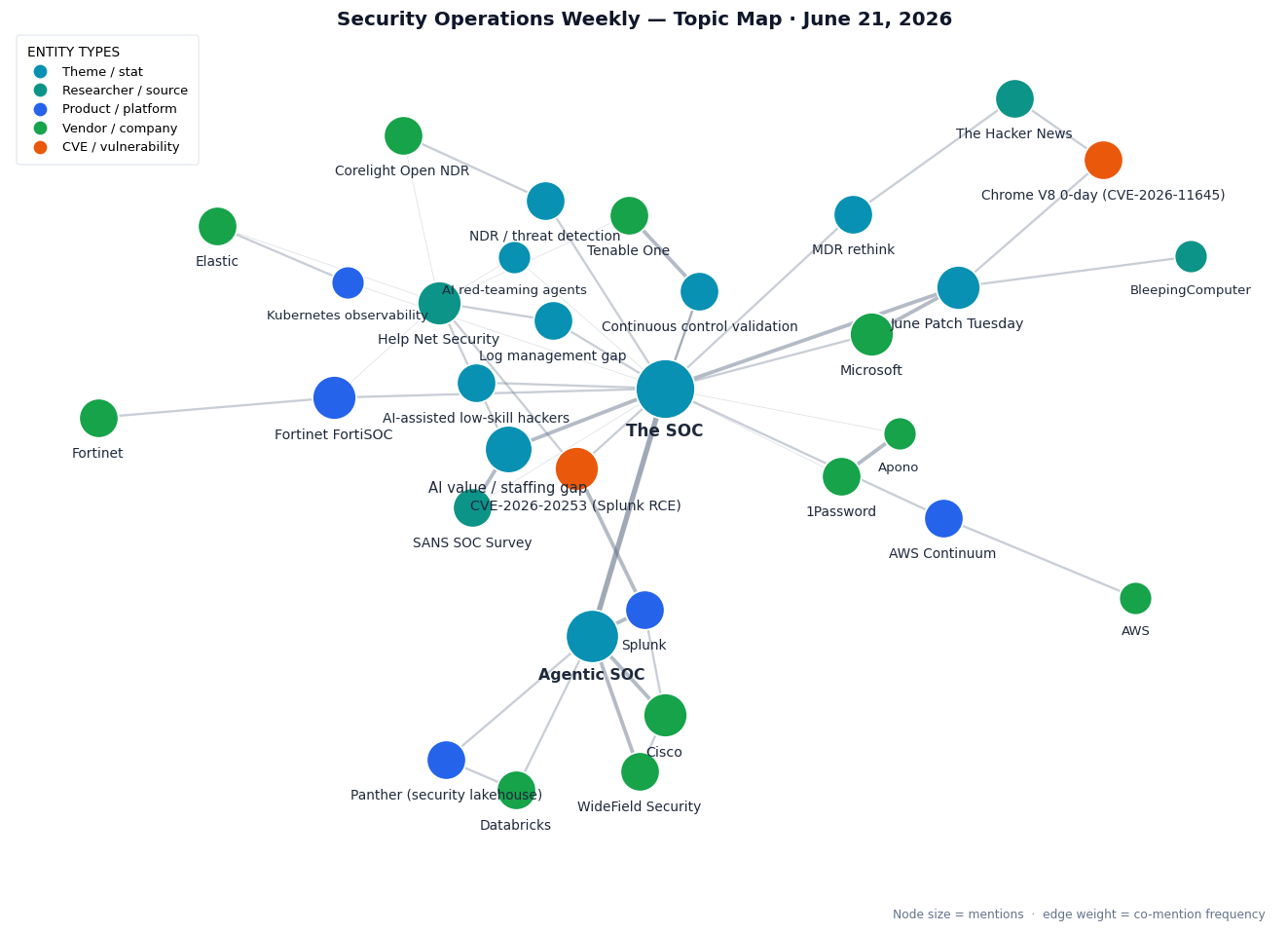
This week’s stories
Platform consolidation & agentic SOC
Three major moves in a single week reframe the SOC architecture debate: unified platforms over federated point tools, agentic automation built into the data layer, and cloud-native continuous security operating at machine speed.
- Fortinet FortiSOC unifies SIEM, SOAR, threat intel, and AI in one platform
- Cisco to acquire WideField Security to boost Splunk’s agentic SOC
- Databricks agrees to acquire Panther, furthering the security lakehouse and AI SOC
- Introducing AWS Continuum: security at machine speed
- Tenable One adds continuous security control validation
Detection engineering & log management
Visibility depends on the logs you keep. This week’s data shows organizations are throwing away the telemetry they need — and that the SANS community has identified staffing and visibility gaps as the underlying structural problem.
- Companies are discarding the logs they need to catch a breach
- The SOC’s visibility gap comes down to staffing (SANS 2026 survey)
- Corelight enhances Open NDR platform for AI-driven threats
- New infosec products of the week — June 19, 2026
Patch operations & active exploits
CVE-flavored items this week are operationally framed: an RCE in Splunk itself is under active attack, and a Chrome V8 zero-day from earlier in the month is still live in the wild.
- Unauthenticated RCE in Splunk Enterprise under active attack (CVE-2026-20253)
- Microsoft June 2026 Patch Tuesday fixes 200+ flaws, multiple zero-days
- Chrome V8 zero-day CVE-2026-11645 exploited in the wild — patch now
- CISA orders federal agencies to “patch smarter” (BOD 26-04)
Workforce & identity operations
AI is reshaping team structures faster than hiring pipelines can keep up; and identity tooling is converging with SOC workflows in a meaningful M&A signal.
- Stressors and AI are forcing changes to cybersecurity teams
- 1Password acquires Apono in $250M–$300M deal
Foundational: attacker capability & SOC strategy
The foundational section this week reframes the threat model: AI is actively lowering the skill floor for attackers, autonomous worms can now reason their way through networks, MDR architecture is under structural strain, and AI red-teaming is changing how detection gets validated. These are the operating assumptions the rest of the week’s tooling needs to be measured against.
- Rethinking MDR as attackers and defenders embrace AI
- Only 10% of SOCs say they’re getting excellent value from AI
- AI is helping low-skill hackers pull off advanced cyberattacks (Anthropic analysis)
- Autonomous AI-driven worm can reason its way through corporate networks
- AI red-teaming agents change how LLMs get tested
- Elastic brings AI-driven incident investigation to Kubernetes and observability tools
The detail
1. Fortinet FortiSOC unifies SIEM, SOAR, threat intel, and AI in one platform
Fortinet launched FortiSOC as a unified platform pulling together SIEM, SOAR, threat intelligence, and AI-assisted triage under a single operational roof. The pitch is architectural rather than incremental: analysts should be able to move from detection through investigation to response inside one consistent data model rather than stitching together four products via APIs and hoping the integrations stay current. For SOC leaders, the substantive question is whether consolidation actually reduces friction in the alert-to-closure workflow or whether it just consolidates the points of failure. The AI triage layer is the component worth watching on a pilot: if it genuinely routes lower-severity signals before they reach an analyst, it addresses one of the structural complaints the SANS and SOC-CMM surveys have been documenting for two years — that the value-chain breaks at handoffs, not at individual tools.
2. Cisco to acquire WideField Security to boost Splunk’s agentic SOC
Cisco agreed to acquire WideField Security in a move explicitly framed around deepening Splunk’s agentic automation capabilities. The deal is a data-plane bet: WideField’s technology is meant to give Splunk’s agents a richer, more unified context layer to reason over, rather than wiring agents to an alert queue and calling it automation. The acquisition continues Cisco’s post-Splunk consolidation logic — the thesis is that a SOC capable of genuine agentic workflows needs its underlying data model to be designed for agent consumption, not retrofitted. For Splunk customers, the near-term question is timeline: WideField capabilities folded into enterprise deployments in a meaningful way will take multiple quarters. In the interim, the announcement is a directional signal about where Cisco sees the SOC tooling market going and a useful frame for evaluating competing agentic claims from other vendors.
3. Databricks agrees to acquire Panther, furthering the security lakehouse and AI SOC
Databricks announced an agreement to acquire Panther, the security lakehouse and detection-as-code platform that built its reputation on Python-native detection rules and real-time streaming pipelines on top of cloud data stores. The deal puts a mature security operations layer inside the world’s leading data platform and extends Databricks’ push into AI-driven SOC tooling. For detection engineers, Panther’s detection-as-code model is the compelling part: rules are versioned, testable, and live in the same developer workflow as everything else, not inside a proprietary SIEM UI. Folded into Databricks’ scale and ML infrastructure, the combined platform gives security teams a genuine path to correlating security telemetry at data-platform scale — a meaningful alternative to SIEM for organizations already standardized on the Databricks stack.
4. Introducing AWS Continuum: security at machine speed
AWS introduced Continuum, its framework for continuous, always-on security posture management across cloud environments operating at machine speed rather than human polling cadence. The core idea is that cloud-native environments change faster than periodic assessments can track, and that effective security posture requires near-real-time feedback loops between configuration state, threat signals, and automated remediation. For SOC teams with significant AWS footprint, Continuum is worth an architectural review: it represents AWS’s vision for how detection-and-response should work in an environment where resources are ephemeral and the attack surface shifts with every deployment. The machine-speed framing is directionally correct — the operational value will be in the specific integrations with existing SIEM and SOAR workflows and how well the continuous posture signal surfaces in analyst tooling.
5. Tenable One adds continuous security control validation
Tenable added continuous security control validation capabilities to the Tenable One exposure management platform, moving the validation function from periodic purple-team exercises to an ongoing automated posture check. The idea is to answer “do my controls actually work right now?” rather than “did they work last quarter when we ran the test?” — a meaningful operational shift for environments where configuration drift is a constant. For detection engineers and vuln-management teams, continuous validation closes the loop that most SOC processes leave open: detection content is authored and assumed to work until something breaks. A sustained, automated validation layer catches control degradation before an attacker does. Worth integrating into the detection-lifecycle workflow as the primary signal that a rule has silently stopped firing in production.
6. Companies are discarding the logs they need to catch a breach
A new report on log management practices finds that organizations are routinely deleting telemetry that would be investigation-critical in a breach — not as a deliberate policy decision but as a side-effect of cost optimization and ingestion-volume controls. The operational consequence is that by the time an incident is confirmed, the forensic timeline is already incomplete. For SOC and detection-engineering teams, this is a data-plane problem before it is a tooling problem: the SIEM, SOAR, or security lakehouse can only work with what it receives, and if endpoint, network, and application logs are being dropped or truncated upstream, downstream detection is working with a partial picture. The right remediation pass starts with a log-coverage audit — what telemetry do you need to reconstruct a lateral-movement chain, and is all of it actually reaching your pipeline?
7. The SOC’s visibility gap comes down to staffing (SANS 2026 AI in the SOC survey)
Help Net Security’s writeup of the SANS 2026 AI in the SOC survey surfaces a finding worth separating from the broader SANS SOC Survey headline: the visibility gap that organizations cite as their top barrier to effectiveness traces partly back to a staffing and skill problem rather than a pure tooling one. Teams lack the people to tune and operate the visibility infrastructure they already have, which means adding more sensors and data sources compounds the problem rather than fixing it. For SOC leads, this reframes the standard “buy more coverage” recommendation: you need coverage your team can actually operationalize, and that requires honest accounting of analyst capacity alongside the coverage map. AI co-pilots that genuinely reduce per-analyst cognitive load are the lever here — but only if they are deployed against the right bottleneck.
8. Corelight enhances Open NDR platform for AI-driven threats
Corelight announced enhancements to its Open NDR platform specifically aimed at detecting AI-assisted and AI-driven threats, extending the Zeek-based network analysis layer with new behavioral detections for the patterns that characterize AI-augmented attack campaigns: unusual API traffic, LLM-assisted reconnaissance signatures, and agent-to-agent communication patterns that traditional signature-based network detection misses. For SOC teams with NDR in their stack, the update is worth a configuration pass: the new detection categories are unlikely to be enabled by default and will require tuning to your specific environment. Network telemetry remains one of the harder-to-fake evidence sources in a breach investigation, making the NDR layer valuable precisely when endpoint telemetry has been tampered with or is incomplete — a scenario the log-discard story this week makes more plausible than it should be.
9. New infosec products of the week — June 19, 2026
Help Net Security’s weekly product roundup for the June 19 cycle covers new and updated tools across the security operations, identity, and cloud security categories. The roundup format is a useful weekly signal-scan for SOC architects and security engineers: it surfaces vendor announcements that do not generate their own news cycle but represent incremental capability changes to platforms already in production environments. For procurement and tooling reviews, this is the right cadence to track — checking once a week rather than relying on vendor newsletters or waiting for analyst firm reports. Notable this cycle are updates touching detection pipeline, cloud posture, and identity-adjacent tooling; the full product list is worth a ten-minute skim to catch anything relevant to your stack.
10. Unauthenticated RCE in Splunk Enterprise under active attack (CVE-2026-20253)
CVE-2026-20253, an unauthenticated remote code execution vulnerability in Splunk Enterprise, has moved from disclosed to confirmed under active exploitation. The operational consequence is acute: Splunk is itself SOC infrastructure, and a compromise of the SIEM platform undermines the investigation capability you would use to detect and contain the breach. For teams running Splunk, patching priority should be highest-possible and the deployment window should be days, not the next maintenance cycle. While patches are in queue, the interim controls matter: restrict Splunk admin and API access to known management networks, review and audit service-account permissions, and increase monitoring on the Splunk platform itself. An attacker with RCE on your SIEM has a significant advantage in covering tracks — treat this as infrastructure-level risk, not an application vulnerability.
11. Microsoft June 2026 Patch Tuesday fixes 200+ flaws, multiple zero-days
Microsoft’s largest-ever Patch Tuesday addressed more than 200 CVEs, 33 rated Critical, including multiple publicly disclosed or exploited zero-days and a Defender elevation-of-privilege flaw. For SOC and vuln-management teams the operational task is sequencing: the actively exploited zero-days go first, the remaining Critical items second, and the rest into the standard patching cadence. The Defender EoP deserves particular attention because it turns a foothold into control of the security agent itself — a scenario where the attacker’s next move is to disable or manipulate the detection layer. Verify patch status on the EoP fix before assuming your endpoint security is intact, and build a brief hunt for indicators of Defender tampering in the week after deployment. Volume alone should not create a false sense of completeness — a large Patch Tuesday rewards deliberate prioritization over a blanket deploy-everything approach.
12. Chrome V8 zero-day CVE-2026-11645 exploited in the wild — patch now
Google patched a memory-corruption flaw in Chrome’s V8 JavaScript engine, CVE-2026-11645, with confirmed in-the-wild exploitation at the time of the fix. Browser zero-days against the V8 engine are high-value attacker assets: they enable initial access via a drive-by or a malicious link without requiring the user to download or execute anything beyond opening a tab. For SOC teams, the operational priorities are rapid Chrome update deployment across the fleet and brief threat-hunting for browser-originating lateral movement in the days surrounding the patch date. Enterprise environments where Chrome auto-update is restricted or where version compliance is not actively monitored are particularly exposed in the window between patch release and complete deployment — query your endpoint management platform for version coverage and prioritize straggling devices.
13. CISA orders federal agencies to “patch smarter” with BOD 26-04
CISA’s Binding Operational Directive 26-04 updates federal patch requirements for the AI era, moving away from calendar-driven patch windows toward risk-based prioritization that accounts for exploitability signals, asset criticality, and the threat landscape at the time of each vulnerability’s disclosure. The directive applies directly only to federal civilian agencies, but the framework it encodes is a useful template for any organization rethinking its vuln-management cadence. The core shift: treat vulnerability prioritization as a continuous, signal-driven process rather than a scheduled queue-clearance exercise. For detection-engineering and vuln-management teams operating outside the federal space, BOD 26-04 is worth reading as an authoritative statement of what risk-based patching looks like in policy form — and as a benchmark for comparing your own prioritization logic.
14. Stressors and AI are forcing changes to cybersecurity teams
Dark Reading’s survey on security team stressors finds that AI is restructuring team composition and skill requirements faster than most organizations can adapt their hiring and training pipelines. The pressures are multi-directional: automation is taking over lower-tier triage work that previously occupied junior analysts, raising the floor on what a new hire needs to be useful; at the same time, more senior analysts are being pulled toward AI governance and model-output validation work that did not exist two years ago. The net effect for many teams is a compression of the analyst career ladder — fewer entry-level roles, higher expectations at every level, and a skills-development pipeline that has not caught up. For SOC managers, the practical takeaway is to audit your team’s actual workflow against the evolving skill mix rather than assuming the hiring profiles from 2024 still fit what the role requires.
15. 1Password acquires Apono in $250M–$300M deal
1Password agreed to acquire Apono, the just-in-time privileged access management platform, in a deal valued at roughly $250M–$300M. Apono’s core capability is dynamic, time-bound access grants for cloud infrastructure and application environments — the operational model where developers or analysts get access for the duration of a specific task rather than holding persistent privileges. Folded into 1Password’s consumer and enterprise password management infrastructure, the acquisition signals that identity and access are converging with the broader security-operations toolset rather than remaining a separate IAM silo. For SOC teams, just-in-time access is increasingly relevant for analyst workflows themselves: granting temporary elevated access for investigation tasks, then automatically revoking it, reduces the standing-privilege attack surface in the SOC’s own accounts.
16. Rethinking MDR as attackers and defenders embrace AI
The piece argues that the traditional MDR model — humans working an alert queue — is structurally failing as AI-assisted attackers learn to exploit low-severity blind spots. The most striking finding: more than half of confirmed compromised endpoints had already been marked “mitigated” by the EDR vendor. That is a coverage-gap problem dressed as a closed ticket, and it speaks directly to EDR-evasion realities and the places where SOAR underdelivered. For SOC leaders, the takeaway is to stop treating “mitigated” as ground truth and to revisit how low-severity signal is triaged, correlated, and escalated before an AI-assisted attacker stitches it into a full intrusion chain. The article pairs well with the log-discard story this week: incomplete telemetry and prematurely closed alerts are two sides of the same visibility failure.
17. Only 10% of SOCs say they’re getting excellent value from AI
The SOC-CMM 2026 Maturity Report documents surging AI adoption — co-pilots up 145% and agents up 118% year over year — against a stark value gap: only 10% of SOCs report excellent value from AI deployments. The diagnosis points to architecture, not ambition. First-wave point-AI bolted onto fragmented stacks never fixes the handoffs between detection, investigation, and remediation, so gains stay local while friction stays systemic. It is hard benchmark data paired with a critique SOC leads can use directly: before adding another co-pilot, fix the handoffs the existing tools cannot cross. The finding is the right counterweight to the consolidation story at the top of this week’s issue — platform-level consolidation is one answer to the handoff problem, but only if the underlying workflow is redesigned rather than merely rehoused.
18. AI is helping low-skill hackers pull off advanced cyberattacks (Anthropic analysis)
Help Net Security’s coverage of Anthropic’s internal analysis of how Claude has been used in cyber operations documents a consistent pattern: AI is most impactful at lowering the skill floor for attackers, enabling individuals without deep technical expertise to execute techniques that previously required specialist knowledge. The analysis found evidence of Claude being used to assist with reconnaissance, payload customization, and evasion research — capabilities that were previously gated behind significant skill requirements. For SOC and detection-engineering teams, the operational implication is a recalibration of attacker assumptions: the tradecraft you built your detection content around may now be accessible to a much wider threat population. Detection content tuned to “nation-state sophistication” signals needs a parallel track of content for the lower-skill attacker who has the same playbook via AI assistance.
19. Autonomous AI-driven worm can reason its way through corporate networks
Researchers demonstrated a prototype autonomous AI worm capable of reasoning through a corporate network environment — identifying targets, adapting its approach based on observed defenses, and moving laterally without pre-programmed exploit chains. The research is a threat-model input rather than a production threat, but the operational implication is significant: the detection assumptions baked into most lateral-movement content assume a human attacker operating at human speed with a finite toolkit. An AI agent that can observe, reason, and adapt in near-real time changes the detection surface in ways that signature-based and even many behavioral detections were not designed to catch. For detection engineers, the relevant question is: which of your lateral-movement detections rely on behavioral invariants that a reasoning agent could observe and avoid, and what telemetry would reveal the agent’s reconnaissance behavior before it makes its first lateral move?
20. AI red-teaming agents change how LLMs get tested
Research on AI red-teaming agents documents a shift in how language models are adversarially evaluated: instead of human red-teamers manually crafting adversarial prompts, automated agent frameworks now run sustained, adaptive adversarial campaigns against LLMs, discovering failure modes at machine speed. The operational relevance for SOC teams extends beyond AI product security: the same agentic red-teaming architecture can be applied to detection content and SOC tooling, running automated adversarial tests against your detection pipeline rather than scheduling quarterly purple-team exercises. As AI systems move deeper into SOC workflows — co-pilots, automated triage, agentic investigation — the testing methodology for those systems needs to be as continuous as the systems themselves. This piece is a useful primer on the architecture. Note: published May 21, slightly outside the standard foundational window but included for relevance.
21. Elastic brings AI-driven incident investigation to Kubernetes and observability tools
Elastic launched an agentic investigation workflow plus MCP-based skills that auto-run diagnostics the moment an alert fires, surfacing the same investigation context inside Claude, Cursor, and VS Code through an MCP integration. The framing is “investigation starts before triage”: instead of an analyst opening a ticket and beginning to gather context, the context is already assembled when they arrive. The MCP-in-the-analyst-workflow angle matters for SOC tooling decisions: investigation moves to where engineers already work rather than forcing a context switch into a separate console. For teams running Kubernetes-heavy environments or mixing security and observability tooling, the Elastic approach is a concrete pilot candidate for compressing mean-time-to-context. Worth benchmarking against how long your team currently takes to gather the same investigation data manually before the alert reaches a senior analyst.
On our watch list
- Platform consolidation as the SOC architecture answer. Three major M&A and product moves this week — FortiSOC, Cisco/WideField/Splunk, Databricks/Panther — all resolve toward the same thesis: the handoff problem in the SOC is an architecture problem, and the answer is a unified data model rather than more integrations. Watch whether the 10% excellent-AI-value number moves in the next SOC-CMM cycle as consolidated platforms reach production deployments.
- Log retention as a structural investigation risk. The week’s finding that organizations discard investigation-critical telemetry for cost reasons is the log-management equivalent of the earlier MDR finding about “mitigated” endpoints. Both are false-closed signals. The audit question is the same: what telemetry does your team assume is available for a breach reconstruction, and is it actually in the pipeline?
- Splunk as a high-value target. CVE-2026-20253 is a reminder that SOC infrastructure itself is on the attacker’s target list. Patch priority for your SIEM platform should be at least as high as for endpoint agents — an attacker with RCE on Splunk has a significant advantage in covering tracks during an active incident. Review access controls on the platform now, before a patch deployment window.
- The attacker skill floor is lower than your detection content assumes. The Anthropic analysis and the autonomous-worm research together define a new threat-model baseline: advanced techniques are accessible to a wider attacker population, and agents can now reason adaptively through defensive environments. Audit your lateral-movement detection content for behavioral invariants that a reasoning agent could trivially avoid, and build detection for the reconnaissance phase before the first lateral move occurs.