At a glance
The week’s defining event is the simultaneous IDC MarketScape SIEM leader wave: CrowdStrike, Palo Alto Networks, and Google all received Leader designations within the same 72-hour window. That clustering is intentional on IDC’s part — it reflects a market where the former SIEM incumbents have been largely displaced by cloud-native platforms that ingest at scale and correlate natively with their own EDR and cloud-security telemetry. For SOC architects evaluating SIEM contracts, the convergence of three major platform vendors in the Leader quadrant is the most useful competitive signal of the quarter: the assessment window for incumbents is now, not after the next renewal cycle. Google’s SecOps platform release notes published the same week underscore that these are not static products — platform parity is being compressed by continuous release cadences, and the differentiation questions are shifting from feature coverage to data-model integration depth and agentic workflow quality.
The agentic SOC build-out accelerated on multiple fronts. Stellar Cyber’s 6.5/6.6 releases advance AI-native autonomous workflows that can close low-complexity alerts without analyst intervention. Expel’s Ruxie AI SOC manager extends agentic coverage across the full threat lifecycle — triage through containment — rather than limiting automation to alert classification. Prophet AI’s platform showcase gives procurement teams a structured evaluation framework at a moment when “AI SOC” is being applied to products with very different underlying capabilities. The combination makes this a week to put a structured AI SOC evaluation framework on the agenda: the products are maturing faster than the procurement criteria most teams are using to assess them. Nebulock’s $25M raise for a “hunt-first” AI-native contextual SecOps model adds another architectural variant to compare against.
The MSP and MSSP operational layer has its own story. SuperOps and Guardz are directly targeting tool sprawl in the MSP stack, bundling PSA, RMM, and agentic SecOps in a unified platform to reduce the integration overhead that consumes engineering time without producing detection value. Cynomi’s largest-ever platform expansion brings scalable vCISO and vulnerability-management capabilities to MSPs who cannot staff a dedicated security architect. On the risk side, MSSP Alert’s survey finding that high AI-security confidence may correlate with higher actual exposure is a governance-readiness warning: the MSPs most certain about their AI posture may be the ones with the least rigorous assessment backing that confidence. The AI governance and readiness theme running through W12, W18, and W19 — across the platform, MSP, and general SOC contexts — is this week’s most operationally durable takeaway: confidence in AI tools is not a substitute for structured evaluation criteria.
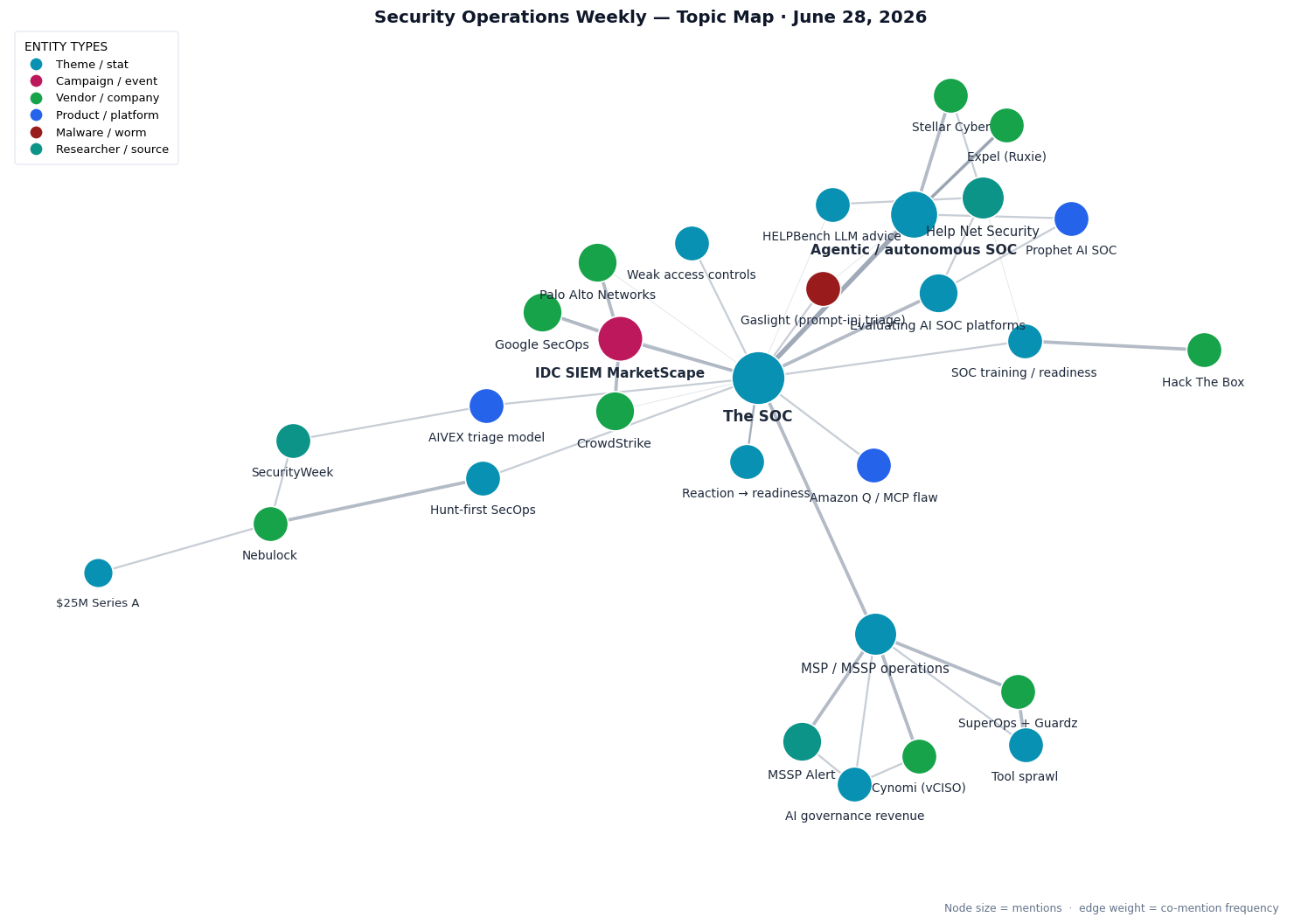
This week’s stories
SIEM platform leadership & platform releases
The IDC MarketScape SIEM leader wave lands three simultaneous designations, compressing the evaluation window for incumbent platforms. Google’s weekly SecOps release notes confirm that platform parity is being set by continuous delivery, not annual roadmaps.
- CrowdStrike named a Leader in 2026 IDC MarketScape for SIEM
- Palo Alto Networks named a Leader in 2026 IDC MarketScape for SIEM
- Google named a Leader in 2026 IDC MarketScape for SIEM
- What’s new in Google SecOps (2026-06-21 platform updates)
- New infosec products of the month: June 2026
Agentic SOC tooling & AI platform evaluation
Autonomous SOC capabilities are advancing from alert classification to full lifecycle coverage. This cluster provides both the new tools and a structured framework for evaluating them — useful as the “AI SOC” label gets applied to products with very different underlying capabilities.
- Stellar Cyber advances autonomous SOC (6.5/6.6, AI-native workflows)
- Expel extends coverage with new agentic AI (Ruxie AI SOC manager)
- Product showcase: how to evaluate AI SOC platforms (Prophet AI)
- Nebulock raises $25M for AI-native “hunt-first” contextual SecOps
MSP/MSSP operations & platform consolidation
The managed-services operational layer is consolidating around unified stacks that eliminate tool-sprawl friction. Governance confidence gaps present a risk: high self-reported AI readiness may not reflect actual posture assessment rigor.
- SuperOps & Guardz bundle PSA/RMM/agentic SecOps for MSPs
- Cynomi delivers largest platform expansion — security governance for MSPs
- MSSP market: high AI-security confidence may signal higher risk
- How MSPs can apply security baselines without premium licensing
SOC training, access controls & detection
This cluster covers the operational fundamentals: analyst readiness via crisis simulation, the access-control weaknesses that leave enterprise networks exposed, and two emerging detection gaps that merit immediate attention from detection engineers.
- Hack The Box adds crisis simulations and SOC training
- Weak access controls leave enterprise networks at risk
- macOS backdoor uses prompt injection to evade AI triage (Gaslight)
- Amazon Q Developer flaw could let malicious repos run code via MCP configs
- Meet AIVEX, a triage model to reduce supply-chain risk
AI readiness, SOC strategy & foundational reading
The AI-in-SOC governance and readiness theme ties together the week’s broader operational question: how do you evaluate AI tools rigorously when the market is moving faster than procurement criteria? LLM security-advice benchmarking (HELPBench) and the two foundational pieces on MDR strategy and new AI-SOC roles provide the evaluative scaffolding.
- AI is outpacing cyber defense: shift from reaction to readiness
- LLM security advice looks solid until you check the hard cases (HELPBench)
- Rethinking MDR as attackers and defenders embrace AI [Foundational]
- 5 new security-operations roles the AI-SOC will create [Foundational]
The detail
1. CrowdStrike named a Leader in 2026 IDC MarketScape for SIEM
CrowdStrike secured a Leader designation in IDC’s 2026 MarketScape for Worldwide SIEM, with evaluators citing the depth of native integration between Falcon SIEM and the broader Falcon platform — EDR telemetry, threat intelligence, identity signals, and cloud coverage share a unified data layer rather than requiring third-party connectors. For SOC teams already operating Falcon for endpoint protection, the SIEM assessment is worth revisiting: the integration depth argument is strongest when the organization is already standardized on CrowdStrike tooling, because the correlation happens at the data layer rather than through API stitching. For heterogeneous environments, the evaluation question is whether the native-integration advantage outweighs the switching cost and ecosystem lock-in. The simultaneous Leader designations for Palo Alto and Google this week make this the right moment for a structured three-way comparison against your current SIEM contract and renewal timeline.
Sources: CrowdStrike
2. Palo Alto Networks named a Leader in 2026 IDC MarketScape for SIEM
Palo Alto Networks received a Leader designation in the same IDC SIEM MarketScape wave, with Cortex XSIAM positioned as the platform that integrates SIEM, SOAR, and extended detection and response into a single operational surface. The IDC evaluation reflects Cortex’s consistent argument that SIEM and SOAR should not be separate purchasing decisions — the analyst workflow that moves from alert to investigation to response should not require a product handoff. For SOC architects, the XSIAM architecture makes the strongest case in environments where alert-to-closure velocity is the primary operational metric and where the team can absorb the configuration overhead of a unified platform. The evaluation criteria to stress-test: how deeply does XSIAM integrate with non-Palo Alto endpoint and cloud telemetry, and what does ingestion cost look like at your actual data volume?
Sources: Palo Alto Networks
3. Google named a Leader in 2026 IDC MarketScape for SIEM
Google Cloud’s Chronicle-based Security Operations platform secured the third Leader designation in this week’s IDC SIEM wave. Google’s differentiation case centers on petabyte-scale ingestion at a flat-rate pricing model and deep integration with Mandiant threat intelligence — a combination that addresses two of the most persistent SIEM operational complaints: cost unpredictability at volume and the gap between threat-intelligence procurement and SIEM correlation. For detection engineers, the Mandiant integration is the most operationally meaningful element: curated, high-confidence threat-intel driving automated detection content rather than requiring the security team to manually translate intel reports into SIEM rules. The simultaneous release of the June 21 Google SecOps platform update (W8) means the evaluated capabilities are not static — what IDC assessed is already being extended.
Sources: Google Cloud
4. Stellar Cyber advances autonomous SOC (6.5/6.6, AI-native workflows)
Stellar Cyber’s 6.5 and 6.6 platform releases advance its AI-native autonomous SOC model, extending the platform’s ability to close low-complexity alerts without analyst intervention while surfacing the higher-complexity cases with pre-assembled investigation context. The operational bet behind the Stellar Cyber architecture is that most SOC alert volume — the repetitive, low-severity tier — can be fully automated with high confidence, freeing analyst time for the cases that genuinely require human reasoning. For SOC leaders evaluating agentic platforms, the right pilot design is to run the autonomous tier against your actual alert mix and measure the false-negative rate on automated closures, not just the volume reduction. The cases the system closes without analyst review are the ones you need to validate most rigorously before expanding the autonomous scope.
Sources: Help Net Security
5. Expel extends coverage with new agentic AI (Ruxie AI SOC manager)
Expel launched Ruxie, an agentic AI SOC manager designed to extend automated coverage across every stage of the threat lifecycle — from initial triage through investigation and into containment actions — rather than constraining automation to the alert-classification step. The architecture reflects a maturation in the agentic-SOC conversation: early AI-in-SOC tools reduced alert noise; the next generation is expected to take dispositive actions. For MDR customers and in-house SOC teams evaluating Ruxie, the substantive evaluation point is the hand-off logic: at what confidence threshold does Ruxie escalate to a human analyst versus taking autonomous action, and how is that threshold configured and auditable? Agentic coverage that extends into containment is a meaningful capability expansion, but the governance model around autonomous action boundaries needs to be explicit before it reaches production.
Sources: PR Newswire
6. Product showcase: how to evaluate AI SOC platforms (Prophet AI)
Help Net Security’s product showcase on Prophet AI’s AI SOC platform doubles as a structured evaluation framework for the category at a moment when “AI SOC” covers a wide range of underlying capabilities. The showcase walks through the platform’s investigation workflow, alert prioritization logic, and integration architecture — the three areas where AI-SOC platforms differ most significantly from each other. For procurement teams, the value of this article is less about Prophet AI specifically and more about the evaluation criteria it surfaces: how does a candidate platform handle alert correlation across heterogeneous telemetry sources, what does the investigation workflow look like before and after automation, and where does the human-in-the-loop hand-off occur? Use it to build or sharpen the RFP criteria before your next AI-SOC vendor briefing.
Sources: Help Net Security
7. SuperOps & Guardz bundle PSA/RMM/agentic SecOps for MSPs
SuperOps and Guardz announced a partnership that bundles professional services automation, remote monitoring and management, and agentic security operations into a unified stack targeted at MSPs struggling with tool proliferation. The operational problem they are solving is well-documented in the MSP market: the average MSP runs too many point tools, and the integration overhead between them consumes the engineering time that should be going into security outcomes. A unified PSA/RMM/SecOps stack removes the handoffs between service-desk workflow, device management, and threat detection — when a security alert fires, the response workflow can initiate directly from the same platform tracking the service contract and device inventory. For MSP operators, the evaluation question is whether the agentic SecOps layer in the bundle meets the detection quality bar of standalone alternatives, or whether operational convenience is being traded against detection depth.
Sources: MSSP Alert
8. macOS backdoor uses prompt injection to evade AI triage (Gaslight)
Researchers documented macOS.Gaslight, a Rust-based backdoor that uses prompt injection techniques to manipulate AI-assisted triage tools — feeding crafted output to LLM-based analysis systems to make malicious activity appear benign at the automated triage stage. The operational implication is direct: if your SOC workflow routes alerts through an AI triage layer before human review, Gaslight-class malware is specifically designed to defeat that layer. For detection engineers, this is a signal to audit how AI triage output is validated before a case is closed. The defense posture involves treating AI-triage verdicts as one signal among several rather than as authoritative closures, and building a secondary detection layer for the behavioral indicators that Gaslight’s prompt-injection technique cannot suppress — network callbacks, persistence mechanisms, and process lineage visible in EDR and network telemetry.
Sources: Infosecurity Magazine
9. Rethinking MDR as attackers and defenders embrace AI
This foundational piece argues that the traditional MDR model — humans triaging an alert queue — is structurally failing as AI-assisted attackers exploit the low-severity blind spots that automated triage tends to deprioritize. The most operationally pointed finding: MDR teams are reporting that a significant proportion of compromised endpoints had previously been marked as mitigated. That is not an MDR vendor failure in isolation — it reflects the broader gap between EDR-evasion capabilities that have matured rapidly and detection content that was authored for a prior attacker model. For SOC leaders evaluating MDR contracts or internal MDR operations, the article surfaces two actionable questions: how is “mitigated” status validated before a case is closed, and what happens to the low-severity alerts that fall below the human-review threshold? The week’s Gaslight story makes both questions more urgent.
Sources: The Hacker News
On our watch list
- SIEM contract timing. Three simultaneous IDC Leader designations for CrowdStrike, Palo Alto, and Google compress the evaluation window for organizations running incumbent SIEMs approaching renewal. The right time for a structured three-way comparison is now, not at renewal notice. The differentiation questions have shifted from feature coverage to data-model integration depth and agentic workflow quality — build your evaluation criteria around those axes.
- Autonomous action boundaries in agentic SOC tools. Expel Ruxie and Stellar Cyber 6.6 both extend automation into containment actions rather than stopping at alert classification. Before any agentic platform goes to production with autonomous action scope, the governance model needs to be explicit: what confidence threshold triggers autonomous action, how are those actions logged and attributed, and what is the escalation path when the agent makes a wrong call?
- Prompt injection as a SOC detection gap. macOS.Gaslight is a proof-of-concept for a class of threat that will grow: malware specifically designed to manipulate the AI triage layer that SOCs are deploying as a first filter. Audit your triage workflow now for cases where AI verdicts are treated as closure signals without a secondary behavioral check. Network and process telemetry from EDR remain the harder-to-fake evidence layer — ensure they are not downstream of the AI triage gate.
- MSP AI confidence versus AI governance. The MSSP Alert survey finding that high AI-security confidence may correlate with higher exposure risk is a governance signal worth acting on. For MSPs delivering security services, the question is whether AI readiness assessments are being driven by vendor claims or by structured internal evaluation. Cynomi’s vCISO expansion and the SuperOps/Guardz bundle both offer tooling — the governance framework for evaluating them needs to precede the procurement decision.