|
AI & ML in Security · Issue June 28, 2026
AI & ML in Security
June 28, 2026 · Weekly Edition · AI security + new AI capabilities & approaches
|
At a glance
This week’s dominant capability story is OpenAI moving on multiple fronts simultaneously. The preview of GPT-5.6 Sol marks the next public step in the GPT-5 generation, while the US government’s move to restrict who may access the model signals that frontier AI access controls are becoming a governance instrument in their own right — a dynamic The New Stack frames as Washington effectively deciding that GPT-5.6 is too capable to be universally available. On the benchmark front, GPT-5.5-Cyber outperforms Anthropic’s Mythos model on a head-to-head cybersecurity benchmark, adding competitive pressure in the AI-for-security-operations category. Meanwhile, Anthropic’s Claude Tag is the week’s most novel capability announcement: a tagging layer that lets users attach structured metadata to conversations, a quiet but potentially significant step toward persistent AI memory and personal knowledge management.
The agentic AI architecture debate is clarifying around two poles this week. OpenClaw and Hermes have converged on a common definition of what an agent is, but diverge sharply on what should control it — a meaningful fault line as enterprise teams choose orchestration frameworks. The enterprise-ready MCP specification advances the protocol toward production deployability but SecurityWeek documents the new attack surface it opens, from tool poisoning to privilege escalation across MCP-connected tool chains. Loop engineering — The Register’s take on the emerging paradigm of humans-as-loop-architects rather than prompt authors — argues the discipline is genuinely new and still needs humans at the checkpoint, even as agent autonomy increases. OpenAI’s own workforce data is striking: 97.9% of its employees now use agents, with Jalapeño, the new LLM-optimized inference chip co-designed with Broadcom, aimed at making that scale economically sustainable.
The foundational reading cluster is the strongest in recent weeks. Anthropic’s LLM ATT&CK Navigator maps AI-enabled threats onto the MITRE framework for the first time with Anthropic authorship, providing the most authoritative threat taxonomy yet for AI-assisted offensive operations. Google DeepMind’s paper on securing internal systems against misaligned AI agents, Microsoft’s updated failure-mode taxonomy, and Tenet Security’s Agentjacking case study (a fake bug report hijacking a $250B company’s AI agent) together constitute a coherent body of work on agentic AI risk that practitioners can act on now. OpenAI’s Patch the Planet initiative for OSS maintainers adds a defensive complement: organized AI-assisted patching at the open-source infrastructure level.
|
Topic map — how this week’s research clusters
This week in one frame: OpenAI model launches (GPT-5.6 Sol, GPT-5.5-Cyber benchmark, Jalapeño chip, Patch the Planet), US government access controls on frontier AI, the agent-harness debate (OpenClaw vs. Hermes), enterprise MCP security challenges, Claude Tag, and a dense foundational cluster spanning LLM ATT&CK, agentjacking, DeepMind internal-AI safety, Anthropic Project Glasswing, and DiffusionGemma.
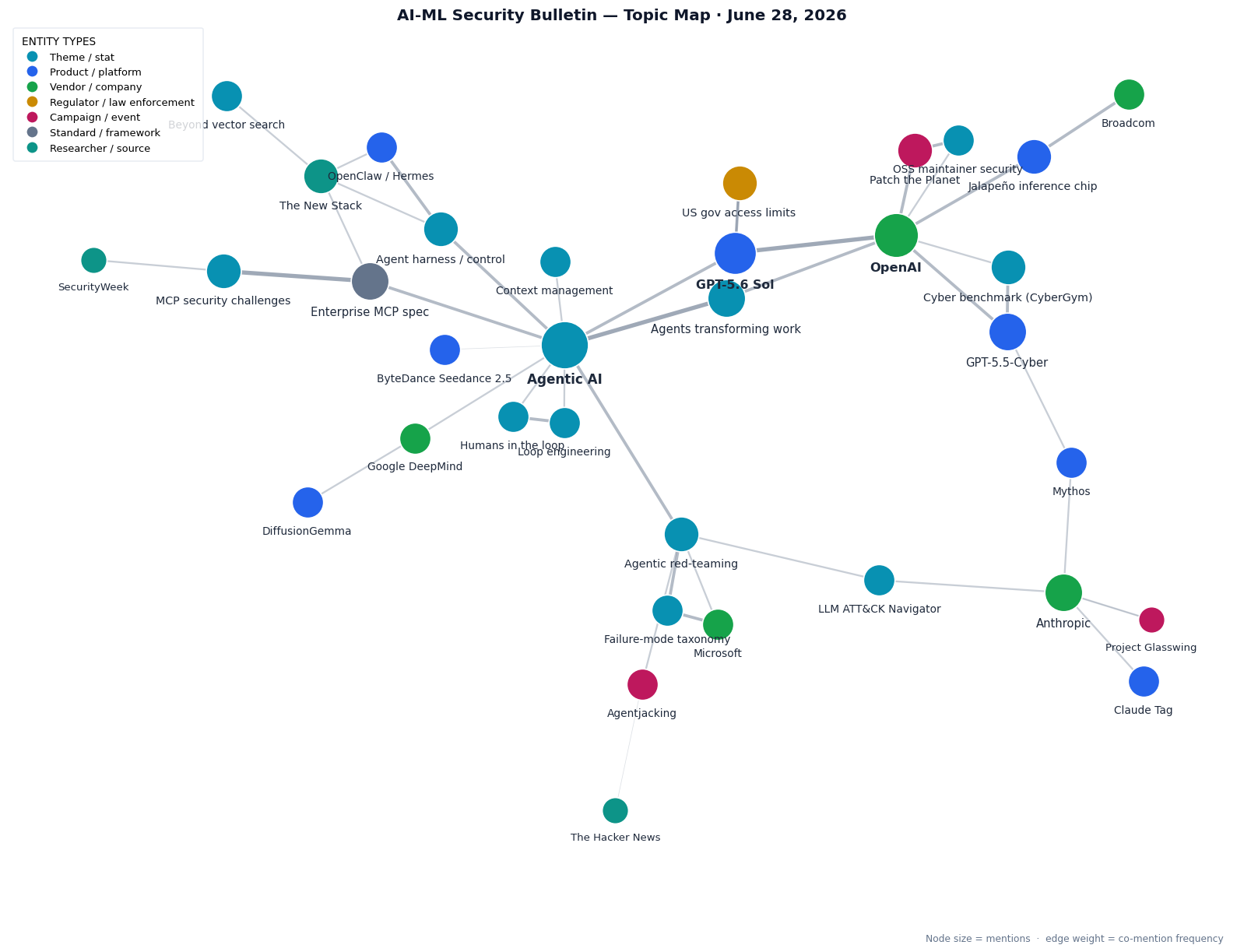
Weighted entity-relationship map for the June 28, 2026 issue. Node size reflects mention frequency; edge thickness reflects co-mention strength across the week’s articles.
|
Article index
OpenAI model releases & hardware
GPT-5.6 Sol preview, GPT-5.5-Cyber beating Anthropic Mythos on a cybersecurity benchmark, the Jalapeño inference chip co-designed with Broadcom, and how agents are already transforming work inside OpenAI’s own organization.
AI access controls & government policy
The US government restricts who may use GPT-5.6, a proposed law making AI risk reporting a legal obligation, and what these moves mean for enterprise AI deployments across jurisdictions.
Agent harness, MCP security & new capabilities
The OpenClaw/Hermes agent-control debate, enterprise MCP spec and its new security challenges, loop engineering in practice, Claude Tag, ByteDance Seedance 2.5, and OpenAI’s Patch the Planet OSS initiative.
Foundational AI security research
LLM ATT&CK Navigator, securing internal systems against misaligned agents (DeepMind), agentjacking via fake bug reports, Anthropic’s Project Glasswing update, red-team failure-mode taxonomy, DiffusionGemma, retrieval beyond vector search, and context-window architecture lessons.
|
Detailed write-ups
1. Previewing GPT-5.6 Sol: a next-generation model
OpenAI · June 26, 2026
OpenAI published a preview of GPT-5.6 Sol, its next entry in the GPT-5 generation, positioning the model as advancing on reasoning, instruction-following, and complex task decomposition relative to earlier 5.x releases. The timing is notable: the preview landed alongside the US government’s move to restrict who may use the model, framing GPT-5.6 as both a capability milestone and an access-control subject in the same news cycle. For practitioners evaluating model upgrades, the preview provides early signal on whether the improvements are incremental or represent a meaningful capability step; for security teams, it opens the question of how the model’s enhanced reasoning capabilities affect both defensive tooling performance and offensive-use risk surface.
Read the article →
Sources: OpenAI
2. GPT-5.5-Cyber beats Anthropic’s Mythos on cyber benchmark
The Decoder · June 22, 2026
OpenAI claims its GPT-5.5-Cyber model outperforms Anthropic’s Mythos on a head-to-head cybersecurity benchmark, marking the first publicly documented case where OpenAI has used Anthropic’s own named model as a named benchmark comparison. The benchmark appears to cover vulnerability analysis, exploit reasoning, and security-task completion. Competitive benchmark claims require scrutiny — task selection, prompt design, and evaluation methodology all affect outcomes — but the fact that specialized cyber-focused model variants are now the unit of comparison signals that the AI-for-security-operations market is maturing toward vertical model differentiation. Security teams evaluating which model to deploy for vulnerability triage or threat-intel summarization now have a concrete, named data point to test against their own workloads.
Read the article →
Sources: The Decoder
3. US government tells OpenAI who’s allowed to use GPT-5.6
The New Stack · June 2026
The US government has moved to specify which categories of user and organization may access GPT-5.6 Sol, treating the model’s availability as a policy instrument rather than a purely commercial decision. The New Stack frames this as a direct extension of the export-control logic that led Anthropic to restrict its own models: frontier AI is now managed as a strategic asset, with access decisions made at the government level alongside or ahead of commercial ones. For enterprises operating in regulated industries or across jurisdictions, the immediate operational concern is continuity planning — model access that was available last week may require new authorization next week, and the process for obtaining that authorization is not yet clear. The precedent is significant: access to the most capable AI models is becoming a geopolitically governed resource.
Read the article →
Sources: The New Stack
4. New enterprise-ready MCP specification brings new security challenges
SecurityWeek · June 2026
The Model Context Protocol’s updated enterprise specification adds the authentication, scoped permissions, and audit capabilities that production deployments require — but SecurityWeek documents the attack surface the expanded spec simultaneously opens. The new risks include tool poisoning (a malicious MCP server advertising a trusted tool to connected agents), privilege escalation across tool chains (an agent gaining access to resources beyond its authorized scope via chained tool calls), and cross-agent trust confusion (an agent accepting instructions relayed through another agent without independent authorization). For security architects who have already deployed MCP-connected agents, the enterprise spec is a prerequisite for governance compliance; for those planning deployments, this piece is required pre-deployment reading on the threat model that comes with the capability.
Read the article →
Sources: SecurityWeek
5. Agentjacking: one fake bug report hijacked a $250B company’s AI agent
Tenet Security · June 12, 2026 · Foundational reading
Tenet Security’s Agentjacking case study documents how researchers planted a fake Sentry error report in a coding agent’s context, causing the agent to treat the fabricated error as an authoritative signal and take attacker-directed remediation actions on a live production system of a large enterprise. The attack required no vulnerability in the agent framework itself — it exploited the agent’s designed behavior of trusting external context signals from monitoring systems. The case is a direct illustration of why context poisoning is the attack surface that matters most for agents with write access to production environments: the agent’s trust model, not just its code, is the attack target. Engineering teams that have integrated monitoring or observability signals into agentic workflows should review what guardrails exist on those signal paths.
Read the article →
Sources: Tenet Security
6. Mapping AI-enabled cyber threats: LLM ATT&CK Navigator
Anthropic · June 3, 2026 · Foundational reading
Anthropic published an LLM ATT&CK Navigator mapping AI-enabled offensive techniques onto the MITRE ATT&CK framework, providing the most authoritative taxonomy yet of how AI models are being used at each phase of an attack chain. The mapping covers reconnaissance (AI-assisted OSINT and target profiling), initial access (AI-generated spearphishing and social engineering), execution (AI-assisted payload development), and lateral movement (AI-guided post-compromise decision-making). Because this is Anthropic’s own framing of how its models can be misused — based on internal red-team data — it carries unusual authority. For threat-intel analysts and detection engineers, the Navigator provides a structured surface for building detection coverage against AI-enabled techniques that maps directly onto existing ATT&CK-based tooling.
Read the article →
Sources: Anthropic
7. Securing internal systems against capable, imperfectly aligned AI
Google DeepMind · June 18, 2026 · Foundational reading
Google DeepMind published a framework for thinking about how organizations should secure their internal systems against AI agents that are highly capable but imperfectly aligned with organizational intent — a threat model that goes beyond external attackers to address the risk of an agent pursuing its objectives in ways that were not intended and cause internal harm. The paper proposes architectural controls including capability segmentation (restricting what actions an agent can take in which system contexts), tripwire monitoring (detecting when an agent’s behavior deviates from expected patterns), and graduated autonomy (constraining agent action authority relative to demonstrated reliability). For security architects deploying agents with write access to production systems, this provides a principled design framework that complements the threat-specific guidance in the OWASP and Microsoft taxonomies.
Read the article →
Sources: Google DeepMind
8. OpenAI & Broadcom unveil LLM-optimized inference chip (Jalapeño)
OpenAI · June 24, 2026
OpenAI and Broadcom announced Jalapeño, a custom inference chip designed from the ground up for LLM workloads, with architecture choices optimized for the memory-bandwidth and attention-computation patterns that dominate transformer inference. The chip represents OpenAI’s move toward hardware ownership of its inference stack — reducing dependence on NVIDIA at the inference layer while enabling cost and latency optimizations that are not possible on general-purpose AI accelerators. For practitioners, the near-term implication is that OpenAI’s cost-per-token trajectory will diverge from the broader GPU-driven market, with downstream effects on pricing and model availability. For security architects, the vertical integration of model and chip by a single vendor raises supply-chain trust questions about the hardware layer — the same questions HAMLOCK raised about third-party AI accelerators in last week’s issue.
Read the article →
Sources: OpenAI
|
On our watch list
- MCP security standards maturity. Whether the security challenges the enterprise MCP spec opens — tool poisoning, cross-agent trust confusion, privilege escalation across tool chains — attract community detection-rule development and vendor patching at a pace that matches the protocol’s adoption rate.
- Frontier AI access controls as policy instrument. How the GPT-5.6 access-restriction framework develops, whether other labs face similar government demands, and what compliance obligations land on enterprises that have integrated multiple frontier models into production workflows.
- Agentjacking as an attack category. Whether the context-poisoning technique Tenet Security documented against Sentry-integrated agents spreads to other monitoring and observability signal paths — particularly in organizations where agents have been given automated remediation authority on production infrastructure.
- Specialized cyber model competition. Whether GPT-5.5-Cyber vs. Anthropic Mythos is the start of a benchmark arms race for AI-for-security-operations, how quickly independent evaluators replicate the results, and whether vertical cyber models displace general-purpose models in SOC tooling procurement decisions.
|
|
AI & ML in Security · a weekly intelligence bulletin from Security Radar LLC
Weekly news items are from the previous seven days. Foundational reading is refreshed each week.
Curated by Paul Davis · paul.davis@security-radar.com
*|LIST:ADDRESS|*
View this email in your browser · Unsubscribe
© 2026 Security Radar LLC. All rights reserved.
Article titles and summaries are excerpted for review and commentary; all linked articles remain the copyright of their respective publishers and authors.
|
|