At a glance
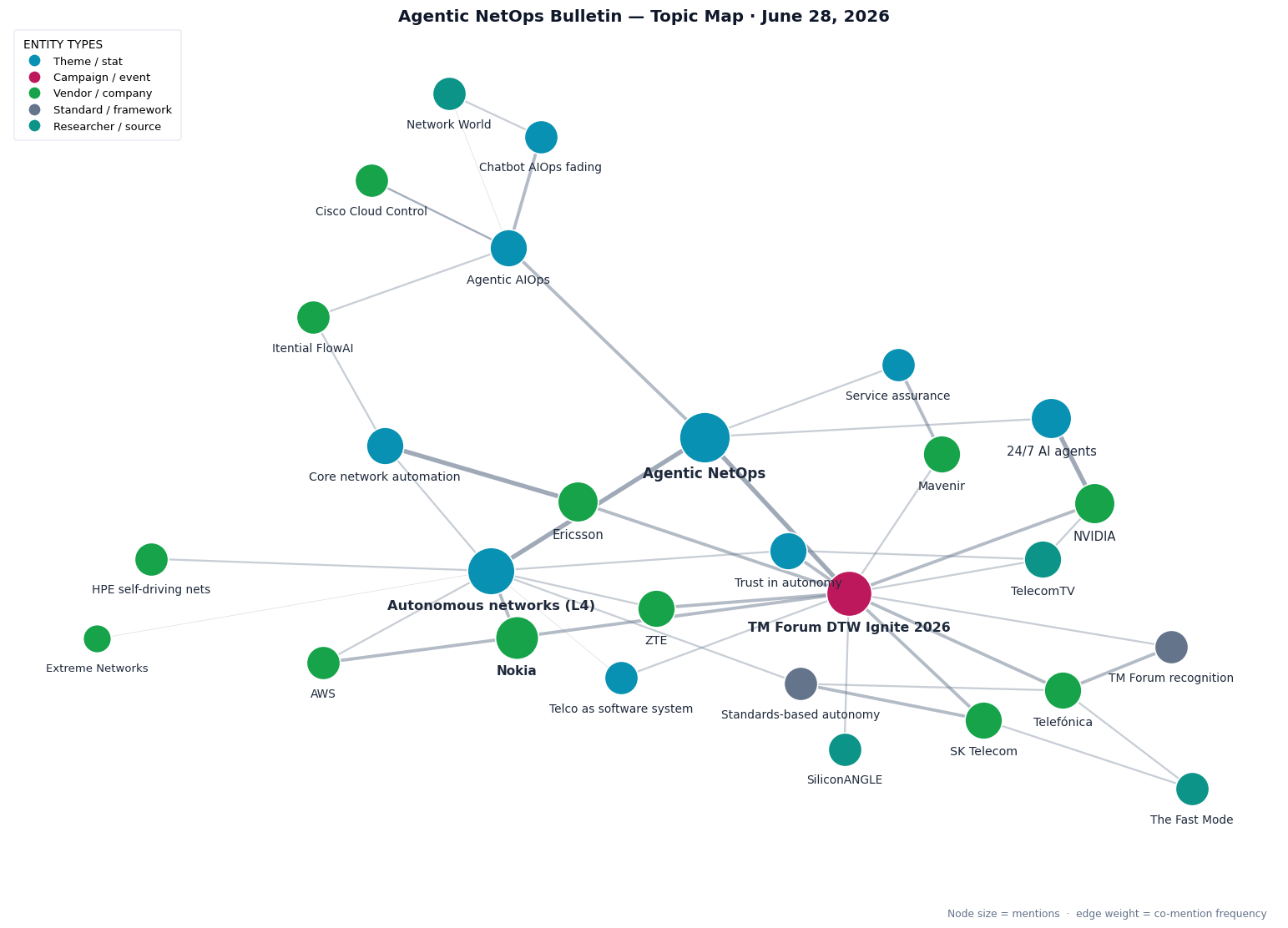
This week the agentic-NetOps beat was effectively a single event: TM Forum DTW Ignite 2026. Nearly every major announcement traces back to the Copenhagen show floor, and the volume of autonomous-network news was the heaviest of the year so far. Nokia led the vendor pack, advancing its autonomous-networks portfolio with upgraded agentic AI and, in a parallel announcement, expanding its collaboration with AWS to target Level-4 (L4) autonomy built for the AI era. NVIDIA used the show to position trusted 24/7 AI agents for telecom operations, while Ericsson extended its Intelligent Automation Platform into core-network automation — a notable move beyond the RAN where most telecom automation has historically concentrated. ZTE, Telefónica, SK Telecom and Mavenir rounded out a crowded field, each staking a position on the road to standards-based, certified autonomy.
Two cross-cutting themes give the week its shape. The first is the contest over autonomy levels — L4 in particular. Nokia/AWS and ZTE both framed their announcements around a “practical path” to Level-4 autonomous operation, and Telefónica and SK Telecom anchored their messaging in TM Forum’s autonomous-network standards and recognition framework rather than vendor-proprietary claims. The autonomy-level taxonomy is becoming the shared language of the segment, much as SAE levels did for vehicles. The second theme — and arguably the more important one — is trust. TelecomTV’s read of the keynote put it bluntly: trust tops the agenda. As operators move from pilots to production, the gating question is no longer whether agents can act on the network but whether operators, regulators and customers can trust them to. NVIDIA’s “trusted” framing and the standards-based positioning from Telefónica and SK Telecom are all responses to the same anxiety.
Stepping back, the analyst coverage of the show (Telecom Review Europe, SiliconANGLE) captured a broader structural shift: telecom is being rebuilt as a software system, and agentic AI is the operating model for that rebuild. The foundational cluster this week grounds that narrative — Network World’s piece on the fading era of chatbot AIOps and the rise of agentic AIOps is the throughline, supported by Itential’s FlowAI launch, the validation signal from Cisco’s Cloud Control, HPE’s self-driving-networks expansion, and Extreme’s autonomous-networking AI agent. Read the foundational layer as the multi-vendor backdrop against which DTW’s telco-centric announcements should be judged: the move from chatbot AIOps to agentic AIOps is happening across enterprise and carrier networks alike, and trust is the common bottleneck.
|
Detailed write-ups
1. Nokia advances autonomous-networks portfolio with agentic AI (#DTW26)
Nokia · Jun 23, 2026
Nokia opened DTW Ignite 2026 by upgrading the agentic-AI capabilities across its autonomous-networks portfolio — the natural next chapter to the NSP agentic framework covered in earlier issues. The emphasis is on agents that act on real-time network state under policy constraints, moving from assisted operation toward higher-autonomy closed-loop control. For operators, the read here is direction of travel: Nokia is treating agentic AI not as a bolted-on copilot but as the operating layer for the portfolio, and pairing it with the AWS collaboration (#2) to supply the cloud and foundation-model substrate. Read this as the anchor announcement of the show’s vendor cluster before the AWS, NVIDIA and Ericsson pieces layer on their respective angles.
Read the article →
Sources: Nokia
2. Nokia & AWS expand collaboration for autonomous networks (L4 autonomy)
GlobeNewswire · Jun 24, 2026
The companion to Nokia’s portfolio announcement: an expanded collaboration with AWS aimed at delivering autonomous networks built for the AI era, with Level-4 autonomy as the stated target. The significance is in who is supplying what. Nokia brings the network-domain knowledge and the agentic operating layer; AWS brings the cloud infrastructure and the foundation-model and managed-AI services that the agents run on. L4 — high autonomy with human oversight rather than continuous human control — is the goalpost the whole segment is now organising around, and a hyperscaler partnership is how Nokia intends to reach it at scale. For operators weighing build-versus-partner decisions on their autonomy roadmaps, this is a concrete data point on how the vendor ecosystem is consolidating around cloud-backed agentic platforms.
Read the article →
Sources: GlobeNewswire
3. NVIDIA brings trusted 24/7 AI agents to telecom operations
NVIDIA · Jun 23, 2026
NVIDIA used DTW Ignite to position trusted, always-on AI agents for telecom operations — pitching the GPU-and-software stack as the substrate beneath the operators’ and equipment vendors’ autonomy ambitions. The word doing the heavy lifting is “trusted.” The technical capability to run agents continuously across network operations is increasingly assumed; the harder problem is giving operators confidence that those agents will behave predictably, stay within policy, and escalate appropriately. NVIDIA’s framing aligns directly with the keynote’s trust theme (#11), and signals that the infrastructure layer is now competing on assurance and guardrails, not just throughput. For NetOps leaders, this is the supply-side counterpart to the operator strategy stories: the same trust bottleneck, viewed from the silicon-and-platform vendor’s side.
Read the article →
Sources: NVIDIA
4. Ericsson Intelligent Automation Platform expands to core network
Ericsson · Jun 23, 2026
Ericsson extended its Intelligent Automation Platform to support core-network automation — a meaningful expansion beyond the RAN domain where the platform and most telecom automation have historically been concentrated. The core network is the riskier, higher-stakes domain: errors propagate across services and subscribers, and the appetite for autonomous action has accordingly been lower. By bringing intelligent automation to the core, Ericsson is signalling that operator confidence in closed-loop operation has matured enough to move into the network’s most sensitive layer. For NetOps practitioners, the question to watch is the autonomy boundary — how much the platform acts versus recommends in the core, and what guardrails gate the difference. This is one of the more technically consequential DTW announcements precisely because of the domain it targets.
Read the article →
Sources: Ericsson
5. Mavenir launches agentic Service Assurance Framework
Help Net Security · Jun 23, 2026
Mavenir introduced an agentic Service Assurance Framework that turns accumulated NOC knowledge into automation for autonomous networks — codifying the operational expertise that today lives in runbooks and senior engineers’ heads into agents that can execute it. This is a usefully concrete take on the autonomy story: rather than a sweeping platform claim, it targets service assurance specifically, the domain where detecting, diagnosing and remediating service degradation has the clearest payback. The knowledge-capture angle also speaks to one of the segment’s real constraints — autonomous operation is only as good as the operational knowledge it encodes, and converting tribal NOC expertise into reliable automation is harder than it sounds. A practical complement to the larger vendors’ portfolio-level announcements at the same show.
Read the article →
Sources: Help Net Security
6. ZTE showcases practical path to Level-4 autonomous networks
The Register · Jun 26, 2026
ZTE used DTW Ignite to lay out what it framed as a practical path to Level-4 autonomous networks, built on agentic AI and cross-domain innovation. The “practical” positioning is the tell: like Nokia/AWS, ZTE is anchoring its message in the L4 autonomy taxonomy and arguing it can get operators there through achievable, staged steps rather than a moonshot. The cross-domain element matters because real autonomy gains tend to stall at domain boundaries — RAN, transport, core and service layers have historically been automated in silos, and coordinated agentic action across them is where the hard problems live. For NetOps readers, ZTE’s pitch is worth reading alongside Nokia’s and Ericsson’s as a third independent vote that L4 and cross-domain orchestration are the segment’s shared near-term objective.
Read the article →
Sources: The Register
7. Telefónica strengthens autonomous-networks leadership, wins TM Forum honour
Telefónica · Jun 25, 2026
Telefónica used the show to reinforce its position as an autonomous-networks leader among operators and picked up global recognition from TM Forum for its work. The operator-side counterpart to the vendor announcements, this matters because Telefónica is anchoring its strategy in TM Forum’s autonomous-network standards and maturity framework rather than vendor-proprietary claims — the same standards-based posture SK Telecom takes (#8). For NetOps leaders, operator recognition from a neutral industry body is a more credible signal of real-world progress than a vendor press release: it indicates that Telefónica’s autonomy program has been assessed against a shared rubric. Read it as evidence that the carrier tier is moving from autonomy ambition to measured, externally validated deployment.
Read the article →
Sources: Telefónica
8. SK Telecom unveils standards-based autonomous-network strategy
The Fast Mode · Jun 25, 2026
SK Telecom presented a global, standards-based autonomous-network strategy at DTW Ignite — the third operator data point alongside Telefónica (#7) pointing toward standards as the organising principle rather than bespoke vendor stacks. The standards-based framing is a deliberate hedge against lock-in: by building its autonomy roadmap on TM Forum and related industry standards, SK Telecom keeps multi-vendor optionality and a portable definition of what each autonomy level means. For practitioners, the recurring lesson across the operator announcements this week is that the serious carriers are not buying autonomy as a product; they are building it as a capability against a common standards yardstick, with vendors competing to fill defined slots. That is a healthier market signal than the vendor-led framing alone would suggest.
Read the article →
Sources: The Fast Mode
9. DTW Ignite 2026: telecom is being rebuilt as a software system
Telecom Review Europe · Jun 25, 2026
Telecom Review Europe’s synthesis of the show steps back from individual announcements to make the structural point: telecom is being rebuilt as a software system, and agentic AI is the operating model for that rebuild. This is the framing piece that ties the week together. The individual vendor and operator stories — Nokia, Ericsson, ZTE, Telefónica, SK Telecom — are not isolated product launches but instances of a single transition from hardware-defined, manually operated networks to software-defined, agent-operated ones. For NetOps leaders, the value of this read is perspective: it helps locate any given DTW announcement within the larger arc, and reinforces that the autonomy conversation is ultimately about an operating-model change, not a feature race. A good piece to read first if you want the forest before the trees.
Read the article →
Sources: Telecom Review Europe
10. Challenges to AI innovation in telecom: insights from DTW Ignite
SiliconANGLE · Jun 26, 2026
SiliconANGLE’s coverage provides the necessary counterweight to the show’s optimism, cataloguing the challenges that still stand between telecom and broad AI innovation. The useful corrective is that for all the L4 ambition on display, real barriers persist — data quality and fragmentation, organisational and skills gaps, integration across legacy estates, and the trust and governance questions that surfaced in the keynote. For NetOps practitioners, this is the grounding read of the analysis cluster: it keeps the vendor and operator announcements honest by naming what is hard, and helps separate genuine progress from conference-floor enthusiasm. Read it alongside the software-rebuild piece (#9) for a balanced picture — one frames the direction, the other the friction.
Read the article →
Sources: SiliconANGLE
11. Trust tops the agenda in DTW Ignite keynote
TelecomTV · Jun 24, 2026
TelecomTV’s keynote report distils the week’s single most important theme into one word: trust. As operators move autonomous operations from pilots into production, the binding constraint is no longer technical capability but confidence — the assurance that agents will act safely, stay within policy, and remain accountable. This piece is the editorial spine of the issue. NVIDIA’s “trusted” agents (#3), the standards-based operator strategies (#7, #8), and even the autonomy-level taxonomy itself are all mechanisms for manufacturing the trust the keynote identifies as the gating factor. For NetOps leaders, the takeaway is to evaluate every autonomy claim through the trust lens: not “can the agent do this?” but “under what guardrails, with what auditability, and with what human oversight can I let it?” That question, more than any product, defines the next phase of agentic NetOps.
Read the article →
Sources: TelecomTV
12. The era of chatbot AIOps is fading as agentic AI gains traction (FOUNDATIONAL)
Network World · Jun 2026
The foundational throughline for this issue: Network World argues the chatbot-style AIOps era — ask-a-question, get-an-answer assistants bolted onto operations tooling — is fading in favour of agentic AIOps that takes action within bounded autonomy. That is precisely the transition DTW Ignite made concrete on the carrier side this week, but the piece is valuable because it frames the shift across enterprise and service-provider networks alike. The conceptual move — from systems that advise to systems that act — is the same whether the network is a hyperscaler fabric, an enterprise campus, or a national mobile core, and so are the prerequisites: grounded operational data, policy guardrails, and earned trust. Read this first to put the DTW announcements in their broader industry context.
Read the article →
Sources: Network World
13. Itential launches FlowAI as agentic ops come to the fore (FOUNDATIONAL)
Futuriom · Jun 2026
Itential’s launch of FlowAI is the enterprise-NetOps counterpart to the carrier announcements at DTW: an agentic-operations capability layered onto network automation and orchestration. It is a useful foundational read because Itential sits in the multi-domain orchestration space — the layer that has to coordinate action across heterogeneous network estates — which is exactly where agentic operations get hard. FlowAI’s emphasis on bringing agents into established automation workflows, rather than replacing them, mirrors the pragmatic, staged-autonomy posture seen from the telco vendors this week. For NetOps readers, the piece is a reminder that the agentic-ops shift is a horizontal trend, not a telco-only story, and that orchestration platforms are positioning to be the control point where bounded agent action is governed.
Read the article →
Sources: Futuriom
14. How Cisco’s Cloud Control launch validates agentic operations (FOUNDATIONAL)
Futuriom · Jun 2026
Futuriom’s analysis of Cisco’s Cloud Control launch reads it as market validation for agentic operations: when the largest enterprise-networking vendor commits its flagship control platform to the agentic model, the approach moves from emerging idea to mainstream direction. This foundational piece pairs naturally with the DTW coverage — Cisco’s control-plane-first framing is the enterprise mirror of the carrier vendors’ portfolio plays. For NetOps leaders, the value is in the validation signal itself: the convergence of enterprise (Cisco, HPE, Extreme) and carrier (Nokia, Ericsson, ZTE) vendors on agentic operations within the same quarter is strong evidence that this is the industry’s settled direction, not a passing cycle. Read it as the enterprise anchor for the multi-vendor backdrop behind this week’s telco news.
Read the article →
Sources: Futuriom
15. HPE expands self-driving networks across edge, campus, data center (FOUNDATIONAL)
HPE · Jun 16, 2026
Carried forward from HPE Discover, this announcement extends HPE’s self-driving-networks vision across edge, campus, data center, and AI-factory environments — the enterprise-domain bookend to the carrier-domain autonomy push at DTW. The “self-driving” framing is the enterprise analogue of the telco L4 taxonomy: both borrow the autonomous-vehicle metaphor to describe staged progression toward networks that operate themselves under oversight. The breadth across edge through AI factories is the notable part, signalling that HPE intends a single autonomy operating model spanning every network tier an enterprise runs. For NetOps practitioners, this is the foundational reference for the enterprise side of the same trend the DTW announcements represent on the carrier side — useful for anyone whose estate spans both worlds.
Read the article →
Sources: HPE
16. Extreme moves toward autonomous networking with AI agent (FOUNDATIONAL)
Network World · May 2026
Extreme Networks’ move toward autonomous networking, built around an advanced AI agent for management, rounds out the foundational cluster as a mid-tier-vendor data point. Extreme matters here precisely because it is not a hyperscaler or a tier-one telco supplier: its commitment to an agent-driven management model shows the agentic-NetOps trend reaching beyond the largest players into the broader enterprise-networking market. For NetOps readers, the value is in the breadth signal — when Cisco, HPE and Extreme all converge on AI-agent management within a couple of months, and the carrier vendors do the same at DTW, the conclusion is that agent-driven operation is becoming a baseline expectation across the networking market rather than a premium differentiator. A useful grounding read on how widely the model has already spread.
Read the article →
Sources: Network World
|