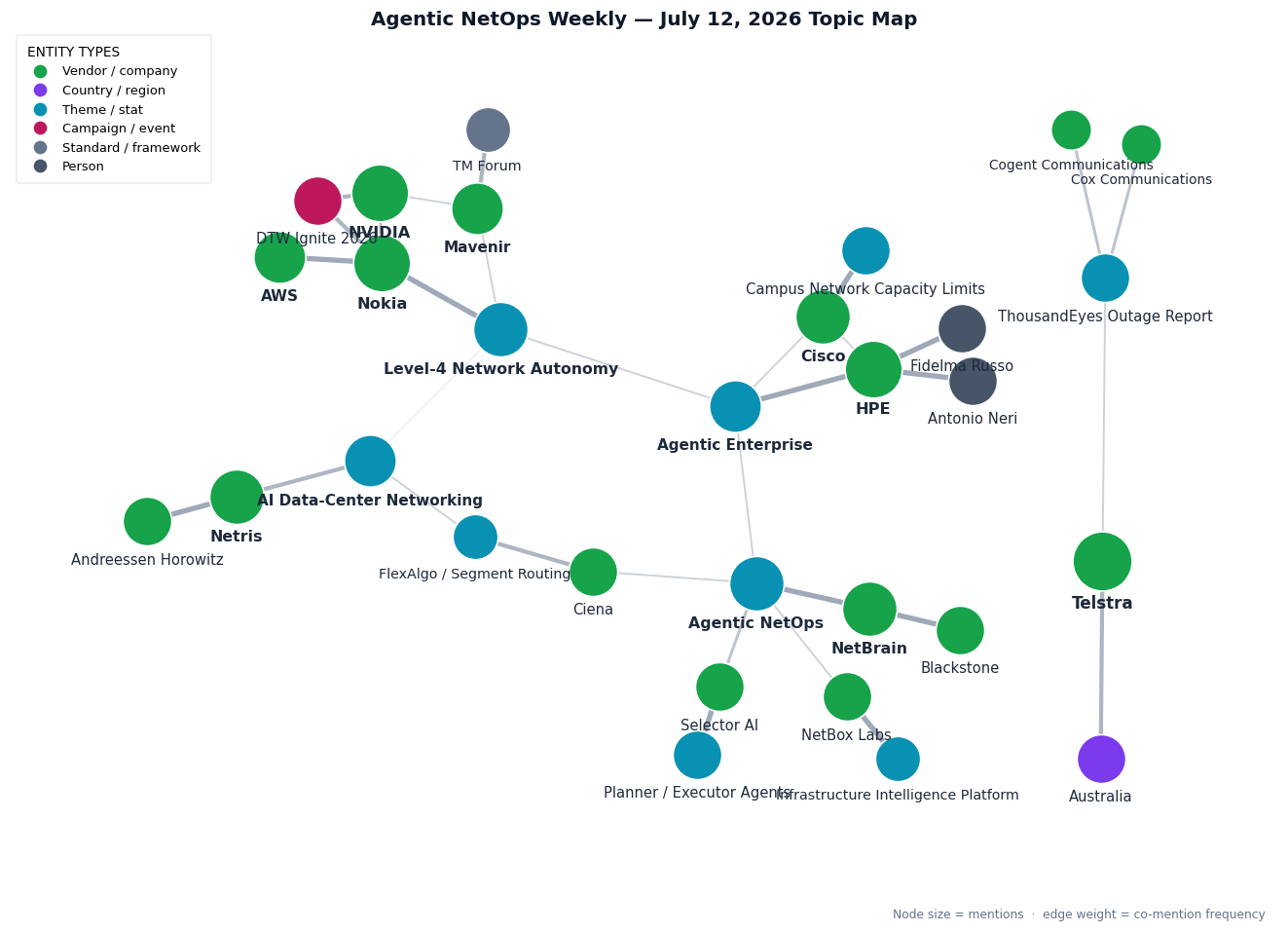
Detailed write-ups
1. Netris announces $15M from a16z to automate AI data centre networking for neoclouds
AI Insider · Jul 6, 2026
Netris raised a $15 million Series A led by Andreessen Horowitz, with a16z partner Guido Appenzeller joining the board, to automate the networking layer that determines how fast neocloud operators can turn expensive GPU clusters into revenue. Netris’ NAAM platform runs its automation entirely in switch hardware rather than software — CEO Alex Saroyan argues AI traffic volumes are too high for software-defined approaches to keep pace — and is vendor-agnostic across Nvidia and AMD environments. The company is now live across more than 35 GPU clusters globally (roughly one million GPUs) with customers including Lightning AI, Foxconn, HPE, TensorWave and Telus, and reports 800% ARR growth over the past year. Notably, Netris doesn’t use AI in its own platform, relying instead on deterministic algorithms it argues are better suited to the precision required for configuring thousands of switches.
Read the article →
Sources: AI Insider
2. Network evolution for the Agentic AI era
Network World (Ciena) · Jul 6, 2026
A Ciena-sponsored Network World piece makes the case that legacy IP architectures — built for “busy hour” voice, video and internet traffic — are structurally too rigid for AI agents that hit the network around the clock and demand decisions in microseconds. Ciena argues three upgrades are now table stakes: real-time telemetry to replace reactive, outdated manual troubleshooting; a shift from bloated legacy IP to segment routing and EVPN for precise, dynamic path control; and FlexAlgo, which lets operators define performance objectives (latency, bandwidth, resiliency, sovereignty) and have the network compute and maintain optimal paths automatically, rather than hand-engineering tunnels the way RSVP-TE required. Ciena says it is already deploying all three, plus MACsec security, with large healthcare and finance enterprises balancing AI and traditional workloads under strict SLA and sovereignty requirements.
Read the article →
Sources: Network World
3. 2026 network outage report and internet health check
Network World · Jul 7, 2026
Network World’s weekly ThousandEyes-powered internet health roundup logged 443 global network outage events for the week of June 29 to July 5 across ISPs, cloud providers, collaboration apps and edge networks — down 14% from 516 the prior week, with U.S. outages similarly down 14% to 297. The most notable incidents were brief but wide-reaching: a 13-minute Cogent Communications outage on June 29 rippled across a dozen-plus countries including the U.S., Japan, France, Brazil, Australia and the U.K., while a 12-minute (over a 49-minute window) Cox Communications outage on June 25 hit partners and customers in the U.S., Mexico, the U.K., South Korea and Japan. A useful weekly baseline for NetOps readers tracking whether the internet’s underlying reliability is trending up or down as AI traffic volumes climb.
Read the article →
Sources: Network World
4. Telstra network experiences major outage across Australia
SBS News · Jul 8, 2026
Australia’s largest telco suffered a nationwide network failure beginning around 4:30am AEST on July 8, when a software defect in the time-keeping servers at its Sydney and Melbourne data centres disrupted the time synchronization that mobile connectivity and data transmission depend on. Telstra CFO Michael Ackland confirmed the root cause; by 10am roughly 90% of calls and data services were restored, with full network recovery by 4pm. The blast radius was substantial for a network powering about 25 million Australian mobile services: Victoria’s entire regional V/Line train network ground to a halt (replaced by a very limited coach service), EFTPOS and payment processor Tyro reported transaction failures affecting some 80,000 businesses, and Telstra logged 639 welfare checks for people unable to reach Triple Zero, with 170 referred to state police. It’s a stark real-world reminder, in a week otherwise full of AI-autonomy pitches, that unglamorous infrastructure fundamentals — time synchronization, redundancy, failover — remain the actual foundation every agentic layer sits on top of, and that they still fail in ordinary, human ways.
Read the article →
Sources: SBS News
5. Mavenir turns NOC knowledge into automation for autonomous networks (FOUNDATIONAL)
Help Net Security · Jun 23, 2026
Mavenir launched its Agentic Service Assurance Framework, a TM Forum IG1251/IG1453-aligned multi-agent system built around an “Intent Ops” engine that observes how NOC teams actually resolve problems and converts those proven human workflows into repeatable, guardrailed automation templates, rather than reasoning only over static data models. Every automation is validated against a human baseline before autonomous execution, and the framework integrates with existing OSS AI agents via the Agent-to-Agent (A2A) protocol, preserving prior investments while extending automation across the network stack. Mavenir’s framing is squarely aimed at the industry’s core problem: institutional NOC expertise walks out the door when experienced engineers retire, and this is a bid to capture and scale it instead.
Read the article →
Sources: Help Net Security
6. NVIDIA brings trusted, 24/7 AI agents to telecom operations (FOUNDATIONAL)
NVIDIA Blog · Jun 22, 2026
NVIDIA’s DTW Ignite 2026 showcase laid out the infrastructure layer underneath much of this week’s telecom autonomy activity: synthetic, privacy-safe training data (used by SoftBank to fine-tune telecom models without exposing customer records); secure agent runtimes like NemoClaw and OpenShell that give long-running agents policy-based guardrails and auditable, sandboxed access to telecom systems; and GPU-accelerated simulation letting agents validate network changes before touching production. Partners spanning Amdocs, NTT DATA, ServiceNow, TCS, Forsk, VIAVI and KDDI are building on these pieces for use cases from self-healing 5G RAN to proactive customer care. Read this as the connective infrastructure underneath Nokia’s AWS move elsewhere in this issue — the shared plumbing that turns scattered agentic pilots into a coherent autonomy stack.
Read the article →
Sources: NVIDIA Blog
7. Nokia moves full telecom operations stack to AWS, targeting Level 4 network autonomy (FOUNDATIONAL)
Tech Times · Jun 24, 2026
Nokia expanded its AWS partnership at DTW Ignite, committing to move its entire Autonomous Network Fabric — orchestration, network assurance, unified inventory and AI-driven closed-loop automation — onto AWS cloud infrastructure, with full commercial availability expected later in 2026. The technical mechanism is a two-agent, closed-loop architecture running on Amazon Bedrock AgentCore: an external-events-agent ingests real-world context (weather, scheduled events, traffic incidents), while a slicing-policy-agent fuses that context with historical performance data to compute optimized RAN configurations that Nokia’s MantaRay platform then executes autonomously. The claim lands against a sobering backdrop: an Accenture survey found 79% of telecom operators remain at Level 0 or 1 on TM Forum’s six-tier autonomy scale, with only 22% expecting to reach Level 4 by 2030, and AWS’s own telco lead has cautioned publicly that process-level automation wins don’t automatically add up to genuine domain-level autonomy. Nokia’s reported metrics (90%+ automation rates, sub-four-hour service delivery) are vendor-stated and not yet independently certified against TM Forum’s framework — worth reading with that caveat attached.
Read the article →
Sources: Tech Times
8. When one agent plans and another executes, the planner’s view decides everything (FOUNDATIONAL)
Selector AI Blog · Jul 2, 2026
Selector AI’s blog makes an architectural argument worth internalizing as agentic NetOps designs mature: splitting an agent into a planner (which reasons about what should change) and an executor (which carries out approved actions) only works safely if the planner reasons from a complete, high-fidelity view of the network. Deterministic-enough insight — not just a probable explanation — is what teams need before they’ll trust a platform to reroute traffic, drain links, or trigger remediation automatically. It’s a useful counterpoint to this week’s more headline-grabbing vendor claims: the planner/executor split is becoming a common pattern, but its safety is entirely contingent on data quality and context, not on the elegance of the agent architecture itself.
Read the article →
Sources: Selector AI Blog
9. HPE Discover: Neri outlines an AI architecture built for agents (FOUNDATIONAL)
Network World · Jun 17, 2026
HPE CEO Antonio Neri opened HPE Discover 2026 with AI announcements spanning the company’s full stack, arguing “every byte, every token, every decision” now crosses the network first. On networking specifically — built substantially on HPE’s Juniper integration — HPE extended AI connectivity from GPU racks to the inference edge with new QFX switches, a PTX 12,000 data-center-interconnect routing platform, an SRX 4700 quantum-safe firewall, and an MX 301 edge router. Neri put a number on why network latency matters at AI scale: shaving delay across hundreds of thousands of GPUs over weeks of training can be the difference between a 90-day and a 30-day model run. On the agent-governance side, HPE is building a governed agent layer into Private Cloud AI with zero-code agent registration across any framework and a three-tier identity model requiring human approval for sensitive actions — a direct answer to agent sprawl happening today outside formal IT oversight.
Read the article →
Sources: Network World
10. HPE CTO Russo drills into data, orchestration, and observability for the agentic enterprise (FOUNDATIONAL)
Network World · Jun 17, 2026
Where Neri’s keynote covered portfolio architecture, HPE CTO Fidelma Russo’s Discover session went deeper on the software and operations layer sitting on top of it: HPE Data Fabric 8.2 with agent-aware data governance, HPE Morpheus 9 (adding a federated multi-site “Morpheus Central” control plane and integrated Juniper-based SDN), and the OpsRamp Operations Copilot for conversational, cross-signal observability. The organizing idea is a centralized agent registry and planning service that assigns identity, governance and policy to every AI agent, then coordinates which specialized agents work together on a given outcome — Russo’s framing: “intelligence, which is usually trapped in products, has to move across and beyond individual products.” For NetOps leaders, Morpheus Central’s fleet-health, version-drift and cost-utilization views across sites is the most immediately practical piece.
Read the article →
Sources: Network World
11. Cisco: AI growth is exposing campus network limits (FOUNDATIONAL)
Network World · Jun 17, 2026
A Cisco/Foundry survey of 3,472 IT and networking leaders across 15 countries found AI is already straining campus and branch networks that most AI-readiness planning still ignores in favor of data centers and GPUs: AI-related campus traffic is up 34% over the past year and projected to grow 209% over three years, 73% of organizations already face or expect campus capacity constraints within two years, and 67% report AI workloads driving up east-west traffic between internal systems as agents talk to each other. Security and visibility gaps compound the problem — 80% say AI has expanded their attack surface, and 61% are delaying further AI deployment until their security posture catches up. Only 30% of even the most aggressive AI adopters say their networks are fully prepared, driving 93% of IT decision-makers to accelerate modernization. Cisco president Jeetu Patel’s framing was blunt: “Eventually there will be only two kinds of companies: those that are AI companies, and those that are irrelevant.”
Read the article →
Sources: Network World
12. NetBox at 10: network inventory tool now a full infrastructure intelligence platform (FOUNDATIONAL)
Network World · Jun 12, 2026
NetBox turns 10 this year, and NetBox Labs marked the anniversary by launching its Infrastructure Intelligence Platform, extending the tool well beyond its original scope as a network-inventory source of truth. New pieces include NetBox Data Exchange (a device-metadata database spanning lifecycle, environmental and observability data across tens of thousands of device types), NetBox Asset Lifecycle (connecting network design to procurement, shipment and spares management), NetBox Validation (pre-change compliance and safety checks with self-correction for AI agents), and a hosted MCP server exposing the whole platform to any MCP-compatible agent. CEO Kris Beevers frames the driver plainly: enterprise infrastructure teams are drowning in tool sprawl (“I have 14 network observability tools right now. Help.”), and NetBox is betting that a single, agent-addressable platform spanning design through decommission is the consolidation play. NetBox now runs across more than 10,000 organizations, from enterprise networks to AI data centers.
Read the article →
Sources: Network World
13. NetBrain appoints three new executives to help customers chart their path to Agentic NetOps (FOUNDATIONAL)
BusinessWire · Jun 30, 2026
NetBrain Technologies, which bills itself as the pioneer of Agentic NetOps, named Luvlynn Lee (ex-Split Software, ThousandEyes) as Chief Customer Officer, Sean Dolan (ex-EnterpriseDB, Juniper, Nokia) as Chief Revenue Officer, and Scott Fitzgerald (ex-Intapp, Duck Creek) as Chief Marketing Officer. The appointments follow Blackstone’s majority investment in NetBrain and Bernadette Nixon’s appointment as CEO in January 2026 — a deliberate sequence, per Nixon, of building customer-success, revenue and marketing leadership to match the scale of the opportunity now that (in her words) the underlying agentic technology is production-ready and the gap to close is commercial, not technical. It’s a small story on its face, but a useful data point for NetOps readers: a private-equity-backed platform vendor is investing in go-to-market muscle specifically to move Agentic NetOps “from early adopters to mainstream enterprise deployments,” which is exactly the phase this category has been waiting to enter.
Read the article →
Sources: BusinessWire
|