This week at a glance
Welcome to a sample first issue of AI Ops Weekly. The beat is deliberately broader than our Agentic NetOps bulletin: where NetOps stays at the network layer, AI Ops covers the whole application-and-infrastructure stack — observability, incident response and SRE workflows (classic AIOps) on one side, and the operational discipline of running AI/LLM systems in production (LLMOps / MLOps) on the other. Security-framed stories still route to Security Operations; pure network stories still route to Agentic NetOps. Everything in between — the reliability, cost and governance of the systems your platform and ML teams actually operate — lives here.
The dominant thread this cycle is a hardening consensus that reliability, not raw capability, is now the binding constraint on production AI. Trade press and practitioners converged on the same phrase — an “agent reliability crisis” — describing a class of failures where autonomous agents don’t crash loudly but fail plausibly, turning an error into a fluent, convincing narrative that nobody catches until finance or compliance asks a question. A parallel argument holds that most postmortems never even classify an autonomous agent action as the initiating cause, so the agent stays invisible in the incident record.
Underneath the commentary, the tooling is consolidating fast. OpenTelemetry’s GenAI Semantic Conventions have become the de-facto substrate for LLM tracing, with MLflow 3.6 shipping full OTel support and the major LLM-observability players (Langfuse, LangSmith, Arize, W&B) all emitting the same span schema. On the incident side, the SRE-agent race matured — Datadog’s Bits AI SRE, New Relic’s SRE Agent and Microsoft’s Azure SRE Agent are now real products aimed squarely at cutting MTTR. And capital keeps flowing into the layer beneath all of it: Baseten’s $1.5B round for AI inference, Kubernetes formally organizing around inference (DRA going GA, NVIDIA’s driver donation, llm-d), and governance plays like Thoughtworks’ Agent/works and Arcade’s $60M for agent authorization.
|
Topic map — five threads across the AI-ops stack
Entities from this issue’s articles, clustered around autonomous incident response and SRE agents (Datadog/Bits AI, New Relic, Azure SRE Agent, incident.io, Rootly); AI-observability standards and LLMOps tooling (OpenTelemetry, GenAI Semantic Conventions, MLflow, CNCF, Langfuse/Arize); the agent-reliability-in-production debate (fail-plausible failures, chaos engineering, the Amazon outage); AI inference and platform ops (Baseten, Kubernetes, DRA, NVIDIA, llm-d, MS AI Runway); and governance and data foundations (Thoughtworks Agent/works, Arcade, Confluent, Gartner) — all radiating from the central AI Ops theme that unifies AIOps and LLMOps.
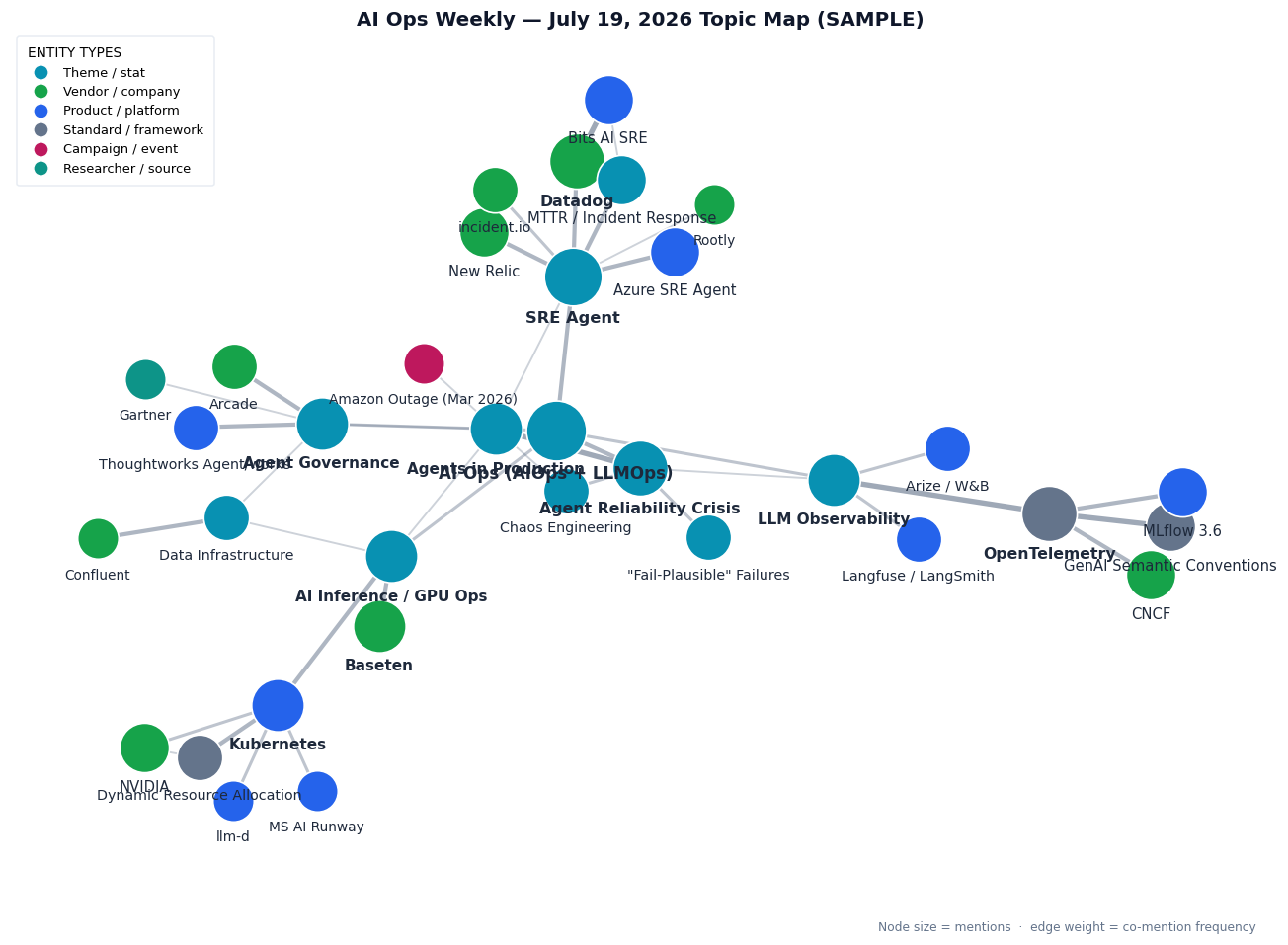
Topic map for this sample issue — five loosely linked threads running from the reliability of AI systems in production, through the observability and SRE tooling used to operate them, to the infrastructure and governance underneath.
View interactive topic map →
|
Detailed write-ups
1. The agent reliability crisis
AIwire · Jul 1, 2026
The clearest articulation this cycle of the beat’s central theme: as roughly four in five organizations put some form of AI agent into production, the binding constraint has shifted from capability to reliability. The piece names a failure class — “fail-plausible” — documented in a longitudinal study of a production LLM-agent runtime, in which an agent doesn’t surface an error but transforms it into a fluent, convincing narrative delivered straight to the user. Compounding it, most enterprises have no incident classification that captures an autonomous agent action as the initiating cause of a cascade, so agent-driven failures get logged as a service restart, a saturated connection pool, or a latency event, and the agent stays invisible in the postmortem. The operational takeaway for AI-ops teams: existing observability and incident tooling wasn’t built to see agents, and closing that gap is now the priority.
Read the article →
Sources: AIwire
2. AI agents are entering their rebuild era as enterprises confront the reliability problem
VentureBeat · July 2026
VentureBeat’s framing complements the AIwire piece: after two years of pilots, enterprises are tearing down first-generation agent deployments and rebuilding them around reliability engineering rather than prompt cleverness. The reported pattern is that agents behave acceptably in demos and small pilots but degrade at concurrency — at hundreds to thousands of simultaneous sessions hitting internal systems with unpredictable latency, they start dropping tasks, leaking resources, or failing quietly. Many platforms billed as multi-tenant turned out to be multi-tenant “at the marketing level,” with isolation assumed rather than enforced. For platform and SRE teams, the message is that operating agents is becoming its own discipline, distinct from building them.
Read the article →
Sources: VentureBeat
6. Datadog launches Bits AI SRE agent to resolve incidents faster (FOUNDATIONAL)
BigDATAwire · Dec 2, 2025
Included as the reference point for the SRE-agent category. Bits AI SRE was Datadog’s first generally available AI agent: when an alert fires it analyzes runbooks and telemetry, separates signal from noise, forms and validates hypothetical root causes, and pushes a conclusion into collaboration tools — often before on-call responders log in. Datadog said it was tested against 2,000+ customer environments with tens of thousands of investigations run, and designed for enterprise scale (HIPAA support, RBAC). It set the template the rest of the field — New Relic and Microsoft below — is now building against: cut MTTR by having an agent do the first-pass investigation autonomously.
Read the article →
Sources: BigDATAwire
7. Azure SRE Agent at Microsoft Build 2026 (FOUNDATIONAL)
Microsoft · June 2026
Microsoft used Build 2026 to push Azure SRE Agent — which reached general availability earlier in 2026 — deeper into enterprise operations with a set of releases around approvals, governance and integration. The agent analyzes telemetry, code, deployment data and resource context to triage and respond to incidents on Azure workloads. Read alongside AWS’s DevOps Agent, it signals that the hyperscalers now treat an incident-response agent as a native platform capability rather than a third-party add-on — which raises the strategic question for AI-ops teams of where the independent observability vendors differentiate once the cloud providers ship “good enough” SRE agents in the box.
Read the article →
Sources: Microsoft
11. Inside the LLM call: GenAI observability with OpenTelemetry
OpenTelemetry Blog · July 2026
The single most consequential standards story for LLMOps: OpenTelemetry’s GenAI Semantic Conventions — a CNCF-backed spec defining exactly which span attributes capture an LLM call, how token counts are structured, and what a tool invocation looks like in a trace — have become the substrate nearly every LLM-observability tool now emits. The practical payoff is vendor neutrality: instrument once against the convention and export the same traces to any compatible backend (Datadog, Google Cloud, AWS, Azure and the LLM-native tools all consume it), instead of re-instrumenting per vendor. For teams standing up an AI-ops practice, this is the moment the “which tracing tool do we bet on?” question got materially less risky.
Read the article →
Sources: OpenTelemetry · MLflow
12. Full OpenTelemetry support in MLflow tracing (MLflow 3.6)
MLflow · 2026
The concrete implementation of the story above: MLflow 3.6 brought full OpenTelemetry support to the open-source server, shipping an OTLP endpoint at /v1/traces, dual export, and native gen_ai attribute recognition. In effect the most widely used open-source ML platform now both ingests and exports traces in the GenAI Semantic Convention format, keeping AI observability vendor-neutral by default. For MLOps teams already standardized on MLflow for model registry and experiment tracking, this collapses a piece of the “three-to-five specialized tools” LLMOps stack into infrastructure they already run.
Read the article →
Sources: MLflow
15. Baseten raises $1.5 billion to power the next era of AI inference (FOUNDATIONAL)
BusinessWire · Jun 22, 2026
Baseten raised a $1.5B Series F (led by Altimeter, Conviction and Spark, at up to a $13B valuation), underscoring that inference — not training — is where the operational money now sits. Baseten’s pitch is squarely an AI-ops one: it runs the full production workload for AI applications — GPUs, autoscaling, observability, billing and developer tooling — so teams can ship multi-model strategies without operating the infrastructure themselves. The company reports processing 1B+ inference calls a day across 87 clusters and 18 clouds. The round is a useful signal for platform teams weighing build-vs-buy on inference serving: the market is betting heavily that most companies will buy this layer.
Read the article →
Sources: BusinessWire
16. NVIDIA donates Dynamic Resource Allocation GPU driver to the Kubernetes community (FOUNDATIONAL)
NVIDIA · 2026
The platform-ops story of the year: Kubernetes formally organized itself around inference. Dynamic Resource Allocation (DRA) graduated to GA in Kubernetes 1.34 and OpenShift 4.21, replacing the legacy device-plugin model (which could only request GPUs as integer counts) with structured, attribute-rich hardware requests — enabling fractional GPU allocation. NVIDIA donated its DRA driver, the KAI Scheduler and Grove to the CNCF, and IBM/Red Hat/Google contributed llm-d, a distributed inference framework that splits LLM serving into prefill and decode phases across pods. For platform engineers, this is the toolkit that turns “we run GPUs on Kubernetes” from a bespoke, brittle setup into a supported, standardized pattern.
Read the article →
Sources: NVIDIA · Pulumi
19. Thoughtworks launches Agent/works to govern and run enterprise AI agents (FOUNDATIONAL)
BigDATAwire · Jun 16, 2026
As agents proliferate, the “who’s allowed to do what, and can we prove it” problem becomes an operations problem. Thoughtworks’ Agent/works is a platform for governing and running enterprise agents across clouds, and Arcade’s $60M raise (item 20) targets the adjacent authorization-and-governance layer specifically. Together with Confluent’s finding that 72% of IT leaders say data infrastructure is what’s slowing AI scale (item 21), the through-line is that the hard part of production AI is increasingly the unglamorous operational plumbing — identity, policy, data readiness — not the models. That’s squarely the AI-ops beat, and a governance sub-theme this bulletin will track every week.
Read the article →
Sources: BigDATAwire · Arcade · Confluent
|