At a glance
This was a positioning week rather than a launch week, and the framing question moved on. ABI Research’s read, carried by RCR Wireless, put it bluntly: the network agents are essentially ready for commercial use — the open question is whether the telcos are, given the data, process and trust work still outstanding. Cisco supplied the vendor answer with a platform path to agentic operations, arguing that agents only become dependable when they sit on a common, observable, policy-governed substrate rather than bolted onto point tools. The operator voices in RCR’s ongoing “Agentic Network” series pulled in the same direction from the buy side: Boost Mobile made the case that the differentiator is not the model but the right data to feed it, and earlier entries with Rakuten Mobile (turning data into outcomes) and Deutsche Telekom (APIs for trusted AI) filled in what the operator-side plumbing has to look like.
The self-driving-network thesis got its business case sharpened. theCUBE Research argued that autonomous network operations are shifting from an efficiency nicety to a business imperative, and HPE (with Juniper in the fold) used a CUBE Conversation to advance its self-driving networking strategy for the AI era — closed-loop assurance, natural-language operations and progressively higher autonomy levels as the through-line. Google Cloud’s earlier sizing of a roughly $60bn agentic-AI opportunity for telecom operators remained the number the commercial case keeps circling, and a VoIP Review piece tied the theme back to the two metrics operators actually answer to: revenue and efficiency.
The infrastructure story stayed on AI-RAN. RCR’s survey of how AI-RAN is taking shape as Open RAN, Cloud RAN and AI converge set the frame, and the foundational reading filled in the roadmap: Red Hat outlined its AI-RAN direction, South Korea launched a national AI-RAN project explicitly aimed at industrial AI, and ZTE made the most concrete autonomy claim of the fortnight with a Light Reading case for achieving Level 4 networks at scale. Cisco’s foundational interview on earning trust in autonomous operations closed the loop back to the week’s real gating factor — capability is arriving faster than the confidence to hand it the keys.
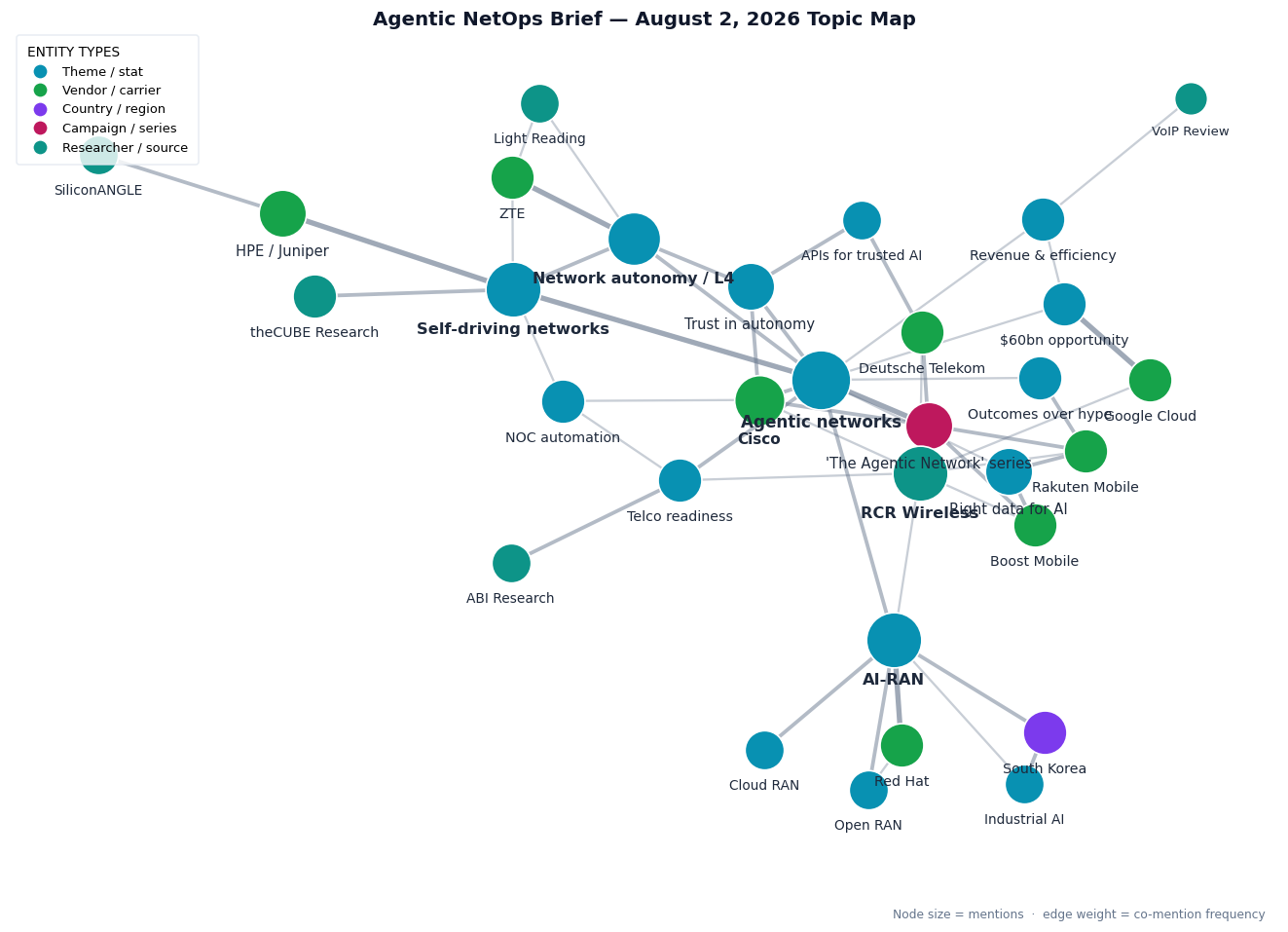
This week’s topic map — the readiness debate and Cisco’s platform path to agentic operations; the operator “Agentic Network” interviews (Boost Mobile on the right data, Rakuten on outcomes, Deutsche Telekom on APIs and trust); self-driving networks as a business imperative (theCUBE, HPE/Juniper); and the AI-RAN build-out where Open RAN, Cloud RAN and AI converge (Red Hat’s roadmap, South Korea’s industrial-AI project, ZTE’s Level 4 case) — with the $60bn opportunity as the recurring commercial anchor. Node size reflects how often an entity is mentioned; edge weight reflects how often two entities are discussed together.
View interactive topic map →
Article index
Weekly News
Are the networks ready — and are the telcos?
The framing shifts from agent capability to operator readiness: an analyst verdict that the agents are commercially ready, Cisco’s platform path to agentic operations, Boost Mobile’s argument that the real work is the data, and the revenue-and-efficiency case for adopting.
Self-driving networks and the AI-RAN build-out
The infrastructure thread: AI-RAN taking shape as Open RAN, Cloud RAN and AI converge, and HPE (with Juniper) advancing a self-driving networking strategy for the AI era.
Foundational Reading
Self-driving networks as a business imperative — and the operator playbooks
Why autonomous operations are becoming mandatory rather than optional, and how the operators driving the “Agentic Network” series are building toward it — trust, data and outcomes, with Google Cloud’s $60bn sizing as the commercial anchor.
AI-RAN roadmaps and Level 4 autonomy at scale
The autonomy roadmap firming up: Red Hat’s AI-RAN direction, South Korea’s national AI-RAN project for industrial AI, and ZTE’s concrete case for achieving Level 4 networks at scale.
Detailed write-ups
1. The question flips: the agents are ready — are the telcos?
RCR Wireless · July 28–30, 2026
The most useful reframing of the week came from ABI Research by way of RCR Wireless: network agents are, by the analyst’s read, essentially ready for commercial use. The bottleneck has moved from the technology to the operator — whether telcos have the clean data, the process maturity and, above all, the organizational trust to let autonomous agents actually run production networks. That shifts the burden of proof from vendors to buyers, and it reframes 2026’s remaining quarters as an adoption-readiness story rather than a capability story.
Cisco’s contribution, in a new entry of RCR’s “Agentic Network” series, is the platform argument for closing that gap. Rather than agents bolted onto individual tools, Cisco pitches a common substrate — observable, policy-governed, with a shared data and telemetry fabric — on which agents can be introduced, bounded and audited consistently. The claim is that dependability is a property of the platform, not of any one agent: you earn the right to automate by making agent actions explainable and reversible across the whole estate. Boost Mobile, interviewed in the same series, supplied the operator-side echo with a sharper point — the differentiator is not the model but the right data to feed it. Agentic ambitions stall on fragmented, low-quality operational data long before they stall on model quality, which is why Boost frames data readiness as the real precondition. A VoIP Review survey of the theme kept the commercial motive in view: operators are embracing agentic AI because it maps directly onto the two numbers they are judged on — revenue and operating efficiency.
Sources: RCR Wireless (ABI — agents ready) · RCR Wireless (Cisco platform path) · RCR Wireless (Boost Mobile — right data) · VoIP Review (revenue & efficiency)
2. Self-driving networks become a business imperative — and AI-RAN the substrate
theCUBE Research · SiliconANGLE · RCR Wireless · July 29–30, 2026
theCUBE Research made the strategic case that self-driving networks are crossing from “efficiency project” to business imperative: as AI workloads push traffic volumes, topological complexity and latency sensitivity past what human-paced operations can keep up with, autonomous network operations stop being a way to save money and become the only way to run the network at all. That argument reframes the autonomy investment as defensive as much as offensive — a prerequisite for supporting AI, not merely a benefit of it. HPE, now carrying Juniper’s networking portfolio, put product substance behind the thesis in a CUBE Conversation, advancing a self-driving networking strategy built on closed-loop assurance, natural-language operations and a graduated climb up the autonomy levels rather than a single leap to full self-driving.
Underneath the operations story sits the radio and compute substrate, and this week that meant AI-RAN. RCR Wireless surveyed how AI-RAN is taking shape as three previously distinct threads — Open RAN‘s disaggregation, Cloud RAN‘s virtualization, and AI’s inference-everywhere push — converge into a single architecture where the same infrastructure runs the radio and hosts AI workloads. The significance for agentic NetOps is that AI-RAN is where the self-driving ambition meets physical reality: an autonomous network is only as autonomous as the RAN it can observe and act on, and the convergence RCR describes is what makes closed-loop control at the edge tractable in the first place.
Sources: theCUBE Research (business imperative) · SiliconANGLE (HPE self-driving strategy) · RCR Wireless (AI-RAN takes shape)
3. The operator playbooks: data, outcomes, APIs and the trust to act on them
RCR Wireless · July 16–23, 2026
The foundational entries in RCR’s “Agentic Network” series read as a composite operator playbook for getting from ambition to production. Rakuten Mobile’s contribution centers on turning data into outcomes — the discipline of tying every agentic capability back to a measurable operational result rather than deploying autonomy for its own sake, which is the same anti-hype instinct that has run through this beat all summer. Deutsche Telekom approached it from the interface layer, arguing that APIs for trusted AI are the connective tissue: agents can only be trusted to act if the systems they touch expose well-governed, permissioned interfaces with clear contracts, so the API estate becomes the place where trust is actually engineered rather than asserted.
Cisco’s foundational interview on earning trust in autonomous operations closes the same loop from the vendor side — the recurring insistence that operators will only cede control once agent actions are explainable, bounded and reversible, and that trust, not raw capability, is the gating variable for 2026. Framing all of it commercially, Google Cloud’s sizing of a roughly $60bn agentic-AI opportunity for telecom operators — spanning network operations, customer experience and monetization — is the number the business case keeps returning to. Read together, the operator and vendor voices converge on a single sequence: get the data right, wire it through trusted APIs, prove outcomes, and expand autonomy only as fast as trust is earned.
Sources: RCR Wireless (Rakuten — data into outcomes) · RCR Wireless (Deutsche Telekom — APIs for trusted AI) · RCR Wireless (Cisco — earning trust) · RCR Wireless (Google Cloud — $60bn opportunity)
4. AI-RAN roadmaps and the first concrete Level 4 claim
RCR Wireless · Light Reading · July 15–22, 2026
If AI-RAN is the substrate, the foundational reading this fortnight showed the roadmap firming up around it. Red Hat outlined its AI-RAN direction, positioning its cloud-native platform stack as the horizontal foundation on which multiple vendors’ RAN and AI workloads can co-reside — the same “own the substrate, let the agents proliferate on top” logic that runs through the platform arguments elsewhere in this issue. South Korea, meanwhile, launched a national AI-RAN project explicitly framed around industrial AI, a reminder that AI-RAN is being pursued not only as a telecom efficiency play but as national infrastructure for AI-driven manufacturing and industry — a state-scale bet that the converged radio-and-compute network is a strategic asset.
The most concrete autonomy claim came from ZTE via Light Reading, which laid out a case for achieving Level 4 networks at scale — the tier at which the network handles the large majority of operational decisions autonomously within defined domains, with humans setting intent and exception-handling rather than driving. L4 has been the aspirational marker in every autonomy-levels discussion this beat has tracked; ZTE’s move to attach it to deployment scale rather than a lab demo is the kind of claim worth watching precisely because “Level 4” still means different things to different vendors. Whether these roadmaps converge on externally validated autonomy levels — or whether L4 stays a marketing tier — is the open question the second half of 2026 will answer.
Sources: RCR Wireless (Red Hat AI-RAN roadmap) · RCR Wireless (South Korea AI-RAN) · Light Reading (ZTE — L4 at scale)
On our watch list
- Readiness moves from vendors to operators. With ABI declaring the agents commercially ready, watch for the first hard operator disclosures — data-quality remediation programs, autonomy-level attestations, incidents auto-resolved in production — that show telcos closing the readiness gap rather than just describing it.
- Data readiness as the real precondition. Boost Mobile and Rakuten both put clean, outcome-linked data ahead of model choice. Watch whether “get the data right” becomes a concrete operator workstream (telemetry normalization, data contracts) or stays a talking point.
- The platform-vs-point-tool contest. Cisco’s platform path and Red Hat’s substrate pitch both argue agents belong on a common, governed foundation. Watch whether operators standardize on a horizontal agentic platform or accumulate a patchwork of NetOps copilots.
- Trust becomes a procurement spec. Cisco’s “earning trust” framing and Deutsche Telekom’s trusted-API argument both make trust engineerable. Watch whether explainability, boundedness and reversibility start appearing as written procurement requirements rather than marketing language.
- AI-RAN convergence hits deployment. With Open RAN, Cloud RAN and AI converging on paper, watch Red Hat’s roadmap and South Korea’s industrial-AI project for the first at-scale AI-RAN deployments that run radio and AI workloads on shared infrastructure.
- Does “Level 4” get validated? ZTE’s L4-at-scale claim advances the autonomy-levels conversation. Watch whether formal, externally verifiable definitions emerge — or whether L4 keeps meaning whatever each vendor needs it to.
- The $60bn number gets tested. Google Cloud’s opportunity sizing remains the commercial anchor. Watch for the first operator P&L evidence — cost saved, headcount redeployed, new revenue — that either substantiates the figure or exposes it as slideware.
|