At a glance
AI Ops Weekly covers the whole application-and-infrastructure stack — observability, incident response and SRE workflows (classic AIOps) on one side, and the operational discipline of running AI and LLM systems in production (LLMOps / MLOps) on the other. This cycle’s dominant thread is that the operator keeps becoming an agent. Dynatrace shipped autonomous SRE agents and, in doing so, exposed what The New Stack called the single hardest part of AI operations — deciding how much of the remediation loop a human still has to hold. Foundational reporting filled in the trajectory: agentic observability is compressing root-cause analysis, and a survey of five ways SRE AI agents augment humans reads less like automation of dashboards than a redefinition of the on-call job around defining objectives and guardrails.
The connective tissue underneath all of this was the Model Context Protocol. The Register reported MCP getting an “enterprise makeover,” InfoWorld walked through the unglamorous work of shipping an MCP test agent, and Microsoft updated its C# SDK to support stateless MCP — the same architectural shift InfoWorld covered separately as the way to make agent tooling scale horizontally without sticky sessions. Around it, agents pushed further into day-to-day engineering: OpenAI fixed GPT-5.6 Sol’s habit of burning usage limits while it waited, Databricks introduced agents that rewrite legacy SQL at scale, and the foundational reading on Codex Multi-Agent and the next challenge for coding agents circled the same tension — capability is outrunning transparency and trust.
The other half of the week was infrastructure and money. A striking run of raises reframed the year’s real bottleneck as inference capacity, not training: chip startup Etched more than doubled its valuation to $10.3B, inference-cloud operator General Compute took on $400M in debt, SambaNova was valued at $11B, Spectro Cloud raised $100M to ease AI infrastructure management, and AMD debuted next-generation silicon aimed at frontier models and agentic workloads. The platform layer that has to absorb all of it kept forming, too — Google’s Agent Substrate makes an explicit bid to be the Kubernetes of the agent era, Red Hat OpenShift 4.22 leaned into AI workloads and cloud cost, and InfoWorld’s piece arguing the platform team is product infrastructure, not a cost center gave the whole trend its organizing thesis.
Above the metal, the model layer kept the operational choices moving. InfoWorld reported that China’s trillion-parameter models may work for enterprises in a narrow set of applications, while SiliconANGLE covered Together AI positioning open-weight models as the enterprise moat for cost, control and IP. The throughline of the week: model selection, inference strategy and the platform beneath them are now a single operations decision — and the teams that win are the ones treating it that way.
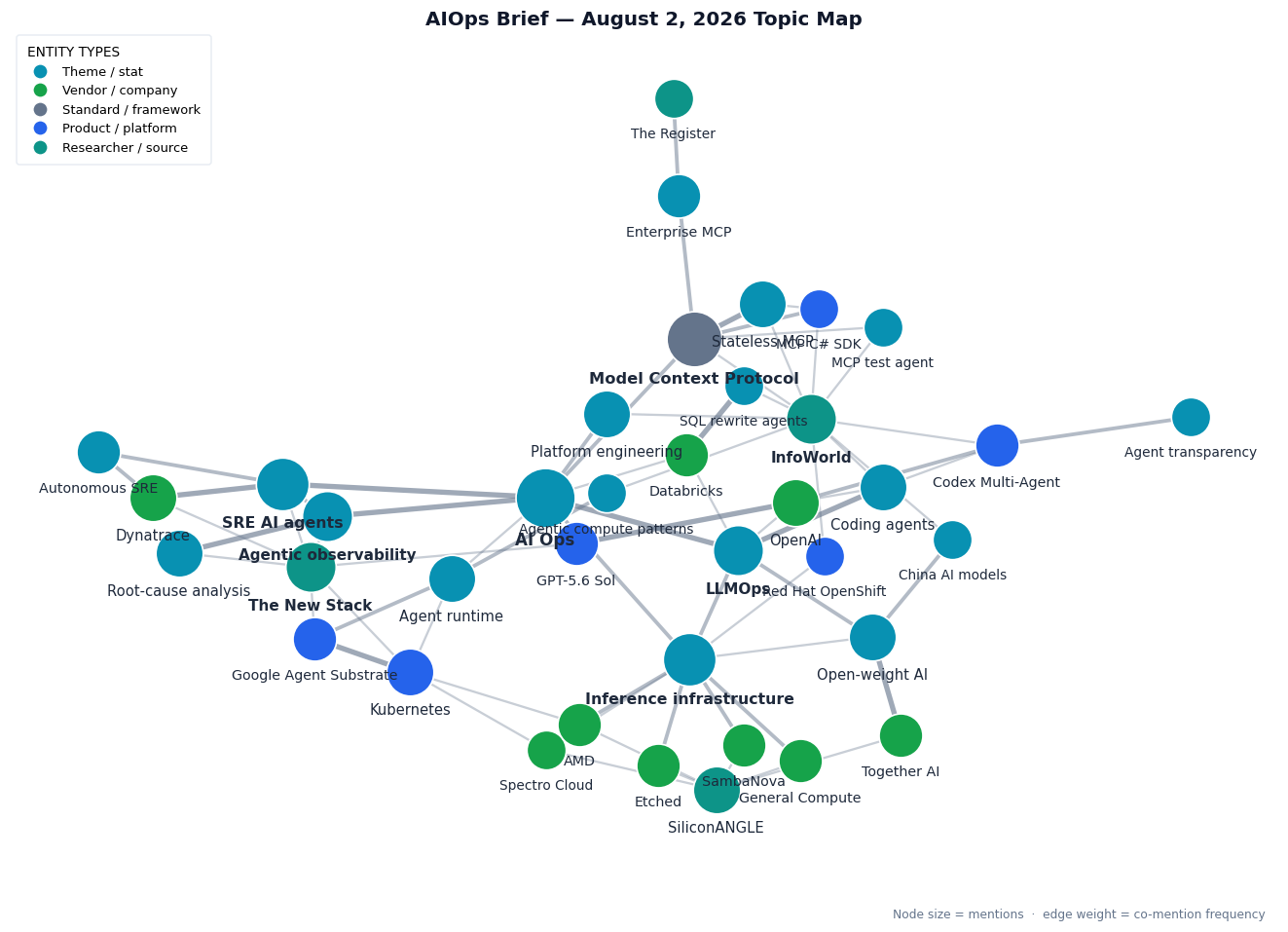
This week’s topic map — six loosely linked threads across the AI-ops stack: agentic SRE and self-healing observability (Dynatrace, autonomous SRE, root-cause analysis); the Model Context Protocol growing an enterprise, stateless spine (enterprise/stateless MCP, Microsoft’s C# SDK, MCP test agents); agents moving into the dev and data workflow (GPT-5.6 Sol, Codex, coding agents, Databricks SQL rewrite); the agent runtime and platform layer (Kubernetes, Google’s Agent Substrate, agentic compute patterns, OpenShift, platform engineering); the inference-infrastructure funding wave (Etched, General Compute, SambaNova, Spectro Cloud, AMD); and open-weight enterprise AI (Together AI, China models) — all radiating from the central AI Ops theme.
View interactive topic map →
Article index
22 articles, grouped by sub-theme. “Weekly News” = this week’s coverage window (July 26–August 2); “Foundational Reading” = longer-form reference reading on the beat.
Weekly News
Agentic SRE and self-healing observability
Reliability work keeps moving from humans reading dashboards to agents acting on telemetry — and the hardest part is deciding how much of the loop to hand over.
The Model Context Protocol grows up
MCP gets an enterprise makeover, a stateless C# SDK, and the boring-but-load-bearing tooling — test agents — that turns a demo protocol into production plumbing.
Agents in the dev and data workflow
Model providers smooth the operational rough edges (GPT-5.6 Sol’s wasted usage limits), while data platforms put agents to work rewriting legacy SQL at scale.
Platform engineering as product infrastructure
The organizing thesis for the whole beat — the platform team isn’t overhead to be minimized; it’s the product surface every AI workload runs on.
Foundational Reading
Agent runtimes and the next platform layer
The infrastructure bid for the agent era — from Google’s Agent Substrate and new agentic compute patterns to OpenShift leaning into AI workloads and cost.
Observability, SRE agents and stateless MCP
The reference reading behind this week’s headlines — agentic RCA, the concrete ways SRE agents augment humans, and why MCP is going stateless to scale.
Coding agents and their limits
Capability is outrunning transparency — multi-agent updates raise trust questions, and the next challenge for coding agents is less about writing code than proving it.
The inference-infrastructure gold rush
Capital floods the serving layer as inference, not training, becomes the gating constraint — chips, inference clouds, and infrastructure management all raising at once.
Open-weight models as the enterprise play
The model-selection story from an ops lens — China’s trillion-parameter models for narrow use cases, and open-weight AI pitched as the moat for cost, control and IP.
Detailed write-ups
1. Agentic SRE arrives: Dynatrace ships autonomous agents, and the hard part is the handoff
The New Stack · July 9–27, 2026
The headline AIOps move this cycle was Dynatrace shipping autonomous SRE agents — and, in The New Stack’s telling, using them to surface the single hardest part of AI operations: not detection or even remediation, but deciding how much of the loop a human still has to hold. An agent that can correlate signals, propose a fix and execute it collapses the mean-time-to-repair curve, but it also introduces a new failure mode, where a confident agent acts on a wrong root cause faster than anyone can catch it. The foundational reading fills in the direction of travel. The New Stack’s piece on agentic AI in observability shows how agents compress root-cause analysis by walking traces and logs the way a senior engineer would, and its survey of five ways SRE AI agents augment humans reframes the on-call role around defining objectives, guardrails and escalation criteria rather than staring at dashboards.
The operational catch is trust, and it is the same catch every time autonomy enters production: the instrumentation that lets an agent act has to be good enough to let a human reconstruct why it acted. For platform and SRE leads the practical read is to treat Dynatrace-style agents as a promotion of the toil ladder, not a replacement for judgment — let agents own triage, correlation and first-pass remediation under bounded blast radius, keep humans on the irreversible actions, and invest in the audit trail before the automation, not after.
Sources: The New Stack (Dynatrace SRE agents) · The New Stack (agentic RCA) · The New Stack (5 ways SRE agents augment)
2. MCP grows up: an enterprise makeover, a stateless spine, and the tooling nobody demos
The Register · InfoWorld · July 24–30, 2026
The connective tissue of the agent stack this week was the Model Context Protocol, and the story was maturation. The Register reported MCP getting an enterprise makeover — the governance, auth and multi-tenancy features that a protocol needs before a large organization will let agents use it against real systems. The most consequential architectural change is the move to stateless MCP: Microsoft updated its C# SDK to support it, and InfoWorld’s separate explainer laid out why it matters — dropping sticky, per-session server state lets agent tooling scale horizontally behind a load balancer like any other stateless service, instead of pinning each conversation to a single process. That is the difference between a protocol that demos and one that survives production traffic.
InfoWorld’s piece on shipping an MCP test agent supplied the unglamorous other half. Making MCP reliable means testing the boring parts nobody puts in a keynote — malformed tool calls, partial failures, retries, schema drift between server versions — and building an agent whose whole job is to exercise those edges. Taken together, the three stories describe MCP crossing from a clever integration pattern into operable infrastructure: stateless so it scales, enterprise-featured so it’s governable, and test-harnessed so it’s trustworthy. For AI-ops teams the takeaway is to treat MCP servers as production services with SLOs, not as glue scripts.
Sources: The Register (enterprise MCP) · InfoWorld (C# SDK / stateless) · InfoWorld (why MCP goes stateless) · InfoWorld (MCP test agent)
3. Agents move into the dev and data workflow — and outrun their own transparency
The New Stack · InfoWorld · July 15–30, 2026
Agents kept pushing deeper into everyday engineering, with the operational rough edges getting sanded down in real time. The New Stack reported OpenAI fixing one of GPT-5.6 Sol’s most frustrating behaviors — burning a user’s usage limits while the model simply waited — a small change that is really an LLMOps story about how opaque quota accounting quietly taxes every downstream agent built on the model. On the data side, Databricks introduced a tool that uses AI agents to rewrite legacy SQL at scale, aiming agents at exactly the kind of high-volume, pattern-heavy migration work that is tedious for humans and tractable for machines — provided the output is verified rather than trusted.
Verification is precisely where the foundational reading lands. InfoWorld’s coverage of the Codex Multi-Agent V2 update captured developer unease that a more capable multi-agent system also became harder to see into — you get more autonomy and less insight into why it did what it did — and its piece on the next challenge for coding agents argues the frontier is no longer generation but validation: making agents run, test and prove their code against the right environment. The composite lesson for AI-ops teams is that adopting coding and data agents is an operations decision about observability and guardrails, not just a productivity bet — the value shows up only when you can audit what the agent actually did.
Sources: The New Stack (GPT-5.6 Sol limits) · InfoWorld (Databricks SQL agents) · InfoWorld (Codex Multi-Agent V2) · InfoWorld (next challenge for coding agents)
4. The agent runtime forms: Google’s Agent Substrate, new compute patterns, and the platform-as-product thesis
The New Stack · InfoWorld · July 14–31, 2026
If agents are the workload, something has to be their operating system — and this week several contenders staked claims. The New Stack framed Google’s Agent Substrate as an explicit bid to be to the agent era what Kubernetes was to containers: a common runtime for scheduling, isolating and connecting long-lived agents. InfoWorld’s survey of new agentic compute patterns describes the shapes that runtime has to support — durable, stateful, tool-using processes that look nothing like the stateless request/response services current platforms were built for. And Red Hat OpenShift 4.22 showed the incumbent platform response, leaning into AI workloads while tackling the cloud-cost problem those workloads create.
InfoWorld’s argument that the platform team isn’t a cost center, it’s product infrastructure is the organizing thesis under all of it. As agent runtimes, GPU scheduling and inference plumbing become the substrate every product depends on, the platform group stops being overhead to be trimmed and becomes the surface that determines whether AI features ship reliably or not. For engineering leaders the practical read is to fund the platform team as a product with its own roadmap and SLOs — because in an agentic stack, the platform is the product’s reliability.
Sources: The New Stack (Google Agent Substrate) · InfoWorld (agentic compute patterns) · InfoWorld (OpenShift 4.22) · InfoWorld (platform as product infrastructure)
5. The inference-infrastructure gold rush: capital piles into the serving layer
SiliconANGLE · July 8–23, 2026
The clearest signal of the week came from the funding pages: the money has decided that inference capacity, not model training, is the binding constraint on what actually ships. AI chip startup Etched more than doubled its valuation to $10.3B in a fresh $300M round; inference-cloud operator General Compute raised $400M in debt financing to build out serving capacity; inference-chip maker SambaNova was valued at $11B in a $1B round; and AMD debuted next-generation AI infrastructure explicitly aimed at frontier models, agentic workloads and autonomous robots. The through-line is a market betting that the bottleneck — and therefore the margin — is in serving tokens efficiently across diverse silicon, not just in producing better models.
The management layer is raising alongside the silicon. Spectro Cloud took $100M to ease AI infrastructure management — the unglamorous but decisive problem of scheduling, standardizing and operating heterogeneous GPU fleets across clouds and edges. For AI-ops and platform teams the composite message is that inference is becoming an end-to-end systems discipline with its own economics: accelerator strategy, capacity planning, utilization and cost-per-token now have to be managed together, and the vendors attracting this capital are the ones promising to make that operable rather than merely faster. Watch cost-per-token and utilization, not peak FLOPS, as the metrics that decide winners.
Sources: SiliconANGLE (Etched) · SiliconANGLE (General Compute) · SiliconANGLE (SambaNova) · SiliconANGLE (Spectro Cloud) · SiliconANGLE (AMD)
6. Open-weight as the enterprise play: China’s big models and Together AI’s moat argument
InfoWorld · SiliconANGLE · July 14–21, 2026
Above the infrastructure, the model-selection debate turned into an operations argument about control. InfoWorld reported that China’s trillion-parameter models may indeed work for enterprises — but only in a narrow handful of specific applications, a useful corrective to the assumption that raw scale translates into broad production utility. The more strategic case came from SiliconANGLE’s coverage of Together AI positioning open-weight models as the enterprise moat for cost, control and intellectual property: teams that own the weights can run on their own infrastructure, tune without vendor permission, keep sensitive data in house, and avoid being surprised by someone else’s quiet context or pricing change.
For AI-ops leaders the two pieces frame model selection as a decision about operability, not just benchmark scores. Open weights shift the burden — and the leverage — onto your own platform: you inherit the serving, scaling and governance work that a hosted API otherwise absorbs, but you also gain the predictability and cost control that this week’s inference-infrastructure story makes so valuable. The practical read is to weigh open-weight against hosted on the same axes you now use for everything else on the stack: cost-per-token, control over change, data residency, and the platform capacity to actually run it.
Sources: InfoWorld (China trillion-parameter models) · SiliconANGLE (Together AI open-weight moat)
On our watch list
- How much of the SRE loop teams actually hand to agents. Dynatrace’s autonomous agents and the agentic-RCA reporting point at self-driving incident response. Watch whether “human approves the irreversible action” holds as the default — and whether audit trails ship fast enough that a wrong-root-cause action stays a bounded incident.
- MCP consolidating into governable, stateless infrastructure. With an enterprise makeover, a stateless C# SDK and test tooling all landing at once, watch whether MCP servers start being run as production services with SLOs and auth — or proliferate as ungoverned glue that becomes the next shadow-integration problem.
- Coding and data agents crossing the verification bar. Databricks’ SQL-rewrite agents and the “next challenge” framing put validation, not generation, at the center. Watch for runtime-verification and eval tooling to become a standard part of shipping agent output — and for transparency to catch up with the Codex-style trust gap.
- Who wins the agent-runtime layer. Google’s Agent Substrate, new agentic compute patterns and OpenShift’s AI push are all bidding to be the platform for long-lived agents. Watch whether a Kubernetes-style default emerges or the runtime stays fragmented across clouds and frameworks.
- Inference capacity as the gating constraint. The Etched, SambaNova, General Compute, Spectro Cloud and AMD raises reframe serving as the bottleneck. Watch for cost-per-token and utilization — not peak FLOPS — to become the metrics that decide which platforms and providers win.
- Open-weight moving from thesis to production. Together AI’s cost/control/IP argument and China’s narrow-fit big models put model ownership on the table. Watch whether enterprises take on the serving and governance burden of open weights — and which workloads they decide are worth it.
- Platform teams funded as product, not overhead. The “platform is product infrastructure” thesis meets budget season. Watch whether AI-ops and platform groups get roadmaps and SLOs of their own, or get squeezed exactly when the agentic stack depends on them most.
|