At a glance
The vendor half of the week was a coordinated drumbeat: the autonomous SOC stopped being a roadmap slide and shipped as product. 7AI expanded its AI-native platform with a Federated SIEM and 7AI Build, a workflow builder that lets teams compose their own agentic detection-and-response logic instead of waiting for a vendor playbook. ZeroFox unveiled HNTR and an Executive Protection module for AI-driven external threat detection; Torq gave its AI SOC a “SOC Brain” that makes investigations continuously self-learning rather than statically scripted; and Dropzone AI moved its AI Threat Hunter to general availability, pitching autonomous threat hunting as a routine, always-on SOC operation instead of an occasional expert exercise. Read together, the four launches sketch the same thesis from four angles — the differentiator is no longer the alert console but how much of the investigate-hunt-respond loop an agent can carry on its own, and how transparently it can show its work when it does.
The threat half of the week was a reminder of what those agents will be pointed at. Two zero-days under active exploitation hit the network edge and went straight onto CISA’s Known Exploited Vulnerabilities list: Arista rushed a patch for a VeloCloud Orchestrator flaw (CVE-2026-16812) already being used in attacks, and Cisco warned that static credentials in its Secure Firewall Management Center (CVE-2026-20316) were being exploited as a zero-day — two more cases of internet-facing management planes becoming the way in. Beneath the headline CVEs, adversaries spent the week attacking the SOC’s own instrumentation. Halcyon’s Q2 data showed ransomware groups increasingly deploying EDR-kill techniques to blind endpoint defenses before they encrypt, and researchers detailed a cryptominer that abuses Linux PAM to hide its process from the analysts and forensic tooling meant to catch it. The pattern is consistent: attackers are treating detection and response as the first thing to disable, which raises the stakes on tamper-resistant telemetry and behavioral, on-the-wire detection that survives a killed agent.
AI showed up on the offensive side too, and in genuinely novel form. CSO Online reported the first document-borne AI worm — a Copilot-abusing self-propagation technique that spreads through ordinary Microsoft Word documents, turning an assistant meant to help users draft into a vector that carries and re-emits a malicious prompt payload as the file moves between people. Separately, the Fuyao ad-fraud botnet used AI-generated sites and device spoofing to industrialize fraud at scale. Both stories say the same thing to a SOC: generative AI is now a first-class tool in the attacker’s kit, not a future concern, and detection engineering has to account for content and identities that machines produce faster than humans can review them.
This week’s foundational reading steps back to the question all of the above forces: what actually changes for the humans in the SOC when AI handles more of the alerts. Help Net Security framed the MDR renewal decision around exactly that — what a managed-detection contract is worth once AI can triage the queue — and made the case that piling on more alerts makes teams slower, with an outcome-based SOC the fix. CSO Online’s companion piece argued the SOC’s hardest problem as AI accelerates both alerts and threats is still a human one: judgment, escalation, and trust in the automation. And on the exposure side, SecurityWeek’s report on a critical Gitea flaw (CVE-2026-20896) under active exploitation is the standing reminder that developer infrastructure is part of the attack surface the SOC has to watch. The tooling is getting more capable; the fundamentals — tamper-resistant telemetry, fast edge patching, and analysts who can supervise the machines — are what decide whether it pays off.
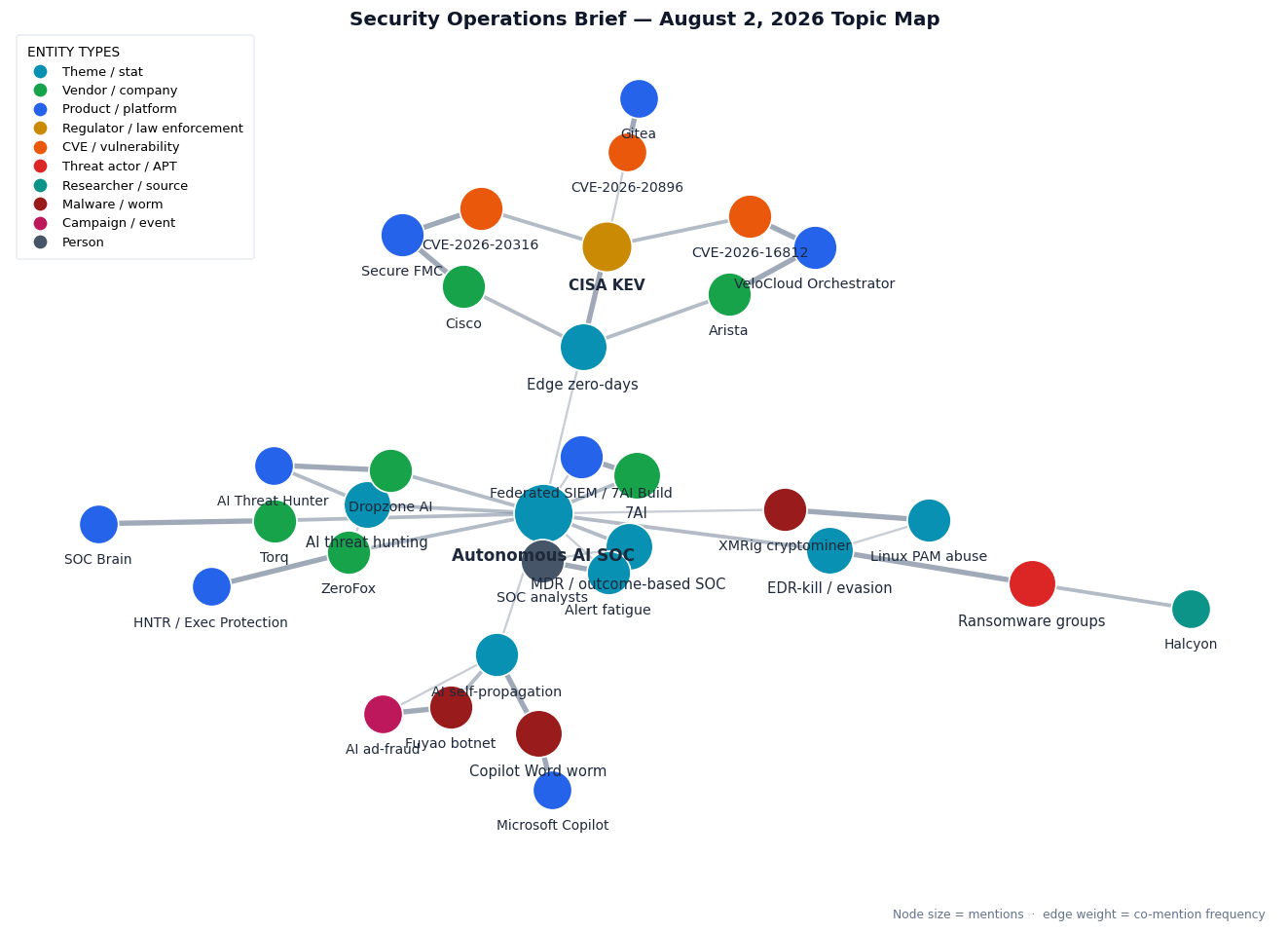
This week’s topic map — the autonomous AI SOC platform wave (7AI’s Federated SIEM, ZeroFox HNTR, Torq’s SOC Brain, Dropzone’s AI Threat Hunter), two actively exploited edge zero-days added to CISA’s KEV catalog (Arista VeloCloud CVE-2026-16812 and Cisco Secure FMC CVE-2026-20316), attackers turning on the SOC’s own defenses (ransomware EDR-kill and a Linux PAM-hiding cryptominer), AI weaponized as a document-borne Copilot Word worm and the AI-built Fuyao ad-fraud botnet, the foundational thread on MDR, the outcome-based SOC and the human analysts behind the automation, and the Gitea flaw (CVE-2026-20896) on the exposure watch.
View interactive topic map →
Article index
Weekly News
The autonomous SOC platform wave
Four launches in one week move the “autonomous SOC” from pitch to product — AI-native SIEM and workflow building, AI-driven external threat detection, self-learning investigations, and threat hunting recast as a routine, always-on operation.
Actively exploited at the edge
Two zero-days already under attack land on CISA’s KEV list in the same week — both in internet-facing management planes, the recurring soft spot where intrusions start.
Turning the SOC’s own defenses against it
Adversaries target the instrumentation first — ransomware crews killing EDR before they encrypt, and a cryptominer abusing Linux PAM to hide from the very analysts and forensic tooling meant to catch it.
AI as the attacker’s tool
Generative AI moves from defensive talking point to offensive capability — the first document-borne AI worm riding Microsoft Word, and an ad-fraud botnet built on AI-generated sites and device spoofing.
Foundational Reading
The AI-augmented SOC: alerts, outcomes, and the human
What actually changes for the people in the SOC when AI handles more of the queue — the MDR renewal calculus, why more alerts make teams slower, and the judgment problem automation can’t retire.
Exposure watch
The standing reminder that developer infrastructure is part of the SOC’s attack surface — a critical, actively exploited flaw in a widely self-hosted Git service.
Detailed write-ups
1. The autonomous SOC ships: 7AI, ZeroFox, Torq, and Dropzone push AI through the whole loop
Help Net Security · July 27–30, 2026
Four launches in a single week moved the autonomous SOC from a category pitch into shipping product, and each attacked a different part of the detection-to-response loop. 7AI expanded its AI-native platform with a Federated SIEM and 7AI Build — the SIEM aggregating telemetry for agent-driven analysis, and Build giving teams a way to compose their own agentic workflows rather than depending on vendor-shipped playbooks. ZeroFox unveiled HNTR alongside an Executive Protection module, aiming AI-driven detection at the external attack surface — impersonation, exposure, and the threats that target named individuals rather than infrastructure. Torq gave its AI SOC a “SOC Brain” designed to make investigations continuously self-learning, so the system refines how it triages and correlates over time instead of running a static, hand-tuned script. And Dropzone AI moved its AI Threat Hunter to general availability, reframing threat hunting — historically an occasional, expertise-bound exercise — as a routine operation an agent runs continuously in the background.
The common thread is where the value is migrating: away from the alert console and toward how much of the investigate-hunt-respond work an agent can carry without a human, and how legibly it explains itself when it does. For a SOC leader evaluating any of these, the questions rhyme across the four: can the agent show why it closed, escalated, or hunted down a given lead; does its behavior hold up against your environment rather than the demo; and does the self-learning loop stay auditable as it drifts from its initial tuning? The category is clearly maturing — but maturity is exactly when buyers should press hardest on explainability and containment, because an autonomous system that acts confidently and opaquely multiplies the blast radius of a wrong call rather than the volume of correct ones.
Sources: Help Net Security (7AI Federated SIEM / 7AI Build) · Help Net Security (ZeroFox HNTR) · Help Net Security (Torq SOC Brain) · Help Net Security (Dropzone AI Threat Hunter)
2. Two edge zero-days hit the KEV list — and a Gitea flaw keeps the exposure grind going
BleepingComputer · Help Net Security · SecurityWeek · July 7–30, 2026
The week’s vulnerability story landed where intrusions so often start: the internet-facing management plane. Arista shipped an emergency patch for a VeloCloud Orchestrator flaw (CVE-2026-16812) that attackers were already exploiting in the wild, and the bug went onto CISA’s Known Exploited Vulnerabilities catalog. Days later, Cisco warned that static credentials in its Secure Firewall Management Center (CVE-2026-20316) were being exploited as a zero-day — a hardcoded-secret weakness in the very console used to administer an organization’s firewalls, and another KEV addition. Two management planes, two active exploitations, one lesson: the systems that operate a network’s defenses are themselves high-value targets, and a flaw in the orchestrator or the firewall manager hands an attacker leverage over everything downstream of it.
The operational instruction is the familiar one, sharpened by the KEV listings: treat actively exploited edge and management-plane flaws as 24-to-48-hour emergencies, not next-cycle patches. Get the VeloCloud and FMC fixes on, rotate any static or shared credentials the FMC issue implicates, and pull management interfaces off the public internet wherever they don’t need to be there. The foundational-reading companion this week makes the same point from the developer-infrastructure side: SecurityWeek reported a critical Gitea flaw (CVE-2026-20896) under active exploitation, a reminder that a widely self-hosted Git service sitting inside the software supply chain is part of the SOC’s attack surface too — and that “patch the exploited thing first” applies to the code-hosting stack as much as to the network edge.
Sources: BleepingComputer (Arista VeloCloud CVE-2026-16812) · Help Net Security (Cisco FMC CVE-2026-20316) · SecurityWeek (Gitea CVE-2026-20896)
3. Attackers go after the SOC’s instrumentation: EDR-kill ransomware and a PAM-hiding cryptominer
Infosecurity Magazine · July 27–30, 2026
Two reports this week described the same tactical shift from different corners of the threat landscape: adversaries are treating the SOC’s own visibility as the first thing to disable. Halcyon’s Q2 2026 data showed ransomware groups increasingly deploying EDR-kill techniques — using vulnerable drivers, tampering, and process termination to blind or unhook endpoint detection before they move to encryption, so the tooling that should raise the alarm is already dead when the payload fires. In parallel, researchers detailed a cryptominer that abuses Linux PAM (the pluggable authentication modules that sit in the auth path on virtually every Linux host) to conceal its process from analysts and forensic tooling, burrowing into a trusted subsystem precisely so that routine investigation walks right past it.
For a SOC the two stories converge on one uncomfortable design assumption: you cannot assume your telemetry survives contact with a competent adversary. The defensive responses are concrete — enable and monitor EDR tamper protection and treat agent-health gaps as incidents in their own right; watch for the known vulnerable-driver and unhooking patterns that precede EDR-kill; and, on Linux, baseline and monitor PAM configuration and module integrity so a malicious module or a hidden process stands out against a known-good state. Above all, this is the case for defense that does not live entirely on the endpoint: on-the-wire and behavioral detection, plus tamper-evident logging shipped off-host, are what still see the attack after the local agent has been silenced.
Sources: Infosecurity Magazine (ransomware EDR-kill, Halcyon Q2 2026) · Infosecurity Magazine (Linux PAM cryptominer)
4. AI as the attacker’s tool: the first document-borne AI worm and an AI-built ad-fraud botnet
CSO Online · Help Net Security · July 30–31, 2026
The week produced a genuine first and a scale story, both showing generative AI already operating on the offensive side. CSO Online reported a Copilot worm that can spread through Microsoft Word documents — the first document-borne AI worm to demonstrate self-propagation. The mechanism turns a productivity assistant into a carrier: a crafted document embeds a malicious prompt that, when Copilot processes the file, causes the assistant to act and to re-emit the payload into new documents, letting the infection travel from person to person on the back of ordinary file sharing rather than a traditional executable. It is a preview of a threat class the SOC has not had to model before — malicious content that targets the AI assistant’s context window instead of the operating system, and propagates through the trust users place in their own tools.
The Fuyao botnet is the industrial-scale counterpart. It leans on AI-generated websites and device spoofing to run ad fraud at volume, using machine-produced content and forged device identities to defeat the fingerprinting and reputation checks that fraud detection relies on. Together the two stories retire the idea of AI-enabled attacks as a future concern: one weaponizes an assistant users trust, the other automates the mass production of convincing fakery. For detection engineering the implication is that content and identities generated by machines — faster and more plausibly than any human review can keep pace with — now belong in the threat model, and that AI-assistant activity itself is telemetry the SOC needs to be able to see.
Sources: CSO Online (Copilot Word worm) · Help Net Security (Fuyao ad-fraud botnet)
5. Foundational: the AI-augmented SOC and the human still in the loop
Help Net Security · CSO Online · July 15–20, 2026
This week’s foundational reading turns from what the vendors shipped to what it actually changes for the people running the SOC. Help Net Security framed the MDR renewal decision around a pointed question — what is a managed-detection contract worth once AI can handle much of the alert triage itself — and, in a companion piece, made the operational case that simply generating more alerts makes a team slower, not safer, with an outcome-based SOC (measured on resolved risk rather than alert volume) as the corrective. The two arguments are really one: automation only helps if it is pointed at the right target, which is the outcome the SOC is trying to produce, not the count of events it can surface.
CSO Online supplied the human counterweight. As AI accelerates both the flow of alerts and the speed of threats, the SOC’s hardest problem stays a human one — the judgment to know which machine verdicts to trust, when to escalate, and how to keep analysts engaged and skilled rather than reduced to rubber-stamping an agent’s output. Read against the four autonomous-SOC launches at the top of this issue, the foundational thread is the necessary corrective: the value of AI in the SOC is real, but it is realized only when the automation is aimed at outcomes and the humans are positioned to supervise it rather than be sidelined by it. The tooling changes the shape of the work; it does not remove the need for someone accountable for the call.
Sources: Help Net Security (MDR renewal question) · Help Net Security (outcome-based SOC) · CSO Online (the human challenge)
On our watch list
- Whether the autonomous SOC can show its work. With 7AI, ZeroFox, Torq, and Dropzone all shipping agent-driven investigation and hunting, watching whether buyers get real explainability and containment — or whether self-learning systems drift into confident, opaque decisions that multiply the blast radius of a wrong call.
- Edge and management-plane zero-days as the standing emergency. The Arista VeloCloud (CVE-2026-16812) and Cisco FMC (CVE-2026-20316) KEV additions say it again: patch actively exploited management-plane flaws in 24–48 hours, rotate static credentials, and get admin interfaces off the public internet.
- Telemetry that survives a killed agent. With ransomware crews leaning harder on EDR-kill, watching whether teams treat tamper protection, agent-health gaps, and off-host tamper-evident logging as first-class controls — because endpoint-only detection is exactly what these techniques are built to defeat.
- Attacks that hide inside trusted subsystems. The Linux PAM-abusing cryptominer is a prompt to baseline and monitor PAM configuration and module integrity, and to assume adversaries will burrow into the auth path and other trusted components precisely to walk past routine forensics.
- The AI worm as a new threat class. The document-borne Copilot worm targets the assistant’s context window, not the OS — watching whether detection engineering and DLP start treating AI-assistant activity and prompt content as telemetry, and how Microsoft and others harden Copilot against prompt-carrying documents.
- AI-generated fraud at scale. Fuyao’s use of AI-built sites and device spoofing signals that machine-produced content and forged identities will keep outrunning fingerprinting and reputation checks; watching how fraud and detection teams adapt when the fakery is generated faster than it can be reviewed.
- Outcome-based SOC vs. alert volume. As AI takes on more triage, watching whether teams re-anchor MDR renewals and internal metrics on resolved risk rather than alert counts — and keep analysts positioned to supervise the automation instead of being sidelined by it.
|