This week at a glance
The incumbents competed on distribution this week. At its networking investor day, HPE raised FY2027 growth guidance to the high teens to low 20s and lifted its Juniper merger savings target from $450 million to $800 million a year. It also set November 1 as “Partner Day One,” when all 60,000 HPE partners can sell the full Aruba and Juniper portfolio through one programme. Before the deal only about 10% of those partners overlapped, so the cross-sell opportunity is large and, by Rami Rahim’s own account, “still very low right now.” Extreme Networks answered in CRN with its fourth strategy interview in seven weeks. This time the pitch is that its rivals offer a chatbot in the corner, while Extreme’s Agent ONE Coworker runs inside the platform all the time. Extreme says it expects more than half its customers on Platform ONE by year-end, up from 10%.
The specialists responded on safety. Forward Networks made Forward Predict generally available and headlined it as the safety layer for “Agentic NetOps,” the category’s own name, with the line “know before you act.” The proof point is a financial-services customer, IG Group, which cut firewall change delivery time by about 95%. Zeus Kerravala made the same argument in Network World the day before: an unverified agent change “fails at machine speed.” Gluware moved into connected medical devices, and Auvik agreed to embed its network management inside Acronis’s MSP tooling. Both are bets that network automation sells better as part of a broader operations platform than as a separate tool.
The buyer data points the same way. Omdia’s Scott Sinclair says AI-powered operations has become a “must-have” buying criterion. 36% of organisations now require integrated AI in infrastructure purchases, and 52% of early adopters had a bad first experience that made them more cautious. An Arelion survey of 518 enterprise network decision-makers found that only 15% are fully confident their provider can quickly detect and fix a serious problem, and 72% would pay a 6–20% premium for one they could trust. Open Systems turned that caution into packaging: buyers can run its platform themselves, run it with AI under human approval, or have Open Systems run it, and they can switch between the three without migrating. Across this week’s vendor and operator interviews, everyone stops short of full autonomy. The commercial question has become who sets the limits on autonomy, who verifies the agent’s changes, and who is accountable when they go wrong.
On our watch list
- HPE’s Partner Day One, November 1. All 60,000 HPE partners can sell the combined Aruba and Juniper portfolio through HPE Partner Ready Vantage from that date, and integrated quoting and ordering launches the same month. The test is whether HPE reports a rising cross-sell win rate on its next earnings call, and whether competitors keep describing the HPE–Juniper channel as disrupted after the programmes merge.
- Extreme’s “operator mode” reveal at its October AI summit. In August Meyercord promised a more autonomous agent with full observability, auditability and guardrails. It will be the first incumbent to name a specific level of autonomy. Watch which actions it is allowed to take without approval.
- Whether Extreme reaches 50% of customers on Platform ONE by year-end. The claim is 10% at the end of last year. A disclosed figure on the next earnings call, plus a named competitive takeout from Cisco or HPE, would turn a CRN talking point into evidence of share gains.
- A second named Forward Predict customer outside financial services. IG Group’s roughly 95% reduction in firewall change delivery time is the only named result, and the $14.2 million average annual benefit comes from a Forward-commissioned IDC study. A reference in healthcare, energy or manufacturing would show whether pre-change verification sells beyond regulated finance.
- Whether “Agentic NetOps” becomes a shared category label. Forward used the term in its headline this week, Selector has a platform built around it, and Gartner already publishes a Market Guide for Agentic NetOps Software. Count how many competitors adopt the term in the next quarter’s launches.
- How many buyers pick Open Systems’ middle tier. Its AIOps model (AI proposes, a human approves, AI acts) is still rolling out next to the fully managed Mission Control. Any adoption split it publishes would be the first public data on how much autonomy buyers will pay for.
- Auvik inside Acronis RMM, January 2027. The OEM integration reaches Acronis’s 21,000-plus service providers. Watch the attach rate and whether other RMM or ITSM platforms sign similar network-management OEM deals.
- Gluware’s second hospital system. IoMT Exposure Management was built with Ohio State’s Wexner Medical Center. A second named health system, or a reseller deal with a medical-device security vendor, would show whether expanding beyond the network wins new budget or stays a feature.
- Network to Code’s first quarter under a new CRO. Chris Millerick comes from Infoblox partner sales, and the company reports 52% recurring-revenue growth on Nautobot’s commercial bundles. Watch for channel or cloud-marketplace deals that shift the open-source challenger toward the enterprise buyer.
- Whether Omdia’s 52% bad-first-experience figure shows up in buyer behaviour. If early adopters’ negative experiences slow purchasing, expect more RFPs to demand rollback, audit trails and staged autonomy. That would favour vendors who already lead with verification and governance.
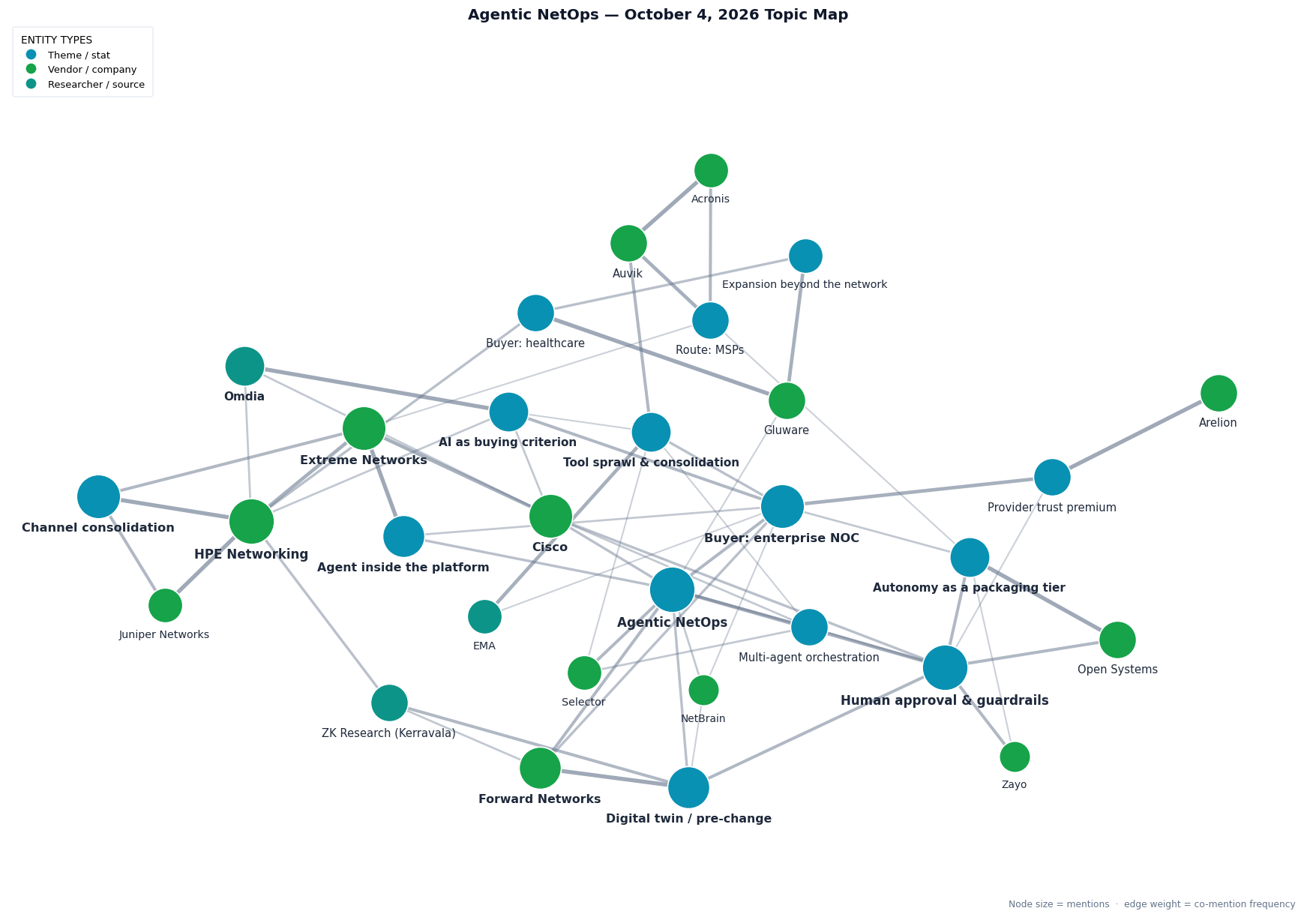
Entities and connections across this week’s 25 tracked stories. Node size reflects how often an entity appears; line weight reflects how often two appear together.
View interactive topic map →
Article index
Competitive moves: platform incumbents
The large vendors spent the week on scale and integration. HPE raised its networking targets and set the date for merging its partner programmes. Extreme argued that an agent built into the platform beats a chatbot added to the console. Analyst commentary on Cisco restated its own survey, in which more than four in five buyers expect an AI-led network operating model within a year, and added that expecting it is not the same as being ready for it. NETSCOUT added a conversational layer over its own network data.
Competitive moves: specialists, challengers and money
The specialists positioned on safety and on moving into adjacent markets. Forward Networks made pre-change verification generally available and pitched it as the safety layer for agents. Futuriom’s analysis frames Selector’s Foundry as a deterministic agent platform tied into ServiceNow, PagerDuty and Jira. Gluware took its automation into hospital medical devices. Network to Code hired a partner-sales CRO from Infoblox. Andreessen Horowitz led a $38 million Series A for doxx.net, a startup whose private network is run by AI agents. NetBrain’s Forrester Total Economic Impact study landed the same week.
Routes to market: channel, MSP and managed operations
Three different routes to the buyer. HPE is merging two partner bases that rarely overlapped. Auvik is embedding its network management in an MSP platform used by more than 21,000 service providers instead of selling it separately. Open Systems now sells one platform under three operating models (run it yourself, run it with AI, or have Open Systems run it), so the level of autonomy becomes a contract choice.
Buyer adoption and demand signal
Buyers are making AI operations a purchase requirement while staying cautious about it. Omdia says integrated AI has become a “must-have” criterion in infrastructure buying, and also that half of early adopters had a bad first experience. Arelion’s survey, commissioned by a carrier, finds enterprise buyers trust their providers in principle but rarely trust them to fix a serious problem quickly, and would pay more for one they could. Saudi German Health UAE is a named healthcare rollout of HPE’s AI-driven network operations across several hospitals.
The NOC operating model
Six views on how far agents should go, and every one keeps a human in the loop. Zayo’s agents propose changes and wait for confirmation. Verizon separates automation (scripting what is known) from autonomy (reasoning about what is not), and keeps humans in charge of the most serious incidents. ThousandEyes argues AI should extend what an engineer can handle rather than replace the engineer. Virtasant finds only 15% of organisations have scaled multi-agent orchestration. A Cisco blog sets out a six-level maturity model from manual to fully autonomous. An AWS piece argues for an agent layer that reasons across existing tools without consolidating them first.
| Article |
Source |
Published |
| 17. Can AI Run Your Network Without Taking Control Away? |
UC Today |
Sep 29, 2026 |
| 18. “Where the agentic world kicks in” – Verizon draws the line, marks the difference |
RCR Wireless News |
Oct 1, 2026 |
| 19. Assurance: Scaling Human Decision-Making with AI-Assisted Operations (foundational, Cisco-authored) |
Cisco ThousandEyes Blog |
Sep 30, 2026 |
| 20. What AIG and Deutsche Telekom Know About AI Orchestration (foundational) |
Virtasant |
Sep 30, 2026 |
| 21. Beyond Operational Obsolescence: The New Paradigm of IT Management in the AI Era (foundational, Cisco-authored) |
Cisco Blogs |
Sep 30, 2026 |
| 22. From Data Silos to Agentic Ops with Amazon Bedrock AgentCore (foundational, AWS community) |
AWS Builder Center |
Oct 1, 2026 |
Market sizing and analyst view
No analyst firm published new NetOps software sizing this week. Three framing pieces landed instead. EMA’s research found 75% of enterprise IT teams running up to 12 observability tools and none reaching a single view. Zeus Kerravala argues the network digital twin is what makes agent changes safe; his piece draws on Forward Networks material and says so. TM Forum’s CTO argues that fragmented estates left by mergers are what keep closed-loop automation stuck in pilots.
Detailed write-ups
1. HPE raises its networking targets and sets a date to merge two channels
SiliconANGLE · CRN · September 30, 2026
HPE used its first networking investor day since closing the Juniper deal to argue that the merger is ahead of plan. According to Zeus Kerravala’s analysis for SiliconANGLE, the combined networking business is projected to grow from $9.3 billion in revenue in FY2024 to $11.3 billion in FY2026, with operating profit up from $1.6 billion to $2.5 billion. FY2027 revenue growth guidance rises to the high teens to low 20s percent, from 14–17%, with mid- to high-20s operating margins targeted through FY2029. Merger cost savings now run to $800 million a year by the end of FY2028, up from the original $450 million. Rami Rahim, who runs HPE Networking, told analysts: “Quite frankly, we, including me, underestimated how explosive market growth is.” These are guidance and targets, not reported results.
The more important date for competitors is November 1, 2026, which HPE calls “Partner Day One.” On that day the Aruba and Juniper partner programmes merge into one, HPE Partner Ready Vantage, and all 60,000 HPE partners can sell the whole networking portfolio. Before the acquisition, Rahim said, only about 10% of Aruba and Juniper partners sold both, and the cross-sell win rate is “still very low right now and it is only going to go up.” HPE’s server and storage sellers have also been trained to sell networking. Integrated quoting and ordering start in November, but supply-chain processes will not be unified until the end of 2027.
This affects every vendor that sells through the same partners. For the next few quarters HPE’s channel will be dealing with a programme migration, new systems and two partner bases learning each other’s products. That is the disruption Extreme says it is exploiting. Once the migration settles, the result is a single channel that is much larger than either Aruba’s or Juniper’s was. HPE also has an operations story to sell through it, since its “self-driving network” positioning is already showing up in deals such as this week’s Saudi German Health UAE rollout.
Sources: SiliconANGLE (Five takeaways from HPE’s Networking Investor Day) · CRN (HPE Networking Chief Rahim: ‘Partner Day One’ Creates Major Cross-Selling Opportunity For Partners) · HPE Newsroom (Saudi German Health UAE transforms digital healthcare in the UAE with the HPE Self-Driving Network)
2. Extreme pitches an agent built into the platform against Cisco’s and HPE’s chatbots
CRN · September 29, 2026
Extreme Networks CEO Ed Meyercord made a narrower and sharper argument in his latest CRN interview. Larger rivals, he says, offer “chatbot-style” AI added to their management consoles, “an AI prompt in the corner” that waits to be asked. Extreme’s Agent ONE Coworker, generally available since September 9, runs inside Platform ONE, watches the environment and offers to do the work. “We’re the first networking vendor that has a proactive, context-aware, always-on agent that is built into the platform,” he said.
The numbers he uses are about adoption. About 10% of Extreme customers were on Platform ONE at the end of last year, and Extreme expects more than 50% by the end of this one. Meyercord says the migration is going faster than the company’s earlier move to cloud management: “what took us three years with cloud is taking us less than a year.” Partners are central to the pitch. Andrew Beynon, chief enterprise architect at the MSP ARO, says Extreme’s focus on networking alone lets it move faster than diversified rivals and is producing new services and recurring revenue for partners. In August Meyercord also promised an “operator mode” at an October AI summit: a more autonomous agent with full observability, auditability and guardrails.
Two cautions. This is the fourth Extreme strategy interview in CRN in about seven weeks, and every adoption and share figure in it is Extreme’s own. Even so, the positioning matters. Extreme is defining the competition as a proactive agent that is always running versus an assistant that answers questions. That framing favours vendors whose agents already understand the network’s context, and it gives buyers a simple question to ask of every rival’s product. Next month’s operator mode will show how much autonomy a challenger is willing to commit to in public.
Sources: CRN (Extreme Networks’ Agentic AI Push Is Fueling Gains Against Cisco, HPE)
3. Forward Networks makes “know before you act” its safety pitch for agents
PR Newswire · Network World · September 28–29, 2026
Forward Networks made Forward Predict generally available. It checks a proposed network change against Forward’s digital twin before the change is made. The headline matters as much as the product: Forward described the launch as “Advancing Safer Agentic NetOps,” and co-founder and Chief AI Officer Nikhil Handigol said, “Know before you act is more than a tagline, it’s the operating model Agentic NetOps requires.” Forward is presenting change verification as the precondition for letting agents act on the network.
The evidence comes from regulated industries. Beta customers were in financial services, media and technology. IG Group cut firewall change delivery time by about 95%, and one unnamed global customer expects $3 million in annual benefits. Forward also cites an IDC study, which it commissioned, putting the average customer’s benefit at $14.2 million a year. The release adds nine devices from six vendors, including Cisco and Check Point firewall management, plus models of Zscaler ZPA and IBM Cloud. That is a push for multi-vendor coverage, aimed at the estates that large enterprises actually run.
Zeus Kerravala made the same case in Network World a day earlier: “An agent making an unverified change doesn’t fail differently than a human making the same mistake; it fails at machine speed, and potentially across many changes running in parallel.” He cites Gartner’s estimate that unplanned network outages cost more than $500,000 an hour. His piece draws on Forward’s own digital-twin guide and says so. The takeaway for the market is that “Agentic NetOps” is becoming shared vocabulary, and the specialists are competing on who can prove an agent’s change is safe before it runs. Buyers will start asking every vendor in the category to show the same proof.
Sources: PR Newswire (Forward Predict is Now Generally Available, Advancing Safer Agentic NetOps and Autonomous Networking) · Network World (Why a network digital twin is the missing piece for AI-era operations)
4. Omdia: AI operations is now a buying criterion, and early adopters are wary
TechTarget · Efficiently Connected · October 1–2, 2026
Scott Sinclair, practice director at Omdia, put the demand shift plainly: “AI-powered operational capabilities and controls have become ‘must-have’ buying criteria in infrastructure purchases.” In Omdia’s research, 80% of organisations are modernising infrastructure to speed up AI adoption, 44% look for integrated AI capabilities in new infrastructure, and 36% treat integrated AI as a requirement. 90% of practitioners say AI for IT operations frees them for more strategic work.
The same research shows the risk. 52% of early AI adopters had negative initial outcomes that made them more cautious. Sinclair lists HPE, Cisco, Dell, IBM, Lenovo, NetApp, Hitachi Vantara and Everpure as offering agentic capabilities in their infrastructure, with ServiceNow and Red Hat supplying agentic IT operations tools, and notes that HPE GreenLake Intelligence uses an open agent protocol for interoperability. ECI Research’s note on Cisco makes the same point from the network side. Cisco’s own survey says more than four in five enterprises expect an AI-led network operating model within twelve months, and nearly a quarter are comfortable with fully autonomous operations. ECI’s comment is that “saying you expect AI-led operations within 12 months does not mean your infrastructure, governance, or tooling is positioned to support it.”
These figures cover infrastructure broadly, not network operations software alone, so treat them as a direction rather than a size. The direction is clear, though. Hardware incumbents are building operations AI into their products, which makes “it comes with the switch” the default offer. A vendor selling across multiple vendors’ equipment has to show that its operations layer delivers more than the bundled one, and that it avoids the bad first experience half of early adopters report.
Sources: TechTarget (AgenticOps becomes a priority in IT infrastructure purchases) · Efficiently Connected (Cisco AI Security Strategy: Palantir, Talos & AgenticOps)
5. Buyers trust their network providers in principle but rarely trust them to fix things fast
PR Newswire · September 28, 2026
Arelion commissioned Savanta to survey 518 senior enterprise network decision-makers at organisations with 2,000 or more employees in the US, UK, Germany and France. 93% say they trust their current network provider. Only 15% are completely confident it can quickly detect and resolve a serious network issue, and 42% say it falls short of expectations several times a year or more. The consequences are concrete: 58% have delayed, scaled back or added safeguards to strategic initiatives because of concerns about their provider, and 49% have seen disruption to AI and data projects.
The pricing findings are what make this a market story. 65% say trust is the dominant factor in pricing decisions, 98% would pay more for a provider that can prove it is trustworthy, and 72% would pay a premium of 6–20%. 85% expect trust to matter more within three years. “Trust is no longer a soft metric,” said Mattias Fridström, Arelion’s chief evangelist. “It influences which strategic initiatives move forward, how organizations manage risk, and provider selection.”
This is a connectivity provider’s own survey, and its findings support its own pitch. Still, the gap it measures (high stated trust, low confidence in detection and repair) is the gap that network assurance and automation products sell into. Buyers in this survey say they will pay a premium for proof that problems are found and fixed quickly. That supports pricing operations software on measured detection and resolution outcomes rather than on features.
Sources: PR Newswire (New report: Trust in network providers is holding back AI and digital transformation initiatives)
6. Open Systems sells autonomy as a contract tier, and operators keep a human approving changes
EIN Presswire via azcentral · UC Today · September 29 – October 1, 2026
Open Systems, a Zurich-based secure networking provider, rebuilt its commercial model this week around a single question: who does the work. Customers get one platform and choose one of three operating models. In Self-serve, the customer runs it. In AIOps, AI runs it alongside the customer under a “propose, approve, act” loop with a human approving. In Mission Control, Open Systems runs it around the clock with senior engineers. Customers can move between the three without changing platform or provider. Mission Control is live, and the other two are rolling out. “SASE spent years becoming a product category. Now it has to become an operating model,” said CEO Dennis Monner. CTO Markus Ehrenmann was more direct: “The goal is not maximum autonomy … autonomy has to be earned. Guardrails first, autonomy second.”
Zayo took the same position in an interview with UC Today. Max Clauson, its SVP of network connectivity, said, “The agents will propose a change, but then would need confirmation before moving forward with taking any action on the network itself.” Zayo starts with low-risk work such as reporting and alert correlation, and Clauson admits the business case beyond speed “remains unproven.”
The packaging is what is new. Open Systems has turned the level of autonomy into something a buyer chooses and can change, rather than a product roadmap. The likely result is that buyers start specifying autonomy in procurement: which actions run unattended, who approves the rest, and who is accountable when something goes wrong. Vendors that can describe their offer in those terms will be easier to buy from than those selling a feature list. The release went out as a paid wire, so read it as Open Systems’ own positioning.
Sources: EIN Presswire via azcentral (The SASE Feature Race Is Over. The AI Operations Race Has Begun.) · UC Today (Can AI Run Your Network Without Taking Control Away?)
7. Gluware moves beyond the network into hospital medical devices
PR Newswire · September 30, 2026
Gluware launched IoMT Exposure Management, which applies its network-automation workflows to connected medical devices such as infusion pumps and patient monitors. The product matches published vulnerabilities to affected devices, finds the applicable patches and makes the changes within a hospital’s existing approval process. It integrates with Claroty’s device inventory and Microsoft’s update catalogue. The Ohio State University Wexner Medical Center worked with Gluware on development.
Gluware’s argument is about budget and headcount: “Hospitals shouldn’t have to stand up a separate platform and separate team to protect devices closest to patient care,” said CEO and co-founder Jeff Gray. The release cites an average of 6.2 known vulnerabilities per connected medical device and an average healthcare breach cost of $7.42 million.
A network-automation specialist is using its change engine to reach a different buyer (clinical engineering and medical-device security) in a vertical where network automation already sells. If it works, Gluware’s per-account revenue grows without competing for the core network budget. It also suggests the specialists see their workflow and approval engines, not only network knowledge, as the asset they can sell into adjacent markets. Healthcare buyers may soon expect their network-automation vendor to cover the devices on the network as well.
Sources: PR Newswire (Gluware Extends Its Automation Platform Beyond the Network to Connected Medical Devices)
8. Auvik embeds network management in MSP tooling as buyers try to cut tool sprawl
Channel Insider · CIO Dive · September 18–30, 2026
Auvik and Acronis signed an OEM agreement to build Auvik’s network management into Acronis’s remote monitoring and management (RMM) platform, with launch expected in January 2027. The reach is large. Acronis says more than 21,000 service providers use its platform to protect more than 750,000 businesses, and Auvik manages one million network devices across more than 100,000 networks. MSPs that do not offer network monitoring today will be able to add it without deploying a separate product. “Tool sprawl is one of the most persistent pain points we hear about across IT operations,” said Auvik president Mark Ralls.
Enterprise research shows the same problem. In EMA’s survey of 356 enterprise IT professionals, reported by CIO Dive, 75% run up to 12 observability tools across cloud, network and services. 62% call consolidation “very important,” yet none has reached a single unified view, and only 32% apply AI extensively to observability. “AI can help, but it also adds a level of complexity,” said EMA research director Parker Hathcock.
Auvik sells mainly to smaller firms and MSPs, so the deal is not a direct Fortune 500 move. It does show where standalone network management is heading: it is being built into broader operations platforms that already own the console. For enterprise vendors, the counterpart risk is that network intelligence gets absorbed into an observability or service-management platform the buyer has already chosen. The defence is to be the network data source those platforms connect to, rather than one more tool to consolidate away.
Sources: Channel Insider (Auvik, Acronis Bring Network Management Into RMM) · CIO Dive (IT orgs grapple with observability tool sprawl)
Calls to action
- Identify which shared partners are most exposed to HPE’s November 1 programme merger. HPE’s 60,000 partners will be migrating programmes and systems this quarter. List the top partners who sell HPE, Aruba or Juniper alongside you, and offer them simpler terms and joint pipeline before the merged programme settles.
- Write your answer to “chatbot in the corner versus an agent built into the platform.” Extreme is setting this as the question buyers ask, and Cisco and HPE bundle operations AI with their hardware. Prepare a one-page answer that shows your agent works in context across multiple vendors’ equipment, with a named customer result.
- Prepare a pre-change verification answer for current deals. Forward is selling “know before you act” under the Agentic NetOps label, backed by a 95% reference from IG Group. Make sure sales teams can show how your agents verify and roll back changes, backed by a named customer.
- Offer autonomy in tiers in proposals. Open Systems sells three operating models, and Zayo and Verizon both keep a human approving changes. Package an advisory tier, a human-approved tier and a pre-authorised tier with the actions allowed in each, so buyers can start cautiously without picking a different vendor.
- Put Omdia’s 52% figure into your business case. Half of early AI adopters had a bad first experience. Lead with a staged rollout, an audit trail and measured detection-and-resolution results, and price against Arelion’s finding that 72% of buyers would pay a 6–20% premium for proven reliability.
- Check that you are the network source for buyers’ observability and service-management platforms. The EMA tool-sprawl figures and Auvik’s embedding deal both point to consolidation. Confirm your integrations with the platforms buyers are consolidating onto, so your product is the network data they draw on rather than one of the tools they remove.
|