This week at a glance
The big platforms spent the week arguing that you do not need a separate “AI SOC” product: the agents should live in the SIEM and endpoint tools you already run. Elastic previewed AlertZero, agents for triage, investigation, hunting, detection tuning and forensics that can call whichever model the customer prefers. Its general manager says the goal is for analysts to supervise agents “on the loop” rather than sit in it. Stellar Cyber 7.0 lets teams switch AI triage on queue by queue and adds case metrics for time to acknowledge and time to resolve. Tanium relaunched its security operations product around per-endpoint behaviour baselines and a plain-language hunting assistant. All of them now sit under Gartner’s new Integrated SOC (ISOC) category, which Microsoft adopted for Defender last month. None of the launches published customer outcome data.
The more useful material this week is about method. Fraunhofer FKIE tested five risk-based alerting hypotheses across eight datasets. Combined scoring reached 0.92, against 0.72 for plain severity, but scoring alerts by rarity was no better than chance. Elastic published how it grades 1,781 of its own detection rules on noise, speed and threat coverage. Only 21.6% of the rules earn the “Recommended” tag. On agents, Hack The Box now scores both the agent and the human supervising it against defined SOC roles. SentinelOne argues that evaluation suites have to come before the agent is built: “unmeasurable capability is unshippable capability.” Two Splunk posts from the .conf26 event SOC show the same discipline in practice: an AI triage label is where an investigation starts, and the packets decide how it ends.
Triage pressure is building on the vulnerability side too. Google paused part of its bug bounty after a surge of mostly invalid automated reports, and an IDC analyst warns that submitted reports could carry prompt injections aimed at AI triage tools. An ArmorCode-sponsored survey sets out a three-way split: automation for deterministic work, agents for reachability and exploitability analysis, and people for risk acceptance. Meanwhile the patch queue did not wait. Cisco fixed five critical Nexus NX-OS flaws and four Smart Licensing bugs rated up to 10.0, and Citrix fixed a NetScaler RCE in SAML configurations. Microsoft’s September release set a record of 973 CVEs, and Pwn2Own Ireland paid $1.26M for 98 zero-days. On phishing, Hoxhunt automated report handling, and a CSO contributor makes the case for hunting attacker servers rather than blocking their domains.
On our watch list
- October Patch Tuesday after a 973-CVE September. Ivanti’s forecast expects a high but smaller release next week, alongside final updates for Windows 11 24H2 Home and Pro and the end of Exchange 2016/2019 extended support. Also watch whether Microsoft resumes KB5002907, the update it paused after reports that it removed Office 2016 and 2019.
- First exploitation of the NetScaler SAML flaw. Citrix says CVE-2026-107406 has not been exploited, but this year’s March and September NetScaler bugs were exploited soon after disclosure, and Shadowserver counts about 21,000 exposed NetScaler fingerprints. A KEV listing would confirm the pattern.
- Pwn2Own Ireland’s 90-day clock. 98 zero-days, including chains against the Pixel 10, Galaxy S26, OpenAI Codex and Oracle’s Autonomous AI Database, are now with vendors. Advisories should land between now and early January. Expect a long tail of mobile and AI-platform patches.
- AlertZero moving from preview to general availability. Elastic has given no date, pricing or performance figures. The proof point is a customer reporting alert burndown and analyst override rates with agents running inside the existing SIEM.
- Outcome numbers from the ISOC vendors. Stellar Cyber now tracks time to acknowledge and time to resolve per case, and Microsoft’s Defender ISOC remains in preview. The first vendor to publish before-and-after case metrics from named customers will set the benchmark for the category.
- Replication of the risk-based alerting results. The Fraunhofer FKIE study found rarity and aperiodicity scoring no better than chance across eight datasets. Watch whether SIEM vendors retune risk scoring in their default content, and whether anyone tests RBA as a prefilter for LLM triage, as the lead author suggests.
- Whether other bug bounty programmes follow Google. Vercel validated only dozens of 1,285 reports in a two-week challenge. Watch for platforms requiring reproducible evidence, rate-limiting submitters, or filtering AI-written reports, and for the first prompt-injection attempt against an AI triage tool through a submitted report.
- Independent agent evaluation benchmarks. Hack The Box offers SOC analyst and pen-tester role scoring now, with more roles promised in the coming months. A third-party benchmark published on alert burndown, time to verdict and cost per alert, the metrics SentinelOne proposes, would give buyers a common yardstick.
- Phishing automation accuracy in the field. Hoxhunt claims 96% accuracy on malicious reports and up to 99% fewer tickets for analysts. The test is how often reversible remediation has to be reversed once customers run it at scale.
- Fallout from the CrowdSec source-code leak. The theft went unnoticed for nearly four months, until the code appeared on a forum. Watch for CrowdSec’s full post-incident timeline and for other Shai-Hulud victims tracing their compromise back to developer access left open during offboarding.
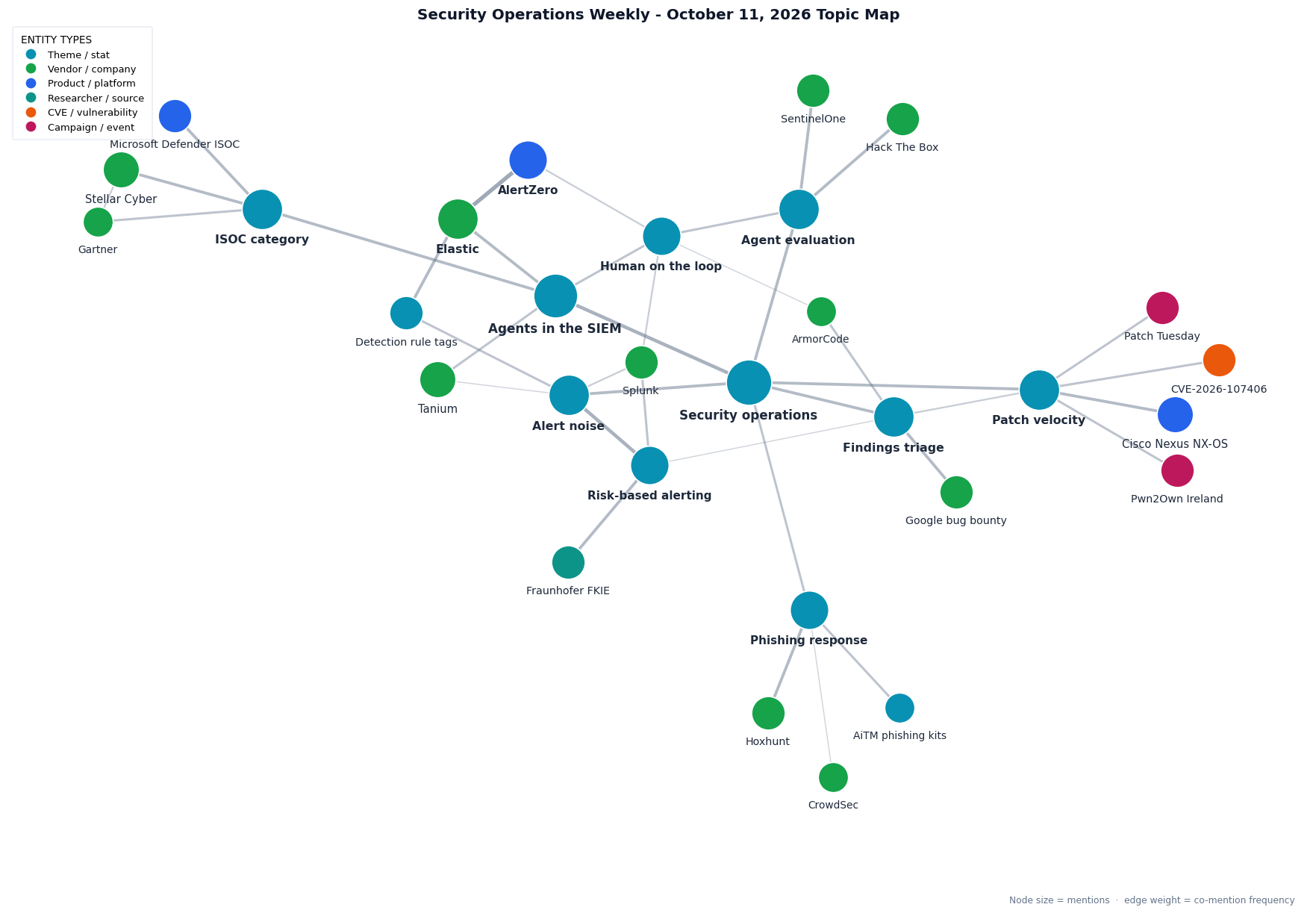
This week’s topic map: agents moving into the SIEM and the new ISOC category (Elastic AlertZero, Stellar Cyber, Microsoft Defender, Tanium), alert noise and risk-based alerting, findings triage under AI-generated report volume (Google, ArmorCode), agent evaluation (Hack The Box, SentinelOne), phishing response (Hoxhunt), and a heavy patch week (Cisco Nexus, Citrix NetScaler, Patch Tuesday, Pwn2Own).
View interactive topic map →
Article index
Agents move into the SIEM and the ISOC
Elastic, Stellar Cyber and Microsoft all argue that agents belong inside the detection platform you already run. The Stellar Cyber launch and the CSO explainer of Gartner’s ISOC category both come from Stellar Cyber (the explainer is by its CTO); the Elastic Security Labs and Microsoft rows are vendor blogs.
Alert noise, queue design and hunting
How to cut and order the queue: research on which risk-based alerting signals work, Tanium’s endpoint-behaviour relaunch (a vendor announcement), and two Splunk posts from the .conf26 event SOC on clustering Findings and checking AI triage against packets. The second Splunk post is by a Cisco solutions engineer.
Findings triage under AI pressure
More findings, arriving faster. Google’s bounty pause and an ArmorCode-sponsored survey of 200 leaders on who should handle each finding, plus two pieces on how AI has compressed the time between disclosure and exploitation.
Evaluating agents and the people who supervise them
How to test an agent before it takes a seat, and what happens to analysts once it does. Hack The Box’s release is a vendor announcement; SentinelOne’s is a vendor engineering blog; the CSO opinion is by 7AI’s CISO; the two TechTarget rows report Billington Cybersecurity Summit panels.
Phishing, identity and offboarding
Hoxhunt’s automation of reported-email handling (vendor-reported figures), a contributor’s case for hunting phishing servers rather than domains, and the CrowdSec source-code theft that began with a departing engineer’s GitHub access.
Patch and exposure week
Critical Cisco Nexus and Smart Licensing fixes, a NetScaler SAML RCE, Ivanti’s forecast for next week’s Patch Tuesday, and 98 zero-days heading to vendors from Pwn2Own Ireland.
Detailed write-ups
1. Elastic puts agents inside the SIEM, and shows how it grades its own rules
Security Boulevard · Elastic Security Labs · October 5–8, 2026
Elastic previewed AlertZero, a layer of agentic AI for its SIEM introduced at an Elastic{ON} event. The agents handle alert triage, investigation, threat hunting, detection tuning and forensic analysis. They can call whichever AI model the customer prefers, and Elastic says they run anywhere. The pitch is aimed squarely at the stand-alone “AI SOC” start-ups: teams invoke agents inside the SIEM they already run, and the agents filter alerts and put recommended actions in front of a human. “The goal now is not to have humans in that loop but rather supervising AI agents by being on the loop,” said Mike Nichols, general manager of Elastic Security. Elastic gave no pricing, release date or performance figures.
The more useful Elastic publication this week is the one about its detection content. Elastic Security Labs now scores 1,781 out-of-the-box SIEM rules each month. An automated pipeline reads 30 days of telemetry (alert volume, cluster counts, execution times) and opens a draft pull request that the team reviews before merging. Each rule gets Noise, Performance and Threat tags plus an overall Profile. Any high-noise rule is marked Aggressive, and low-severity rules can never be Recommended. In the current snapshot, 385 rules (21.6%) are Recommended, 296 (16.6%) are Aggressive and 1,100 (61.8%) carry no profile tag. An LLM may suggest threat categories, but only as a reviewed fallback, capped at five tags from an approved list. “The pipeline generates the proposal, and the team makes the call.” Elastic’s advice is to start with Recommended rules, check noise and performance before enabling Aggressive ones, and give any rule tagged Noise: Unknown two to four weeks before deciding.
Sources: Security Boulevard (Elastic Brings Agentic AI to the SIEM Platform) · Elastic Security Labs (Behind the tags: How Elastic SIEM grades 1,781 detection rules on noise, speed, and threat coverage)
2. The ISOC becomes a category: Stellar Cyber 7.0, Gartner’s definition, Microsoft Defender
Help Net Security · CSO Online · Microsoft Security Blog · September 23 – October 6, 2026
Stellar Cyber 7.0 adds AI case analysis and automated triage that teams can switch on per case queue, so the level of automation can differ by risk, customer or workflow. MSSPs can have high-priority cases triaged across customer environments before an analyst starts work. New Case Metrics track time from case creation to analyst acknowledgment and to resolution. Investigators get more sandbox evidence, network payload visibility and the original records behind correlation-based detections. New response integrations cover Microsoft Defender for Endpoint, Fortinet FortiGate and Cybereason. “The next era is about outcomes,” said CTO Aimei Wei. The release is a vendor announcement with no pricing or customer metrics.
Wei also wrote this week’s CSO explainer on Gartner’s new Integrated Security Operations Center (ISOC) category. Under it, the SIEM stays the system of record and ISOC platforms take on detection, investigation, case management and response. Gartner lists six common features: native detection and response, security data ownership, incident case management, cross-domain correlation, automation and agentic response, and an open ingestion and response fabric. Its stated drivers are cost, faster deployment and SIEM complexity. Microsoft adopted the label in September for ISOC in Microsoft Defender, now in preview, which merges SIEM and threat protection into one foundation for agents. Rob Lefferts, Microsoft’s CVP of Threat Protection, argued that “security cannot operate at AI speed when protection and operations are built as separate systems.” Bear in mind that the vendor explaining the category also sells into it.
Sources: Help Net Security (Stellar Cyber 7.0 adds measurable workflows for AI-powered SOCs) · CSO Online (What exactly is ISOC? And what does it mean for you?) · Microsoft Security Blog (Reimagining the SOC for the agentic era in Microsoft Defender)
3. Tanium bets the next breach looks like an administrator
Help Net Security · October 7, 2026
Tanium relaunched Tanium Security Operations for attacks that use legitimate admin tools and stolen credentials to blend into normal IT activity. It runs on the same real-time endpoint data Tanium’s IT management customers already collect, and it works alongside existing SIEM and EDR tools. Endpoint Drift learns normal behaviour for each machine and ranks the ones acting out of character. A new Insights Engine replaces the old process-injection detection and targets attackers hiding inside trusted processes. Responses run on the endpoint itself, from stopping one process or collecting forensic evidence to isolating a host, on one machine or the whole fleet. A federated model lets separate security teams share the platform with their own suppressions and automatic reactions.
Tanium Atlas answers plain-language hunting questions across every endpoint in seconds. It also ranks the alert queue and recommends whether to dismiss, escalate, hunt or contain each alert. A HuntIQ service puts Tanium’s hunters inside customer environments; Tanium says they built a hunt for the FalconFlank zero-day before a patch or CVE existed. “The next breach won’t look like malware. It will look like one of your own administrators,” said CTO Harman Kaur. Omdia’s Dave Gruber says it addresses “one of the most persistent gaps in enterprise SOC architectures.” This is a vendor announcement with no pricing or availability details.
Sources: Help Net Security (Tanium adds endpoint behavior detection and AI-assisted threat hunting)
4. Risk-based alerting works, but not on rarity
TechTarget · Splunk · October 2–7, 2026
A Fraunhofer FKIE study, led by Rafael Uetz, treats risk-based alerting as a continuous prioritisation problem and tests it with CATS, an open-source experimentation suite. Across eight alert datasets it tested five risk hypotheses: rule level, accumulation, variety, rarity and aperiodicity. Combined scoring averaged 0.92 out of 1.0 at ranking real attacks above noise, against 0.72 for standard severity rules and 0.50 for no prioritisation. Three signals did the work: high rule severity, high alert volume on one asset in a short window, and many alert types on one asset within an hour. Rarity and aperiodicity did no better than chance, because a rare event stops being rare once it repeats during an attack. Uetz says RBA “could act as a prefilter for LLM-based alert triage.”
Practitioners in the piece are realistic about the work involved. Splunk’s Haylee Mills reports typical alert reductions of 50–80% (about 95% in her own deployment). She suggests grouping detections by purpose and running a weekly one-hour analyst review of preproduction alerts before they go live. CGI’s Anand Sagar says the hard part is “getting the risk scoring right and making analysts trust it.” Splunk’s .conf26 event SOC makes a similar argument from the queue side. Christopher Van Der Made clustered related Findings, up to 40 per investigation, by shared entities, timing and detection logic. He kept the AI triage label separate from the final disposition, so Tier 3 received explained clusters rather than loose alerts. “Agents prepare. Humans decide. Evidence proves.”
Sources: TechTarget (Risk-based alerting slashes SOC noise — when done right) · Splunk (The Queue Is a Graph, Not a To-Do List)
5. Triage becomes the bottleneck as AI-written findings pile up
CSO Online · Help Net Security · October 6–7, 2026
Google temporarily stopped accepting certain bug bounty submissions after a surge of largely invalid automated reports. In March it had already tightened its open-source programme rules after a rise in AI-generated submissions. Vercel received 1,285 reports in a two-week challenge on its Sandbox environment; after partly automated triage, dozens were validated. IDC’s Sakshi Grover calls this a warning about the economics of vulnerability reporting: “A larger findings dashboard is not, by itself, evidence of better security.” She also warns that malicious reports could carry prompt-injection instructions aimed at AI triage tools. The advice for internal teams is the same: require reproducible evidence, group duplicates, score reachability and filter automatically before a human looks, and treat submitted text and code as untrusted input.
An ArmorCode-sponsored survey of 200 senior security and technology leaders, mostly at firms with more than 10,000 employees, puts numbers on the strain. 40% named the volume of AI-generated code awaiting human review as their main software-security challenge. 44% named a tiered strategy for AI-assisted vulnerability discovery as their biggest transformation need. ArmorCode’s Rob Chapman proposes a three-layer split. Automation handles deterministic work: normalisation, enrichment, ownership routing, ticketing, SLA tracking and rescan verification. Agents handle the deeper investigation of reachability and exploitability. People make the decisions, and “humans own decisions and their consequences, including risk acceptance and exceptions.”
Sources: CSO Online (Google’s bug bounty pause highlights growing AI vulnerability triage challenge) · Help Net Security (Automation, AI agents or people? Sorting out who handles each security finding)
6. Test the agent, and the analyst supervising it, before go-live
Help Net Security · SentinelOne · September 29 – October 6, 2026
Hack The Box launched AI Range Enterprise Edition so organisations can test their own AI security agents against defined cybersecurity roles. Results include role-based scores, pass or fail per environment, and performance over time, and the tests can be rerun whenever the agent, model or data changes. A second score, Agentic Operator Competence, measures whether the human practitioner can question an agent’s work and step in. AI-augmented SOC analyst and penetration tester roles are available now. Hack The Box’s argument is that agents are often deployed on the strength of benchmark or vendor tests, without being checked against the work they will actually do.
SentinelOne’s engineers make the case from the builder’s side: write the evaluations first. End-to-end tests should measure alert burndown, disposition accuracy against expert ground truth, time to verdict, stability, consistency and cost per alert. Separate competency suites test single skills: SIEM query construction, hypothesis generation, tool-call budget, policy adherence and judging whether the evidence is sufficient. They recommend “a few dozen well-chosen evaluations per capability” drawn from real failures, binary pass or fail rather than quality scores, and a period running in parallel with analysts, where experts re-investigate flagged cases blind before reading the agent’s verdict. “In security response, unmeasurable capability is unshippable capability.” Both are vendor-authored, and SentinelOne publishes no results of its own.
Sources: Help Net Security (Hack The Box helps enterprises evaluate AI agents for cybersecurity roles) · SentinelOne (Building Agents Backwards from Evaluation)
7. Phishing response: automate the reports, hunt the servers
Help Net Security · CSO Online · October 7–8, 2026
Hoxhunt expanded Respond, its platform for handling employee-reported email. Hoxhunt’s own data says 80–85% of reported emails are benign. Respond groups related reports into campaign-level incidents, suppresses safe and duplicate reports, and pulls matching messages from every inbox with remediation that can be reversed. Hoxhunt claims up to 99% fewer tickets needing an analyst, removal of confirmed campaigns in under a minute, and more than 900 analyst hours saved a month at large enterprises. It reports 96% accuracy on malicious emails and over 99% on safe ones. “One employee can spot the attack, and automation can remove it for everyone else,” said CEO Mika Aalto. All of those figures are vendor-reported.
A CSO contributor, Yanky Wilson, argues that blocking domains is aimed at the wrong layer. He timed an attacker going from domain registration to a live credential-harvesting page in under 24 minutes, and estimates a replacement domain costs about a dollar and twenty minutes. Adversary-in-the-middle kits relay real Microsoft sign-ins; Microsoft documented one such campaign reaching more than 10,000 organisations. In his own investigation, a proxy cookie exposed the relay server, which led to dozens of lookalike domains used for about six months of invoice fraud. His advice: hunt servers and shared infrastructure; treat a null scan of a hostname-gated server as unknown, not clean; check sign-ins from hosting-provider IP ranges; hunt token refresh events, not just interactive logins; and revoke sessions before resetting passwords. “The server is where their costs are. That is where ours should be too.”
Sources: Help Net Security (Hoxhunt expands Respond to automate phishing investigations and email removal) · CSO Online (We are fighting phishing at the wrong layer)
8. A patch week at AI speed: Cisco, Citrix, Patch Tuesday and Pwn2Own
BleepingComputer · Help Net Security · Dark Reading · October 5–9, 2026
Cisco fixed five critical NX-OS flaws in Nexus 3000 and 9000 switches running in standalone mode. They allow root-level code execution or a forced reload, but each one depends on a feature being enabled: NX-API and MPLS OAM are off by default, and three of the flaws need NGOAM. Cisco found them in internal testing and knows of no exploitation; Live Protect shields cover switches that cannot be upgraded yet. Four Cisco Smart Licensing flaws are more urgent, rated 9.8, 10.0, 9.1 and 8.8. They affect every configuration and have no workaround, the fix is release 10-202609, and older Smart Software Manager releases will not be patched. Citrix fixed CVE-2026-107406, a memory overflow in NetScaler ADC and Gateway appliances configured as a SAML identity provider or service provider. It is fixed in 14.1-73.46, 13.1-64.29 and the matching FIPS builds. Citrix knows of no exploitation, but Shadowserver counts about 21,000 exposed NetScaler fingerprints, and CISA has flagged 27 exploited Citrix flaws since November 2021.
Ivanti’s Todd Schell notes that Microsoft’s September release set a record of 973 CVEs, two of them exploited. Microsoft paused KB5002907 after reports that it removed or deactivated Office 2016 and 2019. Next week brings the final updates for Windows 11 24H2 Home and Pro and the end of Exchange 2016/2019 extended support. At Pwn2Own Ireland, researchers earned $1,262,000 for 98 zero-days. Ikotas Labs took Master of Pwn with $361,000, including $300,000 for a Pixel 10 chain, and targets included the Galaxy S26, OpenAI Codex and Oracle’s Autonomous AI Database. Dark Reading’s round-up explains why the pace matters: exploitation of several high-profile flaws began within hours of disclosure. watchTowr’s Benjamin Harris says “AI has significantly lowered the bar for understanding what patches do, even if the vendor doesn’t tell us,” and Coalition’s Joe Toomey recommends automatic patching only for mature teams with release rings and staged rollouts.
Sources: BleepingComputer (Cisco warns of critical flaws allowing Nexus switch takeover) · BleepingComputer (Citrix warns admins to patch new NetScaler RCE flaw immediately) · Help Net Security (October 2026 Patch Tuesday forecast: Time for an Office cleanup) · BleepingComputer (Hackers get $1,262,000 for 98 zero-days at Pwn2Own Ireland) · Dark Reading (Need for Speed: AI-Driven Attacks Are Changing Security Strategies)
Calls to action
- Patch Cisco Smart Licensing first. The four Smart Software Manager flaws (up to CVSS 10.0) affect every configuration and have no workaround. Upgrade to 10-202609, and plan a migration for any older Smart Software Manager release, which will not be fixed.
- Check Nexus feature exposure today. On Nexus 3000/9000 in standalone mode, confirm whether NX-API, NGOAM and MPLS OAM are enabled. Disable the ones you do not need, use Live Protect shields where you cannot upgrade yet, and schedule the fixed NX-OS release.
- Find NetScalers acting as SAML IdP or SP. Upgrade them to 14.1-73.46, 13.1-64.29 or the matching FIPS/NDcPP builds. Recent NetScaler flaws were exploited soon after disclosure.
- Hold KB5002907 and inventory Office 2016/2019. Keep the paused update out of your deployment rings until Microsoft reissues it, and use this week to list the machines still running out-of-support Office before Patch Tuesday.
- Drop rarity from your risk scores, or test it. If your risk-based alerting gives points for rare events, compare it with a version that scores only severity, accumulation on one asset, and variety within an hour. Have analysts review the preproduction alerts weekly before switching over.
- Profile your detection content for noise and cost. Whatever your SIEM, rank rules by 30-day alert volume and execution time the way Elastic does, and review the top 15% loudest rules before adding any agent on top of them.
- Write the agent evaluation set before the pilot. Collect a few dozen real past alerts with expert dispositions, and score any triage agent on disposition accuracy, time to verdict and cost per alert. Have analysts re-investigate a sample blind, before they see the agent’s verdict.
- Treat submitted vulnerability reports as untrusted input. If you run a disclosure programme or feed reports to an AI triage tool, require reproducible evidence, group duplicates, and strip or sandbox any instructions in the report text before a model reads it.
- Hunt token refreshes from hosting IP ranges. Query sign-in logs for token refresh events and sign-ins from hosting-provider and virtual-server ranges. On a confirmed AiTM compromise, revoke sessions before resetting the password.
- Close offboarding exceptions at the token layer. Following the CrowdSec breach, list every temporary access extension granted to departing staff, give each an enforced expiry and named owner, and revoke personal access tokens, SSH keys and OAuth grants, not just the corporate account.
|