This week at a glance
This was the week AI SRE stopped being a feature and became a product line. Datadog released Scout 1.0, its first in-house model, post-trained on simulated investigations to power its Bits AI SRE, and claims it matches frontier models on its own scenarios at three to eight times lower inference cost. Cognition launched Devin Oncall, which investigates alerts and opens a tested pull request for an engineer to review. Xurrent turned Sera AI into an incident teammate. The most useful evidence came from a customer: Daimler Truck and AWS report resolution time on a 130,000-user portal falling from two to three hours to about 15 minutes, with a human approving every fix.
The second theme is control. groundcover now lets Claude, Codex, Cursor and Kiro hand investigations to its own agent over MCP, and ScienceLogic added switches to turn off individual MCP tools. ServiceNow announced AI Passport, a signed credential that sets what each agent may do and lets operators pause, restrict or deactivate it, with Nvidia as launch partner. Underneath, the platform ground keeps moving. OpenAI will retire GPT-4o and GPT-4.1 from its API on January 14, 2027, about three months’ notice against a six-month policy, and VentureBeat found 59% of companies that swapped a production model saw performance drop. Nvidia made its Run GPU orchestration platform open source, Modal raised $750 million on more than $1 billion in annualised revenue, and Google put token quotas on BigQuery’s AI functions.
On our watch list
- Scout 1.0 beyond closed preview. Datadog’s cost and accuracy claims rest on its own AlertEval scenarios and SREGym. Watch for a general release date, pricing for Bits Investigation, and any third-party SREGym results that put Scout next to the frontier models it says it matches.
- What Devin Oncall costs, and who merges its fixes. Cognition gave no pricing or availability detail. Watch for the first customer reports on how many Devin pull requests reach production unchanged, and whether any team lets it merge without review.
- AI Passport later this quarter. ServiceNow says AI Passport, shadow AI detection and AI Cost Management arrive later this quarter. Watch for the release, and for third-party agents accepting a ServiceNow credential rather than only ServiceNow’s own.
- Nvidia’s Open Agent Safety Platform as a common layer. ServiceNow is a launch partner and IBM says it is contributing identity and credential work. A third major operations vendor signing on would make it the default way to revoke an agent across tools.
- OpenAI’s January deadlines. Self-serve fine-tuning ends January 6, 2027 and GPT-4o and GPT-4.1 leave the API on January 14. Watch whether OpenAI extends the date after developer pushback, as its policy allows only for safety or compliance exceptions.
- Whether evaluation intent turns into use. Among 61 companies considering an agent orchestration platform, 33% named Anthropic’s against 30% for OpenAI’s, while current use favours OpenAI 43% to 22%. VentureBeat’s next pulse will show whether that shortlist becomes deployments.
- Who sells support for free Nvidia Run. The self-hosted control plane is now Apache 2.0, and only the Support-Entitled Release carries SLAs. Watch for cloud and platform vendors bundling KAI Scheduler, and for Nvidia’s pricing on the paid track.
- Modal’s post-training services. Modal says its new money funds reinforcement learning and post-training services, and that Sandboxes already bring in nearly a third of revenue. Watch for the launch and for rival AI clouds answering on sandbox pricing.
- Push-mode KV transfer as a default. The vLLM post reports up to 3x faster time to first token against pull mode on one benchmark. Watch whether llm-d or Ray Serve LLM make push mode their default, and whether Reflection’s up-to-5x Beam figures are reproduced outside Google.
- Agent observability pricing. Grafana meters agent observability from $1.50 per 1,000 generations and Elastic’s nightshift AI SRE is in private preview. Watch which pricing unit the market settles on: per generation, per node as groundcover charges, or bundled credits like ServiceNow’s.
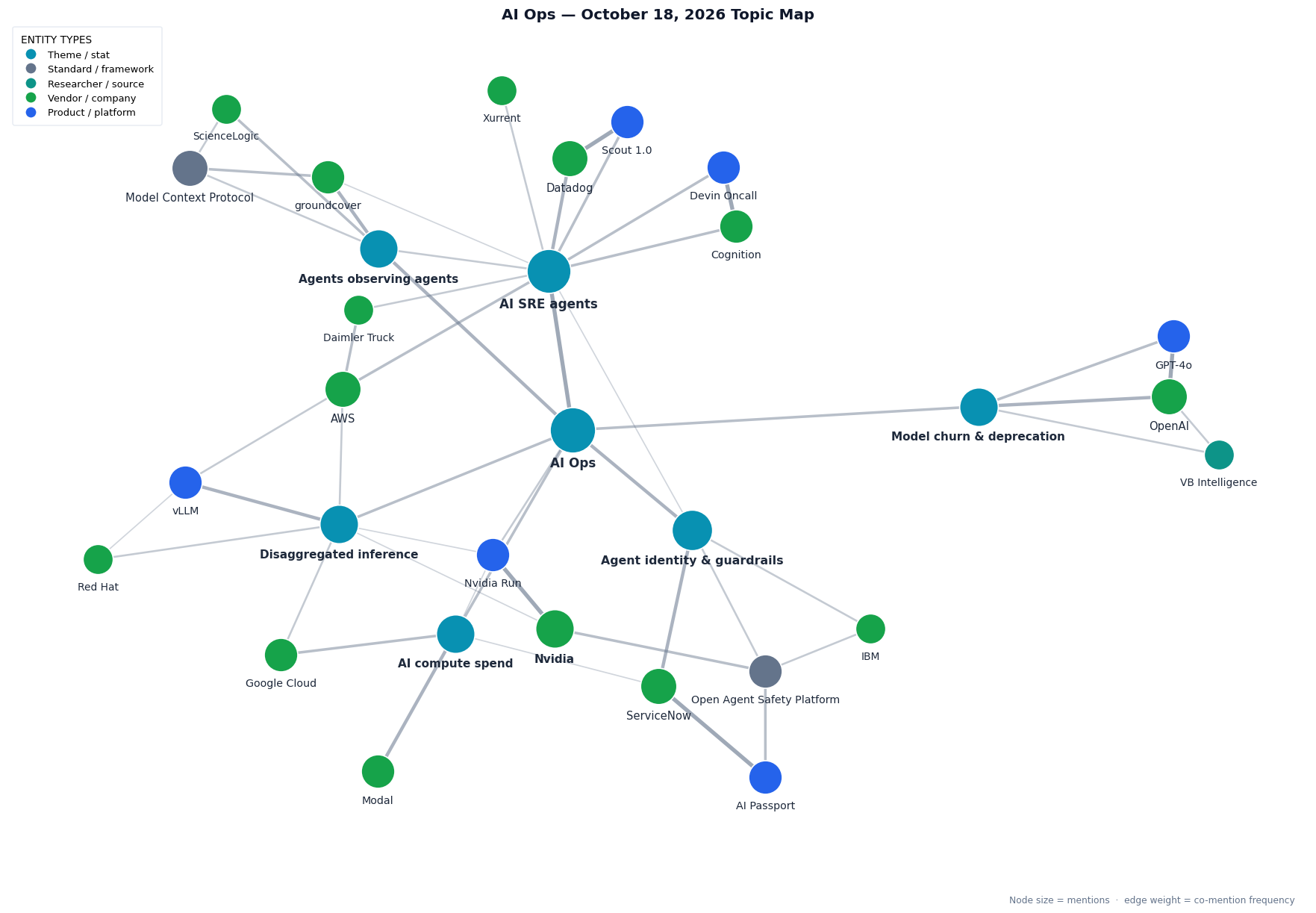
This week’s topic map. AI SRE agents fill the top half, with Datadog, Cognition, Xurrent, AWS and Daimler Truck around them, and groundcover and ScienceLogic link agent observability to MCP on the upper left. ServiceNow’s AI Passport and IBM meet Nvidia at the Open Agent Safety Platform below the centre, and Nvidia also ties Run to the inference cluster with vLLM and Red Hat. OpenAI’s GPT-4o retirement sits on the right under model churn, and Modal and Google Cloud hang off AI compute spend.
View interactive topic map →
Article index
26 articles, grouped by sub-theme. Twenty are from this week’s coverage window (October 11 to October 18). Six are longer foundational reads on the beat. Sponsored coverage, vendor blogs and press releases are labelled within each group.
AI SRE agents take the first call
Three launches and one customer build. The Scout, Xurrent and Cognition figures are the vendors’ own. Xurrent’s item is a press release. The AWS post is vendor-published but co-written with Daimler Truck and its integrator CGI, and reports a measured result.
Agents observing agents
Observability vendors are opening their agents to other agents over MCP and adding controls over what those agents can reach. CX Today’s roundup covers the wider market, including Elastic, Grafana and a Splunk MCP Server flaw.
Identity, guardrails and state for agents
How agents get an owner, a permission set and an off switch. The IBM interview is theCUBE coverage paid for by IBM. The kagent lab is a CNCF ambassador post; the state essay is contributed opinion.
Model churn and platform choice
What happens when the model under a production app changes or disappears. VentureBeat’s figures come from opt-in reader and panel surveys of about 100 respondents each. The Pragmatic Engineer piece excerpts a new O’Reilly book; the trade-offs essay is contributed.
Paying for AI compute
A large AI cloud round, a quota tool and two views on where agent spend should land. The Dell and Intel interview is theCUBE coverage paid for by Dell. Linthicum’s piece is an opinion column.
GPU and inference operations
Running the serving stack: GPU scheduling, KV-cache transfer and gateway quotas. Four of the six are vendor-published (AWS twice, Google Cloud, Red Hat), and the vLLM post is written by AWS and Mistral engineers. The GPUs-on-Kubernetes piece is contributed by CloudBolt’s COO.
Detailed write-ups
1. AI SRE vendors start training their own models
IT Brief Australia / Xurrent · October 15–16, 2026
Datadog released Scout 1.0, its first in-house model for site reliability investigations. It powers Bits Investigation, Datadog’s AI SRE. Scout is built on GLM-5.3 Flash and post-trained with reinforcement learning on simulated investigations, and Datadog says no customer data went into training. On its target scenarios, Datadog says the medium setting matched GPT-6.1 Sol and Claude Opus 5.5 at their high settings for an estimated three to eight times lower inference cost, and the xhigh setting matched Fable xhigh at four times lower cost. Those comparisons come from Datadog’s internal AlertEval framework and the public SREGym benchmark. Scout is used by Datadog’s own engineers and a small closed customer preview. There is no release date or price.
The point is economics. An agent that investigates every alert runs a model on every alert, so a cheaper specialist model changes what is affordable. Datadog’s stated aim is for Bits to act as an always-on first responder that gathers evidence and proposes likely causes for each one.
Xurrent took the opposite route on price. Its press release extends Sera AI into an AI SRE teammate inside its incident management product, pulling context from code repositories, observability tools and past incidents and flagging recent code changes. Five actions cover investigation, stakeholder updates, questions, post-incident write-ups and briefings. Xurrent says the AI comes at no extra charge, without session caps, token limits or overage fees, and names Deutsche Telekom as a customer. Its figures of 75% faster resolution and 40% higher productivity are its own.
Sources: IT Brief Australia (Datadog Scout 1.0) — https://itbrief.com.au/story/datadog-launches-scout-1-0-for-production-issue-checks · Xurrent (press release) (Sera AI SRE teammate, press release) — https://www.xurrent.com/press-release/xurrent-extends-sera-ai-into-an-ai-sre-teammate-to-help-engineering-teams-resolve-incidents-faster
2. Coding agents move onto the on-call rota
RuntimeWire / AWS for Industries · October 12–15, 2026
Cognition launched Devin Oncall, which takes its coding agent into production incident response. It connects to observability and ticketing tools, investigates alerts and bug reports, traces likely causes through systems and code, and can prepare a fix and open a tested pull request for an engineer to review. Cognition says Devin was already handling thousands of production alerts a day before the launch. It gave no pricing or availability details.
The week’s most concrete result came from a customer build. Daimler Truck’s IT Aftersales team and its partner CGI built a multi-agent self-healing system for a portal that runs more than 36 applications on seven EKS clusters for over 130,000 users. CloudWatch and Instana raise alerts. An SRE agent cleans them up, the read-only AWS DevOps Agent finds the root cause, and a separate coding agent, needed because DevOps Agent did not write fixes at the time, patches the code in a sandbox, runs checks and opens a GitHub pull request. Engineers approve every pull request in Microsoft Teams before anything deploys.
The authors report time to resolution falling from two to three hours to about 15 minutes, roughly 88%. Their 10–20% cut in support effort is an estimate. The safeguards are the part to copy: alert de-duplication, a list of repositories the agent may touch, sandbox validation, rate limits, and a circuit breaker that trips on cost.
Sources: RuntimeWire (Devin Oncall) — https://runtimewire.com/article/cognition-devin-oncall-production-incidents · AWS Industries Blog (Daimler Truck multi-agent SRE, vendor blog) — https://aws.amazon.com/blogs/industries/automating-incident-resolution-with-a-multi-agent-self-healing-sre-solution-on-aws/
3. Observability tools open their doors to other agents
SiliconANGLE / DevOps.com / CX Today · October 14–16, 2026
groundcover launched what it calls agent-to-agent observability. Coding agents such as Claude, Codex, Cursor and AWS’s Kiro connect over MCP. If they know what evidence they need, they pull logs, traces and Kubernetes events directly. If the problem is open-ended, they hand it to groundcover’s own agent as an asynchronous task, get a job ID back at once, and receive a root-cause analysis or a draft dashboard later. Telemetry stays in the customer’s own cloud account and pricing is per node rather than per data volume. CEO Shahar Azulay argues that agents “can’t tell you what already did happen in production unless they have access to the evidence.” The company has raised $160 million, including a $100 million Series C in July.
ScienceLogic’s Skylar AI 2.7 works on the control side. It uses traces to show how requests were routed through an MCP server, lets teams switch off individual agent functions or MCP tools, and adds a gatekeeper that can quarantine suspicious content before an agent reads it.
CX Today’s roundup puts the week in context. Elastic launched its nightshift AI SRE in private preview, Grafana began charging for agent observability from $1.50 per 1,000 generations, and Honeycomb research found 71% of respondents deploying agents faster than they can govern them. It also reports a server-side request forgery flaw in Splunk’s MCP Server, CVE-2026-76286, fixed in version 1.2.1. Dataiku CEO Florian Douetteau put the shift simply: “Monitoring tells you an agent is running. Managing tells you whether it’s earned the right to keep running.”
Sources: SiliconANGLE (groundcover agent-to-agent observability) — https://siliconangle.com/2026/10/14/groundcover-lets-claude-and-codex-hand-production-investigations-to-its-own-agent/ · DevOps.com (Skylar AI 2.7) — https://devops.com/sciencelogic-extends-observability-reach-and-control-deeper-into-ai-agents · CX Today (agent observability roundup) — https://cxtoday.com/ai-agent-observability-just-changed-again
4. Agent identity becomes an operations control
SiliconANGLE · October 15, 2026
ServiceNow announced AI Passport, a signed credential that records an agent’s identity, the actions it may take, the systems it can reach and the person accountable for it. It is issued through AI Control Tower and checked while the work runs. In the demo, a third-party customer-service agent was limited to refunds under $25: an $18 refund went through and a $40 request was stopped for human review. Operators can pause an agent by revoking its session tokens, narrow its tool access, or deactivate it, and restoring it requires a recorded reason. Nvidia is design and launch partner, tying AI Passport to its Open Agent Safety Platform.
AI Control Tower also gains shadow AI detection, more than 400 vendor connectors and AI Cost Management. AI Passport, shadow AI detection and cost management arrive later this quarter. “Without that baseline, every guardrail is just advisory,” said Nenshad Bardoliwalla, ServiceNow’s senior vice president of AI products.
In a theCUBE interview paid for by IBM, Tyler Lynch of IBM’s automation group said IBM is contributing agent identity and credential work to the same Nvidia platform. He described agents emitting token-usage telemetry that a policy could use to revoke an API key and pause the agent for review, and said nobody has yet solved how agent controls differ from ordinary authorization, logging and telemetry.
Sources: SiliconANGLE (AI Passport and AI Control Tower) — https://siliconangle.com/2026/10/15/servicenow-adds-ai-agent-controls-and-employee-automation-tools/ · SiliconANGLE (agent safety interview, sponsored by IBM) — https://siliconangle.com/2026/10/15/ibm-ties-intelligent-operations-agent-safety-business-value-ibmaioperatingmodel/
5. GPT-4o’s early exit and the cost of swapping models
The New Stack / VentureBeat / The Pragmatic Engineer · October 13–15, 2026
OpenAI will retire GPT-4o, GPT-4o mini, GPT-4.1 and GPT-4.1 mini from its API on January 14, 2027, including dated snapshots and fine-tuned versions. That is about three months’ notice, against a deprecation policy that promises at least six months for generally available models except for safety or compliance reasons. New self-serve fine-tuning jobs stop on January 6. The suggested replacement, GPT-6 Luna, costs $0.10 per million input tokens and $0.50 per million output tokens, with higher prices past 272,000 input tokens. It supports function calling in Chat Completions only with reasoning turned off; reasoning plus tools needs the Responses API, and reasoning rules out temperature and logprobs.
VentureBeat’s September surveys show why that matters. 62% of companies had replaced a model inside a production app in the past year, and 59% of those saw performance drop and had to rework the app or revert. Only 19% said a swap took almost no engineering work. The same surveys found OpenAI’s agent orchestration platform in use at 43% of companies against 22% for Anthropic’s, though among 61 companies still choosing, Anthropic led 33% to 30%. The samples are opt-in and around 100 respondents each.
The Pragmatic Engineer’s excerpt from Sam Newman’s new book turns this into practice: design for the model being down, rate-limited or out of tokens, combine functional tests with evals because behaviour changes between versions, and track AI spend by team. “Make sure you aren’t wholly dependent on a single model or AI platform,” Newman writes.
Sources: The New Stack (GPT-4o API retirement) — https://thenewstack.io/openai-gpt4o-api-shutdown/ · VentureBeat (agent platform and model-swap surveys) — https://venturebeat.com/orchestration/openais-ai-agent-platform-is-used-by-twice-as-many-companies-as-anthropics-new-venturebeat-survey-finds?ref=techtech.club · The Pragmatic Engineer (Sam Newman on resilient AI software) — https://newsletter.pragmaticengineer.com/p/building-resilient-systems
6. Nvidia gives away Run, and GPU accounting stays hard
TechRepublic / The New Stack / SiliconANGLE · October 12–15, 2026
Nvidia made its full Run GPU orchestration platform, formerly Run:ai, open source on October 13 under Apache 2.0, including the self-hosted control plane. The release includes the KAI Scheduler, a GPU fractioning operator, KAI Resource Management and Workload Map. Images and Helm charts install from NGC without an account, subscription or API key, so teams can run it in production without paying. The paid option is a Support-Entitled Release with enterprise support and service levels. Nvidia AI Enterprise per-GPU licences do not automatically cover a free install, and TechRepublic advises checking the licence of each component.
A contributed New Stack piece by CloudBolt COO Yasmin Rajabi shows what a scheduler alone does not fix. Nvidia’s DCGM exporter reports per physical GPU, so three time-sliced pods on one card each appear to use all of it. GPUs are requested in whole units and never overcommitted. She puts the cheapest MIG-capable A100 on AWS at about $22 an hour against about $5 for a comparable CPU instance, “since the GPU is the most expensive line on the bill.”
For teams running their own open models, startup nFOX plans to release its Blockhouse sandbox under Apache 2.0. It starts workloads with no privileges and restores access through kernel-level policy, and supports vLLM, SGLang and llama.cpp. “Every model has the potential to be hostile,” said founder Gordon Allott.
Sources: TechRepublic (Nvidia Run open source) — https://www.techrepublic.com/article/news-nvidia-runai-open-source-free-paid/ · The New Stack (GPU cost and accounting, contributed) — https://thenewstack.io/gpus-on-kubernetes/ · SiliconANGLE (nFOX Blockhouse sandbox) — https://siliconangle.com/2026/10/15/startup-nfox-to-open-source-its-sandbox-for-open-ai-models/
7. Modal passes $1 billion in revenue as token bills bite
SiliconANGLE / InfoWorld · October 12–15, 2026
Modal raised $750 million in a Series D led by Accel, with Kleiner Perkins joining, at a $15.75 billion valuation, more than triple its value in May. The company says annualised revenue has more than tripled since May to over $1 billion. Nearly a third comes from Sandboxes, its hosted containers for AI workloads. Modal runs on hardware rented from more than 20 cloud providers and plans to add reinforcement learning and post-training services.
Spending control is catching up with the demand. Google made daily token quotas generally available for BigQuery’s generative AI functions. Defaults are 200 billion input and 20 billion output tokens per project per day, and 150 billion and 15 billion per user, with reasoning tokens counted as output. When a quota runs out, queries fail with a QuotaExceeded error, and a quota hit mid-query can return partial results. Analysts quoted by InfoWorld note the limits count tokens, not dollars, so finance still lacks team-level spend.
In a theCUBE interview paid for by Dell, Dell’s Helen O’Sullivan described customers “running through their token budget in a matter of weeks that they had allotted for months.” David Linthicum’s InfoWorld column argues for placing each part of an agent separately: cloud for bursty demand, owned hardware only when steady volume, latency or regulation justify it.
Sources: SiliconANGLE (Modal raises $750M) — https://siliconangle.com/2026/10/14/ai-cloud-startup-modal-raises-750m-at-15-75b-valuation/?ref=genaisecretsauce.com · InfoWorld (BigQuery AI token quotas) — https://www.infoworld.com/article/4235774/google-aims-to-make-bigquery-spending-on-ai-functions-more-predictable-with-token-quotas.html · SiliconANGLE (enterprise AI costs, sponsored by Dell) — https://siliconangle.com/2026/10/12/dell-intel-weigh-costs-enterprise-ai-scalability-dellaileadershipsymposium/ · InfoWorld (where to run agents, opinion) — https://www.infoworld.com/article/4234013/the-best-place-to-run-ai-agents.html
8. Disaggregated inference moves from paper to recipe
vLLM Blog / Google Cloud / AWS / Red Hat · October 12–16, 2026
Splitting prefill and decode onto separate GPUs is now something teams can deploy from published recipes. Engineers from AWS and Mistral added a push mode to vLLM: the prefill server writes the KV cache straight into memory the decode server reserved in advance, over NIXL and AWS EFA, instead of the decode server pulling it afterwards. On a Qwen3-32B test on EC2 P5en with 16k-token inputs, time to first token fell from about 1,744 ms to about 540 ms at 8 queries per second, and time per output token from about 10.4 ms to about 7 ms. The trade-off is that the decode server is chosen earlier, leaving less room for load-aware routing.
Google Cloud published day-zero recipes for Reflection’s open-weight Beam model, launched last week, using llm-d and Nvidia Dynamo for KV-aware routing, prefill/decode separation and tiered KV caching. Reflection reports up to 5x higher throughput and 8x lower latency on GB300 systems, measured against a round-robin baseline on the same hardware in customer benchmarking. AWS shipped a Ray LLM Deep Learning Container that bundles vLLM, Ray Serve LLM and NIXL and runs prefill and decode on separate EKS nodes behind one OpenAI-compatible endpoint.
Red Hat covered the governance side. Red Hat AI Inference 3.5 can run its model-as-a-service layer on AKS, issuing hashed API keys and enforcing per-user token rate limits at the gateway. In its test, a request without a key got a 401 and one over a 1,000-token-per-minute quota got a 429.
Sources: vLLM Blog (vLLM push-based KV transfer) — https://vllm.ai/blog/2026-10-14-nixl-push-connector · Google Cloud Blog (Reflection Beam serving, vendor blog) — https://cloud.google.com/blog/topics/ai-infrastructure/day-0-support-with-5x-perf-for-reflection-beam-on-google-cloud · AWS Machine Learning Blog (Ray LLM DLC, vendor blog) — https://aws.amazon.com/blogs/machine-learning/run-multi-node-inference-workloads-using-ray-llm-deep-learning-containers/ · Red Hat Developer (MaaS governance on AKS, vendor blog) — https://developers.redhat.com/articles/2026/10/13/red-hat-ai-inference-3-5-maas-governance-aks
Calls to action
- Inventory every GPT-4o and GPT-4.1 API call now. Include dated snapshots and fine-tunes, which also retire on January 14. Test GPT-6 Luna on your tool-calling paths before January 6, when new fine-tuning jobs stop, and check whether you need reasoning and tools together, which forces a move to the Responses API.
- Patch Splunk MCP Server. Upgrade to 1.2.1 or later to fix the server-side request forgery flaw CVE-2026-76286, and list every MCP server your agents can reach.
- Put an approval gate on agent-written fixes. Before trialling Devin Oncall or a similar tool, copy the Daimler Truck safeguards: human review of every pull request, an allowed-repository list, sandbox checks, rate limits and a cost-triggered circuit breaker.
- Give each production agent an owner and an off switch. Record what it may do and which systems it may reach, and confirm you can pause, restrict and deactivate it without a redeploy.
- Set BigQuery AI token quotas. Set per-project and per-user limits below the defaults, map them to a dollar figure for finance, and handle QuotaExceeded and partial results in your pipelines.
- Fix GPU utilisation reporting for shared GPUs. If you time-slice GPUs, stop reading DCGM’s per-device figures as per-pod use, and allocate cost by pod before the next budget review.
- Add a model-swap regression suite. Run the same evals against the current and replacement model before any switch. VentureBeat found most swaps degraded performance.
|