This week at a glance
This week OT security went to the supermarket. Overnight on October 11-12, attackers reached store refrigeration controllers across France, stretched defrost cycles from one hour to as many as eight so alarms stayed quiet, and pushed cold rooms to 50°C. The first count was about 300 stores. By midweek France’s finance minister put it at around 700 of the country’s roughly 10,000 supermarkets. ANSSI’s alerts named Danfoss AK-SM and AK-SC controllers first, then Copeland and Dixell XWEB systems. Most of the affected Danfoss units are models that went out of support in 2016 and 2021, and thousands were reachable from the internet. Researchers had published the controller flaws well before the attack. Nobody has yet shown which access path was used or who did it.
The second story is speed. Booz Allen gave frontier AI agents no documentation for its OT lab, and they still met all eight test objectives. In one run the agents went from the perimeter firewall to energising a controller output in just over 16 minutes. Claroty’s Team82 pointed an AI coding agent at Danfoss firmware and had root on a lab controller in about 28 minutes for around $6 in tokens, though a researcher still had to steer it. Censys counts about 134,000 ICS devices still reachable online, roughly 70% of them on mobile or consumer networks, and exposed AI tooling up 63% in nine months.
Regulators are adjusting. FERC’s annual CIP audit lessons now cover AI tools that vendors are building into control environments, generators that never registered new plant, and third parties whose control access nobody counted. MITRE’s ATT&CK v20 adds the Minnesota water attacks and a cross-domain Mexico breach as ICS campaigns, plus 22 new ICS analytics. India’s power-sector rules take effect in April 2027, and Singapore is putting OT first in its quantum-safe migration. In Denmark, a cyber incident took down central systems at the contractor building the Fehmarn Belt tunnel, and staff could not use the digital access controls on site.
On our watch list
- Attribution and the access path in France. French authorities have named no actor and no entry point. Watch for confirmation of whether the attackers used the published Danfoss flaws, default or reused credentials, or a remote-management service, and whether stores in other countries report the same defrost manipulation.
- Whether the exposed count keeps falling. Censys saw more than 1,800 exposed Danfoss panels in France on October 11 and 537 by October 14. A follow-up scan should show whether owners outside France, and Copeland/Dixell XWEB users, are taking theirs offline as quickly.
- The bill, and who pays it. Intermarché reports losses in the tens of millions of euros. Watch whether insurers treat this as a cyber or a property loss, and whether retailers go after the refrigeration service companies that manage the controllers. Les Mousquetaires has already said any criminal complaint is the supplier’s to file.
- Which models Booz Allen used, and what happens without a human approving each step. The report names only “frontier” models, and Booz Allen estimates the attack would take about half as long without human sign-off. A full methodology, or another lab repeating the test, would show how much of the 16 minutes came down to the model and how much to the gaps left open in the lab.
- NERC’s response to FERC on aggregation and AI tools. FERC asked NERC to consider guidance on control spread across many low-impact systems. A NERC project or draft guidance would show the AI-tool and third-party findings turning into requirements, not just audit observations.
- Detections built on ATT&CK v20. The new ICS analytics are tuned to filter out routine engineering work. Watch for OT monitoring vendors mapping their detections to T1701 and the new T0869 sub-techniques, and for the Minnesota campaign (C0066) to appear in their reporting.
- Fehmarn Belt: root cause and who did it. The National Special Crime Unit is investigating, and the minister has called in the parliamentary parties. Watch for a ransomware claim, how long the main Rødbyhavn plant stays down, and whether contractors on other big infrastructure projects get new security requirements.
- India’s CEA rules and Singapore’s quantum grant. India’s power-sector regulations start on April 1, 2027, with six-hour incident reporting and OT kept off the internet. Singapore’s Quantum-Safe Kickstarter Grant opens November 1. Watch how many critical-infrastructure owners put OT migration pilots forward.
- More AI-driven exploit rebuilds of known OT flaws. Claroty had an AI agent reproduce a published exploit chain in under 30 minutes. If other labs publish similar results for other controller families, the time between disclosure and a working exploit becomes something to plan around.
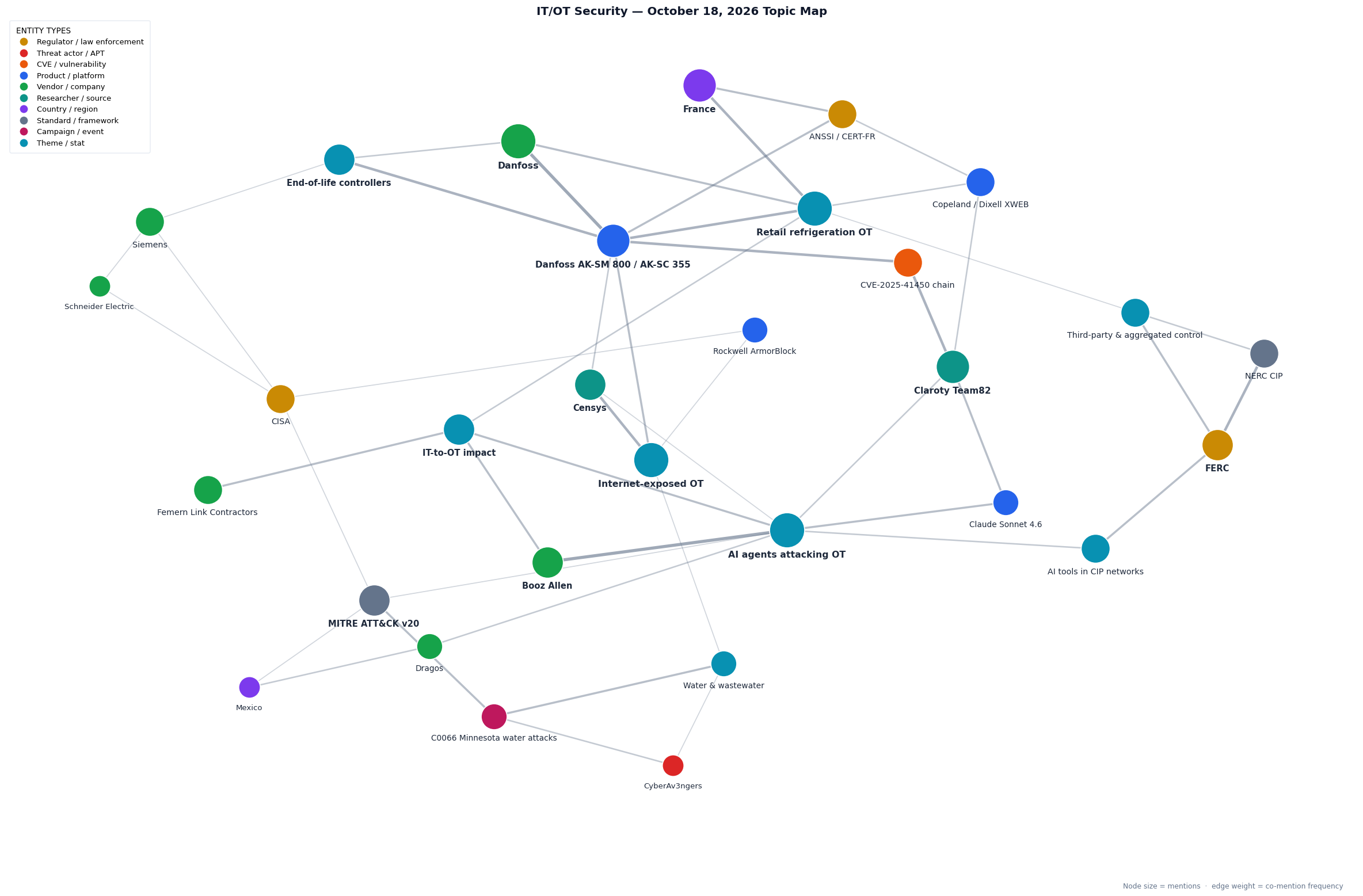
This week’s map centres on the Danfoss AK-SM 800 and AK-SC 355 controllers. They link France, ANSSI/CERT-FR, Copeland/Dixell XWEB, end-of-life hardware and retail refrigeration, and Claroty Team82’s CVE-2025-41450 chain connects them to Claude Sonnet 4.6. Below that, AI agents attacking OT is the second hub, joining Booz Allen, Claroty, Dragos, MITRE ATT&CK v20 and the AI tools FERC found in CIP networks. Censys and internet-exposed OT sit between the two hubs. On the right, FERC links NERC CIP and third-party and aggregated control. At the bottom, ATT&CK v20 ties the Minnesota water campaign to CyberAv3ngers, the only threat actor shown. The French attack and the Fehmarn Belt incident have no confirmed attribution.
View interactive topic map →
Article index
The French refrigeration attack
Attackers hijacked store refrigeration controllers across France overnight on October 11-12 and cooked the stock in roughly 700 supermarkets. Four reports trace how the count grew, which controller makers were drawn in, and how long the flaws had been known. Claroty shows how quickly an AI agent can rebuild the exploit chain.
AI meets OT
Booz Allen’s lab test had frontier AI agents move a robotic arm 16 minutes after breaching the perimeter. Censys adds the exposure side: AI tooling on the internet is up 63% in nine months and about 134,000 ICS devices remain reachable.
Advisories, research and frameworks
Siemens, Rockwell, Schneider Electric, ABB and Moxa fixes on ICS Patch Tuesday, two CISA batches, MITRE ATT&CK v20 with new ICS campaigns and detections, and university research showing encrypted plant-to-cloud traffic can still be selectively disrupted.
Incidents and exposure beyond the supermarkets
A cyber incident halts work at the contractor building the Fehmarn Belt tunnel, criminals turn to building systems, and infostealer data shows how many water utilities have operational credentials in circulation.
Power-sector rules and regulators
FERC’s annual CIP audit lessons now cover AI tools, India sets an April 2027 start for its power-sector cyber rules, Singapore puts OT first in its quantum-safe migration, and DOE and INL begin a weekly course on cyber-informed engineering.
| Article |
Source |
Published |
| 17. FERC identifies cybersecurity compliance gaps in US power sector, flags risks from AI tools and third-party control systems |
Industrial Cyber |
Oct 15, 2026 |
| 18. FERC’s Reliability Office Offers Lessons Learned From 2026 CIP Reliability Audits |
McGuireWoods |
Oct 16, 2026 |
| 19. India’s New CEA Cybersecurity Regulations: What Power Sector Leaders Need to Know Before April 2027 |
Nozomi Networks |
Oct 13, 2026 |
| 20. DOE, INL launch weekly series on cyber-informed engineering to advance cybersecurity in energy infrastructure |
Industrial Cyber |
Oct 14, 2026 |
| 21. Singapore prioritizes critical infrastructure in quantum-safe push, funds cryptographic discovery, legacy OT migration |
Industrial Cyber |
Oct 16, 2026 |
| 22. From cyber fear to grid resilience |
Hitachi Energy |
Oct 16, 2026 |
Vendor threat views
Telemetry and field notes from OT security vendors: who is being targeted, what a long-hidden intruder at a small utility looked like, and how ransomware against industrial firms is trending.
Detailed write-ups
1. French supermarkets: old refrigeration controllers, 50°C cold rooms, about 700 stores
The Record · SecurityWeek · Dark Reading · The Register · October 12-15, 2026
Overnight on October 11-12, attackers remotely set off defrost functions on store refrigeration controllers across France. Cold rooms, freezers and display fridges reached as high as 50°C and fresh food was thrown away. Le Monde, cited by SecurityWeek, reports that the attackers stretched defrost cycles from one hour to as many as eight, which kept alarms from firing. First reports put the damage at about 300 Intermarché and Netto stores and fewer than 100 Coopérative U stores. On October 15, Finance Minister Roland Lescure told lawmakers about 700 of France’s roughly 10,000 supermarkets were affected. Carrefour reported 80 stores, Coopérative U 80 and Intermarché’s owner Les Mousquetaires about 150. Intermarché puts its losses in the tens of millions of euros.
ANSSI’s CERT-FR first warned on October 12 about compromised Danfoss AK-SM and AK-SC controllers, and on October 13 added Copeland XWEB and Dixell XWEB systems. Danfoss says most of the affected units are AK-SM 800s, which lost support in May 2021, and AK-SC 355s, discontinued in 2016. The company says it has more than 50,000 installations and that customers are responsible for updating firmware. Les Mousquetaires said Danfoss manages its systems. Exposure was high going in. Censys counted nearly 3,000 internet-facing Danfoss StoreView panels on October 11, more than 1,800 of them in France, and the French figure was down to 537 by October 14.
The flaws had already been published. Claroty’s Team82 disclosed CVE-2025-41450, -41451 and -41452 in the Danfoss AK-SM 800A, an authentication bypass and command injection that together allow a takeover, and separately reported 23 flaws in Copeland’s XWEB Pro, which Copeland has patched. The Register reports that Team82 warned in August that attackers could “freeze the controller” and “defrost the food.” Neither Danfoss nor the French authorities have linked those flaws to this attack, and there is no attribution. “Get your stuff off the Internet. Do it on an emergency basis,” Andrew Ginter of Waterfall Security Solutions told Dark Reading.
This is a reminder that building and refrigeration controllers count as OT even when no security team owns them, and they are usually managed by an outside service company. If you run stores, warehouses or cold-chain sites, find out who manages your controllers, whether they can be reached from the internet, and which firmware they run.
Sources: The Record, SecurityWeek, Dark Reading, The Register
2. Booz Allen: AI agents went from the perimeter to moving a robotic arm in about 16 minutes
SecurityWeek · Dark Reading · October 14-16, 2026
Booz Allen tested commercial and frontier AI models against its own isolated OT lab, which models an enterprise network with an industrial control segment behind it. The agents got no source code, engineering documents or OT-specific guidance, and they met every objective across eight scenarios, including mapping the environment, finding vulnerabilities and compromising a SCADA system. In one run, the path from the perimeter firewall through the IT network into OT, ending with an energised controller output, took just over 16 minutes. In another, a model found a robotic arm, worked out its protection zones and motion limits, and moved it.
There are caveats. Booz Allen left some known flaws unpatched in the first runs, so the times do not include finding new vulnerabilities or writing exploits. The models are described only as “frontier,” and SecurityWeek notes the report’s “super intelligence” terminology was not explained. Existing defences blocked or slowed some actions, but no single control reliably stopped the agents. Booz Allen estimates that without a human approving each step, the attacks would have taken roughly half as long. “This frontier model testing shows that AI knocks down a lot of those barriers,” said Kyle Miller, Booz Allen’s VP of infrastructure cybersecurity.
Dark Reading adds a real-world comparison. Dragos reported an adversary using two commercial models in early 2026 to reach at least nine Mexican government agencies, but it did not get into a local water utility’s control network. That case and Booz Allen’s lab are the reason to assume IT-to-OT pivots will get faster. Your response time is set by the time from perimeter alert to OT containment, so measure it now.
Sources: SecurityWeek, Dark Reading
3. Claroty: an AI coding agent rebuilt the Danfoss exploit chain in 28 minutes for about $6
Claroty Team82 · October 13, 2026
After the French attacks, Claroty’s Team82 tested how quickly an AI agent could rebuild an exploit chain for the Danfoss AK-SM 800A from the firmware alone. Using Claude Sonnet 4.6 in medium-reasoning mode through the Cursor editor, plus a Ghidra MCP integration the researchers set up to decompile the controller’s 67 MB main binary, the agent had a working exploit on a lab device in about 28 minutes. It cost around $6 in model usage.
The agent reproduced the command-injection flaws CVE-2025-41451 and -41452 first. It failed on the authentication bypass, CVE-2025-41450, until a researcher pointed it in the right direction, and the full chain then gave root command execution. Team82 is careful about what this shows: “The researcher remained essential, but hands-on analysis was substantially reduced.” Its quick Censys and Shodan searches still found thousands of potentially exposed devices.
This was a reproduction of flaws Team82 had already found, not new research, and the post comes from a vendor. It still matters for OT patch planning. Once a flaw is published, a skilled person with an AI agent can have a working exploit in under an hour, while OT patch cycles are still measured in months. For anything that faces the internet, the realistic mitigation is to take it off the internet.
Sources: Claroty Team82
4. ICS Patch Tuesday and CISA: Siemens, Rockwell ArmorBlock, Schneider, ABB and eight CISA advisories
SecurityWeek · CISA · October 13-15, 2026
Siemens published 17 new advisories. It fixed critical flaws in some Simatic S7-1500 CPUs, Industrial Edge devices and the Ruggedcom Crossbow Station Access Controller, and offered mitigations where fixes are not ready. More than 400 of the flaws sit in the GNU/Linux subsystem of the Simatic CPUs. Rockwell Automation’s 1732E ArmorBlock advisory covers a critical flaw that lets an unauthenticated attacker change the web server password and take over the admin account, plus a denial-of-service bug.
Schneider Electric issued two high-severity advisories. One covers Pro-face STW6000 and Harmony STW6, which can be taken over through a malicious webpage. The other covers Sage RTUs, where a privileged user can install malicious firmware. ABB’s dynovaPRO advisory (CVE-2026-18963) is about a credential-reset bypass, and ABB said that “internal log analysis identified 26 password change events affecting 9 customers,” though it knows of no exploitation in the wild. Moxa disclosed two severe protocol-gateway flaws.
CISA’s October 13 batch covers privilege escalation in Inductive Automation’s Ignition and video exposure in Swann SWIFI-SE2KIC cameras. The October 15 batch covers CISA’s own Malcolm, the Eclipse Milo OPC UA library, Guangzhou Juan EseeCloud, two medical advisories (Thermo Fisher Torrent Suite and J4Care dcm4che) and an update to the Red Lion N-Tron 700 series advisory. ArmorBlock and the Sage RTUs are field devices that tend to be forgotten in patch planning. Check whether either is on your floor.
Sources: SecurityWeek, CISA (Oct 13), CISA (Oct 15)
5. FERC’s CIP audit lessons: unregistered generation, uncounted third parties and AI tools
Industrial Cyber · McGuireWoods · October 15-16, 2026
FERC’s Office of Electric Reliability released its fiscal 2026 “Lessons Learned from Commission-Led CIP Reliability Audits” on October 13. This is roughly the tenth year of the series, and the audit count is again described only as “several.” There are three lessons. Some generator owners did not register new generation with NERC or categorise its BES Cyber Systems in time, and one waited more than a year. Misreading NERC’s definition of commercial operation date meant some inverter-based resources ran commercially without the required cybersecurity evaluation. In two cases, systems that were each low-impact together met medium-impact criteria, because affiliates or contractors were monitoring and controlling them and nobody had counted that.
The third lesson is about AI. Auditors saw growing use of chatbots, assistants and automated analytics tools inside CIP-networked environments, often added by vendors faster than compliance programmes could keep up. FERC warns these tools can enable unauthorised access or lateral movement, and that growing sophistication can “enable these tools to perform actions that mimic user behavior.” Its recommendations: confirm the business need, authorise and regularly review access, monitor traffic leaving the CIP-005 perimeter, inventory the tools as generic service accounts, change default passwords, assess them as vendor risk under CIP-013, and use the NIST AI RMF.
The aggregation finding should concern anyone with many small sites. If a third party can control dozens of individually low-impact assets from one place, the combined impact may put you in a higher tier. FERC has asked NERC to consider guidance on this.
Sources: Industrial Cyber, McGuireWoods
6. MITRE ATT&CK v20 adds the Minnesota water attacks, a Mexico IT/OT breach and 22 ICS analytics
Industrial Cyber · October 16, 2026
ATT&CK v20 adds two ICS campaigns. C0066 covers the attacks on more than 30 Minnesota water and wastewater utilities, and C0064 a cross-domain IT/OT breach of Mexican government infrastructure. New ICS software entries are IOControl (S9046), linked to CyberAv3ngers, and BACKUPOSINT v9.0 APEX PREDATOR (S9045), an AI-generated Python toolkit. The ICS matrix gains T1701 Command and Scripting Interpreter, with six sub-techniques, replacing the deprecated T0807 and T0853, and two new command-and-control sub-techniques under T0869: DNS and publish/subscribe protocols.
On the enterprise side there are nine new techniques and sub-techniques, including prompt injection and AI-enabled exfiltration. The release adds 15 detection strategies backed by 38 analytics, 22 of them new ICS analytics tuned to filter out routine engineering and maintenance work. That is the part OT detection teams have been asking for. Threat-intel updates include NIMBUS MANTICORE (G1059), The Gentlemen and Vidar, with Salt Typhoon and APT38 revised. “ATT&CK v20 brings more critical infrastructure and cross-domain activity into the framework,” MITRE’s Amy L. Robertson wrote.
If your OT detections are mapped to ATT&CK for ICS, check them against the T0807/T0853 deprecation and the new pub/sub C2 sub-technique. MQTT and similar protocols are common in newer IIoT deployments, and few monitoring baselines cover them yet.
Sources: Industrial Cyber
7. Censys: 134,000 exposed ICS devices, most of them on mobile and consumer networks
Cybersecurity Dive · October 15, 2026
Censys’s 2026 State of the Internet report counts about 134,000 internet-accessible ICS devices in early 2026, roughly 4% more than in 2024. More than 80% of them also run something other than an industrial protocol, such as an HTTP or FTP server, and about 70% sit on mobile or consumer networks. That points to cellular modems and small-site broadband, not corporate data centres. The US had the most exposed services (62,687 IP addresses), followed by China (42,511) and Germany (31,222).
The AI side is growing faster. About 268,000 internet-connected devices run one of 44 AI products, and five of them, including n8n, OpenClaw and Open WebUI, account for 82%. Exposed AI tooling rose 63% between October 2025 and June 2026, peaking near 300,000 endpoints early this year. “There’s already a characteristic AI infrastructure stack emerging on the Internet,” Censys wrote.
Read alongside the French controller exposure, this suggests the internet-facing OT problem is now mostly at remote and small sites. Your own scan should include cellular address space and the carriers that serve your remote sites, not just the corporate ranges.
Sources: Cybersecurity Dive
8. Fehmarn Belt: a cyber incident halts work at the tunnel contractor
The Copenhagen Post (Ritzau) · October 13, 2026
Femern Link Contractors, the consortium building the tunnel between Rødbyhavn in Denmark and Puttgarden in Germany, was hit by a cyber incident overnight into Monday, October 12. Local paper Lolland-Falsters Folketidende reported that central systems were disabled and work was significantly affected. Follow-up reports say staff were told not to connect to Wi-Fi, switch on computers or open contractor email, large parts of the network were shut down, security guards could not use the digital access systems, and several ships lost access to digital tools and data.
By October 16 some work had resumed, including earthworks, some concrete pours and reinforcement-steel production, and the main production facility was expected back without a firm date. Denmark’s National Special Crime Unit is investigating, nobody has claimed responsibility, and the emergency preparedness minister called in the parliamentary parties to discuss cyber defences. “We are in dialogue with FLC about the situation, and at the present time we do not have further information,” said Jens Villemoes of state-owned Sund & Bælt.
No OT compromise has been reported. This looks like an IT incident that stopped physical work, which is the pattern most large construction and infrastructure projects should plan for. If your organisation owns a major build, find out how the contractor would keep site access, plant operation and vessel navigation running with its network down, and write that into the contract.
Sources: The Copenhagen Post
Calls to action
- Find every refrigeration and building controller you can reach from the internet. Search your external address space, including cellular ranges, for Danfoss StoreView/AK-SM, Copeland and Dixell XWEB and other HVAC-R web interfaces. Take them off the internet and put remote management behind a VPN or broker with MFA.
- Ask your refrigeration service company for firmware levels and access details. Get a list of every managed controller, its model (flag AK-SM 800 and AK-SC 355 as end-of-life), its firmware version, and how the service company connects to it. Replace end-of-life units on a dated plan.
- Set alarms on defrost-cycle and setpoint changes. The French attackers lengthened defrost cycles so alarms stayed quiet. Alert on setpoint or schedule changes made outside maintenance windows, not just on temperature thresholds.
- Patch or isolate Rockwell 1732E ArmorBlock modules and Schneider Sage RTUs. The ArmorBlock web server password can be changed without authentication. Block web access to these modules from anything except engineering hosts until they are updated.
- Apply this month’s Siemens fixes for S7-1500, Industrial Edge and Ruggedcom Crossbow. Where Siemens offers only mitigations, apply them now and track the advisories until fixes ship.
- ABB dynovaPRO users: check password change logs. ABB found 26 password change events across nine customers. Review your own logs for credential resets you did not expect.
- Inventory AI tools inside OT and CIP environments. Follow FERC’s list: confirm the business need, authorise and review access, treat each tool as a service account, change default credentials, and monitor its traffic beyond the electronic security perimeter.
- Check your aggregated control exposure. List the affiliates, integrators and contractors that monitor or control several low-impact sites from one place, and test whether their combined reach puts you in a higher impact tier.
- Time your IT-to-OT containment. Run a tabletop from a perimeter alert to isolating the OT network. If it takes much longer than the 16 minutes in Booz Allen’s lab, decide in advance who can cut the IT/OT link and how.
|