This week at a glance
Nvidia’s GTC Berlin turned AI operations back on Nvidia’s own hardware. Minerva is an AIOps platform for AI factories: it maps GPUs, SuperNICs, switches, cables and jobs into a knowledge graph so a slow training job can be traced to the part causing it. The need is real. In a VentureBeat Intelligence survey, 81% of respondents running AI in production said their GPUs average half capacity or less, and only 10% had a return-on-investment figure that finance had signed off. Meta showed the other side of the bill: more than 11% of the GPUs in its Prometheus supercluster are dead or held as spares, the price of cutting training interruptions by 99%. Power is the hard limit. Microsoft walked away from a planned 23,040-GPU site in Essex that may not get grid power until the 2030s.
On the software side, Anthropic released Claude API version 2026-10-21, its first new version since 2023. It removes temperature, top_p and top_k and changes how SDKs send keys, but only for callers who opt in. Grafana Labs added always-on agents that learn how other agents normally behave, and Microsoft Foundry made scheduled agent Routines generally available with trace-based Insights in preview. DeepSeek open-sourced the inference engine behind its API, with Huawei’s Ascend listed next to Nvidia, and llm-d reached 1.0. Splunk found 60% of teams say surprise AI bills strain operations. Several practitioner pieces made the same point about AI SRE: agents diagnose faster when they get context, but people still decide what changes production.
On our watch list
- When Anthropic sets a date for 2023-06-01. The old version is not deprecated, and the migration guide gives no sunset date. Watch for a deprecation notice. AlphaSignal reports that Anthropic plans more frequent API versions, so the next one may arrive ahead of a model launch.
- Where the temperature workloads go. Calls that lowered temperature on Claude Sonnet 4.6 lose that effect on 2026-10-21, and nothing replaces it. Watch whether teams pin to the old version, move to Claude 4.7, or switch providers for jobs that need repeatable output.
- Minerva pricing and the first results. Nvidia gave no price and did not say whether Minerva is open source. IREN runs it now, and IBM, Lambda, Jio and Tesla are among the planned users. Watch for utilisation or uptime figures from them, and for how the Dell, Lenovo and Supermicro bundles are priced.
- Whether utilisation moves before budgets do. 71% of the low-utilisation group plan a new or replacement AI platform within a year, and 91% of planned adopters have no finance-reviewed return figure. VentureBeat’s next pulse will show whether cost per token, cited by 23% (up from 11% in August), keeps rising as a buying factor.
- DSX pods against the grid. Nvidia says factory-built pods with seven Vera Rubin racks cut deployment from six months to about two weeks, with first units in early 2027. The Essex case shows the grid connection, not the build, often sets the date. Watch where the first pods go and how they are powered.
- DeepInfer’s missing production pieces. The release runs offline inference only, without KV cache management, cross-machine disaggregation or replica load balancing. Watch for those features, and for any benchmark on Huawei’s Ascend 950, since DeepSeek’s published numbers are all on Nvidia.
- llm-d after 1.0. IBM and Red Hat report running 3,000 coding agents at five to 10 times lower cost than a hosted service for the same open model. Watch for an independent reproduction and for llm-d moving beyond CNCF sandbox status.
- Foundry’s evaluation loop. Microsoft targeted a rubric evaluator, trace-to-dataset generation and an Agent Optimizer for general availability later in October. Watch whether they ship, and whether Insights findings can be wired into release gates rather than read by hand.
- Grafana Managed Sandboxes out of preview. The feature lets AI test fixes against production behaviour before a human reviews them. Watch for general availability, pricing, and how Assistant Watchers are billed alongside Grafana’s existing per-generation metering.
- Respan’s gateway past pre-alpha. Respan has published no performance figures or licence name for its Rust gateway. Watch for both, and for other LiteLLM users moving off it after a week in which LiteLLM’s own release was compromised.
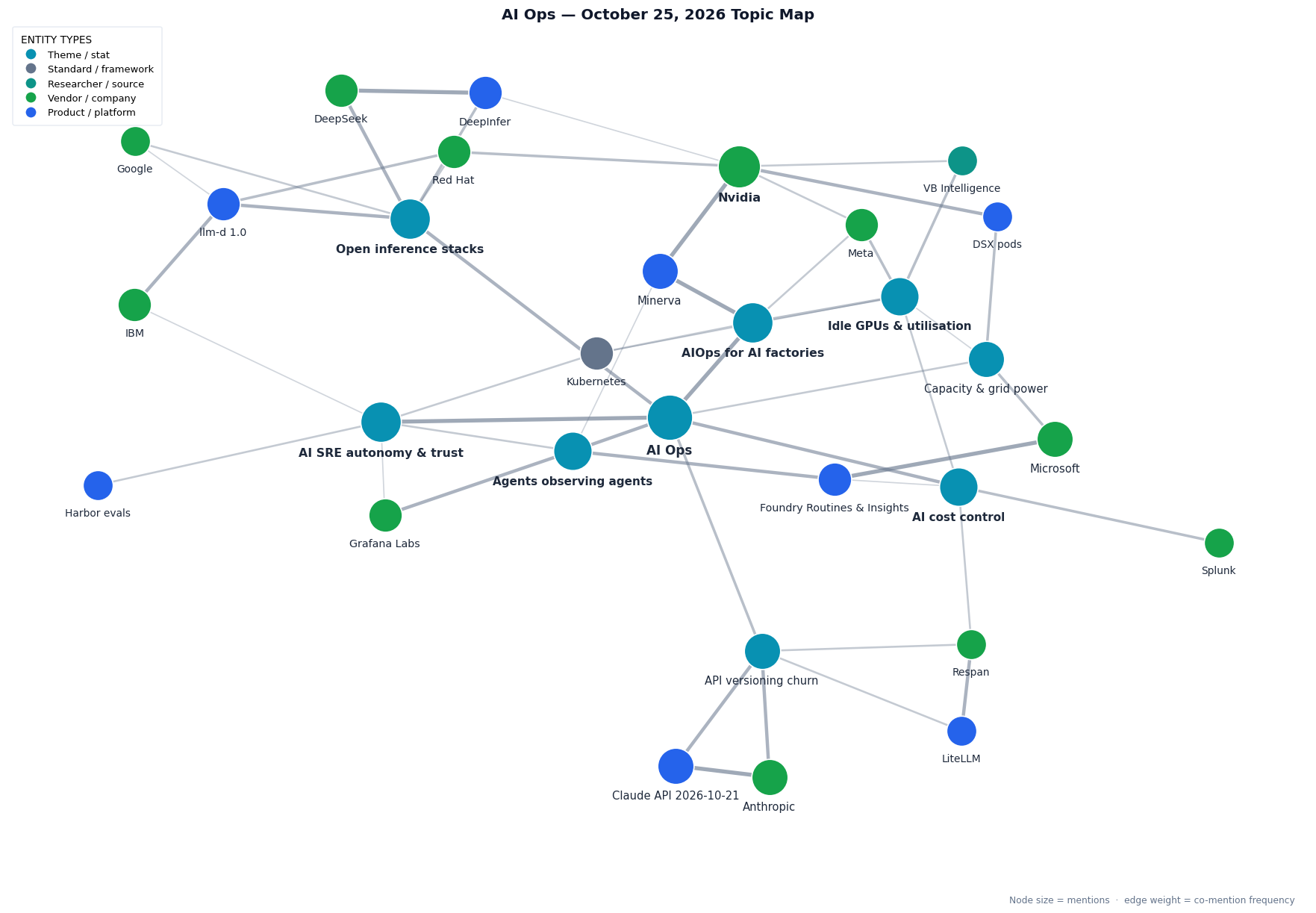
This week’s topic map. Nvidia sits at the top, joined to Minerva and AIOps for AI factories in the centre and to DSX pods, Meta and the idle-GPU cluster on the right, where capacity and grid power meet Microsoft. Open inference stacks fill the upper left with DeepSeek, Red Hat, llm-d, IBM and Google. AI SRE autonomy and agents observing agents sit just left of centre with Grafana Labs and Harbor, and Microsoft’s Foundry links them to AI cost control and Splunk. API versioning churn hangs below, with Anthropic’s new Claude API version, Respan and LiteLLM.
View interactive topic map →
Article index
29 articles, grouped by sub-theme. Eighteen are from this week’s coverage window (October 18 to October 25). Eleven are longer foundational reads on the beat. Sponsored coverage, vendor blogs and contributed pieces are labelled within each group.
AIOps for AI factories
Operating GPU estates as one system, and what low utilisation is costing. The Minerva item is Nvidia’s own blog. VentureBeat’s figures come from a self-selected survey of 102 respondents. The GPU-pool piece is sponsored by CNCF and written by an IBM marketer; the autoscaling post is by AWS engineers.
| Article |
Source |
Published |
| 1. NVIDIA Unveils Minerva to Bring End-to-End Observability for AI Factories (vendor blog) |
NVIDIA Blog |
Oct 22, 2026 |
| 2. Nvidia is pitching AI factories, but 81% of companies say their GPUs run at half capacity or less |
VentureBeat |
Oct 22, 2026 |
| 3. Tens of thousands of Nvidia GPUs sit idle in Meta’s Prometheus supercluster, just waiting for a failure |
The Register |
Oct 20, 2026 |
| 4. How AI workloads are reshaping Kubernetes autoscaling (foundational, member post) |
CNCF Blog |
Oct 19, 2026 |
| 5. Before you expand your GPU pool, measure the outcome (foundational, sponsored by CNCF) |
The New Stack |
Oct 24, 2026 |
Capacity, power and neoclouds
Where new GPU capacity comes from, and what stops it. The neocloud interview is theCUBE coverage paid for by Dell.
Open inference stacks
More of the serving stack is now open source, from DeepSeek’s engine to llm-d 1.0 and PyTorch on TPUs. The inference-stack piece is sponsored by Nebius. Unite.AI’s TorchTPU article carries a byline its publisher describes as an AI research agent, reviewed by editors.
Agents observing agents
Observability platforms now run their own agents to watch the agents customers deploy, and schedule them too.
AI SRE: trust, autonomy and evaluation
When an agent may change production, what to do when it causes the incident, and how to test one before buying. Three DevOps.com pieces are contributed, one by the CEO of an alerting vendor. The CNCF post is by the maker of the context tool it benchmarks, the DZone lab is by a Bronto employee, and the ServiceNow piece is a vendor blog.
| Article |
Source |
Published |
| 18. AI can find IT problems faster, but fixing them is another matter |
TechTarget |
Oct 19, 2026 |
| 19. The Automation Confidence Gap: When Should AI Be Allowed to Change Production? (foundational, contributed) |
DevOps.com |
Oct 23, 2026 |
| 20. When the Agent is the Incident (foundational, contributed) |
DevOps.com |
Oct 22, 2026 |
| 21. Navigating AI Infrastructure Incidents: Bridging the Critical Gap Between Detection and Response (foundational, contributed) |
DevOps.com |
Oct 21, 2026 |
| 22. Before you evaluate an AI SRE, give your existing agent context (foundational, member post) |
CNCF Blog |
Oct 21, 2026 |
| 23. How to Build Your Own AI SRE From Scratch (foundational) |
DZone |
Oct 23, 2026 |
| 24. Hill-climbing enterprise AI: How ServiceNow built its AI specialists (foundational, vendor blog) |
ServiceNow Workflow |
Oct 23, 2026 |
| 25. Harbor Adds Docker Sandboxes to Run Reproducible AI Agent Evals in Isolated MicroVMs |
InfoQ |
Oct 22, 2026 |
APIs, gateways and AI bills
The layer between applications and models: a breaking API version, a gateway rewrite, and the cost of every call. AlphaSignal’s page gives only a relative date.
Detailed write-ups
1. Anthropic ships its first new Claude API version since 2023
AlphaSignal · October 21–22, 2026
Anthropic released Claude API version 2026-10-21, the first new version since 2023-06-01. AlphaSignal’s headline calls it a rewrite. It is closer to a scheduled set of breaking changes, and none apply unless you ask for them. A request changes behaviour only when it sends anthropic-version: 2026-10-21 or comes from an SDK major version that selects it by default, such as the Python anthropic package 2.0.0. Older SDK majors keep sending 2023-06-01, which Anthropic has not deprecated.
The change that matters most for operations is sampling. Requests that send temperature, top_p or top_k now return a 400 error, even at their default values, and sampling runs at the defaults, including a temperature of 1.0. Claude 4.7 and later already accept only the defaults, so nothing changes there. On models such as Claude Sonnet 4.6, a call that lowered temperature for more consistent output loses that effect, and Anthropic’s migration guide says no other setting replaces it. Those calls can stay on the old version.
Other changes affect infrastructure teams. The SDKs and CLI now send keys as Authorization: Bearer instead of X-Api-Key. The API accepts both, but proxies and gateways that read only the old header need updating. Passing more than one credential to a client raises an error, and the CLI drops its --api-key and --auth-token flags. The Messages API rejects document blocks in assistant messages and citation arrays in user messages. Admin and analytics responses rename fields such as actor.email and replace workspace_id on API keys with a scope object, which will break dashboards and cost reports built on them. On Amazon Bedrock the new version works only with Claude 4.7 and later. New SDK releases move from the MIT licence to Apache 2.0.
Sources: AlphaSignal (Claude API 2026-10-21) — https://alphasignal.ai/news/anthropic-rewrites-claude-api-after-3-years-removing-temperature-controls
2. Nvidia brings AIOps to the AI factory as GPUs sit underused
NVIDIA Blog / VentureBeat · October 22, 2026
At GTC Berlin, Nvidia launched Minerva, an AIOps platform for its own estates. It combines telemetry from GPUs, networking, storage, schedulers and jobs, and builds a live knowledge graph of GPUs, SuperNICs, switches, cables and the jobs on them, so an operator can trace a slow job to the part causing it. Nvidia says it processes billions of data points an hour, uses machine learning to spot anomalies and predict failures, and groups related alerts into root-cause incidents. It includes a natural-language assistant grounded in live telemetry, can connect to outside agent tools, and can optionally act through infrastructure APIs. IREN runs it today; Aolani, Bitdeer AI, IBM, Jio, Lambda, Quake AI and Tesla plan to. Dell, Lenovo and Supermicro will sell it with their AI factory systems. IREN CTO Denis Skrinnikoff says it gives his team “one view across the network, the GPUs and the jobs running on them.” Nvidia gave no price.
VentureBeat’s numbers show why the tool has a market. In its September survey of 102 qualified respondents, 55 of the 68 running AI in production, 81%, said average GPU utilisation was 50% or less. Most of that group still plan a new or replacement AI platform within a year, but only 10% of all respondents had a return-on-investment figure that finance had reviewed. Cost per million tokens was a buying factor for 23%, up from 11% in August. The gap between ranks is wide: 52% of VPs and directors cited total cost of ownership, against 4% of individual contributors. The author suggests a better core metric for agent workloads: cost per successfully completed task.
Sources: NVIDIA Blog (Nvidia Minerva, vendor blog) — https://blogs.nvidia.com/blog/minerva-platform-infrastructure/?ref=bitdeer.ai · VentureBeat (idle-GPU survey) — https://venturebeat.com/infrastructure/nvidia-is-pitching-ai-factories-but-81-of-companies-say-their-gpus-run-at-half-capacity-or-less
3. The price of keeping a giant training cluster running
The Register / SiliconANGLE · October 19–23, 2026
Meta says more than 11% of the GPUs in its Prometheus supercluster in New Albany, Ohio, are dead or held in reserve. Each GB200 and GB300 rack has 72 GPUs in one NVLink domain, but only 64 run the main training job; the other eight are hot spares. After The Register’s first report, Meta clarified that the spares run side jobs that can be pre-empted when a GPU fails, and the headline was softened. The spares are one of several steps that cut training interruptions from about 1,000 a day per 8,000 GPUs to about 11, a 99% drop. When a fault is confined to one copy of the model, that copy restarts on spare hosts and the rest of the cluster carries on, “converting a potential total system halt into a minor, temporary reduction in aggregate throughput,” Meta wrote. Distributed checkpoints save model state in the background.
Building capacity is slow too. Nvidia unveiled DSX pods: 28-tonne containers holding seven Vera Rubin NVL72 racks, or 504 GPUs, built and tested at the factory by partners including HPE, Dell and Schneider Electric. Nvidia says they cut deployment from six months to as little as two weeks, with first units early next year. The pods still need power. Microsoft has ended its deal to be the anchor customer for Nscale’s planned 23,040-GPU site in Loughton, Essex, after reports that the grid may not supply enough electricity until the early to mid-2030s. Nscale says the project continues and it is looking at other power sources.
In a theCUBE interview paid for by Dell, Alpha Compute described running a 72-node Blackwell cluster in St. Louis with Dell as managed services partner. Its executive vice president, Tom Richer, warned that when several providers are stitched together, “when stuff goes wrong, the finger-pointing starts.”
Sources: The Register (Meta Prometheus spares) — https://www.theregister.com/systems/2026/10/20/tens-of-thousands-of-nvidia-gpus-sit-idle-in-metas-prometheus-supercluster-just-waiting-for-a-failure/5304269 · The Register (Nvidia DSX pods) — https://www.theregister.com/on-prem/2026/10/21/nvidias-grand-plan-for-speeding-up-datacenter-deployments-ai-trailer-parks/5304303 · The Register (Microsoft exits Essex site) — https://www.theregister.com/on-prem/2026/10/19/microsoft-abandons-uk-ai-supercomputer-as-grid-struggles-to-keep-up/5303824 · SiliconANGLE (neocloud managed services, sponsored by Dell) — https://siliconangle.com/2026/10/23/managed-services-support-keeps-neocloud-gpu-capacity-healthy-dellnewyorksymposium/
4. Agents that watch agents, and agents on a timer
SiliconANGLE / DevOps.com / InfoQ · October 19–20, 2026
At ObservabilityCON, Grafana Labs introduced Assistant Watchers, always-on agents that learn the normal telemetry patterns of other agents and flag anomalies. Grafana Managed Sandboxes, in preview, let AI test code against production behaviour and prepare fixes for a human to review. Grafana also added Pages for custom views of AI workloads, faster log search on rarely queried data at no extra cost, and an archive option that sends logs to the customer’s own object storage in open formats. Director of product Richard Lam summed up the pitch: “Most teams do not have a monitoring problem.”
Microsoft’s September Foundry roundup treats agents as scheduled production jobs. Routines, now generally available, start an agent from a timer, a schedule, a GitHub issue event or a Teams channel event, with identity and run history kept in the Foundry project. Microsoft is clear on the limit: a routine starts one agent and does not confirm that the job finished or delivered. Tool Search, also generally available, lets agents find the tools they need instead of loading every definition into each request, which cuts tokens. Insights, in public preview, groups recurring problems in production traces and attaches evidence, a likely cause and a suggested fix; in one test it caught oversized prompts being resent after rate-limit errors. It does not apply fixes. One cost trap: the hosted-agent runtime defaults to sampling 100% of traces into Azure Monitor. Futurum’s Mitch Ashley put the risk plainly: “A scheduled agent runs when nobody is watching.”
An InfoQ essay gives the reason these tools matter. Agent systems often fail by getting quietly worse rather than throwing errors, so latency and error rates miss the problem. The author recommends tracing at the level of decisions, limits on retries and reasoning depth, and a fixed fallback path when the agent is unsure.
Sources: SiliconANGLE (Grafana Assistant Watchers) — https://siliconangle.com/2026/10/20/grafana-labs-leans-on-ai-agents-to-automate-ai-agent-observability/ · DevOps.com (Foundry Routines and Insights) — https://devops.com/microsoft-foundry-puts-ai-agents-on-a-schedule-and-under-watch · InfoQ (microservices to agents) — https://www.infoq.com/articles/distributed-systems-microservices-agentic-ai/
5. AI finds the problem faster. People still own the fix
TechTarget / DevOps.com · October 19–23, 2026
TechTarget’s round-up puts numbers on the gap. In a Riverbed survey of 1,200 respondents, 90% of organisations want autonomous IT operations, but 77% are reluctant to let AI make operational decisions without human approval. SolarWinds found average resolution time fell 17.8%, nearly five hours, after teams turned on generative AI features, though its analysis does not isolate AI’s share, and 71% of IT staff in a separate SolarWinds survey said their workload stayed the same or grew. Tools reflect the caution: Infotech’s service desk module connects read-only, and NinjaOne’s Katana assistant needs a technician to approve actions. A+E Global Media automated more than 30 service catalogue items, about 5,000 requests a year, and cut resolution from about 17 hours to minutes. Editor James Alan Miller’s conclusion: “someone still has to take responsibility for verifying that it worked.”
Two contributed DevOps.com pieces turn that into practice. One proposes a 0–100 confidence score built from seven factors, including blast radius, rollback readiness and how new the change is. Below 50 the AI only recommends; 50 to 79 needs human approval; 80 to 94 runs within limits with checks at each stage; only proven, low-risk work above 95 runs on its own. A failed policy check blocks the change at any score, a separate service should enforce the limits, and confidence should decay when dependencies change or rollback tests go stale. “A high score cannot override a failed gate,” the author writes.
The other covers what happens when the agent causes the outage. Stopping the agent’s process may not stop work it already dispatched, so responders also need to block its tool access and contain queued tasks. Capture tool requests, logs, and model and prompt versions before cleanup, restore systems with the agent’s write access still off, and return autonomy in steps.
Sources: TechTarget (AI fixes and human approval) — https://www.techtarget.com/it-strategy/news/366652393/AI-can-find-IT-problems-faster-but-fixing-them-is-another-matter · DevOps.com (automation confidence index, contributed) — https://devops.com/the-automation-confidence-gap-when-should-ai-be-allowed-to-change-production · DevOps.com (agent incident response, contributed) — https://devops.com/when-the-agent-is-the-incident
6. More of the inference stack goes open source
The New Stack / SiliconANGLE / Unite.AI · October 20–21, 2026
DeepSeek released DeepInfer, the inference framework behind its own API, under Apache 2.0. It is built to run DeepSeek-V4.1-Flash on your own hardware and bundles DeepSeek’s FlashMLA, DeepGEMM and DeepEP libraries, with speculative decoding and structured outputs. It supports Nvidia’s Blackwell data centre GPUs and Huawei’s Ascend 950, but Hopper is not listed, deterministic sampling works only on Nvidia, and every published benchmark is on Nvidia. It is not yet a full service: the release handles offline inference and lacks KV cache management, multi-machine disaggregation and load balancing across replicas. A companion library reproduces DeepSeek’s API behaviour for self-hosted deployments.
llm-d, the distributed inference project led by IBM, Red Hat and Google, reached 1.0. The release adds quality-of-service controls across tenants, zero-downtime operations and flow control so bursts of agent requests do not swamp latency-sensitive services such as coding assistants. In an agentic coding test its router captured 97% of available cache reuse, and IBM and Red Hat say they ran 3,000 software-engineering agents at once at five to 10 times lower cost than a hosted service for the same open model. IBM Research’s Carlos Costa says the release “adds the maturity to run it like any other critical service.”
Red Hat and Nvidia paired model-as-a-service access controls and an AI gateway with vLLM, llm-d, Dynamo and NIM, and are making Nvidia’s OpenShell agent sandbox native to Red Hat’s platforms. Nvidia’s Sentry watches agents from a BlueField DPU, outside the host, and Red Hat says it can quarantine a compromised agent within milliseconds. “An agent shouldn’t enforce its own boundaries,” said Nvidia’s John Fanelli. Google open-sourced TorchTPU, which runs PyTorch on TPUs in eager mode for debugging and through torch.compile and XLA for production, validated on up to 8,000 Ironwood chips.
Sources: The New Stack (DeepSeek DeepInfer) — https://thenewstack.io/deepseek-deepinfer-huawei-nvidia/ · SiliconANGLE (llm-d 1.0) — https://siliconangle.com/2026/10/20/ibm-backed-llm-d-framework-adds-controls-for-running-ai-models-in-house/ · SiliconANGLE (Red Hat and Nvidia) — https://siliconangle.com/2026/10/21/red-hat-and-nvidia-expand-their-partnership-to-secure-autonomous-ai-agents/ · Unite.AI (TorchTPU) — https://www.unite.ai/google-open-sources-torchtpu-putting-native-pytorch-on-its-tpus/
7. The gateway layer and the AI bill
The New Stack / CIO Dive / InfoWorld · October 20–21, 2026
Respan built on LiteLLM for two years. In January a routine LiteLLM upgrade caused intermittent connection failures; Respan rolled back, never found the cause, and from then on pulled in upstream fixes one at a time. It has now released an open-source AI gateway written in Rust that replaces more than 100,000 lines of wrapper code, with a small core and plugins for providers, routing, MCP tools, realtime voice and security controls. Its Mistral provider is 22 lines. Two trade-offs: plugins are compiled in, so changing one means rebuilding the binary, and they run inside the gateway with access to request data. Respan has published no performance figures, the article names no licence, and the project is pre-alpha. “We still haven’t figured out the cause,” Respan wrote of the LiteLLM failure.
The gateway is also where AI spend gets controlled, and CIO Dive shows how loose that control is. Splunk’s State of Observability 2026 survey of 2,050 ITOps and engineering staff found more than half cannot control AI costs, and 60% say unexpected AI billing spikes strain operations. Google, Oracle and AWS have added caps, token bundles and a FinOps agent. Futurum’s Mitch Ashley: “A monthly report can’t govern a cost that spikes in one afternoon.”
Routing requests to cheaper models is the usual answer. InfoWorld’s guide says routing is likely to pay for itself on cost alone above 100,000 daily active users, with 50% savings common. It also warns of a trap: routers tuned to the hardest fifth of queries can send moderately complex ones to cheap models that fail silently, and the support and retention costs can reach four to five times the inference savings.
Sources: The New Stack (Respan Rust gateway) — https://thenewstack.io/respan-rust-ai-gateway/ · CIO Dive (AI billing spikes) — https://www.ciodive.com/news/ai-billing-spikes-threaten-businesses-operational-strain/833397/ · InfoWorld (model routing) — https://www.infoworld.com/article/4238176/using-model-routing-to-lower-inference-costs.html
8. Test the AI SRE you already have before you buy one
CNCF Blog / DZone / ServiceNow / InfoQ · October 21–23, 2026
A CNCF member post argues that coding agents such as Claude Code can already investigate Kubernetes clusters but miss two things: what is failing now and what changed just before. In the author’s test of 50 faults, the same model given read-only context tools reached a correct diagnosis within two minutes 86% of the time, against 60% with only a shell and kubectl. The author, Roy Libman, is product chief at the company that makes the context tool, so treat the numbers as a vendor’s. His advice holds anyway: measure your current agent with context as a baseline before evaluating a product, and run it read-only, with no access to Secrets and every tool call recorded.
A DZone lab by a Bronto employee walks through building a basic AI SRE in seven steps, adding prompt files, an MCP telemetry server, GitHub issue output, a model swap and read-only source access. The lesson is that the data mattered more than the agent: a quiet-period baseline, latency metrics and a span attribute linking traces to commits drove the gains. The agent could also be confidently wrong, once reading an empty query result as an outage.
ServiceNow’s team describes improving its agents through one-change-at-a-time experiments, tracking the share of work resolved without a human alongside resolution quality, because either alone can be gamed. For repeatable tests, the open-source Harbor evaluation framework now runs each task in its own Docker Sandbox microVM. On Docker’s cloud sandboxes, setup can download dependencies before internet access is restricted for the run, so every agent works under the same network conditions. Docker has not published startup overhead, per-task cost or score variance.
Sources: CNCF Blog (AI SRE context, member post) — https://www.cncf.io/blog/2026/10/21/before-you-evaluate-an-ai-sre-give-your-existing-agent-context/ · DZone (build your own AI SRE) — https://dzone.com/articles/build-ai-sre-from-scratch · ServiceNow Workflow (hill-climbing agents, vendor blog) — https://www.servicenow.com/workflow/ai/hill-climbing-how-we-built-enterprise-ai-agents.html · InfoQ (Harbor and Docker Sandboxes) — https://www.infoq.com/news/2026/10/ai-agents-harbor-docker/
Calls to action
- Pin your Claude API version before the next SDK upgrade. Set
anthropic-version explicitly or hold SDK major versions until you have tested 2026-10-21. A routine dependency bump is enough to start returning 400 errors on calls that send temperature, top_p or top_k.
- Find every call that sets sampling parameters. List the jobs that lower temperature for consistent output, decide which can run at the defaults, and keep the rest on 2023-06-01 for now. Check Bedrock workloads on models older than Claude 4.7, which cannot move yet.
- Check your proxies and gateways for the new auth header. Make sure anything between your apps and the Claude API reads
Authorization: Bearer as well as X-Api-Key, and update cost dashboards that read the renamed analytics fields.
- Measure GPU utilisation and cost per completed task before buying capacity. If you cannot show a finance-reviewed figure, stagger jobs and load-test serving capacity first.
- Add completion checks to scheduled agents. Before turning on a recurring Foundry Routine or similar, confirm you can detect a run that started but never delivered, and lower trace sampling on Foundry hosted agents, which default to 100%.
- Write a kill procedure for agents. Make sure on-call staff can block an agent’s tool access and drain its queued work, not just stop its process, and capture logs and prompt versions before cleanup.
- Give agent changes a gate a score cannot override. Put policy checks for production changes in a separate service the agent cannot approve, and require human approval for anything that is new or hard to roll back.
- Set spend alerts that fire within hours. Put per-team caps or daily alerts on model spend at the gateway, since monthly reports arrive too late for a one-afternoon spike.
|