This week at a glance
The biggest move of the week was a possible change of owner. Reuters reported on November 6 that Extreme Networks, valued at about $3 billion, is working with an investment bank on a sale after receiving takeover interest. Sources named Fortinet, Cisco and NetApp as possible strategic buyers. Extreme’s shares rose about 15% that day. Days earlier Extreme’s CEO had told Channel Dive he was signing large managed service providers away from Cisco and HPE and would share agent-action revenue with partners. The independent challenger in enterprise networking could end up inside a security or storage company, and its customers and partners now face months of uncertainty.
The incumbents spent the week on the channel. Cisco told partners to lead with high-margin resilience services, using Cisco IQ to find risk in a customer’s estate and then deploy agents to fix it. Its channel chief said partners that adopted the new Cisco 360 programme are pulling ahead on profit and that those doing business as usual are not. LogicMonitor took a different route on price: AI is now included in every tier, with an allowance of AI credits per unit, and a UK managed service provider reported 83% less alert noise and 44% faster resolution. After last week’s Gartner warning on metered agent pricing, vendors are now taking clear positions on how they charge for AI.
On demand, IDC says AI is driving networking spend but that “ambition outpaces readiness”, with automation and skills the slowest parts to catch up. Gartner now puts network-as-a-service in the trough of disillusionment at 1–5% adoption, against its forecast of 15%, although Wellesley College replaced Cisco with Nile this summer. Across enterprises and carriers the message on trust was the same. ONUG attendees, Lumen and EchoStar all keep a human approval step before agents change the network, and a TM Forum survey found 72% of operators call their AI trustworthy while only 14% can prove it. For an enterprise NetOps vendor, the week points to three things: watch Extreme’s accounts, be clear about AI pricing, and sell evidence that agents act safely.
On our watch list
- Whether Extreme’s sale process produces a buyer. Reuters names Fortinet, Cisco and NetApp, with others possible. A security buyer would fold Platform ONE into a firewall-led portfolio, Cisco would remove a direct rival, and NetApp would be a move into networking. Any of the three changes who competes for the enterprise NOC.
- How Extreme’s customers and partners react during the process. Extreme expects half its customers on Platform ONE by the end of 2026 and has just signed an unnamed telecom company as its largest managed service provider. Watch for stalled renewals, slower partner sign-ups and rivals targeting Extreme accounts while the outcome is unclear.
- Cisco’s fiscal first-quarter results, expected in mid-November. The date is not yet confirmed. Watch for Cisco IQ adoption, services attached to the refresh cycle, and whether Cisco says anything about Extreme.
- Gartner’s I&O conferences in London (November 16–17) and Las Vegas (December 8–10). Gartner warned last month that metered agent pricing overruns budgets. Watch how its analysts frame agent pricing and verification for buyers, and which vendors, Forward among them, use the stage to make their case.
- Whether other vendors follow LogicMonitor in bundling AI. LogicMonitor includes 20 to 150 AI credits per unit depending on tier. The test is whether customers use up those allowances and pay for more, and whether rivals answer with bundles of their own or stay with metered pricing.
- Who licenses HPE’s Mist AI Ops code, and who buys Aruba Instant On. Both are obligations of HPE’s settlement over the Juniper deal. The buyers will gain a ready-made AI operations engine and a small-business networking line, creating a new competitor in the midmarket.
- Evidence that operators trust their agents. TM Forum’s figures are 72% claiming trustworthy AI and 14% able to prove it, and it has launched a certification for trustworthy AI. EchoStar expects to widen autonomous fixes over the next 12 months. Certified operators or published approval records would show trust moving from claim to proof.
- Whether NaaS climbs out of the trough. Gartner puts adoption at 1–5%. Wellesley is moving its residence halls to Nile over winter break. Watch for more campus wins by Nile and Meter, and whether incumbents respond with their own subscription pricing.
- Arista’s push into the campus. Arista is targeting more than $1.25 billion in campus revenue this year, and its AVA assistant covers campus, WAN, data centre and cloud. Named campus wins against Cisco and HPE would add a third well-funded platform vendor to the enterprise NOC.
- Auvik’s next step to autonomous fixes. Auvik has an automation framework and a vulnerability-monitoring agent but has not published prices. Watch for pricing and for the first remediation that runs without a person, which would bring autonomous operations to the midmarket and managed service providers.
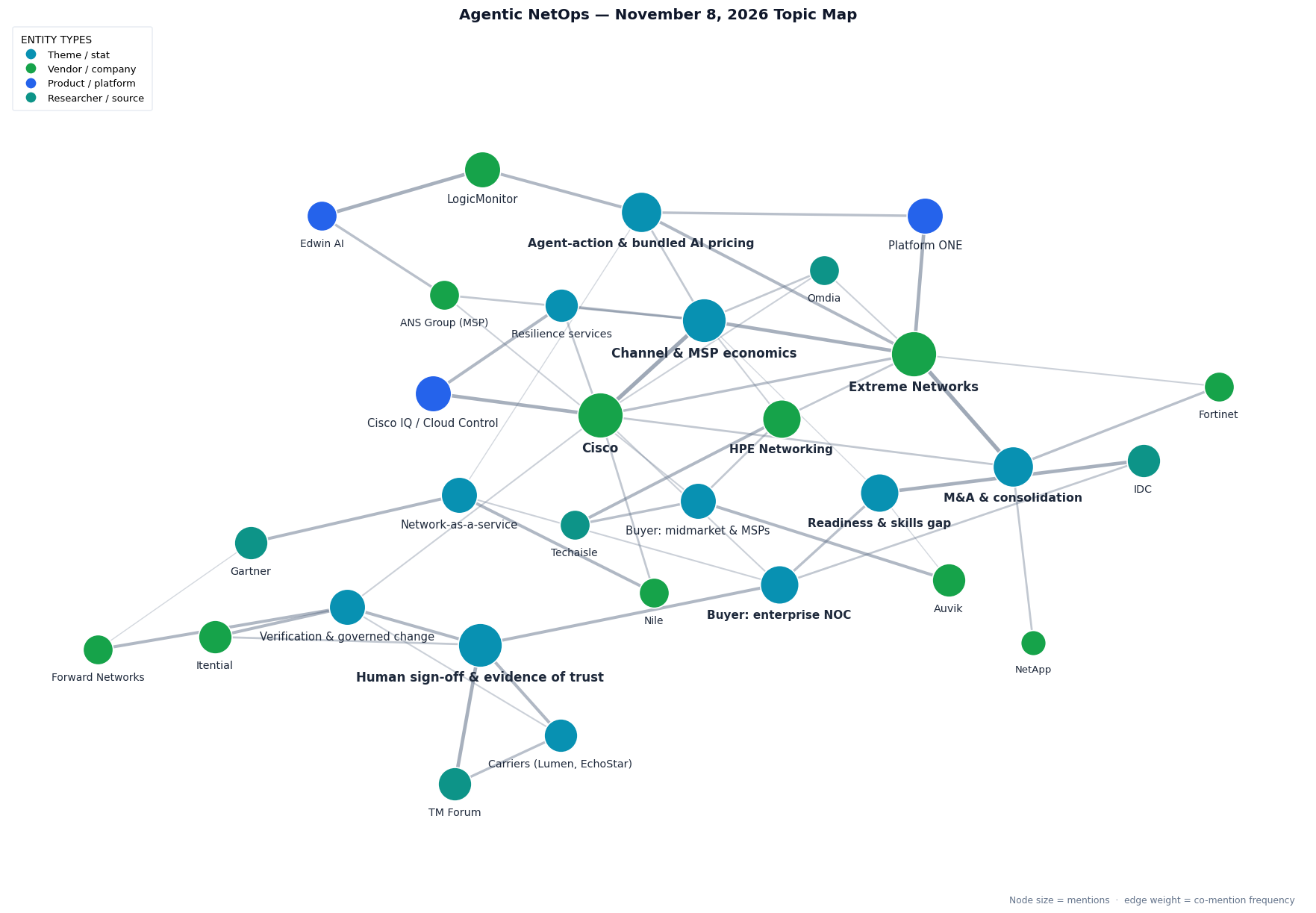
Entities and connections across this week’s 24 tracked stories. Node size reflects how often an entity appears; line weight reflects how often two appear together.
View interactive topic map →
Article index
Deal-making and competitive moves
Extreme Networks is for sale and recruiting Cisco and HPE partners at the same time. Techaisle argues HPE is serving the upper midmarket and leaving smaller buyers exposed, and Arista’s record quarter comes with a campus revenue target of more than $1.25 billion.
Cisco and the channel
Cisco wants partners to sell resilience as a recurring service built on Cisco IQ, and says partners who adopted Cisco 360 are making more money than those who did not.
Pricing, packaging and buyer outcomes
LogicMonitor bundled AI into every tier and published a customer’s outcome figures. Auvik extended its agents into automation and vulnerability checks for the midmarket, and NETSCOUT promoted an EMA brief on data as the basis for AI operations.
Buyer demand and readiness
Spending is rising but readiness is not keeping up: IDC sees automation and skills as the slowest areas. NaaS has fallen far short of Gartner’s forecast, although one college has replaced Cisco with it. Cisco and CBTS say buyers need predictable results and someone accountable for running the platform.
The NOC operating model: trust and governance
Carriers and enterprise network teams gave the same answer: agents can investigate, and people still approve changes. Vendors are selling verification, governed change and the visual tools people use to check what agents find.
| Article |
Source |
Published |
| 15. Autonomous networks are one thing – trusting AI to run them is another |
TelecomTV |
Nov 5, 2026 |
| 14. EchoStar puts guardrails around AI as network automation advances |
Fierce Network |
Nov 5, 2026 |
| 11. AI is rewriting telecom’s old vendor playbook |
Fierce Network |
Nov 4, 2026 |
| 22. ONUG Fall 2026 takeaways: Networks must change faster, and few teams have a safe place to test (foundational, CodiLime-authored) |
CodiLime |
Nov 4, 2026 |
| 18. How much AI risk is acceptable? The compromise infrastructure leaders shouldn’t have to make (foundational, Forward Networks-authored) |
Forward Networks |
Nov 2, 2026 |
| 23. AI Can Work the Ticket. Who Governs the Change? (foundational, Itential-authored) |
Itential |
Nov 5, 2026 |
| 24. You Already Have the Tools for Building AI Agents: Why MCP Is an Option, Not a Prerequisite (foundational, Itential-authored) |
Itential |
Nov 5, 2026 |
| 19. The GUI Isn’t Disappearing. Its Job Is Changing. (foundational, NetCrunch-authored) |
AdRem Software |
Nov 3, 2026 |
| 20. How Agentic NetOps Accelerates Operations Team Efficiency at Scale (foundational, NetBrain CTO byline) |
Petri |
Nov 4, 2026 |
Detailed write-ups
1. Extreme Networks puts itself up for sale
Reuters (via Bellingham Herald) · November 6, 2026
Extreme Networks is exploring a sale after receiving takeover interest, Reuters reported on November 6, citing people familiar with the matter. The company, valued at about $3 billion, is working with an investment bank on the process. Sources named Fortinet, Cisco and NetApp as possible strategic buyers, among others. Extreme and NetApp declined to comment, and Fortinet and Cisco did not immediately respond. Extreme’s shares rose about 15% in Friday trading, and MarketWatch reported they were up 42% for the year. No bid or agreement has been reported.
The timing fits Extreme’s recent progress. Last week it reported 22% growth in SaaS recurring revenue, raised its full-year guidance and launched Agent ONE Operator, an agent that acts within limits engineers set and is paid for by the action. A buyer would get one of the few independent enterprise networking platforms of meaningful size, a cloud management base moving quickly onto Platform ONE, and an agent pricing model already in front of customers.
Each named buyer would change the market differently. Fortinet would add a cloud-managed campus and an AI operations layer to its security-led networking pitch, matching HPE’s move to put SASE in the network console. Cisco would remove the rival that has been courting its unhappy customers and partners. NetApp would be a move from storage into networking. For other vendors, a sale process creates months of uncertainty for Extreme’s customers and partners. They will want assurances on roadmap and support, and some will look at alternatives.
Sources: Reuters (via Bellingham Herald) (Networking firm Extreme Networks explores sale, sources say)
2. Extreme courts Cisco and HPE partners with a share of agent revenue
Channel Dive · November 2, 2026
Before the sale report, Extreme CEO Ed Meyercord told Channel Dive he was recruiting large partners away from Cisco and HPE. In the quarter to September 30, Extreme signed an unnamed telecom company that will become its largest managed service provider, along with German MSP Regio IT and A1 Telekom Austria. Meyercord said 10% of customers were on Platform ONE at the end of 2025, and he expects 50% by the end of 2026 and 80% by the end of 2027.
His pitch to partners is about how AI will be paid for. Extreme will charge for AI inside the platform in tokens, and partners will earn from agent actions. “Our tokens are agent actions. We’re deep in the throes of this,” Meyercord said, adding that it is “still early innings”. No rates were given. He argued that Cisco’s incentives for selling its whole portfolio leave smaller partners behind, and that HPE’s Juniper integration has left partners unsure whether Mist or Aruba Central will survive. Cisco replied that its programme rewards the value partners deliver, not how much of the portfolio they sell. HPE said it is investing in both platforms. Omdia’s Devan Adams said Extreme is targeting networking specialists while Cisco and HPE pay for full-suite breadth.
Extreme is tying partner pay directly to agents doing work. If it works, managed service providers have a direct financial reason to switch on autonomous operations rather than sell hours. The sale process complicates it: a partner weighing a move to Extreme now has to consider who will own the platform next year. For competitors, the specialist partners Extreme is recruiting are also open to other offers.
Sources: Channel Dive (Extreme Networks picks off Cisco and HPE partners)
3. Cisco tells partners to sell resilience as a recurring service
CRN · November 3–4, 2026
A week after its Partner Summit, Cisco is telling partners to lead with “resilient infrastructure” services. Chief customer experience officer Liz Centoni described a three-step sale: use Cisco IQ and Cloud Control to uncover risk and outdated equipment in a customer’s network, modernise operations, then deploy AI agents that act rather than just alert. “This is your professional services, by the way, high value, high margin,” she told partners. Cisco paired the pitch with new AgenticOps features in Cloud Control, Model Foundry and broader Live Protect support.
Channel chief Tim Coogan told CRN that Cisco IQ “is not a product. We don’t sell it”: it is the platform on which partners build recurring and managed services. He cited Omdia’s estimate of six dollars of partner services for every dollar of Cisco revenue. Cisco 360 has added Secure Networking and Secure AI specialisations and a cross-sell incentive that now covers Splunk. Coogan said partners have earned 657,000 Black Belt certifications, but results have been uneven across partners and regions, and those doing “business as usual” have not seen profits rise as fast.
Cisco is turning its installed base into a recurring service run by partners. The assessment finds the risk, the refresh fixes it, and Cisco’s own agents keep it fixed. That is a direct challenge to independent assurance and automation vendors that sell into Cisco estates, because the partner now has a paid reason to recommend Cisco’s tools. Coogan’s admission that results are uneven shows some partners are not yet profiting. Those partners are the ones Extreme, and other vendors, can approach.
Sources: CRN (Cisco Pushes Partners To Lead With ’High-Margin’ Resilient Infrastructure Services) · CRN (Cisco Channel Chief Tim Coogan: Partners Leaning Into 360 Are Pulling Ahead On Profitability)
4. LogicMonitor includes AI in every tier, with published customer results
Business Wire · November 4, 2026
LogicMonitor made its Edwin AI and digital-experience tools standard in all three of its platform tiers. Each tier includes an allowance of AI credits per unit of capacity: 20 in Essentials, 75 in Advanced and 150 in Signature. One allowance covers event intelligence, automation, AI agents and access through MCP. LogicMonitor says it has sold more than 826,000 units since launching this pricing in September 2025, and that more than 90% of new customers this year chose it. “IT teams don’t need more separate Observability tools with AI bolted on; they need a connected operating model,” said chief product officer Garth Fort.
It released customer results the same day. ANS Group, a UK managed service provider, deployed Edwin AI in August and reports 83% less alert noise, 45% fewer incidents (from about 4,300 in July to 2,383 by late October) and 44% faster average resolution, with service levels kept above 97%. ANS calculates a 500% return on its extra Edwin AI spend; that figure has not been independently verified. “AI gives us an opportunity to fundamentally rethink how managed services are delivered,” said ANS CTO Kyle Hill.
Last week Gartner told buyers that metered agent pricing overruns budgets, and Extreme moved its acting agent to metered tokens. LogicMonitor has taken the other side: AI included in the price, with a capped allowance. Paired with a managed service provider’s before-and-after figures, that answers the two questions buyers keep asking, what AI will cost and what it will deliver. Vendors that charge separately for AI should expect to be compared with this offer.
Sources: Business Wire (LogicMonitor Makes AI the Standard, Not the Upgrade) · Business Wire (ANS Cuts IT Alert Noise by 83% with LogicMonitor Edwin AI)
5. Spending is up, but buyers are not ready to automate
Network World · TechTarget · CBTS · November 2–4, 2026
IDC forecasts enterprise AI infrastructure spending of $623 billion in 2026, up 31%. Most of that is servers, with networking the fastest-growing category and a significant campus refresh under way. Dell’Oro reports enterprise networking revenue up 15% in the first half, with double-digit growth in every major segment. But IDC’s analyst told Network World that “ambition outpaces readiness”: organisations have many AI initiatives and few defined use cases, networking is among the least mature areas, and automation will have “a very long tail”. Skills gaps are significant, and IDC recommends training and outside help. AI and security are the budgets least likely to be cut.
Cisco’s Joe Vaccaro told TechTarget that alert volume is now the main reason to adopt AI: “If humans alone were simply responsible for resolving those alerts, you can’t hire enough people to go do that.” His answer is “deterministic execution”, where agents run predefined, tested workflows rather than improvising changes. Services provider CBTS made the buyer’s version of the same point: choosing the platform is only half the decision, and “the other half is who operates it, and who is accountable when it doesn’t work?”
Money is available, but buyers lack the staff and processes to automate. Budgets are rising faster than the skills to use them. Vendors that bring operating help, through managed services, partners or prebuilt workflows, can win deals that a product sale alone would not. Cisco’s emphasis on predictability also sets the standard: buyers want agents that run proven workflows, not agents that experiment on the network.
Sources: Network World (AI networking spending grows, but enterprise network readiness lags) · TechTarget (The rise of agentic AI in networking) · CBTS (AI-native networking: The platform is only half the decision)
6. NaaS falls short of forecasts, while one college replaces Cisco with Nile
Network World · Wellesley College · November 2–6, 2026
In 2021 Gartner forecast that 15% of enterprises would use network-as-a-service by 2024. Its 2026 hype cycle puts adoption at 1–5% and places NaaS in the trough of disillusionment, Network World reports. An ISG survey of 200 network decision-makers found 61% have at least partly adopted NaaS but only 1% have a mature deployment. The common complaints are unpredictable consumption pricing, lock-in to the provider’s hardware, and a term so loosely used that Gartner calls it “nondescriptive”. Buyers that have adopted it report clear benefits. The Rivers School in Massachusetts moved to Meter with a one-person network team; “It’s night and day having visibility in the network,” said its technology director.
A concrete example came from Wellesley College, whose IT leader wrote that it replaced its legacy Cisco network with Nile’s NaaS this summer, citing performance bottlenecks, operating complexity and slow vendor response. The college reported better speed and reliability with little disruption, and plans to move residence halls over winter break.
NaaS is growing slowly, but where it wins, it replaces the incumbent outright, including the operations tools. Nile and Meter are selling the operating model as well as the hardware, which appeals to small teams. For NetOps software vendors the risk is limited for now at enterprise scale, but campus and education estates with small teams are where it is happening.
Sources: Network World (NaaS hasn’t lived up to the hype. Is it still worth it?) · Wellesley College (Reflections on a Busy Summer: Modernizing Campus Infrastructure and Video Management)
7. Enterprises and carriers want proof before agents act
TelecomTV · Fierce Network · CodiLime · Forward Networks · Itential · November 2–5, 2026
A TM Forum survey with IBM found that 72% of service providers believe their AI is trustworthy but only 14% can produce evidence of it. “You can be at Level 4 autonomy, but not trusted,” said TM Forum’s Guy Lupo, whose organisation launched a certification for trustworthy AI governance in October. At FutureNet in New York, Lumen’s Greg Freeman was blunt: “Am I going to allow a generative AI or agentic AI to go out and make changes on my network? I’m not.” Lumen’s agents can only call workflows its engineers have built and tested. EchoStar lets its systems fix some problems on their own and expects to widen that over the next year, if it can validate what the agents do.
Enterprise network teams said the same. At ONUG’s fall meeting, attendees said they would not let AI change production without human approval, and that agents need identity, audit trails and clear limits before they can scale, according to CodiLime’s summary. Vendors are building their pitches around that demand. Forward Networks argues that “AI governance isn’t a policy problem. It’s a verification problem”, and proposes testing every human or agent change against a model of the network first, which also produces evidence for regulators. Itential warns that a high count of closed tickets does not prove service was restored, and treats investigation, approval, execution and verification as separate steps.
Buyers will let agents investigate now. They will let them change the network only with evidence that it is safe. The gap between 72% confidence and 14% evidence is a sales opportunity: vendors that can produce approval records, test results and audit trails give buyers the proof they currently lack. Vendor content that sells autonomy without showing how it is checked is likely to meet resistance from buyers this year.
Sources: TelecomTV (Autonomous networks are one thing – trusting AI to run them is another) · Fierce Network (AI is rewriting telecom’s old vendor playbook) · Fierce Network (EchoStar puts guardrails around AI as network automation advances) · CodiLime (ONUG Fall 2026 takeaways: Networks must change faster, and few teams have a safe place to test) · Forward Networks (How much AI risk is acceptable? The compromise infrastructure leaders shouldn’t have to make) · Itential (AI Can Work the Ticket. Who Governs the Change?)
8. Auvik brings autonomous IT to the midmarket as HPE leaves gaps there
Business Wire · Techaisle · November 4–5, 2026
Auvik, which sells mainly to midmarket IT teams and managed service providers, launched an automation framework that runs scheduled or on-demand jobs across groups of devices, and an agent that checks published vulnerabilities against a customer’s equipment. They join troubleshooting, alert and lifecycle agents released earlier this year; Auvik says its alert agent cuts repeat alert noise by up to 80%. It gave no pricing. “Autonomous IT isn’t something off in the distance. It’s something we have built pervasively into the platform,” said CEO Doug Murray, who described automation as a step toward networks that fix themselves with people in control.
Techaisle analyst Anurag Agrawal argues that HPE serves the upper midmarket well and smaller buyers less well. Under its settlement over the Juniper deal, HPE is divesting Aruba Instant On, its small-business networking line, and licensing Mist’s AI operations code to rivals. Aruba Central and Mist still run as separate platforms. HPE’s channel programme favours partners with depth across its data-centre portfolio. Techaisle’s data shows 85% of midmarket firms short of specialist staff, and HPE routes 90% of its networking business through partners.
The midmarket is where autonomous operations may arrive first: teams are small, alert volumes are high, and managed service providers want to deliver more with fewer engineers. Auvik is selling directly into that gap, and HPE’s required licensing of Mist’s AI code could give other vendors a ready-made engine. Enterprise-focused vendors should watch whether midmarket tools and managed service providers start moving up into larger accounts.
Sources: Business Wire (Auvik Launches Automation Framework and CVE Monitoring Agent, Continuing to Advance Its Vision for Autonomous IT) · Techaisle (Is HPE Solving SMB Problems? Only the Ones the Upper Midmarket Has)
Calls to action
- Build an account plan for Extreme’s customers now. A sale process means months of roadmap and support uncertainty. Identify Extreme accounts and partners in your pipeline and offer coexistence and migration assurances before a buyer is named.
- Recruit the specialist partners Cisco and Extreme are competing for. Omdia says Extreme is targeting networking specialists, and Cisco admits some partners are not yet profiting under Cisco 360. Offer them a managed service they can brand as their own, with a clear share of revenue from automated work.
- Decide and publish how you charge for AI. LogicMonitor now includes AI credits in every tier, and Extreme meters agent actions. Buyers will compare the two, so set out what is included, what is metered and how costs are capped.
- Publish named before-and-after results. ANS’s 83% less noise and 44% faster resolution is the kind of figure buyers can take to a budget meeting. Put comparable figures from your own customers in front of prospects.
- Package your evidence of safe automation. Only 14% of operators can prove their AI is trustworthy. Show buyers the approval records, pre-change tests and audit trails your platform produces, and how agents gain authority one task at a time.
- Bring operating help into the sale. IDC sees automation and skills as the slowest parts of AI readiness. Bundle onboarding, prebuilt workflows or partner-run operations so that a lack of staff does not stall the deal.
|