|
The Competitive Brief · June 14, 2026 · Weekly Edition
The Competitive Brief
Funding, M&A, and platform moves shaping the AI-coding, AI-security, and DevSecOps landscape
|
At a glance
Be honest internally: this was a thin, niche week for competitive intelligence. No megarounds, no M&A, no surprise GA from a hyperscaler. What we got instead was a cluster of competitor self-positioning — conference launches and survey-driven thought-leadership — running alongside competitors’ own security problems. The most useful material this week is the contrast, not the headlines.
GitLab dominated the week from both ends. At its Transcend event it unveiled Next-Gen Source Code Management, an Orbit context graph, and “Governance for Agents” — pitching the exact speed + control + governance triad JFrog uses for its own platform. Then, the same week, it shipped fixes for 12 vulnerabilities including a CVSS 8.7 account-takeover flaw in its Group SAML Identity API. A vendor marketing “governed, auditable” delivery while patching credential-free account takeover is a contrast worth keeping handy. Checkmarx ran the same play in miniature: a 2,350-respondent “2027 AppSec Outlook” report (a thought-leadership move against our own State of the Union motion) launched while its TeamPCP/Trivy GitHub breach — the 96GB Lapsus$ archive — remained live via a June 1 update.
On the pure-play SCA side, Snyk had an active GTM week — a claimed 61% reduction in token cost per SCA fix, lead coverage on the npm “binding.gyp” worm, and a presenting-partner slot at the first AI Engineer World’s Fair security track — momentum worth tracking amid dimming IPO prospects. The npm worm itself (the foundational event of the week) became a competitive land-grab, with Snyk, Wiz, StepSecurity, and Arnica racing out advisories. On our own side: JFrog confirmed Russell 3000 inclusion ahead of the June 26 reconstitution, and our 58-page Supply Chain Security State of the Union earned coverage in The New Stack. Minor, but both are visibility wins to log.
|
Topic map — this week’s competitive landscape
A deliberately thin week: GitLab’s agentic-scale launch shadowed by its own account-takeover CVEs, Checkmarx’s survey report play against a still-live breach recap, Snyk’s GTM momentum around the npm worm, and JFrog’s own index and report visibility.
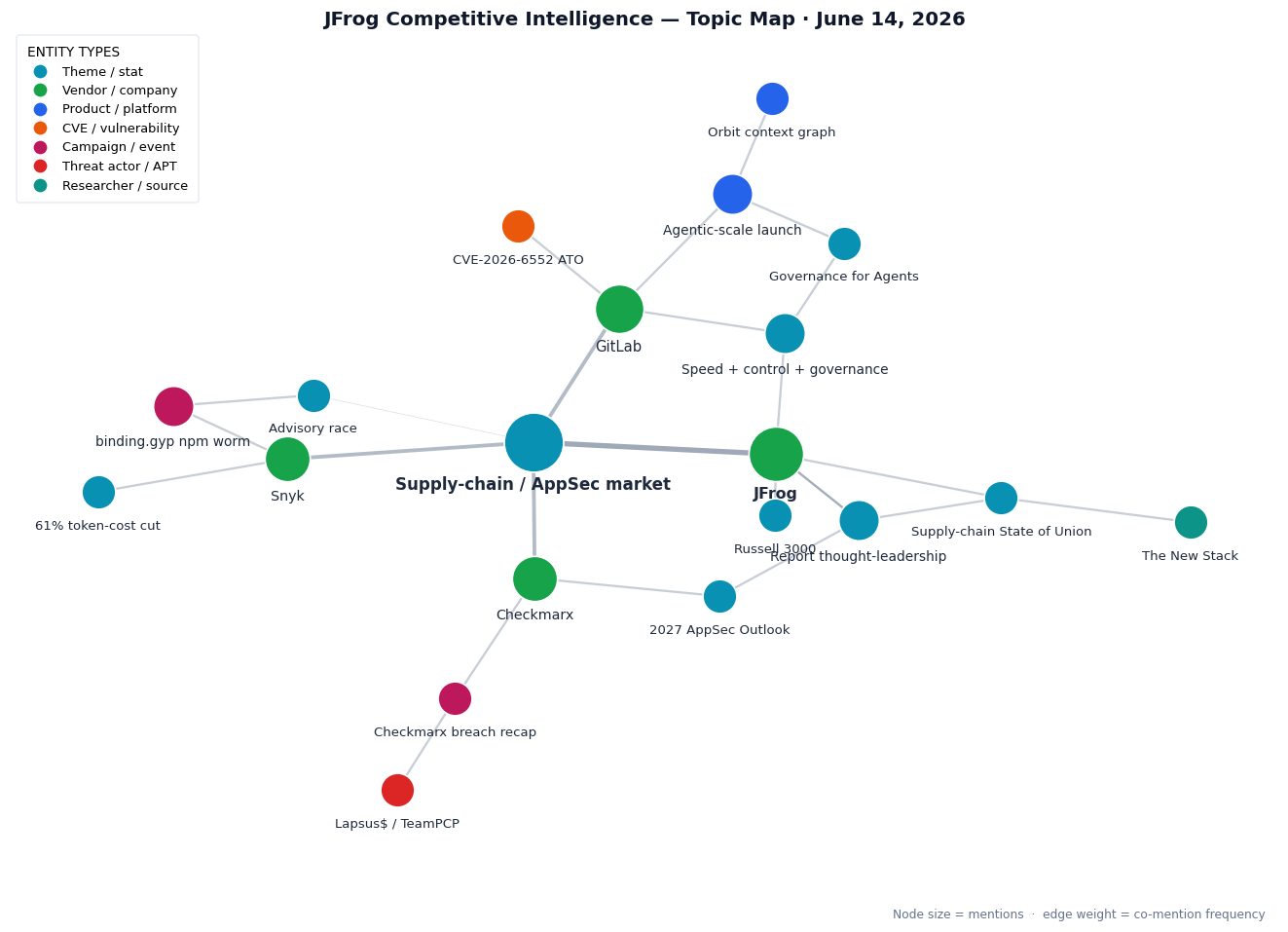
Vendors, products, incidents, and concepts pulled from the eight articles in this issue.
|
Article index
Competitor product & GTM moves (1–2)
GitLab and Checkmarx both ran self-positioning plays this week — one a conference launch borrowing JFrog’s platform pitch, the other a survey-driven thought-leadership report competing with our State of the Union motion.
Competitor security incidents (3–4)
The flip side of the marketing: two direct AppSec/DevSecOps competitors carrying security liabilities in their own pipelines the same week they pitch trustworthy delivery. Useful contrast in security-sensitive deals.
JFrog watch & foundational (5–8)
Foundational context this week: a major live npm supply-chain event the field raced to own, Snyk’s broader GTM read, and two JFrog corporate/visibility milestones — minor individually, but worth logging internally.
|
Detailed write-ups
1. GitLab announces new capabilities for speed and control at agentic scale
At its Transcend event (June 10–11), GitLab unveiled Next-Gen Source Code Management (private beta, claiming ~50x faster agent task execution), the Orbit context graph (public beta), and “Governance for Agents” with AI auditing and control. The framing is unmistakable: speed, control, and governance bundled for the agentic era. JFrog angle: GitLab is pushing the same “speed + control + governance” pitch JFrog uses for its platform — this is direct positioning overlap, and we should expect to meet this messaging head-on in agentic-scale deal cycles.
Read the article →
2. Checkmarx: 95% of CISOs pressured to suppress or delay compliance-related security issues
Checkmarx launched its 2027 AppSec Outlook, built on a Censuswide survey of 2,350 CISOs, AppSec managers, and developers across 14 countries. Headline data points: 96% of developers have AI tooling in their IDEs and 93% acknowledge a recent application-tied breach. The report is a deliberate thought-leadership instrument — a big-sample artifact designed to drive earned media and CISO conversations. JFrog angle: this competes directly with JFrog’s own supply-chain “State of the Union” report motion — Checkmarx is contesting the same data-driven thought-leadership ground we use to set the agenda, and we should benchmark reach and framing against ours.
Read the article →
3. GitLab patches multiple flaws enabling account takeover (incl. CVE-2026-6552)
GitLab shipped fixes for 12 vulnerabilities, including an improper-access-control flaw in the Group SAML Identity API (CVE-2026-6552, CVSS 8.7) that allows account takeover without victim credentials, plus a 2FA bypass and a DoS. The timing is the story: the patch landed the same week GitLab marketed governed, auditable delivery at Transcend. JFrog angle: a direct competitor patching credential-free account-takeover bugs the same week it markets “governed, auditable” delivery is a useful contrast — one to keep on hand for security-sensitive evaluations.
Read the article →
4. Checkmarx cybersecurity incident: timeline, impact, and response
A recap of the TeamPCP/Trivy supply-chain breach of Checkmarx’s GitHub repositories — initial access on March 19, with Lapsus$ posting a 96GB archive — kept current by a Checkmarx update on June 1. The breach hit the vendor’s own development pipeline, the very thing it sells to protect. JFrog angle: a direct AppSec competitor still bleeding from a breach of its own dev pipeline is a credibility liability JFrog can contrast in security-sensitive deals, particularly where pipeline integrity is the deciding factor.
Read the article →
5. npm “binding.gyp / Phantom Gyp” Miasma worm — Snyk and the vendor advisory race
A self-propagating npm worm abused a 157-byte binding.gyp to execute on install, compromising 57 packages across 286+ versions and harvesting CI/CD credentials. Snyk, Wiz, StepSecurity, and Arnica all raced out advisories — turning the response itself into a competitive narrative. JFrog angle: this is a major live supply-chain event where competitors competed to own the detection and response narrative — we need to track who got credit versus JFrog and make sure our coverage and authority on these events is visible.
Read the article →
6. Snyk: active product/GTM week (token-cost-per-fix gains, npm-worm coverage, AI Engineer World’s Fair)
An aggregated read on a busy Snyk week: the company touted a 61% reduction in token cost per SCA fix, led advisory coverage on the npm worm, and served as a presenting partner for the first AI security track at the AI Engineer World’s Fair. JFrog angle: this is a useful read on the closest pure-play competitor’s GTM momentum amid dimming IPO prospects — Snyk is leaning hard into developer mindshare and event presence, and we should watch whether that momentum translates into pipeline against Xray and Curation.
Read the article →
7. JFrog (FROG) joins Russell 3000 Index ahead of 2026 reconstitution
JFrog confirmed inclusion in the Russell 3000, raising index-fund visibility ahead of the late-June reconstitution (effective at close June 26). JFrog angle: a JFrog corporate and investor-visibility milestone — minor, but worth a line internally as a marker of growing market presence.
Read the article →
8. JFrog report recaps a tumultuous year in supply-chain security
The New Stack covered JFrog’s 58-page Software Supply Chain Security State of the Union 2026, surfacing the headline figures: 177K new malicious packages, a 451% surge in malicious npm, and 495 malicious Hugging Face models. JFrog angle: JFrog’s own report earning earned media in a respected dev outlet is a win to track — we should benchmark its reach and framing against Sonatype’s and Checkmarx’s competing reports (see item 2) to gauge who is winning the supply-chain thought-leadership narrative.
Read the article →
|
On our watch list
- GitLab’s agentic-scale messaging vs. our platform pitch. With Next-Gen SCM, Orbit, and Governance for Agents now public, watch how aggressively GitLab pushes the speed/control/governance triad into enterprise deals and whether sales encounters it as a direct comparison against the JFrog platform.
- Checkmarx report reach vs. our State of the Union. Track media pickup and CISO citation of Checkmarx’s 2027 AppSec Outlook against JFrog’s State of the Union 2026. Whoever owns the data-driven narrative shapes the procurement conversation.
- Fallout from GitLab’s account-takeover CVEs. Watch for any exploitation reports tied to CVE-2026-6552 and how GitLab handles the disclosure narrative the same week it marketed governed delivery — useful for security-sensitive evaluations.
- npm worm advisory credit and Snyk GTM momentum. Track who gets cited as the authority on the binding.gyp worm and whether Snyk’s event presence and token-cost claims convert into competitive pressure on SCA — particularly given its dimming IPO prospects.
|
|
The Competitive Brief · a Newshunter publication
Weekly internal competitive intelligence on AI-coding, AI-security, and DevSecOps. Coverage window: June 4 – June 14, 2026.
Unsubscribe · View in browser
*|LIST:ADDRESS|*
Curated by the Security Radar Competitive Intelligence desk.
Newsletter design, layout, and editorial curation © 2026 Security Radar. All rights reserved.
Article titles and summaries are excerpted for review and commentary; all linked articles remain the copyright of their respective publishers and authors.
|
|