At a glance
This week the package registries are the front line again, and the attackers have shifted technique. The headline event is “Atomic Arch”: more than 400 orphaned Arch User Repository packages were adopted by attackers who rewrote their build scripts to pull a malicious npm dependency that drops a Rust credential stealer on build and developer hosts. The lesson cuts straight at install-time build logic as a first-class attack surface — ownership-hijacking of abandoned packages beats typosquatting, and the payload goes straight for SSH keys, GitHub/npm/Vault tokens, and Docker credentials on the machines that run your builds.
It is not an isolated incident. JFrog's “FakeFix” campaign weaponized GitHub issue spam to push 25 malicious npm and PyPI packages mimicking Solana tooling, stealing keypairs and secrets at install and import time. And the Miasma worm — built on open-sourced Mini Shai-Hulud code — self-propagated into Azure's durabletask repository, forcing GitHub to disable 73 repos across four Microsoft orgs in a 105-second sweep. OpenAI, meanwhile, published its postmortem of the TanStack/Mini Shai-Hulud compromise, confirming limited credential exfiltration and rotating its macOS app-signing certificates.
A second front is opening around AI coding agents. Tenet Security's “agentjacking” research shows crafted Sentry error events can trick an AI coding agent reading them over MCP into running attacker-controlled code on the developer's machine — an 85% success rate that reframes the agent itself as an SDLC attack surface. Several of this week's worms now trigger specifically when repos are opened in AI coding tools.
Against that backdrop, the foundational reading is about controls that actually blunt these vectors: GitHub's 2026 Actions security roadmap (SHA pinning, scoped secrets, a native egress firewall), StepSecurity's read of Datadog's DevSecOps 2026 report on upstream-risk and runner hardening, and CNCF's primer on policy-as-code governance with Kyverno.
This issue also widens the lens beyond the week's incidents: a structural fix to npm's install-time script execution arriving in npm 12, JFrog's Software Supply Chain State of the Union read on AI-era risk, a federal audit slamming NIST's NVD backlog, and a set of pieces on what AI is doing to the DevSecOps craft itself — from a hollowed-out junior-developer pipeline to the connective role of the modern DevSecOps engineer.
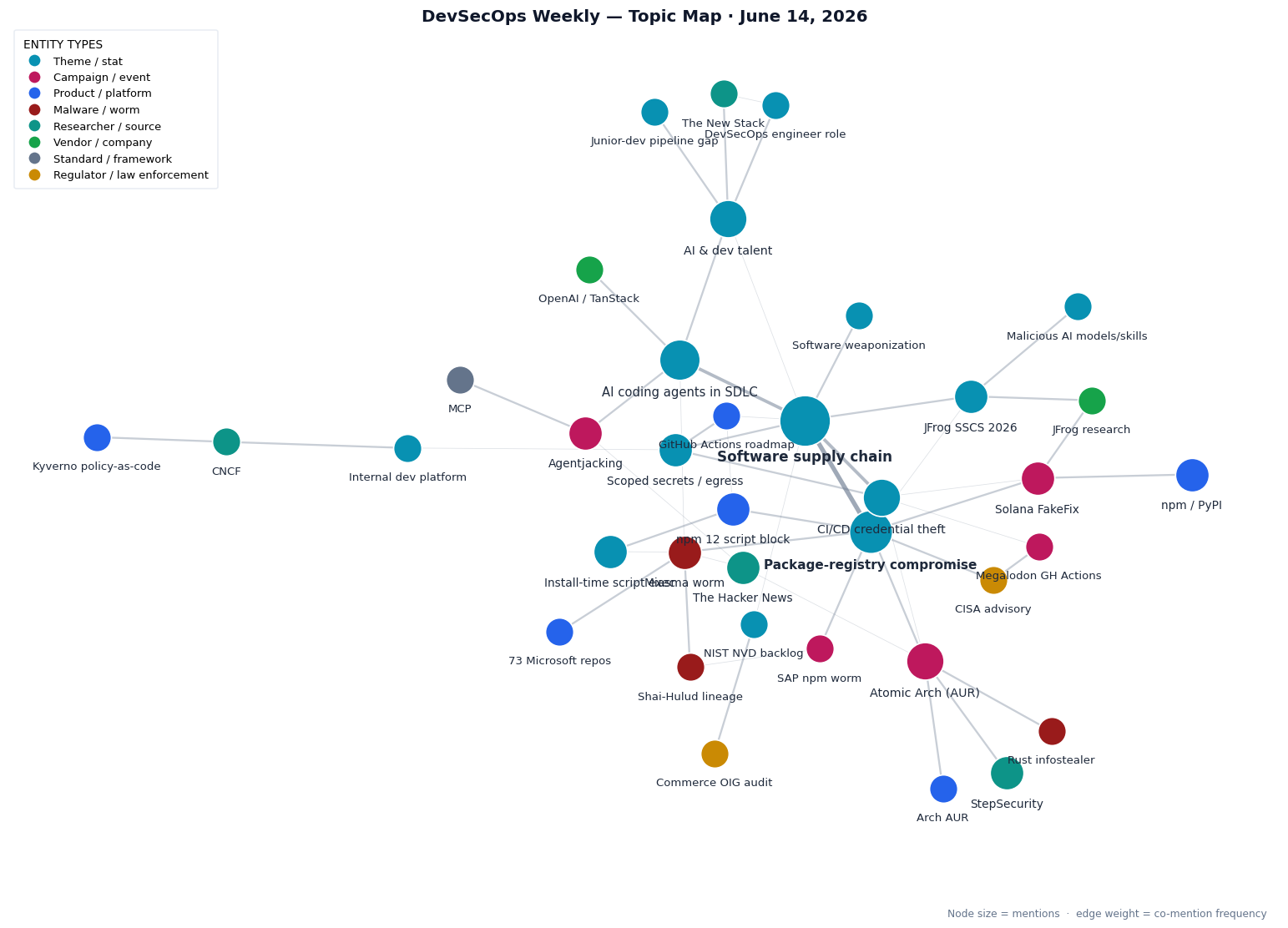
Topic map — a wave of package-registry compromises hitting build-time/install-time, AI coding agents as a new SDLC attack surface, and the platform/policy controls that blunt them.
Article index
Package-registry compromises & build-time risk
The Atomic Arch AUR campaign as paired incident and analysis, plus the FakeFix Solana campaign and the Miasma worm — registry trust under sustained, evolving attack at install and build time.
Articles 1, 2, 4, 5
AI coding agents in the SDLC
Agentjacking turns AI coding agents into a code-execution vector, and OpenAI's incident response shows how the latest worms target developer machines running those agents.
Articles 3, 6
Platform & policy foundations — foundational reading
The controls that blunt the week's attacks: secure-by-default GitHub Actions, practitioner data on upstream risk and runner hardening, and Kubernetes-native policy-as-code.
Articles 7, 8, 9
AI's impact on the DevSecOps craft & talent
Agentic AI is reshaping who writes and reviews code — a warning about a hollowed-out junior pipeline, the connective role of the modern DevSecOps engineer, and what one AI-amplified developer means for team practice.
Articles 10, 11, 12
Supply-chain attacks & registry-level defenses
More registry compromises — a CISA advisory on software-development pipeline attacks, a worming SAP npm campaign, and the “software weaponization” threat shift — plus npm's structural fix to install-time script execution.
Articles 13, 14, 15, 16
Industry reports & vulnerability management
JFrog's Software Supply Chain State of the Union 2026 (trade-press recap and the announcement) on AI-era supply-chain risk, and a damning federal audit of NIST's NVD backlog.
Articles 17, 18, 19
Detailed write-ups
01
400+ AUR packages hijacked: what the “Atomic Arch” campaign means for supply-chain security
Attackers adopted more than 400 orphaned Arch User Repository packages and rewrote their build scripts to pull a malicious npm dependency that drops a Rust credential stealer on build and developer hosts. StepSecurity's analysis frames the core lesson for platform and security teams: install-time build logic is a first-class attack surface, and the defenses that matter are CI-runner and dev-machine hardening plus aggressive credential rotation. If your developers build AUR packages on the same machines that hold their cloud and registry tokens, this campaign is a direct hit on your trust model.
02
Over 400 Arch Linux AUR packages hijacked to deploy infostealer and eBPF rootkit
The Hacker News breaks down the same Atomic Arch campaign from the threat-intel side, and the technique detail is the takeaway: ownership-hijacking of orphaned packages beats typosquatting, because nobody is watching an abandoned package change hands. A second wave used a “js-digest” Bun-based payload. The stealer goes straight for SSH keys, GitHub/npm/Vault tokens, and Docker credentials — the exact secrets that live on build and developer hosts. Read this as the analysis companion to the StepSecurity incident writeup above.
03
Agentjacking tricks AI coding agents into running malicious code
Tenet Security demonstrates “agentjacking”: crafted Sentry error events submitted through a public DSN that an AI coding agent, reading them over MCP, treats as trusted “resolution” steps — leading to code execution on the developer's machine, with an 85% success rate in their tests. The significance for DevSecOps is that the AI coding agent itself becomes an attack surface inside the SDLC: untrusted external data flowing into an agent's context can be turned into instructions. Teams wiring agents into error-monitoring and other MCP data sources should treat those feeds as untrusted input.
04
Solana FakeFix campaign uses 25 malicious npm and PyPI packages to steal developer secrets
JFrog identified a campaign of 25 malicious npm and PyPI packages mimicking real Solana tooling, promoted via GitHub issue spam dressed up as “community fixes.” The packages steal keypairs and SSH, AWS, and .env secrets at install and import time. The social-engineering layer is the notable part: attackers seed legitimate-looking issues directing developers to the poisoned packages, turning the project's own support channels into a distribution vector. Another data point that install-time and import-time execution remain the soft underbelly of both registries.
05
Miasma worm hits 73 Microsoft GitHub repositories
A self-propagating npm worm built on open-sourced Mini Shai-Hulud code pushed a malicious commit into Azure/durabletask, prompting GitHub to disable 73 repos across four Microsoft orgs in a 105-second sweep. Miasma adds Azure and GCP credential collectors and — notably — triggers when repos are opened in AI coding tools, tying the registry-worm threat directly to the agent-in-the-SDLC story elsewhere in this issue. The speed of GitHub's containment is encouraging; the fact that a first-party Microsoft repo was reachable at all is the warning.
06
OpenAI's response to the TanStack npm supply-chain attack
After the TanStack/Mini Shai-Hulud compromise reached two employee devices, OpenAI confirmed limited credential exfiltration from a subset of internal repositories — with no user data, production systems, or IP affected — and detailed its response: rotating macOS app-signing certificates and requiring macOS users to update by June 12. It is a clean example of incident response when a registry worm lands on developer machines: scope the blast radius, rotate the signing material attackers could abuse, and force a client update with a hard deadline. The incident itself dates to May 11.
07
What's coming to our GitHub Actions 2026 security roadmap
GitHub's roadmap for making Actions secure-by-default reads like a direct answer to this week's incidents: workflow-level dependency locking via SHA pinning, policy-driven execution through rulesets, scoped secrets, an Actions Data Stream for observability, and a native egress firewall for hosted runners. Egress filtering and scoped secrets in particular are exactly the controls that would have blunted the credential-exfiltration payloads in the AUR and FakeFix campaigns. Foundational reading for any team building its CI/CD hardening baseline on GitHub.
08
Datadog's DevSecOps 2026 report validates what we've been building
StepSecurity's practitioner commentary on Datadog's DevSecOps 2026 findings connects the data to the week's threat picture. Two figures anchor it: 87% of organizations run a known-exploitable vulnerability, and 50% adopt new library versions within 24 hours of release — a velocity that hands fresh registry compromises a wide-open window. The piece ties this upstream-risk shift to the case for CI/CD and runner hardening, arguing the answer is less about scanning faster and more about constraining what build environments can reach and execute.
09
Policy-as-code: flexible Kubernetes governance with Kyverno
A foundational primer on expressing governance as code: Kyverno models validation, mutation, generation, and cleanup as Kubernetes-native resources, letting platform teams enforce standards at scale without bolting on an external policy language. For shops wrestling with how to operationalize the controls discussed elsewhere in this issue — default-on guardrails, scope enforcement, drift cleanup — Kyverno's resource-native model is a pragmatic way to encode them where the cluster can enforce them automatically. Worth keeping on hand as reference for policy-as-code design.
10
Microsoft execs warn agentic AI is hollowing out the junior developer pipeline
Microsoft's Mark Russinovich and Scott Hanselman warn that agentic AI's productivity gains concentrate value in senior engineers while imposing an “AI drag” on early-career developers who lack the judgment to steer, verify, and integrate AI output. The economic incentive — hire seasoned staff and let AI do the lower-level work — risks starving the industry of its next generation, because the “systems taste” needed to catch failures is built through hands-on production work. Their prescription is to keep hiring and developing juniors even when it dents short-term output. A culture-and-talent read DevSecOps leaders should weigh as they reorganize teams around AI.
11
DevSecOps in 2026 demands more than tools: the engineers who bridge code, culture, and risk
A profile of the modern DevSecOps engineer as a connective role rather than a tooling specialist — embedding security into every commit, dependency update, and pipeline run, and turning it from an end-of-cycle checkpoint into a shared responsibility across development, operations, and the business. The piece argues communication and the ability to influence without authority matter as much as any scanner, layered on a base of CI/CD, cloud, container, and IaC-security fundamentals. Useful framing for leaders hiring or growing the role rather than just buying more tools.
12
One developer, team power: the future of AI-driven DevSecOps
This essay argues AI has raised both what a single developer can accomplish and what that developer must know — which makes collaborative learning and DevSecOps practice more vital, not less, as the connective tissue that transfers knowledge across a team. The throughline: AI amplifies individuals, but teams still need shared guardrails and security discipline to absorb that amplification safely. (Sponsored by GitLab, so the framing leans toward a single-platform view of the workflow.)
13
CISA urges security teams to check for software development compromises
CISA warned that attackers targeted software-development pipelines in recent weeks and urged teams to check their environments for compromise, citing the “Megalodon” campaign and a GitHub compromise via a malicious Nx Console VS Code extension. The May 18 Megalodon attack injected malicious GitHub Actions workflows into more than 5,500 open-source repositories with weak branch protection, harvesting cloud credentials, API tokens, and SSH keys at scale. Read it as a direct prompt to audit Actions workflows, tighten branch protections, and review the editor-extension supply chain your developers run.
14
Ongoing supply chain attacks worm into SAP npm packages
The Register reports a continuing supply-chain campaign worming into SAP-related npm packages, part of the broader self-replicating-worm wave hitting the npm ecosystem. The pattern follows the Shai-Hulud lineage: compromise a package, harvest developer and CI/CD secrets, and reuse them to republish into more packages. It is useful background for why npm's install-time execution model is now being structurally rethought (see article 16) rather than merely scanned around.
15
Software weaponization raises DevSecOps stakes
Mike Vizard argues the decade-old DevSecOps threat model — built around accidental vulnerabilities — is breaking as flaws become strategic assets that nation-states and threat actors stockpile and hold back until they are useful as weapons. The piece contends the industry has over-invested in pre-deployment scanning and under-invested in knowing what is actually running in production, and features practitioners on what “software weaponization” means for engineering and security operations. A framing read for rebalancing toward runtime visibility and exposure management.
16
NPM 12 will change script execution behavior to prevent supply chain attacks
GitHub announced that starting with npm 12 (expected in July), npm install will no longer execute preinstall, install, or postinstall scripts from dependencies unless a project explicitly allows them. The change targets exactly the default automatic script execution that TeamPCP and the Shai-Hulud worm abused to infect thousands of developers at install time. It is the most consequential structural fix to the npm threat model in years — and a prompt to inventory which of your own builds depend on lifecycle scripts before the default flips, so the change lands as a hardening win rather than a broken pipeline.
17
JFrog report surfaces need for rapid DevSecOps change in AI era
DevOps.com's recap of JFrog's Software Supply Chain Security State of the Union 2026 — drawn from an analysis of 18.2 billion artifacts — reports 969 AI agent “skills” carrying high-impact payloads and 495 malicious AI models on Hugging Face, with 48% of organizations still relying on manual processes and the same share needing a week to prove compliance. JFrog Field CISO Paul Davis frames the findings as evidence that AI-era DevSecOps workflows need fundamental rather than incremental change. (JFrog's own report; the same research is covered in this issue's Competitive Intelligence bulletin and AI-ML supply-chain cluster.)
18
New JFrog report warns: AI governance fails as software supply chain attacks hit record highs
The announcement behind the recap above: JFrog's 2026 State of the Union reports record-high software-supply-chain attack volume and warns that AI governance is failing to keep pace, with malicious packages and malicious AI models proliferating across registries and model hubs. The release positions artifact provenance, curation, and AI-model vetting as the controls most organizations are missing. (Vendor press release; the same JFrog report appears from the trade-press angle in article 17 and in this issue's Competitive bulletin.)
19
US government report slams NIST for NVD backlog
A US Department of Commerce Office of Inspector General audit found NIST's National Vulnerability Database backlog had grown past 27,000 unprocessed vulnerabilities, that NIST lacked a strategic plan to manage it, and projected 2026 disclosures would exceed 60,000. NIST agreed with the technical recommendations but pushed back on the report's tone. For DevSecOps teams that lean on NVD enrichment to triage and gate builds, it is a pointed reminder that authoritative CVE metadata is increasingly unreliable — and a nudge toward supplementing it with alternative vulnerability-intelligence sources.
On our watch list
- Ownership-hijacking of abandoned packages. Atomic Arch shows attackers adopting orphaned packages rather than typosquatting new ones — a quieter path that evades name-similarity detection. Watching whether registries (AUR, npm, PyPI) tighten the handoff of maintainership on dormant packages.
- AI coding agents as untrusted-input sinks. Agentjacking and the AI-tool-triggered worms point the same direction: external data flowing into an agent's context is an injection surface. Watching for emerging guidance on treating MCP-sourced data (error events, issues, logs) as untrusted by default.
- CI-runner egress filtering as a default. The credential stealers in this issue all rely on reaching exfil endpoints from build and dev hosts. With GitHub shipping a native egress firewall for hosted runners, watching how fast egress allowlisting moves from advanced practice to baseline expectation.
- Credential rotation hygiene on developer machines. SSH keys, registry tokens, and Docker creds living alongside build tooling are the recurring loot. Watching for tooling that makes short-lived, scoped credentials on developer endpoints the path of least resistance.