This week at a glance
After a genuinely quiet cycle last week, the autonomy story came roaring back. The through-line is the industry-wide push toward Level 4 autonomous networks — the tier where a network operates and maintains itself and humans intervene only by exception. Fresh out of TM Forum’s DTW Ignite in Copenhagen, a new TM Forum report found one in five operators expect to hit L4 by 2027 and 81% have set 2030 as the target, with three-quarters increasing autonomous-network investment this year. But the same event surfaced the sobering counterweight that recurs all through this issue: TM Forum’s own research found 72% of operators believe their AI is trustworthy while only 14% can prove it — a “dangerous blind spot” on the road to autonomy.
The week’s hardest news came from Korea, where AI-RAN crossed from slideware into live industrial networks. South Korea’s Ministry of Science and ICT tapped SK Telecom and KT to lead a two-year, government-funded pilot at the core of the country’s ten-year “AI Highway” initiative, running Samsung, HFR, Ericsson and Nokia equipment side-by-side under real robots on factory floors and petrochemical plants. A day later, Nokia launched what it bills as the industry’s first commercial GPU-powered AI-RAN platform on NVIDIA Aerial — a claim that carries a footnote, since Ericsson has been selling a software-only AI-in-RAN product since June. Under both sits the same argument operators keep making: agents are the easy part; the data foundation is the hard part.
That data-first message ran through the rest of the week. Spanish startup Kenmei — backed by Telefónica, MasOrange and Andorra Telecom — argued the obstacle to autonomous networks isn’t the agents but the messy data underneath, and shipped a Network Performance Data Product on Microsoft Fabric to prove it. IBM added an autonomous-operations AI agent to its Power line. Gartner’s new observability Magic Quadrant showed AI workloads reshaping a market projected to hit $14.3 billion by 2028. And a run of operator-pragmatism pieces — Vodafone on the discipline of “failing fast,” Omdia on getting “beyond agent mania” — kept insisting that selectivity, governance and deterministic guardrails, not blanket agent adoption, are what actually make this work.
|
Topic map — five threads on the road to autonomy
Entities from this week’s fifteen articles, clustered around the march to Level 4 autonomy (TM Forum, Nokia/AWS, ZTE, Telecom Argentina), AI-RAN in Korea (SK Telecom, KT, NVIDIA, Ericsson, Samsung, O-RAN, the “AI Highway”), data foundations for autonomous networks (Kenmei, Microsoft Fabric, Telefónica, IBM), the AI-driven shake-up of observability, and operator pragmatism (Vodafone, Omdia’s “agent mania”). The graph is laid out as a single connected map, with shared concepts — Level 4 autonomy, Agentic NetOps and TM Forum — bridging the clusters.
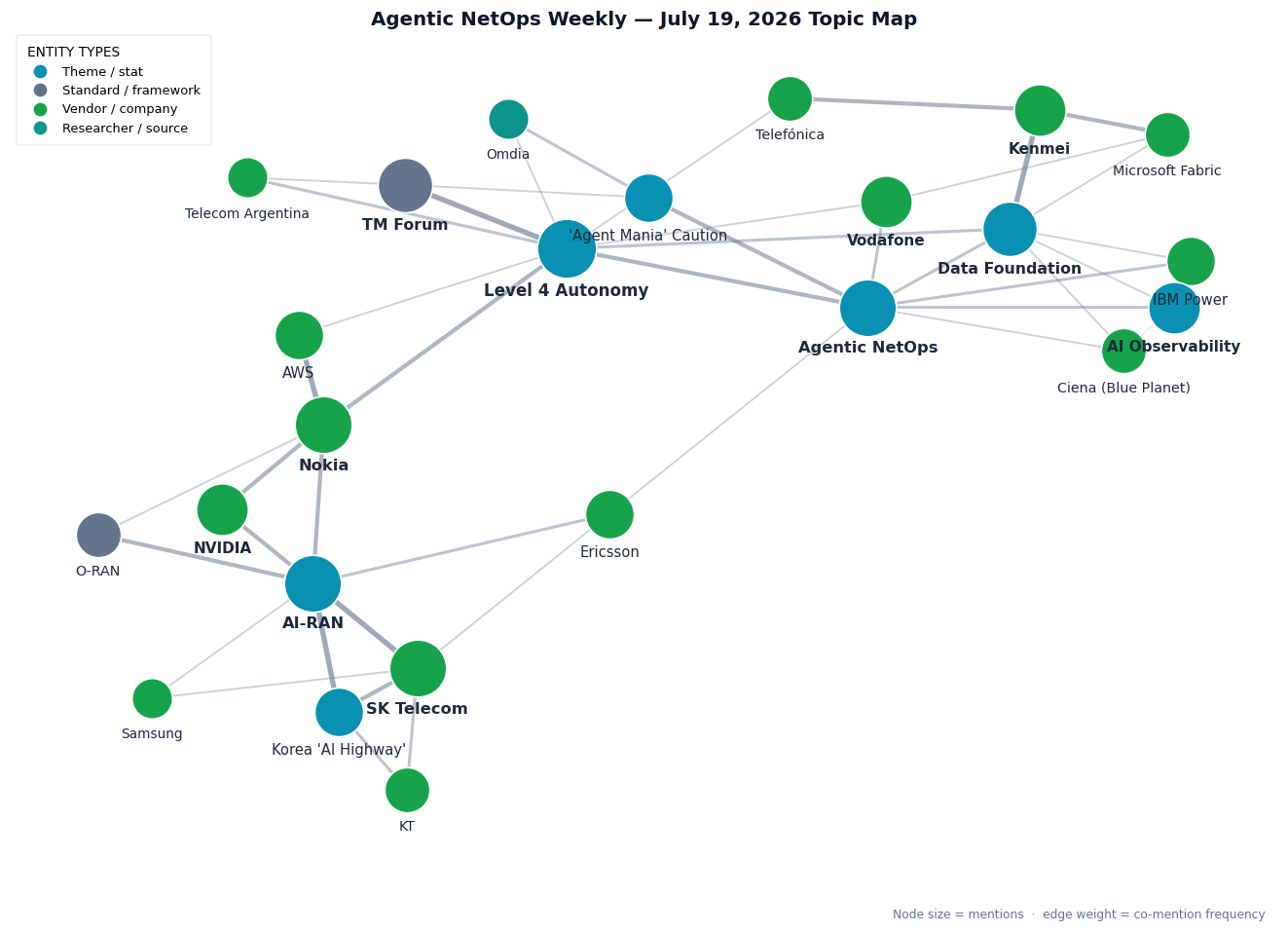
Topic map for this issue — node size reflects how often an entity is mentioned; edge weight reflects how often two entities are discussed together.
View interactive topic map →
|
Detailed write-ups
1. The march to Level 4: DTW moves autonomy from keynote to commitment — but trust is the gating factor
Light Reading · The Fast Mode · SDxCentral · Operator Watch
Coming out of TM Forum’s DTW Ignite in Copenhagen, the industry’s framing of Level 4 autonomy — where a network runs and heals itself and engineers step in only for the unusual — has shifted from aspiration to near-term plan. A new TM Forum report built on a survey of 80 operators found 20% expect to reach L4 or above by 2027, 81% have set L4 (or beyond) as a 2030 goal, and 75% will increase autonomous-network investment this year; the emphasis is moving from cost-cutting to revenue and customer experience. ZTE’s DTW keynote pinned the acceleration on agentic AI, arguing that multi-agent collaboration (single agents hit “cognitive overload” at production scale), low-cost agent “self-evolution” via RAG and memory rather than retraining, and a forward-deployed-engineering delivery model are what make L4 scalable. The Fast Mode’s recap adds the roster of operators — Rakuten, Telefónica, Orange, China Telecom — already demonstrating L4 in specific domains, and Nokia and AWS continuing to advance their joint autonomous-operations platform toward broader commercial deployment later this year, a build-out SDxCentral covered in depth around the Bedrock AgentCore closed-loop architecture. Telecom Argentina’s operator-side perspective rounds out the picture of how a real carrier plots its own road to L4. But the defining caveat came from TM Forum CEO Nik Willetts: research with IBM’s Institute for Business Value found 72% of CSPs believe their AI is trustworthy while only 14% can prove it — a “dangerous blind spot,” and the reason TM Forum used DTW to launch its AI-native “Race to 2030” evolution of the Open Digital Architecture.
Read the article →
Sources: Light Reading · The Fast Mode · SDxCentral · Operator Watch
2. Korea’s ‘AI Highway’ puts AI-RAN into live factories — and Nokia’s “industry first” gets a footnote
Seoul Economic Daily · TechTimes · The Fast Mode
South Korea’s Ministry of Science and ICT selected SK Telecom on July 14 to lead the country’s first commercial AI-RAN deployment, with a parallel KT-led consortium, as the centerpiece of the ten-year “AI Highway” initiative for ultra-low-latency networks built for physical AI. Combined funding for the two consortia totals 17.2 billion won (about $11.5 million). What makes SK Telecom’s two-year pilot notable is its structure: a direct, simultaneous evaluation of Samsung, HFR, Ericsson and Nokia equipment under identical conditions at industrial sites — a quadruped patrol robot watching for gas leaks at SK Incheon Petrochemical, LiDAR-guided autonomous transport in Pangyo, a humanoid low-power mode that offloads perception to the base station to save battery — a multi-vendor design only possible because of O-RAN interoperability. A day after the selection, Nokia launched what it calls the industry’s first commercial GPU-powered AI-RAN platform, built on its anyRAN software and NVIDIA’s Aerial platform, projecting spectral-efficiency gains above 20% now, 50% by 2027 and more than 100% by 2028. The “first” claim carries a real footnote: Ericsson has sold a software-only AI-in-RAN subscription since June 2026, already live across 15-plus deployments (SoftBank, Bell, SKT, Rogers) and running on existing baseband silicon with no GPU — a deliberate bet against the hardware lock-in that Nokia’s GPU approach accepts. Meanwhile the same operator showed the pragmatic near-term face of AI in the network: SK Telecom is standing up a summer “special communication situation room” from July 20 to August 31, using its in-house A-One (AI-agent-linked traffic prediction and quality monitoring) and Spider (cross-core anomaly detection and corrective suggestions) systems across roughly 1,100 high-traffic locations.
Read the article →
Sources: Seoul Economic Daily · TechTimes · The Fast Mode
3. Agents are the easy part: operators put the data foundation first
Fierce Network · Network World
The week’s sharpest contrarian take came from Kenmei, a Valencia-based startup backed by three of its own operator customers — Telefónica, MasOrange and Andorra Telecom. Its bet: the obstacle to autonomous networks isn’t the AI agents but the messy data underneath them. “Agents are relatively easy… all of that can be built by many players. What’s important is the data foundation,” VP of sales Ali Wansa told Fierce. Kenmei’s specialty is cell traces — the hundreds of gigabytes per hour of RAN signaling events — which it turns into a unified, query-ready layer with an ontology agents can reason over; it consolidated RAN sources on Azure and Databricks at Telefónica and correlated 21 data sources at Swisscom. Its new Network Performance Data Product, launched on Microsoft Fabric and sold through Microsoft Marketplace, aims to cut operator data onboarding from months to days, though Wansa was candid that it hasn’t been deployed yet and that Kenmei (a $4.3M Series A) is going up against Nokia, Ericsson and Ciena’s Blue Planet. The same “bake intelligence into the infrastructure” theme showed up a tier down the stack at IBM, which added Power Autonomous Operations — an embedded AI agent that continuously monitors, optimizes and can autonomously resolve issues on Power systems via natural-language interaction — plus a preview of an Agentic Engine for IBM i with a built-in MCP server, observability and object-level security, aimed at edge and distributed deployments on the new AI-ready S1112 server.
Read the article →
Sources: Fierce Network · Network World
4. AI workloads reshape the observability market — and vendor autonomy claims outrun reality
Network World · Jul 17, 2026
Gartner’s new Magic Quadrant for Observability Platforms, unpacked by Network World, shows AI workloads driving a genuine reshaping of the category: 19 vendors made the cut, with Chronosphere, Coralogix, Datadog, Dynatrace, Elastic, Grafana Labs, IBM and New Relic in the Leaders quadrant. Two forces stand out for NetOps readers. First, AI observability is emerging as the key differentiator — buyers now want visibility into token consumption, model latency, response quality and hallucination rates, and the ability to observe and govern AI agents themselves. Second, telemetry cost management has become a top concern as log, trace and metric volumes explode; Gartner notes 5% of its clients now spend more than $10 million a year with a single observability provider, and projects the market to reach $14.3 billion by 2028. With OpenTelemetry and eBPF now “table stakes” that commoditize data collection, vendors are forced to differentiate on analytics, automation and remediation instead. Gartner’s pointed caution is the one worth pinning up: “The transition from generative AI assistants to autonomous agents is more complex than vendor marketing suggests.” (Editorially this piece straddles the line with our AIOps beat — it lands here because it’s the observability substrate agentic NetOps runs on.)
Read the article →
Sources: Network World
5. Beyond ‘agent mania’: the case for selectivity, guardrails and failing fast
Light Reading · VoIP Review · CellStream · Monogoto
The counterweight to the week’s autonomy enthusiasm was a cluster of pieces arguing for discipline. Vodafone’s Andy Linham described how the operator manages more than 900 AI ideas in a Power BI framework that scores feasibility against benefit, and has learned to “fail fast” — cutting projects quickly when they don’t deliver — while the simplest wins (Microsoft Copilot across 60,000 employees, saving about 2.5 hours per week each, roughly the equivalent of 4,000 people) often prove most valuable; the enabler, he said, was years of unglamorous work getting data into a single governed “data ocean” via the Google-Cloud-based AI Booster platform. Omdia’s Ruth Brown makes the architectural version of the same argument in “Beyond agent mania”: as 3GPP pushes toward an AI-native 6G, operators are layering agents as an alternative control plane onto existing infrastructure — but must avoid inserting non-deterministic LLM agents into network functions that demand absolute predictability, leaning on TM Forum’s new AI-Native Blueprint, zero-trust boundaries, and pragmatic bridges like Ericsson repurposing the O-RAN R1 interface for cross-domain agent collaboration. VoIP Review frames autonomous networks as a resilience play, while CellStream poses the blunt question hanging over all of it — efficiency breakthrough or unacceptable risk? — and Monogoto extends the self-healing logic to IoT, arguing that as applications become autonomous their connectivity has to fix itself too.
Read the article →
Sources: Light Reading (Vodafone) · Light Reading (Omdia) · VoIP Review · CellStream · Monogoto
|