|
AI & ML in Security · Issue July 19, 2026
AI & ML in Security
July 19, 2026 · Weekly Edition · AI security + new AI capabilities & approaches
|
This week at a glance
This was the week the open-model wave stopped looking like a sideshow. Thinking Machines shipped Inkling, its first open release, doubling down on a bet against one-size-fits-all frontier models. China’s Moonshot AI unveiled Kimi K3, which CNBC reported matches OpenAI and Anthropic on several public benchmarks while trained at a fraction of their spend — a Decoder analysis framed it explicitly as a second DeepSeek moment forcing Western labs to defend their compute advantage. A 27B-parameter open reasoning model, Bonsai, ran full chain-of-thought reasoning locally on an iPhone, and Sakana AI’s Fugu orchestrator added Nvidia Nemotron to argue that a coordinated ensemble of smaller models can rival a single frontier system. The common thread: capability is decoupling from raw scale faster than the incumbents’ moats assumed. The Register caught the same current from the buyer side, reporting that enterprises are increasingly picking smaller, cheaper, task-specific models over frontier giants.
The agent-attack research kept pace. The Hacker News documented MemGhost, which plants persistent false memories in an AI agent through a single email so the poisoned recollection survives across future sessions, and Agent Data Injection, a technique that manipulates the data an agent reads to make it misclick or run attacker-chosen commands. On the defensive side, OpenAI’s red-team model GPT-Red reportedly outperformed human red-teamers on a prompt-injection benchmark, and separate researchers showed that deliberately planted “context bombs” can derail an attacker’s own AI tooling — the same indirect-injection primitive, now pointed both ways. Over all of it, Google DeepMind CEO Demis Hassabis used the week to call for an independent international standards body to govern frontier AI, arguing self-regulation cannot hold as capability accelerates.
The tooling layer kept reshaping around agents too. OpenAI drew criticism for hiding its Codex agent’s system instructions behind encryption, leaving developers unable to audit what the agent is told; Visual Studio Code added native support for multiple parallel Claude chat sessions; and InfoWorld argued the IDE is giving way to the “ADE” — an agentic development environment — while warning that “tokenmaxxing” is teaching teams to measure the wrong things. Anthropic research found Claude shifts its tone by language — warmer in Hindi, more rigorous in Russian — a reminder that model behavior is culturally contingent in ways that matter for deployment. And OpenClaw reorganized as a nonprofit foundation pitched as “the Switzerland of AI,” a governance experiment worth watching alongside Hassabis’s standards-body pitch. Linus Torvalds offered a grounded counterpoint at the Open Source Summit, saying he is “not a programmer anymore” and now works mostly through email and git — review and integration over authorship — while a widely shared O’Reilly essay by Honeycomb’s Charity Majors mapped the widening enthusiast-vs-skeptic divide in AI-native engineering, arguing for shared reality, tight feedback loops, and plain engineering discipline. On the deployment side, Anthropic expanded Claude Cowork to web and mobile as enterprise use broadened — even as analysts flagged agent-governance and identity gaps — and 1Password shipped an agent-authentication framework that lets AI browser agents use stored credentials through scoped, auditable access instead of scraping them.
|
Topic map — how this week’s research clusters
This week in one frame: the open-model surge cluster (Inkling, Kimi K3, Bonsai 27B, Sakana’s Fugu) and its pull on the compute-advantage race against OpenAI and Anthropic; the AI-agent attack-and-defense cluster (MemGhost, Agent Data Injection, GPT-Red, context bombs) all orbiting prompt injection; the governance cluster (DeepMind’s Hassabis, an independent standards body, the OpenClaw Foundation); and the agentic dev-tooling cluster (OpenAI Codex, Claude, the emerging ADE).
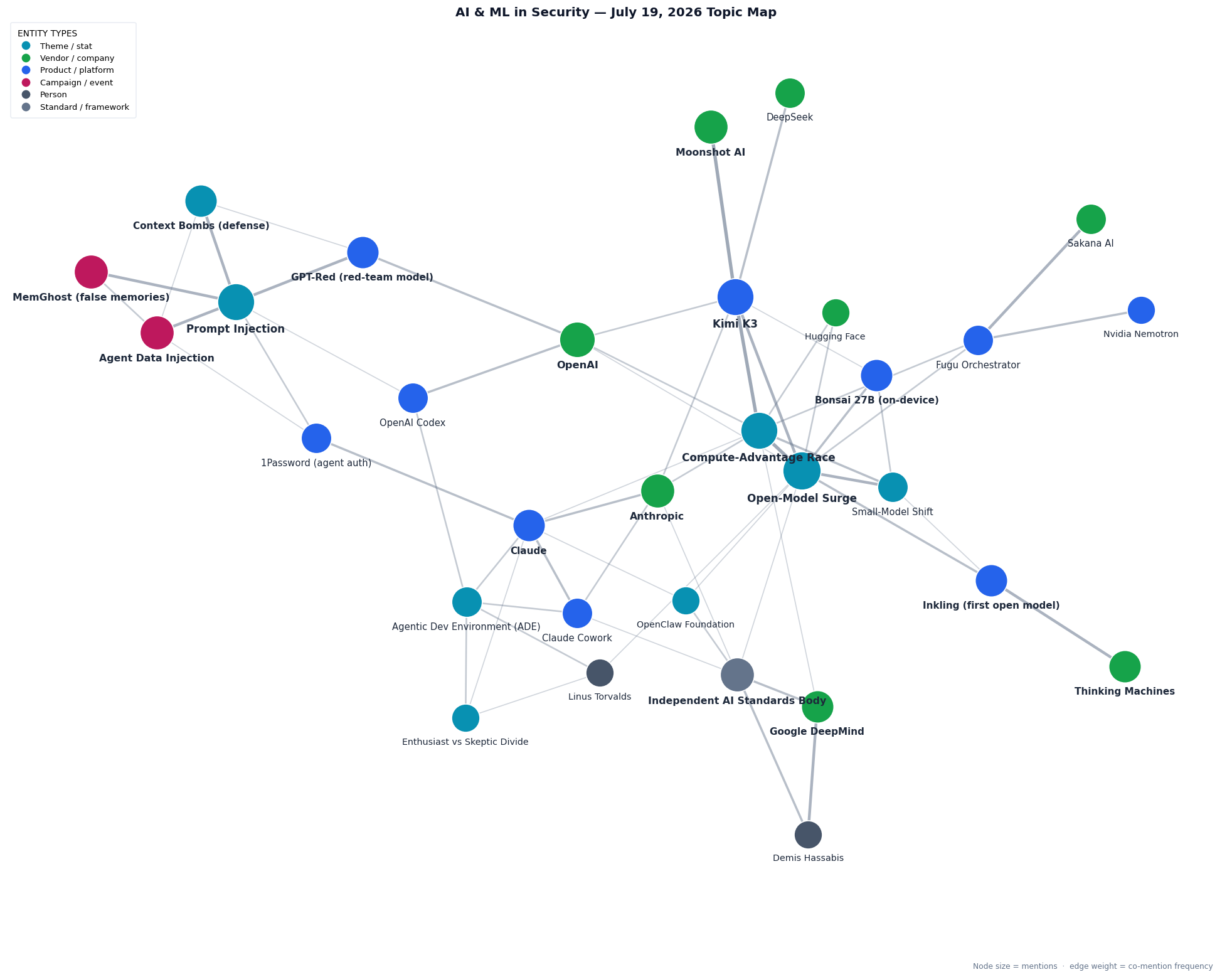
Weighted entity-relationship map for the July 19, 2026 issue. Node size reflects mention frequency; edge thickness reflects co-mention strength across the week’s articles.
View interactive topic map →
|
Article index
The open-model surge & the compute-advantage race
Thinking Machines’ Inkling, Moonshot’s Kimi K3, the on-device Bonsai 27B, and Sakana’s Fugu orchestrator — plus the analyses asking whether raw compute is still the frontier labs’ moat, and The Register on enterprises shifting toward smaller, task-specific models.
| Article |
Source |
Published |
| Thinking Machines releases its first open model, Inkling |
TechCrunch |
July 15, 2026 |
| China’s Moonshot AI unveils Kimi K3 that rivals OpenAI, Anthropic |
CNBC |
July 17, 2026 |
| Bonsai 27B is a full open reasoning model that fits on an iPhone |
The Decoder |
July 15, 2026 |
| Sakana AI’s orchestrator adds Nvidia Nemotron to rival single frontier models |
The Decoder |
July 16, 2026 |
| Just like DeepSeek, China’s Kimi K3 is forcing Western AI labs to question their compute advantage |
The Decoder |
July 17, 2026 |
| The real AI race may no longer be at the frontier |
TechCrunch |
July 14, 2026 |
| AI customers are coming around to the idea that small is beautiful |
The Register |
July 11, 2026 |
AI-agent attack & defense research
MemGhost’s persistent false memories, the Agent Data Injection technique, OpenAI’s GPT-Red beating human red-teamers, “context bombs” that turn indirect prompt injection into a defense, and 1Password’s zero-exposure framework for giving AI browser agents scoped, auditable credential access.
AI governance & the standards question
DeepMind CEO Demis Hassabis’s call for an independent international standards body for frontier AI, OpenClaw’s reorganization into a neutral nonprofit foundation, and Anthropic’s expansion of Claude Cowork alongside the agent-governance and identity gaps analysts flag as enterprise agent use broadens.
Agentic dev tooling & measuring AI work
OpenAI hiding its Codex agent’s instructions behind encryption, VS Code’s multi-chat Claude sessions, the rise of the agentic development environment, and why “tokenmaxxing” measures the wrong things — plus Linus Torvalds’s measured take on AI in Linux development and an O’Reilly essay on the enthusiast-vs-skeptic divide in AI-native engineering.
Model behavior & capability research
Anthropic’s values study finding that Claude systematically shifts tone by the language it is prompted in — warmer in Hindi, more rigorous in Russian.
|
Detailed write-ups
1. The open-model surge and the compute-advantage race
TechCrunch, CNBC & The Decoder · July 14–17, 2026
Four releases in a single week made the same argument from different directions: the frontier labs’ edge is narrowing, and it is narrowing fastest where they assumed compute would keep it widest. Thinking Machines shipped Inkling, its first open model, formalizing the lab’s bet against one-size-fits-all systems in favor of smaller, adaptable, openly available ones. China’s Moonshot AI released Kimi K3, which CNBC reported matches OpenAI and Anthropic on multiple public benchmarks despite a training budget a fraction the size — and a follow-on Decoder analysis was blunt about the parallel, calling it “just like DeepSeek,” a moment forcing Western labs to justify a compute advantage that keeps failing to translate into a durable capability lead. Underneath the headline releases, Bonsai 27B demonstrated a full open reasoning model running chain-of-thought locally on an iPhone, and Sakana AI’s Fugu orchestrator added Nvidia Nemotron to show that a coordinated ensemble of smaller models can rival a single frontier system on hard tasks. TechCrunch’s framing captures the throughline for security architects: if the real race is no longer at the frontier but in efficient, deployable, often open models, then the threat model shifts too — capable models become cheap, local, and ungoverned, and the assumption that dangerous capability stays gated behind a handful of well-resourced API providers stops holding.
Read the article →
Sources: TechCrunch (Inkling), CNBC (Kimi K3), The Decoder (compute advantage), The Decoder (Bonsai 27B), The Decoder (Sakana Fugu), TechCrunch (the real race)
2. False memories, data injection, and machine red-teamers: the agent-attack research pile grows
The Hacker News & Help Net Security · July 13–16, 2026
This week’s attack research converged on the same weak point — an agent’s inability to authenticate the inputs it acts on — and pushed it in new directions. MemGhost plants persistent false memories in an AI agent through a single crafted email: because many agent architectures write salient information to long-term memory, the poisoned recollection survives the session that delivered it and steers the agent’s behavior in future, unrelated tasks, turning a one-shot injection into a durable implant. Agent Data Injection takes the complementary route, manipulating the data an agent reads — page content, tool output, retrieved documents — so the agent misclicks or executes attacker-chosen commands while believing it is following legitimate instructions. Both are prompt injection by another name, and both defeat controls that assume the danger is a malicious user typing into a chat box rather than a malicious document the agent was told to trust. The same week offered the mirror image on defense: OpenAI’s purpose-built red-team model GPT-Red reportedly outperformed human red-teamers on a prompt-injection benchmark, suggesting automated adversarial testing is maturing into something teams can actually run at scale — and researchers demonstrated “context bombs,” deliberately planted content designed to derail an attacker’s AI tooling, weaponizing the very injection primitive that makes agents fragile. For security teams the practical takeaway is that memory and retrieved data are now first-class parts of the attack surface, and that the offense/defense asymmetry around indirect injection is starting to cut both ways.
Read the article →
Sources: The Hacker News (MemGhost), The Hacker News (Agent Data Injection), Help Net Security (GPT-Red), Help Net Security (context bombs)
3. DeepMind’s Hassabis calls for an independent frontier-AI standards body
TechCrunch · July 14, 2026
Google DeepMind CEO Demis Hassabis used the week’s attention to argue that frontier AI has outgrown voluntary self-regulation and needs an independent international standards body — a neutral technical authority that could define, test, and certify safety benchmarks the way analogous bodies do for aviation or pharmaceuticals, rather than leaving each lab to grade its own homework. The call lands pointedly given the open-model surge in the same news cycle: a standards regime built around a handful of API-gated frontier providers is a very different problem than one that has to account for capable open models running on a phone or behind a company firewall, where there is no vendor to audit and no API to throttle. It also rhymes with the week’s other governance experiment — the OpenClaw project’s reorganization into a nonprofit foundation explicitly positioning itself as “the Switzerland of AI,” a neutral steward for shared infrastructure. Whether a standards body can move fast enough to matter, and whether it would have any teeth over open-weight releases, is the open question; for security leaders the signal is that even the labs building the capability are now publicly conceding that the current governance vacuum is untenable.
Read the article →
Sources: TechCrunch, InfoWorld (OpenClaw Foundation)
4. The agentic development environment takes shape — and its transparency gaps show
The Register & InfoWorld · July 8–15, 2026
The tools developers use are reorganizing around agents faster than the practices for governing them. OpenAI drew sharp criticism for shipping its Codex agent with its system instructions encrypted, leaving developers unable to see — let alone audit or override — what the agent has been told to do on their behalf, a transparency gap that matters precisely because these agents run with real credentials and real filesystem and shell access. At the same time Visual Studio Code added native support for multiple parallel Claude chat sessions, and InfoWorld argued the traditional IDE is giving way to the “ADE,” an agentic development environment where the human supervises fleets of agents rather than typing code directly. A companion InfoWorld piece warned that the metrics are lagging the workflow: “tokenmaxxing” — optimizing for token throughput or raw agent activity — teaches teams to measure the wrong things, the agentic-era version of counting lines of code. The security read is straightforward: as more of the software lifecycle moves inside opaque, high-privilege agents, the ability to inspect what an agent was instructed to do, and to measure whether it did the right thing rather than merely a lot of things, becomes a first-order control, not a nicety — and Codex’s encrypted instructions are a warning about which direction the tooling defaults are heading.
Read the article →
Sources: The Register (Codex), InfoWorld (VS Code), InfoWorld (the ADE), InfoWorld (tokenmaxxing)
|
On our watch list
- Whether open models close the gap for good. If Kimi K3, Inkling, and Bonsai-class systems keep matching frontier labs at a fraction of the compute, watch for a genuine repricing of the “compute moat” thesis — and for capable, ungoverned models proliferating onto local devices and inside firewalls where no API throttle applies.
- Agent memory as an attack surface. Whether MemGhost-style persistent-memory poisoning gets reproduced against production agent frameworks, and whether vendors add provenance or authentication to what agents commit to long-term memory rather than treating all remembered content as trusted.
- Automated red-teaming going mainstream. Whether GPT-Red-style adversarial models move from research claim to a tool security teams actually run, and whether “context bomb” defenses hold up once attackers adapt to them — the offense/defense race around indirect injection is now symmetrical.
- Whether Hassabis’s standards-body call gets traction. Whether any government or multilateral body picks up the independent-standards proposal, and whether such a regime could plausibly cover open-weight releases at all — or whether the OpenClaw “Switzerland of AI” model becomes the de facto neutral steward instead.
- Transparency defaults in agentic dev tooling. Whether OpenAI reverses course on encrypting Codex’s instructions, and whether the emerging ADE stack ships with auditability and meaningful outcome metrics built in, or whether “tokenmaxxing” and opaque high-privilege agents become the norm developers have to work around.
|
|
AI & ML in Security · a weekly intelligence bulletin from Security Radar LLC
Weekly news items are from the previous seven days. Foundational reading is refreshed each week.
Curated by Paul Davis · paul.davis@security-radar.com
*|LIST:ADDRESS|*
View this email in your browser · Unsubscribe
© 2026 Security Radar LLC. All rights reserved.
Article titles and summaries are excerpted for review and commentary; all linked articles remain the copyright of their respective publishers and authors.
|
|