|
AI Ops Weekly · July 19, 2026
AI Ops Weekly
Running the app-and-infra stack with AI — and running AI itself in production. This week: the reliability of production agents becomes an evaluation-and-trust problem, observability agents go generally available, and the economics of AI inference move to center stage.
|
This week at a glance
AI Ops Weekly covers the whole application-and-infrastructure stack — observability, incident response and SRE workflows (classic AIOps) on one side, and the operational discipline of running AI/LLM systems in production (LLMOps / MLOps) on the other. Security-framed stories route to Security Operations; pure network stories route to Agentic NetOps. Everything in between — the reliability, cost and governance of the systems your platform and ML teams actually operate — lives here.
The dominant thread this cycle is that reliability is now a measurement problem, not a capability one. A cluster of reporting reframed the same failure in three different vocabularies: enterprises have an agent evaluation gap (they can’t tell whether an agent’s output matches reality), an AI context gap (a trust problem, not a retrieval problem), and an agentic orchestration gap (a deployment problem, with most “agents” still being chatbots). The through-line: 57% of enterprises have already watched an agent be confidently wrong in production, and a proof-of-concept that forgave a fragile data path does not survive contact with operations. Closing that gap is the discipline this bulletin tracks.
On the tooling side, the observability agents matured from preview into product: Microsoft’s Azure Copilot Observability Agent reached general availability (with autonomous operations in preview), PagerDuty pushed incident context directly into GitHub Agent HQ, and New Relic extended observability into the AI-coding loop — part of a broader move from black-box to glass-box AI. The category filled in around them: a CIO roundup cataloged 19 AgentOps / agent-observability tools (from LangSmith and Arize Phoenix to Datadog and Splunk) for tracking agent performance, non-determinism, hallucinations and token cost, while The New Stack showed SRE teams turning agentic AI onto their own telemetry to accelerate root-cause analysis and cut alert noise. Underneath it all, the economics of inference drew the capital and the argument: Meta’s custom AI silicon aims to rewrite cost-per-token, Wall Street and enterprises clashed over a claim that 86% of GPUs run at half capacity or less, and validated full-stack platforms from Vultr/SUSE, Lenovo and Penguin Solutions pitched utilization and automated remediation as the real product.
|
Topic map — five threads across the AI-ops stack
Entities from this issue’s articles, clustered around the reliability of AI in production (agent evaluation gap, AI context/trust gap, agentic orchestration, “confidently wrong” agents); observability and SRE agents (Azure Copilot Observability Agent, PagerDuty in GitHub Agent HQ, New Relic, black-box→glass-box); AI inference economics and platform ops (Meta’s custom chip, GPU utilization, NVIDIA, Vultr/SUSE, Lenovo, Penguin ClusterWareAI); and governance and data foundations (AWS AgentCore, AWS OpenSearch, MongoDB Atlas) — all radiating from the central AI Ops theme that unifies AIOps and LLMOps.
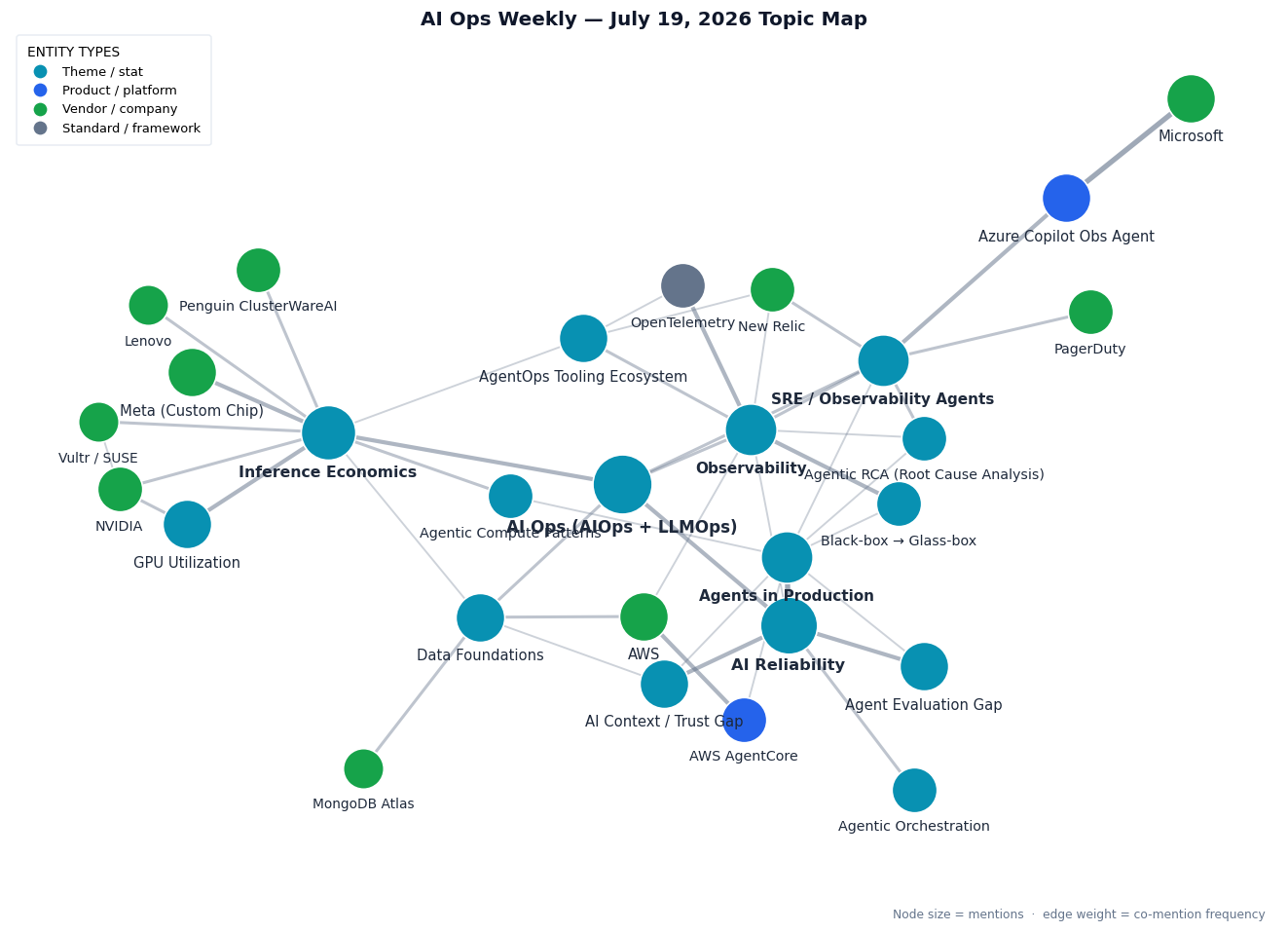
Topic map for this issue — five loosely linked threads running from the reliability of AI systems in production, through the observability and SRE tooling used to operate them, to the inference infrastructure and data governance underneath.
View interactive topic map →
|
Article index
20 articles, grouped by sub-theme. “News” = this week’s coverage window; “Foundational” = longer-form reference reading on the beat.
1 · Reliability of AI in production
2 · SRE agents & incident ops (AIOps)
3 · Observability standards & LLMOps tooling
4 · AI infrastructure & platform ops (inference economics)
5 · Governance & data foundations for AI ops
|
Detailed write-ups
1. The agent evaluation gap — a reality-alignment problem, not a coverage problem
VentureBeat · Jul 16, 2026
The clearest articulation this cycle of the beat’s central theme: enterprises don’t have an agent coverage problem (too few tests), they have a reality-alignment problem — their evals confirm that an agent did what the spec said, not that the output matches the real world. A companion piece reframes the same failure from the deployment side, arguing agentic orchestration is a deployment problem, not a platform problem, and that most systems shipping as “agents” are still chatbots with tool calls bolted on. The uncomfortable finding running through both is that organizations are shipping to production anyway. For AI-ops teams the operational takeaway is concrete: the eval harness, not the model, is the thing that has to be treated as production infrastructure — instrumented, versioned and monitored — because it is the only mechanism that can catch an agent that is technically passing while being substantively wrong.
Read the article →
Sources: VentureBeat (evaluation gap) · VentureBeat (orchestration)
2. The AI context gap — a trust problem, and “confidently wrong” agents
VentureBeat · Jul 17, 2026
The second face of the reliability story is context. VentureBeat argues the enterprise “context gap” is a trust problem, not a retrieval problem: teams can fetch the right documents and still not be able to guarantee the agent will ground its answer in them, so the output is fluent, plausible and unverifiable. The supporting data point lands hard — 57% of enterprises report having already watched an agent be confidently wrong in production, and the proposed fix is a dedicated “agentic context layer,” which most organizations do not yet have. A related field-notes piece makes the operational version of the argument bluntly: a proof of concept forgives a fragile data path, but operational AI does not — the brittle join, the stale cache, the silent schema drift that a demo never exercises becomes the thing that produces a confident wrong answer at scale. For platform teams the message is that data-path reliability and provenance are now first-class AI-ops concerns, not data-engineering afterthoughts.
Read the article →
Sources: VentureBeat (context gap) · VentureBeat (confidently wrong) · VentureBeat (fragile data path)
3. Azure Copilot Observability Agent is GA, autonomous operations in preview (FOUNDATIONAL)
Microsoft · Jun 23, 2026
The observability agent crossed from demo to product: Microsoft made the Azure Copilot Observability Agent generally available, with a more autonomous operations mode in preview behind it. The agent correlates telemetry, metrics and resource context to investigate degradations and surface probable causes inside the Azure portal, moving the hyperscaler-native SRE-agent pattern one step further into the platform. Read alongside AWS’s agent runtime work, it reinforces the strategic question this bulletin will keep asking: as the cloud providers ship “good enough” observability and incident agents in the box, where do the independent observability vendors differentiate — likely on cross-cloud reach, depth of telemetry and trust guardrails rather than on the core investigate-the-alert loop.
Read the article →
Sources: Microsoft
4. Incident context moves into the developer loop: PagerDuty in GitHub Agent HQ, and New Relic AI Coding Observability (FOUNDATIONAL)
PagerDuty · Jul 1, 2026
Two moves this cycle push operational signal earlier, into where code is written. PagerDuty shipped an agent app inside GitHub Agent HQ that brings live incident context into pull requests, so a developer (or a coding agent) sees whether the change they’re about to merge touches a service that is currently on fire. New Relic, in parallel, extended observability into the AI-coding loop itself with AI Coding Observability — instrumenting the increasingly agentic act of writing and shipping code. Together they mark a widening of the AIOps surface: incident response and observability are no longer confined to the run phase but are being wired into the build phase, closing the loop between the agents that write software and the systems that operate it.
Read the article →
Sources: PagerDuty · New Relic
5. Getting from black-box AI to glass-box AI
InfoWorld · Jul 16, 2026
The connective-tissue piece for the observability thread: InfoWorld argues that operating AI in production demands moving from black-box systems, where you see only inputs and outputs, to “glass-box” systems instrumented so you can inspect the reasoning, retrieval and tool calls in between. That is precisely the capability the reliability stories above are asking for — the ability to catch a confidently wrong answer by tracing how it was produced. The unglamorous enabler underneath is cost: AWS’s new analytics engine for managed OpenSearch targets the log-analytics bill directly, and cheaper log/telemetry retention is what makes keeping enough signal to achieve glass-box visibility economically viable at scale. For teams standing up an AI-ops practice, explainability and observability-cost are two sides of the same budget line.
Read the article →
Sources: InfoWorld (glass-box) · InfoWorld (OpenSearch)
6. Meta’s custom AI chip could redefine the economics of AI
HPCwire · Jul 16, 2026
The infrastructure story of the cycle is about cost-per-token, not capability. Meta’s custom AI silicon is framed as an attempt to rewrite the economics of inference by cutting reliance on merchant GPUs for its largest workloads — the clearest sign yet that the operators running AI at scale increasingly see the accelerator itself as an ops lever. It lands against a sharp utilization debate: a VentureBeat piece reports that 86% of enterprises say their GPUs run at half capacity or less, turning “buy more GPUs” into an argument about scheduling, batching and inference efficiency rather than raw supply. For platform teams the combined signal is that the marginal cost of a token is now a first-class operational metric — and that squeezing utilization out of existing fleets may beat expanding them.
Read the article →
Sources: HPCwire (Meta chip) · VentureBeat (GPU utilization)
7. Validated full-stack platforms: Vultr/SUSE, Lenovo and Penguin ClusterWareAI, plus new agentic compute patterns
HPCwire / InfoWorld · June–July 2026
The market’s answer to the utilization problem is packaging: validated, full-stack platforms that promise higher effective utilization and less bespoke plumbing. Vultr and SUSE launched a validated full-stack NVIDIA enterprise AI platform; Lenovo pitched its enterprise-AI economics story around agentic AI and inferencing; and Penguin Solutions expanded ClusterWareAI with AI-driven operations and automated remediation — the last one squarely an AIOps play, applying agents to keep the AI infrastructure itself healthy. Sitting above the hardware, InfoWorld’s survey of new agentic compute patterns describes how the shape of the workload is changing — long-running, tool-calling, bursty agent sessions that don’t map cleanly onto request/response infrastructure. For platform engineers the through-line is build-vs-buy: the vendors are betting that most teams will buy a validated stack rather than assemble and tune their own.
Read the article →
Sources: HPCwire (Vultr/SUSE) · BigDATAwire (Lenovo) · HPCwire (Penguin) · InfoWorld (compute patterns)
|
On our watch list
- Does the eval harness become production infrastructure? The reliability thread hinges on catching agents that pass their tests while being substantively wrong. Watch whether teams start treating evals like they treat monitoring — versioned, instrumented and on-call — and whether the observability vendors ship reality-alignment checks rather than just coverage metrics.
- The “agentic context layer” as a product category. With 57% of enterprises reporting confidently-wrong agents and most lacking a dedicated context layer, watch which vendors credibly claim that slot — and whether it consolidates into existing data platforms (MongoDB Atlas reranking, retrieval tooling) or emerges as a standalone tier.
- Hyperscaler observability agents vs. independents. With the Azure Copilot Observability Agent now GA and AWS raising AgentCore runtime quotas, watch how New Relic, PagerDuty and the observability pure-plays differentiate — likely on cross-cloud reach, depth of telemetry and build-phase integration rather than the core investigate-the-alert loop.
- Cost-per-token as the deciding metric. Meta’s custom silicon and the “86% of GPUs at half capacity” claim reframe the buildout as a utilization problem. Watch for published before/after cost-per-token and utilization numbers from teams adopting validated stacks (Vultr/SUSE, Lenovo, Penguin) — the figures that will settle build-vs-buy.
- Data foundations as the bottleneck. MongoDB folding reranking into Atlas and AWS cutting log-analytics costs point at the same reality: the hard part of production AI is increasingly the unglamorous data and telemetry plumbing. Watch for the operational plumbing — provenance, retention economics, retrieval quality — to become the visible constraint on scaling agents.
|
About this bulletin
AI Ops Weekly covers the operation of the application-and-infrastructure stack with AI, and the operation of AI systems themselves in production — spanning AIOps (observability, incident response, SRE) and LLMOps/MLOps (model deployment, evals, inference infrastructure, governance). It is written for SRE, platform and IT-operations engineers as well as ML-platform and MLOps engineers. Network-layer stories route to Agentic NetOps; security-framed stories route to Security Operations.
|
|
AI Ops Weekly · a weekly intelligence bulletin from Security Radar LLC
Coverage window: July 13–19, 2026 news, with foundational reference reading.
Curated by Paul Davis · paul.davis@security-radar.com
*|LIST:ADDRESS|*
View this email in your browser · Unsubscribe
© 2026 Security Radar LLC. All rights reserved.
Article titles and summaries are excerpted for review and commentary; all linked articles remain the copyright of their respective publishers and authors.
|
|