At a glance
This was a patch-and-policy week. Microsoft closed a record 622 vulnerabilities on July’s Patch Tuesday, including two already being exploited in the wild, and a proof-of-concept for a fresh Windows zero-day surfaced within hours of the release — a reminder that “patched” and “protected” are not the same thing once attackers reverse the fixes. CSO Online used the moment to argue the flaw surge should force CISOs to rethink vulnerability management altogether — toward exploit-driven, just-in-time patching as AI accelerates both flaw discovery and weaponization. Against that operational backdrop, the bigger shifts this week were regulatory: the Pentagon suspended CMMC Phase 2 while it rethinks how it holds defense contractors to a cybersecurity standard, prompting a full round of industry reaction in SecurityWeek’s Feedback Friday; the White House launched an AI-driven vulnerability clearinghouse dubbed “Gold Eagle” to speed federal cyber remediation; and the European Commission ordered Google to open Android to rival AI agents — an interoperability mandate with direct implications for how security teams will vet, sanction and monitor third-party agents on managed fleets.
Governance and accountability ran underneath all of it. A new SANS report highlights a widening gap between how fast organizations are deploying AI and how slowly they are governing it, and Cybersecurity Insiders reports CISO personal-liability fears have nearly doubled as AI-governance mandates expand — a pairing that turns “who signs off on the model” into a career-risk question, not just a compliance checkbox. CSO Online sharpened the point from the top down, reporting that roughly two-thirds of senior executives admit using unsanctioned AI tools — leadership itself is now the biggest hole in any shadow-AI strategy. Coupang’s $409M fine, revisited in this week’s foundational reading, is the cautionary tale those anxieties are built on. Dark Reading, meanwhile, pressed the harder philosophical questions: where the frontier-AI rulebook actually is, how to tame unpredictable agentic systems, why “Yellow Teams” may define the future of AI security, and why blind trust in AI is the real threat.
The rest of the week filled in the attack surface: SecurityWeek warned that AI data centers are being built faster than they can be secured, CSO Online dissected the SaaS blind spot that leaves security teams unable to see inside their own apps, TechRepublic covered a new FCC proposal that pits phone privacy against fraud prevention, and Microsoft’s “Project Perception” emerged as a possible challenger to Anthropic’s Mythos in AI security tooling. Foundational reading closes on the role itself — cybersecurity reframed as survival rather than protection, the modern CISO increasingly cast as the next CFO, a profile of policy-bridging veteran Jen Ellis, six tips for security leaders learning to speak business risk, and a CIO conversation on what next-generation IT leadership looks like.
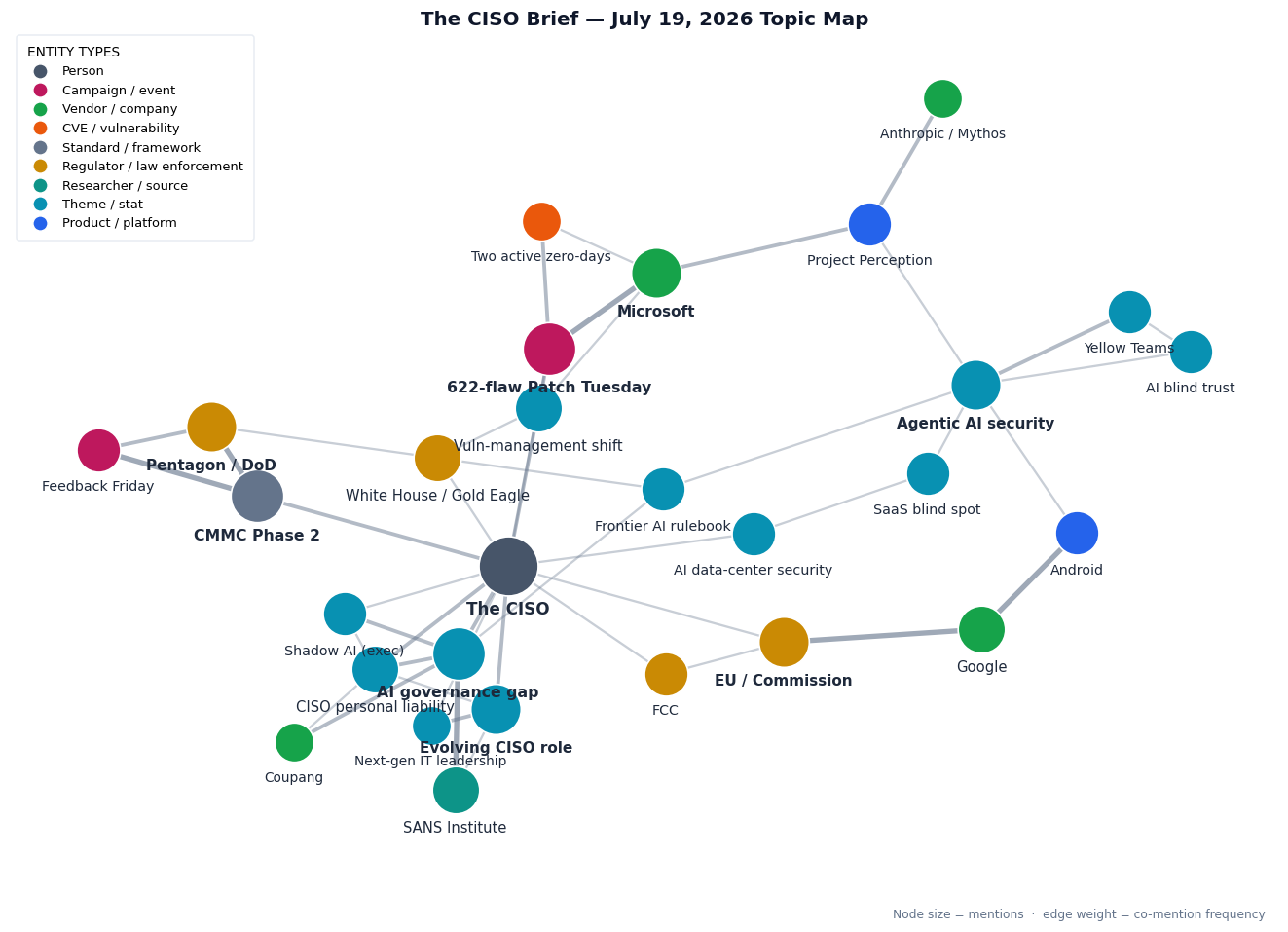
This week’s topic map — Microsoft’s 622-flaw Patch Tuesday and its two active zero-days feeding a broader vulnerability-management shift, the Pentagon’s CMMC Phase 2 suspension (and Feedback Friday reactions), the White House’s “Gold Eagle” AI-driven vulnerability clearinghouse, the SANS AI-governance gap with CISO personal-liability and executive shadow-AI risk, the EU’s order to open Android to rival AI agents, the agentic-AI security theme (Project Perception, Yellow Teams, blind trust, the frontier-AI rulebook), the AI data-center and SaaS attack surface, and the evolving CISO role and next-generation IT leadership.
View interactive topic map →
Article index
Cluster 1 — Patch Tuesday and the vulnerability firehose
Microsoft’s July release set a volume record and shipped fixes for flaws attackers were already using — the operational reality every other story this week sits on top of.
Cluster 2 — Regulation, compliance and enforcement
The Pentagon hit pause on its contractor cybersecurity standard, the White House stood up an AI-driven vulnerability clearinghouse to speed federal remediation, the EU forced open Android to rival AI agents, and the FCC weighed a phone-identity rule that trades privacy for fraud prevention.
Cluster 3 — AI governance, accountability and personal liability
A SANS report quantifies how far governance is trailing AI adoption, CISOs’ personal-liability fears nearly double, senior executives themselves turn out to be the biggest shadow-AI risk, Dark Reading asks where the frontier-AI rulebook is, and Coupang’s $409M fine shows the price of getting it wrong.
Cluster 4 — Securing agentic and frontier AI
Practitioner-facing pieces on how to make autonomous AI safe to run: taming unpredictable agents, the Microsoft-vs-Anthropic tooling race, the rise of “Yellow Teams,” and the case that blind trust is the real risk.
Cluster 5 — The AI-era attack surface
Two pieces on where AI is outpacing security controls: the data centers being stood up faster than they can be defended, and the SaaS estate security teams still can’t see inside.
Cluster 6 — Foundational: the evolving CISO role
Longer-form reading on how the job is changing — from protection to survival, from technologist to something closer to a CFO, and how to speak the language of business risk.
Detailed write-ups
1. Microsoft patches a record 622 flaws, with two zero-days already under attack
The Hacker News · July 14, 2026
Microsoft’s July Patch Tuesday was the largest on record, addressing 622 vulnerabilities across Windows, Office, Azure and the rest of the stack — and two of them were already being exploited in the wild when the fixes shipped, moving them straight to the top of any remediation queue. Volume at this scale is itself a governance problem: a 622-CVE release is far more than most patch-management programs can test and deploy in a single cycle, forcing CISOs to triage by exploitability and exposure rather than patch everything at once. The window is unforgiving in both directions — the two actively exploited bugs demand emergency action, while the sheer size of the release gives attackers a rich menu to reverse-engineer for the flaws organizations will inevitably defer. For security leaders, the takeaway is less about any single CVE than about capacity: whether the patch pipeline, asset inventory and compensating controls can absorb record-setting monthly releases without leaving predictable gaps.
2. Pentagon suspends CMMC Phase 2 — and the industry weighs in
SecurityWeek · July 14–17, 2026
The Department of Defense abruptly suspended Phase 2 of its Cybersecurity Maturity Model Certification program while it reconsiders how contractor cybersecurity requirements should work — a significant pause for the tens of thousands of defense-industrial-base firms that had been racing to meet assessment deadlines. SecurityWeek’s follow-up Feedback Friday collected industry reaction, which ran the full range: relief from smaller suppliers who found the certification burden and cost punishing, frustration from firms that had already invested heavily to comply and now face uncertainty, and concern from others that a pause signals wavering commitment to a baseline the DIB genuinely needs. The common thread in the commentary is that suspending the enforcement mechanism does not suspend the threat — the underlying requirement to protect controlled unclassified information persists, and vendors are being advised to hold their security posture rather than treat the pause as a reprieve. For CISOs inside or adjacent to the defense supply chain, the practical guidance is to keep NIST 800-171 alignment on track and watch closely for what replaces Phase 2, since a rethink of this scope often produces a stricter, not looser, successor.
Sources: SecurityWeek · SecurityWeek (Feedback Friday) · Breaking Defense · Industrial Cyber
3. The AI-governance gap widens — and CISOs feel it personally
Intelligent CISO · Cybersecurity Insiders · July 15–17, 2026
A new SANS report puts structure around a worry many security leaders already have: organizations are deploying AI far faster than they are governing it, leaving a widening gap between AI in production and the policies, oversight and controls meant to keep it accountable. Landing in the same week, Cybersecurity Insiders reports that CISOs’ fears of personal liability have nearly doubled as AI-governance mandates expand — regulators and boards are increasingly looking for a named, accountable owner when AI systems cause harm, and that owner is often the security executive. The two stories reinforce each other: the faster the governance gap grows, the more exposed the person nominally responsible for closing it becomes. TechRepublic’s revisited analysis of Coupang’s $409M fine is the concrete illustration of the downside, and Dark Reading’s “where’s the rulebook?” piece frames the structural cause — frontier capabilities are outrunning any settled regulatory framework. For CISOs, the defensive move is documentation and shared ownership: written AI-use policies, board-level sign-off, and a clear governance record that shows decisions were made deliberately rather than by default.
4. EU orders Google to open Android to rival AI agents
CSO Online · July 17, 2026
The European Commission ordered Google to open Android to competing AI agents, an interoperability mandate that would let third-party assistants reach the same device-level hooks and integration points Google’s own AI enjoys. Framed as competition policy, the order carries direct security consequences: a device platform that must admit rival agents becomes a platform on which more autonomous software can act on users’ behalf, expanding the population of agents that enterprise security teams need to inventory, sanction, and monitor on managed fleets. For CISOs, this reframes mobile management questions — which AI agents are permitted to operate on corporate devices, what data and actions they can access, and how to distinguish a sanctioned assistant from an impersonator — from a Google-controlled default into an open, multi-vendor problem. The regulatory direction of travel is toward more agent interoperability, not less, so mobile-security and app-vetting programs should start planning for a world where the agent layer on managed devices is heterogeneous by mandate.
5. Making agentic AI safe to run: Yellow Teams, Project Perception and the case against blind trust
Dark Reading · TechRepublic · July 13–17, 2026
A cluster of practitioner pieces this week tackled the same question from different angles: how do you actually operate autonomous AI without getting burned? Dark Reading’s “Taming the Unpredictable” argues that agentic systems demand a different security posture than deterministic software — the right response is to ask sharper questions about scope, permissions and failure modes before deployment, not to assume unpredictability can be engineered away entirely. A companion piece profiles the rise of “Yellow Teams” — a collaborative blend of builders and breakers positioned between traditional red and blue teams — as an emerging model for securing AI systems where the line between development and defense blurs. On the tooling side, TechRepublic reports that Microsoft’s “Project Perception” is shaping up as a challenger to Anthropic’s Mythos in the AI-security space, a sign the market for purpose-built agent-security tooling is consolidating into named platforms. Tying the theme together, Dark Reading’s “The Real AI Threat Is Blind Trust” makes the cultural argument underneath all of it: the most dangerous failure mode is not a clever attack but uncritical acceptance of AI output, and the fix is verification discipline baked into workflows rather than bolted on after an incident.
On our watch list
- What replaces CMMC Phase 2. Watching whether the Pentagon’s rethink produces a lighter-touch model or a stricter successor — and how quickly defense-industrial-base firms get clarity, given many paused mid-investment.
- Whether AI-governance liability lands on a named owner. With personal-liability fears nearly doubling, watching for the first enforcement actions or board policies that formally designate the CISO (versus a chief AI or risk officer) as accountable for AI harm.
- How the Android AI-agent order gets implemented. Watching the technical shape of Google’s compliance — which hooks open to rival agents, and what device-management controls enterprises get to govern them on managed fleets.
- Exploitation of the deferred Patch Tuesday flaws. With 622 CVEs in one release, watching which of the non-emergency bugs attackers weaponize first as organizations work through a backlog no single cycle can clear.
- Consolidation in agent-security tooling. Watching whether Microsoft’s Project Perception, Anthropic’s Mythos and the “Yellow Team” operating model converge into a recognizable category CISOs can standardize on, or stay fragmented.
|