At a glance
This week’s marquee story is a textbook trusted-pipeline compromise. Attackers backdoored the popular AsyncAPI npm packages by tampering with the project’s GitHub Actions release workflow, so malicious builds were signed and published through the maintainers’ own legitimate CI/CD pipeline. The twist that makes it dangerous: the payload fires at import time — the moment a developer’s code loads the module, not when they call a specific function — across a package family pulling roughly two million downloads a week. The Hacker News broke the campaign and Microsoft’s security team published a detailed teardown of the multi-stage delivery. It is the clearest illustration yet that “we only install from the official registry” is not a control when the official registry is fed by a compromised pipeline.
Alongside it, JFrog’s research team and The Hacker News detailed a second, very different campaign: 148 npm packages disguised as student web proxies that, once installed, turned the host browser into a node in a distributed DDoS botnet — JFrog tracks it as “Lucide Proxy.” It is a reminder that not every malicious package steals secrets; some just quietly rent out your compute. Set against these live incidents, two defensive pieces frame the response: npm v12 ships this month with install scripts blocked by default — exactly the class of automatic-execution behavior these campaigns lean on — and Unit 42’s survey of the npm threat landscape maps the full attack surface and the mitigations that actually move the needle.
The rest of the week fills in the supply-chain picture: Socket’s coordinated npm-and-PyPI typosquat of popular payment SDKs, The Register’s reporting on the Miasma campaign poisoning 20-plus npm packages to hunt developer secrets, an FBI warning that the TeamPCP crew is compromising developer tools directly, and a routine-but-important round of GitLab patches. Two foundational reads sharpen the strategy behind all of it: Netizen argues that supply-chain security cannot stop at SBOMs — a bill of materials is an ingredient list, not a defense, and needs reachability, provenance, and runtime context on top of it — a point Insignary presses commercially by pitching binary-level SBOM accuracy, while Help Net Security looks upstream at how public grant funding shapes the health and sustainability of the open-source projects the whole chain rests on. On the AI-and-recon side, attackers are increasingly working the human and account layer rather than the code: The Hacker News showed how dormant GitHub accounts let adversaries blend in while quietly mapping a target’s corporate org structure, InfoWorld argued that AI-generated code creates a distinct and harder-to-service kind of technical debt — a claim LeadDev now backs with data showing maintainability plummets in the AI coding era — and JetBrains pitched a governance suite to corral the sprawl of competing AI coding agents inside one organization. The through-line: the pipeline, the registry, the SBOM, and the coding assistant are all now first-class parts of the attack surface.
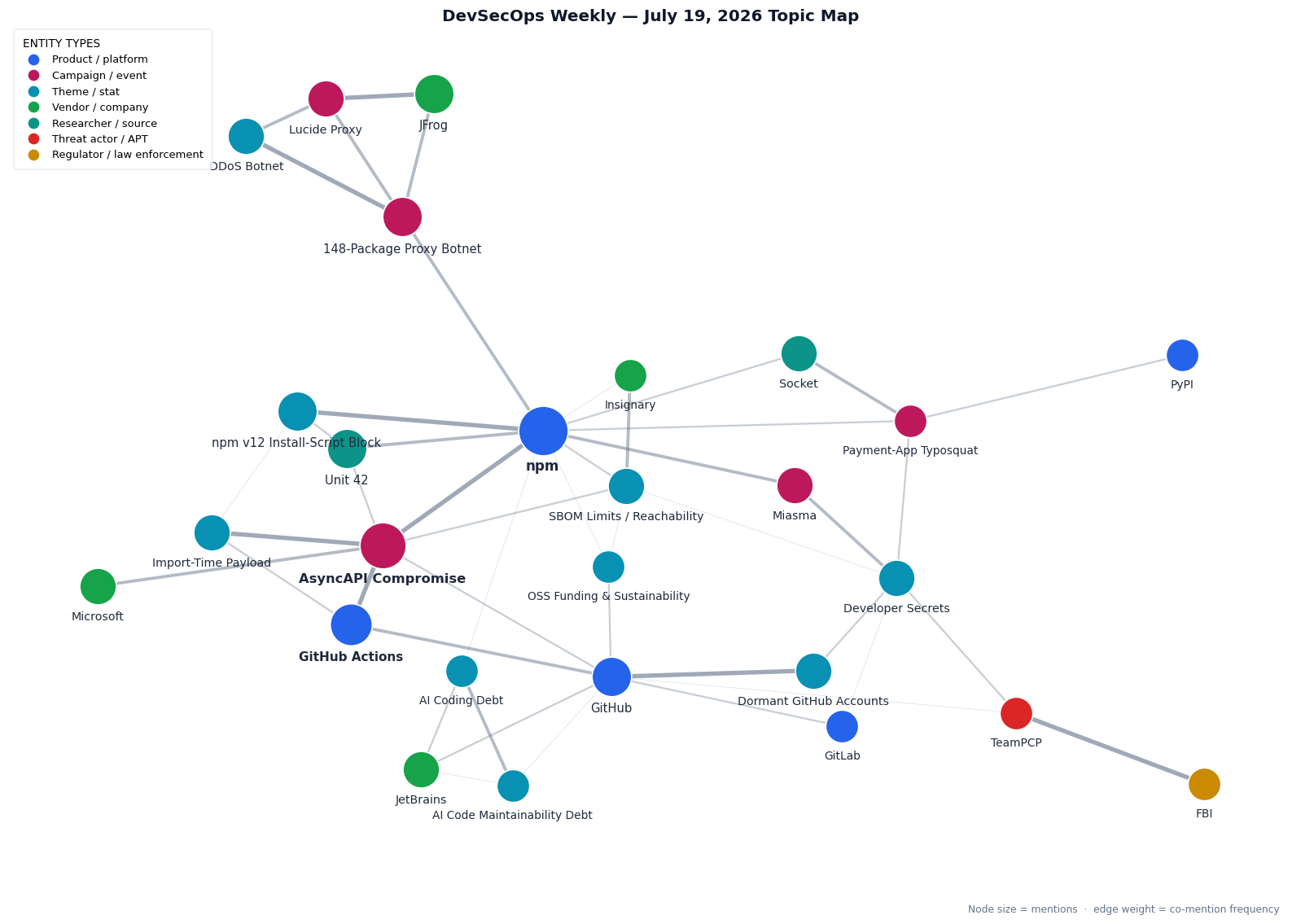
Topic map — the AsyncAPI npm supply-chain compromise (backdoored via GitHub Actions, import-time payload, Microsoft teardown), the 148-package student-proxy DDoS botnet (Lucide Proxy / JFrog), npm ecosystem threats & defenses (Unit 42 threat landscape, npm v12 install-script blocking, Socket payment-app typosquat, Miasma), and attacks working the account and AI-agent layer (dormant GitHub accounts, AI coding debt, JetBrains governance, TeamPCP / FBI). Foundational threads round it out: SBOM limits & reachability (Insignary), open-source funding & sustainability, and AI code-maintainability debt.
Article index
The AsyncAPI npm supply-chain compromise
The week’s marquee incident: the widely used AsyncAPI npm packages (~2M weekly downloads) were backdoored through the project’s own GitHub Actions release pipeline, with a payload that executes at import time. The Hacker News broke the story; Microsoft’s security team published the multi-stage teardown.
- Compromised AsyncAPI npm Packages Deliver Multi-Stage Botnet Malware (The Hacker News, Jul 15) — W1
- Unpacking the AsyncAPI npm Supply-Chain Compromise: Import-Time Payload Delivery (Microsoft Security Blog, Jul 15) — W2
npm packages as botnet infrastructure
A separate campaign this week disguised 148 npm packages as student web proxies that, once installed, enlisted the host browser into a distributed DDoS botnet. JFrog Security Research tracks it as “Lucide Proxy” and provides the technical breakdown.
- 148 npm Packages Disguised as Student Proxies Turned Browsers Into a DDoS Botnet (The Hacker News, Jul 14) — W3
- Lucide Proxy: Turning Student Web Proxies into DDoS Bots (JFrog Security Research, Jul 14) — F1
The npm threat landscape & defenses
Two defensive frames plus two more live campaigns: Unit 42 maps the full npm attack surface and mitigations, npm v12 disables install scripts by default this month, Socket details a coordinated payment-SDK typosquat, and The Register covers the Miasma campaign hunting developer secrets. Three foundational reads widen the lens beyond npm to the supply-chain fundamentals: why SBOMs alone are not a defense, a vendor push (Insignary) for binary-level SBOM accuracy, and how public funding shapes open-source project health.
- The npm Threat Landscape: Attack Surface and Mitigations (Unit 42 / Palo Alto Networks, Jul 15) — F2
- npm v12 Ships This Month, Blocking Install Scripts (TechTimes, Jul 8) — F3
- Coordinated npm and PyPI Campaign Typosquats Popular Secure Payment Apps (Socket, Jul 8) — F4
- Miasma Campaign Poisons 20-Plus npm Packages, Hunts for Developer Secrets (The Register, Jun 26) — F5
- Why Software Supply-Chain Security Cannot Stop at SBOMs (Netizen, Jul 17) — F11
- Insignary Tackles SBOM Accuracy Gap as AI Tools Intensify Software Supply-Chain Risk (Security Boulevard, Jul 6) — F12
- What Public Money Does to Open-Source Projects (Help Net Security, Jul 16) — F13
Developer accounts, AI coding agents & tooling
Attackers increasingly work the account and assistant layer: dormant GitHub accounts provide cover for corporate-org reconnaissance, AI-generated code creates a distinct kind of technical debt — now measured, with LeadDev reporting maintainability plummeting in the AI coding era — and JetBrains pitches governance for AI-agent sprawl, while the FBI warns of direct developer-tool compromises and GitLab ships a security patch round.
- Dormant GitHub Accounts Help Attackers Blend In While Mapping Corporate Orgs (The Hacker News, Jul 9) — F6
- Why AI Coding Debt Is Different (InfoWorld, Jun 18) — F7
- Code Maintainability Plummets in the AI Coding Era (LeadDev, Jul 7) — F14
- JetBrains Seeks to Unify Fragmented AI-Based Software Development With a Governance Suite (InfoWorld, Jul 9) — F8
- FBI Warns TeamPCP Hackers Compromise Developer Tools in Supply-Chain Attacks (developer-tech.com, Jul 2) — F9
- GitLab Patches 8 Vulnerabilities Affecting CE and EE Installations (GBHackers, Jul 8) — F10
Detailed write-ups
01
AsyncAPI npm packages backdoored through the project’s own GitHub Actions pipeline
This is the supply-chain story of the week. Attackers didn’t typosquat a lookalike name or slip malware past a sleepy reviewer — they compromised the AsyncAPI project’s trusted release path itself. By tampering with the GitHub Actions workflow that builds and publishes the packages, they got malicious builds signed and pushed to npm through the maintainers’ own legitimate CI/CD pipeline, so the poisoned versions carried every mark of authenticity a defender normally looks for. AsyncAPI’s tooling is deeply embedded in event-driven and API development, and the affected package family pulls roughly two million downloads a week, giving the campaign an enormous blast radius. The detail that makes it especially dangerous is the trigger: the payload executes at import time — the instant a developer’s code loads the module — rather than waiting for a specific function call, so simply building or testing an app that depends on AsyncAPI is enough to detonate it. Microsoft’s security team published a multi-stage teardown of how the backdoor stages its follow-on payload, and The Hacker News broke the campaign. The takeaway for DevSecOps teams: registry provenance and package signing prove where a build came from, not that the build machine was trustworthy — pipeline integrity (workflow-file review, pinned action SHAs, least-privilege release tokens) is the control that matters here.
Sources: The Hacker News, Microsoft Security Blog
03
148 npm packages posed as student proxies and drafted browsers into a DDoS botnet
Not every malicious package is after your secrets — some just want your bandwidth. JFrog Security Research and The Hacker News detailed a campaign of 148 npm packages dressed up as free student web proxies (the kind students use to route around school network filters) that, once installed, conscripted the host into a distributed DDoS botnet, turning ordinary developer and end-user machines into attack infrastructure. JFrog tracks the campaign as “Lucide Proxy” and walks through how the packages establish command-and-control and participate in coordinated floods. The scale — 148 distinct packages — is the notable part: publishing at volume raises the odds that a careless npm install or an AI assistant reaching for a “proxy” helper grabs one of them, and it makes takedown a game of whack-a-mole. For defenders, the lesson pairs neatly with the AsyncAPI story: even packages that never touch your credentials can quietly monetize your compute and drag your IP space into someone else’s attack, so “does this dependency actually need to exist” belongs in the review alongside “does it steal anything.”
Sources: The Hacker News, JFrog Security Research
05
The defensive frame: npm v12 blocks install scripts, and Unit 42 maps the whole attack surface
Against a week of live compromises, two pieces point at what actually reduces risk. First, npm v12 ships this month with a structural change that has been years in coming: install scripts (the preinstall/postinstall hooks that execute automatically the moment a package is added) are now disabled by default. That single default flip blunts an entire class of attack — the run-on-install payloads that have powered a long line of supply-chain incidents — and while it won’t stop an import-time payload like AsyncAPI’s, it removes the most common no-interaction execution path malware relies on. Second, Unit 42’s survey of the npm threat landscape steps back from any single incident to map the full attack surface — typosquatting, dependency confusion, maintainer-account takeover, malicious install scripts, and trusted-pipeline compromise — and lays out the mitigations that move the needle: lockfiles and pinned versions, disabling automatic script execution, scoped and short-lived publish tokens, and provenance verification. Read together, they make the same argument this bulletin keeps circling: shift the defense left, to what enters and runs in the pipeline, because by the time a payload is executing on a build runner the window to stop it has usually closed. DevSecOps teams should plan the npm v12 cutover now — audit which of their dependencies genuinely need install scripts before the default flips underneath them.
Sources: TechTimes (npm v12), Unit 42 (npm threat landscape)
09
Beyond the bill of materials: why SBOMs are a starting point, not a defense
If the AsyncAPI compromise showed how a trusted pipeline can be turned against you, this week’s foundational reads ask the obvious follow-up: what would actually have caught it? Netizen’s answer is that a software bill of materials, on its own, would not. An SBOM is an ingredient list — it tells you which components are present, not whether any of them is reachable, exploitable, or actively malicious — so treating “we have SBOMs” as a control confuses inventory with defense. Netizen argues the list only becomes protective when layered with reachability and exploitability context (does the vulnerable code actually run?), provenance and attestation (where did this build really come from?), and runtime monitoring that watches what dependencies do after they are installed — precisely the pipeline-integrity gaps the AsyncAPI attackers exploited. Pushing on the same weak point from the vendor side, Insignary has announced a product angle focused on the SBOM accuracy gap, positioning binary-level analysis and reachability as a way to close the blind spots that source-declared manifests miss, and framing AI-assisted development as a force that is intensifying supply-chain risk faster than manifest-based tooling can keep up (this one is a press-release-style announcement, so read the specific claims with the usual vendor caution). Widening the lens further, Help Net Security looks upstream at the health of the open-source projects the entire chain depends on, summarizing research on how public and government grant funding affects project sustainability and maintainer capacity — a reminder that supply-chain security ultimately rests on whether the people maintaining these components can afford to keep doing it. Together the three make one argument: the bill of materials is where supply-chain security starts, not where it stops.
Sources: Netizen (beyond SBOMs), Security Boulevard (Insignary), Help Net Security (OSS funding)
12
Working the account layer: dormant GitHub accounts, AI coding debt, and agent governance
The rest of the attack surface this week is human and organizational rather than purely code. The Hacker News reported on how attackers use dormant GitHub accounts — long-lived, aged, apparently benign identities — to blend into open-source and corporate spaces while quietly mapping a target’s org structure: who commits to what, which internal repos exist, who the maintainers and key engineers are. An aged account attracts none of the suspicion a freshly registered one does, which makes it ideal cover for the reconnaissance phase that precedes a social-engineering or trusted-pipeline attack of exactly the kind AsyncAPI suffered. Feeding the same risk from the inside, InfoWorld argues that AI-generated code produces a distinct flavor of technical debt: it is plausible-looking, fast to accumulate, and often lacks the mental model a human author would carry, so it is harder to review, harder to attribute, and harder to service later — a governance problem as much as a quality one. LeadDev now puts numbers behind that thesis, reporting that code maintainability plummets in the AI coding era, with measurable rises in churn and duplication as AI-generated code enters the repo — the kind of quality erosion that widens the review gap security teams have to cover. JetBrains is pitching directly at that governance gap with a suite meant to unify the fragmented sprawl of competing AI coding assistants inside an organization, giving teams shared policy, visibility, and controls over which agents touch which code. The connective tissue: as the pipeline and registry get harder to attack head-on, the developer’s identity, the assistant at their elbow, and the debt those assistants leave behind all become part of the security team’s remit.
Sources: The Hacker News (dormant accounts), InfoWorld (AI coding debt), LeadDev (AI maintainability), InfoWorld (JetBrains governance)
On our watch list
- Trusted-pipeline compromise as the new normal. AsyncAPI was hit through its own GitHub Actions release workflow, not a lookalike package. Watching whether other high-download projects with automated npm publishing audit their workflow files, pin action SHAs, and scope release tokens — and whether import-time payloads become the preferred trigger to dodge scanners tuned for install-script behavior.
- npm v12’s install-scripts default flips this month. Disabling
postinstallexecution by default closes the most common no-interaction payload path. Watching how many teams audit and allowlist the dependencies that genuinely need install scripts before the cutover, and whether attackers pivot harder toward import-time execution to route around the change. - Volume campaigns and botnet-as-a-package. The 148-package Lucide Proxy botnet shows attackers publishing at scale so a single careless install lands a bot. Watching whether registry-side rate-limiting and behavioral detection keep pace, and whether AI coding assistants reaching for “helper” packages become a reliable delivery vector.
- Reconnaissance through aged accounts and AI tooling. Dormant GitHub accounts for org-mapping, plus the review and attribution gaps introduced by AI-generated code, push more of the risk onto the identity and assistant layer. Watching whether GitHub tightens signals on long-idle accounts and whether governance suites like JetBrains’ gain traction as organizations try to corral agent sprawl.