At a glance
This was a platform week for the SOC. Sophos launched Sophos Fusion, folding SIEM, XDR, and MDR into a single AI-native system built around an agentic analyst rather than a stack of consoles the human has to stitch together — the clearest sign yet that the “autonomous SOC” pitch is moving from slide decks to shipping products. It did not land alone. Torq and Criminal IP paired up to feed decision-ready threat intelligence straight into autonomous SOC workflows, SecurityHQ pushed its AXCEL platform to shrink the gap between detection and response, Beacon Security raised $13 million for a security-data platform aimed at the same automation problem, and Pulse Security debuted an operational-management layer pitched at the security leaders who have to run all of this. Read together, the throughline is unmistakable: the industry is racing to make the SOC’s data pipeline and response loop run with less human hand-holding, and the differentiation is shifting from “which console” to “whose automation you trust.”
Alongside the big launches, several quieter releases point at where the detection surface is moving. Cloudflare’s Precursor uses continuous behavioral analysis rather than static fingerprints to catch advanced bots that now look almost human; Nudge Security added agentic detection of risky OAuth grants and rogue browser extensions, the exact SaaS-identity blind spot that keeps widening as employees wire AI tools into corporate accounts; and Lineation.ai emerged with a zero-trust control plane for the runtime behavior of autonomous AI agents — a reminder that the same agents the SOC is deploying to defend the enterprise are themselves a new class of thing that needs watching. The same blind spot showed up in a concrete bug this week: Manifold Security found that malicious Chrome extensions can forge synthetic clicks that Claude for Chrome accepts as genuine user actions, abusing the assistant’s privileges to read Gmail, Docs, and Calendar — still exploitable eight releases after it was first reported. The pattern under all of it: the object of detection is increasingly a behaving software agent, human or not, and the control that works is the one watching what it does over time.
The week’s hard-edged operational lesson came from CISA, which folded the hard-won lessons of its own recent credential-exposure incident directly into new coordinated-vulnerability-disclosure guidance — turning a painful postmortem into a usable playbook for defined researcher-reporting channels and repeatable response. It arrived the same week a researcher published a working Windows zero-day proof-of-concept just hours after Patch Tuesday, a blunt demonstration of how little runway a SOC now gets between disclosure and weaponization. The same shrinking-window pressure showed up all over the patch queue: CISA also urged immediate on-prem SharePoint hardening as three actively exploited CVEs landed on the KEV list under a three-day federal deadline; an OpenSSL denial-of-service flaw dubbed HollowByte shipped a fix in June with no CVE, advisory, or changelog note, leaving scanners blind to it; and Microsoft put Windows Server 2022 on a 90-day countdown to end of mainstream support — a reminder that lifecycle planning is as much a part of the exposure surface as the monthly rollup. This week’s foundational reading turns that pressure inward: The Hacker News makes the case for a “fast and slow” SOC that pairs autonomous AI with analyst copilots, SecurityWeek warns that AI token costs can quietly break a security program’s economics, The Register finds practitioners souring on automated pentesting tools, Help Net Security reports UC Berkeley’s Prismata treating web-agent prompt injection like the XSS of the browser-agent era, and Corelight and Prophet AI both argue the fix for collapsing triage is explainable AI you can actually audit — not more black-box automation. The tooling wave is real; so is the reminder to buy the automation you can explain.
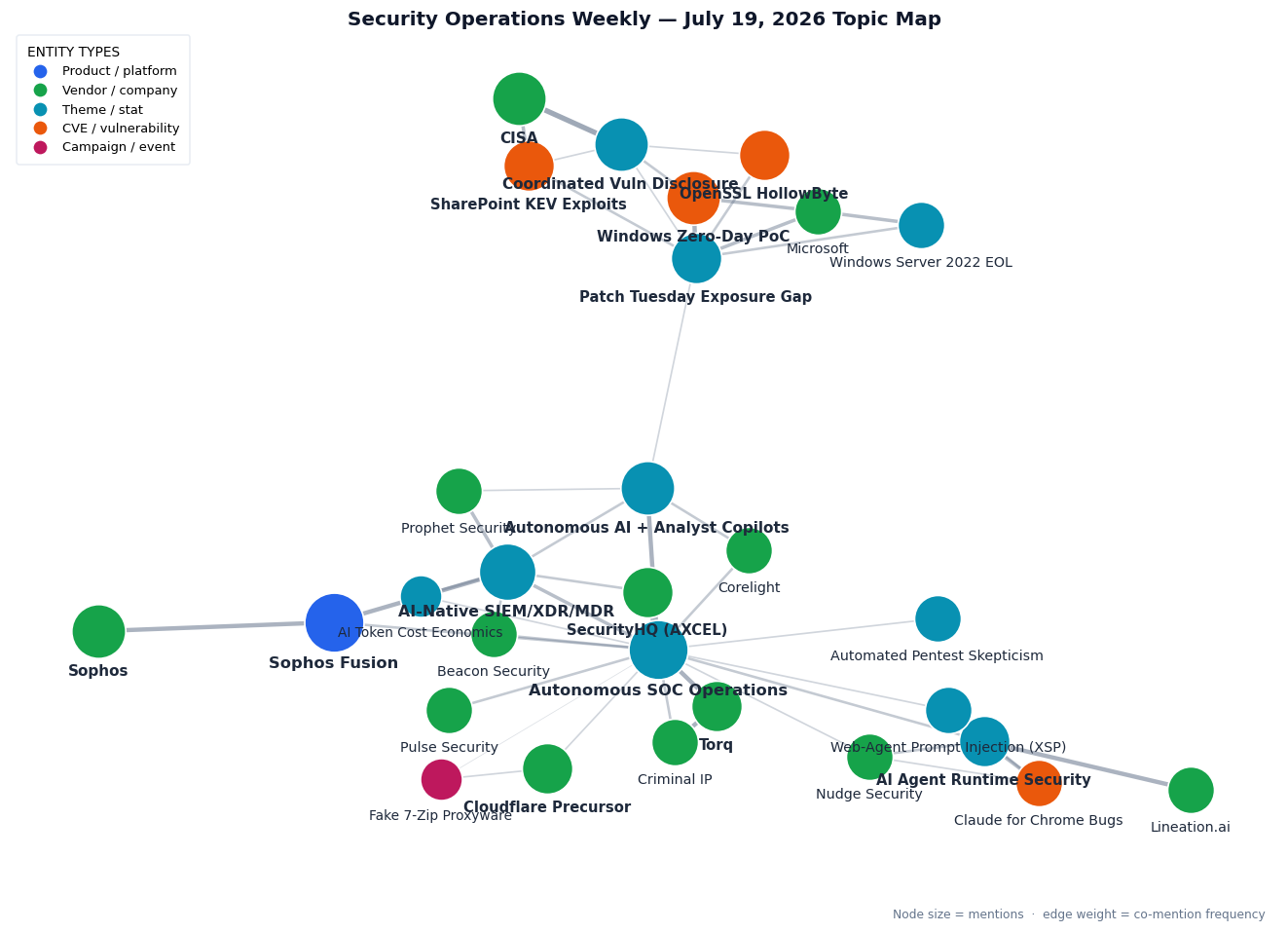
This week’s stories
AI-native SIEM/XDR and the autonomous-SOC platform wave
The week’s dominant story: a cluster of launches, partnerships, and funding all aimed at the same target — running the SOC’s detection-to-response loop with less human hand-holding. Sophos Fusion consolidates SIEM, XDR, and MDR into one AI-native system, while Torq, SecurityHQ, Beacon, and Pulse each attack a different piece of the autonomous-SOC problem.
- Sophos Launches Sophos Fusion, an AI-Native SIEM/XDR/MDR Defense System
- Torq and Criminal IP Partner for Decision-Ready Threat Intel for Autonomous SOC Ops
- SecurityHQ Advances AXCEL to Close the Gap Between Detection and Response
- Beacon Security Raises $13 Million for Security Data Platform
- Pulse Security Debuts Operational Management Platform Built for Security Leaders
Detection, response, and runtime control for AI-era operations
Four items showing where the detection surface is moving: continuous behavioral analysis for near-human bots, agentic discovery of risky OAuth grants and browser extensions, a zero-trust control plane for the runtime behavior of the autonomous AI agents the SOC is now deploying itself, and a live bug in which a malicious extension abuses an AI assistant’s own privileges.
Vulnerability disclosure and patch-cycle pressure
CISA turns its own recent incident into public coordinated-disclosure guidance the same week a researcher publishes a working Windows zero-day PoC just hours after Patch Tuesday — two sides of the shrinking window between disclosure and exploitation that every SOC now operates inside. Around them, a fuller patch-and-lifecycle picture: three actively exploited SharePoint CVEs on the KEV list, an OpenSSL denial-of-service flaw shipped with no CVE or advisory, and a 90-day countdown on Windows Server 2022 mainstream support.
- CISA Folds Its Own Hard-Won Lessons Into Coordinated Vulnerability Disclosure Guidance
- Researcher Drops New Windows Zero-Day PoC Hours After Patch Tuesday
- CISA Urges Immediate SharePoint Hardening as Exploits Mount
- OpenSSL HollowByte Flaw Could Freeze Server Memory with 11-Byte TLS Requests
- Windows Server 2022 Reaches End of Mainstream Support in 90 Days
Foundational reading: the analyst, the economics, and the tooling reality of the modern SOC
Eight longer reads on the parts of the SOC that don’t show up in a launch announcement — how to combine autonomous AI with human analysts, why AI-speed attacks break the incident-response model, what AI token costs and automated-tooling hype do to a security budget, how to defend web agents against prompt injection, and the case for explainable AI in triage over more black boxes.
- Thinking Fast and Slow in the SOC: Combining Autonomous AI with Analyst Copilots
- AI-Speed Attacks Are Forcing a Rethink of Incident Response
- The AI Token Costs That Can Break Cybersecurity
- Infosec Professionals Sour on Automated Pentesting Tools
- Product Showcase: How to Evaluate AI SOC Platforms (Prophet AI)
- SOC Triage Is Breaking Down. Corelight Targets It With Explainable AI
- Prompt Injection Is Becoming the XSS of the Web-Agent Era
- Fake 7-Zip Installers Turn Devices Into Residential Proxy Nodes
The detail
1. Sophos Launches Sophos Fusion, an AI-Native SIEM/XDR/MDR Defense System
Sophos unveiled Sophos Fusion, its attempt to collapse three product categories the SOC has always run as separate tools — SIEM for log aggregation and correlation, XDR for cross-surface detection and response, and MDR for the human-run managed service — into one AI-native platform built around an agentic analyst rather than a wall of consoles. The pitch is that Fusion ingests telemetry across endpoint, network, identity, cloud, and email into a single data layer, then runs autonomous triage and investigation on top of it, escalating to Sophos’s MDR analysts only when a case genuinely needs a human — the “fast and slow” division of labor that this week’s foundational reading argues is the right shape for the modern SOC. What makes this notable beyond the marketing is who is shipping it: Sophos is a mainstream, mid-market-heavy vendor, not a startup, and its move to fold SIEM into an MDR-plus-XDR bundle is a signal that the “autonomous SOC” category is consolidating from a set of point tools into an integrated platform play. For SOC leaders, the operational question Fusion forces is the same one every consolidation raises: does folding your SIEM, detection, and managed response into one vendor’s AI reduce the swivel-chair tax and alert-routing friction enough to justify the lock-in and the loss of best-of-breed choice in each layer — and can that vendor show you why its agent reached a verdict, not just that it did.
Sources: Sophos
2. The Autonomous-SOC Tooling Wave: Torq & Criminal IP, SecurityHQ AXCEL, and Beacon Security’s $13M
Sophos Fusion was the loudest launch, but it landed inside a full week of autonomous-SOC activity that, read together, maps where the category is investing. Torq and Criminal IP announced a partnership to pipe Criminal IP’s attack-surface and threat-intelligence data directly into Torq’s hyperautomation platform as “decision-ready” intel — enrichment that arrives already scored and contextualized so an autonomous workflow can act on it without a human first tab-switching to a threat-intel portal; the bet is that the bottleneck in SOC automation is no longer the playbook but the quality and readiness of the data feeding it. SecurityHQ advanced its AXCEL platform with the explicit goal of closing the gap between detection and response — the dwell-time window where an alert has fired but no action has been taken — positioning AXCEL as the orchestration layer that turns a verified detection into a contained incident without waiting on a queue. And Beacon Security raised $13 million to build a security-data platform, part of a broader investor thesis that the unglamorous plumbing — normalizing, routing, and cost-controlling the telemetry that feeds every AI-SOC tool above it — is where the next durable value sits, especially as SecurityWeek’s reporting elsewhere this week warns that AI token costs can quietly break a security program’s economics. Pulse Security rounded out the week with an operational-management platform aimed at the leaders who have to run all of this. The takeaway for a SOC evaluating any of it: the differentiation is migrating away from the detection console and toward two things — the readiness of the intel and the trustworthiness of the automation — so weight your proofs-of-concept accordingly.
Sources: Torq / Criminal IP (GlobeNewswire) · SecurityHQ AXCEL (GlobeNewswire) · Beacon Security (SecurityWeek) · Pulse Security (GlobeNewswire)
3. CISA Folds Its Own Hard-Won Lessons Into Coordinated Vulnerability Disclosure Guidance
CISA published updated coordinated-vulnerability-disclosure (CVD) guidance that is notable less for its recommendations than for its provenance: the agency has folded the lessons from its own recent, uncomfortable incidents directly into the document, effectively converting a painful postmortem into a reusable playbook for everyone else. The guidance presses two points a SOC can act on immediately. First, define your researcher-reporting channels before you need them — a clearly published, monitored intake path for outside researchers to report a potential exposure, so a good-faith disclosure does not bounce off an unstaffed inbox or a contractor who never responds while the clock runs. Second, have a repeatable response process ready in advance rather than assembling one mid-incident: who validates the report, who owns credential rotation and takedown, who communicates, and on what timeline. The subtext is the same lesson CISA learned the hard way — a disclosure process built while an incident is already unfolding is a process built too late, and the fix costs far less to stand up in calm conditions than to improvise under pressure. For SOC and vulnerability-management leaders, the practical exercise is to read this guidance next to your own intake and response runbooks and ask whether an external researcher who found something in your environment today would know where to send it, and whether anyone would be ready to act when they did.
Sources: Help Net Security
4. Researcher Drops New Windows Zero-Day PoC Hours After Patch Tuesday
Within hours of Microsoft’s July Patch Tuesday, a researcher published a working proof-of-concept for a fresh Windows zero-day — a flaw not addressed in the monthly rollup — handing the offensive side of the internet functional exploit code before most organizations had even begun testing the patches that did ship. The timing is the whole story for a SOC: the release deliberately rides the seam of the patch cycle, when defenders are busy validating and staging the month’s known fixes and least prepared to absorb a brand-new, unpatched bug with public exploit code attached. It is a concrete instance of the collapsing gap between disclosure and weaponization that has been reshaping SOC operating models all year, and it argues for a few things that don’t depend on a vendor patch existing yet: detection content and behavioral rules for the exploited technique rather than the specific CVE, so coverage lands before a fix does; compensating controls and network segmentation for the affected component; and a monitoring posture that treats the days immediately after Patch Tuesday as an elevated-risk window rather than a quiet one. The uncomfortable operational reality this PoC underlines is that “we’re patched” and “we’re covered” are no longer the same statement — and the gap between them is now measured in hours.
Sources: The Hacker News
5. The Patch-and-Lifecycle Queue: SharePoint on KEV, OpenSSL’s Silent “HollowByte,” and Windows Server 2022’s 90-Day Clock
Beneath the platform launches, the week handed the SOC three concrete patch-and-lifecycle problems that between them describe the modern exposure surface. CISA urged immediate hardening of on-prem SharePoint as three actively exploited flaws — CVE-2026-56164, CVE-2026-45659, and CVE-2026-32201 — were added to the Known Exploited Vulnerabilities catalog, putting federal civilian agencies under a three-day BOD 22-01 remediation deadline. CISA’s own framing is the operative line: “stop measuring this in patch speed.” Beyond applying the fixes, defenders are told to enable AMSI, rotate the ASP.NET machine keys an attacker may already have stolen, and segment the servers — because on internet-facing SharePoint, patching a box that’s already been touched does not evict the intruder. The second problem is the opposite of a loud KEV entry: an OpenSSL denial-of-service flaw that Okta’s red team dubbed “HollowByte,” in which an 11-byte malformed TLS handshake header triggers glibc heap fragmentation that strands server memory and can freeze the process. OpenSSL shipped the fix back in its June 9 releases (4.0.1, 3.6.3, 3.5.7, 3.4.6, and 3.0.21) — but with no CVE, no advisory, and no changelog note, meaning vulnerability scanners have nothing to match on and a patch-management program organized around CVE feeds can be fully exposed while believing it is clean. The third is pure lifecycle: Microsoft confirmed Windows Server 2022 reaches end of mainstream support on October 13, 2026 — 90 days out — after which it enters extended support with security-only updates through October 14, 2031, with Server 2025 as the upgrade path. Read together, the three make the same point the SharePoint advisory does out loud: patch speed is necessary but no longer sufficient, and the gaps that hurt are the ones your tooling can’t even see — an unadvertised fix, a compromised-but-patched box, or a support clock nobody put on the calendar.
Sources: SharePoint hardening (CSO Online) · OpenSSL HollowByte (The Hacker News) · Windows Server 2022 EOL (BleepingComputer)
On our watch list
- The autonomous SOC is consolidating into platforms. Sophos Fusion folding SIEM, XDR, and MDR into one AI-native system — alongside Torq, SecurityHQ, Beacon, and Pulse each attacking a piece of the same problem — means the buying decision is shifting from best-of-breed layers to whose end-to-end automation you trust. Start pressure-testing vendors on whether their agent can explain a verdict, not just render one.
- Decision-ready intel and the data layer are the new bottleneck. Torq & Criminal IP’s partnership and Beacon Security’s $13M both bet that the constraint on SOC automation is the readiness and cost of the data feeding it, not the playbooks. Read that against SecurityWeek’s warning on AI token costs before you scale any AI-SOC pilot to production.
- Your own AI agents are now a detection target. Lineation.ai’s runtime control plane and Nudge Security’s OAuth/extension discovery point at the same widening blind spot: the autonomous agents and SaaS integrations the SOC is deploying to defend the enterprise need their own runtime governance. Inventory what your AI tools can reach before an auditor asks.
- Post-Patch-Tuesday is now an elevated-risk window. A working Windows zero-day PoC dropping hours after the July rollup is the pattern, not the exception. Build detection content around exploited techniques rather than specific CVEs, and treat CISA’s new coordinated-disclosure guidance as a prompt to make sure your own researcher-intake and response runbooks exist before you need them.
- Patch speed is necessary but no longer sufficient. This week made the case three ways: three SharePoint CVEs on KEV where CISA says to rotate machine keys and segment, not just patch; an OpenSSL “HollowByte” DoS fix shipped in June with no CVE, advisory, or changelog for scanners to match; and a 90-day countdown to Windows Server 2022 end of mainstream support. Audit for silent fixes and lifecycle dates your CVE feed will never surface, and treat a patched-but-previously-exposed box as still compromised until proven otherwise.