|
Agentic NetOps Weekly · July 26, 2026 · Weekly Edition
Agentic NetOps Weekly
A quieter week, but the carriers commit — Cisco, AT&T and Verizon stake out agentic operations, the vendor platforms proliferate (Blue Planet, Arista AVA, NTT DATA), and the skeptics push back on the autonomy narrative
|
This week at a glance
After a busy DTW cycle, this week was lighter on hard launches and heavier on positioning — the operators making the case that their networks are ready for the agentic wave, and the vendors racing to supply the agents. The loudest voice was Cisco, whose “Agentic Network” framing puts trust at the center of autonomous operations: the technology to let agents act on the network is arriving faster than the governance to let operators believe them. AT&T argued its network is already built for the agentic AI wave, Verizon reprised its AI-horizon and network-autonomy story across two pieces, and Google Cloud put a number on the prize — a $60bn agentic-AI opportunity for telecom operators. The recurring “telco diary” column tied it together with a reminder that agents are only worth deploying against real outcomes.
On the vendor side, the platform race kept moving. Blue Planet (Ciena) introduced AI agents aimed squarely at OSS configuration drift — the unglamorous but chronic problem of network state diverging from intended state. Arista folded its AVA autonomous-NetOps assistant into a unified SD-WAN edge platform, and NTT DATA launched a Software-Defined Infrastructure (SDI) Agent for enterprise AI operations. A CIO-side foundational piece rounded out the theme, arguing that building the network for agentic AI is the prerequisite for autonomous enterprise operations, not an afterthought.
And, as ever, the counterweight: The Fast Mode’s “Double-Slit Autonomy Delusion” essay warned that the industry keeps mistaking the appearance of autonomy for the real thing, while Huawei’s autonomous-networks framework being “canonized” for telco agent proliferation shows the standards machinery grinding forward underneath the hype. A look back at the U.S. Open’s AI-ready network provided the reminder that in the field, “autonomous” still means a great deal of human engineering to make the environment cooperate.
|
Topic map — three threads from a lighter week
Entities from this week’s thirteen articles, clustered around the carriers committing to agentic operations (Cisco, AT&T, Verizon, Google Cloud and the $60bn opportunity), the vendor platforms supplying the agents (Blue Planet, Arista AVA, NTT DATA’s SDI Agent), and the autonomy reality check (Huawei’s ADN framework and TM Forum, the “autonomy delusion,” the U.S. Open’s AI-ready network). Shared concepts — Agentic AI, Autonomous Networks and Trust in Autonomy — bridge the clusters.
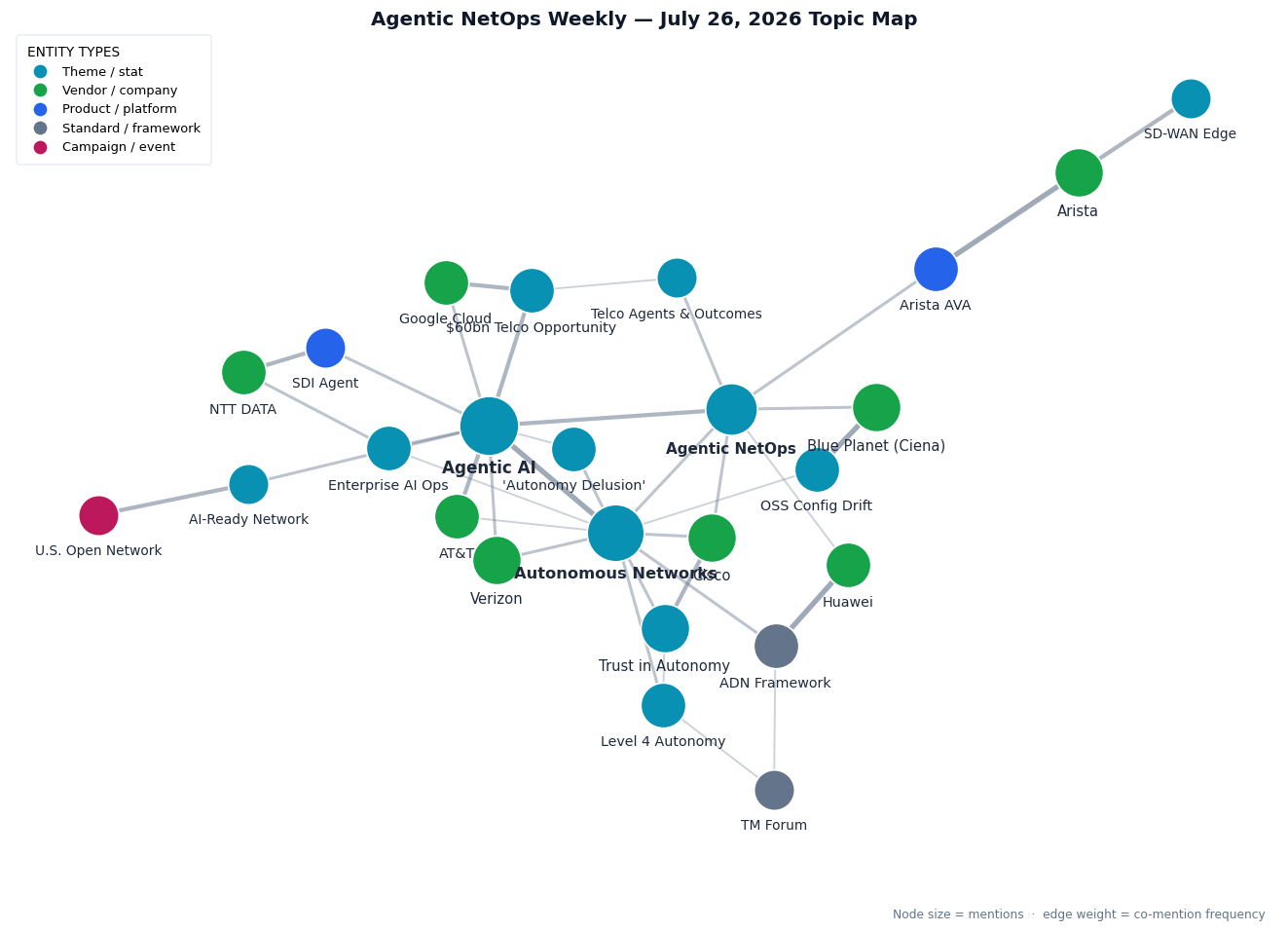
Topic map for this issue — node size reflects how often an entity is mentioned; edge weight reflects how often two entities are discussed together.
View interactive topic map →
|
Article index
Carriers commit to agentic operations
Vendor platforms: agents on the network
Autonomy reality check: frameworks and skepticism
|
Detailed write-ups
1. The carriers commit — and Cisco makes trust the gating factor
RCR Wireless · SDxCentral
The dominant theme of a quieter week was operators and their partners moving from “interested” to “committed” on agentic network operations. Cisco set the tone with its “Agentic Network” framing, which puts trust — not capability — at the center of autonomous operations: agents can increasingly act on the network, but operators will only cede control once actions are explainable, bounded and reversible, so Cisco’s pitch is as much about guardrails and human-in-the-loop escalation as about automation. Google Cloud put a size on the prize in a parallel RCR piece, framing agentic AI as a roughly $60bn opportunity for telecom operators across network operations, customer experience and monetization. The carriers themselves lined up behind the story: AT&T argued its network is already built for the agentic AI wave, positioning years of cloud-native and software-defined investment as the foundation rather than a gap to close, while Verizon reprised its AI-horizon narrative in RCR’s “telco diary” and, in a foundational SDxCentral interview, had its CTO detail generative-AI-fueled network-autonomy efforts already underway. The counter-melody through it all — captured in the “telco agents and outcomes” column — is that agents are only worth deploying where they move a real operational outcome, not as a checkbox on an AI strategy.
Read the article →
Sources: RCR Wireless (Cisco) · RCR Wireless (Google Cloud $60bn) · RCR Wireless (AT&T) · RCR Wireless (Verizon) · RCR Wireless (agents & outcomes) · SDxCentral (Verizon CTO)
2. The vendor platform race: agents aimed at config drift, the SD-WAN edge and enterprise infrastructure
RCR Wireless · Network World · The Fast Mode · CIO
If the carriers supplied the intent this week, the vendors supplied the machinery. Blue Planet (Ciena) introduced AI agents aimed at one of the most stubborn problems in network operations — OSS configuration drift, where the network’s live state gradually diverges from its intended, documented state until faults and audit failures follow. Blue Planet’s framing ties the agents directly to telco trust: an agent that continuously reconciles configuration is only useful if operators can trust what it changes and why. Arista took a platform approach, folding its AVA autonomous-NetOps assistant into a unified SD-WAN edge platform so that anomaly detection, root-cause and remediation live at the edge rather than in a separate console. NTT DATA extended the pattern down into the data center with a Software-Defined Infrastructure (SDI) Agent for enterprise AI operations, pitched as an autonomous layer that manages the compute-and-network substrate AI workloads run on. Underneath all three sits the argument CIO made in its foundational piece: building the network for agentic AI — observable, programmable, policy-governed — is the precondition for autonomous enterprise operations, not a bonus that arrives once the agents are switched on.
Read the article →
Sources: RCR Wireless (Blue Planet) · Network World (Arista AVA) · The Fast Mode (NTT DATA SDI Agent) · CIO (foundation)
3. The reality check: an ‘autonomy delusion,’ a canonized framework, and what “AI-ready” looks like in the field
The Fast Mode · SDxCentral · Network World
Against the week’s commitment and product news, three pieces supplied the counterweight. The Fast Mode’s “Double-Slit Autonomy Delusion” essay argues that digital infrastructure keeps mistaking the appearance of autonomy for the thing itself — that what looks self-driving under observation often collapses back into scripted automation and human intervention the moment conditions change, and that operators should be honest about which they actually have. On the standards side, SDxCentral covered Huawei’s autonomous-networks framework being “canonized” as a reference model for telco agent proliferation — the quieter, structural story of levels, interfaces and definitions being fixed so that a market of interoperable agents can grow on top of them. And Network World’s look back at the U.S. Open’s AI-ready network is the field-level reminder underneath both: delivering an “autonomous” or AI-ready network in a genuinely challenging, high-density environment still takes an enormous amount of deliberate human engineering to make the environment cooperate. Together they frame the honest question for the second half of 2026 — how much of “autonomous” is capability, and how much is narrative.
Read the article →
Sources: The Fast Mode (autonomy delusion) · SDxCentral (Huawei ADN framework) · Network World (U.S. Open)
|
On our watch list
- Trust becomes the product, not the caveat. Cisco’s “Agentic Network” framing and Blue Planet’s config-drift agents both lead with trust and reconciliation rather than raw automation. Watch whether operators start demanding explainability and reversibility as procurement requirements — the point at which “trust” stops being marketing and becomes a spec.
- The $60bn number gets tested. Google Cloud’s agentic-AI opportunity sizing is the bull case; AT&T’s “already built for it” posture is the operator echo. Watch for the first hard operator disclosures — cost saved, incidents auto-resolved, headcount redeployed — that either substantiate the figure or expose it as slideware.
- Platform consolidation at the edge and the substrate. Arista folding AVA into a unified SD-WAN edge and NTT DATA’s SDI Agent both push agents down into the infrastructure layer rather than a separate console. Watch whether the agent-in-the-platform model wins out over standalone NetOps copilots.
- Framework vs. reality gap. Huawei’s canonized ADN framework advances the standards machinery just as the “autonomy delusion” critique lands. Watch whether formal autonomy-level definitions produce externally validated claims, or whether “Level 4” keeps meaning whatever a vendor wants it to.
|
|
Agentic NetOps Weekly · a weekly intelligence bulletin from Security Radar LLC
Coverage window: July 19 – July 26, 2026, with foundational reading from the past 30 days.
Curated by Paul Davis · paul.davis@security-radar.com
*|LIST:ADDRESS|*
View this email in your browser · Unsubscribe
© 2026 Security Radar LLC. All rights reserved.
Article titles and summaries are excerpted for review and commentary; all linked articles remain the copyright of their respective publishers and authors.
|
|