|
AI Ops Weekly · July 26, 2026 · Weekly Edition
AI Ops Weekly
Running the app-and-infra stack with AI — and running AI itself in production. This week: SRE moves from dashboards to self-healing agents, the inference supply crunch turns cost-per-token into the deciding metric, and a fresh model wave (Opus 5, Kimi K3, GPT 5.6) reshapes the LLMOps stack.
|
This week at a glance
AI Ops Weekly covers the whole application-and-infrastructure stack — observability, incident response and SRE workflows (classic AIOps) on one side, and the operational discipline of running AI/LLM systems in production (LLMOps / MLOps) on the other. Security-framed stories route to Security Operations; pure network stories route to Agentic NetOps. Everything in between — the reliability, cost and governance of the systems your platform and ML teams actually operate — lives here.
The dominant AIOps thread this cycle is that the operator is becoming an agent. InfoWorld mapped how AI is reshaping site reliability engineering, The New Stack walked through building a self-healing GPU node agent for EKS that drains and replaces unhealthy Kubernetes nodes without a human, and Elastic data suggests most enterprises will hand root-cause analysis to AI agents within two years. AWS engineers showed the plumbing underneath — troubleshooting agentic systems with OpenTelemetry and OpenSearch. The counterweight came from Gartner, warning via The Register that a rush of AI-ops tools will create console sprawl and break IT more often before it breaks it less.
On the LLMOps side, the story was capacity and cost. Moonshot’s Kimi K3 launched and then had to shut down new subscriptions within 48 hours when demand overran its inference capacity — the clearest sign yet that serving, not training, is the bottleneck. Infinity raised $15M to run inference on any chipset, AWS standardized more AI billing data to make cost analysis tractable, and InfoWorld reported that most companies still lack the data to compute AI ROI at all. Above the infrastructure, the model wave kept moving: Anthropic shipped Claude Opus 5 with efficiency and safety gains, OpenAI’s Codex context reduction for GPT 5.6 frustrated developers, and Thinking Machines Lab pitched a US open-weight alternative. And the operational surface widened: Block built a Slack-style workspace giving every AI agent its own passport, while coding agents, evals, memory-database scaling and agent supply-chain security filled in the governance layer teams now have to operate.
|
Topic map — four threads across the AI-ops stack
Entities from this issue’s articles, clustered around AIOps observability and incident ops (AI in SRE, self-healing nodes, root-cause analysis, OpenTelemetry/OpenSearch, Kubernetes, Elastic, the Gartner tool-sprawl warning); inference infrastructure and economics (Infinity, Moonshot/Kimi K3, GPU nodes, AI caching tradeoffs, AI cost/ROI, AWS); LLMOps models and coding agents (Anthropic’s Claude Opus 5, OpenAI’s Codex/GPT 5.6, Thinking Machines, open-weight AI, coding agents, evals); and the agent platform and data layer (Block’s agent workspace, Model Context Protocol, memory/database scale, agent supply-chain security) — all radiating from the central AI Ops theme that unifies AIOps and LLMOps.
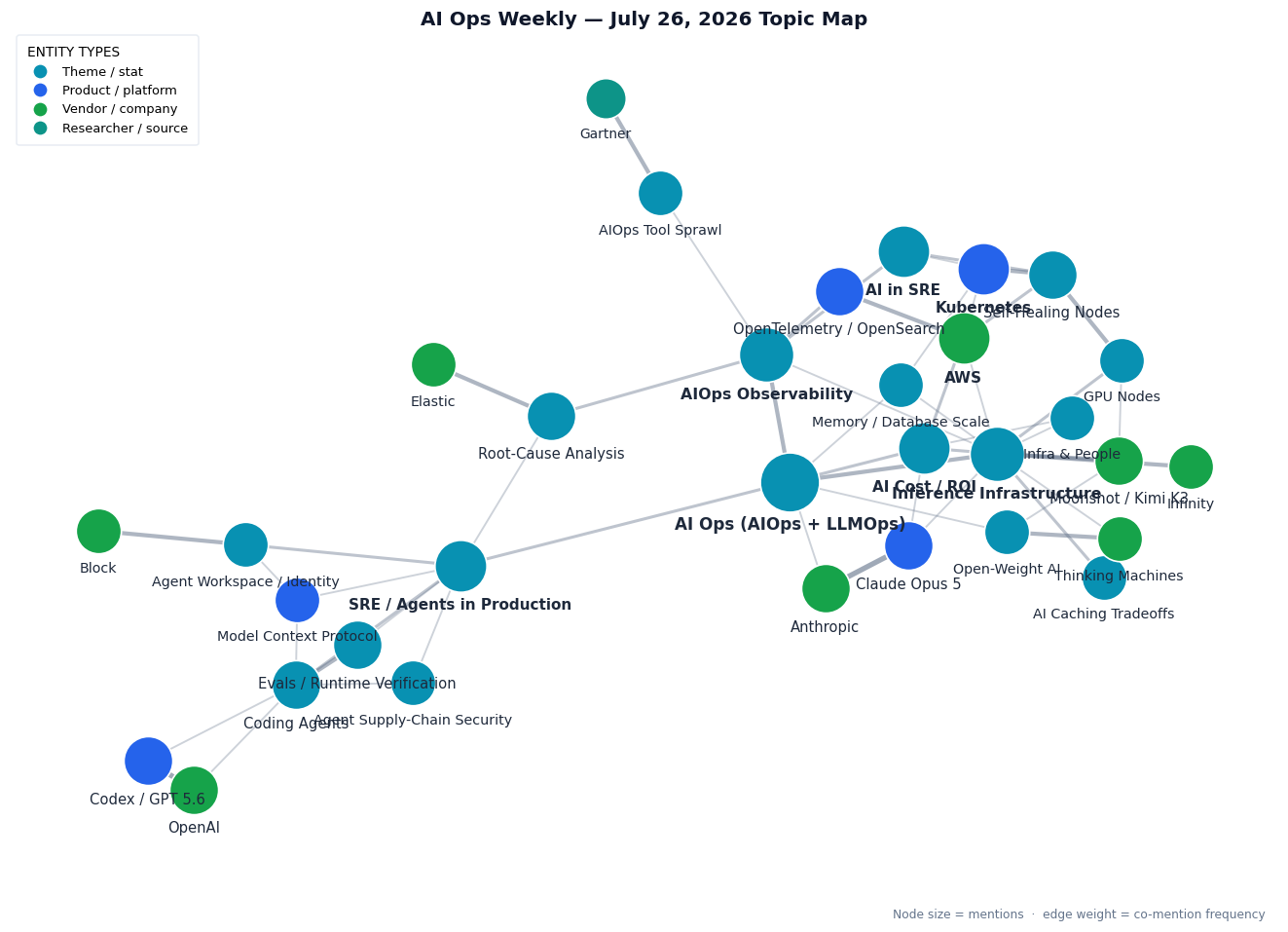
Topic map for this issue — four loosely linked threads running from AIOps observability and self-healing incident response, through the inference infrastructure and cost pressures underneath, to the model race and the agent platform and data layer teams now operate.
View interactive topic map →
|
Article index
20 articles, grouped by sub-theme. “News” = this week’s coverage window; “Foundational” = longer-form reference reading on the beat.
1 · AIOps: observability, SRE & incident ops
2 · Inference infrastructure & cost
3 · Models, coding agents & evals (LLMOps)
4 · Agent platform, data & governance
|
Detailed write-ups
1. SRE becomes agentic: from dashboards to self-healing nodes and agent-led root-cause analysis
InfoWorld / The New Stack · Jul 8–21, 2026
The headline AIOps shift this cycle is that reliability work is moving from humans reading dashboards to agents acting on telemetry. InfoWorld’s survey of how AI is reshaping site reliability engineering frames the transition: toil — triage, correlation, first-pass remediation — is exactly the surface AI is eating first, pushing the SRE role up the stack toward defining objectives and guardrails. The New Stack made it concrete with a walkthrough of a self-healing GPU node agent for Amazon EKS that watches node health signals and autonomously cordons, drains and replaces failing Kubernetes nodes before they take workloads down — the closest thing yet to a production self-healing loop for accelerated infrastructure. And Elastic data reported by The New Stack projects the direction of travel: most enterprises expect to hand root-cause analysis to AI agents within two years. The operational catch is trust — an agent that drains the wrong node or misattributes a root cause is a new failure mode, so the same instrumentation that lets an agent act has to let a human audit why it acted.
Read the article →
Sources: InfoWorld (AI in SRE) · The New Stack (self-healing GPU nodes) · The New Stack (Elastic / agentic RCA)
2. The observability plumbing — and Gartner’s warning about AIOps console sprawl
The Register / The New Stack · Jul 7–20, 2026
Underneath the self-healing ambition sits unglamorous telemetry engineering. In a walkthrough from AWS engineers, The New Stack showed how to troubleshoot agentic AI by wiring it up with OpenTelemetry for traces and OpenSearch for querying them — the practical answer to “how do you debug a non-deterministic agent,” which is to make every tool call and retrieval step a span you can inspect. A companion piece on operating Kubernetes controllers at scale reinforces the reconciliation-loop mindset the agentic approach inherits: declare intent, continuously enforce it, expect drift. But Gartner, via The Register, supplied the necessary cold water: the rush of AI-ops tools will create console sprawl and break IT more often before it helps, as teams bolt on overlapping agents each with its own console, blast radius and failure mode. The takeaway for platform leads is to consolidate on a shared telemetry backbone before adding agents on top — sprawl at the tooling layer becomes sprawl at the incident layer.
Read the article →
Sources: The Register (Gartner console sprawl) · The New Stack (OpenTelemetry / OpenSearch) · The New Stack (Kubernetes controllers)
3. The inference supply crunch: Kimi K3 sells out, Infinity chases chipset flexibility, caching bites back
The New Stack / SiliconANGLE · Jul 16–21, 2026
Serving, not training, was the bottleneck this week. Moonshot launched Kimi K3 to strong demand and then had to shut down new subscriptions within 48 hours when inference capacity couldn’t keep up — a vivid reminder that a great model is worthless if you can’t serve it. The market’s structural answer is decoupling models from specific silicon: Infinity raised $15M to run AI inference on any chipset, betting that portability across GPUs and alternative accelerators is the way out of supply constraints and vendor lock-in. And The New Stack’s deep dive on AI caching tradeoffs is the cautionary counterpoint: smarter semantic caching can slow a system down when cache lookups, invalidation and near-miss handling cost more than the inference they were meant to save. For platform teams the composite lesson is that inference efficiency is an end-to-end systems problem — capacity planning, accelerator strategy and caching all have to be measured together, not optimized in isolation.
Read the article →
Sources: The New Stack (Kimi K3 bottleneck) · SiliconANGLE (Infinity) · The New Stack (AI caching tradeoffs)
4. The cost reckoning: AWS standardizes AI billing while most companies still can’t compute ROI
InfoWorld / The New Stack · Jul 6–23, 2026
If inference is the bottleneck, cost is the accountability. AWS standardized more of its AI billing data, giving FinOps and platform teams cleaner, more granular line items to attribute spend across models, tokens and agent workloads — a precondition for managing AI cost rather than merely absorbing it. But InfoWorld’s reporting on AI ROI lands the harder truth: most companies lack the baseline data to prove return on their AI investments at all, because they never instrumented the before-state the savings are supposed to be measured against. The New Stack’s field study of why most AI projects fail points at the same root cause from the delivery side — the blockers are infrastructure and people (data pipelines, platform readiness, skills and ownership), not model quality. Together the three make the case that AI ROI is an operations problem: you can’t optimize, or defend, a cost you never measured.
Read the article →
Sources: InfoWorld (AWS AI billing) · InfoWorld (AI ROI data gap) · The New Stack (why AI projects fail)
5. The model wave hits LLMOps: Opus 5 lands, Codex trims context, Thinking Machines pitches open-weight
SiliconANGLE / InfoWorld · Jul 16–24, 2026
A fresh model cycle reshaped the choices platform teams have to operate. Anthropic launched Claude Opus 5 with efficiency and safety improvements — the efficiency angle matters most to this beat, since a cheaper, faster frontier model directly changes the inference-cost math from the previous story. On the friction side, OpenAI’s Codex quietly reduced the context window for GPT 5.6 and drew sharp developer backlash, a case study in how an opaque LLMOps change — a config tweak invisible in the release notes — degrades downstream agent and coding-tool behavior and erodes trust. And Thinking Machines Lab made the sovereignty and control argument, offering enterprises a US open-weight alternative for teams that want to own the weights, run on their own infrastructure and avoid being surprised by someone else’s context change. The operational throughline: model selection is now an ops decision about cost, transparency and control, not just a benchmark score.
Read the article →
Sources: SiliconANGLE (Claude Opus 5) · InfoWorld (Codex / GPT 5.6) · InfoWorld (Thinking Machines)
6. Operating the agents: Block’s agent workspace, runtime evals, memory-database scale and supply-chain risk
The New Stack / Socket · Jun 27–Jul 21, 2026
As agents move into production, a governance-and-data layer is forming that AI-ops teams now have to run. Block built a Slack-style workspace for AI agents and gave each one its own “passport” — a scoped identity and audit trail — a pragmatic answer to the machine-identity problem of knowing which agent did what. The reliability of those agents comes down to what they’re tested against: The New Stack’s piece on coding agents and runtime evals (Greptile, Cursor, Devin) argues the consensus is now that agents should run their code, and that the environment they run it in is the thing that matters, while a companion piece warns that the traditional merge gate becomes a liability once agents author most changes. Underneath, “the database is the product” captures what breaks when agent memory scales — the datastore, not the model, is where production pain concentrates. And a Risky Biz discussion on agent software supply chain security closes the loop: agents that pull dependencies and run code widen the attack surface teams have to operate safely. The composite picture is a new operational stack — identity, evals, memory and supply-chain integrity — sitting between the model and the business.
Read the article →
Sources: The New Stack (Block agent workspace) · The New Stack (coding agents / evals) · The New Stack (merge gate) · The New Stack (database is the product) · Socket (agent supply-chain security)
|
On our watch list
- Does self-healing survive contact with production? The EKS node-monitoring agent and Elastic’s two-year RCA-to-agents projection point to autonomous remediation. Watch whether teams ship guardrails and audit trails fast enough that a self-healing agent draining the wrong node stays a bounded incident rather than an outage — and whether “human-approves-the-action” remains the default.
- Console sprawl vs. a shared telemetry backbone. With Gartner warning that stacked AI-ops tools will break IT more often, watch whether platform teams consolidate on OpenTelemetry/OpenSearch-style pipelines before layering agents on top — or accumulate overlapping consoles whose combined blast radius is the new failure mode.
- Inference capacity as the gating constraint. Kimi K3 selling out in 48 hours and Infinity’s any-chipset bet reframe launches as a serving problem. Watch for more “great model, can’t serve it” episodes, and for accelerator-portability and smarter (not just more) caching to become standard parts of the inference plan.
- AI cost/ROI moving from slideware to instrumentation. AWS standardizing billing data and the ROI-data-gap reporting suggest the winners will be teams that instrumented a baseline. Watch for published cost-per-token and utilization numbers — and for FinOps-for-AI to harden into a real practice.
- The agent governance layer as a product category. Block’s per-agent passports, runtime evals, memory-database scaling and supply-chain risk are converging into an operational tier between model and business. Watch which of identity, evaluation, memory and supply-chain integrity consolidates into platforms versus staying a stack of point tools.
|
About this bulletin
AI Ops Weekly covers the operation of the application-and-infrastructure stack with AI, and the operation of AI systems themselves in production — spanning AIOps (observability, incident response, SRE) and LLMOps/MLOps (model deployment, evals, inference infrastructure, governance). It is written for SRE, platform and IT-operations engineers as well as ML-platform and MLOps engineers. Network-layer stories route to Agentic NetOps; security-framed stories route to Security Operations.
|
|
AI Ops Weekly · a weekly intelligence bulletin from Security Radar LLC
Coverage window: July 19–26, 2026 news, with foundational reference reading.
Curated by Paul Davis · paul.davis@security-radar.com
*|LIST:ADDRESS|*
View this email in your browser · Unsubscribe
© 2026 Security Radar LLC. All rights reserved.
Article titles and summaries are excerpted for review and commentary; all linked articles remain the copyright of their respective publishers and authors.
|
|