|
The Competitive Brief · July 26, 2026 · Weekly Edition
The Competitive Brief
FROG whipsaws through its earnings run-up — a stock pop, then a 5–8% drop on cybersecurity-breach speculation, then an $84.86 Street target — while Chainguard lands Booz Allen and its CEO stakes a CRA-steward flag, and GitLab and Astelia race out auto-remediation
|
This week at a glance
JFrog had a whipsaw week heading into its earnings run-up. FROG opened the week popping higher on positive momentum, then gave it all back and more — down 5% then roughly 8% in a single session — on speculation that JFrog was caught up in a cybersecurity issue, with the market linking the move to the broader OpenAI-breach story dominating headlines. By week’s end the Street had reset expectations: brokerages settled on an $84.86 average price target. The read for us: the “security company” repositioning cuts both ways — the moment JFrog is perceived as a security platform, any whiff of a JFrog-adjacent incident becomes a share-price event, fairly or not. Field teams should expect competitors to lean on the “are they even secure themselves” FUD; get ahead of it with facts before the speculation hardens into a talking point.
Chainguard kept converting its enterprise-open-source narrative into contracts and credibility. Booz Allen Hamilton signed an enterprise license agreement with Chainguard — a marquee federal-adjacent integrator win that plants Chainguard’s hardened-images story deep in exactly the regulated, public-sector accounts JFrog wants. In parallel, CEO Dan Lorenc published a wide-ranging essay (“Growing up the hard way”) staking Chainguard’s claim as a serious enterprise-open-source steward, including its CRA (EU Cyber Resilience Act) steward role — a deliberate move to own the compliance-and-provenance high ground ahead of the CRA deadlines. This is the sharper competitive threat this week: Chainguard is building the regulated-buyer trust position through both a lighthouse logo and thought leadership, on the same turf where JFrog’s evidence-and-governance depth should win.
Competitors kept pushing on remediation and supply-chain hygiene. GitLab previewed auto-remediation of vulnerable dependencies — agents that don’t just flag a vulnerable package but open the fix — and Astelia extended its reachability analysis with agentic AI for vulnerability management, chasing the same “only fix what’s actually exploitable, then fix it automatically” axis. Meanwhile the supply-chain drumbeat never let up: GitGuardian documented “four more” Shai-Hulud-style attacks hitting npm and PyPI (the streak continues), and StepSecurity shipped tooling to find unused, stale, and OIDC-replaceable GitHub Actions secrets across an org. The through-line: reachability-gated auto-remediation is becoming table stakes, and the pipeline itself (registries, Actions secrets) is the live battleground — both places JFrog’s curation-plus-evidence platform story should be loudest.
|
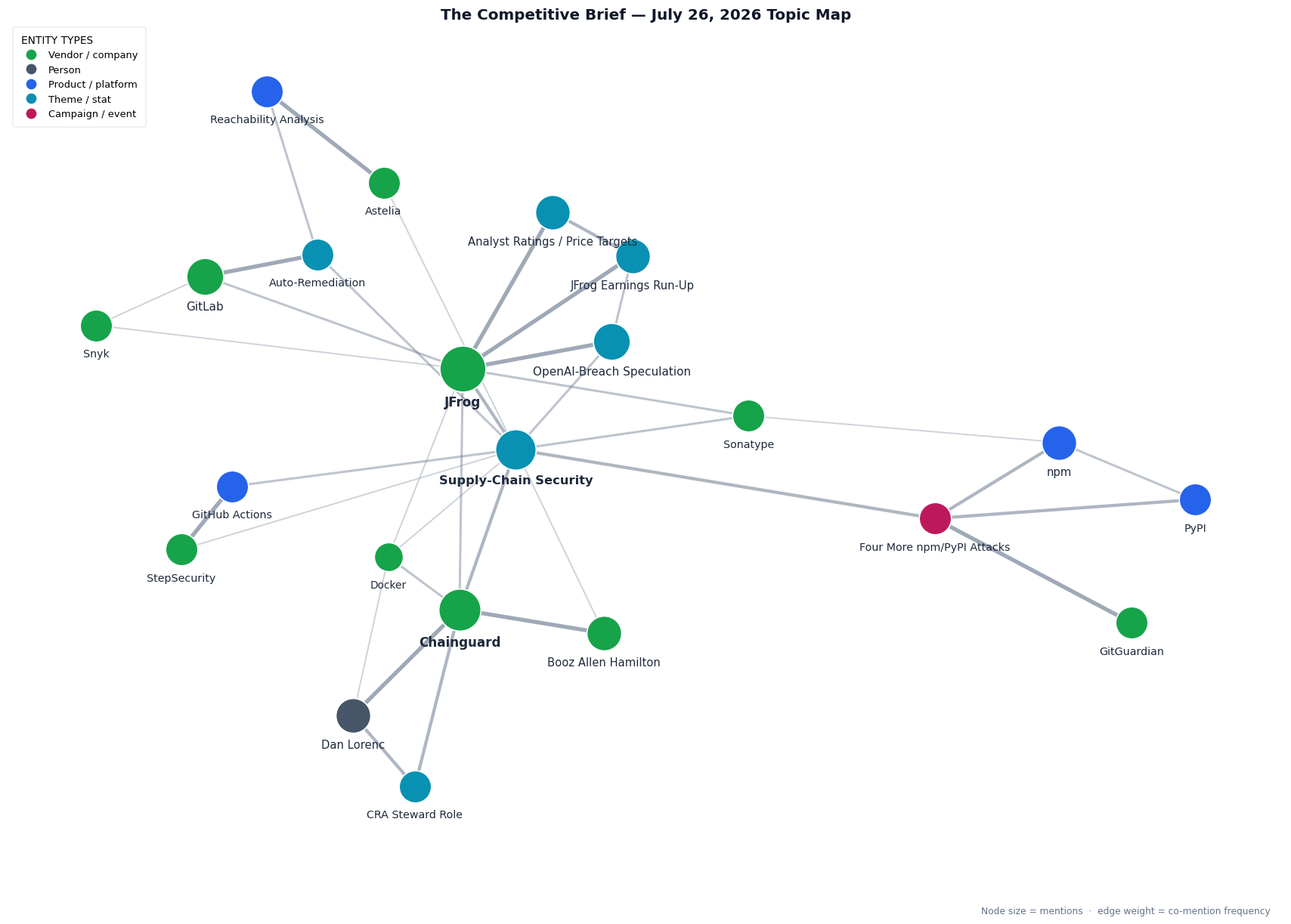
Topic map — this week’s competitive landscape
JFrog sits at the center, pulling in its volatile earnings run-up, the analyst price targets, and the OpenAI-breach speculation that dragged the stock. Chainguard draws its own cluster — the Booz Allen Hamilton license, CEO Dan Lorenc, and the CRA steward role. GitLab connects through auto-remediation and Astelia through reachability analysis; GitGuardian anchors the “four more” npm/PyPI attacks, with Sonatype nearby on the supply-chain theme; StepSecurity connects through GitHub Actions secrets; and Docker sits on the container/image axis against Chainguard. Supply-Chain Security is the shared hub tying the week together.
|
Article index
Weekly News
JFrog — a stock pop, a breach-speculation drop, and a reset price target
FROG jumped, then fell 5–8% on speculation of a cybersecurity issue tied to the OpenAI-breach news cycle, before brokerages settled on an $84.86 average target — the marquee JFrog storyline of the week, heading into earnings season.
Chainguard — a Booz Allen enterprise license win
Chainguard signs Booz Allen Hamilton to an enterprise license agreement — a marquee federal-integrator logo that pushes its hardened-images story into regulated accounts.
Competitor remediation moves — reachability-gated and auto-applied
GitLab previews auto-remediation of vulnerable dependencies, and Astelia extends reachability analysis with agentic AI — two competitors converging on “prioritize what’s exploitable, then fix it for you.”
Supply-chain drumbeat — more npm/PyPI attacks, and stale CI secrets
GitGuardian documents four more Shai-Hulud-style npm/PyPI compromises (the streak continues), and StepSecurity ships tooling to find unused, stale, and OIDC-replaceable GitHub Actions secrets across an org.
Foundational Reading
Chainguard strategy — the CEO stakes a CRA-steward flag
Dan Lorenc’s essay on building an enterprise-open-source company, including Chainguard’s CRA (EU Cyber Resilience Act) steward role — the strategic context behind the Booz Allen win.
|
Detailed write-ups
1. JFrog’s whipsaw week: a pop, a 5–8% drop on breach speculation, and an $84.86 reset target
QuiverQuant / GuruFocus / TIKR / Markets Daily · July 20–24, 2026
FROG ran the full round trip in one week. It opened higher on positive momentum (QuiverQuant walked through the pop), then sold off hard — down 5%, and roughly 8% intraday — on speculation that JFrog was entangled in a cybersecurity issue. GuruFocus and TIKR covered the same drawdown from two angles: GuruFocus framed it as a speculation-driven 5% slide, while TIKR’s “fell 8% in a day” piece tried to triangulate where the stock goes from here. The speculation rode the coattails of the week’s dominant OpenAI-breach story — the market reasoning, thinly sourced, being that a widely-used software-supply-chain platform could be exposed if a major AI provider was compromised. By Friday brokerages had recalibrated to an $84.86 average price target. Competitive read-through: this is the double edge of the “JFrog is a security company now” repositioning. When you sell trust and provenance, the market prices you as a trust vendor — and unverified speculation of your own exposure becomes a same-day share-price event, no incident confirmation required. Two actions for us. First, expect competitors (Snyk, Chainguard, GitLab reps) to quietly seed “can they even secure themselves?” doubt into live deals; arm field teams with the actual facts and JFrog’s own security posture before the rumor calcifies. Second, the $84.86 consensus and the earnings run-up mean the next print is the referendum on whether the security narrative is converting to revenue — brief teams to expect competitors to pounce on any growth deceleration.
Read the article →
Sources: FROG stock up (QuiverQuant) · 5% drop on speculation (GuruFocus) · Fell 8% in a day (TIKR) · $84.86 average target (Markets Daily)
2. Chainguard lands Booz Allen and its CEO plants a CRA-steward flag — the regulated-buyer play, executed
Chainguard · July 21–22, 2026
Booz Allen Hamilton signed an enterprise license agreement with Chainguard — a lighthouse win in the federal-and-regulated integrator world, where Booz Allen’s footprint means Chainguard’s hardened, minimal, provenance-backed container images now have a channel into a huge base of government and defense-adjacent programs. Two days earlier (and reinforced the same week), CEO Dan Lorenc published “Growing up the hard way,” a candid essay on building an enterprise-open-source business that doubles as a positioning document: it foregrounds Chainguard’s role as a serious steward of open source, explicitly including its CRA (EU Cyber Resilience Act) steward role. Taken together, this is Chainguard executing the exact playbook that overlaps most with JFrog’s regulated-buyer strategy: a marquee compliance-driven logo plus thought leadership that claims the provenance-and-transparency high ground ahead of hard CRA deadlines. Competitive read-through: Chainguard is the more focused threat this week than any single feature launch. Its narrative — “secure by default, minimal attack surface, we steward the upstream” — is purpose-built for the CRA/SBOM/regulated-procurement conversation, and the Booz Allen deal is proof it sells. But Chainguard is fundamentally an images company; it hardens what goes into the container, not the full artifact lifecycle across every package type, build, and release gate. JFrog’s counter is breadth and evidence: curation across all package types, artifact-level provenance, and release governance that spans far more than base images. The risk is letting Chainguard define “software supply chain security” as “hardened images plus CRA stewardship” and winning the framing. Field and marketing should engage the CRA/regulated-procurement conversation directly — provenance and evidence across the whole pipeline, not just the image — rather than ceding it.
Read the article →
Sources: Booz Allen enterprise license (Chainguard) · Growing up the hard way / CRA steward role (Chainguard)
3. The remediation race tightens: GitLab previews auto-remediation, Astelia gates it with agentic reachability
InfoWorld / Help Net Security · July 22, 2026
GitLab previewed auto-remediation of vulnerable dependencies — moving from “here’s a vulnerable package” to agents that open the fix (the bump, the patch, the MR) inside the platform. Separately, Astelia extended its reachability analysis with agentic AI for vulnerability management, pushing the other half of the equation: use reachability to prove which vulnerabilities are actually exploitable in your code paths, then let agents act only on those. Put together, the two moves define where AppSec is heading this quarter — reachability-gated, auto-applied remediation: don’t drown teams in CVEs, surface the exploitable few, and fix them automatically. Competitive read-through: “an agent that fixes your dependencies” is rapidly becoming table stakes rather than a differentiator, and GitLab’s version rides its all-in-one substitution pitch (it’s just another thing you get in the suite). The durable differentiation is not the fix — it’s the governance and evidence around the fix. An auto-applied dependency bump is itself a supply-chain change: what pulled it, was the new version curated and trusted, who approved it, and can you prove what changed and reproduce it later? That is precisely JFrog’s home turf — curation at ingestion, artifact-level provenance, and release gating. Push evaluators to demand of GitLab and Astelia the same questions JFrog can answer end-to-end: prove the fix is safe, governed, and auditable — not just that an agent applied it. Reachability is a genuinely good idea worth matching in messaging; auto-remediation without governance is a talking point that turns into a liability the first time an unsupervised fix breaks prod.
Read the article →
Sources: GitLab auto-remediation (InfoWorld) · Astelia reachability + agentic AI (Help Net Security)
4. The supply-chain drumbeat: four more npm/PyPI attacks, and a call to clean up stale CI secrets
GitGuardian / StepSecurity · July 22, 2026
GitGuardian documented “four more” Shai-Hulud-style supply-chain attacks hitting npm and PyPI — the streak simply continues, with self-propagating, credential-stealing packages now a steady-state threat rather than a headline event. In parallel, StepSecurity shipped tooling to find unused, stale, and OIDC-replaceable GitHub Actions secrets across an organization — attacking the other end of the same problem: the long-lived secrets sitting in CI that a compromised package or workflow can exfiltrate. Competitive read-through: both vendors are working the registries-and-pipeline battleground with sharp, timely, developer-credible content, and each uses the steady stream of incidents as ongoing proof of relevance. GitGuardian owns the secrets-detection-plus-supply-chain-monitoring narrative; StepSecurity owns hardened, least-privilege CI (pinning Actions, replacing static secrets with OIDC). Neither directly displaces JFrog, but together they keep reinforcing a market story where “supply-chain security” means “watch the registries and lock down CI” — a framing that centers detection and hygiene rather than curation and provenance. JFrog’s strongest answer to “four more npm/PyPI attacks” is the preventive one: curated, vetted packages that never enter the build in the first place, plus artifact evidence if something does slip. Use each new npm/PyPI compromise as the concrete example in curation conversations, and treat OIDC/short-lived-credential hygiene as a “yes, and” that complements — rather than substitutes for — a governed, evidenced artifact pipeline.
Read the article →
Sources: Four more npm/PyPI attacks (GitGuardian) · Stale GitHub Actions secrets (StepSecurity)
|
On our watch list
- FROG’s next earnings print and the security narrative. With brokerages at an $84.86 average target and the stock whipsawing on speculation alone, the next quarterly report is the referendum on whether the security repositioning is converting to revenue. Watch growth, security-product attach, and any commentary that puts the breach speculation to bed — and brief field teams to expect competitors to seize on any deceleration.
- The “can they secure themselves?” FUD. The 5–8% drop on unconfirmed cybersecurity speculation shows how cheaply that doubt can be seeded now that JFrog sells trust. Track whether competitors pick it up in live deals, and get ahead of it with JFrog’s actual security posture rather than letting the rumor set the terms.
- Chainguard’s regulated-buyer march. Booz Allen plus a public CRA-steward posture is a coherent, repeatable play for exactly JFrog’s regulated accounts. Watch for the next integrator/public-sector logo and whether Chainguard successfully defines “supply-chain security” as “hardened images plus CRA stewardship” — and counter by owning the full-lifecycle provenance framing.
- Reachability-gated auto-remediation as table stakes. GitLab (auto-remediation) and Astelia (agentic reachability) are converging on the same pattern; Snyk, Checkmarx, and Aikido are already there. The differentiator is governance and evidence around the auto-applied fix, not the fix. Watch for the first public incident caused by an unsupervised auto-remediation — that’s when the “governed remediation” argument sells itself.
- The registries-and-CI battleground. GitGuardian’s ongoing npm/PyPI attack tracking and StepSecurity’s Actions-secrets hygiene keep centering detection and CI hardening as the definition of supply-chain security. Track whether the market framing shifts toward prevention/curation, and push JFrog Security Research to match the incident-response cadence on the next major npm/PyPI compromise — silence cedes the “we’d have caught it” narrative.
|
|
The Competitive Brief · a Newshunter publication
A weekly intelligence bulletin from Security Radar LLC. Internal competitive intelligence on AI-coding, AI-security, and DevSecOps. Coverage window: July 19 – July 26, 2026.
Curated by Paul Davis · paul.davis@security-radar.com
*|LIST:ADDRESS|*
View this email in your browser · Unsubscribe
© 2026 Security Radar LLC. All rights reserved.
Article titles and summaries are excerpted for review and commentary; all linked articles remain the copyright of their respective publishers and authors.
|
|