At a glance
Only twelve items met the bar this week, but two of them frame a real architectural fork. NVIDIA’s telecom pitch, delivered through Chris Penrose, is a full-stack argument: foundational models that “speak telco,” wrapped in NeMo Guardrails and sandboxed OpenShell environments, validated against Aerial Omniverse digital twins before an agent ever touches a live network — the discipline being that agents must “predict, recommend, simulate, validate and only then act.” Adtran’s answer, in the same week, is the opposite instinct: its new Mosaic One Fabric exposes network data and telecom expertise as reusable, Model Context Protocol–based tools so operators build their own agents rather than inherit a vendor’s stack, keeping control of token economics and model choice. HPE and Telefónica supplied the “why now” on either side of that fork — HPE arguing self-driving is categorically different from automation (“autonomy without accuracy creates risk”), Telefónica committing to Level 4 autonomous networking across Spain, Brazil and Germany by 2030 while its CTIO warns that “you cannot be autonomous using a process that was built 10 years ago.”
Agentic traffic itself became a policy story. Cisco’s Bob Everson testified before the Senate Commerce telecom subcommittee that an AI agent generates 450% more traffic than a person doing the same task, and that AI-driven campus and branch traffic will surge 209% over three years — the basis for Cisco’s ask for a secure, American-led AI-native stack, modernized permitting, and balanced spectrum policy. Extreme Networks’ CEO made the commercial version of the same argument to CRN, framing MSP growth and AI adoption as market share the company is actively taking.
Underneath, the AI-RAN build-out and its trust gap both moved. Ericsson landed as the sole global vendor in South Korea’s national Hyper-AI consortium, tying AI-RAN directly to the country’s “AI Highway” agenda; a TelecomTV survey found rApps-delivered automation set to more than triple in two years as operators route around legacy SON tooling. And a Reader Forum piece put a name on the thing that’s been implicit all year: agentic AI can’t get the operational context it needs from telecom’s fragmented OSS/BSS, messaging and middleware — more telemetry won’t fix it, unifying the plumbing first will. Tech Mahindra’s TM Forum Catalyst win, built with Google Cloud, showed what the mature end of that looks like: over 90% end-to-end automation by tying network events to business impact. Light Reading’s foundational read cautioned against “agent mania” in the meantime, and AT&T closed the loop by betting its fiber and 600 MHz spectrum — not its 5G marketing — on the uplink-heavy traffic agentic workloads actually generate.
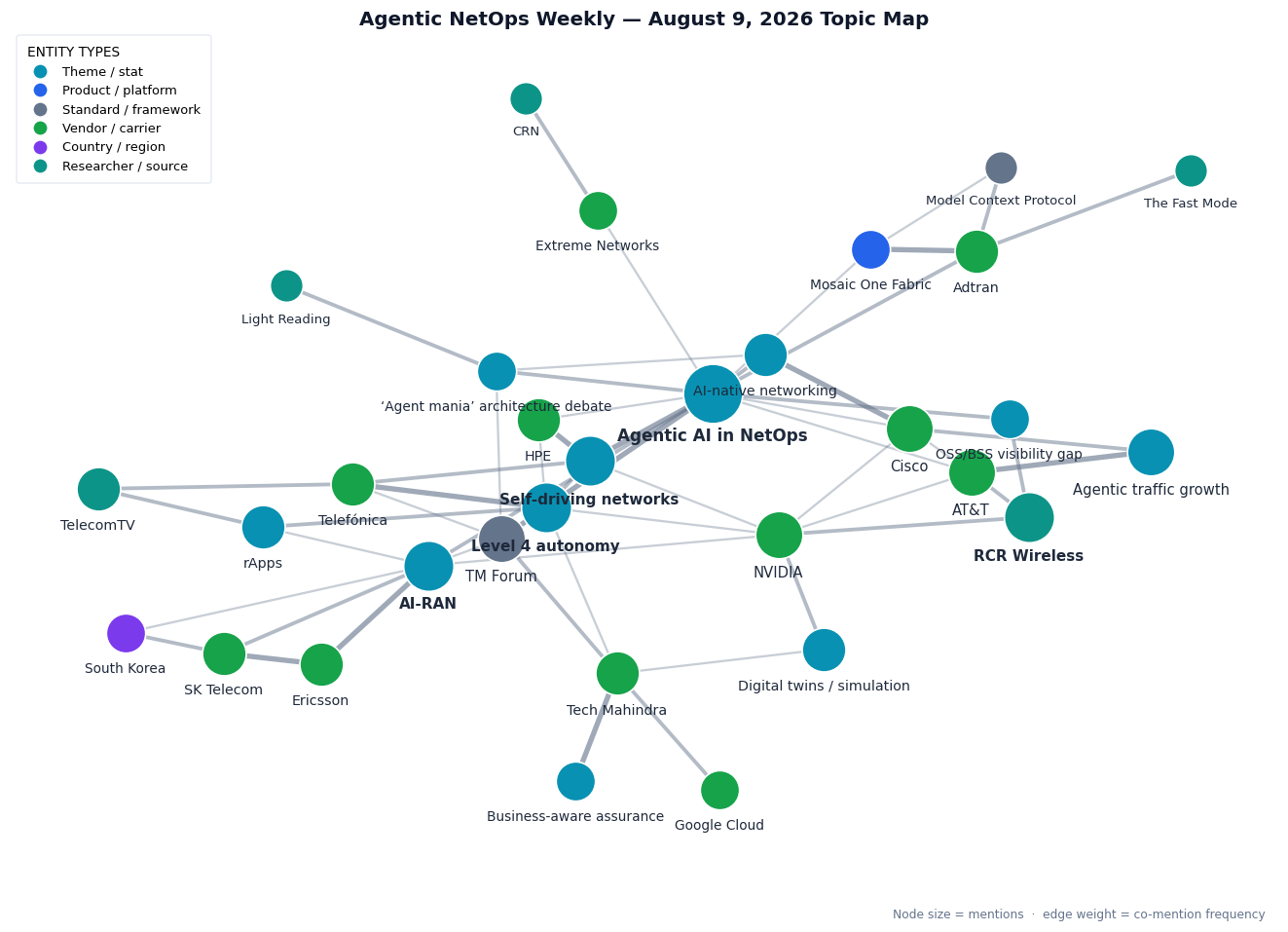
This week’s topic map — the full-stack-vs-open-fabric fork (NVIDIA, Adtran, HPE, Telefónica); agentic traffic as a policy and growth story (Cisco’s Senate testimony, Extreme Networks); the AI-RAN build-out and Korea’s Hyper-AI consortium (Ericsson, SK Telecom); telecom’s named visibility gap and Tech Mahindra’s TM Forum Catalyst counter-example; and the foundational caution against “agent mania” alongside AT&T’s infrastructure bet. Node size reflects how often an entity is mentioned; edge weight reflects how often two entities are discussed together.
View interactive topic map →
Article index
Weekly News
The full-stack vs. open-fabric debate: two visions for self-driving networks
NVIDIA argues the case for a validated, vendor-supplied full stack — foundational models, guardrails, digital twins — while Adtran counters with an operator-controlled, MCP-based agent fabric. HPE and Telefónica supply the urgency on either side.
Agentic traffic becomes a policy and growth story
Cisco takes agentic traffic growth to the Senate; Extreme Networks’ CEO takes the same underlying story to investors.
AI-RAN, the visibility gap, and a Level 4 proof point
Ericsson and SK Telecom anchor a national AI-RAN consortium tied to Korea’s AI Highway plan; a Reader Forum op-ed names telecom’s fragmented-OSS/BSS visibility problem outright; Tech Mahindra’s TM Forum Catalyst win shows the mature counter-example.
Foundational Reading
Beyond the hype: architecture discipline, rApps, and AT&T’s infrastructure bet
rApps keep taking share of RAN automation on the road to Level 4; a Light Reading piece cautions against “agent mania” in favor of disciplined data and orchestration layers; AT&T stakes its fiber and 600 MHz spectrum on agentic traffic’s uplink demands.
Detailed write-ups
1. The full-stack vs. open-fabric debate: two visions for how self-driving networks get built
RCR Wireless · The Fast Mode · HPE Newsroom · TelecomTV · August 3–7, 2026
NVIDIA’s telecom pitch, laid out by Chris Penrose, is unapologetically full-stack: operators need foundational models that “speak telco,” built on privacy-preserving synthetic data (NeMo Safe Synthesizer and NeMo Anonymizer, already used by SoftBank), then wrapped in NeMo Guardrails and sandboxed OpenShell environments so agents operate within hard security parameters. NVIDIA’s discipline is procedural: agents must “predict, recommend, simulate, validate and only then act,” with validation happening against Aerial Omniverse digital twins — work NVIDIA says, with partners including KDDI, Keysight and Samsung Research America, cut RAN simulation time from hours or days to seconds in some cases. The company frames telecom’s physical footprint — land, power, central offices, cell sites — as an “AI Grid” asset for distributed inference and token-based monetization, with the AT&T/Cisco edge-AI collaboration announced earlier this year as an early proof point.
Adtran’s answer, landing the same week, is the opposite instinct. Mosaic One Fabric exposes network data and telecom domain expertise as reusable, agent-ready tools built on the Model Context Protocol, explicitly so operators can build their own agents and workflows “around their own operational priorities” instead of inheriting a vendor’s model choices. The pitch keeps token economics and model selection in the operator’s hands, layering deterministic root-cause analysis and cross-domain correlation into whatever agents get built, with governance guardrails for safety. HPE supplied the categorical argument for why any of this matters now: self-driving networks aren’t automation with better dashboards, they “continuously observe, learn, optimize, and heal,” and HPE’s own framing — “autonomy without accuracy creates risk. Autonomy with proven efficacy creates transformation” — is a direct jab at anyone offering AI-generated recommendations without the track record to back autonomous execution. Telefónica put a date on the ambition: Level 4 autonomous networking across Spain, Brazil and Germany by 2030, part of its “Transform & Grow” 2026–30 plan, with CTIO Andrea Folgueiras naming the real obstacle — “you cannot be autonomous using a process that was built 10 years ago.”
Sources: RCR Wireless (NVIDIA full-stack path) · The Fast Mode (Adtran Mosaic One Fabric) · HPE Newsroom (self-driving networks) · TelecomTV (Telefónica Level 4 by 2030)
2. Agentic traffic goes to Washington — and into a CEO’s growth pitch
Cisco Blogs · CRN · August 4–6, 2026
Cisco’s Bob Everson, Chief Architect for the company’s Service Provider Mobility team, testified before the Senate Commerce telecom subcommittee on July 30 with numbers meant to make agentic AI’s network impact concrete rather than abstract: an AI agent generates 450% more traffic than a person performing the same task, and Cisco projects AI-driven campus and branch traffic will surge 209% over the next three years, driven by AI workloads’ uplink-intensive, two-way communication pattern rather than the download-heavy traffic networks were built around. Everson’s ask to Congress had three parts: accelerate a secure, American-led AI-native technology stack through initiatives like AI-WIN; modernize permitting and infrastructure deployment as computing becomes more distributed; and keep spectrum policy balanced between licensed and unlicensed access. The underlying argument is that agentic operations — agents that monitor, self-heal and flag threats at machine speed — are no longer optional once agent traffic itself is straining the network.
Extreme Networks’ CEO made the commercial mirror of that argument to CRN the same week, framing managed-service-provider growth and AI adoption as market share the company is actively taking from competitors rather than a rising tide lifting all networking vendors. Read together with Cisco’s testimony, the two pieces show the same phenomenon — agentic AI reshaping network traffic and demand — being argued simultaneously as a national infrastructure-policy issue and as a competitive vendor-share issue.
Sources: Cisco Blogs (Senate Commerce testimony) · CRN (Extreme Networks CEO)
3. AI-RAN’s national-consortium moment, and telecom’s visibility problem finally gets a name
Ericsson · RCR Wireless · PR Newswire / Yahoo Finance · August 4–5, 2026
Ericsson landed as the sole global technology vendor among main partners in South Korea’s Hyper-AI Network Infrastructure Demonstration Project, a government initiative led by the Ministry of Science and ICT and the National Information Society Agency to build and validate AI-RAN pilot networks as a foundation of the country’s national “AI Highway” agenda and its 6G ambitions. Ericsson will supply end-to-end AI-RAN infrastructure, its Intelligent Automation Platform, and AI-powered rApps for autonomous network control; a second phase will deploy the network at KG Mobility’s manufacturing facility, tying AI-RAN directly to industrial-AI use cases like robotics and real-time decision-making rather than keeping it a purely radio-side story.
A Reader Forum op-ed from meshIQ’s Greg DeaKyne put a name on the problem that’s been implicit in every agentic-NetOps pitch this year: fragmented OSS/BSS, middleware and messaging platforms deny agentic AI the operational context it needs, and operators are “drowning in telemetry” without the connective infrastructure to make that data meaningful — a gap DeaKyne says persists even though 54% of CSP executives expect AI to significantly boost revenue. His prescribed order of operations is blunt: unify middleware management first, correlate events to actual business processes (activations, billing, provisioning) second, and only then apply AI. Tech Mahindra’s TM Forum DTW Ignite 2026 Catalyst win — built with Google Cloud’s Graph Neural Networks running on Spanner Graph, using TM Forum Open APIs for multi-vendor correlation across RAN, Core and Cloud — is close to a live answer to DeaKyne’s prescription: the business-aware assurance framework demonstrated over 90% end-to-end automation by prioritizing issues on business impact rather than raw infrastructure alarms.
Sources: Ericsson (SK Telecom Hyper-AI consortium) · RCR Wireless (visibility problem, Reader Forum) · Yahoo Finance / PR Newswire (Tech Mahindra TM Forum Catalyst)
4. Beyond agent mania: architecture discipline, rApps, and AT&T’s fiber-and-spectrum bet
TelecomTV · Light Reading · RCR Wireless · July 13–25, 2026
TelecomTV’s read on rApps — standardized applications deployed within Service Management and Orchestration platforms — found operator demand for rApp-delivered automation set to more than triple in two years, per a 2026 Analysys Mason survey of Tier 1 operators; 38% named end-to-end automation the top reason for moving off legacy Self-Organizing Network tooling, and 90% of operators plan to source rApps from multiple third-party developers rather than a single vendor, with 76% expecting to build some internally within five years. Light Reading’s foundational piece argued the industry needs to resist “agent mania” — introducing non-deterministic LLM agents into functions that require absolute predictability or don’t need agents at all — in favor of a disciplined, multi-layered architecture running from a unified data substrate up through orchestration to business intent, paralleling 3GPP’s early 6G push for decoupled data layers, with zero-trust and TM Forum’s AI-Native Blueprint as the governance backstop for the expanded attack surface multi-agent systems create.
AT&T’s contribution is the infrastructure version of that discipline: rather than chasing millimeter-wave capacity, the carrier is betting its 5,000 central offices, 75,000 cell sites and 600 MHz spectrum — paired with mid-band spectrum from EchoStar — specifically because that combination delivers the stable, high-quality uplink agentic workloads actually need, inverting decades of network design built around downstream speed. AT&T points to 400G wavelength connectivity into 40 U.S. metro markets and 130 interconnection nodes, direct fiber to roughly 600 data centers, and planned upgrades to 1.6 Tbps on key routes, with CEO John Stankey citing a Cisco forecast of 6.6x consumer traffic growth by 2035 and AI inference accounting for roughly a quarter of that total — a projection AT&T itself notes depends on demand materializing as forecast.
Sources: TelecomTV (rApps and autonomous RAN) · Light Reading (beyond agent mania) · RCR Wireless (AT&T fiber and spectrum bet)
On our watch list
- Full-stack vs. open-fabric. NVIDIA’s validated, vendor-supplied stack and Adtran’s operator-controlled MCP fabric are now explicit alternatives. Watch which model operators actually standardize on as they move past pilots.
- Level 4 gets a delivery date. Telefónica’s 2030 commitment across three markets is one of the most concrete Level 4 timelines yet. Watch for the first interim milestones or slippage as legacy-process migration hits reality.
- Agentic traffic as policy leverage. Cisco’s 450%-more-traffic and 209%-growth figures are now part of a Senate policy ask. Watch whether AI-WIN or similar AI-native-stack legislation gains traction off the back of these numbers.
- The visibility problem gets named. DeaKyne’s fragmented-OSS/BSS critique and Tech Mahindra’s 90%+ automation counter-example bookend the same issue. Watch whether more operators publish concrete business-aware-assurance results, or whether the visibility gap stays a talking point.
- AI-RAN goes national. South Korea’s Hyper-AI consortium ties AI-RAN to industrial policy, not just telecom efficiency. Watch for other governments following with their own state-backed AI-RAN programs.
- Agent mania vs. architecture discipline. Light Reading’s caution against indiscriminate agent deployment is a useful counterweight to a hype-heavy category. Watch whether TM Forum’s AI-Native Blueprint and similar guidance actually change deployment patterns.
- Infrastructure follows the traffic, not the marketing. AT&T’s uplink-first spectrum bet is a bet that agentic traffic patterns are real and durable. Watch whether rival carriers make similar upstream-capacity investments or keep prioritizing downstream speed.
|