At a glance
AI Ops Weekly covers the whole application-and-infrastructure stack — observability, incident response and SRE workflows (classic AIOps) on one side, and the operational discipline of running AI and LLM systems in production (LLMOps / MLOps) on the other. It was a quiet news week on this beat, but the two stories that landed both pointed at the same maturing question: how do you actually evaluate whether an agent deployment is safe and effective, not just impressive in a demo? InfoWorld laid out five criteria for evaluating AI agent orchestration platforms — observable controls, secure and resilient operations, built-in testing and feedback, open standards like MCP and A2A, and vendor viability. Red Hat answered the observability half of that question directly, walking through how MLflow tracing, its EvalHub quality-scoring service and the Garak adversarial scanner combine into the “evidence layer” that lets a team catch duplicate tickets, billing errors and hallucinated policies before customers do.
Agents also kept pushing into unglamorous production work rather than headline demos. InfoWorld argued that agents are coming for data — just slowly, because LLMs only recently got reliable enough at SQL to be trusted with schema-change detection and mechanical data-quality fixes; proactive insight-surfacing is still far off. AWS supplied the concrete proof point: Hyundai AutoEver built a multi-tenant generative-AI sandbox on Amazon Bedrock and put a four-agent ErrorWatcher pipeline into production that cut incident response from hours to five minutes, alongside a 14-node workflow for Hadoop cluster diagnostics — both built on LangGraph and OpenSearch with human-in-the-loop safeguards.
The rest of the week was money and metal. Optical-networking startup Lumilens launched with a $900M round at a $5.51B valuation to sell co-packaged optics that link GPUs inside AI clusters at up to 1.6 Tbps, and AMD more than doubled data-center revenue to $6.7B on the strength of its new Helios rack — though the stock fell on capex and margin worries, a reminder that inference-infrastructure demand and inference-infrastructure profitability are not the same story. Foundational reading rounded out the observability and platform threads — InfoWorld on why frontend teams need observability as much as backend ones, and on how AI is already reshaping SRE work — while The Register’s “Platform Engineering 2.0” argued existing internal platforms need GPU-aware, FinOps-aware evolution, and VentureBeat’s interview with an early chip-design-LLM researcher cautioned that buying AI capacity alone won’t decide semiconductor leadership.
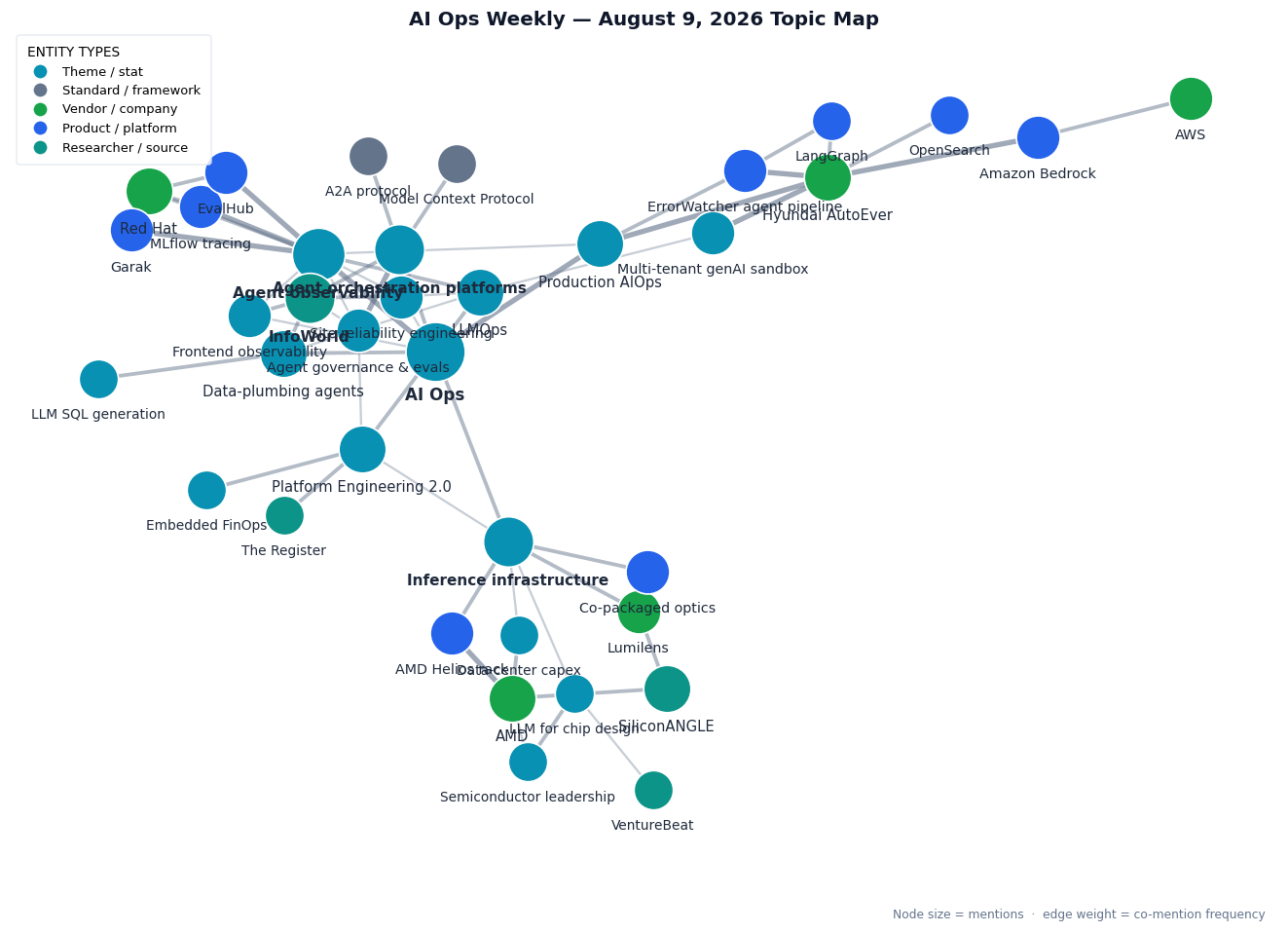
This week’s topic map — a thin but focused week across five threads: agent orchestration and governance (evaluation criteria, MCP, A2A); agent observability (Red Hat’s MLflow tracing, EvalHub, Garak); agents doing production data work; Hyundai AutoEver’s production AIOps on Amazon Bedrock (ErrorWatcher, LangGraph, OpenSearch); the inference-infrastructure and silicon funding wave (Lumilens, AMD); and the observability/platform-engineering discourse underneath it all — all radiating from the central AI Ops theme.
View interactive topic map →
Article index
10 articles, grouped by sub-theme. “Weekly News” = this week’s coverage window (August 3–9); “Foundational Reading” = longer-form reference reading on the beat. A thin week on this beat — only verified, directly-sourced items are included.
Weekly News
Evaluating and instrumenting agent platforms
Two pieces on how to know whether an agent deployment actually works — evaluation criteria for orchestration platforms, and the tracing/eval/scanning stack that makes agent behavior observable.
Agents move into production data and ops work
From data-plumbing maintenance to a real five-minute incident-response pipeline — agents doing the unglamorous work rather than the demo work.
Inference infrastructure keeps drawing capital
A $900M optics round and a blowout AMD earnings report both point at inference capacity as the constraint that matters — even as AMD’s own stock wobbled on the capex bill.
Foundational Reading
Observability’s widening footprint
The case for observability keeps extending outward — from backend SRE work to frontend teams that assumed it wasn’t their problem.
Platform and silicon strategy for the AI era
Two angles on preparing the substrate underneath AI workloads — the internal platform teams have to rebuild, and the silicon strategy question that AI spend alone doesn’t answer.
Detailed write-ups
1. What “good” looks like for agent platforms: evaluation criteria and the evidence layer
InfoWorld · Red Hat · August 5, 2026
Two pieces this week converged on the same underlying question — how do you know an agent deployment is working, not just demoing well? InfoWorld’s five ways to evaluate AI agent orchestration platforms reads like a procurement checklist for the agentic era: observable controls and governance to preserve accountability, secure and resilient operations that satisfy compliance, built-in testing and feedback loops for continuous improvement, support for open standards like MCP and A2A so agents interoperate across vendors, and a hard look at vendor viability and roadmap before betting production workloads on a platform.
Red Hat supplied the observability half of the same problem with specifics rather than a checklist. The post opens with three real failure modes — duplicate tickets, billing errors, hallucinated policies — that observability and evaluation would have caught, then walks through the stack that catches them: MLflow tracing captures every agent reasoning step in a searchable, OpenTelemetry-compatible format; EvalHub runs continuous LLM-as-judge quality scoring to flag bad outputs before customers see them; and Garak performs pre-deployment adversarial scanning for jailbreaks and prompt-injection risk. Together the two pieces describe the same maturing discipline from opposite ends — what to demand from a platform, and what to instrument once you’ve picked one.
Sources: InfoWorld (evaluating agent orchestration platforms) · Red Hat (agent observability operational layer)
2. Agents take on the unglamorous work: data plumbing and a five-minute incident-response pipeline
InfoWorld · AWS · August 4–6, 2026
InfoWorld’s agents are coming for data (just slowly) makes a useful corrective argument: LLMs only recently became reliable enough at writing SQL to be trusted with data work at all, which is why agents haven’t yet proliferated in a domain they’re otherwise well suited for. The realistic near-term win is unglamorous — detecting schema changes, automating mechanical fixes, organizing and testing data context — while the more ambitious goal of agents proactively surfacing business insight remains hard for the same reason human-tuned alerting is hard: false positives. The practical advice for data teams is to build infrastructure that scales for bursty agent query traffic and cuts database latency now, before query dependencies compound.
AWS supplied the concrete counter-example of an unglamorous win already in production. Hyundai AutoEver built a multi-tenant generative-AI sandbox on Amazon Bedrock using attribute-based access control to isolate tenants within a single AWS account while inheriting compliance from AWS Config, Macie and Security Hub. Two systems built on that sandbox make the case for production AIOps: a four-agent ErrorWatcher pipeline that cut incident response from hours to five minutes, and a fault-tolerant 14-node workflow for Hadoop cluster diagnostics — both orchestrated with LangGraph and OpenSearch, using metadata-filtered RAG, parallel root-cause analysis with self-falsification, and human-in-the-loop checkpoints. It is exactly the kind of mechanical, high-volume, verifiable work InfoWorld’s piece says agents are actually ready for today.
Sources: InfoWorld (agents coming for data) · AWS (Hyundai AutoEver production AIOps)
3. Inference infrastructure keeps drawing capital — and AMD shows the capex tension underneath it
SiliconANGLE · August 4–6, 2026
Optical-networking startup Lumilens launched out of stealth with a $900M Series C at a $5.51B valuation, backed by Atreides Management, Bain Capital Ventures, Meritech and others. The pitch is co-packaged optics that replace copper with fiber inside data centers, linking thousands of GPUs per rack and supporting scale-out bandwidth up to 1.6 terabits per second — CEO Ankur Singla says large-scale deployment is still “two to three years away,” but the company already has billions in chip orders booked. It is another data point in the now-familiar thesis that inference capacity, not model quality, is the resource investors are chasing.
AMD’s earnings made the flip side of that thesis concrete. Data-center revenue more than doubled — up 107% to $6.7B — on GPU and EPYC CPU sales, with the new Helios rack (AMD’s answer to Nvidia’s full-stack infrastructure play) beginning shipments this quarter to OpenAI, Oracle and Meta. Yet the stock fell in after-hours trading anyway, because capex jumped to $808M from $282M a year earlier and investors read that as margin pressure ahead. CEO Lisa Su still projects data-center unit sales will double in 2027. For AI-ops and platform teams tracking the inference-infrastructure story, AMD’s report is the reminder that demand for capacity and profitability from capacity are two different bets — and the market is pricing them separately.
Sources: SiliconANGLE (Lumilens) · SiliconANGLE (AMD earnings)
4. Observability’s case keeps extending outward — from SRE to the frontend
InfoWorld · July 21–31, 2026
Two foundational InfoWorld pieces make the same argument from different vantage points: observability isn’t a backend-only discipline, and AI is accelerating that realization. Why observability matters to frontend teams more than they think pushes back on the assumption that instrumentation is someone else’s job — user-facing latency, rendering errors and broken client-side flows are exactly the failures that erode trust fastest, and they’re invisible without frontend-native tracing. Isaac Sacolick’s how AI impacts site reliability engineering covers the complementary shift on the ops side, where AI is changing what the SRE role even watches and automates.
Read together with this week’s agent-observability news, the throughline for AI-ops teams is that instrumentation coverage has to widen at the same rate autonomy does — whether the thing acting on production is a human on-call engineer or an agent triaging an incident, the audit trail has to reach every layer, frontend included, or the loop degrades a service confidently and invisibly.
Sources: InfoWorld (frontend observability) · InfoWorld (AI and SRE)
5. Rebuilding the platform for the AI era — and a caution that buying AI isn’t a strategy
The Register · VentureBeat · August 3–6, 2026
The Register’s Platform Engineering 2.0 argues existing internal developer platforms need evolution, not replacement, to absorb AI workloads — GPU provisioning, AI-agent identity and lifecycle management, real-time token-cost tracking, and new attack surfaces none of the old container-era tooling was built for. The piece proposes five pillars — AI-native infrastructure, multi-persona experiences, embedded FinOps, shifted-left security, and composable design — and a practical starting audit: check your platform for GPU-support gaps, non-human identity management, and real-time cost attribution.
VentureBeat’s interview with a researcher behind an early LLM for chip design supplies a complementary caution at the strategy level: buying AI capacity alone may not determine semiconductor leadership. The argument lands squarely on this week’s inference-infrastructure funding wave — capital and chips are necessary but not sufficient, and the organizations that win are the ones that also build the platform, tooling and design expertise to use that capacity well. It is the same lesson as the Register piece, one level up the stack: infrastructure spend without operational and organizational readiness doesn’t automatically convert into advantage.
Sources: The Register (Platform Engineering 2.0) · VentureBeat (chip-design LLM researcher)
On our watch list
- Agent evaluation criteria hardening into procurement standards. InfoWorld’s five-point checklist and Red Hat’s tracing/eval/scanning stack both point at agent observability becoming table stakes. Watch whether MCP and A2A support becomes a hard requirement in agent-platform RFPs, not just a nice-to-have.
- Data agents graduating from maintenance to insight. InfoWorld’s piece puts agents squarely in schema-fixing, not insight-surfacing, territory today. Watch for the false-positive problem in proactive data agents to start closing — that’s the signal the next phase has arrived.
- Production AIOps proof points raising the bar. Hyundai AutoEver’s five-minute MTTR via ErrorWatcher is a concrete number other enterprises will be measured against. Watch for more named, quantified production deployments to surface — and for human-in-the-loop design patterns to standardize around them.
- Inference-infrastructure demand outrunning inference-infrastructure profitability. AMD’s doubled data-center revenue met a falling stock price on capex worries the same week Lumilens raised $900M for more capacity. Watch cost-per-token and margin, not just funding rounds and revenue growth, to see who actually profits from the buildout.
- Observability coverage widening to match agent autonomy. Frontend observability and AI-reshaped SRE are both foundational reads this week, alongside live agent-observability tooling. Watch whether instrumentation keeps pace with where agents get deployed, or leaves blind spots exactly where autonomy is highest.
- Platform teams auditing for AI-readiness gaps. The Register’s GPU-support, non-human-identity and cost-attribution checklist is a concrete near-term to-do. Watch whether platform teams get the budget and mandate to close those gaps before the next wave of agent workloads lands on them.
|