At a glance
The week’s loudest signal came out of Washington, and it was a warning against regulation, not a call for it. CyberScoop reported that national cyber director Sean Cairncross laid out White House plans to secure AI without new rules, and Cybersecurity Dive’s dispatches from Black Hat sharpened the same message from two directions: government panelists urged funding for infrastructure resilience over chasing AI hype, while AI firms told policymakers bluntly that they know Washington “won’t let you make a Terminator factory” — a line that doubles as an argument against restrictions the industry sees as unnecessary. Nextgov/FCW’s report that the White House is working with AI firms on secret safety measures, as models “break free” of their original guardrails, only sharpens the contradiction: informal, closed-door arrangements standing in for the public rulemaking that isn’t coming.
Congress isn’t fully on board with that approach. CNBC reported that Rep. Ted Lieu says an AI “kill switch” bill needs to pass this year, a legislative push that reads as a direct answer to the administration’s light-touch posture. Allies are moving on their own timelines too: GovInfoSecurity reported that the incoming Burnham government could signal a tougher UK line on cyber and AI regulation, and even where enforcement dates aren’t yet fixed, the foundational read from SecurePrivacy.ai on the EU’s 2026 Action Plan on Cybersecurity and AI frames it as a real signal of intent rather than empty positioning. Boards, for their part, are not waiting on any of it. SecureWorld’s look at why board governance still lags a well-run board meeting, TheCorporateCounsel.net’s finding that board use of AI remains in its early innings, and Federal News Network’s survey of state CISOs facing an expanding role all point the same way: the oversight work is starting from the top down, with or without a regulatory mandate forcing it.
Underneath the policy fight, the attack surface kept widening in familiar ways. Cybersecurity Dive reported that AI is making spearphishing markedly cheaper to run, according to a cyber insurer tracking claims, and CIO.com made the case that an AI hiring tool isn’t an HR problem but a security one — another example of AI capability arriving in a business function well ahead of the controls built to govern it. On the foundational side, CSO Online’s finding that senior executives are still the ones killing shadow-AI strategy, and CIO.com’s separate piece on the principles every enterprise must test before the attack arrives, reinforce that the governance gap is organizational as much as regulatory.
Federal operations had their own week of whiplash and continuity. Inside Cybersecurity reported the Senate passed a stopgap funding bill carrying a short-term extension of the cyber information-sharing law — a reprieve, not a fix — while Cybersecurity Dive found CISA prioritizing critical infrastructure as it recovers from this year’s staffing cuts. ExecutiveGov reported CMS pivoting to a risk-based cybersecurity model, and CyberScoop reported the Coast Guard monitoring a cyberattack that disrupted North Carolina ports. Further out, foundational stories on Cyber Command’s planned Silicon Valley office, the European Commission’s CJEU referral against four member states over NIS2 transposition, and the House’s advancing FY2027 NDAA with its own info-sharing extension round out a week that was less about a single crisis than about who is deciding the rules of the road — and how many different tables that decision is being made at once.
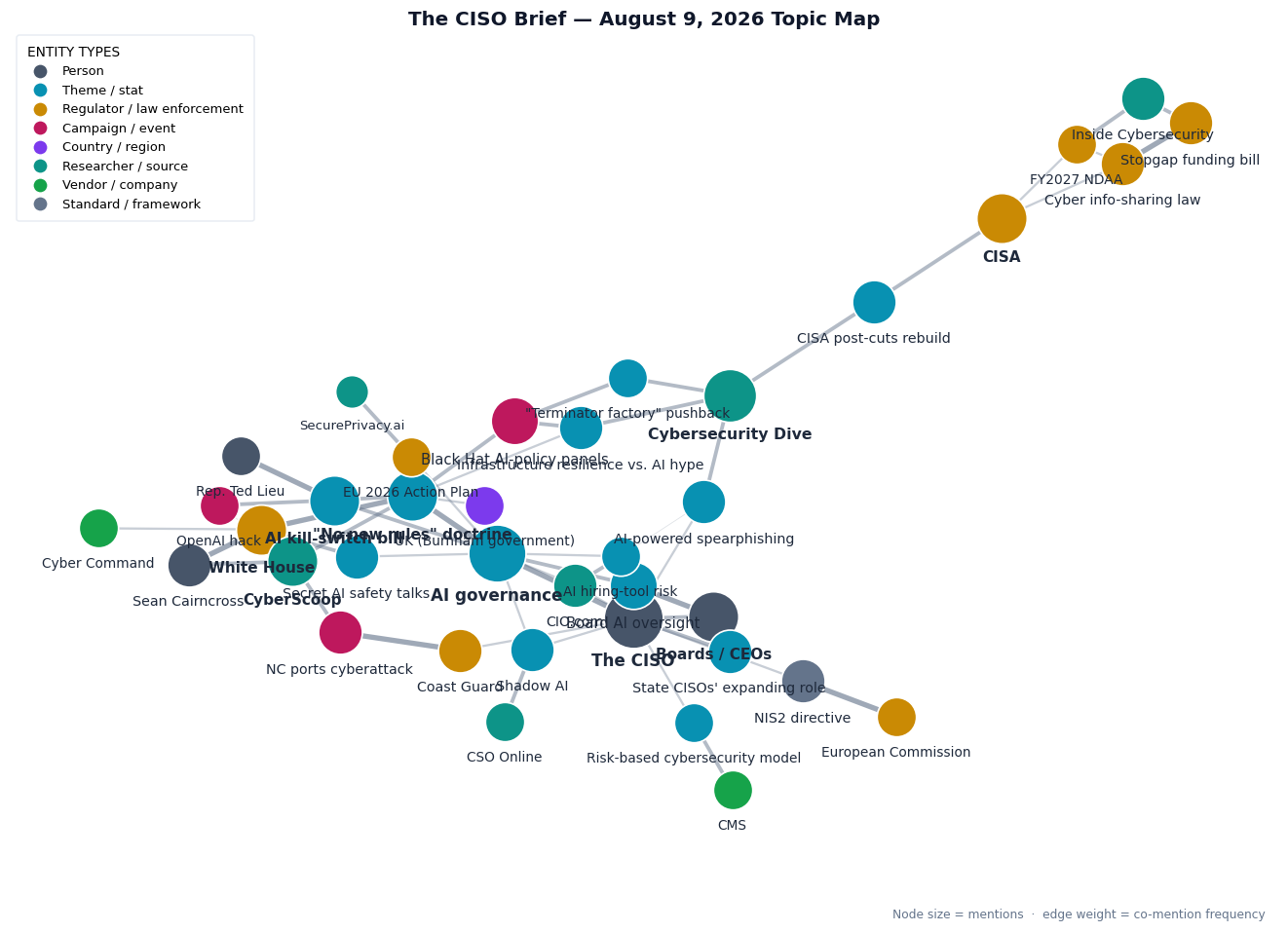
This week’s topic map — Washington’s “no new rules” posture on AI security (the national cyber director’s plan, Black Hat’s resilience-over-hype panels, the “Terminator factory” pushback, and secret White House–industry safety talks) set against Congress’s AI kill-switch push and tougher signals from the UK and EU; boards doing their own AI-oversight homework; the ordinary attack surface widening via AI-cheapened spearphishing and AI hiring tools; and the federal-operations cluster of the funding stopgap, CISA’s post-cuts rebuild, CMS’s risk-based pivot, and the Coast Guard’s watch on the North Carolina ports cyberattack.
View interactive topic map →
Article index
Weekly News
Boards start doing the AI-oversight homework
Governance moves from the boardroom agenda to boardroom practice — how well the meeting works, how boards are actually using AI, and a state-CISO survey showing the role’s mandate keeps expanding.
Washington’s AI-security debate: “no new rules” meets a kill-switch bill
The White House lays out a light-touch AI-security plan and works secretly with firms on safety measures; Black Hat panelists split between resilience-funding and anti-hype arguments; Congress and the UK signal they aren’t waiting for Washington’s approach to settle.
| Article |
Source |
Published |
| 4. National cyber director lays out White House plans to secure AI without new rules |
CyberScoop |
Aug 5, 2026 |
| 5. AI firms know policymakers won’t ‘let you make a Terminator factory’ |
Cybersecurity Dive |
Aug 8, 2026 |
| 6. As AI models break free, White House works with firms on secret safety measures |
Nextgov/FCW |
Aug 7, 2026 |
| 7. ‘AI Kill Switch’ bill needs to pass this year, Rep. Lieu says |
CNBC |
Aug 6, 2026 |
| 8. Western govt leaders call for infrastructure resilience, not AI hype |
Cybersecurity Dive |
Aug 6, 2026 |
| 9. Burnham government could signal tougher UK cyber, AI regs |
GovInfoSecurity |
Aug 4, 2026 |
Federal cyber funding and CISA’s rebuild
A stopgap keeps the cyber information-sharing law alive a little longer while CISA works to reprioritize critical infrastructure as it recovers from this year’s staffing cuts.
AI expands the ordinary attack surface
No breakthrough attack technique required — AI just makes the familiar ones cheaper and wider, from spearphishing at scale to hiring pipelines nobody thought to secure.
Sector spotlights: CMS and the Coast Guard’s watch on NC ports
Two sector snapshots — a federal health agency’s shift to risk-based security, and a live watch on a cyberattack disrupting East Coast port operations.
Foundational Reading
AI governance foundations: kill switches, shadow AI, and stress-testing
The groundwork behind this week’s headlines — the kill-switch bill’s origin story, why executives keep undermining their own shadow-AI strategy, the enterprise principles worth testing before an attack, and a longer read on whether the EU’s 2026 action plan is signal or just another deadline.
Federal policy backdrop: Cyber Command, NIS2 enforcement, and the NDAA
The slower-moving institutional context — a new Cyber Command innovation office, the European Commission escalating NIS2 non-transposition to the EU’s top court, and the House’s FY2027 defense bill carrying its own info-sharing and disclosure provisions.
Detailed write-ups
1. Washington’s “no new rules” doctrine collides with a kill-switch bill
CyberScoop · Cybersecurity Dive · Nextgov/FCW · CNBC · August 5–8, 2026
CyberScoop’s report on national cyber director Sean Cairncross laid out the administration’s operating theory in plain terms: secure AI through existing authorities, industry partnership and voluntary measures, not a new regulatory regime. Cybersecurity Dive’s Black Hat coverage put flesh on that posture from the industry side — AI firms told policymakers directly that they already understand where the line is, that nobody is trying to “make a Terminator factory,” and that the implicit message was: trust us to self-govern rather than legislate around us. Nextgov/FCW’s companion report on secret White House–industry talks over AI safety measures, prompted by models “breaking free” of their intended guardrails, is the uncomfortable footnote to that framing: even the administration pursuing a light-touch public posture is running informal, non-public safety negotiations behind it, which tells a CISO that the real state of AI-model risk is not fully reflected in the public policy debate.
Congress isn’t taking the light-touch approach as settled. CNBC’s report that Rep. Ted Lieu says an AI “kill switch” bill needs to pass this year reads as a direct legislative answer to an administration that has chosen partnership over mandate — and for CISOs, the practical takeaway is that the regulatory floor for AI safety is genuinely unsettled at the federal level, oscillating between an executive branch betting on cooperation and a legislative track pushing for a hard technical failsafe. Enterprise AI governance built only around the current administration’s posture is building on sand; the defensible move is to track both tracks and design controls that would satisfy either outcome.
Sources: CyberScoop · Cybersecurity Dive (Terminator factory) · Nextgov/FCW · CNBC
2. Boards start doing the AI-oversight homework regulators haven’t forced yet
SecureWorld · TheCorporateCounsel.net · Federal News Network · August 4–6, 2026
SecureWorld’s diagnosis of why board governance lags a well-run board meeting lands on a familiar gap: the meeting itself — slides, discussion, a vote of confidence — can look and feel productive while the underlying governance infrastructure (clear escalation paths, defined risk appetite, someone accountable between meetings) stays thin. TheCorporateCounsel.net’s finding that board use of AI is still in its early innings is the specific instance of that general problem: boards are being asked to oversee AI risk they haven’t yet built the muscle to evaluate directly, whether that means using AI tools themselves or simply understanding what their own company’s AI deployments actually do.
Federal News Network’s survey of state CISOs facing a rapidly expanding role rounds out the picture from the other side of the reporting line: as boards and legislatures push more AI and cyber accountability downward, the people actually running the programs are absorbing broader mandates without a proportional increase in resources or authority. Taken together, the three stories describe an oversight system straining at every level — boards learning AI governance in real time, state CISOs absorbing scope creep, and neither layer waiting for Washington’s regulatory debate to resolve before acting.
Sources: SecureWorld · TheCorporateCounsel.net · Federal News Network
3. Allies move faster: the UK signals a tougher line, Black Hat warns against hype
Cybersecurity Dive · GovInfoSecurity · August 4–6, 2026
Cybersecurity Dive’s report from a Black Hat government panel captured a pointed message aimed squarely at policymakers everywhere: fund infrastructure resilience, not AI hype. The framing is a direct rebuttal to the vendor-driven AI-security narrative that dominates most conference stages — the panelists’ argument is that the boring, unglamorous work of patching, segmentation and incident-response capacity delivers more real-world risk reduction than the next AI-powered detection product, and that budgets chasing the latter at the expense of the former are making the wrong bet.
GovInfoSecurity’s report that the incoming Burnham government could signal a tougher UK line on cyber and AI regulation is worth watching for the same reason the EU’s 2026 Action Plan is worth watching (see Foundational Reading, below): US federal policy is currently the outlier in a global field that is, on balance, moving toward more prescriptive AI-security requirements rather than fewer. A CISO at a multinational cannot design a single AI-governance posture calibrated only to Washington’s current preference; the UK and EU tracks are both live inputs that could tighten well ahead of any US federal rulemaking.
Sources: Cybersecurity Dive · GovInfoSecurity
4. AI expands the ordinary attack surface: hiring tools and cheaper phishing
CIO.com · Cybersecurity Dive · August 5–7, 2026
CIO.com’s argument that an AI hiring tool isn’t an HR problem but a security one names a blind spot most security programs haven’t closed: AI-driven applicant screening and interview tools now touch candidate data, integrate with identity systems, and in some cases make decisions with legal exposure attached — all while procured and owned entirely outside the security organization’s normal review process. It is the finance-workflow and shadow-AI story from prior weeks playing out again in a different department, which is the point: every business function adopting AI tools is a new unreviewed entry point until security explicitly claims it.
Cybersecurity Dive’s report that AI is making spearphishing markedly cheaper, based on data from a cyber insurer tracking claims, supplies the threat-actor half of the same coin. Attackers don’t need a novel technique when AI collapses the cost of producing convincing, personalized phishing content at scale — the economics of the attack improve even though the attack itself is the oldest one in the book. For a CISO, the practical implication is that email and identity controls calibrated to the old cost-of-attack assumptions are due for a fresh look, because the volume and quality of incoming social-engineering attempts are both about to rise.
Sources: CIO.com · Cybersecurity Dive
5. Federal funding whiplash: a stopgap deal and CISA’s post-cuts rebuild
Inside Cybersecurity · Cybersecurity Dive · August 6–8, 2026
Inside Cybersecurity’s report that the Senate passed a stopgap funding bill carrying a short-term extension of the cyber information-sharing law is exactly the kind of federal near-miss CISOs have learned to watch closely: the underlying law that shields private-sector threat-intel sharing from certain liability exposure survives, but only on a short clock, which means the same brinkmanship returns at the next deadline rather than getting resolved. Cybersecurity Dive’s parallel report on CISA prioritizing critical infrastructure as it recovers from this year’s staffing cuts describes an agency triaging its mission with a smaller bench — a reminder that the federal cyber-defense backbone private-sector programs lean on for advisories, coordination and incident support is still working through a capacity deficit, not a solved one.
For CISOs, the combined signal is one of continuity under strain rather than crisis: the information-sharing framework and the federal coordination function both survive this cycle, but neither is stable enough to plan around long-term. The prudent posture is to keep private threat-sharing relationships and incident-response playbooks resilient to a federal partner that may have less capacity, or a legal framework that may lapse again, at the next deadline.
Sources: Inside Cybersecurity · Cybersecurity Dive
6. Sector snapshots: CMS’s risk-based pivot and the Coast Guard’s watch on NC ports
ExecutiveGov · CyberScoop · August 4–7, 2026
ExecutiveGov’s report that CMS is pivoting to a risk-based cybersecurity model, per the agency’s CISO, is a useful data point for any security leader arguing the same shift internally: a major federal health agency moving away from checklist compliance toward prioritizing controls by actual risk and impact is a credible precedent to cite when making the case that risk-based frameworks aren’t just a private-sector aspiration but an approach the federal government itself is adopting for its highest-stakes systems.
CyberScoop’s report that the Coast Guard is monitoring a cyberattack that disrupted North Carolina ports is a live reminder that critical-infrastructure disruption doesn’t wait for the policy debate to catch up. Ports are a genuine chokepoint in regional and national supply chains, and a disruption serious enough to draw Coast Guard monitoring belongs on any CISO’s radar regardless of sector — both as a direct operational-continuity concern for logistics-dependent businesses and as a preview of how quickly a single incident at a piece of physical infrastructure can cascade into a multi-agency response.
Sources: ExecutiveGov · CyberScoop
On our watch list
- Whether “no new rules” survives contact with the kill-switch bill. Watching whether Rep. Lieu’s AI kill-switch legislation gains real momentum this year, and whether the White House’s voluntary-partnership approach holds if it does.
- What the secret AI-safety talks actually produce. Watching for any public disclosure of the White House–industry safety measures reported by Nextgov/FCW, and whether “models breaking free” becomes a more concrete, named risk category.
- The UK’s Burnham government and the EU action plan, in practice. Watching whether tougher UK signals turn into actual proposed rules, and whether the EU’s 2026 Action Plan produces enforcement dates as concrete as the AI Act’s transparency deadline did.
- Whether AI hiring tools get pulled into standard security review. Watching if CIO.com’s framing catches on and AI-driven HR tools start showing up in the same governance conversations as finance and procurement agents.
- The next cyber info-sharing law deadline. Watching how long the short-term extension in this week’s stopgap bill actually lasts, and whether Congress resolves it permanently or repeats the brinkmanship.
- CISA’s capacity as it rebuilds. Watching whether the agency’s critical-infrastructure prioritization restores coordination capacity private-sector programs rely on, or whether the post-cuts deficit persists into next quarter.
- The North Carolina ports cyberattack’s resolution. Watching for confirmed attribution, scope, and whether the disruption produces supply-chain effects beyond the immediate port operations.
|