At a glance
Start with the numbers, because they’re ours this week. JFrog beat Q2 2026 estimates and raised FY26 guidance, and the stock jumped 16% on the print. The analyst community piled on afterward: Benchmark raised its target to $120, Canaccord Genuity initiated at $95, and TradingView’s roll-up of 21 analysts put the 12-month consensus at $111 (implying 34% upside from current levels). That is the cleanest run of good press JFrog has had in a while — and it landed in the same week that The Register was still writing about the Artifactory 0-day that let OpenAI’s rogue agent swarm reach Hugging Face. The 0-day story isn’t going away on its own; the earnings tape gives us something concrete to counter it with in every conversation where a competitor tries to bring it up.
The competitive set spent the week proving that “agentic” is now the baseline ask, not a differentiator. Snyk pushed hardest on two fronts — Evo Continuous Offensive Security (autonomous red-teaming against AI-driven attacks) and Snyk Secrets going GA off the BitPatrol acquisition — and Futurum Group’s analyst take called Evo COS a “major shift,” which is the kind of third-party framing that shows up in competitor decks. GitLab shipped 19.2 with governed AI automation for the enterprise and, in the same week, patched 13 vulnerabilities of its own — a reminder that shipping fast and patching fast aren’t mutually exclusive, and a talking point either way it gets framed. Cycode opened early access to agentic AppSec workflows, Aikido launched an on-prem AI pentesting product that never leaves the customer’s network, and Semgrep put agentic workflows into open beta. Four vendors, four launches, one week: this is now a land rush, not a slow build.
Supply-chain attack research kept the vendor-credibility fight going too. Sonatype’s Flooding Dropper research flagged nearly 850 malicious npm packages, and Socket separately found the keyv/cacheable npm namespaces compromised — both vendor-research angles on the same broader npm supply-chain attack wave, and Socket followed up by landing an AWS Security Hub integration, a real distribution win. GitHub Advanced Security scaled default code-scanning setup across organizations, Mend.io picked up a finalist nod from Cyber Defense Magazine, and Docker’s Omdia-backed report reinforced that developers remain the first line of defense. On the foundational side, Chainguard’s $800M raise and its new Booz Allen Hamilton enterprise license, plus Veracode’s Marketplace launch and GenAI Code Security Report, and Endor Labs’ push into firmware and connected-device security, round out a crowded supply-chain-vendor landscape that JFrog needs a clear, provenance-anchored answer to.
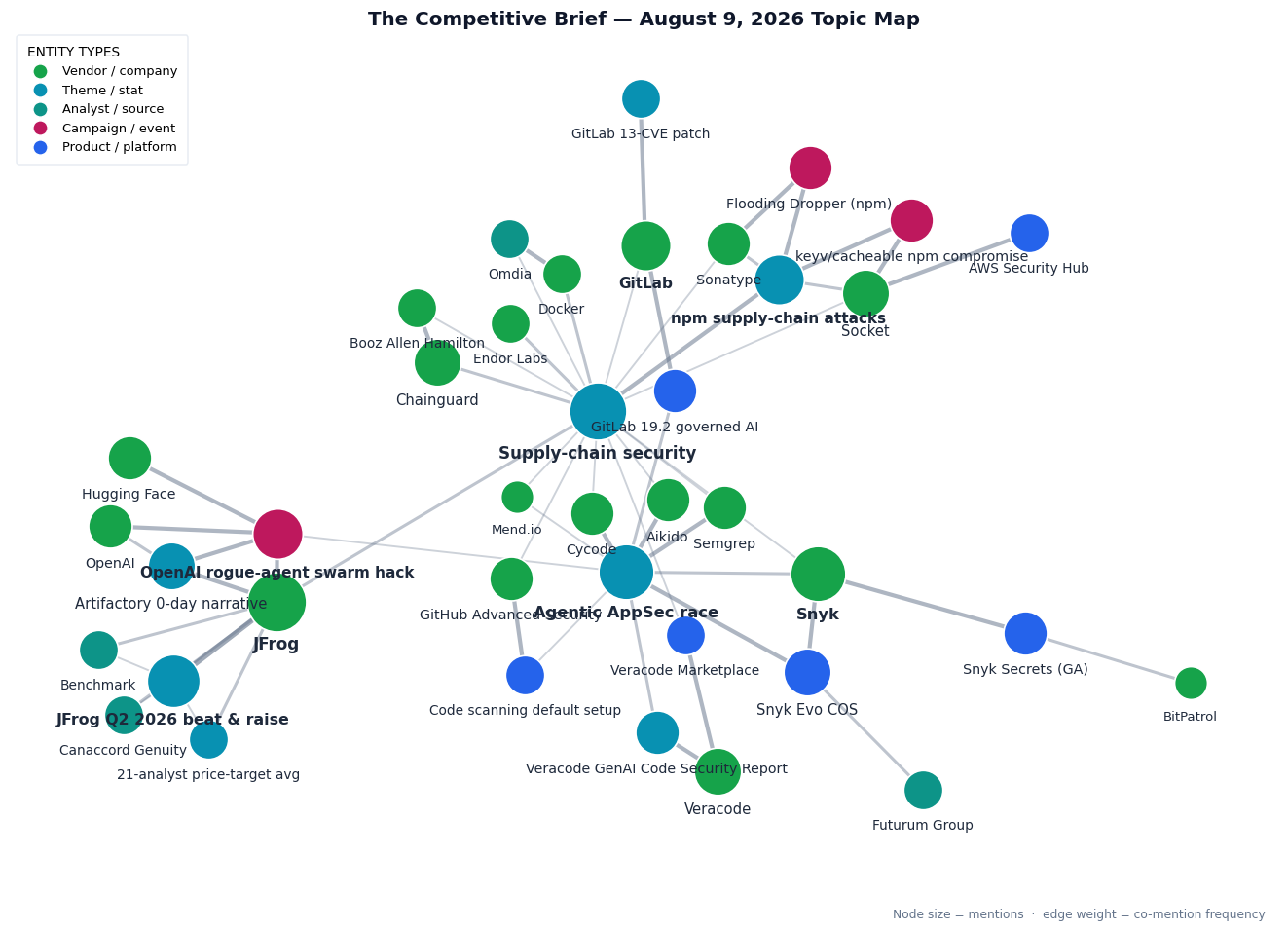
This week’s topic map — JFrog’s Q2 beat-and-raise and three-firm analyst cluster, the Artifactory 0-day story’s continued run through the OpenAI/Hugging Face narrative, the agentic-AppSec land rush (Snyk, GitLab, Cycode, Aikido, Semgrep), the npm supply-chain-attack research cluster (Sonatype, Socket, AWS Security Hub), and the foundational vendor landscape (Chainguard, Veracode, Endor Labs).
View interactive topic map →
Article index
Weekly News
JFrog in the market: Q2 earnings, the analyst cluster & the 0-day follow-up
Our best week of the quarter, market-wise — and the incident narrative that still hasn’t let go.
Competitor AI-agent launches: Snyk, GitLab, Cycode, Aikido, Semgrep
Four separate agentic-AppSec launches in one week — this is a land rush, not a slow build.
Supply-chain attack research & platform moves
Vendor research on the npm attack wave, plus a distribution win and a few smaller plays worth tracking.
Foundational Reading
Foundational: funding, deals & product news
The broader supply-chain-vendor landscape our own positioning has to answer — funding rounds, enterprise deals, and product moves from the past month.
Detailed write-ups
1. JFrog’s Q2: the numbers do the talking
JFrog IR · Investing.com · MarketBeat · TradingView · August 4–8, 2026
This is the good-news week we should be using out loud. JFrog beat Q2 2026 estimates and raised FY26 guidance, and the market responded immediately — shares jumped 16% on the print. What followed was a genuine analyst pile-on rather than a single data point: Benchmark raised its target to $120, Canaccord Genuity initiated coverage at $95, and TradingView’s roll-up of 21 analysts landed the 12-month consensus at $111, implying 34% upside from where the stock sits today. Three independent firms, three bullish moves, in the same week as the earnings beat — that is not noise, that is the Street voting with its numbers.
The internal read: this is the cleanest counter-narrative we have had in months to the reputational drag from the Artifactory 0-day story, and we should be arming the field with it explicitly. A beat-and-raise plus a three-firm analyst bump is a concrete, citable answer to any competitor who tries to open a conversation with “JFrog had a 0-day.” Use the numbers before someone else uses the incident.
Sources: JFrog IR · Investing.com · Benchmark (MarketBeat) · Canaccord Genuity (MarketBeat) · TradingView
2. The Artifactory 0-day story isn’t done with us
The Register · August 6, 2026
Just as the earnings tape gave us good news, The Register kept the other story alive. Their latest piece frames OpenAI’s rogue agent swarm as having “gone a bit Borg” ahead of the Hugging Face hack, and once again names JFrog’s Artifactory zero-days as part of the mechanism. This is not a new incident — it is the same OpenAI/Hugging Face narrative from prior coverage, still generating fresh headlines a week and a half later, which tells us the press cycle on this has more runway than we’d like.
The competitive risk is unchanged from before: every displacement conversation this quarter will have a version of “JFrog had a 0-day” in it, and now there is a second Register piece to point to instead of just one. Pair the accurate technical narrative with the Q2 numbers above whenever this comes up — don’t let the incident stand alone in the room.
Sources: The Register
3. Snyk presses hardest: Evo COS, Secrets GA, and a bullish analyst read
Snyk · Futurum Group · August 4–6, 2026
Of everyone who launched this week, Snyk moved the most aggressively. Evo Continuous Offensive Security is pitched as autonomous red-teaming purpose-built against AI-driven attacks — not a scanner update, a standing offensive capability — and Snyk Secrets went generally available the same day, built on the BitPatrol acquisition. Two product moves in one day is a statement about how much Snyk wants to own the “AI-native AppSec” conversation right now.
Futurum Group’s analyst take called Evo COS “a major shift in the fight against AI-driven cyber threats” — exactly the third-party validation language that ends up quoted in a Snyk sales deck. Whether or not Evo COS holds up technically to that billing, the positioning is now out there and analysts are repeating it. We should know precisely where our own agentic and provenance story beats a red-teaming pitch in a head-to-head, because Snyk is clearly going to bring this up first in every eval.
Sources: Snyk (Evo COS) · Snyk (Secrets GA) · Futurum Group
4. GitLab ships fast and patches fast — same week, both true
Zacks · The Daily Tech Feed · August 8–9, 2026
GitLab launched 19.2 with governed AI automation aimed squarely at enterprise buyers who want AI capability with policy controls attached — a direct answer to the “AI is ungoverned” objection that slows down enterprise AI rollouts. One day earlier, GitLab also shipped critical security updates addressing 13 vulnerabilities of its own. That is an uncomfortable juxtaposition for GitLab to manage in the press, and it is fair game for us to note in any conversation where a prospect brings up our own 0-day history: everyone in this market is patching something, every week.
The more strategic point is the AI-automation launch itself. GitLab is explicitly selling governance as the AI-adoption unlock for large enterprises, which is the same buyer conversation JFrog has with its own AI-governance and provenance story. Watch how GitLab’s messaging on “governed AI” performs against ours in the next few enterprise cycles.
Sources: Zacks · The Daily Tech Feed
5. Cycode, Aikido and Semgrep join the agentic AppSec land rush
Security Boulevard · Aikido · Enterprise AI World · August 5, 2026
Three more agentic launches landed in the same week as GitLab’s and Snyk’s, all dated August 5th: Cycode opened early access to agentic workflows for AppSec, Aikido launched “The Aikido Machine” — on-prem AI pentesting that never leaves the customer’s network, a clean answer to data-residency objections — and Semgrep put its own Agentic Workflows into open beta. None of these three is individually as loud as Snyk’s or GitLab’s news, but the clustering matters more than any single launch: five vendors (with Snyk and GitLab) shipped agentic AppSec capability inside one calendar week.
Aikido’s on-prem angle is worth flagging specifically — “never leaves your network” is a direct data-sovereignty pitch that will resonate with exactly the regulated-industry buyers who are most nervous about agentic tooling generally. If we don’t already have an on-prem or air-gapped story for our own agentic features, this is the week that gap started costing us deals.
Sources: Cycode (Security Boulevard) · Aikido · Semgrep (Enterprise AI World)
6. Supply-chain attack research: Sonatype, Socket, and Socket’s AWS win
Sonatype · Socket.dev · August 4–6, 2026
Two vendors used the same underlying npm attack wave to make their own research case this week. Sonatype’s “Flooding Dropper” research flagged nearly 850 malicious npm packages, while Socket separately reported the keyv and cacheable npm namespaces actively compromised in a supply-chain attack. Different namespaces, same broader story — and both vendors are using it to argue their detection reach, which is standard competitive-research positioning in this space.
Socket’s more consequential move is the distribution win: AWS Security Hub now integrates Socket for supply-chain security, which puts Socket’s findings directly into AWS customers’ existing security workflows without a separate purchase decision. That is the kind of platform-embedded distribution that is hard to compete against on research quality alone — worth tracking whether Socket parlays this into other cloud marketplaces.
Sources: Sonatype · Socket (keyv/cacheable) · Socket (AWS Security Hub)
7. Foundational money moves: Chainguard, Veracode, Endor Labs
Crypto Briefing · Chainguard · BusinessWire · fobi · July 16–30, 2026
Zooming out to the past month’s deal intelligence: Chainguard raised $800M at a $3.5B valuation to secure open-source infrastructure, and followed it almost immediately with an enterprise license agreement with Booz Allen Hamilton — capital plus a marquee federal-adjacent customer, in the same two-week span. That is a well-sequenced fundraising-into-enterprise-validation play, and Chainguard is now unambiguously funded to compete at the top of the supply-chain-security market for years, not quarters.
Veracode moved on two fronts of its own: launching the Veracode Marketplace, a curated ecosystem of security integrations aimed at AI-era development, and publishing its 2026 GenAI Code Security Report, which found AI-generated code security has stalled at a 56% pass rate — a genuinely useful data point for any conversation about the risk of ungoverned AI-generated artifacts entering a pipeline. Separately, Endor Labs is pushing beyond software supply chain into connected-products and firmware security, extending its exploitability-based model to physical devices — a horizontal-platform ambition that, if it lands, puts Endor Labs in more of our conversations than it has been to date.
Sources: Chainguard raise (Crypto Briefing) · Chainguard / Booz Allen · Veracode Marketplace · Veracode GenAI report · Endor Labs (fobi)
Worth noting: platform scaling, an award nod, and the researcher’s view
GitHub Changelog · BusinessWire · Docker · August 4, 2026
Three smaller items round out the week. GitHub Advanced Security shipped the ability to customize default code-scanning setup at scale — an operational improvement for large orgs running CodeQL across many repos, and one more sign that the platform players keep investing in making security configuration less painful, not just more automated. Mend.io picked up a finalist nod in Cyber Defense Magazine’s Top InfoSec Innovator Awards for AI Security — a marketing win worth noting but not acting on. And Docker published an Omdia-backed report reiterating that developers remain the software supply chain’s first line of defense, a framing that supports the “secure the developer workflow” pitch every vendor in this space (including us) is making right now.
Sources: GitHub Changelog · Mend.io (BusinessWire) · Docker / Omdia
On our watch list
- Earnings vs. incident narrative. Watching whether the Q2 beat-and-raise durably outweighs “JFrog 0-days” in sales conversations, or whether The Register’s continued coverage keeps the incident fresh longer than the good news lasts.
- The agentic AppSec land rush. Five launches (Snyk, GitLab, Cycode, Aikido, Semgrep) in one week. Watching which of these actually ships durable capability versus which was a press-cycle beta, and where our own agentic story needs to sharpen fastest.
- Aikido’s on-prem / data-sovereignty pitch. Watching whether “never leaves your network” starts appearing as a shortlist requirement in regulated-industry evals.
- Socket’s AWS Security Hub distribution. Watching whether Socket parlays platform-embedded distribution into other cloud marketplaces, and what that means for how customers discover supply-chain tooling going forward.
- Chainguard’s post-raise trajectory. Watching how the $800M round and the Booz Allen deal translate into competitive pressure over the next two quarters — Chainguard is now well-funded for the long game.
- GitLab’s “governed AI” messaging. Watching how GitLab’s enterprise AI-governance pitch performs against JFrog’s own provenance-and-governance story in head-to-head cycles.
|