At a glance
Black Hat USA 2026 produced the densest cluster of agentic-SOC platform launches this bulletin has tracked in a single week. SentinelOne pitched a governed, closed-loop response model meant to make an autonomous SOC trustworthy enough to act without a human in the loop for routine cases. Arctic Wolf expanded its Agentic SOC with AI-driven investigations and backed the pitch with a $3 million cyber warranty. ServiceNow reorganized its autonomous-security push around six distinct solution areas, Tanium extended its platform across AI, exposure management, and SecOps in one move, TENEX.ai promised a turn-key agentic SecOps platform deployable in a week, and Fortinet rolled its detection, response, and orchestration into a single unified SOC platform, FortiSOC, powered by agentic AI. Six vendors, one thesis: the SOC platform itself is being rebuilt around an agent that acts, not just an alert console that waits.
A second wave of launches went narrower — AI agents built specifically to hunt and investigate. Simbian added an AI threat-hunting agent to its autonomous SecOps platform, Sumo Logic took its SOC Analyst Agent to general availability, Crogl made its Enterprise AI SOC Agent available as a free download to widen adoption, and Vectra AI introduced Vectra AI Pro to feed its own agents better attack signals. The common pitch across all four: hunting and investigation, historically the most expertise-bound SOC tasks, recast as something an agent can run continuously rather than something an analyst does occasionally.
The SIEM and detection-engineering layer picked up its own agentic refresh. Securonix added governed AI agent detection to its Unified Defense SIEM, Elastic pushed its Attack Discovery feature toward what it calls “Alert Zero,” RapidFort Runtime added continuous CVE monitoring and tamper detection to the pipeline, and Vega introduced Detection Skills, pitched as an open standard for how AI reasons through agentic defense — an attempt to keep the new agent layer interoperable rather than another set of walled gardens.
A fourth cluster addressed a problem the rest of the week’s launches are creating: who governs and defends the AI agents themselves. Mimecast introduced AI agent governance alongside managed threat response, ESET added new AI capabilities aimed at securing autonomous agents, Sevii’s APS Module pitched preemptive, autonomous cyber defense, and Expel launched what it’s calling the first MDR built for the full AI attack surface — treating the organization’s own AI agents, not just its endpoints and network, as something that needs monitored detection and response.
Zoom out and the week’s two non-vendor stories frame everything above. The Register argued that AI is now both the weapon and the target in the latest wave of cyberattacks — the same generative and agentic capability that is shipping in every SOC platform above is also what attackers are turning against defenders. And SiliconANGLE’s Black Hat wrap captured the tension on the show floor: big money chasing AI, and a visibly smaller world for security budgets and headcount outside of it. This week’s foundational reading picks up the thread from the quieter side of the conference — CSO Online on why AI is accelerating the SOC’s race against time, and GBHackers on cybercriminals now commercializing adversarial prompt-injection toolkits built specifically to evade the AI security tools this issue is full of.
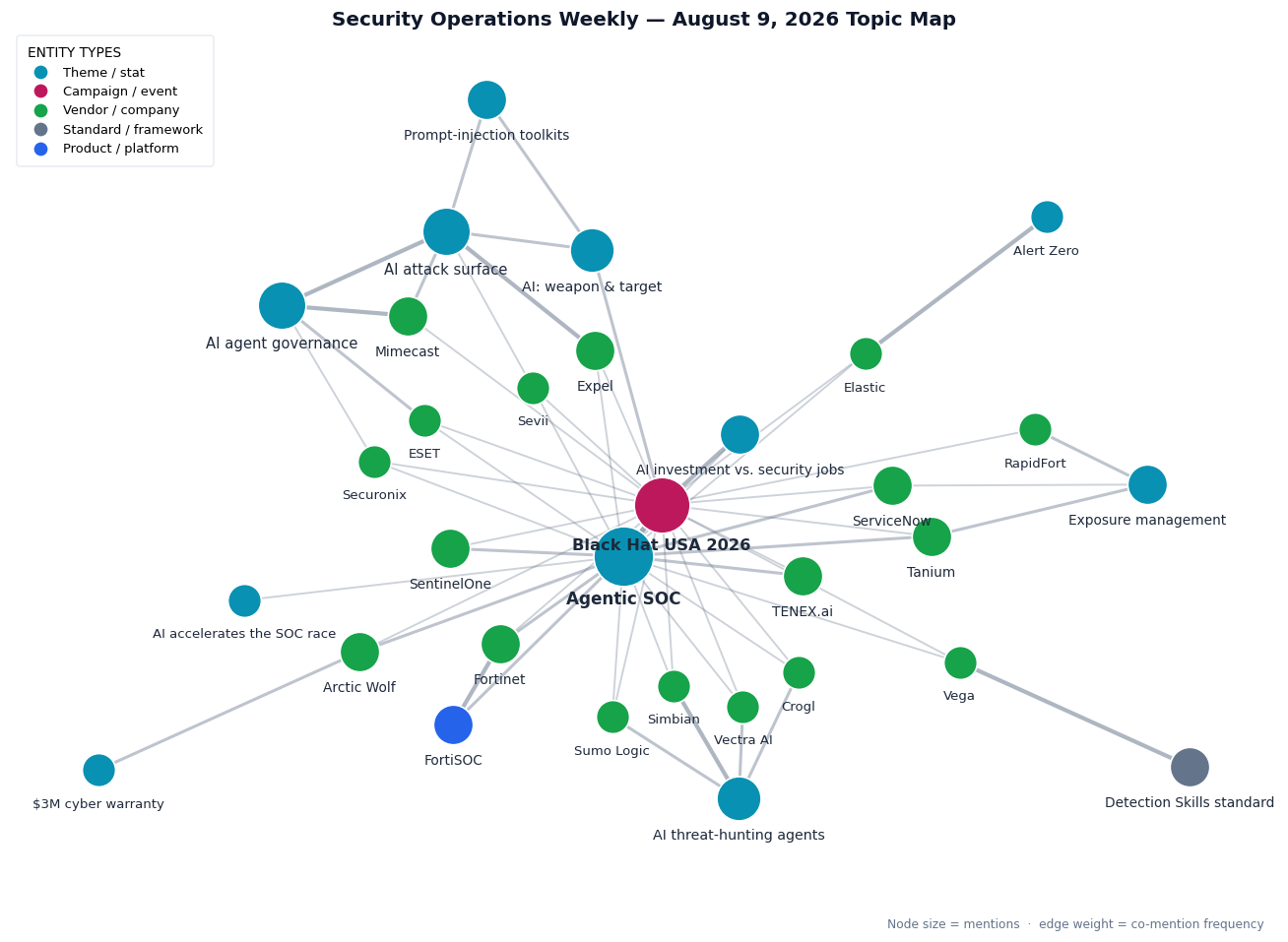
This week’s topic map — Black Hat’s agentic SOC platform wave (SentinelOne, Arctic Wolf, ServiceNow, Tanium, TENEX.ai, Fortinet’s FortiSOC), AI threat-hunting and investigation agents (Simbian, Sumo Logic, Crogl, Vectra AI Pro), the SIEM/detection-engineering refresh (Securonix, Elastic’s Alert Zero, RapidFort, Vega’s Detection Skills standard), governing and defending the AI attack surface itself (Mimecast, ESET, Sevii, Expel), AI as both weapon and target, the AI-investment-vs-security-jobs tension at Black Hat, and the foundational threads on the AI-accelerated SOC race and commercialized prompt-injection toolkits.
View interactive topic map →
Article index
Weekly News
The agentic SOC platform wave: Black Hat’s biggest theme
Six vendors used Black Hat week to ship — not pitch — a rebuilt SOC platform organized around an agent that acts on its own, from governed closed-loop response to a turn-key deployment in a week.
| Article |
Source |
Published |
| 1. SentinelOne makes the Autonomous SOC trustworthy with governed, closed-loop response |
BusinessWire |
Aug 3, 2026 |
| 2. Arctic Wolf expands Agentic SOC with AI investigations and $3M cyber warranty |
MSSP Alert |
Aug 3, 2026 |
| 3. ServiceNow organizes autonomous security around six solution areas |
Help Net Security |
Aug 4, 2026 |
| 4. Tanium expands autonomous security across AI, exposure management, and SecOps |
Help Net Security |
Aug 4, 2026 |
| 5. TENEX.ai launches turn-key agentic SecOps platform, deployable in a week |
Security Boulevard |
Aug 5, 2026 |
| 6. Fortinet launches unified SOC platform FortiSOC, powered by agentic AI |
TechPartner News |
Aug 7, 2026 |
AI threat-hunting and investigation agents multiply
A second, narrower launch wave recasts hunting and investigation — historically the SOC’s most expertise-bound tasks — as something an agent runs continuously rather than something an analyst does occasionally.
SIEM, MDR, and detection engineering get an agent refresh
The detection layer underneath the new agents gets its own upgrades — governed agent detection inside a SIEM, an “Alert Zero” push, continuous runtime CVE monitoring, and an open standard for how AI reasons through defense.
Governing — and defending — the AI attack surface
A fourth cluster answers the question the rest of the week’s launches raise: who governs and protects the AI agents themselves, now that they’re deployed across the SOC.
AI as weapon and target, and where the money’s going
Two non-vendor stories frame the whole week: the same AI capability shipping in every platform above is also what attackers are turning against defenders, and Black Hat’s show floor makes the investment tilt visible.
Foundational Reading
The AI-accelerated SOC race, and the toolkits built to evade it
Two longer-form pieces bookend this week’s product wave: why AI is accelerating the SOC’s race against time, and how cybercriminals are already commercializing tools built to evade the AI security stack.
Detailed write-ups
1. Black Hat’s biggest theme: six vendors ship a rebuilt, agentic SOC platform
BusinessWire · MSSP Alert · Help Net Security · Security Boulevard · TechPartner News · August 3–7, 2026
Black Hat USA 2026 produced the densest single-week cluster of agentic-SOC platform launches this bulletin has tracked. SentinelOne pitched governed, closed-loop response as the feature that makes an autonomous SOC trustworthy enough to act without waiting on a human for routine cases. Arctic Wolf expanded its Agentic SOC with AI-driven investigations and backed the pitch with a concrete guarantee — a $3 million cyber warranty. ServiceNow reorganized its autonomous-security push around six distinct solution areas rather than a single bundled product, Tanium extended its platform to span AI, exposure management, and SecOps in one move, and TENEX.ai promised a turn-key agentic SecOps platform deployable in a week, explicitly targeting the deployment friction that has slowed prior autonomous-SOC pitches. Fortinet capped the wave by folding detection, response, and orchestration into a single unified platform, FortiSOC, powered by agentic AI.
Read across six vendors, the pitch has converged: the differentiator is no longer the alert console but how much of the SOC’s own operating model — investigation, response, deployment, and now even the platform’s internal organization — an agent can carry. For a buyer, that convergence is useful and risky in the same breath. Useful because it means genuine competition on autonomous capability rather than marketing gloss; risky because a warranty, a governed closed-loop claim, or a “deployable in a week” promise is only as good as how it holds up against a real environment, not a Black Hat demo floor. The question worth asking every one of these vendors is the same: what does the agent do when it’s wrong, and how fast can a human see and reverse it?
Sources: BusinessWire (SentinelOne) · MSSP Alert (Arctic Wolf) · Help Net Security (ServiceNow) · Help Net Security (Tanium) · Security Boulevard (TENEX.ai) · TechPartner News (Fortinet FortiSOC)
2. Hunting and investigation become agent work: Simbian, Sumo Logic, Crogl, and Vectra
Help Net Security · Security Boulevard · SiliconANGLE · August 3–5, 2026
A second, narrower launch wave targeted the two SOC tasks that have most resisted automation: threat hunting and investigation. Simbian added a dedicated AI threat-hunting agent to its autonomous SecOps platform. Sumo Logic took its SOC Analyst Agent to general availability, moving it from pilot to production default. Crogl went the opposite distribution route, making its Enterprise AI SOC Agent available as a free download to widen adoption rather than gating it behind a sales cycle. And Vectra AI introduced Vectra AI Pro specifically to feed its own agents better attack signals — a reminder that an agent’s hunting quality is bounded by the signal it’s given, not just the model behind it.
The shared bet across all four is that hunting and investigation can become a routine, always-on background operation rather than an occasional exercise reserved for a team’s most senior analysts. That’s a genuine expansion of coverage if it holds up: a SOC that could only afford to hunt occasionally now has an agent hunting continuously. But it also means the quality bar moves from “did a skilled analyst find something” to “can the agent be trusted to know what it doesn’t know” — and free-download distribution in particular, as with Crogl, puts that trust question in front of a much wider and less vetted set of environments than a traditional enterprise sales motion would.
Sources: Help Net Security (Simbian) · Security Boulevard (Sumo Logic) · Security Boulevard (Crogl) · SiliconANGLE (Vectra AI Pro)
3. The detection layer gets its own agent refresh: SIEM, Alert Zero, and an open reasoning standard
Help Net Security · Security Boulevard · PR Newswire · August 4–5, 2026
Underneath the platform and hunting-agent launches, the detection-engineering layer picked up upgrades of its own. Securonix added governed AI agent detection to its Unified Defense SIEM — detecting the behavior of AI agents themselves as a first-class SIEM use case, not just the traditional host and network telemetry. Elastic expanded Attack Discovery to push security teams toward what it calls “Alert Zero,” an explicit target of driving true-positive, actionable alerts down toward zero noise. RapidFort Runtime added continuous CVE monitoring and tamper detection to the runtime pipeline, closing the gap between a vulnerability being disclosed and a workload actually being watched for exploitation of it. And Vega introduced Detection Skills, pitched as an open standard for how AI reasons through agentic defense — an attempt to keep this fast-multiplying layer of agents interoperable rather than turning into another set of vendor-locked black boxes.
Vega’s open-standard framing is the one worth watching longest. Every other launch this week is a vendor’s own agent inside its own platform; a shared standard for how those agents reason is the precondition for a SOC being able to mix agents from different vendors and still audit and compare their decisions consistently. Whether Detection Skills gets adopted beyond its own launch, or joins the long list of proposed security standards that never cleared critical mass, is the real test of whether this week’s agent wave becomes an open ecosystem or a set of walled gardens.
Sources: Help Net Security (Securonix) · Security Boulevard (Elastic Alert Zero) · Help Net Security (RapidFort Runtime) · PR Newswire (Vega Detection Skills)
4. Who governs the agents: Mimecast, ESET, Sevii, and Expel address the AI attack surface
Help Net Security · PR Newswire · August 3–4, 2026
A fourth cluster answered the question the rest of the week’s launches raise by existing: now that AI agents are running across the SOC, who governs and defends the agents themselves? Mimecast introduced AI agent governance alongside managed threat response, treating agent oversight as a service rather than a checkbox. ESET added new AI capabilities aimed specifically at securing autonomous agents. Sevii’s APS Module pitched preemptive, autonomous cyber defense — acting ahead of an attack rather than only responding to one. And Expel launched what it calls the first MDR built for the full AI attack surface, extending managed detection and response to cover an organization’s own AI agents and models as monitored assets, not just its endpoints and network.
Expel’s framing is the most structurally significant of the four: it says plainly that the AI agents a SOC deploys are now part of what needs to be monitored, not just the tooling doing the monitoring. That’s the same insight driving Mimecast’s and ESET’s launches from different angles, and it points at a near-term reality worth planning for now — every agent adopted from this week’s other clusters (the platforms, the hunters, the SIEM add-ons) becomes a new asset this cluster’s governance and MDR offerings need to cover. The AI attack surface isn’t a future category; it’s the same agents already announced above, viewed from the defender’s side of the ledger.
Sources: Help Net Security (Mimecast) · Help Net Security (ESET) · Help Net Security (Sevii) · PR Newswire (Expel)
5. AI is both the weapon and the target — and Black Hat’s money doesn’t agree on what to fund
The Register · SiliconANGLE · August 3–9, 2026
Two non-vendor stories framed everything else this week. The Register argued that AI is now both the weapon and the target in the latest wave of cyberattacks — the same generative and agentic capability shipping inside every platform, hunter, and governance tool announced above is also what attackers are using to design and run their attacks, collapsing the line between “the tool that defends you” and “the tool that’s used against you” into the same underlying technology. SiliconANGLE’s on-the-ground Black Hat wrap made the resourcing tension visible: big money is chasing AI, while the rest of the security world — headcount, budget for non-AI tooling, the fundamentals — looks comparatively smaller.
Together the two stories are a check on the week’s enthusiasm rather than a contradiction of it. If AI genuinely is both weapon and target, then the investment SiliconANGLE describes flowing overwhelmingly into AI-labeled products is rational in one sense and risky in another — rational because that’s where the offensive innovation is happening too, risky if it starves the non-AI fundamentals (patching, identity, network segmentation) that still stop the majority of intrusions that have nothing to do with an agent on either side. A SOC leader watching this week’s launches should ask not just “does this agent work” but “is my budget still covering the boring things that don’t get a Black Hat keynote.”
Sources: The Register (AI as weapon and target) · SiliconANGLE (Black Hat money vs. security)
6. Foundational: the SOC’s race against time, and the toolkits built to evade the AI it’s racing to deploy
CSO Online · GBHackers · July 22–29, 2026
This week’s foundational reading bookends the product wave with two longer-form pieces. CSO Online examined why AI is accelerating the SOC’s race against time — both the pace at which threats develop and the pace at which defenders are expected to respond, with the platforms above positioned as one attempted answer to that acceleration. GBHackers reported that cybercriminals are already commercializing adversarial prompt-injection toolkits built specifically to evade the AI security tools now shipping across the industry — packaged, sellable kits designed to defeat the very agent-based detection this issue’s vendor wave is racing to deploy.
Read against everything above, the GBHackers piece is the necessary corrective to Black Hat’s enthusiasm: the moment AI agents become the default SOC layer, they become the default thing attackers build tooling to evade, and that tooling is already commercial rather than theoretical. The race CSO Online describes doesn’t end with this week’s launches; it just moves to a new front, where the question is no longer “can an agent detect this” but “can an agent detect an attack specifically engineered to look invisible to an agent.” That’s the standard every platform, hunter, and governance product announced this week should ultimately be measured against.
Sources: CSO Online (AI and the race against time) · GBHackers (commercialized prompt-injection toolkits)
On our watch list
- What the agent does when it’s wrong. With SentinelOne, Arctic Wolf, ServiceNow, Tanium, TENEX.ai, and Fortinet all shipping autonomous SOC platforms in the same week, watching whether buyers get real explainability and fast human override — or whether “governed closed-loop” and warranty language substitutes for it.
- Hunting and investigation agents outside the demo. Simbian, Sumo Logic, Crogl, and Vectra all pitch continuous, always-on hunting; watching whether that holds up in noisy real-world environments, and how free-download distribution (Crogl) affects the vetting bar.
- Whether Detection Skills becomes a real standard. Vega’s open standard for AI reasoning in agentic defense is the one launch this week that could make the agent wave interoperable rather than vendor-locked — watching for adoption beyond its own announcement.
- The AI attack surface as a monitored asset, not a slide. Mimecast, ESET, Sevii, and Expel all now treat an organization’s own AI agents as something to govern and defend; watching whether that coverage keeps pace with how fast this week’s other clusters are adding new agents to monitor.
- Weapon and target, same technology. The Register’s framing means every defensive AI capability launched this week has an offensive mirror; watching how detection engineering adapts as attackers use the same class of tooling defenders just adopted.
- Budget tilt at Black Hat. SiliconANGLE’s “big money for AI, smaller world for security” read is worth tracking into next quarter’s spend data — watching whether non-AI fundamentals (patching, identity, segmentation) keep funding as AI dominates the show floor.
- Prompt-injection toolkits going commercial. GBHackers’ report that adversarial prompt-injection kits are now being sold, not just researched, means the AI security tools in this issue need to be tested against attackers who are already targeting them specifically, not just against generic threats.
|