This week at a glance
The week belongs to the NGMN Alliance, whose Phase III publication — Network Automation and Autonomy Phase III: Agentic AI for Autonomous Mobile Networks — is the most complete public statement yet of what agentic AI still owes the mobile network before anyone can call Level 4 autonomy trustworthy. NGMN’s framing is deliberately unromantic: agentic systems that reason, plan, collaborate and execute are now credible, but operators cannot run them without governance and trust frameworks, policy adherence, observability, explainability, determinism, security assurance, cost control and calibrated human oversight. Orange CTO and NGMN chairman Laurent Leboucher supplied the headline — “AI is no longer restricted to analytics” — and China Mobile’s Guangyi Liu and Vodafone’s Luke Ibbetson supplied the caveat, that none of this arrives without coordination across operators, standards bodies, vendors, hyperscalers and open source. Telecoms.com read the same document as a to-do list and counted roughly a dozen open shortfalls: no unified end-to-end standards view, thin multi-vendor agent-to-agent interoperability, no frameworks for knowledge acquisition, cross-domain situational awareness, agent lifecycle onboarding, cost management or human-machine control — plus a live fragmentation risk in proprietary A2A variants.
The practitioner commentary this week converged on the same conclusion from the operational side: the binding constraint is data trust and scale, not model capability. Sutherland’s Jay Naillon and Snowflake’s Sreedhar Rao pointed at a TM Forum finding that only 14% of operators can produce externally reviewable evidence that their AI systems are trustworthy, and argued that agents dropped into siloed inventory, assurance and customer data will not scale no matter how good the model is — in a market they expect to reach roughly $11.09 billion by 2030. Accenture’s Jacopo Sebastiani and Matteo Salmini made the structural version of the argument: real gains exist (up to 30% opex reduction, ~17% capital efficiency, ~11% revenue uplift) but stay trapped in single domains, and only 22% of operators expect advanced autonomy by 2030. Ericsson repositioned its OSS/BSS portfolio around exactly that critique, launching Business Value Pathways that work backward from business outcomes, with portfolio head Jason Keane conceding the obvious — “if you don’t have good data, you’re really not getting a good outcome” — and Appledore’s Robert Curran naming fragmented data as the first and most critical CSP problem. AWS’s Amir Rao made the pragmatist’s case for meeting operators where they are, mainframes and 30-year-old billing code included.
Against that backdrop, operators reported deployments rather than intentions. T-Mobile US chief network officer Ankur Kapoor described a three-tier operating model — machine-speed alarm handling, automated root-cause analysis, and human-supervised live change — anchored to customer-experience KPIs rather than equipment metrics; its Dynamic CX Platform executed over 11,000 automated optimizations across 12 World Cup fan events. NTT DoCoMo and Samsung pushed AI-RAN down to the individual subscriber, cutting speed-degradation incidence from 13.1% to 7.2% in Japanese field trials. Ooredoo Kuwait put NWDAF into its 5G core as the analytics substrate for closed-loop automation, U Mobile wired OpenAI models onto AWS across contact centre, RAN and back office, and Telefónica embedded generative AI into business voice at the network layer in Spain. The transport story ran in parallel: Lumen bet on east-west cloud-to-cloud growth of 10–13% against 1–2% for premise-to-cloud, Celona folded Wi-Fi 7 into private 5G behind an agentic Orchestrator AI, and Comcast Business and Colt began building agent-mediated cross-border NaaS. Cisco’s Q4 supplied the market read — $4 billion in AI infrastructure orders, 145,000 support cases closed with no human in the loop, and security revenue up 14% to $2.2 billion precisely because agentic AI is widening the attack surface it also has to defend.
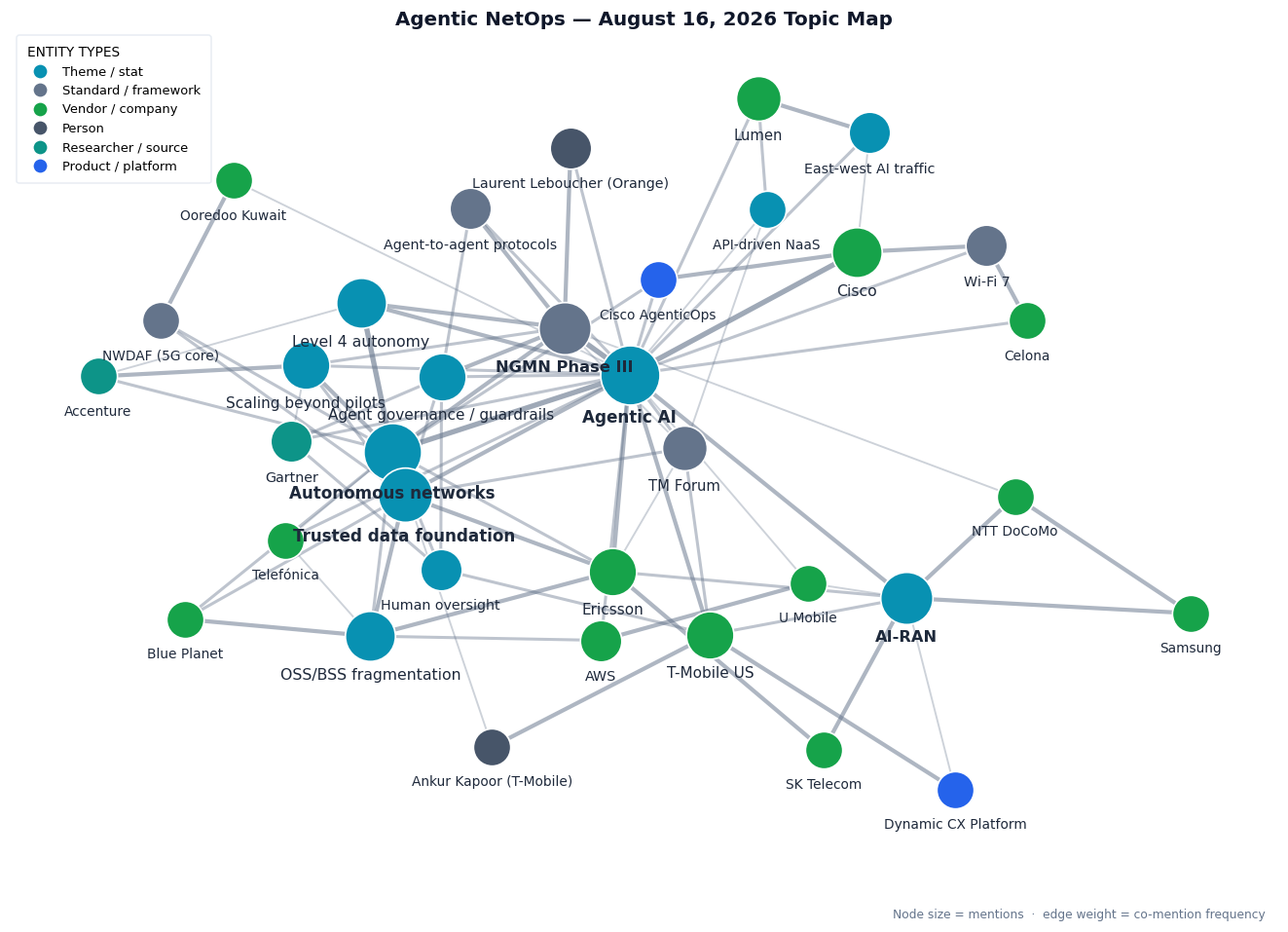
This week’s topic map — NGMN’s Phase III requirements list and the agent-governance gap; trusted data and cross-domain scale as the real constraint (Ericsson, Accenture, Blue Planet, TM Forum); AI-RAN reaching the handset and the cell site (NTT DoCoMo, Samsung, SK Telecom, T-Mobile US); operator production deployments (Ooredoo Kuwait, U Mobile, Telefónica); and the transport and enterprise-edge layer carrying agentic traffic (Lumen, Cisco, Celona). Node size reflects how often an entity is mentioned; edge weight reflects how often two entities are discussed together.
View interactive topic map →
Article index
Weekly News
NGMN Phase III: what trusted Level 4 autonomy still costs
NGMN’s third-phase publication sets out the architecture, standards, security, operations and governance work agentic AI still needs before autonomous mobile networks can be trusted — and Telecoms.com counts the open items.
Data trust and scale, not models, are the binding constraint
Four independent arguments landing the same week: agents fail on fragmented operational data, gains stay stuck inside single domains, and vendors are rebuilding their pitches around business outcomes and legacy reality rather than architecture diagrams.
Operators in production: agents, AI-RAN and network-embedded intelligence
T-Mobile US ties automation to customer outcomes and a three-tier control model; DoCoMo and Samsung take AI-RAN to the individual handset; Ooredoo Kuwait installs the analytics substrate; U Mobile and Telefónica move AI into the operator’s own service layer.
Carrying the traffic: programmable fabric, private wireless and cross-border NaaS
Lumen restructures around east-west AI traffic and a programmable fabric; Celona bundles Wi-Fi 7 into private 5G behind an agentic operations platform; Comcast Business and Colt start building agent-mediated cross-border connectivity.
Market signals: what Cisco’s quarter says about agentic networking
Two reads on the same results. Network World takes the infrastructure and operations view; Cybersecurity Dive reads the security line as a networking-market signal — demand rising because agentic AI is expanding the surface the network has to defend.
Foundational Reading
Context before control: architecture, AI-RAN groundwork, and a caution on console sprawl
Blue Planet argues agents are only as good as the context you build for them; Ericsson’s SK Telecom pilot shows the national-scale AI-RAN groundwork; Cisco makes the enterprise wireless case for AgenticOps; and Gartner supplies the counterweight — agentic I&O at scale will break things before it fixes them.
Detailed write-ups
1. NGMN Phase III: the industry writes down what trusted Level 4 autonomy actually requires
NGMN Alliance · Telecoms.com · August 11, 2026
The NGMN Alliance’s Network Automation and Autonomy Phase III: Agentic AI for Autonomous Mobile Networks is the week’s centre of gravity, and its argument is that agentic AI is now a plausible route to Level 4 — highly autonomous networks that make decisions, self-optimise, self-heal and self-manage — but only if the industry first builds the parts nobody has yet standardised. NGMN’s list of prerequisites is explicit: governance and trust frameworks, policy adherence, observability, explainability, operational safety, determinism, security assurance, cost control, and human oversight placed where it actually matters. Orange group CTO and NGMN chairman Laurent Leboucher framed the shift — “AI is no longer restricted to analytics… the rapid arrival of Agentic AI has introduced the prospect of autonomous systems able to reason, plan, collaborate and execute actions” — while China Mobile’s Guangyi Liu called for “increased collaboration among MNOs, SDOs, vendors, hyperscalers, and open-source communities” and Vodafone R&D’s Luke Ibbetson insisted trustworthiness and security “must be in place” before safe, interoperable, scalable deployment is possible. NGMN’s own verdict on the ecosystem is blunt: it remains “largely complex and unevenly mature,” and the industry needs to move off isolated proofs-of-concept toward operational deployment before fragmentation hardens.
Telecoms.com’s Nick Wood read the same document as a to-do list and counted roughly a dozen unresolved items, which is the more useful way to consume it. Among them: no unified end-to-end view across the various standards development organisations and industry groups; limited multi-vendor interoperability despite genuine progress on agent-to-agent protocol work; no agreed frameworks for how agents acquire knowledge and context; no standard for sharing situational awareness between agents across domains; unresolved end-to-end trust and security; undefined organisational change requirements; absent cost-management frameworks for agentic AI spend; scalability problems at enterprise scale; undefined agent onboarding and lifecycle management; and no framework governing how human engineers retain control. Wood also flagged the fragmentation risk that comes with proprietary A2A variants — Huawei’s A2A-T among them — landing in a market already wary on vendor lines, and the coordination hazard NGMN itself names: agents in different domains “working at cross purposes” because their awareness of network state is inconsistent. The tone from both pieces is cautious optimism rather than deflation; the momentum is real, the plumbing is not finished.
Sources: NGMN Alliance (Phase III publication) · Telecoms.com (NGMN’s AI to-do list)
2. The constraint is data trust and cross-domain scale — and vendors are finally pitching to it
The Fast Mode · RCR Wireless · SDxCentral · August 10–13, 2026
Sutherland’s Jay Naillon and Snowflake’s Sreedhar Rao wrote the sharpest version of the week’s dominant argument: autonomous networks will not scale without AI-led, trusted data, and treating agentic AI as primarily a technical problem is the mistake. Their evidence is a TM Forum finding that only 14% of operators can produce externally reviewable evidence that their AI systems are trustworthy — in a telecom agentic AI market they see nearly tripling to roughly $11.09 billion by 2030. The failure mode they describe is familiar: agents dropped into fragmented legacy environments where operational data, network inventory, service information and customer-impact data all sit in separate silos. Their prescribed order is high-value use cases first (alert prioritisation, incident correlation, root-cause analysis rather than blanket automation), then governance — decision boundaries, accountability, standardised APIs — then a unified data foundation across network, IT and service domains, and only then measurable scaling tied to demonstrated operational improvement. Human oversight is not a transitional stage in their model; the goal is supervising increasingly autonomous systems, not removing the supervisor.
Accenture’s Jacopo Sebastiani and Matteo Salmini made the structural case alongside it. The gains from AI-driven automation are real — up to 30% opex reduction, roughly 17% capital efficiency improvement, revenue uplift in the 11% range — but they stay “confined to specific domains,” and the obstacle to coordinating decisions end-to-end is organisational fragmentation and legacy infrastructure rather than any missing technology. Their data point on ambition is sobering: only 22% of operators expect advanced levels of autonomy by 2030, with fewer still expecting full autonomy. They point to Deutsche Telekom’s RAN Guardian agent, AT&T’s push beyond isolated use cases, and Telstra’s platform-level investment in unified data as the operators actually attacking the layer problem, and propose a three-layer AI-native platform: an outside-in view of network experience, a cognitive decision layer, and an execution layer driven by autonomous agents.
Ericsson spent the week repositioning its OSS/BSS portfolio around precisely that critique. Its new Business Value Pathways work backward from business priorities to the technology, data and operational capabilities required, across four routes: faster data transformation, zero-touch product launch, agentic AI service experience, and agentic AI for intelligent IT operations — all pointed at accelerating monetisation, enabling experience and improving efficiency. Jason Keane, who heads Ericsson’s portfolio business and OSS, put the dependency plainly: “AI is a huge impact on the industry, but if you don’t have good data, you’re really not getting a good outcome,” and the point of the exercise is to “get the actual value back out of the network.” Appledore Research’s Robert Curran backed the diagnosis, calling fragmented data the first and most critical challenge CSPs face. Ericsson’s own framing — that operators have “over-indexed on the architecture and under-indexed on the business result” — is a notable concession from a vendor that has sold plenty of architecture. AWS’s Amir Rao, global director for telecom solutions, supplied the pragmatist’s coda: agentic AI is best positioned first as a cloudification assistant for the systems operators already run, mainframes and 30-year-old homegrown billing software included, because “we’ll have to meet the industry where it is first before we can embark upon some of the extremely disruptive thinking.”
Sources: The Fast Mode (AI-led, trusted data) · The Fast Mode (scaling is the real challenge) · RCR Wireless (Ericsson Business Value Pathways) · SDxCentral (AWS on AI as cloudification assistant)
3. T-Mobile US: automation that doesn’t move a customer KPI doesn’t count
RCR Wireless · August 14, 2026
Ankur Kapoor, T-Mobile US EVP and chief network officer, gave the week’s clearest operator statement of intent: “Our vision was no automation is good enough unless it’s really impacting customer experience.” That is a governance decision as much as a technical one — it rules out the standard trap of scoring agentic programmes on alarms suppressed or tickets auto-closed. T-Mobile instead measures against application responsiveness, successful data uploads, video session completion rates, net promoter score, and the volume of network-related customer service calls, and builds its knowledge architecture from “real people in real places doing real things” so optimisation tracks actual application usage rather than abstract equipment metrics.
The control model behind it is a three-tier split that maps neatly onto NGMN’s human-oversight requirement: Tier 1 handles alarm monitoring fully automatically at machine speed; Tier 2 automates root-cause analysis and fault localisation; Tier 3 makes live network changes but keeps human oversight on high-risk decisions. The showcase is the Dynamic CX Platform, which pairs AI with self-organising network technology to anticipate large-scale events and tune performance in near-real time — during this summer’s FIFA World Cup it executed over 11,000 automated optimisations across 12 fan events, serving 2.26 million fans across 78 matches and roughly a petabyte of stadium traffic. Alongside it sit Live Translation as an AI-native core service feature and AI-RAN work pushing intelligence toward the cell site. The industry validation arrived at DTW Ignite 2026, where T-Mobile’s work on the TM Forum-hosted Agentic NOC project took an Outstanding Catalyst Award and its conflict-management approach for intent-based networks won the Attendees’ Choice Award — conflict management being, notably, one of the exact cross-domain coordination gaps NGMN flagged this week.
Sources: RCR Wireless (The Agentic Network — T-Mobile US)
4. AI-RAN reaches the handset, and three more operators put intelligence in the network itself
SDxCentral · Telecom Review · RCR Wireless · August 11–13, 2026
NTT DoCoMo and Samsung demonstrated the most concrete AI-RAN result of the week by shrinking the unit of optimisation from the cell to the individual user. Their system uses machine learning over aggregated device data to read real-time radio conditions, user context and movement trends, flags early signs of throughput degradation, and retunes configuration for that specific subscriber — with the AI running on Samsung hardware to predict degradation before quality drops. The Japanese field test cut the frequency of communication-speed degradation from 13.1% to 7.2% against conventional operations. Just as interesting operationally, the pair built a selective data-collection method that gathers only the information relevant to a specific user issue, cutting the congestion that bulk telemetry collection creates — a direct, if partial, answer to the “drowning in telemetry” problem the data-trust commentary keeps naming. DoCoMo’s Masafumi Masuda (SVP, 6G R&D) and Samsung’s JinGuk Jeong (EVP, advanced communications research) both framed the work as 6G groundwork and committed to feeding findings into 3GPP.
Ooredoo Kuwait took the less glamorous but structurally important step of deploying NWDAF, the 5G core’s Network Data Analytics Function, as the analytics substrate for everything above it: collecting and analysing network, service and user-performance data, applying AI and ML to detect anomalies and anticipate demand, and enabling predictive rather than reactive management. CTO Issa Haidar’s framing — “data has become one of the most valuable assets in the telecommunications industry, while the ability to transform that data into intelligent, real-time insights is becoming increasingly important” — is the operator-side echo of the week’s vendor commentary, and Ooredoo is explicit that NWDAF is the foundation for closed-loop automation and network autonomy, not the destination. U Mobile in Malaysia went the partnership route, pairing OpenAI’s frontier models and agentic systems with AWS infrastructure (SageMaker and Bedrock) across contact centre operations, RAN optimisation and back-office automation, while positioning its Enterprise Innovation Platform as an ecosystem broker where OpenAI joins Qualcomm, Huawei Malaysia and Palo Alto Networks in a data-resident environment. And Telefónica embedded generative AI — transcription, summarisation, virtual agents — directly into its Spanish business voice network rather than bolting on a third-party overlay: calls route through edge nodes running LLMs and retrieval-augmented generation across 100+ languages, built on Nokia edge infrastructure and integrated with IMS signalling, so enterprises keep their existing numbers and PBX setups. That is a revenue play as much as a NetOps one, and it deepens the operator’s position inside customer business processes.
Sources: SDxCentral (DoCoMo/Samsung AI-RAN) · Telecom Review (Ooredoo Kuwait NWDAF) · RCR Wireless (U Mobile, OpenAI and AWS) · RCR Wireless (Telefónica AI voice services)
5. The transport layer repositions, and Cisco’s quarter prices the demand
RCR Wireless · Network World · Cybersecurity Dive · SDxCentral · August 11–14, 2026
Lumen spent two days making the same argument from two angles: the traffic AI generates is east-west, and the network built for north-south does not capture it. CTO Jim Fowler put numbers on the divergence — cloud-to-cloud connectivity growing 10–13% annually against 1–2% for traditional premise-to-cloud — and the company is monetising 17 million miles of US fiber through roughly $13 billion in private connectivity fabric deals plus a digital layer built on its $475 million Alkira acquisition. Fowler says the Alkira deal advanced Lumen’s programmable network strategy “by two years,” citing 84% faster multi-cloud deployments with 47% fewer staff; NaaS customers have doubled past 3,000 enterprises and strategic revenue is up 14% year on year. He is also honest about the open question: where physical AI inference infrastructure ends up sitting, and therefore how the east-west/north-south balance settles, is “the unknown.” At the enterprise edge, Celona CEO Rajeev Shah bundled Wi-Fi 7 access points into existing private 5G subscriptions at no extra cost, unified under an agentic AI operations platform called Orchestrator AI, aimed at robotics and autonomous mobile robots in manufacturing, logistics and energy; Shah reports deployments “more than double, actually close to tripling, year over year.” And Comcast Business brought Colt into its Innovation Lab — its first international carrier partnership there — to build API-driven interoperability where agentic AI automates discovery, ordering and fulfilment of cross-border connectivity, on top of Mplify lifecycle service orchestration standards.
Cisco’s Q4 is the market’s price signal for all of this. Network World’s read identifies an agentic-AI-driven networking supercycle: scale-across architectures linking multiple data centres generate roughly 14 times the traffic of traditional setups; Cisco booked $4 billion in AI infrastructure orders in Q4 alone, 60% of it on Silicon One; enterprise product orders grew 21% with campus networking up 20% and Wi-Fi 7 access points accounting for more than half of all wireless orders; and Cisco resolved 145,000 support cases entirely through AI with zero human intervention — the vendor’s own dogfooding of autonomous operations. Read as a networking-market signal rather than a security story, the security line is the most telling: revenue up 14% to $2.2 billion on total quarterly revenue of $17.3 billion (up 18%), firewall orders up more than 30%, and over 1,500 new customers on Hypershield, Secure Access and AI Defense. CEO Chuck Robbins tied it directly to the same force driving the networking upgrade cycle: “the rise of agentic AI is expanding the threat landscape, driving demand for our security and observability solutions,” with customers wanting “a unified approach across users, applications, and agents.” Agents are simultaneously the workload the network is being rebuilt to carry and the reason the rebuild has to include the security and observability layer.
Sources: RCR Wireless (Lumen programmable fabric) · RCR Wireless (Lumen east-west bet) · RCR Wireless (Celona private 5G/Wi-Fi 7) · SDxCentral (Comcast Business and Colt) · Network World (five takeaways from Cisco’s Q4) · Cybersecurity Dive (Cisco security revenue up 14%)
Foundational reading
Context, groundwork and a useful dose of pessimism
RCR Wireless · Cisco Blogs · The Register · July 20 – August 7, 2026
Four pieces that set up this week’s arguments. Blue Planet’s case for context before control is the architectural companion to the data-trust commentary: VP of products and alliances Gabriele Di Piazza argues that “agents are only as good as the context you build for them,” and that the transition from operational support systems to autonomous intelligence systems requires preserving operational reasoning alongside the network model — so future agents can learn from previous interventions and their outcomes — with orchestration, assurance, analytics and configuration connected rather than siloed. Ericsson’s selection as sole global technology partner in SK Telecom’s Hyper-AI Network Infrastructure Demonstration Project is the state-backed AI-RAN groundwork under this week’s DoCoMo/Samsung result: a two-phase pilot under South Korea’s “AI Highway” plan, using Ericsson’s Intelligent Automation Platform for autonomous network control aimed at physical-AI workloads, with phase two testing at KG Mobility’s logistics facility by 2027.
On the enterprise side, Cisco’s argument that the workforce has AI agents while the Wi-Fi network still has tickets makes the AgenticOps case concretely: 87% of executives now treat agentic AI as a fundamental transformation, over half of IT staff are stuck in reactive troubleshooting, and closing the gap means Wi-Fi 7 for AI traffic, machine-speed automated troubleshooting, and security built for a larger attack surface. The counterweight is Gartner’s warning that AI ops tools will create console sprawl and break IT more often, and it deserves to be read next to every deployment story above. Gartner expects AI to handle 25% of IT operations work autonomously by 2030, with 75% done by humans augmented by AI — but forecasts that by 2028, 40% of I&O organisations running agentic I&O at scale will experience a business-critical service disruption, up from under 1% today, even as 60% of enterprises deploy agentic AI for infrastructure operations by 2029 and the share of AI-suggested actions requiring human approval falls from 80% in 2025 to 20%. That is the trust curve NGMN is trying to get ahead of.
Sources: RCR Wireless (Blue Planet) · RCR Wireless (Ericsson / SK Telecom AI-RAN pilot) · Cisco Blogs (AgenticOps and Wi-Fi 7) · The Register (Gartner on agentic I&O risk)
Calls to action & watch list
- Read Phase III against your own roadmap this month. NGMN has effectively published the gap analysis for you. Walk its requirement list — governance, policy adherence, observability, explainability, determinism, security assurance, cost control, human oversight — and mark which you can evidence today. The items you cannot evidence are your Level 4 blockers.
- Test the 14% question internally. Ask whether your organisation could produce externally reviewable evidence that a deployed AI system is trustworthy. If the answer is no, that gap — not model selection — is what limits how far agents can be scaled.
- Copy T-Mobile’s tiering, and its scorecard. The Tier 1/2/3 split gives a defensible boundary for where humans stay in the loop, and pinning success to customer KPIs rather than alarm counts is the cheapest guard against automation theatre.
- Budget for the data layer before the agent layer. Ericsson, Accenture, Sutherland/Snowflake, Blue Planet and AWS arrived at the same conclusion independently this week. Unify operational, inventory, service and customer-impact data first; agents deployed onto silos will stall at pilot scale.
- Watch agent-to-agent interoperability. NGMN named proprietary A2A variants as a live fragmentation risk. Whether multi-vendor A2A converges on open protocols or splinters along vendor lines is the single standards question most likely to determine 2027 procurement.
- Watch selective telemetry as a pattern. DoCoMo and Samsung’s issue-scoped data collection is a small result with large implications — if per-user, per-issue collection generalises, it changes the cost model for network AI as much as any model improvement.
- Watch where the AI edge lands. Lumen’s Fowler calls the placement of physical AI infrastructure “the unknown.” The east-west/north-south split will decide which transport investments pay off, and nobody has resolved it yet.
- Watch Gartner’s 2028 disruption forecast as a governance deadline. Forty percent of at-scale agentic I&O adopters suffering a business-critical outage is a prediction worth planning against — blast-radius limits, rollback paths and approval gates should be designed now, while the approval rate is still high.
|