This week at a glance
Last week the NGMN Alliance published its Phase III requirements list; this week the detail underneath it landed, and it is squarely a NetOps problem rather than an AI one. Project lead Johann Reindl and co-lead Guenter Klas make the case that commercial adoption of agentic AI “will depend less on individual AI models and more on reliable support systems” — meaning identity for every agent, least-privilege access to every device and API, and auditability of every action before a multi-agent system is allowed near a production network. NGMN also flags something operators have not yet priced: asymmetric autonomy maturity between carriers. Basic roaming will survive it, but service assurance and enterprise network slices that span two operators at different autonomy levels will not degrade gracefully. The report’s technical note is worth reading too — graph neural networks complement rather than replace LLMs for topology reasoning, and they bill as ordinary cloud compute rather than as tokens, which changes the cost model for anyone budgeting agentic assurance. FNT Software’s Daria Batrakova named the same failure from the practitioner side as the grounding problem: an agent that recommends a circuit path without knowing a fibre segment was rerouted during emergency maintenance will confidently sell you false redundancy. Her answer is a governed digital twin that keeps planned, implemented and current state distinct — not another inventory database. Cisco and Auvik shipped the unglamorous version of that argument the same week, and HCLTech quantified the cost of skipping it: 60% of telecom leaders call AI critical to future revenue, only 25% think they can operationalise it at scale, and 49% blame fragmented BSS/OSS and legacy networks.
The strategic argument of the week is about who owns the intelligence. GSMA director of AI technologies Louis Powell warned operators against outsourcing their AI future to hyperscalers, noting that frontier models simply do not know telecom — “we saw a gap between what these models were capable of in general areas and what was happening in telecoms” — and that only 16% of telecom AI deployments touch network operations at all. The GSMA’s Open Telco AI initiative, launched at MWC Barcelona 2026, is the counter-move: shared benchmarks, datasets, purpose-built open models and pooled GPU capacity, with Huawei contributing its TeleLogs root-cause dataset. The numbers behind Powell’s argument are moving his way — 89% of telcos now call open-source models important to their AI strategy, up from 40% planning to use open-source tooling a year ago, and 42% intend to build in-house. But Broadcom supplied the uncomfortable counterpoint on the same day: VP of products Hasan Siraj says hyperscalers are increasingly buying and owning the long fibre between GPU sites themselves rather than leasing it, and will use a carrier only “if they need” one. AT&T CEO John Stankey made the third point in the same argument — the AI efficiency wins in software development, customer care and pricing will be “competed away” and become table stakes, so the durable value has to come from something a rival cannot buy off the shelf. Ericsson Americas CSTO Joe Constantine thinks that something is the edge, arguing MEC failed in the 2010s because it was a supply-side concept and now has an actual demand driver in inference, with mobile traffic tripling between 2023 and 2029 and uplink up 10x by 2035; Nokia is voting with its balance sheet, closing Hangzhou R&D, cutting 1,600 jobs and exiting mainland China by year-end while AI and cloud sales run at €446 million, up 105% year on year.
Underneath all of it sits the fabric, and Hot Interconnects 2026 (19–21 August, 1,500-plus registrations, a record-low 23.7% paper acceptance rate) was the week’s densest technical event. The organising committee’s framing — that scale-up, scale-out and scale-across are converging into one design problem — was echoed independently by all three keynotes. Nvidia’s Gilad Shainer mapped it onto NVLink 6 (3.6 TB/s all-to-all per GPU, 130 TFLOPS of in-network compute), Spectrum-X Ethernet targeting at least 95% effective bandwidth, Spectrum-XGS for multi-site, and BlueField-4 for infrastructure services, with co-packaged optics now in production claiming 5x lower optical power and 10x higher MTBI. Meta’s Omar Baldonado walked the same ladder from 24,000–32,000-GPU clusters through a 129,000-GPU system to Prometheus at 1 GW across multiple buildings and Hyperion designed for 5 GW, with the blunt conclusion that networking “can no longer be designed independently from compute, power, cooling, storage, job scheduling, or even data center site selection.” Broadcom’s Mohan Kalkunte made the all-Ethernet case: Tomahawk Ultra with 512 lanes of 100G PAM4 for scale-up, Tomahawk 6 at 102.4 Tbps supporting 128,000 XPUs in two tiers, Multipath Reliable Connection extending RoCE with packet spraying and trimming, and Jericho deep-buffer boxes for scale-across. The optics track carried the same message from the physical layer: Ciena’s Bilal Riaz put 448G SerDes at 2028–2029 and optical scale-up starting 2027; the OCI MSA (AMD, Broadcom, Meta, Microsoft, Nvidia, OpenAI) shipped a Gen1 200 Gbps spec with 400G in 2027; and Marvell showed a photonic fabric memory appliance pooling 32 TB of DDR5 across 16 accelerators at roughly 300 ns to attack the KV-cache wall.
For the people who have to run this, three practical signals. First, the constraint is no longer only silicon: Light Reading’s panel had Lumen’s Melissa Mann arguing permitting is now an engineering blocker — Lumen goes from 17 million fibre miles in 2025 to a planned 58 million by 2031, with up to 50% of its internet traffic already driven by autonomous agents and 90% of its customers on multiple AI and cloud providers — while Arista quietly killed its DCA-AGNI-100 appliance on 18 August because of DDR4 and Xeon end-of-life, a reminder that the memory squeeze reaches the NAC control plane, not just the GPU rack. Second, the market ranking moved: Forrester’s new data centre networking Wave crowned Cisco, Arista and Huawei as leaders and demoted Nvidia to contender for gaps in hybrid cloud, edge and zero trust — a useful corrective if your board has been reading Nvidia’s “largest networking company in the world” line. Third, the compensation data confirms where the work is going: Foote Partners measured a 20% average cash premium for network architecture skills across 5,137 employers, with CCDE up 50% in market value and routing skills up 16.7% in a year, and analyst David Foote summarising it as “automation isn’t eliminating networking so much as shifting where the economic value lies within it.” The WBBA’s new AI-Net certification — 400GE-plus backbone, IPv6/SRv6, slicing, service-level monitoring, multi-site redundancy, with Indonesia first certified — is the institutional version of the same shift.
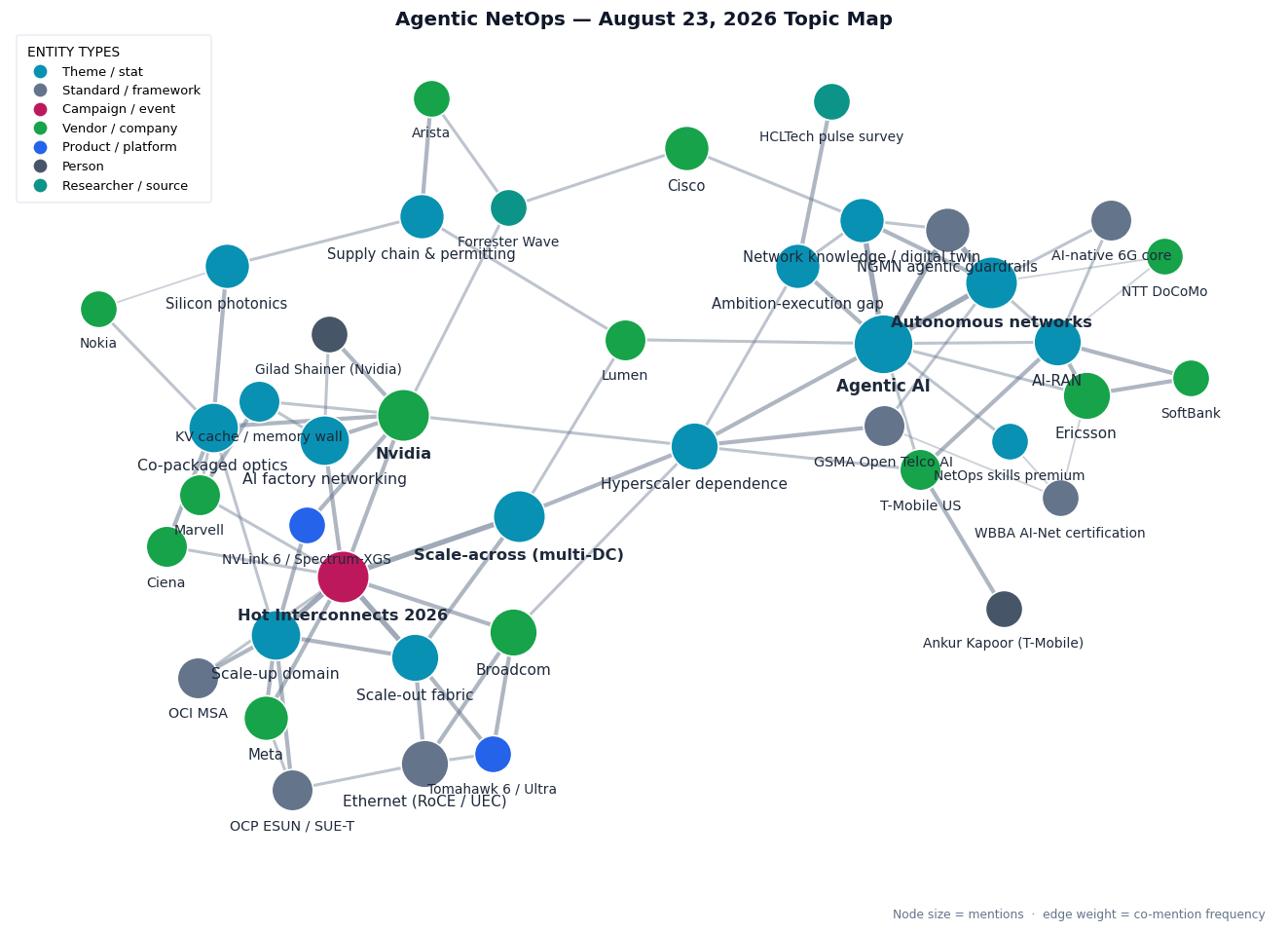
This week’s topic map — NGMN’s agent guardrails and the network-knowledge grounding problem; the hyperscaler-dependence argument running from GSMA Open Telco AI through Broadcom to T-Mobile US; AI-native RAN and the 6G core (Ericsson, SoftBank, NTT DoCoMo); the Hot Interconnects 2026 scale-up / scale-out / scale-across fabric thread (Nvidia, Meta, Broadcom, OCP ESUN, Ethernet); the optics and memory-wall layer (co-packaged optics, Ciena, Marvell, OCI MSA, silicon photonics); and the supply-chain, market-ranking and skills signals around the edges. Node size reflects how often an entity is mentioned; edge weight reflects how often two entities are discussed together.
View interactive topic map →
Article index
Weekly News
Guardrails first: what agentic AI still owes the network
NGMN moves from requirements to mechanics — agent identity, least privilege, auditability — while FNT Software, HCLTech and Cisco all land on the same precondition: the agent is only as good as the network knowledge you can hand it, and most operators cannot hand it much.
Operator AI strategy and the hyperscaler tension
The GSMA tells operators to build their own telecom models; Broadcom reports hyperscalers already routing around carriers on inter-site fibre; AT&T warns the efficiency wins will be competed away; Ericsson makes the edge case again; Nokia and Indosat put capital behind their answers.
AI-native RAN, carrier trials and the road to a 6G core
Ericsson and SoftBank put an AI-native scheduler into a commercial 5G network; T-Mobile US argues distribution is the operator’s real advantage over hyperscalers; DoCoMo doubles down on quantum annealing for signalling; Omdia pours cold water on a clean-sheet AI-native 6G core; Keysight’s order book shows who is testing all of it.
Hot Interconnects 2026: scale-up, scale-out, scale-across
The week’s densest technical thread. Three keynotes and a wall of MSAs converge on one argument — the three fabric domains are becoming a single design problem — while Cerebras, NEC, Forrester, Lumen and Arista supply the market and supply-chain context around it.
| Article |
Source |
Published |
| 17. AI Networking Converges Around Scale Up, Scale Out and Scale Across |
Converge Digest |
Aug 21, 2026 |
| 18. Hot Interconnects: NVIDIA’s Gilad Shainer Maps AI Network Architecture |
Converge Digest |
Aug 20, 2026 |
| 19. Hot Interconnects: Meta’s Omar Baldonado on Scale-Up, Scale-Out, Scale-Across |
Converge Digest |
Aug 20, 2026 |
| 20. Hot Interconnects: Broadcom Maps Ethernet Across AI Fabrics |
Converge Digest |
Aug 19, 2026 |
| 21. Cerebras reimagines AI cluster design with switchless CS-4 architecture |
Network World |
Aug 19, 2026 |
| 22. NEC taps Cornelis to aid AI and HPC networking in Japan |
SDxCentral |
Aug 21, 2026 |
| 23. Forrester challenge to Nvidia’s networking claims by crowning Cisco, Arista, and Huawei |
SDxCentral |
Aug 20, 2026 |
| 24. AI networks face a triple threat: Capacity, permits and supply chains |
Light Reading |
Aug 21, 2026 |
| 25. Arista Networks calls time on server line due to supply chain pressures |
SDxCentral |
Aug 19, 2026 |
Optics, photonics and the memory wall
Copper has run out of reach and DRAM has run out of capacity. Ciena maps the post-DAC roadmap, the OCI MSA standardises optical scale-up, Marvell disaggregates KV cache over fibre, and the silicon-photonics forecasts — and their geopolitics — catch up.
NetOps skills, pay and certification
Two data points on where the profession is going: Foote Partners prices design judgement at a 20% cash premium as automation eats routine operations, and the WBBA starts grading whole countries and carriers on whether their IP networks are AI-ready.
Foundational Reading
The tooling layer: domain models, better abstractions, AI-native clouds
Cisco is about to publish a model that claims to read routing and switching configs better than a frontier model; Bruce Davie explains why bolting an API onto a box was never the answer; and CoreWeave makes the purpose-built case against general-purpose cloud.
Reality checks: where AI-RAN actually lands, and where the switch demand goes
Two useful correctives to the hype curve — Jamie Davies on why GPU-heavy AI-RAN will be selective rather than universal, and Dell’Oro on inference and agentic workloads pulling front-end switch demand in a direction training never did.
Detailed write-ups
1. NGMN gets specific: agent identity, least privilege, auditability — and the grounding problem underneath
Fierce Network · The Fast Mode · August 21, 2026
Last week’s NGMN Phase III publication read as a list of things the industry has not built. This week’s coverage gets to the mechanics, and they are recognisably NetOps mechanics rather than AI ones. Project lead Johann Reindl and co-lead Guenter Klas argue that commercial adoption of agentic AI “will depend less on individual AI models and more on reliable support systems” — and the support systems they name are the ones any engineer who has run a change-control process will recognise. Every agent needs an identity. Every agent needs least-privilege access scoped to the devices, domains and APIs it is actually allowed to touch. Every action needs to be auditable after the fact. None of that is novel security thinking; what is new is that it now has to apply to a non-deterministic actor operating at machine speed against a live production network, and that most operators’ existing RBAC and change-audit machinery was built on the assumption that the thing making the change is a human with a login.
Two details in the report deserve more attention than they will get. The first is asymmetric autonomy maturity: NGMN observes that operators will reach Level 4 at very different times, and that this unevenness will surface in service assurance and in enterprise network slices that cross carrier boundaries. Basic roaming should survive it. An SLA-backed slice handed between an operator running closed-loop agentic remediation and one still running a ticket queue almost certainly will not, and nobody has written the interconnect semantics for that mismatch. The second is architectural and quietly practical: NGMN positions graph neural networks as complements to LLMs rather than replacements — the right tool for topology, dependency and impact reasoning — and notes they bill through conventional cloud compute metrics rather than token consumption. If you are building a cost model for agentic assurance, that distinction matters, because the parts of the workload that scale with network size are the parts that do not scale with token prices.
FNT Software’s Daria Batrakova, a twenty-year OSS integration veteran, wrote the practitioner’s version of the same argument and gave it a name: the grounding problem. “Agentic AI can only make decisions based on the network and infrastructure knowledge available to it,” she writes, and her worked example is the one that should worry anyone running diverse-path services — a service delivery agent recommending a circuit path while unaware that a fibre segment was rerouted during emergency maintenance, and therefore confidently asserting redundancy that no longer exists. Confidence is not accuracy. Her prescription is a governed network digital twin rather than another inventory database: a layer that maintains validated relationships across the physical and logical stack and, critically, keeps planned, implemented and current state distinct from one another, because agents that cannot tell those apart will act on intent as though it were reality. She also points at the regulatory tailwind — NIS2, DORA, the EU AI Act and North American continuous-monitoring rules all raise the value of documentation you can actually defend. Cisco and Auvik shipped the modest, buyable version of that thesis the same week: automated multi-vendor discovery, real-time inventory, configuration snapshots and API access to operational data across Cisco, Meraki and third-party estates, under the plainest headline of the week — AI-ready operations start with knowing your network.
Sources: Fierce Network (NGMN on agentic guardrails) · The Fast Mode (agentic AI and network knowledge) · Cisco Blogs (Cisco and Auvik on network modernization)
2. Who owns telecom’s AI? The GSMA says build it; Broadcom says the hyperscalers already went around you
Fierce Network · RCR Wireless · August 17–21, 2026
GSMA director of AI technologies Louis Powell spent the week making an argument operators have been avoiding: the frontier models everyone is renting do not know telecom. “We saw a gap between what these models were capable of in general areas and what was happening in telecoms,” he said, and the deployment data backs the concern — only 16% of telecom AI deployments target network operations at all, with the rest clustered in customer care and back office where general-purpose models happen to work. The GSMA’s answer, Open Telco AI, launched at MWC Barcelona 2026, pools the things no single operator can build alone: telecom-specific benchmarks, shared datasets, purpose-built open models and GPU capacity, with Huawei contributing its TeleLogs open dataset for root-cause-analysis training and Hugging Face as the distribution surface. Powell’s structural worry is narrower than sovereignty rhetoric usually is — the “supply chain of AI is very narrow,” and an industry that outsources the model layer to three vendors has outsourced its own network intelligence. Operators appear to agree in principle: an Nvidia survey has 89% of telcos now calling open-source models important to their AI strategy against 40% planning to use open-source tooling a year earlier, with 42% planning in-house development and 38% planning co-development.
Broadcom supplied the awkward counter-evidence on the same day. VP of products Hasan Siraj, who runs routing, switching, high-performance NICs and open networking software, told Fierce that hyperscalers increasingly own the fibre between their GPU sites outright rather than buying it from a carrier — “they are owning that connectivity,” and they will use a provider only “if they need” one. That is the scale-across market, and the physics are unforgiving: a 10 MW building holds roughly 7,000 XPUs, inter-site distances run from tens of kilometres to about 100, and Siraj’s rule of thumb is that the network wants to be in place three to six months before the compute arrives. Read against the GSMA’s argument, the two stories describe the same squeeze from opposite ends — carriers are being told to build their own intelligence at the same moment their biggest prospective AI customers are deciding they can lay their own glass. AT&T CEO John Stankey made the third leg of the argument bluntly: AT&T is getting strong returns from AI in software development, engineering, customer service and pricing, but expects those gains to be “competed away” as everyone buys the same tools. “The things that we do that really give us strategic advantage… are the ones that maybe we get to keep.” AWS telecom CTO Ishwar Parulkar named the hard part of keeping them — teaching agents to contextualise wireless network data, a problem specific to this industry and not solved by any customer-service copilot — and pointed at AWS Context, due December 2026, as the semantic-layer play.
The capital allocation this week tells you who believes what. Ericsson Americas chief strategy and technology officer Joe Constantine reopened the edge case with an honest post-mortem: MEC failed in the 2010s because “MEC was a supply side concept” with no demand behind it, and inference is the demand that was missing. His numbers — global mobile traffic tripling between 2023 and 2029, uplink growing 10x by 2035, 5G capable of 15 ms latency at five nines — point at physical AI, robotics, drones and autonomous vehicles, where “routing all this traffic to a centralized cloud isn’t just slow, it’s economically not sustainable” and autonomous systems need networks to “think with” them. Nokia is making the harder version of the same bet: closing its Hangzhou R&D centre, cutting 1,600 jobs and shutting nearly all mainland China operations by the end of 2026 under CEO Justin Hotard, while AI and cloud sales hit €446 million, up 105% year on year and now 9% of quarterly revenue, and optical networks grew 20%. And Indosat Ooredoo Hutchison showed the sovereign-AI route with an Nvidia AI Technology Center at Universitas Gadjah Mada in Yogyakarta, fronted by its GPU Merdeka sovereign GPU-as-a-service offering, alongside a roughly $2 billion Citigroup-arranged financing for AI data centre silicon — with AI-RAN positioned as the connective tissue between centralised AI factories and edge inference.
Sources: Fierce Network (GSMA on hyperscaler dependence) · Fierce Network (Broadcom on scale-across) · Fierce Network (ROI is not enough) · Fierce Network (Ericsson on the telco edge) · Fierce Network (Nokia’s China retreat) · RCR Wireless (Indosat and Nvidia AI center)
3. Hot Interconnects 2026: three fabric domains, one design problem
Converge Digest · August 19–21, 2026
IEEE Hot Interconnects 2026 ran virtually from 19 to 21 August with more than 1,500 registrations, over 1,000 live attendees and a record-low 23.7% paper acceptance rate across nine accepted papers — and the organising committee, via vice chair David Ozog, framed the whole event around a single observation: the boundaries between scale-up (inside the accelerator domain), scale-out (across a facility) and scale-across (between buildings and sites) are dissolving, and the engineering concepts are increasingly shared. All three keynotes independently confirmed it. Nvidia’s Gilad Shainer, SVP of networking, made the architectural claim most directly: “An AI factory has to operate as a single computing system supported by multiple purpose-built network infrastructures,” and mapped four tiers onto it — NVLink 6 for scale-up at 3.6 TB/s of all-to-all bandwidth per GPU with 130 TFLOPS of in-network compute; Spectrum-X Ethernet for scale-out with adaptive routing, telemetry-driven congestion control and a SuperNIC that reorders packets so the switch does not have to, targeting at least 95% effective bandwidth; Spectrum-XGS for scale-across; and BlueField-4 for networking, security, telemetry and storage services. His underlying argument is a power argument: optical networking is now roughly 10% of compute power in large systems, so co-packaged optics — in production for Spectrum-X switches using silicon-photonic microring modulators and TSMC COUPE packaging, claiming 5x lower optical-network power, 4x fewer lasers and 10x higher MTBI — is how you buy back token throughput inside a fixed facility power envelope.
Meta’s Omar Baldonado, senior director of networking, gave the operator’s version and the most quotable line of the week: at gigawatt scale, networking “can no longer be designed independently from compute, power, cooling, storage, job scheduling, or even data center site selection.” His scaling ladder is the concrete evidence — from 24,000–32,000-GPU training clusters, through a 129,000-GPU system, to Prometheus at 1 GW spread across multiple buildings and Hyperion designed to reach 5 GW — and Meta is deliberately heterogeneous across Nvidia GB200/GB300-class systems, AMD MI450-based systems and its own MTIA accelerators, which is precisely why it is pushing open scale-up standards rather than a single vendor’s fabric. OCP’s ESUN (Ethernet for Scale-Up Networking) went from 12 founding companies to more than 175 participating organisations since its 1.0 specification in March 2026, and Baldonado sketched scale-up domains exceeding 1,000 GPU packages beyond 2028, with ZR optics carrying scale-across. Broadcom’s Mohan Kalkunte, VP of architecture and technology, then argued all three domains can be Ethernet: Tomahawk Ultra with 512 lanes of 100G PAM4 plus OCP’s SUE-T and ESUN for scale-up; Tomahawk 6 at 102.4 Tbps, enough for a 128,000-XPU network in two switching tiers, for scale-out; Multipath Reliable Connection extending RoCE with packet spraying, out-of-order delivery, SRv6 path management, selective retransmission and packet trimming; Thor Ultra 800G NICs at the endpoint; and Jericho-class deep-buffer boxes for scale-across. His summary is the sentence to take to a design review: “the critical question is no longer simply how fast an individual accelerator can operate, but how effectively thousands of accelerators can be interconnected.”
Two counter-currents are worth holding alongside it. Cerebras unveiled the CS-4, a rack-scale system that removes the switch entirely: Direct Wafer Links cut wafer-to-wafer latency to roughly two microseconds, the system carries 7.2 Tbps of I/O, and the company claims twice the CS-3’s speed, up to 10x better throughput-per-watt and 30x faster per-user inference on GPT-OSS-120B against GPU clusters. Counterpoint’s Neil Shah put the networking implication plainly — “you eliminate a huge, complex layer of networking hardware that typically eats up a big chunk of an AI cluster’s budget and up to a third of its electricity” — while TechInsights’ Manish Rawat supplied the caveat that external connectivity, storage, orchestration and heterogeneous compute still need conventional networking. And in Japan, NEC expanded its partnership with Cornelis Networks to bring the 400 Gb/s CN5000 Omni-Path platform and the forthcoming Ultra Ethernet-compliant 800 Gb/s CN6000 to Japanese AI and HPC customers — with Cornelis CEO Lisa Spelman conceding the direction of travel: “the industry is attracted to what Ethernet represents for the long haul, which is industry standards that multiple people can build on top.”
Sources: Converge Digest (AI networking converges) · Converge Digest (Nvidia’s Gilad Shainer) · Converge Digest (Meta’s Omar Baldonado) · Converge Digest (Broadcom maps Ethernet across AI fabrics) · Network World (Cerebras switchless CS-4) · SDxCentral (NEC and Cornelis in Japan)
4. Copper ran out of reach, DRAM ran out of room: the optical scale-up year begins
Converge Digest · SDxCentral · August 18–21, 2026
The optics track at Hot Interconnects was where the abstractions became dates. Ciena’s Bilal Riaz, senior director of product line management and head of interconnect strategy, laid out a roadmap that assumes no single technology wins: the 6.4T Vesta 200 CPX optical engine supporting 102.4T switch ASICs today, the same 6.4T building block reaching 204.8 Tbps with external lasers, 448G SerDes arriving 2028–2029, and a Nitro 2004 linear redriver keeping 200G-per-lane active copper alive out to about four metres at 1.5 pJ/bit. Co-packaged optics is “ramping this year”; the Open CPX MSA, launched March 2026, is close to finishing v1 for socketed optical engines; co-packaged copper is emerging to bypass PCB traces; and direct-to-plug liquid cooling with integrated cold plates is arriving alongside. Riaz’s framing is the useful one for anyone specifying a 2028 fabric: “the future of AI interconnects will be defined less by a single winning technology than by how effectively we combine the right technologies across distance, power, density, and scale.” His date to circle is optical scale-up deployment beginning 2027.
The standard behind that date got its own session. The OCI MSA — Optical Compute Interconnect, founded in March 2026 by AMD, Broadcom, Meta, Microsoft, Nvidia and OpenAI — exists to take copper out of the scale-up domain so that system size is bounded by switch radix rather than by cable reach. Gen1 is 200 Gbps using four 50 Gbps NRZ wavelengths over DWDM, bidirectional on a single fibre with separate transmit and receive wavelength groups; Gen2 targets 400 Gbps in 2027 and Gen3 800 Gbps in “202x”. The design priorities are power, latency and cost rather than headline bandwidth, and the whole point is a common PHY so accelerator and switch suppliers from different vendors interoperate without proprietary lock-in. Meta’s Drew Alduino gave the presentation its best line and its correct posture: “we don’t deploy innovation, we deploy products.”
Then Marvell attacked the other wall. Its Photonic Fabric Memory Appliance, presented by senior director of product management Ravi Mahatme, pools up to 32 TB of DDR5 plus 1 TB of HBM3e across 16 AI servers over optics — 72 GB of HBM3e and eight DDR5 DIMMs per module, 7.2 Tbps of optical bandwidth per module, roughly 300 ns average latency through the PF-NIC over a metre of fibre and about 230 ns through the PF-chiplet, qualified to 50 metres with 25–30 metres recommended for memory work. In pre-silicon simulation on Llama-405B it held time-to-first-token close to flat through 300 concurrent conversations at an 82% KV cache hit rate, a claimed 6x concurrency improvement over a conventional 2 TB CPU DRAM configuration. The results are simulated, not measured, and should be read that way — but the direction is the story: disaggregated, optically attached memory is now a fabric design decision, and it arrived at Marvell via the Celestial AI acquisition that closed on 2 February 2026. Two supporting data points close the loop. China Insights Consultancy projects silicon photonic revenue growing 23x between 2024 and 2030 against $4.7 trillion of global AI capex over 2026–2030, with laser chips compounding at 44.1% to $22.9 billion and silicon photonics taking 63.7% share — a forecast produced for a Huawei-backed Chinese laser vendor at exactly the moment integrated photonics is designated a technology of concern in the US National Security Science and Technology Strategy, so treat the supply chain as a live risk rather than a footnote. And Credo is forming the Lightweight Serial Interconnect workstream inside OCP, pairing 112 Gb/s short-reach chip-to-chip SerDes with Arm’s AXI protocol, with VP of product Vishal Shah claiming up to 25x greater memory density and 5% more bandwidth than HBM4 for chiplet-attached LPDDR5X.
Sources: Converge Digest (Ciena on CPO and 448G) · Converge Digest (OCI MSA optical scale-up) · Converge Digest (Marvell shared optical memory) · SDxCentral (23x silicon photonic growth) · SDxCentral (Credo and OCP open chiplet interconnects)
5. AI-native RAN gets a commercial scoreboard — and Omdia pours cold water on the clean-sheet 6G core
SDxCentral · Light Reading · RCR Wireless · August 19–21, 2026
The most concrete radio result of the week came from Japan. SoftBank and Ericsson ran what they describe as Japan’s first trial of an AI-native link adaptation scheduler inside a commercial 5G network — a model running on the baseband that ingests live performance parameters and retunes link configuration in real time, aimed squarely at cell-edge users and unstable radio conditions. The measured results are unusually specific for a vendor trial: up to 25% better spectral efficiency, up to 50% higher downlink user throughput against legacy scheduling, and at least 10% improvement across every measured parameter at every trial location. That last figure is arguably the important one, because it is the consistency claim rather than the peak claim, and consistency is what determines whether a feature ships estate-wide or stays in a lab. It also lands in a competitive field: Ericsson ran a comparable trial with T-Mobile US earlier in 2026, and Samsung ran one with NTT DoCoMo.
T-Mobile US chief network officer Ankur Kapoor used the week to stake out a different claim about where operators win. His answer is topology: T-Mobile’s network is “four- to five-times more distributed than any of the hyperscalers,” with roughly 100-plus locations against something like 22 to 25 for a hyperscaler region footprint, and his position on the rivalry is deliberately non-confrontational — “we’re not competing with hyperscalers.” What the operator has that the cloud does not is context: “the network actually adapts based on actual usage of people, phones, and signals,” with link adaptation adjusting every two milliseconds, and “nothing in the physical AI space is going to work without context.” The proof point he offers is operational rather than architectural — during a recent storm recovery, AI-driven network adaptation reconnected over 95% of affected customers within the first six hours. T-Mobile is working with Ericsson on AI-RAN, runs an AI-RAN Alliance test facility in Bellevue, Washington, and plans a commercial AI-RAN field trial by the end of 2026. Meanwhile NTT DoCoMo expanded its quantum-annealing work with D-Wave into a second production application, optimising tracking-area configuration across 333 base stations, three tracking area lists and nine tracking areas in about five minutes — cutting location-registration signalling by more than 65% at daily peak while also reducing paging signals by 7%. Senior manager Hiroshi Kawakami notes the application “balances two competing network requirements,” which is exactly the class of multi-objective problem that defeats hand-tuned heuristics; the first DoCoMo/D-Wave application had already collapsed a 27-hour test cycle to 40 seconds.
Omdia’s Ruth Brown and Gabriel Brown supplied the strategic brake. Three themes are shaping 6G core design — standalone from day one, AI-native with a dedicated “AI domain” or AI plane where network functions embed orchestrated agents in something resembling a hyperscaler agent fabric or TM Forum ODA, and service-aware operation where devices signal intent rather than requesting bearers. Their conclusion is that the first commercial 6G cores around 2030 will nonetheless run on evolved 5G foundations, because neither the supplier ecosystem nor operator finances can deliver a clean-sheet AI-native core on that timescale. Their analogy is apt and slightly uncomfortable: building EVs on combustion platforms “works, but the EV native design will ultimately win.” For planning purposes that means the AI plane is something you retrofit into a 5G SA core, not something you wait for. The money confirms the volume of work involved — Keysight posted Q3 FY2026 revenue of $1.846 billion, up 36%, on orders of $2.91 billion, up 56%, with Commercial Communications passing $1 billion in a quarter for the first time; communications solutions president Kailash Narayanan says “higher data rates and lower latency are shrinking design margins” to the point that customers must “test in production” rather than trust design validation, across 800G to 1.6T to 3.2T transitions, chiplets, silicon photonics and AI-RAN.
Sources: SDxCentral (Ericsson and SoftBank AI-native scheduler) · SDxCentral (T-Mobile US network chief) · SDxCentral (NTT DoCoMo and D-Wave) · Light Reading (AI-native 6G cores on 5G foundations) · RCR Wireless (Keysight test demand)
6. Permits, DDR4 and a Wave report: the constraints nobody put in the architecture diagram
Light Reading · SDxCentral · August 19–21, 2026
Light Reading’s policy panel produced the most useful non-technical networking story of the week, because it names the three things that will actually gate AI buildouts: capacity, permits and supply chains. Lumen chief public policy officer Melissa Mann put the second one squarely in engineering territory — “it’s not just an engineering question. It’s really a policy question” — and followed it with the operational version: “if we’re actually going to do this and double our fiber capacity across the industry, we’ve got to fix permitting.” Lumen’s own numbers frame the scale: from 17 million fibre miles in 2025 to a planned 58 million by 2031, with as much as 50% of its internet traffic already driven by autonomous agents and 90% of its customers using multiple AI and cloud providers, which is why programmability rather than raw capacity is now the differentiator (and why it bought Alkira). Mann’s third point is the one to put in front of application owners: “latency is no longer a preference. There’s a floor on latency for many of these use cases.” AT&T’s Giulia McHenry reported 15% overall traffic growth since 2023, CableLabs’ Mark Walker and Public Knowledge’s Harold Feld covered the reform mechanics — shot clocks, cost-based fees — and the panel noted CPE costs rising on memory shortages while the FCC router ban complicates compliance for equipment makers. Cisco’s forecast of AI network traffic tripling within three years is the demand curve all of that has to absorb.
The memory squeeze is not confined to CPE. Arista discontinued its DCA-AGNI-100 appliance on 18 August, closing sales immediately, because the Dell PowerEdge R450 underneath it depends on DDR4 and third-generation Intel Xeon Scalable processors that Intel discontinued in January 2026. The replacement AGNI-200 moves to a Dell R470 with Xeon 6 and DDR5, and the support runway is long — new service contracts until August 2027, bug fixes to August 2029, renewals to 2030, full end-of-life in 2031 — but the lesson for anyone running network access control is that the control plane for your NAC is a commodity server subject to the same component cycle as everything else. CEO Jayshree Ullal described “solid progress” on a “tight” supply chain, and COO Todd Nightingale said the company has secured multi-year agreements giving visibility “well into 2027 across DDR4, DDR5, and NAND memory” — in the same period Arista passed $3 billion in quarterly revenue for the first time. Plan refresh cycles on component availability, not on feature roadmaps.
Finally, a market correction worth handing to anyone repeating vendor marketing. Forrester’s new Wave on data centre network solutions names Cisco, Arista and Huawei as leaders — Cisco on market share, security and a unified Nexus Dashboard (with customer notes on stability and maturity), Arista on AI innovation and an EOS operating system customers praise for “simplicity, automation, and reliability,” Huawei on “strong, engineering-led innovation” and emerging-market scale. Nvidia, which has publicly called itself the largest networking company in the world, lands as a contender: strongest-in-class AI infrastructure capability, but an AI-focused niche that “leaves gaps in its vision and roadmap” for hybrid cloud, edge networking and zero trust, with weak management and deployment tooling. HPE is a strong performer on the back of the Juniper integration, Nokia likewise; Extreme, Dell and ZTE sit as contenders. None of that means Nvidia’s fabric is the wrong choice for a training cluster — it means the AI fabric and the enterprise data centre network are still two different procurements, and conflating them is how you end up with a great GPU network and no coherent operations story.
Sources: Light Reading (capacity, permits and supply chains) · SDxCentral (Arista ends server line) · SDxCentral (Forrester Wave on data centre networking)
7. The execution gap, the pay packet and the certificate
RCR Wireless · Network World · Telecoms.com · Fierce Network · August 18–21, 2026
HCLTech and Mobile World Live put a number on the distance between the slide deck and the network. In their 2026 telecom AI pulse survey, 60% of telecom leaders see AI as a driver of future revenue while only 25% believe they can operationalise it at scale — a 35-point execution gap, against GSMA Intelligence’s estimate of $400 billion in enterprise value on the table. The barriers are the ones this bulletin keeps returning to: legacy technology and ageing networks, fragmented BSS/OSS creating data silos, shortages of AI/ML specialists, data engineers and cloud architects, and change-resistant culture — 49% describe their internal transformation culture as merely “moderate,” 49% name slow product and service innovation as the primary barrier, 80% launch fewer than five new digital products a year, and 20% have made no significant digital platform investment at all. The measurement problem is the sharpest finding: 91% of organisations believe their AI investments deliver results, but only 33% can measure the business value, and The Economist’s July 2026 TMT work expects 43% of major AI initiatives across industries to fail. If you cannot measure it, you cannot defend it in next year’s budget round, and an agentic programme with no measured baseline is an automation pilot waiting to be cancelled.
Against that, the labour market is unusually legible about where value is moving. Foote Partners, sampling 1,417 certified and non-certified IT skills across 5,137 US and Canadian employers, measures a 20% average cash premium for network architecture skills — against roughly 9% for 752 non-certified skills generally — with Cisco’s CCDE carrying an 11% premium after a 50% jump in market value, and routing skills up 16.7% in a year. Chief analyst David Foote is precise about what is being bought: “employers aren’t paying 20% extra merely for networking knowledge. They are paying for the ability to make expensive, enterprise-wide design decisions correctly.” His summary of the barbell — “automation isn’t eliminating networking so much as shifting where the economic value lies within it” — is the clearest career signal in this issue, and it is consistent with everything above: agents are absorbing the ticket queue while the blast-radius decisions climb the stack.
Two institutional responses close the loop. The World Broadband Association launched AI-Net at the Asia-Pacific Broadband Development Summit in Bangkok on 15 July 2026, a certification scheme grading countries and operators on IP-network readiness for AI: 400GE-and-above backbone links, IPv6 and SRv6 adoption, network slicing, service-level monitoring and multi-site redundancy. Director general Martin Creaner frames it as aligning the industry on “shared standards” for what an AI-capable network actually means — a reasonable ambition given how loosely the phrase is currently used in RFPs. Indonesia is the first certified country on the back of its Net5.5G roadmap, with carrier XLSmart named the first AI-Net Champion. The traffic data behind the scheme is the part NetOps teams should note: Ericsson found uplink growing faster than downlink at 43 of 55 service providers measured in 2025, growing 1.5x faster at 17 of them, with AI potentially pushing uplink volumes to three times 2025 levels by 2031 and the GSMA expecting the uplink-to-downlink ratio to narrow from roughly 1:9 today to between 1:3 and 1:6 by 2030. Networks dimensioned on a 1:9 assumption have a capacity plan with an expiry date. Meanwhile Lightyear showed what agentic AI looks like when it is aimed at the procurement side of NetOps rather than the control plane: a Quoting Agent returning bids 30–50% faster with 15–25% more qualified bids, an Implementation Agent cutting installation time by five to ten days, and customers assembling circuit inventory reports in a median of one minute using two prompts — trained on more than two million quotes across 1,200 carriers since 2019, with about 400 enterprise customers and $65 million raised. CEO Dennis Thankachan‘s pitch is a fair description of the gap: “when it comes to buying, managing vendors, making vendor decisions — there’s actually nothing that exists for the enterprise.”
Sources: RCR Wireless (HCLTech telecom AI pulse survey) · Network World (network architecture pay) · Telecoms.com (WBBA AI-Net certification) · Fierce Network (Lightyear agentic procurement platform)
Foundational reading
Domain models, better abstractions, and two reality checks
The Register · SDxCentral · Telecoms.com · Light Reading · July 28 – August 13, 2026
Five pieces that set up this week’s arguments. Cisco’s forthcoming networking models are the vendor bet on exactly the gap the GSMA describes: DJ Sampath, SVP and GM of Cisco’s AI software and platform business, says the model “understands routing and switching configs” and “solves network problems better than a frontier model,” and it will be published on Hugging Face alongside the Antares security models. It arrives with Cloud Control, an agentic operations tool that queries across Cisco products to diagnose issues — cross-referencing security policy against AP configuration to explain a Wi-Fi failure, for instance — and, notably for change management, gives a “blast radius” explanation before a reboot. US availability was set for end of August 2026, with Europe and Asia-Pacific following, included in existing subscriptions with token pricing still being worked out, and an on-premises option. Set against it, Bruce Davie’s column on why an API is not an abstraction is the sceptic’s foundation text and the most useful thing here for architects. Davie tried to put a programmatic API on Cisco routers in the late 1990s and watched it fail because every new CLI feature became extra work for the API; he points at NAPALM — supporting five vendor operating systems, three of them Cisco’s — as evidence of “breathtaking inconsistency of features across devices” even within one vendor. His conclusion, by way of Scott Shenker and his own move to Nicira in 2011, is that what the industry needed was “better abstractions for networks, not just different interfaces.” Any agentic tool built on per-device APIs inherits that inconsistency; the ones built on a consistent model of the network do not.
On the infrastructure side, the rise of AI-native clouds explains why the fabric conversation is diverging from the general-purpose cloud one: CoreWeave EVP Chen Goldberg and SVP Corey Sanders argue that storage, caching and throughput tuned for one workload class beat breadth, with Sanders noting it is “trickier to deliver a very specific AI solution focused on storage, caching, and throughput if you need to support a wide range of different services” — a thesis Gartner endorsed by placing CoreWeave as a top visionary in its debut Magic Quadrant for cloud AI infrastructure in mid-July 2026. Then two correctives. Jamie Davies argues AI will be everywhere but AI-RAN will not, and his three-way split is the cleanest taxonomy available: “AI for RAN” (optimising coverage, capacity and energy on existing CPU and software), “AI and RAN” (radio and AI workloads sharing GPU infrastructure) and “AI on RAN” (edge applications such as video analytics). His verdict — “AI techniques everywhere, GPU-heavy AI-RAN in selected locations” — with Disruptive Analysis’ Dean Bubley reminding everyone that “mobile networks are never homogenous,” is the Massive MIMO precedent applied to GPUs: sound technology, selective deployment. Finally, Dell’Oro’s front-end network forecast quantifies where agentic workloads actually land in the switch market: more than half of front-end data centre switch sales growth over the coming years will come from AI, with roughly 40% CAGR in new AI pull-through, accelerating 800 Gbps and 1.6 Tbps adoption — and, importantly, driven by inference and agentic traffic whose network requirements differ from training. Accton, Arista, Celestica, Cisco, HPE/Juniper, H3C, Huawei and Nvidia are named as the beneficiaries.
Sources: The Register (Cisco networking AI models) · The Register (APIs are not abstractions) · SDxCentral (AI-native clouds) · Telecoms.com (AI will be everywhere, AI-RAN won’t) · Light Reading (Dell’Oro on front-end networks)
Calls to action & watch list
- Give your agents identities this quarter. NGMN’s mechanics — per-agent identity, least-privilege scoping to specific devices and APIs, and an audit trail of every action — are things your existing IAM and change-audit stack can start on now, before any agent gets write access. If an agent currently acts under a shared service account, that is the first ticket.
- Test your inventory against the grounding problem. Pick a recent emergency reroute and ask whether your source of truth would let an agent correctly answer “are these two circuits diverse today?” If planned, implemented and current state are not separable in your records, a digital twin is the prerequisite project, not the follow-on one.
- Fix the measurement gap before the model choice. Only a third of organisations can measure the business value of their AI investment. Define the baseline KPI for each agentic use case before deployment; unmeasured automation is the first line item cut when the 43% failure rate arrives at your board.
- Watch asymmetric autonomy at the interconnect. NGMN’s quietest finding is that operators at different autonomy levels will struggle to assure slices and services across each other’s boundaries. If you sell or buy cross-operator enterprise slices, start asking partners where they sit on the autonomy ladder and what their agents are allowed to do unsupervised.
- Dimension for uplink, not downlink. Ericsson measured uplink outgrowing downlink at 43 of 55 operators, and the GSMA expects the ratio to move from roughly 1:9 to somewhere between 1:3 and 1:6 by 2030. Any capacity plan built on a 1:9 assumption needs re-running this planning cycle.
- Put 2027 optical scale-up on the roadmap. Ciena puts optical scale-up deployment at 2027 and 448G SerDes at 2028–2029; the OCI MSA’s Gen1 200 Gbps spec is out with 400G targeted for 2027. If you are specifying a fabric that must live past 2028, the copper-reach assumption is the one to challenge first.
- Treat the network as a three-to-six-month lead item. Broadcom’s Siraj wants the network in place three to six months before the compute lands, and Lumen says permitting is now the binding constraint on fibre. Whichever side of that you sit on, the procurement and permitting clock starts before the GPU order does.
- Requalify your hardware roadmap against the memory cycle. Arista pulled a shipping NAC appliance because of DDR4 and Xeon end-of-life. Ask every vendor with an appliance in your estate which component generation it depends on and when that generation goes end-of-life — not when the product’s own EOL is scheduled.
- Watch whether open telco models get real traction. GSMA Open Telco AI, Huawei’s TeleLogs dataset and Cisco’s forthcoming networking model on Hugging Face are three different answers to the same gap. Whether a credible open network-domain model exists by mid-2027 determines how much leverage hyperscalers have over operator AI roadmaps.
- Point your training budget at design, not operations. A 20% cash premium for network architecture, CCDE up 50% in market value, routing up 16.7% — while routine operations is exactly what agents absorb first. Fund the design and blast-radius judgement your team will still be paid for in 2029.
|