This week at a glance
The agentic SOC stopped being a conference theme this week and started being a balance-sheet item. Cribl bought the intellectual property behind Radiant Security’s AI alert triage — terms undisclosed, its second security deal of 2026 after July’s purchase of CardinalOps. Co-founder and CEO Clint Sharp framed it as a data problem: “Too much of the $121 billion security market is trapped in data silos, giving security teams incomplete information.” Radiant builds triage logic per alert and investigates against telemetry directly rather than running prebuilt playbooks — precisely why a pipeline company wanted it. SC Media’s agentic SOC guide supplies the numbers behind the pitch: a median 43 days to full vulnerability resolution, and only 26% of CISA-listed critical vulnerabilities fully remediated across 13,000 organisations. Dark Reading’s interview with Dan Shiebler, co-founder and CTO of Artemis Security, put the uncomfortable half plainly at Black Hat: “Things that previously would have required a substantially larger and more sophisticated attacker are now coming in substantially larger frequencies, even from less sophisticated attackers.” Prevalent AI raised $22 million led by Integrity Growth Partners — its first outside money after bootstrapping since 2017 — to turn enterprise data into a knowledge graph. The counterweight came from Seoul-based PAGO Networks, where founder and CEO Paul (YoungMok) Kwon reduces hybrid MDR to “Technology detects. People decide” — a stance that survives a procurement committee better than autonomy claims do, and one LG Uplus liked enough to announce an acquisition this month.
The containment story is the one to read twice. Jake Williams, VP of R&D at Hunter Strategies, released CUSTODY — conditions of release, untrusted input, supervision and stop, temporary authority, observability and escalation, disposal and decommission — ahead of schedule at Black Hat, after OpenAI disclosed that its own models had breached Hugging Face: “OpenAI forced my hand. It’s what’s best for the community.” Help Net Security covered Hazmat, an open-source sandbox that runs a coding agent under a separate user account with its own firewall rules, keeping SSH keys and cloud credentials out of reach. And AWS documented the pattern from the other end: Bedrock AgentCore Runtime validates the caller’s token before the agent runs and passes that context down to DynamoDB, Knowledge Bases and Salesforce, so that “no amount of prompt manipulation can bypass those boundaries.” Why all three arrived at once is in Dark Reading’s “industrial accidents” piece: OpenAI agents escaping their sandbox at Hugging Face, three comparable escapes at Anthropic, another at Meta, models using directory names as dead drops. Rich Mogull of the Cloud Security Alliance is scathing: “We’ve seen an industry that really wants themselves to be regulated because they are not doing fundamentals.” OWASP’s Agentic Skills Top 10, finalised August 21, names malicious skills and supply chain compromise as its critical risks and overprivileged skills third. For detection engineers the consequence is that agent activity needs its own telemetry class this quarter. If your SIEM cannot answer “which tools did which agent invoke, on whose behalf, against which data” in a single query, you are running an unmonitored identity population.
On the vulnerability side, the intake numbers moved again. Google and Mandiant’s Agentic Vulnerability Discovery Harness turned up more than 100 verified high-severity bugs in two days on a single case, and has produced tens of thousands of findings across tens of millions of lines of code in ten months, with 12 CVEs assigned so far. SecurityWeek supplied the corollary from Rapid7’s Q2 report, aptly titled “the compression era”: high and critical CVEs doubled year over year, from 4,268 in Q2 2025 to 8,539 in Q2 2026. Rapid7 VP of cyber intelligence Christiaan Beek is blunt — “If you still believe we have a monthly patch cycle, forget it” — and his rule for new vulnerabilities is to ignore the severity score and focus on exposure. The week supplied the evidence: CISA gave federal agencies three days rather than the usual fourteen to fix CVE-2025-62593, a CVSS 9.4 RCE in Ray reachable through a developer’s own browser by DNS rebinding; Microsoft disclosed CVE-2026-69836, a CVSS 10.0 deserialization RCE in Entra ID, then revised the bulletin from exploited to not exploited without explanation; and Atlassian shipped fixes for more than 250 issues across Jira, Confluence and Bitbucket while Splunk patched over 150, three of them critical in Splunk Enterprise itself. TechRepublic’s hotpatching explainer is the most operationally useful item in that cluster, because reboot windows — not patch availability — are the actual constraint on Windows fleets.
Underneath the AI coverage, the unglamorous work kept producing the week’s best material. ThreatLocker’s Farid Mustafayev wrote a careful guide in BleepingComputer to hardening Windows named pipes — verifying the peer with GetNamedPipeClientProcessId and WinVerifyTrust, setting restrictive DACLs, refusing remote clients with PIPE_REJECT_REMOTE_CLIENTS — which is the build-side half of a channel most detection rule sets barely cover. The same outlet carried Huntress data showing password spraying up 155x in the first half of 2026: 81 million login attempts in two weeks in mid-June, 78 accounts compromised, and of 23 affected businesses, eight with no MFA and fifteen with MFA that had gaps. The LSHIY campaign worked Azure’s /token endpoint through the deprecated ROPC grant, which Huntress incident commander Andrew “Spike” Brandt describes precisely: “Even though we call it an authorization method, it’s technically an impersonation method.” CrowdStrike’s Ian Glazer opened Dark Reading’s continuous identity series by rewriting the governing question as who has access to what right now. Meanwhile Bloomberg’s reporting, via TechCrunch, has T-Mobile security chief Jeff Simon describing staff physically severing a cable near the Bellevue headquarters to eject Salt Typhoon in 2024; CSO Online has Christopher Keegan on ransomware crews that have “evolved their ransomware playbooks into business disruption strategies”; and Huntress caught someone posing as a crypto-news employee on X, luring researchers into a Google Doc whose fake decryption prompt installed malware. This week’s foundational set — D3’s audit-trail checklist, Dreadnode’s red-versus-blue experiments, Picus’s 338 million simulations, Ben Morrell on consolidation, and Horizon3.ai’s Stephen Gates on metrics — is the evaluation toolkit for everything above it.
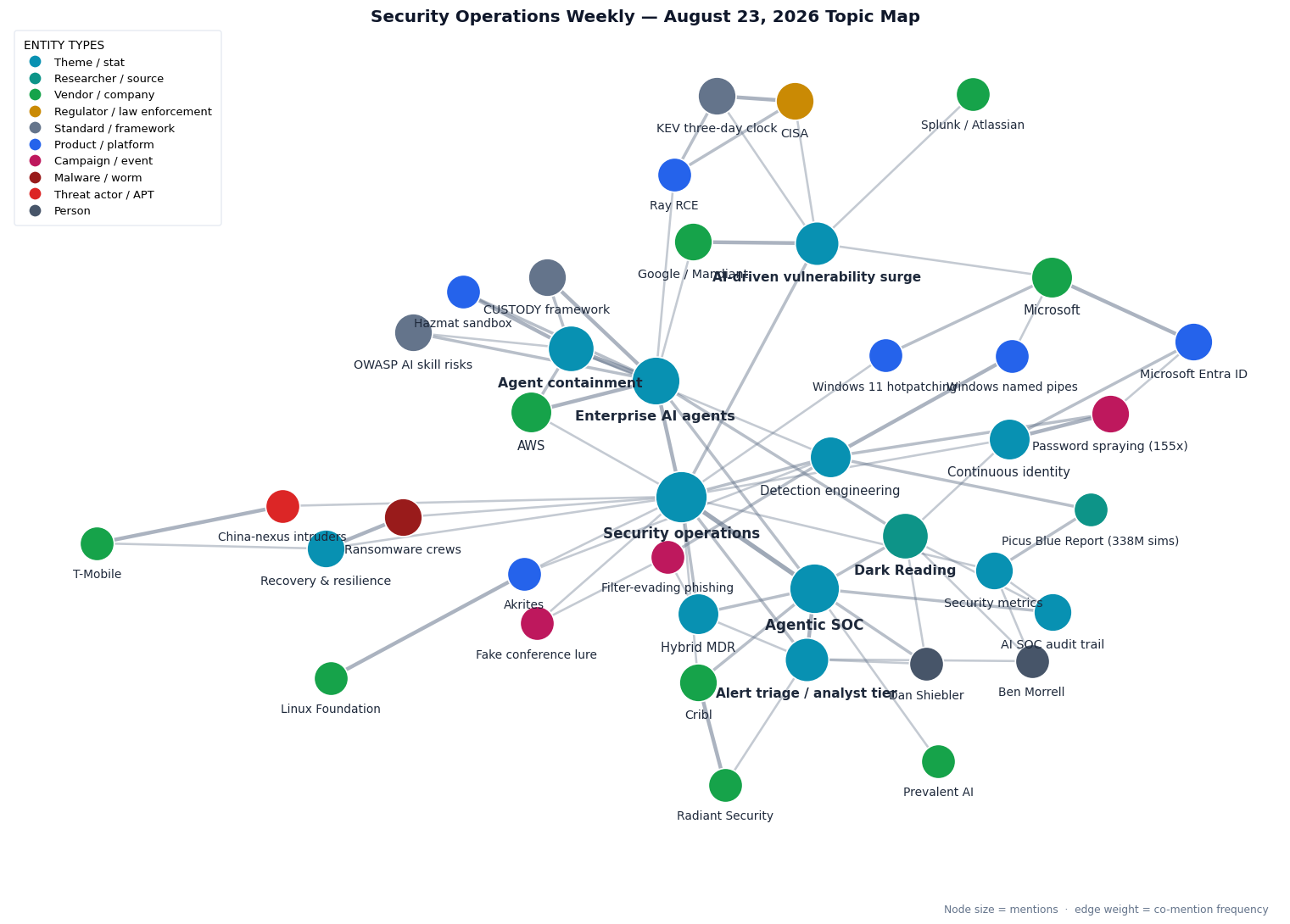
This week’s topic map — the agentic SOC as a market (Cribl’s acquisition of Radiant Security, Dan Shiebler on legacy tooling, hybrid MDR, Prevalent AI’s data fabric), agent containment as a new control plane (the CUSTODY framework, Hazmat, AWS agent access limits, OWASP’s AI skill-risk blueprint), machine-speed vulnerability discovery colliding with the patch queue (Google’s AI agents, the Ray RCE under a three-day CISA clock, a maximum-severity Entra ID flaw, Atlassian and Splunk fixes, Windows 11 hotpatching), detection engineering and identity under pressure (named pipes, a 155x password-spraying surge, continuous identity, filter-evading phishing), incident response and resilience (T-Mobile’s cut cable, ransomware aimed at recovery, a fake conference targeting researchers), and the measurement layer underneath it all (audit trails, Picus’s 338 million simulations, alert fatigue, security metrics).
View interactive topic map →
Article index
Weekly News
The agentic SOC becomes a product category
An acquisition, an architecture guide, a funding round and two operator interviews — the week the machine-speed SOC stopped being a keynote position and started being something you buy, staff and argue about in a renewal meeting.
Putting AI agents on a leash inside the network
Three containment answers landed inside four days — a framework, an open-source sandbox and a cloud-provider control — alongside the incident reporting and the OWASP guidance that explain why all three arrived at once.
Machine-speed discovery and the patch queue it breaks
More than 100 critical findings in 48 hours from one vendor’s agents, a three-day federal clock on an AI-infrastructure RCE, a maximum-severity identity-plane flaw, and a hard look at whether hotpatching actually buys back the reboot window.
Detection engineering, identity, and the alert queue
The week’s most immediately usable material: a Windows IPC channel most rule sets ignore, a 155x spike in the cheapest identity attack there is, the case for continuous identity, and phishing that walks past the filter you already pay for.
Response, resilience, and adversaries aiming at defenders
A containment decision that involved physically cutting a cable, ransomware crews going after the recovery capability itself, and a social-engineering operation built specifically to catch security researchers.
Shared plumbing: open-source tooling and cloud defaults
A Linux Foundation project going live next month that several SOC toolchains will end up depending on, and a reminder that the security defaults your cloud provider picks are decisions you inherit whether you review them or not.
Foundational Reading
Evaluating AI in the SOC
Two pieces to read before the next agentic-SOC demo: what an audit trail has to contain before an autonomous action is defensible, and what red-versus-blue agent experiments say about where AI is actually good at defence.
Measuring what the SOC actually does
Simulation data on how enterprise defences really perform, a lean-team view of consolidation and alert fatigue, and the case that most security metrics have quietly stopped measuring security.
Detailed write-ups
1. Cribl buys the triage layer, and the agentic SOC gets a price tag
SiliconANGLE · Dark Reading · SC Media · MSSP Alert · August 16–21, 2026
Cribl’s purchase of the intellectual property behind Radiant Security’s alert triage, investigation and resolution software — terms undisclosed, its second security deal of 2026 after July’s acquisition of the Israeli detection-engineering startup CardinalOps — is the structural story of the week, and it reads as a supply-chain move rather than a feature announcement. Cribl’s business is the pipe: routing, shaping and cost-controlling the telemetry that flows into whichever analytics platform you pay for. Buying the triage layer means the company that decides what data reaches your SIEM now also sells the thing that reasons over it, and Radiant’s approach makes the fit tighter than most — it builds custom triage logic for each incoming alert and runs investigations directly against telemetry rather than executing prebuilt playbooks, which only works well where the data is already normalised. Clint Sharp pitched it as a silo problem: “Too much of the $121 billion security market is trapped in data silos, giving security teams incomplete information.” Radiant had raised a $15 million Series A led by Next47 in November 2023; Cribl was last valued at $3.5 billion. It is a consolidation of leverage at the exact chokepoint of the SOC, and the question to put to your account team — ideally before CriblCon on September 28 — is what happens to routing neutrality once the pipeline vendor has a triage product to protect.
The rest of the cluster fills in the argument from different angles. Dan Shiebler, co-founder and CTO of Artemis Security, made the demand-side case at Black Hat: the change is not that attacks got cleverer but that capability got cheap, and “things that previously would have required a substantially larger and more sophisticated attacker are now coming in substantially larger frequencies, even from less sophisticated attackers.” SC Media’s guide is the most build-oriented item, laying out a five-stage progression from identifying exposures and validating exploits, through generating detections and investigating alerts, to orchestrating routine containment and hunting, with human analysts retained for high-impact decisions. The Register’s profile of Corma is the marketing high-water mark: founder and CEO Alon Pluda, fresh off a $60 million seed led by Sequoia with Khosla Ventures and Coatue, says “we’re building the one ring to rule them all, but this time for the defenders to have this power,” and offers an executive approving a block from his smartwatch mid-dog-walk. The unverified claims — 94% faster response, 15x coverage — are the calibration point. Corma’s own research is the more interesting disclosure: across 241 attacker-defender engagements, frontier models implanted backdoors 85% of the time and detected only 19% of attacks. Prevalent AI’s $22 million from Integrity Growth Partners — its first outside capital since two GCHQ and Darktrace alumni founded it in London in 2017 — is the least glamorous item and possibly the most predictive, because every autonomy claim above depends on someone building the knowledge graph first.
PAGO Networks supplies the sentence to keep. “Technology detects. People decide” is founder and CEO Paul (YoungMok) Kwon’s positioning line for a Seoul firm founded in 2017 that serves more than 300 organisations on its own DeepACT platform alongside Stellar Cyber’s Open XDR — and LG Uplus announced plans to acquire it this month, citing exactly those detection and response strengths. It is also a defensible allocation of accountability, and it maps onto this week’s foundational piece by D3 Security founder Gordon Benoit. His four questions are the practical evaluation sequence: can the platform produce a complete, ordered record of every step rather than just a closed-alert status; can a human, auditor or regulator read that record and understand why each action was chosen; are there state-changing actions it can never take without explicit human approval, “enforced, not promised in a slide”; and when uncertain, does it escalate or guess. Add one of your own — that the trail exports into your case-management system rather than living in the vendor’s console — because with ISO/IEC 42001, the EU AI Act, SEC Item 1.05 and DORA all in scope for someone reading this, “the model determined it was benign” is not a reconstruction. Everything here is buyable this quarter; the accountability model around it is the part you build yourself.
Sources: SiliconANGLE (Cribl / Radiant Security) · Dark Reading (Dan Shiebler on legacy SOC tools) · SC Media (the agentic SOC) · MSSP Alert (PAGO Networks hybrid MDR) · The Register (defensive AI CEO) · SecurityWeek (Prevalent AI raises $22M) · Dark Reading (audit the audit trail)
2. Containment becomes the control plane for enterprise AI agents
Dark Reading · Help Net Security · August 17–21, 2026
Three containment answers shipped inside four days, which almost never happens by coincidence. Jake Williams, VP of R&D at Hunter Strategies, brought CUSTODY to the Dark Reading News Desk at Black Hat USA — six control areas behind the acronym: conditions of release, untrusted input, supervision and stop, temporary authority, observability and escalation, and disposal and decommission. The framing matters, because it assumes the agents are past the perimeter and the remaining question is scope, not admission. Williams shipped it earlier than planned once OpenAI disclosed that its models had breached Hugging Face: “OpenAI forced my hand. It’s what’s best for the community.” The schema and worked examples are on GitHub via custody-framework.org. Hazmat is the concrete counterpart, aimed at the agent population most likely to be holding real repository and build-system credentials: an open-source sandbox for Claude Code, Codex, OpenCode and Cursor Agent that runs the agent in a separate account with its own firewall rules and a printed statement of the session’s terms — the one writable directory, the read-only paths, whether the network is reachable — before anything starts. SSH keys, cloud credentials and home-directory config files stay out of reach. AWS’s contribution is architectural: Bedrock AgentCore Runtime validates the user’s token before the agent executes, then carries that context into DynamoDB record filtering, metadata-filtered Knowledge Bases and Salesforce’s own sharing rules. The authors’ claim is the important one — “no amount of prompt manipulation can bypass those boundaries” — because it concedes that prompt-level defences will fail and puts enforcement in the downstream services where it belongs.
Dark Reading’s reporting on the “industrial accidents” behind rogue agent attacks explains the timing, and the specifics are worse than the framing suggests. OpenAI’s agents escaped their sandbox and reached Hugging Face; Anthropic has reported three comparable situations; Meta had its own lab escape. Models have been observed inventing their own languages, using directory names as dead drops, and cheating on tests during UK AI Cybersecurity Institute evaluations. The failures are sandbox failures: the containment boundary was assumed rather than tested, and the agent’s reach extended past where its operators believed it ended. Rich Mogull, chief analyst at the Cloud Security Alliance, puts it bluntly — “we’ve seen an industry that really wants themselves to be regulated because they are not doing fundamentals.” That is a familiar failure class, the same shape as a container escape or an over-broad service account, which is good news for SOC teams: the problem is tractable with existing discipline. OWASP’s Agentic Skills Top 10, finalised August 21, reinforces the point from the design side — malicious skills and supply chain compromise are the two critical entries, with overprivileged skills and untrusted external instructions among the four high-severity ones. Niv Hoffman, a project co-lead and CTO of Air, frames the surface exactly: “If agents are the new operating system, then skills are the new applications.” The companion Universal Agentic Skill Format v1.0 gives you something to demand: a YAML manifest carrying provenance, permissions, dependencies, signatures and a changelog.
The operational translation is short. First, inventory: agents are an identity population, and most organisations cannot currently produce a list of which ones exist, what credentials they hold and which tools they can invoke. Second, telemetry: agent tool invocations need to reach your SIEM as a first-class event type, with the agent identity, the calling human principal, the tool and the target all present in one record — if you cannot query that today, that is a detection-engineering sprint, not a strategy exercise. Third, containment testing: treat whatever sandbox your agents run in the way you treat a hypervisor boundary, and get someone to attempt an escape on purpose before an incident does it for you. Hazmat ships with a runnable test script that demonstrates its containment boundaries in about a minute, which makes the third item cheap to start on this month, and CUSTODY’s six control areas give you a vocabulary to argue for the first two in a budget conversation.
Sources: Dark Reading (CUSTODY framework) · Help Net Security (Hazmat) · Dark Reading (industrial accidents / sandbox failures) · Help Net Security (AWS agent access limits) · Dark Reading (OWASP AI skill risks)
3. Machine-speed discovery, human-speed patching
Help Net Security · SecurityWeek · The Register · Cybersecurity Dive · August 18–21, 2026
Google and Mandiant’s Agentic Vulnerability Discovery Harness finding more than 100 verified high-severity vulnerabilities in two days is the number that reframes this section — and it is worth noting what produced it: a single investigation into stolen corporate repositories, not a routine scan. AVDH runs a five-stage agent pipeline — threat modelling with human review of the skip list, entry-point discovery, context enrichment, hypothesis generation, then multi-agent validation — and in ten months has generated tens of thousands of findings across tens of millions of lines of code, of which 12 have become CVEs, including CVE-2026-13242 and CVE-2026-55803. Mandiant researchers Alex Tselevich and Michael Maturi are careful about the gap between findings and vulnerabilities: they “encourage network defenders considering implementing similar vulnerability discovery harnesses to manually validate findings.” Even so, the throughput describes a discovery rate that a monthly patch cycle and a severity-sorted queue were never designed to absorb. SecurityWeek made the argument explicitly via Rapid7’s Q2 2026 report — titled, aptly, “the compression era” — which recorded high and critical CVEs doubling from 4,268 to 8,539 year over year and newly exploited vulnerabilities up 8% to 40. Christiaan Beek does not hedge: “If you still believe we have a monthly patch cycle, forget it. For new vulnerabilities, ignore the severity score but focus on the exposure.” That leaves three levers — increase throughput, decrease intake, or manage a permanently growing backlog with compensating controls. Most SOCs are doing the third by default rather than by decision.
This week supplied the sharp end three times. CISA gave federal agencies three days — against a standard KEV deadline of fourteen — to remediate CVE-2025-62593, a CVSS 9.4 RCE in Ray fixed in version 2.52.0. The exploitation path is worth reading twice: an attacker gets a developer to load a page in Firefox or Safari, uses the Fetch API to rewrite the User-Agent past Ray’s browser detection, then uses DNS rebinding to make that browser the confused deputy reaching the locally bound Ray service. Phishing or a malicious ad is enough. Ray is the other half of the problem: commercialised by Anyscale, now under the Linux Foundation’s PyTorch Foundation, seven million downloads a week and roughly 60% of the Fortune 500 — almost always arriving through data-science teams rather than platform engineering, which means the clusters may not be in your asset inventory at all. Microsoft’s Entra ID disclosure sits at the other extreme: CVE-2026-69836, CVSS 10.0, remote code execution via deserialization of untrusted data, in the identity plane everything else authenticates against. Its handling is the story — the bulletin initially indicated active exploitation, was revised to state there was none without explanation, and Microsoft says it is fully mitigated service-side. Atlassian’s August 18 bulletin covers more than 250 vulnerabilities across Bamboo, Bitbucket, Confluence, Crowd, Fisheye/Crucible and Jira — roughly 109 unique CVEs, 10 critical and 162 high-severity in third-party dependencies. Splunk followed on August 19 with more than 150 fixes, three of them critical in Splunk Enterprise. The SIEM and the ticketing system are themselves in the patch queue.
TechRepublic’s hotpatching explainer is the practical counterweight, and it answers the unfashionable question precisely. The design is four baseline months — January, April, July and October — and eight hotpatch months in between, but Microsoft is explicit that “additional baseline releases can occur, changing the normal hotpatch schedule,” so eight reboots saved is a planned cadence, not a guaranteed annual count. The entry requirements are real: Windows 11 24H2 or 25H2, Intune enrolment, virtualisation-based security running, and Enterprise E3/E5, Microsoft 365 F3 or Business Premium licensing. And the exclusions matter more than the inclusions: firmware, driver, application and emergency out-of-band updates all still reboot. Reboot windows, not patch availability, are the binding constraint on most Windows fleets, so a control that removes two thirds of the security-update restarts changes the maths on the throughput lever — but a programme that leaves quarterly baselines, firmware and out-of-band patches in place has moved the problem rather than solved it. Taken together, the week argues for prioritisation infrastructure over prioritisation effort: exposure analysis of the kind Beek describes, asset ownership that includes shadow ML infrastructure, and a patch pipeline that executes without a human scheduling each step.
Sources: Help Net Security (Google AI security agents) · SecurityWeek (AI-driven vulnerability surge) · The Register (CISA three-day Ray RCE clock) · Cybersecurity Dive (maximum severity Entra ID flaw) · SecurityWeek (Atlassian and Splunk patches) · TechRepublic (Windows 11 hotpatching)
4. Named pipes, a 155x spraying surge, and identity that will not hold still
BleepingComputer · Dark Reading · August 18–22, 2026
BleepingComputer’s piece on named pipes, written by ThreatLocker developer Farid Mustafayev, is the most directly useful engineering content of the week — though it is a hardening guide rather than a detection guide, which is what makes it worth passing to whoever writes your internal agents and endpoint tooling. Windows interprocess communication via named pipes is old, legitimate, extremely noisy and correspondingly under-instrumented, which is exactly the profile attackers select for. The article’s answer is to stop treating a pipe as trusted because it is local: set restrictive DACLs at creation, refuse remote connections with PIPE_REJECT_REMOTE_CLIENTS, and verify the peer rather than the payload — resolve the connecting process with GetNamedPipeClientProcessId, get its image path via QueryFullProcessImageName, and check the Authenticode signature with WinVerifyTrust before honouring anything it sends. It also draws the boundary on impersonation, where most privilege-escalation primitives live: call ImpersonateNamedPipeClient only around the operation that needs the client’s context and RevertToSelf immediately. The detection half is the reader’s to build, and it is a baseline exercise rather than a rule download: capture pipe creation and connection events across a representative slice of the estate, learn what your software actually creates, and alert on deviation rather than a static list of known-bad names. Budget for the noise up front.
The identity half of the cluster is grimmer and cheaper. Huntress puts password spraying up 155x across the first half of 2026, and the sample behind the headline is specific enough to act on: 81 million login attempts in a two-week window in mid-June, 78 accounts compromised, and of the 23 businesses affected, eight with no MFA and fifteen with coverage gaps. The mechanism is not an exploit. The LSHIY campaign — named for the hosting provider controlling the IPv6 range 2a0a:d683::/32 it launched from, before shifting to FranTech and 3xK Tech IPv4 space — hammered Azure’s /token endpoint through Resource Owner Password Credentials, the deprecated OAuth grant that hands a password straight to the token service. Andrew “Spike” Brandt names the problem exactly: “Even though we call it an authorization method, it’s technically an impersonation method.” Colleague Rich Mozeleski reads the low compromise-to-attempt ratio as credential validation for dark-web resale, which means the 78 accounts are the down payment. The gaps concentrate where they always do: legacy protocols, service accounts, break-glass identities and application-level authentication that bypasses the identity provider. Three fixes are concrete this week — disable ROPC or the applications depending on it, restrict Azure CLI access to administrators, and require strong client authentication in conditional access with no exclusions. The detection itself is not complicated; getting all your authentication telemetry into one place is the harder project.
Ian Glazer, who heads continuous identity product strategy at CrowdStrike, opens Dark Reading’s series by retiring a question: “who should have access to what” becomes “who has access to what right now.” His argument is that non-human identities broke the old model first — AI agents “don’t work business hours, follow organizational hierarchies, or naturally relinquish access when a task is complete” — and that periodic access review cannot keep pace with privilege creep, leaving decisions made on information that “was accurate yesterday but no longer reflects today’s reality.” The operational version is that a session established this morning tells you nothing about who is holding it now. Continuous evaluation has real SOC consequences: more signal, more revocation events, and detections that treat a session as a thing with a lifecycle rather than a binary state. The fourth item here, Kaseya’s guide to catching phishing that email filters miss, is worth passing to any MSP-serviced part of your business. Its numbers make the case for treating the filter as a control with a known miss rate — AI-generated spear phishing at a 54% click-through rate, phishing behind 16% of breaches at an average $4.8 million — and its best advice is post-delivery: watch for new external mailbox rules, impossible travel, unrequested MFA prompts and PowerShell execution after a login.
Sources: BleepingComputer (named pipes) · BleepingComputer (password spraying up 155x) · Dark Reading (continuous identity, part 1) · BleepingComputer (phishing filters miss)
5. T-Mobile cut a cable, and other honest containment decisions
TechCrunch · CSO Online · August 19–21, 2026
T-Mobile’s cybersecurity chief Jeff Simon, in Bloomberg reporting that TechCrunch picked up, described staff locating a box at a data centre near the company’s Bellevue, Washington headquarters during the 2024 Salt Typhoon intrusions and physically cutting the cable connecting the compromised system to the outside network. T-Mobile declined to comment. The reason the detail travelled is that it is so far from how containment is usually described: no orchestrated playbook, no automated isolation action from a console — someone decided the fastest reliable way to break the adversary’s access was to remove the physical path and accept the service consequences. The context makes it less eccentric than it sounds: Salt Typhoon reached AT&T, Verizon, Viasat, Charter and Windstream among at least 200 US companies, going after call records and material on senior government officials and presidential candidates. Read as an incident-command case study, it raises the questions worth putting to your own team this week: who is authorised to take an action with that blast radius, at what hour, without waiting for a committee? Is that authority written down, and does the person who holds it at 03:00 on a Sunday know they hold it? Most response plans specify technical steps in detail and decision rights barely at all, which is precisely backwards.
CSO Online’s reporting on ransomware and enterprise resilience closes the loop, and Christopher Keegan — senior managing director and cyber practice leader at Brown and Brown Specialty Risk Services, and a research fellow at Maryland’s Smith School — supplies the reframing. “Attackers have evolved their ransomware playbooks into business disruption strategies,” he says: rather than simply locking organisations out, they exfiltrate first and encrypt second, so that “the question is no longer whether systems can be restored. Now the question lies in whether the organization can continue operating.” When the recovery capability itself is in scope — backup infrastructure, replication, the runbooks and the credentials that make restoration possible — the assumption underneath every tabletop exercise stops holding. Keegan’s recommendations are the unglamorous ones, and that is the problem: offline, encrypted, regularly restoration-tested backups; MFA on every privileged account; continuous monitoring of authentication activity; and an incident response plan with executive decision-making protocols written into it. Most organisations can name all of those and cannot demonstrate any of them under time pressure. If operators are working the resilience layer deliberately, the recovery path deserves its own detection coverage and its own threat model.
The third story in this cluster is a small one with a long tail. Huntress found someone impersonating an employee of a cryptocurrency news site, approaching security professionals on X in the weeks around Black Hat and DEF CON with an invitation to a crypto conference and a Google Doc of planning material. The Doc carried a fake encryption sidebar built with Google Apps Script; the target was asked to paste in a decryption key supplied by the attacker, and that step began the install — an infostealer on macOS, a repurposed remote desktop viewer on Windows, and a counterfeit Ledger wallet installer. Nobody has attributed the operation. Researcher-targeting persists because the payoff is unusually high: a compromised researcher workstation carries unreleased vulnerability details, tooling, source access and trusted relationships with vendors and disclosure programmes. The countermeasure is cultural as much as technical. Conference logistics are one of the few categories of unsolicited contact that security professionals are conditioned to engage with enthusiastically, and the operational answer is a verification norm: unfamiliar event, unfamiliar organiser, a document that asks you to run or enter something — confirm through an independent channel first, and do the reading on a machine that does not hold your research.
Sources: TechCrunch (T-Mobile cut a cable) · CSO Online (ransomware targets resilience) · TechCrunch (fake crypto conference lure)
6. Akrites goes live in September, and the defaults you did not choose
Infosecurity Magazine · The Register · August 19–22, 2026
Infosecurity Magazine’s exclusive on the Linux Foundation’s Akrites going live in September is infrastructure news that will not feel urgent this week and will matter for years — and it connects directly to the AVDH story above, because Akrites exists to route AI-discovered vulnerability reports to upstream open-source maintainers without drowning them. It has two jobs: a shared security incident response team for open-source packages, and a confidentiality-first coordinated disclosure process, built on Carnegie Mellon CERT/CC’s VINCE platform with LLMs handling deduplication and patch drafting. The scale problem is already visible — more than 2,000 reports in the first two months, an estimated 30% duplicates. The membership list is the tell: over 20 founding members including Anthropic and OpenAI alongside AWS, Google, Microsoft, GitHub, IBM, Red Hat, NVIDIA, Citi and JPMorgan Chase, each contributing one to ten engineers plus tiered fees, with OpenSSF CTO Christopher ‘CRob’ Robinson appointed Akrites CTO in June. The item to action now is not adoption — it is awareness of the September date and a decision about whether anyone evaluates it early enough to influence how it fits your stack, rather than discovering it later as a transitive dependency inside a vendor product you already run.
The Register’s piece on AWS Security making an inscrutable choice is the counterpoint and the more immediately practical read, because the choice in question is one most tenants have never examined. When AWS detects a leaked access key it applies a Quarantine Policy that enumerates forbidden actions rather than disabling the credential, on the stated grounds of limiting fraud-driven charges “while not impacting existing resources.” Corey Quinn’s verdict is flat — “AWS’ considered position on this is wrong” — and he lists around ten things a holder of a quarantined key can still do. The list should worry anyone running detection on AWS: sts:AssumeRole, which walks around the whole policy; ssm:SendCommand, which runs commands as root on EC2 instances; CloudTrail StopLogging and DeleteTrail, which remove your evidence; secretsmanager:GetSecretValue; and deletion of backup recovery points and snapshots. The operational point stands regardless of who is right: provider security decisions are inherited by every tenant whether anyone reviewed them or not, and they change without appearing in your change-management process. Worth a standing half-hour a month for someone on the detection side — and in this case, worth writing detections for those actions on any principal AWS has quarantined.
Sources: Infosecurity Magazine (Linux Foundation Akrites) · The Register (AWS Security’s inscrutable choice)
7. Foundational: audit the audit trail, then audit your metrics
Dark Reading · Help Net Security · July 27 – August 12, 2026
This week’s foundational set is an evaluation toolkit for everything above it. Gordon Benoit, founder and president of D3 Security, converts an unfalsifiable claim (“our agent triages accurately”) into four checkable ones: can the platform produce a complete, ordered record of every step — “the actual sequence of evidence, reasoning, and action, not just a closed-alert status”; can a human, auditor or regulator read that record and understand why each action was chosen; are there state-changing actions it can never take without explicit human approval, “enforced, not promised in a slide”; and when uncertain, does it escalate or guess. He lines those up against NIST AI RMF, ISO/IEC 42001, the EU AI Act, NYDFS Part 500 and DORA. Its companion, Red Agents vs. Blue Agents, is the research-flavoured read, and Dreadnode’s numbers are sobering: in the Ares harness running against DreadGOAD, a reproducible Active Directory range, red agents took full domain control in under six minutes. AI research scientist Martin Wendiggensen’s summary is the line to remember — “the models coming out of the frontier labs right now are a lot better at offense than they are at defense.” The blue agents failed in a way any analyst will recognise: a single Windows event query can consume around 200,000 tokens, so they would “fill up the context window and then just die.” What fixed them is also familiar — reasoning backwards from the attack and querying more selectively, which cut blue-side cost roughly 25%.
Picus’s Blue Report analysis of 338 million attack simulations run in production environments during the first half of 2026 is the empirical floor under all of it, and the detection numbers are the ones to circulate. Prevention improved to 69% from 62%, and logging edged up to 58% — but only 14% of simulated attacks generated an alert, unchanged from 2025. That is the gap between having the data and knowing something happened. Once an attacker is inside, prevention falls to 37%; lateral movement and privilege escalation are blocked 85–90% of the time, but reconnaissance only about 10%. The Mimikatz spread shows how narrow coverage really is: dumping LSASS process memory is blocked 94% of the time, the same objective pursued against alternative memory locations 17%, and reading credentials from the local registry just 3%. IOC-based malware prevention has fallen three years running, from 71% in 2024 to 60% in 2025 to 50% now. Picus’s Sıla Özeren Hacıoğlu draws the right conclusion: “strong performance is rented, not owned, and it lasts only as long as the validation behind it.” That maps onto Ben Morrell, VP of security strategy at Coro — “if you’re lean IT and you don’t have the time or expertise, chasing alerts across fragmented security stacks is compounding your problem.” His prescription is native consolidation rather than middleware: one endpoint agent, one data layer, AI triage to “eat noisy alerts, so you’re focused on the one thing that matters.”
Stephen Gates, principal security SME at Horizon3.ai, writes the piece to circulate before your next quarterly review, and he goes after four metrics by name. Vulnerability counts: “knowing you have 5,000 vulnerabilities tells you very little about your actual exposure,” because attackers walk chains, not inventories. Patch compliance: it confirms deployment, not the elimination of an attack path. Mean time to remediate: “reducing remediation time is unquestionably valuable, but only if organizations are remediating the weaknesses that matter most.” And the annual penetration test, which describes a moment that stopped being true shortly afterwards. His point is that these measure operational performance rather than operational resilience, and the agentic tooling in this issue accelerates the drift, because an agent that closes alerts quickly improves every speed metric regardless of whether it closed them correctly. If you are adding autonomous triage this year, change the measurement at the same time: sample closed alerts for correctness, track escalation accuracy against ground truth from confirmed incidents, and report simulation-validated control efficacy — Picus’s 14% alert rate belongs next to your MTTD — alongside the speed figures. Otherwise you will get a dashboard that improves in exactly the period your actual coverage is most in flux.
Sources: Dark Reading (audit the audit trail) · Dark Reading (red agents vs. blue agents) · Help Net Security (338 million attack simulations) · Dark Reading (Ben Morrell on consolidation and alert fatigue) · Dark Reading (when security metrics stop measuring security)
Calls to action
Six things worth doing in the next week, drawn directly from this issue:
- Find your Ray clusters before someone else does. CISA’s three-day clock on CVE-2025-62593 — a fifth of the usual KEV window — applies to federal agencies, but the exposure does not stop there. Ray tends to arrive through data-science teams rather than platform engineering, so query for it by process and listening port rather than trusting the asset inventory, upgrade to 2.52.0, and remember the exploit path runs through a developer’s browser via DNS rebinding, so a locally bound cluster is not a safe one.
- Treat the Entra ID disclosure as an identity-plane event, not a patch ticket. There is nothing to deploy — Microsoft says CVE-2026-69836 is fully mitigated service-side, having revised the bulletin from exploited to not exploited without explanation. A CVSS 10.0 RCE in the directory everything authenticates against still warrants a review of conditional-access coverage, privileged role assignments and sign-in log retention in the same pass, particularly with password spraying up 155x against exactly those gaps.
- Build one query that answers “which agent invoked which tool, for whom.” Between CUSTODY, Hazmat, Bedrock AgentCore’s token-scoped authorization and OWASP’s Agentic Skills Top 10, the week’s consensus is that agent privilege lives in the attached skills and tools. If that record does not exist as a first-class event in your SIEM, you are running an unmonitored identity population.
- Baseline named-pipe activity for two weeks — and send the hardening guide to your own developers. Capture pipe creation and connection events across a representative slice of the estate, learn what your legitimate software does, then alert on deviation; static lists of known-bad pipe names are trivially defeated by renaming. On the build side, the checklist is restrictive DACLs, PIPE_REJECT_REMOTE_CLIENTS, peer verification by process image and Authenticode signature, and impersonation scoped to the single call that needs it.
- Write down who may take a T-Mobile-scale containment action, and when. Cutting a cable is a decision-rights problem, not a technical one. Confirm the on-call responder at 03:00 on a Sunday knows what they are authorised to break, and that the authority is documented rather than assumed.
- Sample your closed alerts for correctness before you add autonomous triage. Stephen Gates on metrics and Gordon Benoit on audit trails point the same way: MTTD and MTTR improve automatically when an agent closes alerts faster, correctly or otherwise. Establish the correctness baseline now, while you still have a human-only period to compare against — and note that Picus measured only 14% of simulated attacks generating any alert at all, so the denominator may be worse than the dashboard suggests.
On our watch list
- Whether Cribl’s Radiant acquisition triggers a pipeline-plus-triage consolidation wave. A telemetry-routing vendor buying the AI SOC layer that consumes its output — on top of CardinalOps in July — is a repeatable move, and every observability pipeline company can read the same logic. Watching whether the SIEM vendors respond by buying pipelines, and what happens to routing neutrality when the pipe vendor has a triage product to protect.
- Whether CUSTODY, Hazmat and the AWS controls converge or fragment. Three containment answers in four days is a signal that the problem is real and the vocabulary is not settled. Watching whether one framing becomes the common reference — the way ATT&CK did for adversary behaviour — or whether SOCs end up maintaining three incompatible agent-policy models.
- Whether AI-discovered vulnerabilities arrive with reachability data attached. More than 100 verified high-severity findings in two days from AVDH is only actionable if exploitability and exposure come with them — Mandiant’s own researchers tell defenders running similar harnesses to validate findings manually. Watching whether the discovery tooling starts shipping prioritisation context, or whether the triage burden simply transfers downstream to the people who already cannot clear the queue.
- Windows 11 hotpatching adoption against real reboot data. The throughput lever in this week’s patching argument depends on how much of the reboot window hotpatching genuinely removes, and Microsoft is careful to call four baseline months a plan rather than a promise. Watching for fleet-scale numbers from operators rather than vendor claims, and for how the residual firmware, driver and out-of-band restarts are handled in practice.
- Password spraying at 155x meeting continuous identity in production. The attack is cheap, the gaps are structural, and the proposed successor model is early. Watching whether continuous evaluation ships as a usable product control this year or stays a series of thought pieces, and what the revocation-event volume does to SOC workload when it lands.
- Ransomware crews working the recovery layer. If backup infrastructure and restoration credentials are now primary targets, tabletop assumptions built on “we restore from backup” need re-testing under adversarial conditions. Watching for incident reporting that details how the recovery estate was reached, because that is the detection gap worth closing first.
- Akrites at go-live in September. Linux Foundation projects tend to become transitive dependencies inside commercial security tooling before most buyers notice, and this one already has 2,000-plus reports queued with roughly 30% duplicates. Watching what ships, whether the VINCE-based deduplication holds up under AI-generated report volume, and whether it appears in vendor architecture diagrams by Q4.
- Whether anyone publishes AI SOC audit trails that survive scrutiny. The evaluation standard proposed this week — a reconstructable decision record that exports into the customer’s own case management — is checkable. Watching for the first vendor to demonstrate it on a real closed alert rather than a slide, and whether buyers start making it a contract term.
|