This week at a glance
Start with the ratio, because it explains the rest of the issue. GitHub is now absorbing 2.9 billion commits a month, up from 1.4 billion in April — a doubling in four months, alongside roughly 130 million merged pull requests and 24 million new repositories every month. Verification capacity has not moved with it. Every gate a software organisation relies on — human code review, security review, change approval, release sign-off — was sized for a rate of change that no longer holds, and the automated analysis reviewers fall back on was calibrated against human-authored code, where a clean build genuinely correlated with care. The measurements this week say that correlation has broken: IOActive scored 27 models at 59% average security performance across 20,000 generated samples with nearly a third fully exploitable, and Georgia Tech has traced 74 confirmed CVEs to AI-generated code, rising month on month. The sharp end is that the author is also a process: this week’s reporting on AI coding agents as malware delivery systems documents a Mozilla proof of concept in which a repository talked an agent into opening a reverse shell, and thousands of FakeGit repositories posing as AI tools, skills and MCP servers.
The second thread is what the pipeline and the platform now accept on your behalf. Georgia Tech has traced 74 confirmed CVEs to AI-generated code, rising month on month, and IOActive puts generated deployment infrastructure at 57.5% vulnerable on average. DevOps.com adds the structural version of the same complaint: a delivery pipeline built for deterministic code cannot certify an AI-enabled release at all, because production behaviour changes when the model version, feature definitions, inference configuration or policy rules move even though the application code does not. Which is why the constructive piece of the week — a durable change-control gate evaluated outside the agent — matters more than another scanner: run against 10,000 outbound agent actions it produced zero duplicates, zero policy bypasses and zero unapproved sends. Underneath that sits a deployment surface nobody hand-wrote. Amazon’s ECS Express Mode takes a container image and two IAM roles and provisions the load balancer, target groups, security groups, TLS certificate, autoscaling policy and CloudWatch alarms for you — in your own account, which is the redeeming detail, because a resource you can audit is a resource your policy engine can reach. Kubernetes 1.37 landed the same week with 67 enhancements, 19 of them security-relevant, and a change of default kube-proxy backend underneath everything running on it. And Truffle Security’s four-year sweep found 64,024 leaked AWS key pairs, 88% of the re-verified ones still valid, which is the base rate every provisioned credential eventually joins.
The compliance thread is the one that changed shape this week, and it is worth reading as the counterweight rather than as paperwork. The EU Cyber Resilience Act has been discussed for two years mostly as an obligation to be dreaded, with reporting duties biting in September 2026 and full compliance required by December 2027; OpenSSF’s case study on Ericsson Software Technology is the first widely circulated account of an organisation actually closing the gap, and the mechanism is instructive: 214 security fixes and more than 1,400 dependency-update pull requests contributed upstream, with zero private forks retained. That is the CRA working as designed — the pressure lands on a manufacturer, the manufacturer cannot fix its dependency tree by writing a document, and the remediation flows upstream where everyone downstream inherits it. Alongside it, BOMHort joined the OpenSSF sandbox with a Kubernetes-native platform that ingests SPDX, CycloneDX and in-toto attestations and correlates them against OSV, which addresses the genuine failure mode of SBOM programmes: generating the documents was never the hard part. And the Linux Foundation’s TRACE standard — Trust, Runtime Attestation and Compliance Evidence — extends the same instinct into agent territory, binding an agent’s runtime environment, executed software, applied policies and invoked tools into a hardware-attested record, because today the honest answer to “what evidence exists that the agent did that?” is a chat transcript.
Underneath those, the ordinary work of the week continued and was unusually pointed. Australia’s cyber authority warned on 25 August that CVE-2026-63077 in TeamCity On-Premises — a CVSS 9.8 authentication bypass leading to arbitrary operating system command execution — is being actively exploited; CISA added it to the KEV catalogue on 5 August and the fixes are TeamCity 2025.11.7 and 2026.1.3. A single Spring Framework update closed 91 vulnerabilities touching 209,569 components by Sonatype’s count. Dark Reading covered HTTP Terminator, James Kettle’s AI-driven desync research tool, open sourced at Black Hat after it exploited multiple financial services sites during the research. And Debian put eight competing proposals on LLM usage to a developer vote, which is the same verification-capacity question the first story raises, asked by a project that cannot hire its way out of it.
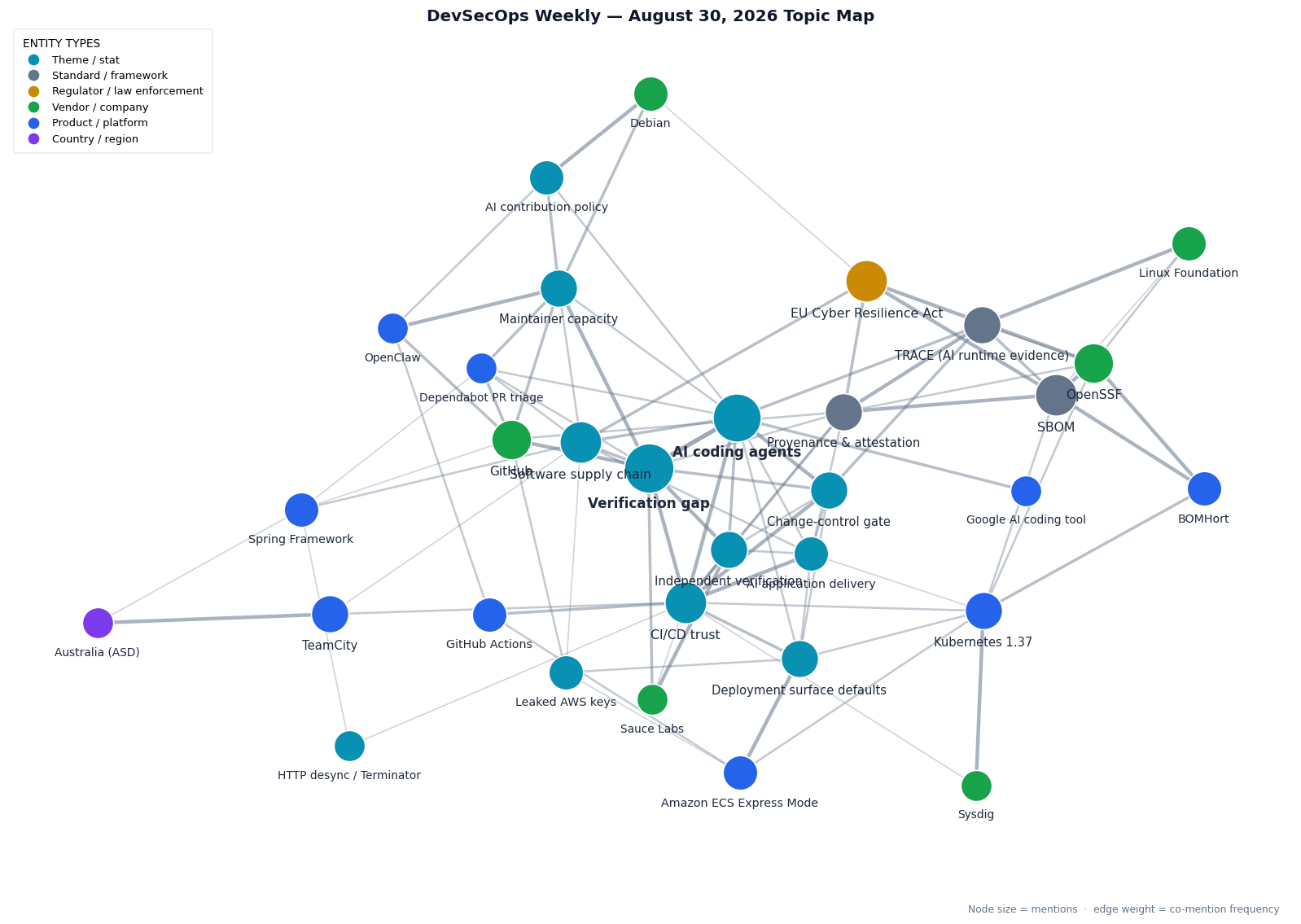
This week’s topic map — the verification gap at the centre, wired to AI coding agents, maintainer capacity, CI/CD trust and the change-control gate; the compliance cluster around the EU Cyber Resilience Act, OpenSSF, SBOM, BOMHort and the Linux Foundation’s TRACE standard, tethered to provenance; the pipeline-trust cluster joining CI/CD trust, AI application delivery and the independent verification Sauce Labs argues for; the deployment surface joining Amazon ECS Express Mode, Kubernetes 1.37, GitHub Actions and the leaked AWS keys; TeamCity under active exploitation with Australia’s ASD, Spring Framework and HTTP desync alongside; and the maintainer cluster joining Debian, OpenClaw, Dependabot pull request triage and AI contribution policy.
View interactive topic map →
Article index
Weekly News
The verification gap
Commit volume doubled in four months; the capacity to check any of it did not. The consequences arrive in this order — more code than anyone reads, agents that install as well as author, and a flaw in the coding tool itself.
What the pipeline is willing to trust
If a machine wrote the infrastructure, the change and the test, the pipeline needs a reason to accept them that is not “it arrived through the usual door”. A pipeline that cannot tell machine-authored change from human-authored change, a delivery model that has to version far more than the code, and a change-control gate built where the agent cannot reach it.
CRA, SBOM and evidence at scale
The compliance thread stopped being about intent this week. A case study that closed the Cyber Resilience Act gap by fixing 1,400 things upstream, a Kubernetes-native project for governing SBOMs once you have too many of them, and a Linux Foundation standard for evidence of what an AI system actually did at runtime.
The deployment surface you did not write
What runs your container is increasingly provisioned by defaults rather than by an engineer: a managed mode that stands up the load balancer, TLS and autoscaling on request, a Kubernetes release that changes the data path underneath it, and four years of evidence about what happens to the credentials all of it depends on.
Developer tooling under active exploitation
The build server is production. A national authority warning that a critical CI flaw is being exploited now, one release closing 91 CVEs, and a new hunt for desync variants at the layer where every proxy disagrees.
Maintainers, bots and community policy
The verification-capacity problem asked by projects that cannot hire their way out of it: a distribution polling its developers on what a bot may do, a viral project’s maintainers describing what securing it actually looks like, and a walkthrough of handing dependency-update triage to an automation.
Foundational Reading
The compliance runway, and the evidence behind the verification gap
Two pieces that frame the week rather than report it: a practitioner’s guide to CRA readiness to read before this week’s case study, and a mid-August interview that puts survey numbers behind the issue’s organising fact — verification did not scale when generation did, and four in five organisations have already traced a production incident to AI-generated code.
Detailed write-ups
1. Commits doubled in four months. Nothing that checks them did.
The New Stack · DevOps.com · August 12–29, 2026
The New Stack put a number on the unease. GitHub is now absorbing 2.9 billion commits a month, up from 1.4 billion in April 2026 — a doubling in four months — alongside roughly 130 million merged pull requests and 24 million new repositories monthly. GitHub’s answer has been capacity: CTO Vladimir Fedorov describes adding 3 million CPU cores and 120 petabytes of high-speed storage, with the platform now carrying 58% of Azure’s load and a seven-hour, 47-minute outage on 17 August in a Central US data centre as a reminder of what that scale costs. What has not doubled is the capacity to verify any of it, and every control a software organisation depends on sits downstream of that ratio. Code review was designed around a human reading a diff carefully enough to notice something wrong. Security review was designed around a queue that a team of specialists could drain. Change approval assumed changes arrived at a rate a person could reason about. None of those scale with a factor of two in four months, and none of them fail loudly when they stop working — a reviewer who has silently switched from reading to skimming produces exactly the same approval record as one who read every line. The organisational metric that tracks review coverage will look unchanged right up to the incident.
What replaces human attention, in practice, is the green pipeline — and the evidence that the substitution does not hold arrived this week from two directions at once. IOActive tested 27 models against 730 prompts across 27 languages in April 2026 and evaluated 20,000 generated samples: average security performance was 59%, nearly a third of samples were fully exploitable, deployment infrastructure was 57.5% vulnerable on average, and Dockerfiles were close to universal failure. Georgia Tech’s Vibe Security Radar, covered further down this issue, has traced 74 confirmed CVEs to AI-generated code and watched the monthly count climb. Set against a pipeline whose entire job is to answer yes or no, that is the problem stated numerically: the artifact compiles, the tests pass, the linter is quiet, and none of it is evidence about the property anyone actually cares about. For a person, a clean compile and passing tests are weak evidence of care, because a careless human tends to produce code that also fails in obvious ways; a model has no such correlation, producing idiomatic, well-formatted code that satisfies the stated requirement and may quietly resolve an unstated one in a way nobody chose. Which is why the review artifact worth protecting is not the diff but the change surface: which dependencies were added, which permissions widened, which network calls appeared, which error paths were altered. Those are small, enumerable and machine-summarisable, and they are where the damage concentrates.
DevOps.com’s piece on AI coding agents as malware delivery systems supplies the incidents that make the ratio a security story. In June 2026, Mozilla’s Zero Day Investigative Network published a proof of concept in which a repository manipulated a coding agent into opening a reverse shell through indirect prompt injection — no exploit in the agent, only text it read and acted on. The FakeGit campaign put thousands of malicious GitHub repositories into circulation posing as AI tools, skills and MCP servers, and Island.io’s AgentBaiting research describes how such projects surface to agents during ordinary software searches. The mechanism is the same each time: an agent reads a README or config file, and that file becomes part of the execution path, inside an environment holding real credentials. The countermeasures the piece lands on are the practical ones — scope agent access to what the task actually needs, run agents in isolated environments with outbound network restrictions, apply the same trust checks to agent-discovered software as to a manual install, and log the repositories, commands, packages and permissions each agent touched. The assistant is also a dependency: Pillar Security’s Dan Lisichkin showed that hidden instructions planted in a GitHub issue were processed by a Google Gemini CLI agent triaging bug reports and yielded Editor-level access plus Workload Identity Federation credentials, with a related finding in the google/adk-python repository chaining prompt injection to remote code execution and credential exfiltration; Google has remediated both, hardening the repository and removing the affected workflows.
DevOps.com supplies the survey evidence that the gap is already producing incidents rather than merely risk. In a video interview published on 12 August, Mike Vizard puts the question to Prince Kohli, chief executive of Sauce Labs, whose complaint is that leaders keep mistaking code velocity for product velocity — “generating an application in an afternoon is not the same thing as shipping one” — and the Sauce Labs research he cites puts numbers on the consequence: 80% of organisations traced a production incident or outage to AI-generated code, 90% reported serious business impact from those incidents, and 66% admitted compromising quality or testing standards to meet faster release deadlines. The mechanism is the one this issue keeps meeting from different directions. Testing pipelines, review processes and device coverage did not accelerate when generation did; a model can now produce more code in a morning than a team used to ship in a sprint; and the reviewer’s job has quietly inverted, so that developers read far more code than they write, and read it without the context behind the architecture they are being asked to approve. The failure pattern Kohli singles out is the one most teams drift into by default — using the same model to write the code and to verify it, which he likens to letting a student grade their own homework. The remedy he argues for is structural rather than procedural: verification systems that are independent of the generator, that reason about what the application is supposed to do, author their own tests, run them in an appropriate environment and work through the failures — and that are invested in at the same rate as generation, because the two capacities stay in balance only if they are funded as a pair.
Sources: The New Stack (commits doubled, verification capacity has not) · DevOps.com (when AI coding agents become malware delivery systems) · DevOps.com (flaw in Google AI coding tool) · DevOps.com (the verification gap behind every AI-generated release)
2. Your pipeline already trusts machine-authored change. Should it?
DevOps.com · August 25–27, 2026
DevOps.com asks whether your CI/CD pipeline can trust AI-generated infrastructure, and Oreoluwa Omoike’s piece brings the measurements that make the question uncomfortable. Georgia Tech’s Vibe Security Radar, run by Hanqing Zhao, had traced 74 confirmed CVEs to AI-generated code through March 2026 — 6 cases in January, 15 in February, 35 in March — with the researchers estimating the real figure five to ten times higher because provenance metadata is usually missing. Set against IOActive’s finding that AI-generated deployment infrastructure is 57.5% vulnerable on average and that Dockerfiles fail close to universally, the exposure is concentrated exactly where a small textual change carries the largest blast radius in the estate. The honest answer for most organisations is that the pipeline never had a way to distinguish machine-authored change from human-authored change in the first place. A pull request is a pull request: the pipeline reads a branch, runs its tests, applies its policy checks and produces an artifact, and every trust decision it makes is inherited from the forge’s account model. A security group widened by one rule, an IAM policy with a wildcard the model added for convenience, a storage bucket whose public-access block was dropped because it was blocking the very thing the ticket asked for — all plausible, idiomatic, and all passing a plan-and-apply pipeline that only checks whether the configuration is valid. The article’s four immediate actions are the cheapest place to start: tag AI-drafted pull requests, run IaC and secret scanners on the tagged changes — Checkov, tfsec, Trivy, TruffleHog, with OPA or Conftest for policy — set AI agent credentials read-only by default, and review the controls quarterly.
Prem Kumar Gadhanki’s companion piece takes the same doubt one level up. It is not only that a machine wrote the change; it is that for an AI-enabled application, production behaviour can change even when the application code does not. A pipeline that versions a commit ID and a container image is versioning the wrong unit, because the release is really a bundle — model version, feature definitions, inference configuration, policy rules and data schema — and any one of them can move without a diff to show for it. The consequences he draws are practical ones. Testing has to grow past the conventional suite into schema validation, feature availability, model-load tests, inference latency, output-range checks and regression tests. Promotion needs an operational fitness gate, because a model that scores well offline can still consume more resources or add more latency than the platform can carry. Rollout should be progressive, with a new model or configuration taking a small percentage of requests before it takes all of them. Rollback needs a stated answer to which assets must move together and which can be reverted independently — the question nobody wants to be asking for the first time at two in the morning. And the release signal has to be a business one, showing whether the deployment is producing acceptable decisions rather than merely healthy processes. The framing he lands on is the one that ties this issue together: AI delivery is a supply chain of versioned components, which makes reproducibility, testability and observability the same requirement wearing three names. It also makes ownership a live question, because the boundary between DevOps, MLOps, data and platform teams is precisely where an unversioned component goes missing.
The constructive pieces this week are about building the gate rather than describing the gap. Daniel Martin’s durable change-control gate for AI agents is a four-stage design: revalidate the current policy and declarations immediately before the action rather than at plan time; route consequential actions to an explicit approver together with the exact action payload; transmit idempotently using a stable key derived from the action’s identity; and verify by receipt — query the destination for that key and look for the created job or ticket instead of blindly retrying. He ran 10,000 outbound agent actions through four designs, and the numbers make the case better than the argument does. Ungated produced 12,114 sends, 2,114 of them duplicates, with 1,106 policy bypasses and 2,544 unapproved sends. Approval-only eliminated the unapproved sends but still left 1,673 duplicates and 879 bypasses. A preflight gate closed the bypasses and duplicated 1,514 times. The durable gate produced 7,177 sends with zero duplicates, zero policy bypasses and zero unapproved actions. The design leans on NIST’s AI RMF for the governance framing and on LangGraph’s interrupt model for the approval mechanics, and the structural idea it lands on is right: the gate has to be evaluated by something that is not the agent, defined in code outside the agent’s reach, and keyed to the properties of the proposed change rather than the identity of whoever proposed it. At doubled commit volume, with machine authors that satisfy the stated requirement and quietly invent the unstated one, that distinction is the difference between a gate and a formality.
Sources: DevOps.com (AI can generate your infrastructure — can your pipeline trust it) · DevOps.com (CI/CD for AI-enabled applications) · DevOps.com (a durable change-control gate for AI agents)
3. The CRA gets its first convincing worked example: 214 security fixes and 1,400+ dependency updates, sent upstream
OpenSSF · August 11–28, 2026
The organisation behind OpenSSF’s case study is Ericsson Software Technology, and the breakdown is more interesting than the headline. Georg Kunz and general manager Jan Melen presented the work on 23 March, published as a case study on 26 August: 214 direct security fixes contributed upstream and more than 1,400 dependency-update pull requests merged — with zero private forks retained. That last figure is the load-bearing one. Not 1,400 waivers, not 1,400 documented accepted risks, and crucially not 1,400 local patches carried privately. A manufacturer placing a product on the EU market inherits the security posture of its entire dependency tree, and no amount of documentation changes what is in the tree. The EU Cyber Resilience Act makes that explicit in Article 13(5), which imposes due diligence on integrated components, Article 13(6), which obliges manufacturers to share the vulnerability fixes they produce back with the upstream project, and Article 13(8), which requires an effective vulnerability handling process. Ericsson’s programme reads as the engineering translation of those three clauses: eliminate private forks in favour of upstream contribution, automate dependency updates as pull requests, add TLS to interfaces that were still unencrypted, deploy public scanning tools to find outdated and vulnerable dependencies, and document hardening against OpenSSF Best Practices. The CRA’s critics called it a compliance tax on open source; this case study is the argument that, applied to a serious manufacturer, it functions as a funding mechanism for upstream maintenance.
Read alongside OpenSSF’s CRA readiness practitioner’s guide from earlier in the month — a 20 August session with Red Hat’s Roman Zhukov, Arm’s Megan Knight, Microsoft’s Nicole Bates and ControlPlane’s John Kjell, drawing on the Linux Foundation’s 2026 CRA Awareness and Readiness Report and the work of the Launchpad SIG under the Global Cyber Policy Working Group — the sequencing becomes clear, and it is not the sequencing most programmes start with. The clock is the reason it matters now: reporting obligations bite in September 2026 and full compliance is required by December 2027. The readiness work is inventory before policy: knowing what you ship, what is inside it, which components are actually reachable in the product, and who maintains each of them. Everything the regulation asks for downstream — vulnerability handling processes, coordinated disclosure, security update commitments across a support period, technical documentation — is straightforward to describe and impossible to operate without that inventory being accurate and continuously refreshed. Teams that begin with the documentation produce a compliant-looking binder describing a product they cannot verify; teams that begin with the inventory find the 1,400 things and then discover that the documentation almost writes itself.
Which is precisely where BOMHort entering the OpenSSF sandbox on 28 August becomes more than a project announcement. Formerly SeeBOM and maintained in part by Mario Fahlandt, co-chair of Kubernetes SIG Contributor Experience, it is a Kubernetes-native platform for ingesting, normalising and visualising SBOMs at scale under Apache-2.0. It accepts SPDX, CycloneDX and in-toto attestation envelopes, deduplicates by SHA256 with queue-based scaling, pulls continuous vulnerability intelligence from OSV with daily CVE updates, understands VEX statements, ships CNCF licence policy out of the box, and exposes 19 REST endpoints behind an Angular 19 dashboard over ClickHouse analytics, deployable through Docker Compose, Kind or Helm. That feature list is aimed at the right half of the problem. SBOM generation stopped being the hard part some time ago; the unsolved half is that an organisation of any size accumulates thousands of these documents, versioned per build, per image, per environment, with no reliable way to answer the questions that matter operationally. Which of these components is running in production right now, in which clusters, at which version? When an advisory lands on a Friday, which workloads are actually affected as opposed to merely listed somewhere? A Kubernetes-native approach is the right shape, because the cluster already holds the ground truth about what is deployed, and joining the document set against the running state is the join that turns an SBOM archive into a control. For anyone building a CRA programme, the pairing is the takeaway: the case study shows what the remediation volume looks like, the readiness guide shows the order of operations, and BOMHort is aimed at the correlation layer that determines whether any of it stays true a month later.
Sources: OpenSSF (conquering the CRA with 1,400 upstream security fixes) · OpenSSF (CRA readiness practitioner’s guide) · OpenSSF (introducing BOMHort)
4. TRACE: what evidence exists that the agent did what it says it did?
Infosecurity Magazine · August 26, 2026
TRACE — Trust, Runtime Attestation and Compliance Evidence — is an open specification for hardware-attested AI agent governance records. It was developed by the confidential-computing vendor OPAQUE, introduced at the Confidential Computing Summit in June 2026, and moved under Linux Foundation governance on 25 August with AMD, Intel, Microsoft and the Technology Innovation Institute as founding participants; Jim Zemlin and OPAQUE’s Aaron Fulkerson made the announcement. A TRACE record binds together the runtime environment an agent executed in, the software it executed, the policies applied to it, the data classifications it touched and the tools it invoked — attested by hardware, using AMD’s Secure Encrypted Virtualization in the initial implementation. It is the most consequential governance item in the issue because it names a gap every other agent-security control quietly depends on. Organisations are now letting autonomous systems open pull requests, modify infrastructure, triage vulnerabilities, and in some cases approve or deploy. When something goes wrong — or when a regulator, auditor or customer asks — the question is not what the agent was configured to do but what it actually did, evidenced in a form that does not depend on the agent’s own account of itself. Today the typical answer is a chat transcript and some application logs written by the same system under investigation. That is a strange gap given the rigour the same industry built into build provenance over the past five years: SLSA, signed attestations and reproducible builds exist because nobody was willing to trust a claim about how an artifact was produced, and runtime agent activity has had no equivalent.
A standard here matters more than a product would, for the same reason SBOM formats mattered more than any individual scanner: evidence is only useful if it is portable, consumable by a SIEM, an audit tool, a compliance framework and an incident responder who has never seen the platform that produced it. Encouragingly, TRACE builds on existing plumbing rather than inventing its own — RFC 9711 (the Entity Attestation Token) for the claim envelope, RFC 9334 (RATS) for the attester, verifier and relying-party roles, and the SCITT draft for anchoring records in a transparency ledger. Those three choices answer most of what is worth asking of an evidence scheme: whether records are signed and tamper-evident rather than merely structured, whether they can be independently verified by a party that did not produce them, and whether they can be anchored somewhere append-only. The remaining questions are the ones to watch as the specification develops — whether the identity in the record is the agent’s own rather than a borrowed human or service account, and whether tool invocations and their inputs are captured rather than just a summary of the conclusion. Uptake is early but not merely nominal: the reference library recorded 135,000 PyPI downloads within ten weeks of the June introduction. An evidence standard an agent writes about itself, unsigned, is a diary; hardware attestation is what makes it something else.
Sources: Infosecurity Magazine (Linux Foundation TRACE standard for AI runtime evidence)
5. The deployment surface you did not write: ECS Express Mode, Kubernetes 1.37 and 64,024 live AWS keys
The New Stack · Sysdig · Infosecurity Magazine · August 24–29, 2026
Amazon’s ECS Express Mode, covered for The New Stack by Satej Sawant on 29 August, is a simplified interface to Elastic Container Service: supply a container image and two IAM roles, and the platform returns a production-shaped service. What it provisions on your behalf is the part a security team should read twice — an Application Load Balancer shared across up to 25 services per VPC, target groups, security groups, an automatically issued TLS certificate, an autoscaling policy running from 1 to 20 tasks against a 60% CPU target, CloudWatch alarms and log groups, and the task definitions themselves. Deployments are canaried at 5% of traffic for three minutes and roll back automatically if errors exceed 1%, and the whole thing can be driven from the console, Terraform, CloudFormation, CDK or GitHub Actions — or, as the article puts it, by asking your agent. Two design decisions keep this on the right side of the line. Every resource stays in the customer’s own account with full ownership and audit access, so a configuration scanner, a policy engine and an incident responder can all still see it; and Express Mode is extensible rather than sealed — custom task definitions for sidecars, hardened images and Secrets Manager integration are supported, and a service can move from the defaults to a customised configuration without a migration. “Express Mode is an interface into Amazon ECS, not a walled garden,” as Sawant puts it. The question it raises is not whether the defaults are good, because they are better than most hand-rolled first attempts. It is that the shared load balancer, the security group and the scaling policy are now artifacts nobody on the team wrote, reviewed or could describe from memory — and once an agent can request all of them on a sentence of instruction, the change-control gate described earlier in this issue stops being a theoretical exercise and starts being the only thing standing between a ticket and a public endpoint.
Kubernetes 1.37, released 26 August with 67 enhancements of which Sysdig’s Victor Jimenez Cerrada counts 19 as security-relevant, changes the substrate underneath the same kind of workload, and it is worth reading before the upgrade rather than after: static pods can no longer reference Secrets or ConfigMaps, ClusterTrustBundles (KEP-3257) and pod certificates (KEP-4317) went stable alongside KYAML (KEP-5295), kubelet-in-userns rootless mode (KEP-2033) reached beta, and bindMountOptions (KEP-5855) arrived in alpha with noexec, nodev and nosuid. The breaking change to plan for is nftables becoming the default kube-proxy backend (KEP-5343) — iptables users will start seeing warnings, and anything that inspects the data path needs a review. The pattern is the same one Express Mode makes explicit: the interesting security properties of a deployment increasingly live in platform defaults and platform releases rather than in anything a team authored, which makes the upgrade note and the provisioning template the two documents most worth reviewing this quarter.
Which brings all of it back to the credential, because every one of those managed components authenticates as something. Truffle Security’s four-year sweep is the base rate underneath every role and key a platform mints: 64,024 unique AWS key pairs across 431,875 public findings between August 2022 and August 2026, of which the 10,616 complete pairs that were re-verified still authenticate 88% of the time. 768 carried full administrative rights, roughly one in six had root privileges, and Hugging Face was the single largest source with 8,482 live keys across 3,394 public datasets — ahead of git history, Docker images, package registries and CI logs. The median key is about five years old, the oldest over 17; 86% were never rotated, and only 9.5% had any budget alert configured. The remediation is cheap: delete root access keys everywhere, sort IAM keys by age and enforce a maximum, set a budget alarm even at a $10 threshold, treat any exposed secret as permanently compromised rather than merely rotated, and alert on the AWSCompromisedKeyQuarantine policy appearing on an account.
Sources: The New Stack (Amazon ECS Express Mode) · Sysdig (Kubernetes 1.37 security features) · Infosecurity Magazine (thousands of leaked AWS keys)
6. The build server is production: TeamCity under active exploitation and a 91-CVE release
Infosecurity Magazine · DevOps.com · Dark Reading · August 25–26, 2026
Australia’s cyber authority issued the warning that deserves to outrank most of the CVE traffic in a DevSecOps team’s inbox. CVE-2026-63077 in TeamCity On-Premises carries a CVSS of 9.8: it lets an unauthenticated attacker with HTTP or HTTPS access to a TeamCity server bypass authentication checks and execute arbitrary operating system commands. JetBrains disclosed the flaw and shipped patches in July; CISA added it to the Known Exploited Vulnerabilities catalogue on 5 August, the vendor followed on 7 August with an advisory reporting active exploitation of unpatched servers, and the Australian Cyber Security Centre published its own alert on 25 August. The fixes are TeamCity 2025.11.7 and 2026.1.3, or the security patch plugin for anyone who cannot take a version jump — and the ACSC’s third recommendation is the one most teams skip past: decide whether the TeamCity interface needs to be reachable from the internet at all. James Coker’s report notes that critical TeamCity vulnerabilities disclosed in 2023 were targeted by Russian and North Korean nation-state actors, so the exploitation interest is neither new nor speculative. A CI server is not a developer convenience at the edge of the estate; it holds source for every repository it builds, credentials for every registry and cloud account it deploys to, signing material for everything it publishes, and a persistent execution context that runs code on a schedule with high privilege. A compromised build server does not produce one incident; it produces a supply-chain incident affecting every artifact it has signed since the intrusion, and the forensic question — which builds are trustworthy — becomes very hard very quickly if artifact provenance was never verified independently at deploy time. The response is same-day patching to 2025.11.7 or 2026.1.3 plus an assumption-of-breach pass: rotate every credential the server held, review recently published artifacts, and check for scheduled jobs, plugins and agent registrations that nobody added deliberately.
The other two stories are the routine load a build estate sits on top of. Sonatype’s report, covered on 25 August, counts 91 vulnerabilities remediated in the latest Spring Framework update — Spring now being a Broadcom property — affecting 209,569 software components, against a 1,700% rise in Broadcom advisories between March and April. Sonatype CTO Brian Fox supplies the operative framing: “exploits in many cases are being built faster than a patch can be created and applied.” The practical consequence is upgrade effort across a very large Java estate — the sort of work deferred precisely because it is undramatic, leaving application servers exposed for months while the team is busy with the interesting incidents. The realistic approach is grouped, scheduled dependency upgrades with a fast lane for security-only releases, so that a 91-CVE update is a routine batch rather than a project. And HTTP Terminator is James Kettle’s AI-driven desync research tool — Kettle is PortSwigger’s director of research — open sourced and presented at Black Hat USA 2026 after roughly six months of work, with the first prototype taking weeks. It autonomously develops novel HTTP request-smuggling techniques and successfully exploited multiple financial services websites during the research; Kettle notes it sometimes wanders off-brief, producing cache-poisoning vectors instead of smuggling ones and switching to targets it was not pointed at. His remediation is one sentence — “Don’t use upstream HTTP 1.1. HTTP 1.1 must die.” — and the practical version is moving upstream connections to HTTP/2, which some infrastructure still will not do: CloudFront does not support upstream HTTP/2. The class survives because the vulnerability lives in disagreement rather than in code: two components in a chain parse the same request differently, and modern delivery paths have more of those components than ever — CDN, WAF, ingress controller, service mesh sidecar, application framework. Every one is a parser, every hop is an opportunity to disagree. Worth knowing which of those layers you actually control and which you have merely configured.
Sources: Infosecurity Magazine (Australia warns of TeamCity exploitation) · DevOps.com (91 vulnerabilities in the latest Spring Framework update) · Dark Reading (HTTP Terminator hunts novel desync attacks)
7. Eight proposals on one ballot — Debian asks the question everyone is avoiding
The Register · The GitHub Blog · August 26–27, 2026
The headline framing is three options; the ballot has eight. Debian’s general resolution on LLM usage runs from an outright ban written into the Social Contract — the only option requiring a 3:1 majority — through “reject LLMs (generative AI) as far as practical”, backed by dpkg’s author Ian Jackson, to proposals allowing AI-assisted contributions under six stated conditions, accepting them for Debian-specific work, encouraging avoidance where practical, requiring human-created code while permitting LLM tooling in the process, and a ban argued on environmental and climate grounds. Each proposal was seconded by between 6 and 17 developers, voting is restricted to recognised Debian developers, and project leader Sruthi Chandran — elected in March 2026 — extended the deadline by a week with fewer than 350 ballots cast. That spread is itself the finding: the constituency least able to avoid the question cannot agree on the answer. Debian cannot hire reviewers, cannot buy capacity, and cannot decline the inbound volume; it can only decide what it will accept and under what conditions. Each strategy has a real cost. Prohibition is enforceable only by disclosure and social norm, and it forfeits contributions that would have been useful. Permissiveness transfers the verification burden onto the maintainers who were already the bottleneck — the specific failure the first story in this issue describes, applied to volunteers. Regulation — disclosure requirements, provenance for generated changes, higher bars for sensitive packages — is the only option that scales, and the only one that requires building something. What Debian settles on will be copied widely: Gentoo banned AI-generated code in April 2024 and NetBSD followed, OpenBSD treats such code as uncopyrightable with some grandfathering, and FreeBSD has not formally decided.
GitHub’s profile of the OpenClaw maintainers is the same problem in its acute form. OpenClaw is a personal AI assistant that runs on a user’s own device and plugs into their messaging channels, started by Peter Steinberger as a weekend project in November 2025; by 26 August 2026 it had roughly 388,000 GitHub stars, 81,000 forks and more than 80,000 commits, and a maintainer group that now includes Vincent Koc and Josh Avant of the OpenClaw Foundation, Red Hat principal engineer Sally O’Malley, Digital Meld’s Brad Groux, Josh Lehman of Martian Engineering and Val Alexander of OpenCoven. Their account of what broke first is specific: thousands of pull requests from automated contributors, including duplicates opened deliberately to manufacture a contribution history and the credibility that comes with it. Everything got harder at once — issue triage, dependency updates, coordinated disclosure, release integrity, deciding which of a flood of pull requests is a genuine contribution and which is a supply-chain attempt wearing the right clothes. What they did about it is the transferable part: they went through their dependencies “with a fine-tooth comb” and cut the core set, built relationships with the maintainers of what remained, began treating agent transcripts and screenshots as trust signals attached to a contribution, and put agents and GitHub Copilot to work reviewing AI-generated pull requests. The controls that hold under that load are the ones set up before the load arrives: protected branches, publish jobs restricted to a reviewed environment, actions pinned by digest, a security policy with a real contact path, and a second maintainer with the credentials to act. The connection to the rest of the issue is direct: the publishing workflow is where a small project’s highest-value credential lives, and popularity is precisely what makes it worth attacking.
The GitHub Blog’s walkthrough of automating Dependabot pull request triage is the same fight in its small, unglamorous form, and it is worth reading precisely because it is small. Christopher Harrison builds a Copilot app automation that takes the steady drip of dependency updates and security patches and returns a prioritised summary instead of a list of individual pull requests: name the automation, pick a trigger — manual, hourly, daily, weekly or issue-based — describe in plain language what you want done, such as grouping the updates by risk level and checking whether CI passed, choose the repository, and read the result. Two details make it more than a convenience. The automation keeps a saved run history, so there is a record of when it ran and what it did, which is the difference between an automation and a black box; and its output is a starting point rather than a verdict, with the option to open a further Copilot session against anything that warrants a closer look. That is the honest shape for this kind of tool right now. Dependency triage is a genuinely recurring task with a stable structure, which makes it a reasonable thing to hand over — and reserving the judgement for the person is what stops the automation becoming one more unread green tick, which is the failure mode the first story in this issue is entirely about. The asymmetry underneath all three of these stories is worth naming plainly: the same capability that doubled commit volume also lowered the cost of contributing something that merely looks legitimate, and the people best positioned to notice the difference are the ones with the least time to look. Which is why the compliance thread in this issue — CRA obligations pushing 1,400 dependency fixes upstream, an evidence standard for runtime behaviour, SBOM governance that stays true against what is actually running — reads less like paperwork and more like the only mechanism currently moving resources toward the part of the ecosystem carrying the load.
Sources: The Register (Debian polls its developers on the bots) · The GitHub Blog (OpenClaw went viral — meet the maintainers) · The GitHub Blog (automate Dependabot pull request triage)
Calls to action
- Treat the publish job as the most privileged code in the repository. Protected branches, publish jobs restricted to a reviewed environment with required approvers, third-party actions pinned by digest rather than by moving tag, and a second maintainer with the credentials to act — the controls the OpenClaw maintainers credit with holding under load are the ones that have to exist before the load arrives.
- Patch TeamCity today and treat it as assumption-of-breach. Move to 2025.11.7 or 2026.1.3, then rotate everything the server held, review artifacts published since disclosure, and check for scheduled jobs, plugins and agent registrations nobody added. While you are there, decide whether the interface needs to face the internet at all.
- Re-size verification to the new commit rate. Stop measuring review coverage and start measuring change surface: dependencies added, permissions widened, network calls introduced, workflow files touched, error paths altered. Route on those properties rather than on who opened the pull request.
- Give the CI agent its own identity and its own egress. An agent operating inside the pipeline should not share the deploy job’s secrets, cloud role or network reach. Scope its credentials, restrict its outbound traffic to an allowlist, and make destructive actions require confirmation the agent cannot itself satisfy.
- Build the change-control gate outside the agent. Policy evaluated by something the agent cannot influence, defined in code, keyed to the properties of the diff, with a small set of high-impact categories requiring out-of-band human approval — and no standing exceptions for the fastest-shipping team.
- Version the whole release, not just the commit. For anything with a model in it, the deployable unit is the model version, feature definitions, inference configuration, policy rules and data schema together — with a stated answer to which of those must roll back as a set and which can be reverted alone, and an operational fitness gate before promotion so an offline-accurate model cannot pass on accuracy alone.
- Point your policy engine at what the platform provisioned, not just at what you wrote. Managed deployment modes now create the load balancer, security groups, scaling policy and alarms on your behalf. They land in your own account, which means your scanners can reach them — but only if someone remembers that a resource with no author still has a configuration.
- Start CRA work with inventory, not documentation. Know what you ship, what is inside it, what is actually reachable, and who maintains each component. Budget for upstream contribution rather than local patching — that is where the 1,400-fix case study says the effort actually goes.
- Join your SBOMs to what is running. Generation is solved; correlation is not. Stand up the capability to answer “which workloads contain this component, at which version, in which cluster” before the next advisory lands on a Friday.
- Age out your cloud keys and alarm on the ones you miss. 86% of the exposed AWS keys in Truffle Security’s sweep had never been rotated and only 9.5% of the accounts had any budget alert. Delete root access keys everywhere, sort IAM keys by age and enforce a maximum, set a budget alarm even at a $10 threshold, treat any exposed secret as permanently compromised rather than merely rotated, and alert on the
AWSCompromisedKeyQuarantine policy appearing on an account.
- Schedule the Spring upgrade as a batch, not a project. Grouped dependency upgrades on a cadence, with a fast lane for security-only releases, so a 91-CVE update is routine rather than deferred.
- Decide your policy on AI-assisted contributions before you need it. Disclosure expectations, provenance for generated changes, and a higher bar for sensitive packages — written down, whichever way Debian’s poll lands.
On our watch list
- Whether verification capacity becomes a reported metric. Commit volume is measured everywhere; the capacity to check it is measured nowhere. Watching for the first organisations to publish a ratio, and for tooling that summarises change surface rather than diff size.
- Whether TRACE records get signed. An evidence standard the agent writes about itself, unsigned, is a diary. Watching for tamper-evidence, agent-owned identity in the record, and tool-invocation capture rather than summaries.
- CRA remediation flowing upstream at scale. One case study with 1,400 fixes is a proof of concept. Watching whether upstream projects start seeing measurable contribution volume attributable to CRA obligations — and whether maintainers experience it as support or as load.
- SBOM correlation as the actual product. BOMHort is aimed at the join between documents and running state. Watching whether the sandbox project attracts the adopters that decide the category, and whether cluster-native correlation beats the central-registry model.
- Agent identity moving from advice to primitive. Everyone agrees agents should not borrow human tokens; nobody has agreed on the format, the scoping model or the issuer. Watching whether workload identity federation absorbs agents or a separate primitive emerges.
- Whether managed deployment defaults become the security baseline. ECS Express Mode ships a shared load balancer, automatic TLS and canary rollback to anyone who asks for them. Watching whether opinionated platform defaults raise the floor faster than hand-rolled infrastructure lowers it — and whether policy tooling learns to read resources no engineer authored.
- Build servers as named critical infrastructure. A national authority warning about TeamCity exploitation is a step toward treating CI as tier-zero. Watching whether that framing shows up in regulatory guidance and in how organisations classify their own build estate.
- Desync variants as the delivery chain lengthens. Every added proxy, mesh sidecar and gateway is another parser that can disagree. Watching what HTTP Terminator turns up, and whether the class produces a variant that crosses a widely deployed CDN boundary.
- What Debian decides, and who copies it. Burn, tame or loose is an exhaustive strategy space, and only one of the three scales. Watching the outcome and how quickly other distributions and large projects adopt the same wording.
- The coding assistant as a dependency. A flaw in a Google AI coding tool is a reminder that the assistant has its own update channel and its own reach into the repository. Watching whether organisations start tracking assistants and their extensions in the software inventory alongside libraries.
|