This week at a glance
This was the week the AI-networking thesis stopped being a roadmap argument and started arriving as audited revenue, and the numbers landed hard enough to reorder how a NetOps team should read the rest of the year. Broadcom reported $16.7 billion of AI semiconductor revenue in fiscal Q3, up 221% year on year and 54% sequentially inside a $29.6 billion quarter, and guided Q4 AI silicon to roughly $21.7 billion — while sorting its own networking portfolio into three explicit tiers, Tomahawk for scale-out Ethernet, Tomahawk Ultra for Ethernet-based scale-up and Jericho for scale-across. Dell’Oro supplied the structural marker: in 2Q2026, AI back-end network switch sales exceeded front-end datacenter switch sales for the first time, within three years of the category existing at all, with 800 Gbps taking the vast majority of both shipments and revenue and 1.6 Tbps only beginning to sample. The Next Platform then made the uncomfortable argument that follows — that NVSwitch is becoming to scale-up what InfiniBand was to HPC, a proprietary fabric with a $25.74 billion trailing-twelve-month networking business behind it, against a UALink 1.0 spec that can address 1,024 XPUs at a single switching level but has yet to ship at volume. On the physical layer the same money showed up differently: Marvell‘s fiscal Q2 FY2027 put electro-optical components at roughly $1.4 billion against roughly $425 million of custom AI XPU silicon, and Ciena booked $1.67 billion with coherent pluggables growing more than 100% and component supply locked through 2029. HPE‘s $2.9 billion networking quarter came with a gigawatt-scale multi-year supply agreement for Oracle Cloud Infrastructure built on the ex-Juniper PTX, MX and QFX lines, Equinix and Microsoft both pitched interconnect as an open-API product rather than a private pipe, and Juniper shipped a 16 Tbps 1RU leaf for inference fabrics. Against all of that, the operations half of the bulletin is deliberately quieter and more honest: SK Telecom‘s Topda is genuinely in the field, inspecting 2.35 million utility poles from cameras bolted to work vans that were already driving the routes, at 88% detection accuracy; the TM Forum Game-X Catalyst that Cisco and TM Forum both wrote up claims 2x faster time to market and 30% better operational efficiency from agentic closed-loop automation; and beyond those, Ericsson and Mobily signed a memorandum to explore Level 4 autonomy, Render Networks previewed an agent it has not shipped, and Nokia published a set of AI-RAN spectral-efficiency claims it has proved out in structured trials rather than commercial deployments. The gap between the fabric half and the operations half is the story: one is being measured in billions of dollars of delivered hardware, the other still largely in intent.
On our watch list
- Whether AI back-end switching holds its lead after a single crossover quarter. Dell’Oro recorded the crossover in 2Q2026, on one quarter and on 800 Gbps, with 1.6 Tbps only beginning to sample and its ramp expected in the second half of 2026. The next quarterly release is the test of whether this is a durable inversion or a lumpy one, and whether the vendor ordering — Celestica first, NVIDIA a close second, Arista third, Cisco the biggest share gainer — survives the deferred revenue that Dell’Oro says would move Arista higher. Note that the release carries no dollar values and no share percentages, so any that appear attached to it later are someone’s estimate rather than Dell’Oro’s finding.
- Whether the scale-up interconnect settles toward NVSwitch or UALink. Nothing this week resolved it: NVSwitch scales to 72 accelerators and 576 across two tiers with a $25.74 billion trailing-twelve-month networking business behind it, while UALink 1.0 addresses 1,024 XPUs at a single switching level on paper and has yet to ship at volume. The signal to watch for is a second major silicon vendor committing shipped product one way or the other. Marvell already carries the scoreboard as a line item — roughly $300 million of network components tied to UALink, ESUN, NVSwitch and Celestial AI in FY2027 — and how that splits will tell you more than any consortium membership announcement.
- Whether optics keeps outgrowing custom silicon at Marvell. In fiscal Q2 FY2027, electro-optical components at roughly $1.4 billion (up 97.2%) outran AI XPU sales of roughly $425 million, and the XPU line declined sequentially while optics rose. Marvell guides Q3 FY2027 to about $3.15 billion, puts custom CPU and XPU work at roughly $2 billion in FY2027 and expects it to double in FY2028. The next quarter is where you find out whether the sequential XPU decline was program timing or the beginning of a mix that Marvell’s own guidance does not assume.
- Whether Ciena’s price increases stick, and what supply contracted to 2029 implies. Ciena is passing on increases from high single digits to the high teens and low twenties depending on customer and product line, has finalised agreements securing key components through 2029 including incremental capacity, and holds a $10 billion backlog extending into 2028. Watch whether those increases survive the next two quarters or get competed away, and whether hyperscaler-linked revenue keeps climbing from its current 53% of the total. A supplier contracting that far out is a supplier expecting the constraint to outlast this cycle.
- Whether an operator reproduces Nokia’s AI-RAN spectral-efficiency numbers. The roughly 20% combined gain and the target of doubling spectral efficiency by 2028 are Nokia’s own figures, and T-Mobile US, SoftBank and Indosat are named as structured proofs of concept rather than commercial deployments. The result that would change the weight of the claim is a measured figure published by an operator, in its own spectrum and traffic mix, or one of those proofs of concept converting into a deployment. Absent that, the percentages stay a vendor’s, however plausible the engineering.
- Whether Level 4 memoranda turn into deployments with published metrics. Ericsson and Mobily signed a memorandum targeting TM Forum Level 4 autonomy in key scenarios, with no metrics, no percentages and no timeline attached; the Game-X Phase II Catalyst’s 2x time-to-market and 30% operational-efficiency figures were produced by a multi-operator group under project conditions. What to look for is the first of these reappearing as a named production deployment with numbers measured in a live network — and to be careful, when the 2x and 30% turn up again, that it is the same measurement being repeated rather than a second one.
- Whether SK Telecom’s 2027 Topda targets hold. The roadmap is specific enough to be falsifiable: roughly 150 vehicles and 70% coverage of major wireline sections in 2027, more than 90% coverage in 2028, detection accuracy rising from 88% to roughly 95% next year, and tunnel inspection scope expanding by the end of 2026. The tunnel milestone lands first and is the earliest read on whether the pilot’s economics survive the jump from six vehicles to about 150. These figures come from RCR Wireless News’s account of the programme.
- Whether Render’s Quartermaster ships, and with whom. Quartermaster was previewed ahead of Metro Connect with no customers, no fibre miles and no passings disclosed, and the only concrete claim attached to it is retrospective, about the already-released Field Quality Agent. The test is a general-availability announcement carrying named customers and delivery figures. Another preview cycle with neither would itself be the answer, and it is the cheapest available check on how far the agentic delivery story has actually travelled.
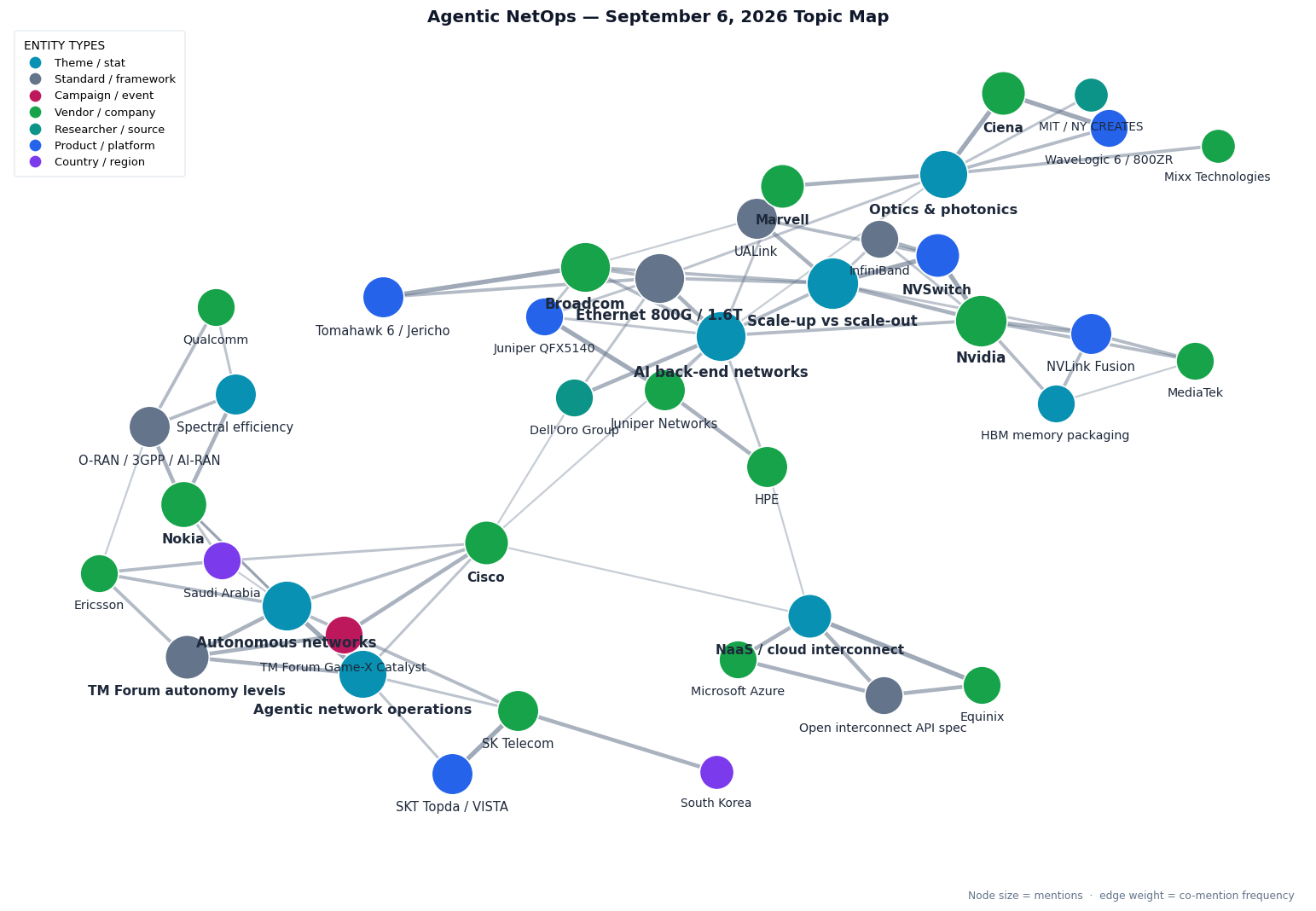
This week’s topic map — the fabric silicon fight (Nvidia and NVSwitch, NVLink Fusion, UALink, InfiniBand, Broadcom and Tomahawk 6, Juniper’s QFX5140, AI back-end networks); the optics and photonics layer (Marvell, Ciena and WaveLogic 6, Mixx, MIT and NY CREATES); cloud interconnect and NaaS (Equinix, Microsoft, HPE, the open interconnect API specification); autonomous telco operations (SK Telecom and Topda, the Game-X Catalyst, Cisco, Ericsson, TM Forum autonomy levels); and AI-native RAN and 6G (Nokia, Qualcomm, O-RAN and 3GPP). Node size reflects how often an entity is mentioned; edge weight reflects how often two entities are discussed together.
View interactive topic map →
Article index
Scale-up versus scale-out: the AI fabric silicon war
The week’s spine. Broadcom’s $16.7 billion AI quarter and its three-tier networking taxonomy, Dell’Oro’s crossover of back-end past front-end switching, The Next Platform’s NVSwitch-as-InfiniBand argument, the $3.5 billion NVIDIA–MediaTek NVLink Fusion tie-up, NVHBM as memory packaging with fabric consequences, Juniper’s 16 Tbps QFX5140, and Nvidia PAIR at the very small end.
| Article |
Source |
Published |
| 1. Broadcom’s AI Business Hits $16.7B as XPUs, Ethernet and Optics Accelerate |
Converge Digest |
Sep 2, 2026 |
| 2. AI Back-End Networks Switch Sales Surpass Front-End Networks for the First Time in 2Q2026 |
Dell’Oro Group |
Sep 3, 2026 |
| 3. In The Long Run, Nvidia NVSwitch Is The InfiniBand Of Scale Up AI Networks |
The Next Platform |
Aug 31, 2026 |
| 4. NVIDIA and Mediatek Ink $3.5B Investment Deal, Accelerate NVLink Fusion Adoption |
ServeTheHome |
Sep 1, 2026 |
| 5. Nvidia unveils alternative high-bandwidth technology to bolster AI cards |
Network World |
Aug 31, 2026 |
| 6. Introducing the QFX5140 |
Juniper Elevate Community |
Aug 31, 2026 |
| 7. Nvidia lets you build your own AI clusters locally with PAIR software |
Network World |
Sep 4, 2026 |
Optics, photonics and the physical layer
Marvell’s optics-over-ASICs split, Ciena’s $1.67 billion quarter and $10 billion backlog, Mixx Technologies’ 24,576-fibre rack unit, ProLabs’ long-reach 400G and 800G claims, and a wafer-scale flexible photonics platform out of MIT aimed at wearables and sensing rather than the datacenter.
Cloud interconnect, NaaS and datacenter platform networking
HPE’s gigawatt-scale Oracle agreement on ex-Juniper PTX, MX and QFX platforms, Equinix pitching Fabric One at the network-as-a-service market, Azure Multicloud Interconnect arguing for spec-level interoperability across hyperscalers, VMware Cloud Foundation 9.1’s transit gateways and native EVPN VXLAN, and the AMD, Cisco and HUMAIN buildout in Saudi Arabia.
Autonomous and agentic network operations in the telco
Where the agentic claim meets deployment reality. SK Telecom’s Topda inspection fleet is in the field; the TM Forum Game-X Phase II Catalyst that both TM Forum and Cisco wrote up carries the week’s only operator-side efficiency figures; Ericsson and Mobily are at memorandum stage; Render Networks is at preview stage. Three foundational pieces from Telefónica, HCLTech and Detecon close the section.
| Article |
Source |
Published |
| 18. SK Telecom commercializes AI “Topda” safety-inspection solution, expands autonomous AI in network operations |
Maeil Business Newspaper |
Sep 1, 2026 |
| 19. AI traffic changes everything. Networks have to deliver outcomes, not connectivity |
TM Forum Inform |
Sep 3, 2026 |
| 20. The Power of Co-Innovation for AgenticOps and Autonomous Networks |
Cisco Blogs |
Aug 31, 2026 |
| 21. Mobily advances autonomous networks with AI |
Ericsson |
Aug 31, 2026 |
| 22. Render Networks Previews Agentic AI Expansion, Brings Autonomy to Scale Network Delivery |
Business Wire |
Sep 1, 2026 |
| 23. Autonomous Networks, AI, and Advanced Automation: Telefonica’s Strategy for Building the Network of the Future (foundational) |
Telefónica |
Aug 31, 2026 |
| 24. Is the traditional NOC dead? Why autonomous network operations is no longer optional (foundational) |
HCLTech |
Sep 1, 2026 |
| 25. The end of workflow-centric operations: How Agentic AI is rewriting the rules of telcos and techCos (foundational) |
Detecon |
Sep 1, 2026 |
AI-native RAN, 6G and the research pipeline
Nokia’s AI-RAN platform and its spectral-efficiency targets, Qualcomm’s 6G Leadership Day and the shape of 3GPP Release 21, a European project teaching 6G networks to run themselves, Nokia’s new Saudi R&D centre for network automation, and Bell Labs research headcount halving as the counterweight to all of it.
Detailed write-ups
1. The fabric silicon quarter: Broadcom’s $16.7B, Dell’Oro’s crossover, and NVSwitch as the new InfiniBand
Converge Digest · Dell’Oro Group · The Next Platform · ServeTheHome · Network World · Juniper Elevate Community · August 31 – September 4, 2026
Broadcom posted the quarter that defines the week. AI semiconductor revenue reached $16.7 billion in fiscal Q3 2026, up 221% year on year and 54% sequentially, inside total revenue of $29.6 billion (up 86%), split between Semiconductor Solutions at $20.8 billion (up 127%) and Infrastructure Software at $8.8 billion (up 29%). Free cash flow was $13.7 billion, 46% of revenue, against a non-GAAP operating margin target of roughly 66%. Guidance escalates from there: Q4 AI semiconductor revenue of about $21.7 billion, up 236% year on year, on total revenue of roughly $34.8 billion, with a longer-range outlook of approximately $115 billion of AI semiconductor revenue in FY2027 and $230 billion in FY2028. Hock Tan, Broadcom’s president and CEO, put it without hedging: “Demand for our custom AI accelerators and networking continues to be very strong. Q3 AI semiconductor revenue of $16.7 billion grew 221% year-over-year, and 54% quarter-over-quarter. In Q4 the momentum continues, and we expect AI semiconductor revenue to accelerate to $21.7 billion, up 236% year-over-year.” For a network architect, the interesting disclosure is not the revenue line but the taxonomy underneath it. Broadcom now sorts its switching portfolio by fabric tier rather than by port speed: Tomahawk for scale-out Ethernet, Tomahawk Ultra for Ethernet-based scale-up, and the Jericho class for scale-across between sites, with Tomahawk 6 cited at 102.4 Tbps of switching capacity. That is a vendor deciding that the three problems are architecturally distinct enough to need different silicon, which is a useful signal for anyone still trying to buy one switch family and use it everywhere. The custom-accelerator side names its customers plainly — Google’s Ironwood TPU v7 and TPU v8I, and OpenAI’s first-generation custom inference accelerator, “Jalapeno” — and every one of those parts arrives needing a fabric wrapped around it.
Dell’Oro Group published the structural marker in the same week, and it deserves to be read carefully because it is a shape claim rather than a size claim. In 2Q2026, AI back-end network switch sales exceeded front-end datacenter network switch sales for the first time — a category that did not exist three years ago overtaking the large, well-established general-purpose datacenter switching market. “AI back-end networks have grown at such a rapid pace that, within just three years of their emergence, spending surpassed that of the large, well-established front-end network market,” said Sameh Boujelbene, vice president at Dell’Oro Group. The supporting detail matters more than the headline. 800 Gbps switches accounted for the vast majority of both Ethernet switch shipments and revenue in AI back-end networks during the quarter, while 1.6 Tbps switches only began sampling, with a ramp expected in the second half of 2026 — so the crossover happened on 800G, not on the speed everyone is currently designing towards. Dell’Oro expects the market to remain supply-constrained for the next one to two years, and attributes demand to the top four US cloud providers and the top three in China. The vendor ordering in Ethernet AI back-end for the quarter runs Celestica first, NVIDIA a close second, Arista third and Cisco as the biggest share gainer, with Dell’Oro noting that Arista would rank higher if deferred revenue were included. Two conclusions follow for buyers. First, a supply-constrained market for one to two years means lead time is now an architectural input, not a procurement detail. Second, when a contract manufacturer leads the ranking, a meaningful share of this spend is not going through the traditional switch-vendor channel at all.
The Next Platform supplied the argument that ties the silicon to the strategy, and it is the piece most worth an hour of a network architect’s time this week. Its thesis is that NVSwitch is becoming to scale-up AI what InfiniBand was to HPC: technically ahead, commercially entrenched, and increasingly hard to displace by committee. The current NVSwitch domain scales to 72 accelerators, with two-tier expansion to 576 devices. UALink 1.0, by specification, can address 1,024 XPUs or GPUs at a single switching level — a better number on paper. Latency is where the comparison gets careful: InfiniBand port hops are given at 100 to 120 nanoseconds and the UALink specification targets roughly 100 nanoseconds, while NVSwitch is described only as rumoured to sit closer to Ethernet latencies, which the piece flags as unconfirmed rather than measured. The commercial position is not in doubt. Nvidia’s networking revenue for the trailing twelve months ending in July is put at $25.74 billion, of which the analysis estimates roughly $25.67 billion is Ethernet plus NVSwitch interconnect, and Nvidia’s share is characterised as roughly 95% of GPU revenues and roughly 75% of combined GPU and XPU revenues, drifting downward through calendar 2027. The consortium timeline is the counterweight: the Ultra Ethernet Consortium was founded in July 2023 and UALink in May 2024, with AMD, Broadcom, Cisco Systems, Google, HPE, Intel, Meta Platforms and Microsoft among its members. The historical parallels the piece draws are the ones to keep in mind when someone tells you an open standard will fix this by default — Mellanox bought Voltaire for $218 million in November 2010, Intel bought QLogic’s InfiniBand business for $125 million in January 2012, and Oracle bought Sun Microsystems for $5.6 billion in April 2009. InfiniBand consolidated rather than democratised. The open question for 2027 is whether UALink converts specification advantage into shipped switches before the installed base decides for it.
Two Nvidia items extend the same strategy in opposite directions. NVIDIA is investing $3.5 billion in MediaTek via convertible bonds, explicitly to accelerate NVLink Fusion adoption — the components named are the Fusion chiplet, NVLink-C2C for chip-to-chip connection, and NVHBM as a custom memory protocol. The two companies already co-developed the GB10 SoC used in DGX and RTX Spark systems, and the roadmap names Vera Rubin Spark and Rosa Feynman Spark parts running through 2030, positioned against Google’s TPUs, Meta’s MTIA, OpenAI’s Jalapeno and AWS Trainium4. No bandwidth figures were disclosed. NVHBM itself is worth reading precisely, because its name invites a misfiling: it is a memory architecture, not a fabric one. It moves the memory controller off the XPU compute die and onto the base die of the HBM stack. Nvidia’s claims, all measured against HBM4E and all its own, are up to 30% more memory bandwidth, up to 15% lower HBM power, up to 25% more area returned to the XPU compute die, up to 67% less PHY and interface area, up to 80% more usable silicon overall, and roughly 30% end-to-end XPU performance improvement. Amazon’s Annapurna Labs is the first announced partner, with Micron, SK Hynix or Samsung named as possible producers. The reason it belongs in a networking bulletin at all is that it ships as part of the NVLink Fusion platform: the packaging decision is what makes the interconnect story affordable for third-party silicon, and it deepens the same platform dependency the NVSwitch analysis describes.
At the opposite end of the scale, two items show what the same architecture looks like when it lands in a rack or on a desk. Juniper’s QFX5140 is a 1RU leaf built for exactly the workloads above: 16 Tbps of switching capacity on a Broadcom Trident5-X12 ASIC with native 112G PAM4 SerDes, presenting 24 QSFP112 ports at up to 400GbE, 8 OSFP800 ports at up to 800GbE and 2 SFP28 ports at 10/25GbE, reaching up to 160x 100GbE via breakout. The variants are the QFX5140-24CD8O-AO, -AI and -CHAS. Power and thermals are documented rather than implied — dual 1600W AC supplies in 1+1 redundancy, 883W maximum draw against 543W typical, six hot-swap fan modules — and the control plane is an Intel Ice Lake-D CPU with 32GB of memory and dual M.2 SSDs running Junos OS Evolved. Juniper targets it at AI inference fabrics, storage fabrics, leaf and spine, border leaf and HPC Ethernet, with first revenue shipment of the DC-power variant planned for late 2026. Note the positioning: this is an inference-fabric box, and inference is where most enterprises will actually meet AI networking. Finally, Nvidia PAIR — Personal AI Router, a free beta — links Windows, macOS and Linux machines on the same network into a local inferencing cluster behind a single interface, supporting DGX Spark desktop systems, PCs with RTX GPUs and some macOS devices. Read the fine print before you extrapolate: Nvidia states that the systems run tasks in parallel and that PAIR does not turn them into a virtual GPU. It distributes work; it does not pool memory or present one logical device. That distinction is the entire difference between PAIR and everything else in this section.
Sources: Converge Digest (Broadcom’s AI business hits $16.7B) · Dell’Oro Group (AI back-end switch sales surpass front-end) · The Next Platform (NVSwitch as the InfiniBand of scale-up) · ServeTheHome (NVIDIA and MediaTek $3.5B deal) · Network World (Nvidia’s alternative high-bandwidth technology) · Juniper Elevate Community (introducing the QFX5140) · Network World (Nvidia PAIR software)
2. Optics outrun custom silicon: Marvell’s split, Ciena’s backlog, and a 24,576-fibre rack unit
The Next Platform · SDxCentral · Converge Digest · September 1–4, 2026
Marvell‘s fiscal Q2 FY2027, which ended on 1 August 2026, produced the most quietly important number in this issue. Datacenter product sales were $2.17 billion, up 45.7% year on year and 18.5% sequentially, making up 79.3% of total sales — 89% counting enterprise networking. Total AI revenue is estimated at $1.82 billion, up 90.9% year on year and 23.6 times the level of Q1 FY2024. The split inside that number is the story: electro-optical components at roughly $1.4 billion, up 97.2%, against AI XPU sales of roughly $425 million, which grew 43.1% year on year but declined sequentially. Optics is outrunning custom silicon by better than three to one, at a company whose strategic narrative for two years has been custom accelerators. Elsewhere in the quarter, non-AI datacenter products fell 28.4% to roughly $347 million while legacy enterprise networking rose 37.4% to roughly $266 million; operating income was $460 million (up 58.5%), net income $308 million (up 58.1%), and cash on hand $3.93 billion. Guidance is Q3 FY2027 at roughly $3.15 billion (up 51.8%), FY2027 raised to $12 billion from $11.5 billion, and FY2028 at $18 billion — roughly 50% growth with datacenter above 60%. Custom CPU and XPU work is put at about $2 billion in FY2027 (up 33%) and expected to double in FY2028, while network components tied to UALink, ESUN, NVSwitch and Celestial AI are forecast at roughly $300 million, of which Celestial AI hardware is about $150 million. The portfolio moves behind the mix are worth noting together: Marvell acquired Inphi and Celestial AI, acquired IBM’s custom chip business from GlobalFoundries, and sold its automotive chip business to Infineon, with AWS (Graviton), Google and Celestial AI named as customers and partners. One naming caution for anyone reading across this week’s coverage: Celestial AI, Marvell’s optical-interposer partner, is a different company from Celestica, the contract manufacturer topping Dell’Oro’s AI back-end ranking. The two names appear in adjacent stories this week and are easy to conflate.
Ciena gave the transport side of the same argument, and its backlog is the number to keep. Fiscal Q3 2026 revenue was $1.67 billion, up 37% year on year, with optical networking at $1.19 billion, or 71% of the total. The customer mix has genuinely shifted: hyperscaler-linked revenue is now 53% of total against 37% for service providers, an inversion of the historical shape of this business. Backlog stands at $10 billion and extends into 2028, against a full-year revenue growth target of 35%. Product detail runs where you would expect: the Reconfigurable Line System and Waveserver platforms grew more than 55% year on year, coherent pluggable optics grew more than 100%, and WaveLogic 6 Nano 800ZR modules hit record shipments, with WaveLogic 5 Extreme and WaveLogic 6 Extreme also named. “AI is currently driving and will continue to drive significant increases in both bandwidth connectivity demand and network traffic growth,” said CEO Gary Smith. The operationally consequential disclosures are the two nobody puts on a slide. CFO Marc Graff confirmed the supply position directly: “In recent weeks, we finalized long-term agreements that secure supply of certain key components through 2029, including incremental capacity for those key components that will enable us to support growing customer demand.” And Ciena is passing price increases to customers ranging from high single digits to the high teens and low twenties, depending on customer and product line. Read alongside Dell’Oro’s one-to-two-year supply constraint, that is the clearest signal available that optical budgets set in 2025 will not buy the same bill of materials in 2027. Hyperscale expansion is called out in India, the Middle East and Asia, with “neoclouds” or “neoscalers” named as a growing buyer class in their own right.
Two component stories fill in the physical layer. Mixx Technologies, a San Jose startup founded by Vivek Raghuraman (CEO, formerly an R&D director at Broadcom) and Rebecca Schaevitz (chief product officer, formerly a Broadcom principal engineer), unveiled the SxC Connector, which supports 64 fibres per connector. Sixteen units carry 1,024 fibres, and roughly 24 units fit in one OCP-compliant rack unit to reach 24,576 fibres per rack unit — a claimed 4x improvement on the density of current MMC VSFF miniature multifibre connectors, in an 800 square millimetre footprint intended for backplane use. The company acquired Sophic Silicon in July 2026 and has a manufacturing collaboration with Kaynes Semicon; funding was not disclosed. The reason this matters beyond the spec sheet is that fibre count, not fibre bandwidth, is what breaks physical designs at scale-up density — cable management, bend radius and serviceability are the constraints that actually stop a rack from being buildable. ProLabs debuted 400G and 800G QSFP-DD optics for ultra-long-haul use, claiming up to 30 repeater hops against around six for competing 400G products and roughly 1,490 miles of reach. Both figures are vendor claims; the announcement carries no model numbers, no ZR or ZR+ designation and no named customers, so treat the reach number as a starting point for a lab evaluation rather than a planning assumption. Amphenol is the parent company, and Stefan Löhmann is EMEA sales director.
One research item in this section needs to be read for what it is rather than where it sits. MIT, working with NY CREATES at the Albany NanoTech Complex, demonstrated a 300mm wafer-scale process for flexible, transparent silicon-photonic chips a few microns thick, built from oxide and patterned waveguide layers on transparent polyester film at a maximum process temperature of 500°C. The work is led by Jelena Notaros, associate professor in MIT’s department of electrical engineering and computer science, and published in Optica. The target applications are wearables, sensing and augmented reality — not datacenter interconnect — and the announcement gives no waveguide loss figures. It belongs in this section because it is silicon photonics on a 300mm line, which is the same manufacturing base that eventually feeds transceiver economics; it does not belong in the AI-optics narrative above, and reading it as a datacenter roadmap item would be a mistake.
Sources: The Next Platform (optics still driving Marvell’s AI business) · SDxCentral (Ciena earnings and supply chain) · SDxCentral (Mixx Technologies SxC Connector) · SDxCentral (ProLabs ultra-long-haul transceivers) · Converge Digest (MIT wafer-scale flexible photonics)
3. Interconnect becomes a product: HPE’s gigawatt Oracle deal, Equinix Fabric One and Azure’s open-spec pitch
SDxCentral · Network World · Cisco Newsroom · August 31 – September 3, 2026
HPE closed a Q3 that finally validates the Juniper acquisition on the numbers rather than the narrative. Total revenue was $12.2 billion, up 35% year on year, and the networking portfolio reached $2.9 billion, up 74.9%. The breakdown is where the AI effect is visible: datacenter networking $1.4 billion, up 112% year on year; campus and branch $1.4 billion, up 31%; routing $788 million, up 270%; and security $281 million, up 75.6%. The Cloud and AI division came in at $9 billion (up 25%), servers at $6.8 billion (up 35.3%) and storage at $1.3 billion (up 10%), with AI-related orders hitting a new high of $700 million at triple-digit growth. FY2026 revenue growth guidance was raised to 34–37% from a prior 9–33% range. The headline event is a multi-year supply agreement with Oracle covering Oracle Cloud Infrastructure datacenter and edge networks, described as gigawatt scale, and it is built on ex-Juniper platforms: PTX and MX for routing and switching, plus QFX switches for the AI back-end networks. CEO Antonio Neri framed the Oracle work as “an expansion of what Juniper used to do, but now we’re doing at gigawatt scale,” and gave the supply-side caveat that runs through every vendor in this issue: “Growth in our backlog shows strong customer demand is running ahead of available supply.” CFO Marie Myers carried the financial commentary. The 270% routing figure is the one to sit with. Routing has been the slow-growth line in enterprise networking for a decade; triple-digit growth there says AI datacenter buildouts are pulling wide-area and DCI capacity behind them at a rate that campus refresh cycles never did.
Equinix went at the network-as-a-service market with Fabric One, a managed connectivity service that automates routing, cloud connectivity, encryption and failover through APIs and intent-driven workflows. The architecturally interesting part is what it is built on: OpenAPI 3.0 and an open interconnect specification developed jointly with AWS and Google Cloud. “Fabric One will reduce complexity by automatically managing connectivity across distributed architectures, based on customer intent,” said Chris Audie, Equinix’s chief product officer, with Robert Kennedy, VP of AWS Network Services, and Rob Enns, VP of engineering for Google Cloud Networking, quoted alongside. Beta is scheduled for later in 2026 with general availability in North America in 2027, and the coverage names Megaport, Nile and Alkira as the competitive set. What the announcement does not contain is equally worth recording before you build a business case on it: no port speeds, no bandwidth tiers, no metro counts and no pricing. An intent-driven interconnect service with hyperscaler co-authorship of the specification is a genuinely different proposition from a portal in front of a cross-connect, but it is a 2027 proposition, and the details that determine whether it fits your estate are not yet public.
Microsoft‘s announcement in the same week is the one most likely to be misread from its coverage. This is not a bespoke private pipe stitched between Azure and AWS. It is Azure Multicloud Interconnect, a product built on open API specifications, delivering 100 Gb/s connectivity with MACsec encryption and four-nines (99.99%) availability. The argument Microsoft is making is about the specification, not the pairing. Narayan Annamalai, VP and head of products for Azure Networking Services, said it directly: “We see the opportunity to extend this model beyond a single cloud-to-cloud relationship… The same open API specification can help enable broader interoperability across hyperscale cloud providers, creating a more consistent experience for customers operating in increasingly diverse multicloud environments.” Put that beside Equinix’s open interconnect specification with AWS and Google Cloud and a pattern emerges that is worth a NetOps team’s attention: the hyperscalers are converging on a shared API surface for inter-cloud connectivity, which is either the end of bespoke multicloud plumbing or the beginning of a standards fight, and which of the two it turns out to be will be visible from whether the two specifications converge or diverge over the next year.
Two platform items round out the section. VMware Cloud Foundation 9.1, announced by Broadcom at VMware Explore 2026, addresses several long-standing constraints in the NSX networking model at once. Tenants can now run multiple transit gateways where previously there was one, and availability modes are decoupled from tier-0 gateways. A new Virtual Network Appliance provides centralised NAT, DHCP and load balancing without requiring NSX edge nodes — a meaningful simplification for smaller deployments that were paying an edge-cluster tax for basic services. VLAN-backed subnets now attach directly to physical VLANs, VPC connectivity policies govern inter-VPC traffic on a model explicitly borrowed from Cisco private VLANs, and native EVPN VXLAN support arrives using a small route-controller VM that handles the BGP control plane only and stays out of the data path. No scale numbers and no GA date were given, so treat it as a design-review input rather than a deployment plan. Finally, AMD, Cisco and HUMAIN announced an expansion of Saudi Arabia’s AI infrastructure with AMD Instinct systems going live — one of three items this week pointing at the same geography, alongside Nokia’s new Saudi R&D centre and the Ericsson–Mobily autonomy memorandum below.
Sources: SDxCentral (HPE Q3 and the Oracle gigawatt-scale deal) · SDxCentral (Equinix Fabric One) · SDxCentral (Azure Multicloud Interconnect) · Network World (VMware Cloud Foundation 9.1) · Cisco Newsroom (AMD, Cisco and HUMAIN in Saudi Arabia)
4. Autonomy in the field and autonomy on paper: SK Telecom’s Topda, the Game-X Catalyst, and everything still at intent stage
Maeil Business Newspaper · TM Forum Inform · Cisco Blogs · Ericsson · Business Wire · August 31 – September 3, 2026
SK Telecom‘s Topda is the item in this issue that most deserves a NetOps engineer’s attention, because it is autonomy that has already been driven around a city rather than autonomy that has been announced. The figures below come from RCR Wireless News’s detailed account of the programme. The design decision that makes it work is deliberately unglamorous: rather than commissioning dedicated inspection runs, SK Telecom mounted AI cameras, a GPS antenna and a neural processing unit on work vans that were already driving the routes, so wireline plant gets inspected as a by-product of technicians doing their existing jobs. The estate involved is roughly 2.35 million utility poles plus fibre-optic cable described as five times the circumference of the Earth — a scale at which scheduled manual inspection is arithmetically impossible, which is precisely why the ride-along model matters. Topda detects 11 risk factors: nearby construction sites and heavy equipment operating near cables, sagging lines, leaning or damaged poles, unauthorised attachments, and safety-compliance items down to helmet use and traffic-cone placement. Detection accuracy is now 88%, up from 65% in 2024, with a target of roughly 95% next year. The four-month pilot ran from May to August 2026 using six vehicles and covered 50% of major wireline sections in the Seoul metropolitan area; the roadmap calls for roughly 150 vehicles and 70% coverage in 2027, more than 90% coverage of major wireline sections in 2028, and tunnel inspection scope expanding by the end of 2026.
The architecture underneath is as instructive as the results. Topda runs on SKT’s VISTA digital-twin platform across three distinct AI layers — Vision AI for object recognition, Context AI for judging whether a detection is actually relevant, and Spatial AI for positioning — and it works from standard camera and drone footage with no LiDAR, which is what keeps the per-vehicle cost low enough to put on 150 vans. Positioning comes from a partnership with Swift Navigation giving one-to-two-metre accuracy. Related results from the VISTA-Drone programme are cited at a 60% time reduction and an 85% improvement in image interpretation. The whole thing sits inside SKT’s broader “Network AX” strategy for AI-driven network automation. Telecompaper independently confirms the vehicle-camera model and the 11 abnormality types. The transferable lesson for anyone running physical plant is the separation of the three AI layers: most failed inspection-automation projects fail at the Context stage, drowning operations teams in technically correct detections that nobody needed to see, and building relevance judgement as its own layer rather than as a confidence threshold on the vision model is what turns a detection pipeline into something a field team will actually use.
The week’s only operator-side efficiency figures come from the TM Forum Game-X Catalyst, and they arrived twice — once in TM Forum Inform’s Catalyst write-up and once in Cisco’s thought-leadership post around it. These are the same project, Game-X: Game-changing autonomous network experience, Phase II, which won Best Moonshot Catalyst, Autonomous Networks, at DTW Ignite 2026, and they carry the same numbers rather than two independent measurements. The claims are 2x faster time to market through agentic orchestration and a 30% improvement in operational efficiency through agentic closed-loop automation. The participant list is the part worth studying: Colt, stc, Telefónica, Türk Telekom, Verizon and Etiya and Ni2, with Cisco contributing Crosswork Planning, Crosswork AgenticOps and Cloud Control. Chetan Narang, director of AI product strategy at Colt Technology Services, gave the framing that makes the exercise more than a bake-off: “For networks, this signals a shift from purely delivering connectivity to enabling measurable outcomes, where experience becomes the primary value metric.” A Catalyst is a multi-operator proof of concept, not a production deployment, and the figures should be read as what a coordinated group of operators and vendors achieved under project conditions. That is still a more useful data point than a vendor benchmark, because the multi-vendor constraint is the one that breaks most real autonomy programmes.
The remaining two items in this section are honest about where they sit, and the bulletin should be too. Ericsson and Mobily signed a memorandum of understanding to explore AI-enabled, goal-based autonomous operations, targeting TM Forum Level 4 autonomy in key scenarios across process automation, self-healing, network optimisation and energy management in a multi-vendor environment. The named platform is Ericsson Operations Engine, and a multi-year EOE deployment is described as completed within a twenty-year Ericsson–Mobily relationship, with Saudi Arabia’s Vision 2030 and LEAP 2026 as context. There are no metrics, no percentages and no deployment timeline attached — this is an intent-stage announcement, and Level 4 in key scenarios is a materially narrower claim than Level 4 as an operating posture. Render Networks previewed Quartermaster, the next expansion of its ClearWay agentic AI architect, ahead of Metro Connect in Austin on 2–3 September. Quartermaster is a preview rather than a shipping product, and the announcement names no customers, fibre miles or passings. The one concrete claim is retrospective and about the previously released Field Quality Agent: “The Field Quality Agent proved a hyperscaler could trust an agent to grade field evidence against spec at scale,” said CEO Stephen Rose. Set the four items side by side and the gradient is clear — one programme measured in vans on the road, one measured under Catalyst conditions, one memorandum, one preview. That gradient is the actual state of agentic network operations in September 2026.
Sources: Maeil Business Newspaper (SK Telecom commercializes AI “Topda”) · TM Forum Inform (networks have to deliver outcomes, not connectivity) · Cisco Blogs (co-innovation for AgenticOps and autonomous networks) · Ericsson (Mobily advances autonomous networks with AI) · Business Wire (Render Networks previews agentic AI expansion)
5. AI-native RAN, the 6G specification clock, and Bell Labs at half strength
Nokia · Light Reading · 6G Flagship · SDxCentral · August 31 – September 3, 2026
Nokia published the clearest current statement of what an AI-native RAN platform actually consists of, written by Pallavi Mahajan, its chief technology and AI officer. The platform offers three deployment options under the anyRAN software umbrella: the AirScale ABIG AI-accelerated plug-in card for existing basebands, a purpose-built accelerated AI-RAN node, and a COTS-server Cloud AI-RAN running on GPU-powered servers from Dell, Supermicro and Quanta. That range is the important design point — it means an operator can adopt AI-RAN as a card in installed hardware, as a new node, or as software on commodity servers, and those are three very different capital arguments. Nokia claims roughly 20% combined spectral efficiency gain from its AI-assisted RAN algorithms today, with a stated target of doubling spectral efficiency by 2028. The component claims underneath are itemised: AI-assisted link adaptation up to 13% throughput across all users and up to 18% for fixed wireless access users; AI-powered channel estimation delivering 5–10% uplink spectral efficiency; AI-based carrier aggregation around 5% user throughput; deep receivers (DeepRx) around 10% throughput against conventional receivers; deep transmitters (DeepTx) around 10%; and CSI feedback compression around 10% spectral efficiency. Every one of those percentages is a Nokia figure rather than an independent measurement, and the named engagements with T-Mobile US, SoftBank and Indosat are structured proofs of concept, not commercial deployments — worth stating plainly, because “AI-native RAN starts now” invites a different reading. The ecosystem context is 3GPP, the O-RAN ecosystem and the AI-RAN Alliance, with Altiplano and Corteca also named in the portfolio. For a NetOps audience the transferable point is that spectral efficiency is the RAN equivalent of the fabric-efficiency argument running through the first half of this issue: in both cases the interesting engineering has moved from adding capacity to extracting more from capacity already deployed.
The specification clock behind all of it got a public reading at Qualcomm’s 6G Leadership Day in San Diego on 26 August, reported by Light Reading’s Jeff Baumgartner. 3GPP Release 21 is the first 6G specification, with standards finalised in 2029 and initial commercialisation targeted for the same year. The spectrum under discussion spans upper and lower C-band — 440MHz contiguous — plus 2.7GHz, 4GHz and 7GHz. The framing that makes this a NetOps story rather than a wireless one came from Durga Malladi, Qualcomm’s EVP and GM of technology planning: “AI is becoming the center of action and you build the devices around it and the protocols around it, not the other way around.” That is a claim about protocol design, not about features. If Release 21 is genuinely specified with AI as the organising assumption rather than as an overlay, the operational consequence is that the network’s control loops become model-shaped from the standard up — which is a very different inheritance from the 5G experience, where AI arrived as a layer bolted onto protocols designed without it. On the research side, the 6G Flagship programme published work on AURORA-6G, framed around teaching future 6G networks to run themselves, and Nokia opened a new research and development centre in Saudi Arabia aimed at accelerating AI-powered network automation — the third Saudi item in this issue, after the AMD, Cisco and HUMAIN infrastructure expansion and the Ericsson–Mobily memorandum.
Against that pipeline, the week’s counterweight is a downsizing story. Nokia Bell Labs research staff has roughly halved since Marcus Weldon’s departure in 2021, falling from over 1,200 to about 600 today, of which about 250 is attributed to organisational transfers rather than departures — a 50% reduction across 2021 to 2026. Guru Parulkar replaced Peter Vetter as head of Nokia Bell Labs Research in June 2026, with the “president” title eliminated in the process. The wider Nokia programme targets 14,000 job cuts by 2026 against a current headcount of about 78,000, and Weldon — who created the Future X Network concept in 2016 as a ten-year vision — is quoted critically in the coverage. Read it as what the evidence supports: a research organisation operating at half its former scale, with its leadership title downgraded, while the same company publishes ambitious AI-RAN roadmaps and opens new automation R&D centres elsewhere. The tension between those two facts is the interesting part. Long-horizon industrial research and near-term applied AI engineering compete for the same budget, and the sector is currently resolving that competition in one direction almost everywhere. Whether that turns out to be a rational reallocation or a decade-long mistake is not a question this week’s reporting can answer, but it is the right question to hold onto as the 2029 6G date approaches.
Sources: Nokia (the era of AI-native RAN starts now) · Light Reading (6G and AI are on a collision course) · 6G Flagship (AURORA-6G) · Nokia (new R&D centre in Saudi Arabia) · SDxCentral (Nokia Bell Labs downsizing)
Foundational reading
Three longer views on what replaces the workflow-centric NOC
Telefónica · HCLTech · Detecon · August 31 – September 1, 2026
Three pieces sit underneath this week’s news and are worth reading in the order below, because they move from operator strategy to operating model to organisational consequence. Telefónica sets out autonomous networks, AI and advanced automation as its strategy for building the network of the future — the operator-side companion to the Catalyst work above, and useful precisely because Telefónica is one of the named Game-X participants, so its published strategy and its Catalyst behaviour can be read against each other. HCLTech asks whether the traditional NOC is dead and argues that autonomous network operations is no longer optional, which is the systems-integrator framing of the same question and the one most likely to turn up in your organisation’s next transformation deck. Detecon’s whitepaper on the end of workflow-centric operations takes the argument furthest, into how agentic AI rewrites the rules for telcos and techcos.
The reason to read all three rather than one is that they disagree, usefully, about where the difficulty lies. An operator strategy document treats autonomy as an architecture and roadmap problem. An integrator’s blog treats it as a transformation-programme problem. A consultancy whitepaper treats it as an operating-model problem — and the phrase “workflow-centric” is the sharpest of the three, because it names the thing that actually has to be dismantled. Most NOCs are not organised around networks; they are organised around workflows, with tooling, roles, shift structures, escalation paths and vendor contracts all shaped to the assumption that a human executes a defined sequence. An agent that reasons about an outcome does not fit that shape, and the mismatch shows up as governance friction long before it shows up as a technical limitation. Whichever of these three framings matches your organisation, the practical test is the same and it is worth applying before the next planning cycle: pick one recurring incident class, write down every workflow step, and mark which steps exist because the network requires them and which exist because a person is doing the work. The second list is the scope of your autonomy programme, and it is usually longer than anyone expects.
Sources: Telefónica (autonomous networks, AI and advanced automation) · HCLTech (is the traditional NOC dead?) · Detecon (the end of workflow-centric operations)
Calls to action
- Put lead time into your fabric design, not just your purchase order. Dell’Oro expects AI back-end switching to stay supply-constrained for one to two years, and HPE’s CEO says demand is running ahead of available supply. Design decisions that assume you can buy the part you specified, in the quarter you specified it, are the ones that will slip. Ask every fabric vendor for current lead times in writing and re-run the design against them.
- Budget optical refresh at the new prices, not last year’s. Ciena is passing on increases from high single digits to the high teens and low twenties depending on customer and product line, and has locked component supply through 2029. If your 2027 optical plan was costed in 2025, it is wrong by a margin that matters. Re-price it now, while there is time to change the scope rather than the schedule.
- Decide your scale-up interconnect position deliberately. NVSwitch has a $25.74 billion trailing-twelve-month networking business behind it; UALink 1.0 addresses 1,024 XPUs at a single switching level on paper. The InfiniBand precedent says technical superiority and consortium breadth do not settle this on their own. Write down what a migration away from your chosen scale-up fabric would cost before you commit to it, not after.
- Check that your 800G plan is a plan and your 1.6T plan is a hypothesis. The crossover Dell’Oro recorded happened on 800 Gbps, which took the vast majority of both shipments and revenue, while 1.6 Tbps only began sampling with a ramp expected in the second half of 2026. Build for 800G today and treat 1.6T as a roadmap dependency with a sampling-stage supply chain behind it.
- Read NVHBM as a memory decision with fabric consequences. Moving the memory controller onto the HBM base die is packaging, not networking — but it ships inside NVLink Fusion, and every Nvidia figure quoted for it is Nvidia’s own against HBM4E. If a vendor puts NVHBM in a fabric proposal, ask which of the claimed gains apply to your workload and who measured them.
- Track the two open interconnect specifications as one question. Equinix’s Fabric One is built on OpenAPI 3.0 and an open interconnect specification developed with AWS and Google Cloud; Azure Multicloud Interconnect is built on open API specifications and pitched explicitly at broader hyperscaler interoperability. Whether these converge or diverge over the next twelve months determines whether multicloud connectivity becomes a commodity or a second standards war. Ask both vendors, in the same meeting, which specification they mean.
- Separate relevance judgement from detection in any inspection automation. SK Telecom’s Topda runs Vision AI, Context AI and Spatial AI as three distinct layers and reaches 88% detection accuracy across 11 risk factors, using cameras on vans already driving the route. If you are scoping any physical-plant automation, copy the layer separation and the ride-along model before you copy anything else — both are what keep the cost and the alert volume survivable.
- Grade autonomy announcements by evidence stage before they reach your roadmap. This week alone produced a fielded deployment, a multi-operator Catalyst with 2x and 30% figures under project conditions, a memorandum of understanding targeting Level 4 in key scenarios, and a conference preview of an unshipped agent. All four were reported as progress. Only one of them is something you could buy and run, and knowing which is which is the whole skill.
- Treat vendor AI-RAN percentages as a test plan, not a result. Nokia’s roughly 20% combined spectral efficiency claim and its per-technique figures are Nokia’s own, and T-Mobile US, SoftBank and Indosat are named as structured proofs of concept rather than deployments. If AI-RAN is on your roadmap, the useful next step is defining what you would need to measure in your own spectrum and traffic mix to reproduce any of those numbers.
- Audit which steps in your runbooks exist for the network and which exist for the human. The foundational reading converges on the same diagnosis: NOCs are organised around workflows rather than networks. Take one recurring incident class, list every step, and mark it. The steps that exist only because a person is executing them are your autonomy scope — and that list is the honest version of a business case.
|