This week at a glance
This was the week Agentic NetOps stopped being a positioning word and became a market with a boundary drawn through the middle of it. Gartner, as cited by Itential, published its first-ever Market Guide for Agentic NetOps Software in May 2026 and split the category into two camps: infrastructure-embedded agents that live inside a single network vendor’s own platform, and infrastructure-independent software that reasons and acts across every domain and vendor. Gartner named no vendors in either camp — which means the placement fight is open, and it is the fight that will decide renewals for the next three years. The same guide carries the forecast everyone will now quote at your customers: by 2030, AI agents will be the most common approach for executing network runtime activities, up from less than 1% in early 2026. Within days of that frame landing, the market started filling it in. Extreme Networks took the embedded side and made packaging the weapon — Agent ONE Coworker went generally available on September 10 and ships included with existing Platform ONE subscriptions, with no separately disclosed price and no premium agentic SKU, against a backdrop of $1.28 billion FY2026 revenue, 13% growth and 187 customers spending $1 million or more a year. Zayo did something structurally stranger and arguably more important: a connectivity provider bundled agentic network operations into its DynamicLink NaaS subscription, reachable from a customer’s own AI workflows rather than only from Zayo’s portal — which puts a carrier into the same buying conversation as enterprise automation vendors. NETSCOUT and BackBox pushed their own agentic messages into the same week, BackBox twice in three days. Meanwhile the bill for the last consolidation wave came due in public. Arista Networks, which acquired VeloCloud from Broadcom in July 2025, is in court-ordered mediation with TPx Communications, a Chapter 11 managed service provider that says it has paid more than $59 million for VeloCloud access since 2016, paid $2.34 million in May 2025 to convert its perpetual licenses, and has now been quoted $46 million to renew for three years — while 13,000-plus managed edge devices and one customer’s 110 sites sit on the outcome. On the other side of the same trend, HPE showed what consolidation looks like when it works: networking revenue up 117% year over year for the nine months ended July 31, and networking now 26% of a $32 billion segment base against 15% of $25 billion a year earlier, with the Juniper line, not AI infrastructure, carrying the growth. Dynatrace bought Arize AI, moving observability toward evaluating the agents rather than just the systems. And two sobering counterweights closed the week: Bain & Company warned that AI in operations either replaces 20–30% of traditional cost or simply adds 20–30% with no reduction at all, and public status-page data showed median incident resolution moving only from 3.2 hours in 2023 to 3.6 hours in 2026 while AI-related incidents went from 1.7% to 10.7% of the total. The category has a name and a forecast. It does not yet have a proof point with a customer’s name on it.
On our watch list
- Which side of Gartner’s split each incumbent claims — and whether buyers accept the claim. Gartner, as cited by Itential, divides the category into infrastructure-embedded and infrastructure-independent and places no vendor by name. Every platform vendor will assert breadth; every multi-vendor tool will assert neutrality. The tell is not the marketing, it is whether a vendor will demonstrate action across equipment it does not sell. Itential’s framing of the independent case — “software embedded in one vendor’s stack cannot coordinate what it cannot see” — is Itential’s position, not Gartner’s, but it is the sentence the independent side will run on.
- Extreme’s “Operator mode” in early 2027, and the Extreme AI Summit in Amsterdam on October 20. Agent ONE Coworker shipped as an assistant; the genuinely autonomous tier is a roadmap item. If Extreme lands a more autonomous mode at a bundled price, it resets what an agentic capability is worth as a line item across the embedded camp. The Amsterdam event is the next scheduled disclosure point.
- Whether “included in the subscription” becomes the category’s default price. Extreme bundled Agent ONE into Platform ONE at no separately disclosed price; Zayo bundled agentic networking into DynamicLink at no separately disclosed price. Two vendors in one week declined to charge separately for the agent. If that holds, agentic capability becomes a renewal-defence feature rather than a revenue line, and every business case built on a premium agentic SKU needs rewriting.
- The Arista–TPx mediation, which began September 1 with no timeline set. TPx sued on August 28 in the U.S. Bankruptcy Court for the Southern District of Texas after Arista restricted administrative access on July 20. The precedent cuts the other way: TPx contested comparable license-conversion restrictions with Broadcom in September 2024 and Broadcom backed down. Whichever way this lands becomes the reference point for every enterprise and provider holding perpetual licenses on a product an acquirer now owns.
- Whether post-acquisition licensing becomes a standing procurement risk rather than a Broadcom story. Reporting frames Arista as adopting Broadcom-style licensing after acquiring VeloCloud, alongside Broadcom/VMware disputes involving Siemens, AT&T and Tesco. The pattern to watch is the gap between what a conversion fee bought and what the acquirer later defines as a subscription-tier service — in TPx’s case, $2.34 million paid in May 2025 against a $46 million three-year renewal quote that Arista calls a significant discount.
- Whether HPE’s networking growth survives contact with Cisco’s base. HPE networking grew 117% over nine months and roughly doubled its share of segment mix, while Cisco networking sales topped $9.7 billion in a single three-month period. Fast growth off a much smaller base is not yet a share shift. The next two quarters tell you whether the $14 billion Juniper purchase bought momentum or a step change.
- Bain’s two scenarios, and which one your own pilots are tracking toward. Bain’s target-state mix is roughly 70–80% traditional operating expense and 20–30% AI agent and token cost within three to five years — either replacing traditional cost or adding to it. The deciding variable is not model price, which Bain notes fell nearly tenfold in a year, but whether the legacy workflow actually gets retired. Watch for the first vendor willing to price against cost per resolved incident rather than per seat or per token.
- The gap between rising incident load and flat recovery. Public status-page data spanning 2018 to June 2026 puts median resolution at 3.6 hours in 2026 against 3.2 hours in 2023, while AI-related incidents rose from 1.7% to 10.7% of the total. That dataset is cloud and SaaS status pages, not enterprise NOC tickets, so read it as a directional market signal rather than a benchmark — but it is the number every agentic business case is implicitly promising to move.
- Observability vendors buying into agent evaluation. Dynatrace’s acquisition of Arize AI is the week’s hard fact in the observability thread — Arize’s open-source Phoenix project is used by more than 4,000 enterprises. If monitoring the agents becomes a feature of the observability platform rather than a separate purchase, that changes who the agentic-NetOps buyer talks to first.
- Proof points with customer names on them. Zayo disclosed no pricing, no named customers and no measured outcomes. Extreme’s resolution-time and onboarding figures are beta-customer claims relayed by Extreme, with no customers named. NETSCOUT’s token and time-to-knowledge figures come from its own testing. The first vendor to put a named Fortune 500 reference and an audited before-and-after number behind an agentic claim will reset the evidence bar for everyone else.
- Coordinated vendor pushes dressed as market momentum. Two BackBox-originated items landed in trade press within three days — one staff-reported product announcement, one bylined by a BackBox executive whose affiliation appears only in the author bio. Expect more of this as the category heats up, and discount accordingly when counting “independent” signals of demand.
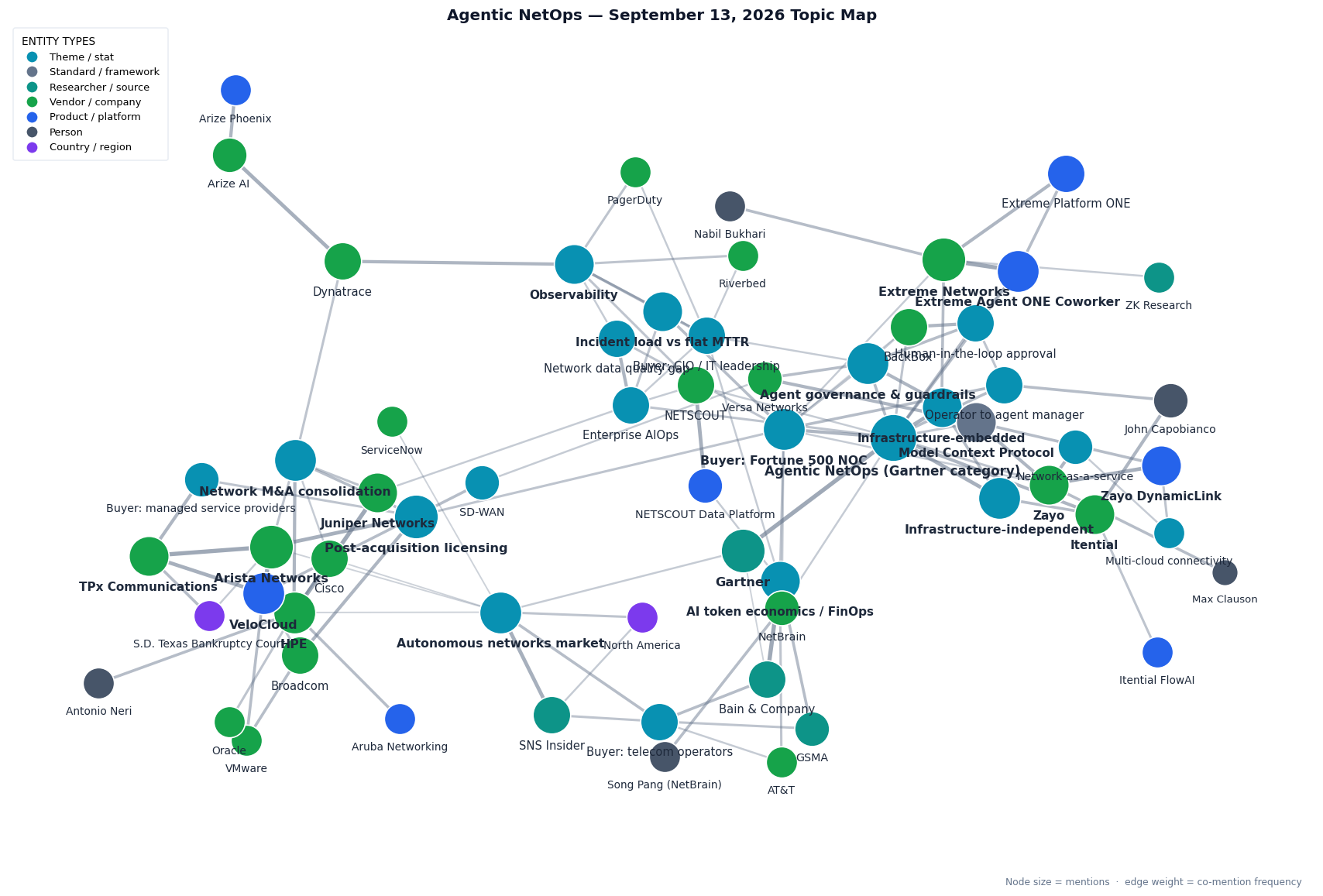
Entities and connections across this week’s 20 tracked stories. Node size reflects how often an entity appears; line weight reflects how often two appear together.
View interactive topic map →
Article index
Competitive moves: vendors claiming the agentic category
Four vendors moved to plant a flag in the same week. Extreme bundled an agent into an existing subscription, Zayo turned agentic operations into a carrier service, NETSCOUT repositioned its data platform as the feed that makes agents affordable, and BackBox built its pitch around keeping a human on the approval.
Consolidation and the post-acquisition bill
Three consequences of the same M&A wave. Arista’s VeloCloud licensing fight with a bankrupt MSP shows what the buyer pays when a product changes hands; HPE’s Juniper numbers show what the acquirer gets when it works; Dynatrace buying Arize AI shows the next assets being bought — the tooling that watches the agents.
Market sizing and the analyst view
The numbers that will be quoted back at you in every vendor meeting this quarter — a new Gartner category with a 2030 forecast, a $52 billion market projection from a commercial research firm, and Bain’s warning that the savings case may not survive contact with token bills.
Buyer adoption: what stalls a rollout
What vendors say gets in the way, plus one dataset that does not depend on a vendor’s framing. Note the source class: four of these five are vendor-authored, so read them as the market’s emerging sales objections rather than as independent evidence.
The NOC operating model and the CIO agenda
Who does the work, who sponsors the budget, and how the job description changes. The through-line is that the agentic pitch is arriving at the CIO as an operating-model question, not a tooling one.
Detailed write-ups
1. Gartner names the category — and draws the line the market will be sold on
Itential · August 25, 2026
The single most consequential thing to happen to this market did not happen this week — it happened in May, and the industry is only now organising around it. Gartner, as cited by Itential, published its first-ever Market Guide for Agentic NetOps Software. Agentic NetOps is now a named Gartner category, which means it will appear in budget lines, in RFP boilerplate and in the questions boards ask about network operations spend. The forecast carried in the guide, again as cited by Itential, is the number that will do the selling: by 2030, AI agents will be the most common approach for executing network runtime activities, up from less than 1% in early 2026. Every figure here reaches us through a vendor blog rather than from Gartner directly, and should be treated accordingly — but the category name and the split are the part that matters strategically, and they are not in dispute.
The split is where the competitive positioning lives. Gartner divides the market into infrastructure-embedded agentic NetOps — agentic capability built into a single network vendor’s own platform — and infrastructure-independent agentic NetOps, software that reasons and acts across every domain and every vendor. Critically, Gartner places no vendors into either camp by name. That leaves the placement fight entirely open, and it is the fight that determines who gets the enterprise budget: the platform vendor arguing that its agent sees everything that matters because the customer standardised on it, or the independent vendor arguing that a Fortune 500 estate is never one vendor deep. Itential, which sells on the independent side and positions its FlowAI product in the post, puts the argument bluntly: “Software embedded in one vendor’s stack cannot coordinate what it cannot see.” That is Itential’s position rather than Gartner’s finding, but expect to hear a version of it in every competitive deal for the next two years.
The guide also does something useful for anyone building a business case: it identifies five production-validated use cases — incident triage, pre-flight change validation, fault remediation, firewall policy automation and compliance evidence collection. That list is narrower and more operational than most vendor marketing, and it is a reasonable filter for judging whether a pitch is describing shipped capability or ambition. The author, John Capobianco, is Itential’s Head of AI and Developer Relations and a twenty-five-year network automation veteran previously at Selector AI, Cisco and the Parliament of Canada; his framing of where the autonomy boundary belongs is the most quotable line in the week: “Let the agent be creative about the diagnosis. Never let it be creative about the change.” That sentence is, in practice, the risk posture most enterprise buyers will adopt — and vendors that cannot demonstrate it will lose deals on governance rather than on capability.
Sources: Itential (What Is Agentic NetOps? Gartner’s New Category)
2. Extreme bundles the agent — and turns packaging into the competitive move
SiliconANGLE · September 10, 2026
Extreme Networks made Agent ONE Coworker generally available on September 10 at its CIO event in Seattle, and the strategically interesting fact is not the product, it is the price tag: there isn’t one. Agent ONE Coworker is included with existing Platform ONE subscriptions, with no separately disclosed charge and no premium agentic SKU. Extreme calls it the “industry’s first proactive context-aware AI agent for networking,” a claim we cannot verify, but the packaging decision needs no verification to matter. A vendor that bundles agentic capability into a subscription customers already pay for is doing two things at once: defending renewals against independent tooling, and pushing the whole category toward treating agents as a platform feature rather than a separate purchase. Anyone modelling agentic NetOps as new incremental revenue should price that scenario now.
The business context explains why Extreme can afford the move. FY2026 revenue was $1.28 billion, up 13% year over year, with Q4 at $339 million and nine consecutive quarters of sequential growth. Platform ONE drove nearly half of subscription bookings last quarter, and 187 customers now spend $1 million or more annually. Bundling the agent protects that subscription base rather than cannibalising a product line. The outcome claims attached to the launch are softer and should be read as marketing rather than evidence: resolution time moving from “hours to minutes” and new-engineer onboarding cut by as much as 50% are beta-customer claims relayed by Extreme, with no customers named. Extreme’s own telemetry — a 900% increase in interactions in the first eight days — measures curiosity, not value. Note also that the coverage is analyst-authored: Zeus Kerravala of ZK Research wrote it off an Extreme briefing, so it is closer to informed positioning than arm’s-length reporting.
The roadmap is where the real competitive threat sits. A more autonomous Operator mode is slated for early 2027, with the next capability wave due at the Extreme AI Summit in Amsterdam on October 20. Today’s product answers questions; the 2027 product is meant to act. Extreme’s CTO and President of AI, Nabil Bukhari, framed the adoption problem in a way that reads like a deliberate positioning against all-or-nothing autonomy pitches: “Trust is not binary. It’s not like I trust AI or I don’t trust AI.” Built on Platform ONE and ExtremeCloud IQ with a proprietary knowledge graph, this is the infrastructure-embedded case made concrete — deep context inside one vendor’s estate, at no extra charge, with the multi-vendor question left conspicuously unanswered.
Sources: SiliconANGLE (Extreme Networks’ Agent ONE Coworker moves AI networking from dashboards to answers)
3. Arista, TPx and the post-acquisition bill: what a $2.34 million conversion fee buys when the vendor changes hands
SDxCentral · Channel Dive · September 10–11, 2026
This is the week’s clearest warning about what consolidation costs the buyer, and it is playing out in open court. The ownership chain runs VeloCloud to VMware to Broadcom, via the November 2023 VMware acquisition, and then to Arista Networks, which closed its VeloCloud purchase on July 1, 2025. (Terms were never officially disclosed; SDxCentral says “approximately $1 billion” while Dell’Oro cites reporting putting it well under that, so treat any headline price as unconfirmed.) On the other side is TPx Communications, a managed service provider that filed Chapter 11 in late June 2026 with roughly $1.1 billion of debt and cancelled its bankruptcy auction on August 10 for lack of qualified bidders. TPx says it has paid more than $59 million for VeloCloud access since 2016, including $2.34 million in May 2025 — $500,000 to convert 12,143 perpetual licenses plus $1.84 million for three years of support. Arista has since quoted $46 million to renew for three years, a figure Arista characterises as a significant discount.
The dispute is about what the conversion fee actually bought. Arista’s position is that the fees covered “license conversion as well as limited technical support” only, and that upgrades, hosted orchestration and subscription-tier services require separate payment; it says it provided subscription-level services “for about four months as a courtesy” and warned that upgrade access would end on 20 May. Its own letter to TPx puts it plainly: “TPx persistently ignores that paying the specified fees does not entitle it to the same benefits as a subscription service.” Arista filed a 98-page objection on July 21 and restricted administrative access on July 20, reserving Operator Superuser rights for its own administrators on security grounds. That control had operational consequences: after a late-July Arista security incident requiring certificate updates, with Arista holding sole administrative control, one TPx customer suffered outages across 110 locations and another a full enterprise outage. TPx sued on August 28 in the U.S. Bankruptcy Court for the Southern District of Texas, and court-sanctioned mediation began September 1 with no timeline set.
For a CEO the specifics matter less than the pattern. Reporting frames Arista as adopting Broadcom-style post-acquisition licensing, in the same lineage as Broadcom/VMware disputes involving Siemens, AT&T and Tesco — and TPx itself contested comparable license-conversion restrictions with Broadcom in September 2024, when Broadcom backed down. The exposure here is concrete: TPx manages more than 13,000 edge devices, and six major customers alone represent $714,000 in monthly recurring revenue, roughly $8.5 million a year. Every enterprise and every provider holding perpetual licenses on a product that has since been acquired is now looking at a live example of the downside case — not a price rise, but a renewal quote roughly twenty times the last payment, with administrative control of production infrastructure sitting on the vendor’s side of the table. That is a procurement risk that belongs on a board agenda, and it is also, bluntly, the strongest argument any vendor-neutral automation vendor has ever been handed.
Sources: SDxCentral (Arista goes full Broadcom in VeloCloud license fight with TPx) · Channel Dive (TPx butts heads with Arista over post-bankruptcy VeloCloud support)
4. The other side of consolidation: HPE’s Juniper deal turns networking into the growth engine
Futuriom · September 8, 2026
HPE closed its $14 billion acquisition of Juniper Networks on July 2, 2025, and the first full accounting of what it bought is unusually clear. Networking revenue grew 117% year over year for the nine months ended July 31, 2026. More telling than the growth rate is the mix shift: networking moved from 15% of a $25 billion segment revenue base to 26% of a $32 billion base, roughly doubling its share of HPE’s business. Over the same nine months, Cloud and AI products grew a comparatively modest 15%. The story HPE is now able to tell is that networking, not AI infrastructure, is carrying its growth — which inverts the narrative most of the industry has been running on for two years.
The proof points are commercial rather than technical. Named wins and collaborations include Oracle for OCI datacenters, AMD on Helios rack integration, and Tensordyne on routing protocols, across the PTX and MX routers, QFX and EX switches, the AIOps software line and Aruba Networking. CEO Antonio Neri’s framing points at supply rather than demand as the constraint: “Routing and data center switching demand accelerated in the quarter with orders substantially ahead of revenue and our backlog at its highest ever.” Orders running ahead of revenue with record backlog is a good problem, but it is still a delivery risk, and it is the metric to track next quarter.
Two caveats keep this in proportion. First, scale: Cisco networking sales topped $9.7 billion in the three months ended July 25, 2026, so HPE is growing quickly off a base that remains much smaller — fast growth is not yet a share shift. Second, source: this assessment is Futuriom’s own editorial, with no third-party analyst commentary, and it omits the DOJ settlement conditions attached to the Juniper deal. Read together with the Arista/TPx fight above, though, the strategic point is hard to miss: the same consolidation wave produces both an acquirer with a doubled networking mix and a customer facing a twenty-fold renewal quote. Which of those two outcomes a given buyer experiences depends almost entirely on whether they were on the acquirer’s roadmap or merely on its licence ledger.
Sources: Futuriom (How the Juniper Networks Deal is Paying Off for HPE)
5. A $52.36 billion forecast — and why the enterprise NOC should read the segmentation, not the headline
GlobeNewswire (SNS Insider) · September 10, 2026
A market-sizing number entered circulation this week that will be quoted in vendor decks for the next year, so it is worth knowing exactly what it is and where it comes from. SNS Insider, a commercial market-research firm rather than a tier-one analyst house, puts the autonomous networks market at $8.28 billion in 2025 growing to $52.36 billion by 2035, a 20.27% CAGR over a 2026–2035 window. This arrived as a press release, not as reporting: no analyst is quoted, and the methodology is described only as surveys, video discussions and focus groups. The headline is directionally useful as evidence that the category has become investable. It is not a substitute for a Gartner or IDC sizing, and it should never be cited as one in a board paper.
The segmentation is where the genuinely useful intelligence sits, and it carries a warning for anyone selling into Fortune 500 network operations. By end user, telecom operators hold 55% of the market and cloud providers are the fastest-growing segment — meaning the money in this forecast is overwhelmingly carrier-side, a different buyer with a different procurement cycle from the enterprise NOC. By autonomy level, Level 2 partial automation holds roughly 42% share while Level 4 high autonomy grows fastest: the installed base is still assisted, not autonomous, which is a more honest picture of adoption than most vendor messaging admits. By component, solutions take about 68% share with services growing fastest; by solution type, AI networking is about 30% with intent-based networking the fastest riser; by network type, hybrid holds roughly 45% with virtual growing fastest.
Geographically, North America leads with about 38.5% of the 2025 market, and the US alone is 90.1% of North America — $7.26 billion in 2025 rising to $45.24 billion by 2035 at a 20.1% CAGR. Europe goes from $2.48 billion to $14.51 billion at 19.3%, while APAC grows fastest with China at 41.5% of the region in 2025. The vendor list SNS Insider names is the telco supply chain plus the hyperscalers: Huawei, Ericsson, Nokia, Cisco, Juniper, ZTE, NEC, Samsung, Arista, Ciena, IBM, Microsoft, AWS, Google, Oracle, Dell, HPE, Broadcom, VMware and ServiceNow. The enterprise network automation specialists are absent from it entirely — which tells you less about their standing than about whose market this report is actually measuring.
Sources: GlobeNewswire / SNS Insider (Autonomous Networks Market to Reach $52.36 Billion by 2035)
6. Bain’s opex reckoning: the savings case that moves the budget instead of shrinking it
Fierce Network · September 11, 2026
The most useful piece of commercial thinking this week is a warning about the business case that every agentic vendor is selling. Bain & Company’s research, titled “AI in Telecom: The Opex Reckoning” and reported by Fierce Network, lays out two scenarios with the same input and opposite outcomes: either AI-related expense replaces 20–30% of traditional operating cost, or it is added on top of existing spend with no cost reduction at all. Bain’s target-state cost mix over the next three to five years is roughly 70–80% traditional operating expense and 20–30% AI agent and token cost. Whether that 20–30% is a substitution or an addition is, in effect, the entire return on investment. Fierce names no Bain authors and gives no publication date for the underlying research, so verify before citing a date.
The mechanism Bain describes will be familiar to anyone who has watched a cloud bill compound. Token cost creep comes from expanded usage, power users, growing task complexity and migration to more sophisticated models that consume more tokens per request — and it is compounded by organisations failing to retire the legacy workflows the AI was supposed to replace. Bain notes that model prices fell nearly tenfold over the past year, and makes the obvious point that falling unit prices do not save money if consumption grows faster. Two corroborating voices in the piece come from elsewhere and should be attributed separately: Gartner predicts that 30% of employees laid off due to AI will need to be rehired by 2030, and the GSMA’s Louis Powell, Director of AI Technologies, is blunter still — “We are very concerned with people or operators adopting AI to try to reduce opex, but all they’re doing is just growing their cloud costs 10x, and they feel they’re doing a good job, but they’re just really moving their budgets around.”
Bain’s prescription is the part worth carrying into product and pricing conversations, because it is a measurement change rather than a technology change: redesign the workflow instead of bolting AI onto it, and measure cost per resolved customer issue, per network incident and per proposal generated — not cost per token. That reframing is a commercial opportunity as much as a caution. The named operators are working the problem from different angles: AT&T is using open models as a “tokenomics” cost-control strategy, with Telefonica Deutschland and SK Telecom also cited. This research is telecom-focused, and the enterprise NOC has a different cost structure — but the failure mode Bain identifies, buying an agent and keeping the runbook, translates without modification.
Sources: Fierce Network (Telco AI cost savings could become an opex trap, Bain warns)
7. A carrier starts selling agentic operations: Zayo bundles agents into its NaaS contract
SDxCentral · September 9, 2026
Zayo launched Agentic Networking for DynamicLink on September 8, available immediately as part of the existing DynamicLink platform. The structural significance outruns the product detail: a connectivity provider is now selling agentic network operations as part of a network-as-a-service subscription, which drops a carrier into the same buying conversation as enterprise network automation vendors. For a category still arguing about whether agents belong inside a platform or above it, a third answer just appeared — agents delivered as part of the circuit contract. As with Extreme, the capability is bundled rather than separately priced, which reinforces the week’s emerging pricing norm.
What the agents do is described in operational terms: establishing cloud-to-cloud connectivity, correlating context across network, cloud and application environments, coordinating multi-cloud connectivity as workloads shift, surfacing context on unusual activity, and executing approved changes through authorised DynamicLink tools. The detail with the most strategic weight is reach — these agents are callable from a customer’s own enterprise AI workflows, not only from Zayo’s portal, delivered through a Model Context Protocol server plus retrieval grounded in DynamicLink’s knowledge base. Zayo claims this is the “industry’s first production MCP server built specifically for networking,” which we cannot verify. If that integration pattern becomes normal, the question for every automation vendor shifts from which devices it can reach to which agents it can be reached by.
The evidence standard, though, is exactly where the rest of the week sits. There is no pricing, there are no named customers, and there are no measured outcomes — no MTTR figures, no ticket-volume numbers, no headcount effects — and no named AI model provider. What Zayo does bring is scale: 32 million fiber miles, 224,000 route miles across North America and more than 400 markets globally, per the company, with DynamicLink having won a 2026 CRN Tech Innovator Award. Max Clauson, Zayo’s SVP of Network Connectivity, framed the ambition in terms that make the governance question central rather than incidental: “Enterprise AI will increasingly be measured by what it can responsibly accomplish across the systems that run the business.” This is positioning, not proof — but positioning by a carrier, aimed squarely at enterprise operations budgets, is a competitive development worth tracking.
Sources: SDxCentral (Zayo disrupts networking with AI agent service)
Calls to action
- Make every vendor state, in writing, which side of the Gartner split they are on. Infrastructure-embedded or infrastructure-independent is now a documented category boundary, not a marketing distinction. Put the question into the next round of RFPs and renewals, and require a demonstration of agent-driven action across equipment the vendor does not manufacture. The answers will sort your competitive set faster than any feature matrix.
- Reprice your agentic business case for a bundled world this quarter. Extreme included Agent ONE Coworker in Platform ONE subscriptions and Zayo included agentic networking in DynamicLink, both without a separately disclosed price. If your revenue model assumes a premium agentic SKU, run the alternative now — agent capability as a renewal-defence feature — and know which parts of the plan survive it.
- Inventory every perpetual licence you hold on a product that has since been acquired. TPx paid $2.34 million in May 2025 to convert 12,143 perpetual VeloCloud licences and was later quoted $46 million for a three-year renewal. Identify the equivalent exposure across your estate and your customers’, confirm in writing what your conversion fee entitles you to, and establish who holds administrative superuser rights on production systems. Do this before a renewal cycle forces the question.
- Change the metric before you run the next agentic pilot. Bain’s prescription is to measure cost per resolved network incident rather than cost per token, and to redesign the workflow rather than bolt AI onto it. Pick one incident class, instrument cost per resolution today, and refuse to approve a pilot that cannot report against that number.
- Pull your own incident-load and resolution curve for the last three years. Public status-page data shows median resolution moving from 3.2 hours in 2023 to 3.6 hours in 2026 while AI-related incidents grew from 1.7% to 10.7%. That is cloud and SaaS data, not enterprise NOC data — which is exactly why you need the internal equivalent. It is the baseline every agentic claim will be judged against, including yours.
- Set the autonomy boundary as policy now, not per deal. Adopt Capobianco’s line as a design rule — let the agent be creative about the diagnosis, never about the change — and make the approval gate an explicit, demonstrable product behaviour. BackBox is already selling on keeping humans in control; governance is becoming a purchase criterion rather than a compliance afterthought.
- Ask for a named customer and an audited before-and-after number in every competitive pitch you face. This week produced beta-customer claims relayed by vendors, vendor-internal test figures and one launch with no outcomes at all. Nobody has yet set the evidence bar. Being first to clear it, with a named Fortune 500 reference, is a defensible position while the category is still arguing in adjectives.
- Check whether your data layer can actually feed an agent before you buy one. The network data quality problem is the stall condition vendors themselves keep naming, and NETSCOUT is now selling directly against it. Audit what your telemetry can answer today, and treat data readiness as a gating item in the deployment plan rather than a discovery-phase surprise.
- Write the agent-manager job description this quarter. The operating-model shift from operator to agent manager is arriving faster than the hiring plans. Define what the role approves, what it monitors and what it escalates, and staff against it now — Gartner’s prediction that 30% of AI-driven layoffs will be reversed by 2030 is a warning about cutting the wrong roles first.
- Discount coordinated vendor pushes when you count market momentum. Two BackBox-originated items appeared in three days, one of them bylined by a BackBox executive whose affiliation appeared only in the author bio. When you brief your board on category traction, count independent signals separately from placed ones — and expect competitors to be doing the same arithmetic on yours.
|