This week at a glance
Three separate things moved this week, and they point the same way: the money in this category is shifting from what you license to what you can prove. The loudest move was Splunk’s, which abandoned both of its commercial models at once — ingest-based licensing and workload-based pricing, each of which required indexing everything at the door — in favour of activity-based pricing on a new Machine Data Lake, where the customer pays when data is searched rather than when it lands. No rate card was published, so treat the economics as unproven; but the strategic point is not the price, it is that Cisco is now layering network topology data onto Splunk’s security and operational data and calling the combination the moat. Stephen Elliot of IDC put it plainly: Splunk holds security data, operational data “and increasingly, network data — that’s a very unique data set.” The same week, Cisco confirmed the shape of what it is building around it: three acquisitions inside 2026 (Galileo Technologies, Astrix Security and WideField Security, all at undisclosed prices), layoffs explicitly reallocating resource toward AI and security, a partner programme re-weighted toward AI outcomes, and Cisco Cloud Control — one agentic control plane spanning four portfolios, built on Cisco Data Fabric and running on Splunk. For anyone selling multi-vendor network automation, that is the competitive question of the next two years stated in a single product name.
The second move was quieter and, for pricing strategy, more immediately useful. Riverbed launched NPM 360 with agentic AI folded into its existing portfolio and — the actual news — offered it at no premium to current AppResponse and NetProfiler pricing. Extreme Networks did the same thing with Agent One Coworker, which reached general availability on September 10 inside the Extreme Platform One subscription with no separately disclosed price. Two independent vendors, in one week, declined to sell the agent as an upsell tier. That is now a pattern rather than an anecdote, and it is the single data point most likely to matter to a business case that assumes agentic capability is new incremental revenue. Meanwhile NetBox Labs answered the go-to-market question differently, embedding its platform into Presidio’s Modern Networks practice — its third named enterprise-integrator partnership of 2026 after AHEAD and World Wide Technology. NetBox Labs is assembling a US enterprise channel rather than scaling a direct salesforce, and it is doing it in financial services, healthcare and entertainment, which are the same rooms most of this field is selling into. At the top of the observability market, Datadog set the benchmark everyone else gets measured against: roughly 4,720 customers at $100k+ ARR, up 23% year over year against a total base growing 6%, with remaining performance obligations of $3.47 billion up 43%. Forward commitment is growing faster than revenue, which is what genuine enterprise pull looks like in the numbers.
The third thing that moved was the evidence, and it moved against the vendors. Deloitte puts the pilot-to-production failure rate for AI agents at 89%. Teradata finds 78% of enterprises running at least one agent pilot but only 14% scaled organisation-wide; McKinsey puts genuine scale at 11%. Gartner, surveying 782 infrastructure and operations leaders in April 2026, finds 120 of every 1,000 AI projects reach production and only 34 of those meet their ROI target. The causes are not model quality: 61% of failures are attributed to scope creep and data quality, and Forrester reports that agents without automated evaluation show a 47% rollback rate against 9% with full coverage, while only 38% of production agents have evaluation on every prompt change. Read alongside Itential’s publicly stated adoption path — read-only first, permissions and audit trails before autonomy — and Splunk’s own posture of tightly constrained agents, the convergence is hard to miss: in this category, governance and operations are the binding constraint, not intelligence. Which makes the week’s market sizing look about right. MarketsandMarkets has network automation at $8.69 billion in 2026 reaching $14.42 billion by 2032 — an 8.8% CAGR, with services the fastest-growing cut at 9.5%. That is a steady enterprise software market with money moving toward delivery and outcome. It is not an AI-boom number, and the vendors who win it will be the ones who can show a customer in production rather than a forecast.
On our watch list
- Splunk’s first published activity-based rate, and the first customer willing to compare bills. The move off ingest- and workload-based licensing came with no rate card, no per-unit figure and no percentage change. The only quantified claim is Splunk’s own stated goal of adding a zero to the volume processed at unchanged cost — an intent, not a measured outcome. Until a real invoice comparison surfaces, treat activity-based pricing as a competitive posture, and expect every observability and NetOps vendor to be asked to price against it anyway.
- Whether “no premium” survives first renewal. Riverbed described NPM 360 as initially offered at no premium to AppResponse and NetProfiler pricing; Extreme put Agent One Coworker inside Platform One with no separate price. Both are introductory positions. The date to watch is each vendor’s next renewal cycle: if the agent stays free, agentic capability is a renewal-defence feature across this category rather than a revenue line, and premium-SKU business cases need rewriting now.
- Whether Cisco Cloud Control ships as one control surface or four dashboards. The claim is a single agentic control plane across networking, security, collaboration and observability on Cisco Data Fabric and the Splunk platform. The proof point is a customer operating all four from one place, and the tell is whether Cisco demonstrates action — not just visibility — across equipment it does not sell. That demonstration, or its absence, is the multi-vendor argument’s whole future.
- Splunk’s new-logo cadence under Cisco. Q4 FY2026 added 280-plus new Splunk logos and passed the 1,000 new-logo annual target, with 1,500-plus customers buying newer security products in the quarter and double-digit security order growth. The next two quarters tell you whether the Cisco data-set thesis is converting or whether the bundle is simply moving existing spend. Watch the new-logo number specifically, not total security revenue.
- Datadog’s Q3 print against its own guidance. Guidance is $1.135–1.145 billion for Q3 and $4.45–4.47 billion for the full year, with RPO at $3.47 billion growing 43% and current RPO around 40%. A beat with RPO still outgrowing revenue means enterprise commitment is deepening and the observability buyer is consolidating; a miss with decelerating RPO is the first real sign the enterprise land-grab is maturing. Either way it resets the comparison every board asks for.
- NetBox Labs’ fourth integrator — and whether anyone discloses partner-sourced pipeline. Three named integrator partnerships in 2026 is a deliberate channel strategy, not a run of luck. No deal value, partner-sourced revenue or pipeline figure has been disclosed for any of them, and the named engagements — a North American bank, a US metropolitan court system, a smart-home firm, a global media provider — are all unnamed. The first disclosed channel-sourced number in this field will tell you whether integrator routes actually convert at enterprise scale.
- Which market number your competitors quote at customers. MarketsandMarkets published two reports days apart: network automation at 8.8% CAGR to $14.42 billion by 2032, and AI in network at 17.0% CAGR to $21.52 billion. The second spans enterprise and carrier networks including 5G and edge, so it is not a like-for-like read on the enterprise opportunity. Expect the 17% to appear in vendor decks far more often than the 8.8%, and be ready to explain the difference in a customer meeting.
- The first vendor to ship agent evaluation as a product feature rather than a professional-services engagement. Forrester’s 2026 numbers make evaluation the sharpest commercial lever in the category: 47% rollback without automated evaluation against 9% with full coverage, six times higher production success where systematic evaluation frameworks exist, and only 38% of production agents evaluated on every prompt change. That gap is a product roadmap waiting to be filled, and whoever fills it gets to set the evidence bar.
- Whether network-as-a-service climbs out of the trough on schedule. Futurum Group puts NaaS adoption at 13% against 62% of enterprises actively evaluating it for production, and Gartner places the category in the trough of disillusionment with two to five years to the slope of enlightenment, describing it as adolescent. That 13-versus-62 gap is the same pilot-to-production shape showing up in a consumption model, and it is a useful leading indicator for how agentic operations will be bought.
- HPE Hybrid Cloud’s operating cadence under a new COO. Sheila Rohra, previously chief executive of Hitachi Vantara, becomes Chief Operating Officer of HPE Hybrid Cloud reporting to CTO and EVP/GM Fidelma Russo, filling a seat vacant since Hang Tan left in April 2026. HPE Cloud and AI revenue is up over 25% year on year to $9 billion. A COO hire of that seniority into a growing unit usually signals an execution and integration agenda; watch what it does to HPE’s networking go-to-market over the next two quarters.
- Agent security surfacing as a procurement gate. Gravitee’s 2026 research puts 54% of organisations as having experienced or suspected an agent-related security or privacy incident in the past year, with only 20% fully securing agents in production. Once that figure reaches a board, agent security stops being a feature discussion and becomes a condition of purchase — and the vendors with audit trails, scoped permissions and read-only defaults already built will be the ones still in the deal.
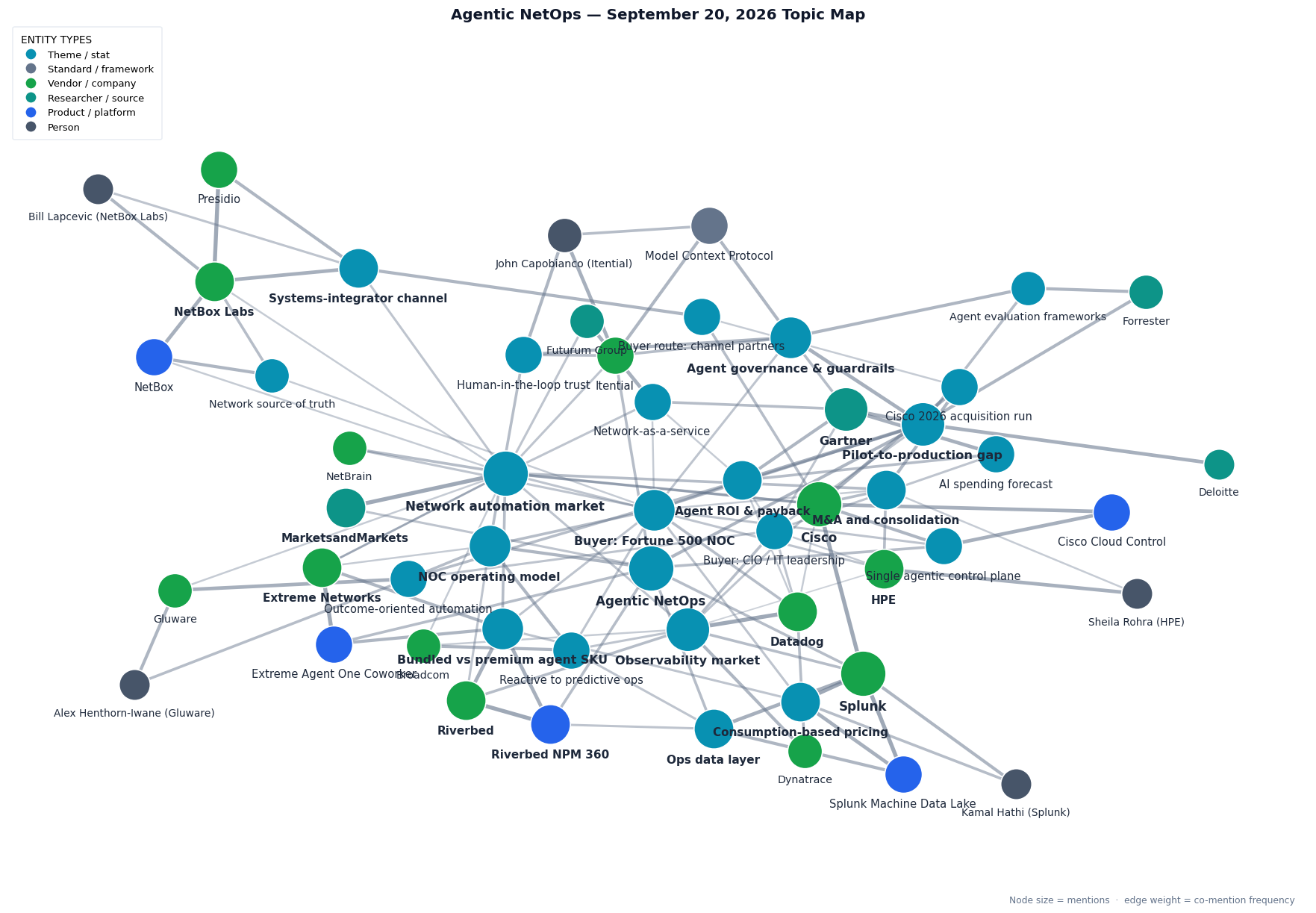
Entities and connections across this week’s 18 tracked stories. Node size reflects how often an entity appears; line weight reflects how often two appear together.
View interactive topic map →
Article index
Competitive moves: the platform consolidators
The week’s centre of gravity. Splunk replaced both of its commercial models with activity-based pricing on a new Machine Data Lake, and rebuilt the platform around agents in the same announcement — Agent Launchpad, Observability Studio, a tiered split of its security line, and federation out to Snowflake, Databricks and AWS CloudWatch instead of copying data in. Cisco supplied the strategy around it: three acquisitions inside 2026, a partner programme re-pointed at AI outcomes, and Cisco Cloud Control as one agentic control plane across four portfolios. The Q4 FY2026 numbers show what it is buying — 280-plus new Splunk logos in the quarter and the 1,000 annual new-logo target passed. HPE, meanwhile, put a new chief operating officer into its Hybrid Cloud unit.
Competitive moves: packaging and route to market
Four answers to the question of how agentic capability actually gets sold. Riverbed folded agentic AI into its existing network performance portfolio and priced it at no premium to AppResponse and NetProfiler; Extreme put Agent One Coworker inside the Platform One subscription with no separate price — two independent vendors declining an upsell tier in the same week. NetBox Labs took the third route entirely, embedding its platform into Presidio’s Modern Networks practice rather than hiring a salesforce. And Datadog’s enterprise cohort is the benchmark all of it gets measured against.
Buyer adoption and the demand reality
The counterweight to every launch above. Seven research houses now put numbers on the pilot-to-production gap, and they agree on direction even where their definitions differ: most agent pilots never become production systems, and the causes are operational rather than technical. Network-as-a-service shows the same shape in a consumption model — 13% adoption against 62% actively evaluating. Itential’s publicly stated adoption path is worth reading as a competitor’s view of what a buyer will actually accept: read-only first, permissions and audit trails before autonomy.
The NOC operating model
Two vendor-authored essays, both worth reading for the argument rather than the product. Broadcom’s Jeremy Rossbach, Chief Technical Evangelist for Network Observability, makes the case for retiring MTTR as the organising metric in favour of topology-anchored prediction. Gluware’s Alex Henthorn-Iwane, Senior Vice President of Marketing, makes the sharper commercial point: task-oriented automation sells engineering efficiency, which does not survive a board conversation, while outcome-oriented automation sells a business result. Gluware’s own outcome claims carry no disclosed methodology and are not reproduced here.
Market sizing and the analyst view
The numbers that will be quoted back at you this quarter, and what each one actually measures. MarketsandMarkets sizes network automation at $8.69 billion in 2026 growing to $14.42 billion by 2032 — an 8.8% CAGR with services the fastest-growing cut. Its AI-in-network report, published two days later, runs at 17.0% CAGR to $21.52 billion but spans carrier as well as enterprise networks, so the two are not two readings of the same market. Gartner’s AI spending forecast and its 2027 strategic predictions set the wider frame: both are general AI-market calls rather than NetOps ones, and the only cuts that bear on this business are AI software and the agents-and-assistants line.
Detailed write-ups
1. Splunk changes what customers pay for — and Cisco makes network data the reason to stay
TechTarget · SiliconANGLE · September 15–18, 2026
Splunk is retiring both of its commercial models at once. Ingest-based licensing, charged on the volume of data indexed each day, and workload-based pricing, charged on search and analytics resource, both required universal indexing at ingestion. They are being replaced by activity-based pricing delivered through a new Machine Data Lake, where indexing at the door is no longer mandatory and the customer is charged when data is searched rather than when it arrives. For a decade, every buyer in this market has made architecture decisions to manage an ingest bill. Mike Leone of Moor Insights & Strategy named exactly what changes: “A lot of Splunk customers have spent years architecting around ingest-based licensing, deciding what to index versus what to keep somewhere cheaper. Weighting search equally with ingest changes that math.” Every vendor whose value proposition rests on helping customers avoid ingest costs should reread that sentence.
What has not been published is any number. There is no rate card, no list price, no per-unit figure and no percentage change. The only quantified claim belongs to Splunk itself — Kamal Hathi, senior vice president and general manager, framing the goal as adding a zero to the volume of data processed while holding cost flat. That is a stated intent, not an achieved result, and it should be carried into any competitive conversation as such. The friction is real too: Karun Subramanian, Senior Director of AI at UnitedHealth Group, says data rehydration latency in Federated Search is still a problem mid-incident — “you cannot really wait for an hour for data to be rehydrated.” A pricing model that encourages leaving data unindexed only works if retrieving it is fast enough to use during an outage, and that is not yet settled.
The architecture announced alongside it explains the strategy. Splunk is rebuilding the platform around agents: an Agent Launchpad, an Observability Studio, a tokenomics layer for cost control, and a tiered split of the security line into Enterprise Security Essentials and Enterprise Security Premier — with federation out to Snowflake, Databricks and AWS CloudWatch rather than copying data in. The stated direction is raw telemetry turned into AI-ready signals plus a context layer built to be consumed by autonomous agents. And the differentiator is not the engine, it is the corpus. Stephen Elliot of IDC put the competitive asset precisely: Splunk holds security data, operational data “and increasingly, network data — that’s a very unique data set.” Cisco network topology data is being layered on top. Read commercially, this is a move to make the data layer the lock-in rather than the licence — and for anyone selling network automation into a Splunk-and-Cisco account, the question a buyer will now ask is not whose agent is better but whose context is richer.
Sources: TechTarget (Seismic shift in Splunk pricing spotlights AI data management) · SiliconANGLE (Splunk rebuilds its platform around agents)
2. Cisco assembles one control plane across four portfolios — and re-points the channel at it
MSSP Alert · Zacks / The Globe and Mail · September 16–17, 2026
The structurally important fact for a network-automation competitor is a single product: Cisco Cloud Control, announced as one agentic-AI control plane spanning networking, security, collaboration and observability, built on Cisco Data Fabric and running on the Splunk platform. Cisco is not shipping four agents for four portfolios. It is assembling one control surface across all of them, on top of the data layer described above. Whether that is a shipping product or a roadmap in a press release is the open question — but as a statement of where the largest vendor in enterprise networking intends to compete, it is unambiguous, and it defines the ground on which every multi-vendor automation platform will be asked to justify itself.
The corporate machinery behind it moved in the same direction. Three acquisitions closed inside 2026: Galileo Technologies in AI observability (April), Astrix Security in identity protection (May), and WideField Security in June, to be folded into the Splunk platform. No purchase price was disclosed for any of the three, and undisclosed should not be read as small. Cisco is also running layoffs explicitly to reallocate resource toward AI, security and quantum networking, with no headcount figure given. And the Cisco 360 Partner Program has been updated with new designations weighted toward AI-ready data centres and digital resilience — channel economics re-pointed at AI outcomes rather than product volume. That last item deserves more attention than it usually gets: when the largest vendor in the category changes what it pays partners for, it changes what partners sell, and that reaches customers faster than any product launch.
The commercial evidence that the strategy is landing comes from the quarter’s results rather than the announcement. In Q4 FY2026 Splunk added more than 280 new logos and passed its 1,000 new-logo annual target; more than 1,500 customers bought newer security products — Secure Access, XDR, Hypershield and AI Defense — in the quarter, and security order growth was double-digit. That is a real acquisition engine, not a repackaging exercise, and it is being pointed at the same accounts that buy network operations software. The caution worth carrying: the strategy brief itself is a short aggregator item with no named executives, no revenue figures and no attributed quotes, so treat the direction as well evidenced and the detail as thin. The number to track next quarter is new logos, not total security revenue — it is the only figure that separates genuine expansion from a bundle moving spend that was already Cisco’s.
Sources: MSSP Alert (Cisco accelerates AI strategy with acquisitions, restructuring, and partner program updates) · Zacks / The Globe and Mail (CSCO’s Splunk AI Push Gains Momentum: Can It Outpace DDOG, CRWD?)
3. Two vendors, one week, no upsell: the agent is becoming a subscription feature
Network World · Telecom Reseller · September 14–16, 2026
The headline on the Riverbed story reads as a product launch. The market-relevant fact is the price. NPM 360 folds agentic AI into Riverbed’s existing network performance management portfolio — not as a separate AI product — and is initially offered at no premium to current AppResponse and NetProfiler pricing, available immediately. The stack behind it is Riverbed IQ as the intelligence layer, spanning causal, predictive, generative and agentic AI, with Riverbed Q as a conversational interface over AppResponse for packet capture, NetProfiler for enterprise-scale flow, and NPM+ for endpoint data covering remote users, Zero Trust, data centre and cloud. The positioning is consolidation-led — one integrated data set rather than correlation across fragmented multi-vendor tools — and notably, no competitor is named. Richard Tworek is Riverbed’s chief technology officer. Bob Laliberte of Liberte Research Group supplied the adoption argument, and it is the one incumbents will lean on all year: “Users benefit from a tightly integrated solution into what they are using today vs. learning a new tool.”
Four days earlier, Extreme Networks did the same thing. Extreme Agent One Coworker reached general availability on September 10, delivered inside the Extreme Platform One subscription with no separately disclosed price. Extreme’s own claim of up to fifteen times faster issue resolution carries no disclosed methodology and is not reproduced here as a fact; the independent perspective in the coverage comes from Shamus McGillicuddy, Vice President of IT Research at Enterprise Management Associates, on why context-aware agents matter to operators. Strip both announcements back and the same decision sits underneath: agentic capability shipped inside a subscription the customer already pays for, rather than sold as a premium tier.
Two independent vendors making that call in one week is a pattern, and it is the most consequential commercial signal of the issue. If agentic capability becomes a standard inclusion, three things follow. Revenue models built on a premium agentic SKU need rewriting, because the market is pricing the agent at zero at the point of sale. Competitive differentiation moves from having an agent to what the agent can reach — which favours whoever has the broadest multi-vendor context rather than whoever shipped first. And renewal defence becomes the real purpose of these launches: an incumbent that bundles an agent makes switching cost the argument, exactly as Laliberte describes. The caveat is that “no premium” is described as an initial offer in Riverbed’s case, so read it as an introductory land-grab price rather than a permanent position. Neither vendor disclosed customer counts, deployment numbers or outcome data, so this is a packaging signal, not evidence of traction.
Sources: Network World (Riverbed bolsters network performance monitoring with agentic AI) · Telecom Reseller (Extreme Networks Launches Context-Aware AI Coworker for Network Operations)
4. NetBox Labs builds a channel instead of a salesforce — for the third time this year
GlobeNewswire · September 15, 2026
NetBox Labs is embedding its infrastructure intelligence platform into Presidio’s Modern Networks practice. This is a route-to-market move, not a product move, and the pattern is the story: it is NetBox Labs’ third named enterprise-integrator partnership of 2026, following AHEAD in April and World Wide Technology. A company selling network source-of-truth software into large enterprises has decided that the way to reach Fortune 500 network operations is through the integrators already inside those accounts, rather than by scaling a direct salesforce against incumbents with twenty-year relationships. For any competitor weighing channel investment against direct hiring, that is a deliberate strategy being executed in public, three times over.
The scale each side brings is the commercial logic. NetBox Labs cites more than 10,000 organisations using the open-source NetBox — a community number, not a paying customer count, and it should never be quoted as revenue-bearing — while Presidio is cited at more than 6,800 customers. The open-source base is the demand-generation engine and the integrator is the conversion path; that is a coherent model, and it is cheaper than the alternative. Rollout is North America first with planned expansion into Europe and Asia Pacific. The named target verticals — financial services, healthcare and entertainment — are the same rooms most of this field sells into. The platform is available as SaaS or self-managed, which matters more than it sounds: both are consumption models an integrator can resell and wrap services around. Bill Lapcevic, NetBox Labs’ chief revenue officer, described the intent in terms that are really about deal size: “Together, we are positioning the NetBox Labs platform as a foundational layer within larger initiatives.” Brian Wisler is vice president of Presidio Modern Networks.
What is missing tells you where this sits on the evidence curve. No funding amount, valuation, revenue figure, deal value or partner-sourced pipeline number was disclosed by either side. The named engagements are described but not identified — a major North American bank, a US metropolitan court system, a US smart home and security firm, a global media services provider. NetBox Labs’ investors are given as NGP, Notable Capital, Flybridge, IBM, Salesforce and Two Sigma, which is a credible bench without being a valuation. So treat this as strategy visible in motion rather than proof it works. The measurable moment arrives when someone in this field discloses what share of enterprise revenue actually arrived through an integrator — until then, three partnerships in nine months is a hypothesis being tested at speed.
Sources: GlobeNewswire (NetBox Labs and Presidio Announce Strategic Partnership to Anchor Enterprise Infrastructure Modernization and Automation)
5. Why 89% of agent pilots die — and why it is an operations problem, not a model problem
AI News · September 14, 2026
This is the most important set of numbers in the issue, because it is the one every agentic business case is implicitly arguing against. Deloitte’s 2026 technology trends research puts the pilot-to-production failure rate for AI agents at 89%. Teradata finds 78% of enterprises running at least one agent pilot but only 14% scaled to organisation-wide use. Gartner, surveying 782 infrastructure and operations leaders in April 2026, finds that 120 of every 1,000 AI projects reach production and only 34 of those meet their ROI target; its Agentic AI Pulse survey puts 41% of deployments at positive ROI inside twelve months, with 19% never reaching payback at all. Independent corroboration on the scale gap comes from McKinsey, which puts organisations running agents at genuine scale at 11%, and S&P Global Market Intelligence, which puts those with at least one agent in production at 31%. These are seven houses with seven definitions of pilot, production and scale, so the figures are directionally consistent rather than arithmetically comparable — attribute each to its source and never blend them into one headline percentage.
What is not in dispute is where the failures come from, and it is not model capability. Scope creep and data quality together account for 61% of failures; 83% of enterprises are said to need infrastructure overhauls to support agentic AI; cancelled projects saw costs run two to three times beyond estimate. Forrester then quantifies the fix, and this is the number to build a roadmap around: agents without automated evaluation show a 47% rollback rate against 9% with full coverage, systematic evaluation frameworks correlate with six times higher production success rates, and only 38% of production agents currently have automated evaluation on every prompt change. Security is a gate rather than an afterthought too — Gravitee’s 2026 research finds 54% of organisations experienced or suspected an agent-related security or privacy incident in the past year, with only 20% fully securing agents in production.
For a vendor in enterprise network operations, this reframes what is actually being sold. The buyer’s risk is not that the agent will be insufficiently clever; it is that the deployment will stall, roll back, or never be trusted with a change window — and the evidence says that outcome is the base case, not the edge case. That is why Itential’s publicly described adoption path is worth reading as market intelligence: read-only access first, tool selection fixed at build time rather than left to the agent, role-based access control and OAuth2 through the Model Context Protocol, full audit trails, and a staged progression from human-in-the-loop to human-on-the-loop to human-in-the-lead — with one cited customer study putting 64% of network-operator activity in the read-only category to begin with. Splunk’s stated posture of tightly constrained agents points the same way. Three independent sources converging on governance as the constraint is the strongest demand-side signal of the week, and it says the differentiator that wins deals in the next eighteen months is evidence of safe operation, not autonomy.
Sources: AI News (Why Most Enterprise Agent Pilots Never Reach Deployment) · TFiR (AI Agents in Network Operations: Itential’s John Capobianco on trust, guardrails and onboarding agents like new hires)
6. An 8.8% market, not an AI boom — and why the services line is the tell
MarketsandMarkets / PR Newswire · September 14–16, 2026
MarketsandMarkets puts the network automation market at $8.69 billion in 2026, reaching $14.42 billion by 2032, an 8.8% compound annual growth rate. That framing matters more than the absolute number. An 8.8% CAGR is a solid enterprise software market; it is not a hypergrowth AI number, and the analyst house is plainly treating this category as steady infrastructure spend rather than a land rush. Anyone building a plan on the assumption that agentic capability will bend the category’s growth curve upward is arguing against the house view, and should be ready to say why. The stated demand driver is unglamorous and durable: buyers replacing fragmented, manual operating processes with centralised and programmable approaches as infrastructure scale and diversity grow.
The segmentation carries the commercially useful signal. Services is the fastest-growing cut of the market at a 9.5% CAGR — faster than the market as a whole — which means money is moving toward delivery and outcome rather than licences alone. That is a direct corroboration of both NetBox Labs’ integrator strategy and Gluware’s argument that the business buys outcomes, not tasks. By type, orchestration automation is the largest segment while AI-driven network automation carries the highest growth rate; by organisation size the enterprise segment holds the largest share; by application, data centre networks lead; by region, Asia Pacific grows fastest. The named competitive landscape puts the top five as Cisco, HPE, IBM, Huawei and Broadcom, with NetBrain Technologies, Forward Networks, SolarWinds, Itential, Extreme Networks, Arista, Nokia, Ericsson and Fujitsu also listed. That is a report inclusion list, not a ranking by share, and should not be presented as a leaderboard.
Two days later the same house published an AI in network market report: $8.38 billion in 2026 to $21.52 billion by 2032 at a 17.0% CAGR, with managed services fastest at 20.4%, enterprises the fastest-growing end user and Asia Pacific again the fastest region. It will be tempting to read the two together as confirmation of the same trend. They are not. The AI-in-network report explicitly spans both enterprise and telecom or carrier networks including 5G and edge, so its 17% is not a like-for-like read on the enterprise network-automation opportunity that the 8.8% describes. Expect the larger number to appear in competitors’ decks considerably more often than the smaller one, and be ready to explain the boundary difference in a customer meeting before someone else defines it for you. Both are promotional releases for paid reports, published without underlying method or sample, and belong in a board pack as directional context rather than as a sizing you would defend.
Sources: MarketsandMarkets / PR Newswire (Network Automation Market worth $14.42 billion by 2032) · MarketsandMarkets / PR Newswire (AI in Network Market worth $21.52 billion by 2032)
7. Datadog sets the enterprise benchmark this market gets measured against
Zacks / Yahoo Finance · September 17, 2026
Datadog now has approximately 4,720 customers spending $100,000 or more a year, up 23% year over year from roughly 3,850, against a total base of approximately 33,400 versus 31,400 a year earlier. The high-value band is growing roughly three times faster than the base — the clearest available picture of what enterprise consolidation onto an operations platform looks like when it is genuinely working. Enterprise new-logo annualised bookings more than doubled year over year. Q2 2026 revenue was $1.12 billion, up 36%, with non-GAAP operating margin at 23% from 20% and free cash flow of $279 million against $165 million. This matters to a network-automation vendor because it is the comparison a board will reach for: when the CIO is already writing a seven-figure cheque to an operations platform, every adjacent purchase gets evaluated against that relationship.
The forward indicator is the one to watch. Remaining performance obligations reached $3.47 billion, up 43% year over year, with current RPO growing about 40% — committed future revenue growing faster than revenue itself, which is what deepening enterprise commitment looks like before it shows up in a quarter. Guidance for 2026 is $1.135–1.145 billion for Q3 and $4.45–4.47 billion for the full year, with non-GAAP operating income of $1.01–1.03 billion. AI is a named demand driver rather than a narrative one: more than 750 AI-native customers, and all of the top ten AI companies as customers. The competitive benchmarks in the same coverage put Dynatrace at $2.14 billion total ARR, up 17%, with new-logo ARR growth above 160%, and Elastic with more than 1,800 customers at $100,000-plus annual contract value and 27% RPO growth.
Two things to carry from this. First, the observability buyer and the network operations buyer are converging on the same budget conversation, and the observability side currently has the stronger enterprise expansion story — which is precisely why Splunk and Cisco are pushing network data into that platform, and why Riverbed positions NPM 360 as one integrated data set. Second, the valuation context is worth knowing before a board meeting: the stock is up 74.7% year to date against roughly 17% for its sector, on a forward price-to-sales of 16.04 against an industry average of 4.2. The market is paying for the enterprise expansion curve, not the revenue. Note that the reported financials come from Datadog’s own results and are sound, while the Zacks Rank, Value Score and EPS estimate carried in the same piece are that publisher’s editorial ratings rather than company data, and should not be presented as market fact.
Sources: Zacks / Yahoo Finance (Datadog’s Enterprise Customer Expansion Accelerates)
Calls to action
- Reprice the agentic business case for a bundled market this quarter. Riverbed shipped NPM 360 at no premium to AppResponse and NetProfiler pricing and Extreme put Agent One Coworker inside Platform One with no separate price. Run the scenario where agentic capability carries a list price of zero and the revenue shows up as retained renewals instead, and establish which parts of the plan survive it before a customer asks.
- Write the answer to “why not just use Cisco Cloud Control?” before the question arrives in a deal. Cisco has stated it is building one agentic control plane across networking, security, collaboration and observability on the Splunk platform. Prepare the multi-vendor case on evidence rather than principle: name the equipment classes and vendors your agents act on today, and be ready to demonstrate an action — not a dashboard — on kit no single platform vendor sells.
- Make evaluation coverage a product commitment, not a services engagement. Forrester’s numbers make this the sharpest commercial lever available: 47% rollback without automated evaluation against 9% with full coverage, six times higher production success with systematic evaluation, and only 38% of production agents evaluated on every prompt change. Ship evaluation as a feature with a number attached and you can sell against the failure rate rather than around it.
- Lead the next three customer conversations with the read-only path. The evidence says stalls, rollbacks and lost trust kill these deployments, not insufficient autonomy — and Itential is already selling a staged path from human-in-the-loop to human-on-the-loop to human-in-the-lead, with one cited study putting 64% of network-operator activity in the read-only category. Package a first-ninety-days read-only deployment with scoped permissions and full audit trails as the default entry point.
- Get one named customer with an audited before-and-after number. Nothing in this week’s launches carried customer counts, deployment numbers or measured outcomes — Riverbed, Extreme and NetBox Labs all disclosed none. The evidence bar in this category is still on the floor. Being first over it, with a named Fortune 500 reference and a figure someone else verified, is a defensible position while competitors are still arguing in adjectives.
- Brief the field on the two MarketsandMarkets numbers this week, not next quarter. The enterprise network-automation market is sized at 8.8% CAGR to $14.42 billion by 2032; the AI-in-network report runs at 17.0% to $21.52 billion but includes carrier networks, 5G and edge. Give sellers a one-paragraph explanation of the boundary difference so they can answer it in the room rather than concede the larger figure by silence.
- Shift pricing and packaging toward services and outcomes. Services is the fastest-growing cut of the network automation market at 9.5% CAGR, ahead of the market overall, and Gluware’s argument is that task-oriented automation sells engineering efficiency while outcome-oriented automation sells a business result. Pick one high-frequency incident class, define the outcome a buyer would pay for, and price against that outcome in the next packaging review.
- Audit whether your own data layer can answer what an agent will ask of it. Splunk is explicitly repositioning raw telemetry as AI-ready signals plus a context layer for agents, and Cisco is layering network topology onto it as the differentiator. Whatever you sell, the customer’s agent is going to reason over someone’s data. Establish now whether that data is yours, whose context is richer in your top ten accounts, and what it would take to close the gap.
- Decide your channel position deliberately rather than by default. NetBox Labs has signed three enterprise integrators in nine months, and Cisco has re-weighted its 360 Partner Program toward AI outcomes — both are moving buying influence toward partners. Review what share of your pipeline is partner-sourced, what an integrator actually earns on your platform, and whether a direct-hire plan still beats a channel plan at the enterprise sizes you are chasing.
|