This week at a glance
The advisory cycle is the spine of the week. CISA published eight industrial control system advisories on September 15 — ICSA-26-258-01 through -08 — and the batch is unusually vendor-diverse for a single release: two SCADA and RTU platforms (mySCADA myPRO Manager, Schneider Electric SCADAPack x70), three Siemens products (the Reyrolle 7SR5 protection relay, Mendix SAML and Teamcenter), two video-surveillance lines (Digital Watchdog VMAX DVR/NVR, CareCam CM2507), and one marine propulsion and fleet-operations system, Wärtsilä FOS-Onboard. The highest-scoring flaw is CVE-2026-73807 in myPRO Manager at CVSS v3.1 9.8: the command API does not enforce authentication on privileged functions, reachable over the network with no credentials, fixed in 2.2. The one to read twice if you run anything afloat is FOS-Onboard, which carries two hard-coded cryptographic key flaws, CVE-2026-78225 at v3.1 9.0 and CVE-2026-81855 at v3.1 9.1. Hard-coded keys cannot be rotated without a patch, so that is a standing exposure rather than a configuration mistake, and the fix comes from the vendor on contact rather than as a published version number. At the other end of the batch, CareCam CM2507 has no fix at all — the vendor was non-responsive, and network isolation is the only mitigation on offer.
The maritime timing is a coincidence worth sitting with, but the tanker story needs to be read precisely. The Coast Guard and the FBI boarded two oil tankers, on August 21 in the Gulf of Mexico and on August 24, with Coast Guard law enforcement personnel, a vessel inspector, a Coast Guard Cyber Protection Team and the FBI’s Cyber Action Team aboard. What is confirmed is narrow: indications that the vessels’ networks were compromised, boardings intended to “ensure integrity of the vessel’s operational and information technology systems,” and a 30-hour loss of communications. The Coast Guard reported no operational disruption, no vessel instability, no physical danger and no environmental impact. “Foreign cyber actors” is the Coast Guard’s own characterisation — no state has been named by any US agency and no group has claimed responsibility. The vivid claims now circulating, that attackers increased engine speed and disabled fuel and engine-oil tank systems, come from the Iranian outlet Mehr and are explicitly not confirmed by US authorities. Dahvid Schloss, COO of Suzu Labs, has publicly warned that two separate claims are circulating and urged skepticism pending verification. That is the right posture this week.
On the regulatory side, FERC approved NERC CIP-014-4, published in the Federal Register on September 15 with an enforceable date of October 1, 2028. It does three things that change work rather than paperwork: R1 collapses the split 30-month and 60-month review timelines of CIP-014-3 into a single 36-month cycle; R2 newly requires identifying nearby facilities within 1,500 feet, measured fence-line to fence-line; and R3 demands a documented risk assessment methodology with “technically justified thresholds for instability, uncontrolled separation or cascading.” As filed, the burden falls on 344 transmission owners. Elsewhere in standards, Health-ISAC published a nine-domain MedTech cybersecurity baseline aimed at procurement and deployment decisions, and the Healthcare Sector Coordinating Council backed a set of healthcare cybersecurity bills while calling for broader funding and tighter HHS–CISA coordination.
The sector data was blunter than the policy. Black Kite’s 2026 Manufacturing & Distribution Report, covering January 1 to July 29, counted 1,183 manufacturing ransomware victims, up 39.7% on the 847 in the same window of 2025 and 22% of all 7,551 disclosed victims across industries. The interesting part is not the growth but its shape: US victims were 412 cases, only 34.8% of the total, while European victims rose 85.4% year over year and Germany alone rose more than 83%. Seven in ten victims sat in the $10M–$100M revenue band, median revenue $42.9 million. The hygiene picture that Cybersecurity Dive draws out of the same dataset is the genuinely new finding: critical vulnerability exposure fell to 75% of large manufacturers in 2026 from 80% in 2024 and known-exploited exposure to 54% from 67%, while credential exposure stayed flat at around 70% and stealer-log presence among breached firms climbed from 25% in 2023 to 42% in 2026. Patching is working. Identity is not. Two research items sharpen the same point from different directions — TXOne’s honeypot data shows 91% of malware downloads arriving over a single port and roughly 5.4 million SSH credential attempts against generic pairs, and Dragos’s reconnaissance research describes adversaries whose objective is your network diagrams and alarm data rather than your perimeter. Finally, a caution on one headline: the “12 new Siemens SCALANCE vulnerabilities” reported this week are CVE-2025 identifiers with a fix available since V4.0 HF0, only nine of which are in the SCALANCE at all. It is a research publication, not a fresh disclosure.
On our watch list
- Whether the two unfixed advisories in this batch ever get a fix. CareCam CM2507 (ICSA-26-258-08) has no vendor patch and a non-responsive vendor, and Schneider’s SCADAPack x70 advisory (ICSA-26-258-04) has published no CVE identifier, CVSS score or fixed firmware version. Watching for a CVE assignment and a firmware release on the Schneider items, and for whether CareCam responds at all — until it does, isolation is the whole mitigation.
- The Wärtsilä FOS-Onboard patch route. Both hard-coded key flaws are fixed only by contacting the vendor; no fixed version number has been published against affected version 5.07.0923.01. Watching for a published version, because a fleet operator cannot evidence remediation across vessels against a patch that has no number, and hard-coded keys stay valid until the firmware changes.
- October 1, 2028 — and the 1,500-foot surveys that have to precede it. CIP-014-4’s initial risk assessments are due on that date and every 36 months thereafter. The new R2 obligation to identify nearby facilities within 1,500 feet fence-line to fence-line is a physical survey of adjacent land use at every in-scope station. Watching for the first NERC implementation guidance on how “nearby facility” is scoped, because that determination sets the workload for all 344 transmission owners.
- What “technically justified thresholds” turns out to mean in audit. CIP-014-4 R3 requires a documented risk assessment methodology with technically justified thresholds for instability, uncontrolled separation or cascading, and R6 through R10 carry forward unchanged. Watching for the first regional entity guidance or audit approach that says what evidence satisfies “technically justified” — a study, a reference case, or an engineer’s signature.
- Whether any US agency ever names an actor for the tanker incidents. Today there is a Coast Guard characterisation of “foreign cyber actors,” no named state, no claim of responsibility, and a set of engine-manipulation claims sourced only to Iranian state media. Watching for an attribution statement, a marine safety information bulletin, or an advisory with indicators — and treating the engine-speed claims as unverified until one of those appears.
- Whether the FOS-Onboard advisory changes anything in maritime procurement. A shipboard fleet-operations system with hard-coded cryptographic keys is exactly the class of finding that charterers and class societies can turn into a contractual question. Watching for newbuild and charter specifications that start asking for key-management evidence rather than a vulnerability-disclosure policy.
- Whether manufacturing’s identity numbers move next year. Black Kite’s longitudinal read shows patching exposure falling while credential exposure sits flat near 70% and stealer-log presence among breached firms rises to 42%. Watching the next edition of the same dataset: if patching keeps improving and identity stays flat, the case for spending the next dollar on credential hygiene rather than on vulnerability management stops being arguable.
- The Gentlemen’s trajectory. The group did not exist before September 2025 and already ranks second in manufacturing victims for January–July 2026 with 142 incidents, behind Qilin’s 178. Watching whether that is a durable operation or an affiliate surge that fragments — and whether European victim growth of 85.4% year over year keeps tracking it.
- Nozomi Compass’s January 2027 general availability. The platform is announced with framework-mapping claims against NERC CIP, IEC 62443, NIS2 and TSA directives, but it does not ship to customers until January 2027, and there is no pricing, no named customer and no independent validation yet. Watching for GA, a reference customer, and whether the compliance mapping survives contact with an actual audit.
- Whether Cylus.ai turns into a product with a standard attached. The launch at InnoTrans came with no availability date, no customers, no metrics and no named rail standard — no CLC/TS 50701 or IEC 62443 claim. The substantive news was the advisory board. Watching for a shipping date and a conformance claim.
- How the OT chapters of SANS DAIR get used. The framework is the first rebuild of the SANS incident response model in two decades, replacing the linear PICERL sequence, and its control-systems material is contributed rather than core. Watching whether OT teams adopt the adaptive model in exercises this autumn, or whether it stays a reading-list item while playbooks keep the six linear steps.
- Whether state cyber services reach utilities at all. NASCIO and GDIT report 90% of state CIOs rank attacks on critical systems a high concern, but only 32% of states extend cyber services to public utilities and 24% to public hospitals. Watching for states that copy Utah’s shared-services model — roughly 80% of local government entities reached, plus $1.5 million in additional water-sector funding — because that is the only demonstrated route from state capability to a small water system.
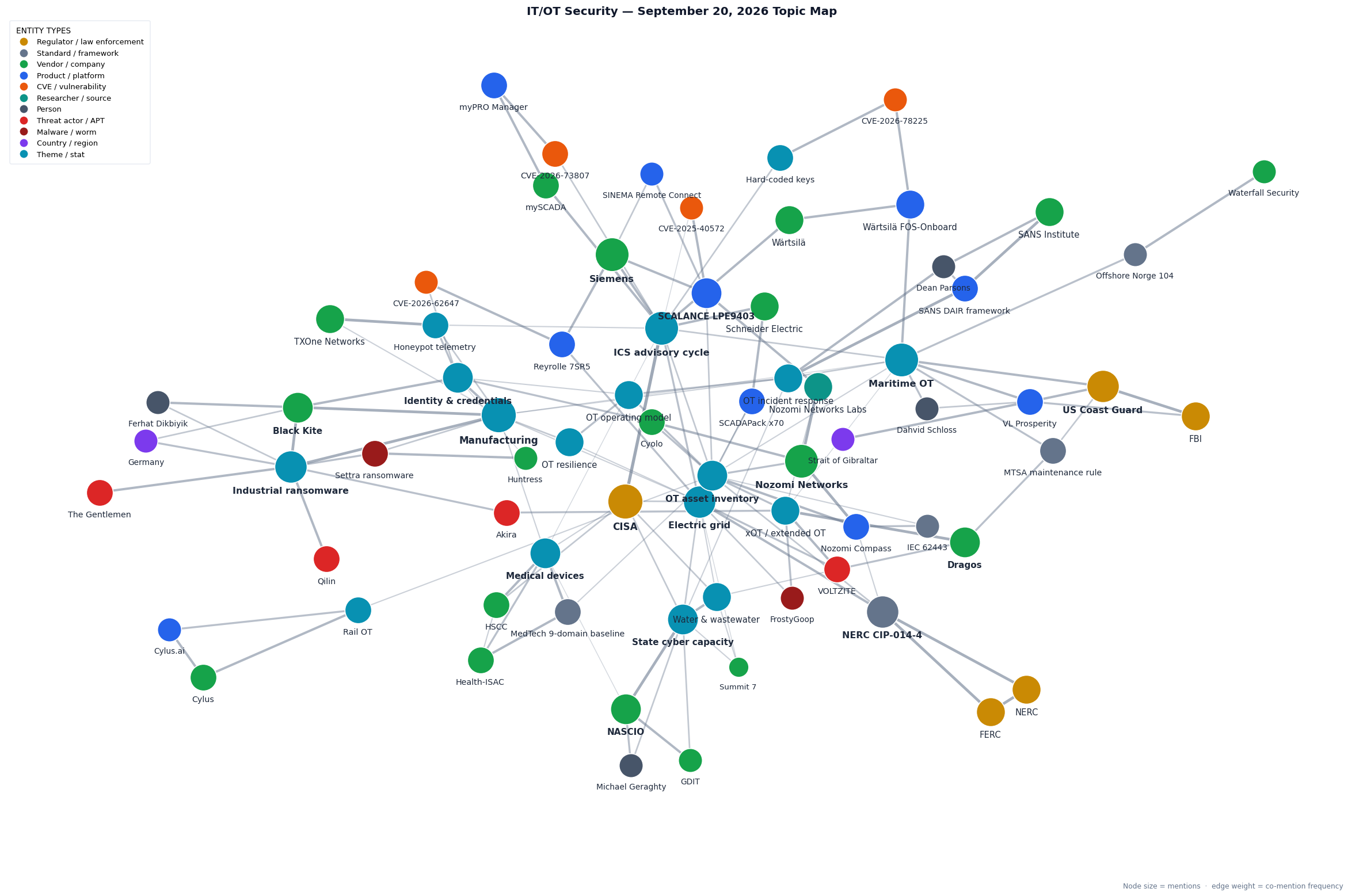
This week’s topic map — an advisory-and-vulnerability week with a maritime incident running through it. The ICS advisory cycle sits at the centre with CISA, drawing in Siemens and the Reyrolle 7SR5 relay, Schneider Electric and SCADAPack x70, mySCADA’s myPRO Manager with CVE-2026-73807, and Wärtsilä’s FOS-Onboard with CVE-2026-78225 and the hard-coded key theme; a separate Nozomi Networks Labs cluster carries the SCALANCE LPE9403 and SINEMA Remote Connect research under CVE-2025-40572. Maritime OT links the US Coast Guard, the FBI, the VL Prosperity and the Strait of Gibraltar to the MTSA maintenance rule and Offshore Norge 104. FERC and NERC anchor CIP-014-4 against the electric grid. Black Kite ties industrial ransomware to manufacturing, Qilin, The Gentlemen, Akira and Germany, with identity and credentials as the crossing point into TXOne’s honeypot telemetry. Dragos carries xOT, VOLTZITE and FrostyGoop; NASCIO, GDIT and state cyber capacity run into water and wastewater; and an OT tooling band joins Nozomi Compass, Cyolo, Cylus and the SANS DAIR framework to OT asset inventory and incident response.
View interactive topic map →
Article index
The ICS advisory cycle
Eight advisories in one release, and one piece of vulnerability research whose headline needs correcting before you act on it. The advisory batch carries the week’s real patch load; the SCALANCE research describes CVEs that have had a fix available since last year.
Maritime OT: under attack, and under-maintained
One incident where the confirmed facts are much narrower than the headlines, and two pieces about the unglamorous engineering and maintenance work that maritime OT security actually consists of. The Wärtsilä FOS-Onboard advisory in the batch above belongs conceptually in this group too.
Regulation and standards moving
A transmission physical-security standard with a firm 2028 date and a new survey obligation, plus two healthcare items that are about procurement leverage rather than technology.
Manufacturing as the ransomware front line
One dataset with a clear longitudinal finding, and one ransomware variant that reached this section on the word “manufacturing” — its tradecraft is worth knowing, but no OT or ICS impact was reported in either victim.
State and whole-of-nation critical infrastructure capacity
One report and three pieces circling the same finding: the states that hold the mandate do not consistently reach the utilities that hold the risk. The fourth item is an opinion piece, and its author’s affiliation is stated in the write-up below because it bears on the argument.
Threat telemetry and adversary reconnaissance
Two vendor research pieces that point the same way from opposite ends — one counts what hits exposed industrial services at internet scale, the other describes what a patient adversary is actually looking for once inside.
OT tooling and vendor announcements
Three announcements from the asset-intelligence corner of the market, two of them from the same vendor, and one incident response framework that earns its place here because of its contributed control-systems chapters. Availability dates and what is actually shipping are stated where the vendors disclosed them.
Building the OT security function
Two practitioner guides published the same day, one on the operating model and one on what resilience actually controls. Read together they are the organisational counterpart to the advisory load above.
Detailed write-ups
1. Eight ICS advisories in one cycle, and the two with no version number to patch to
CISA · September 15, 2026
CISA released eight industrial control system advisories on September 15, ICSA-26-258-01 through -08. The batch is worth reading as a set rather than a queue, because the vendor spread is unusual for one cycle: two SCADA and RTU platforms, three Siemens products, two video-surveillance lines and one shipboard fleet-operations system. CISA’s own stated action is the usual one — “CISA encourages users and administrators to review these ICS Advisories for technical details and mitigations” — so the triage is yours to do.
Start with the highest score. ICSA-26-258-03 covers mySCADA myPRO Manager, where CVE-2026-73807 is a missing-authorization flaw (CWE-862) on the command API at CVSS v3.1 9.8 and v4.0 9.3: an unauthenticated attacker reaching the network can invoke privileged management functions. Versions 2.1 and earlier are affected and 2.2 fixes it. The same advisory carries CVE-2026-82567, an unauthenticated HTTP endpoint on the notification gateway that will send arbitrary SMS through a connected GSM modem — lower-scoring at v3.1 6.3 and adjacent-network only, but a useful reminder that the messaging path out of a SCADA box is an attack surface as well as an alerting one. ICSA-26-258-01, Digital Watchdog’s VMAX DVR and NVR lineups, is the other critical: CVE-2026-66890 and CVE-2026-66887 both at CVSS 9.6, with authentication bypass, hard-coded credentials, missing authorization and predictable session-token generation chaining to root-level command execution. Firmware updates are available and there is no known public exploitation of any advisory in the batch.
Two advisories in this cycle cannot be closed the normal way, and they are the ones to escalate. ICSA-26-258-02 covers Wärtsilä FOS-Onboard, the shipboard fleet-operations system, with two hard-coded cryptographic key flaws under CWE-321: CVE-2026-78225, a hard-coded server key in the deployer-ng Update Controller at CVSS v3.1 9.0 and v4.0 9.5, and CVE-2026-81855, a hard-coded client authentication key in the robot testing framework component at v3.1 9.1 and v4.0 9.3. Affected version is 5.07.0923.01; the patch comes from the vendor on contact, with no published fixed version number. Because the keys cannot be rotated without patching, this is a standing exposure on shipboard control infrastructure rather than something a configuration change closes. ICSA-26-258-08, the CareCam CM2507 IP cameras, is worse in one specific way: CVE-2026-88259 at CVSS 7.5 plus CVE-2026-84398, CVE-2026-85497 and CVE-2026-81321 covering unauthenticated video stream access, empty passwords on privileged accounts and weak credentials — and the vendor was non-responsive, so there is no fix. Network isolation is the entire mitigation.
The remainder are conventional, with one gap. ICSA-26-258-05 covers the Siemens Reyrolle 7SR5 transmission protection relay under Siemens advisory SSA-142885, with at least seven CVEs; the one that matters is CVE-2026-62647, a random number generator not seeded from a true RNG that produces predictable session identifiers, CVSS v3.1 7.4 and v4.0 9.3, letting an unauthenticated remote attacker predict authentication tokens and impersonate a legitimate user on management interfaces. All versions before V2.70 are affected and V2.70 fixes it. CVE-2026-62652 in the same advisory is debugging symbols shipped in firmware binaries, which eases reverse engineering rather than granting access. ICSA-26-258-06 (Siemens Mendix SAML) and -07 (Siemens Teamcenter, a reflected cross-site scripting flaw in the authentication redirect) are both rated high, and Siemens has released new versions for Teamcenter. ICSA-26-258-04, Schneider Electric SCADAPack x70 — the 47x, 47xi, 47xd, 470R and 57x RTU lines — is rated medium and is the frustrating one: no CVE identifier, CVSS score or fixed firmware version has been published, and Schneider’s own mitigation language warns that “failure to apply the mitigations provided below may increase the risk of unauthorized access to RTU configuration.” Treat it as a configuration-hardening task now and a patch task later. One thing this batch is not: the Schneider Modicon M580 issue from the same September cycle is a separate advisory and not part of these eight.
Sources: CISA
2. The tanker boardings: what the Coast Guard actually said, and what it did not
The Record · September 16, 2026
US authorities boarded two oil tankers following suspected cyber incidents: the first on August 21 in the Gulf of Mexico, the second on August 24. The boarding parties were not routine inspections — they combined Coast Guard law enforcement personnel, a Coast Guard vessel inspector, a Coast Guard Cyber Protection Team and the FBI’s Cyber Action Team. One vessel is named by Bloomberg as the VL Prosperity, attacked on August 7 while transiting the Strait of Gibraltar; the second tanker has not been named.
Separating the confirmed from the attributed matters more than usual here. Confirmed by the Coast Guard: indications that the vessels’ networks were compromised, that the boardings were conducted to “ensure integrity of the vessel’s operational and information technology systems,” and a 30-hour loss of communications as the one concrete operational effect. Also confirmed, and just as important: no operational disruptions, no vessel instability, no physical danger and no environmental impact from either incident. Attributed but not established: “foreign cyber actors” is the Coast Guard’s characterisation, not a named state or group, and nobody has claimed responsibility. Unverified entirely: the striking claims that attackers increased engine speed and disabled fuel and engine-oil tank systems originate with the Iranian outlet Mehr and are explicitly not independently confirmed by US authorities. Dahvid Schloss, COO of Suzu Labs, has noted publicly that two separate claims are circulating and urged skepticism pending verification. If you are briefing a board or a fleet operations group this week, brief the 30-hour comms loss and the network-compromise indications, and mark the propulsion claims as unconfirmed single-source reporting.
The useful takeaway is not the attribution, it is the response model. A cyber incident on a vessel underway produced a physical boarding by a federal cyber team, and the artefacts that determine how well that goes — current network diagrams, an inventory of what is actually on the bridge and engineering networks, logs that survive a 30-hour communications outage, and a designated shipboard point of contact — are the same artefacts the MTSA maintenance obligations exist to keep current. That is the connection worth drawing between this incident and the two maritime engineering pieces in this week’s index. The Wärtsilä FOS-Onboard advisory in the same fortnight makes the point sharper still: shipboard systems are now carrying advisory-grade cryptographic findings while the fleet is at sea.
Sources: The Record · Dragos (MTSA maintenance) · Waterfall Security Solutions
3. CIP-014-4: one 36-month clock, a 1,500-foot survey, and a 2028 date
Industrial Cyber · September 16, 2026
FERC has approved NERC CIP-014-4, published in the Federal Register on September 15. The enforceable effective date is October 1, 2028, which sounds distant until you read what R2 now asks for. Three changes carry the standard. R1 establishes a single unified 36-calendar-month cycle for transmission owners to review and update their list of applicable transmission stations and substations, replacing the split 30-month and 60-month timelines that sat under R5 of CIP-014-3. R2 is new: identification of nearby facilities within 1,500 feet — 457 metres — measured fence-line to fence-line. R3 requires a documented risk assessment methodology with “technically justified thresholds for instability, uncontrolled separation or cascading.” Requirements R6 through R10 carry forward substantively unchanged from CIP-014-3 R2 through R6, so the existing physical security plan machinery survives.
Applicability is unchanged in shape: transmission facilities at 500 kV and above, substations in the 200–499 kV band that meet the specified interconnectivity and criticality tests, and nuclear interface facilities. As filed, the compliance burden falls on 344 transmission owners, estimated at 3,440 hours annually and $286,862 in total, which works out to $833.90 and 10 hours per entity per response. Those are the filing’s own numbers, and they are almost certainly an underestimate of the R2 work for any entity with stations in developed areas.
The R2 obligation is the one to start scoping now, because it is a land-use survey rather than a desk exercise. Fence-line to fence-line at 1,500 feet means someone has to determine what sits adjacent to each in-scope station — a fuel depot, a rail siding, a data centre, a school, a building tall enough to overlook the yard — and document it. That is GIS work plus site verification, repeated on the 36-month cycle, and it is the kind of task that is cheap if you already hold current facility mapping and expensive if you do not. Initial risk assessments are due by October 1, 2028, with subsequent assessments no later than every 36 months thereafter. The sensible sequencing is to do the station list under R1 first, run the 1,500-foot identification against that list, and only then write the R3 methodology — because the thresholds you have to technically justify will be much easier to defend once you know what is actually next door.
Sources: Industrial Cyber
4. The SCALANCE “12 vulnerabilities” headline, corrected
Industrial Cyber · September 18, 2026
Nozomi Networks Labs published a technical writeup this week on twelve vulnerabilities affecting the Siemens SCALANCE LPE9403 Local Processing Engine, Siemens part number 6GK5998-3GS00-2AC2. Two corrections belong on the front of it before anyone opens a ticket. First, the twelve CVEs span two product lines, not one: CVE-2025-40572 through CVE-2025-40580 — nine of them — affect the SCALANCE LPE9403, while CVE-2025-40581 through CVE-2025-40583 affect the SINEMA Remote Connect Edge Client at V2.1 and below. Second, and more important for triage, these are CVE-2025 identifiers. CVE-2025-40572 was published on May 13, 2025, and Siemens advisory SSA-327438 with the fix in V4.0 HF0 has been available since. This is a research publication about vulnerabilities disclosed over a year ago, not a fresh disclosure of unpatched devices. If your LPE9403 estate is on V4.0 HF0 or later, this week’s headline does not create work for you.
What the research does add is the chaining picture. The flaw classes across the set are privilege escalation, path traversal, authentication bypass, command injection, buffer overflow and memory-handling errors, scoring from CVSS 5.3 to 8.5 individually — none of them dramatic alone. CVE-2025-40572 is representative: CWE-732, improper permission assignment on critical resources, CVSS v3.1 5.5 and v4.0 6.8, letting a non-privileged local attacker read sensitive data off the device. Four of the flaws, CVE-2025-40575 through CVE-2025-40578, sit in the DCP protocol implementation, each at 5.3. Chained together, though, they yield root-level control of the device, and Nozomi’s claimed downstream impact is the part that translates to plant risk: telemetry manipulation and alarm suppression, lateral movement across OT networks by way of compromised SINEMA servers, and exfiltration of credentials, configuration files and network maps.
The practical action is a version audit rather than an emergency patch. Confirm every SCALANCE LPE9403 is at V4.0 HF0 or later — all versions below that are affected — and confirm your SINEMA Remote Connect Edge Client version separately, because that is the half of the finding the headline drops. Then note the pattern for the next time it appears: a medium-severity set whose individual scores justify a routine patch window, but whose chained outcome is root on a device that sits between your cell networks and your remote-access path.
Sources: Industrial Cyber
5. Manufacturing ransomware: patching is improving, identity is not
Cybersecurity Dive · September 17, 2026
Black Kite’s 2026 Manufacturing & Distribution Report, covering January 1 to July 29, 2026, counted 1,183 manufacturing ransomware victims — up 39.7% on the 847 recorded in the same window of 2025, and 22% of all 7,551 disclosed victims across every industry. The multi-year line is steeper than any single year suggests: 540 incidents in 2022, 926 in 2023, 1,071 in 2024, 1,600 in 2025. The victim profile is consistent and specific: 70.2% of victims sat in the $10M–$100M revenue band, with a median victim revenue of $42.9 million. Mid-market manufacturers, in other words — large enough to lose real money to downtime, small enough to run a thin security function.
The geography has shifted, and that is the headline most coverage misses. US victims numbered 412 cases, only 34.8% of the manufacturing total, while European victims rose 85.4% year over year and Germany alone rose more than 83%. The group mix behind it: Qilin with 178 incidents, The Gentlemen with 142, Akira with 96, DragonForce with 70 and INC Ransom with 65 — and The Gentlemen did not exist before September 2025. Worst-hit subsectors were Machinery Manufacturing with 701 victims (15.2%), Fabricated Metal Products with 515 (11.2%), and Transportation Equipment and Chemical Manufacturing with 425 and 423 (9.2% each).
The genuinely new finding is the hygiene trend line, and it cuts in two directions at once. An attack-surface scan of the largest manufacturers as of August 2026 found 74.8% carrying a CVSS 8+ vulnerability, 61.4% carrying a CVSS 9+, 54.2% hosting a known exploited vulnerability, and 69.1% appearing in stealer logs. Set against prior years, the patching numbers are moving the right way — critical vulnerability exposure down to 75% in 2026 from 80% in 2024, known-exploited exposure down to 54% from 67%. Credential exposure did not move: flat at roughly 70%, with stealer-log presence among breached firms rising from 25% in 2023 to 42% in 2026. Ferhat Dikbiyik, Black Kite’s Chief Research and Intelligence Officer, puts the demand side plainly: “What makes manufacturing and distribution so attractive to ransomware operators is the immediate operational impact.” The supply side is now mostly credentials. If your OT security programme is still structured around a patch cadence and a vulnerability dashboard, this dataset says the marginal dollar belongs somewhere else — on credential hygiene, on remote-access paths, and on knowing which of your engineers’ accounts appear in an infostealer dump.
One adjacent item belongs here with a caveat attached. Huntress research published this week describes a new Settra ransomware variant deployed against a retailer and a manufacturer, with genuinely interesting IT tradecraft — MeshAgent RMM for persistence, bring-your-own-vulnerable-driver, cipher and diskpart used for anti-forensics, binaries named after the victim’s domain, and a .locked extension. No OT or ICS impact was reported in either victim. It reached an OT bulletin because one victim manufactures things, which is precisely the reasoning that lands an IT intrusion in a plant network in the first place.
Sources: Cybersecurity Dive · Infosecurity Magazine
6. The states hold the mandate; the utilities hold the risk
Industrial Cyber · GovInfoSecurity · CyberScoop · September 16–18, 2026
NASCIO and General Dynamics Information Technology published “The Expanding Cyber Perimeter: States and Critical Infrastructure Protection,” drawing on the 2026 NASCIO State CIO Survey and the 2026 NASCIO-Deloitte Cybersecurity Study. The headline numbers show intent: 90% of state CIOs rate cyberattacks on critical systems a high concern, and 73% have folded critical infrastructure protection into comprehensive state plans. The reach numbers show the gap. State cyber services extend to other branches of government for 57% of states, to local governments, libraries and special districts for 55%, to K-12 for 53%, to higher education for 35% — and to public utilities including electric, water and wastewater for just 32%, to tribal governments for 28% and to public hospitals for 24%. The constituencies with the most operational technology are the ones state programmes reach least.
The report names OT directly as the pressure source: “Rising operational technology (OT), Supervisory Control and Data Acquisition (SCADA) systems and cyber-physical risks further intensify pressure on states.” Its sector list is the full critical-infrastructure spread — communications networks, electric grids, water and wastewater systems, data centres, hospitals, oil pipelines, transportation systems, and dams and hydro-water systems. Its own conclusion is that without clearer governance authority, stronger local capacity and stable federal support, “national resilience will remain uneven.” Michael Geraghty, CISO for the State of New Jersey, supplies the sentence that explains why reach is hard even where funding exists: “You can’t simply tell local governments that you’re from the state and you’re here to help; you have to demonstrate it through meaningful action.”
Utah is the worked example of doing that. Its shared-services model reaches roughly 80% of local government entities, and the state secured $1.5 million in additional water-sector cybersecurity funding. The funding and support channels named around it are the State and Local Cybersecurity Grant Program, CISA programmes and MS-ISAC. Two GovInfoSecurity pieces this week circle the same territory from the practitioner side — one on states extending cyber support beyond their own networks, one arguing that cyber defence alone cannot keep critical services running, which is the resilience half of the same problem.
The fourth item in this group is an opinion piece and its provenance matters. Writing in CyberScoop, Darron Makrokanis argues that US cyber strategy overlooks the infrastructure that moves the military — commercial ports and railroads carrying military equipment, civilian utilities serving installations, small water systems, ICS calibration settings and engineering-data integrity — and cites 130 documented attack techniques across five threat groups, Iranian-linked water utility attacks across 12 states, and a four-day UK power plant outage. He is also Chief Revenue Officer at Summit 7, a CMMC compliance services firm, and the piece argues against the current CMMC implementation pause. The infrastructure argument stands on its own facts; the regulatory recommendation travels with a commercial interest, and both should be read together.
Sources: Industrial Cyber · GovInfoSecurity (states expand support) · GovInfoSecurity (defence alone) · CyberScoop (opinion)
7. Medtech gets a procurement baseline, and a funding argument
Industrial Cyber · September 17–18, 2026
Health-ISAC has set a nine-domain MedTech cybersecurity baseline intended to guide medical device procurement and deployment. The significant word in that sentence is procurement. A baseline organised around what a buyer can require at purchase and commissioning is a different instrument from a standard organised around what a manufacturer should build — it gives a hospital, an integrated delivery network or a group purchasing organisation a structure to write into a contract, and it gives device manufacturers a single set of domains to answer against rather than a different questionnaire per customer.
Alongside it, the Healthcare Sector Coordinating Council has backed a set of healthcare cybersecurity bills while calling for broader funding and stronger coordination between HHS and CISA. Those two items belong together: a procurement baseline gives buyers leverage, and the coordination and funding question determines whether the smaller providers — the ones with the oldest imaging fleet and no clinical engineering security role — ever get to use it. For anyone running biomedical or clinical engineering estate, the practical read this week is to check whether the nine domains map onto your existing device intake checklist, and to treat any gap as a question for your next contract cycle rather than a retrofit project.
Sources: Industrial Cyber (Health-ISAC baseline) · Industrial Cyber (HSCC)
8. Three asset-intelligence announcements, and what is actually shipping
Industrial Cyber · September 16–17, 2026
Three announcements landed in the OT asset-intelligence corner within two days, two of them from Nozomi Networks. They are genuinely distinct pieces of news rather than one launch told three times, but they are at very different stages of reality, and the difference is the useful part.
The most concrete is the Cyolo integration, announced September 16. It describes bidirectional asset synchronisation between the two platforms, with Nozomi risk scores feeding Cyolo access policies — which is a specific, checkable claim: the asset inventory becomes an input to the access decision rather than a separate database someone reconciles quarterly. Michael Langer, VP Product at Cyolo, and Adam Markham, Technology Alliances Director at Nozomi, front the announcement. If you already run both products, this is a configuration question for this quarter.
Nozomi Compass, announced September 17, is the bigger claim and the further-off one. It brings OT asset intelligence, governed workflows and compliance management into a single platform, with mapping claimed against NERC CIP, IEC 62443, NIS2 and TSA directives. What it does not have yet is availability: it ships to customers in January 2027. There is no pricing, no named customer and no independent validation, and the quotes are from CEO Andrea Carcano and CTO Moreno Carullo. Every capability claim is therefore forward-looking, which is fine for roadmap planning and not yet usable as a procurement decision.
Cylus launched Cylus.ai at InnoTrans 2026, adding what it describes as agentic intelligence to its CylusOne rail platform. Read the announcement carefully and the product half is thin: no availability date, no customers, no metrics, and no named rail standard — no CLC/TS 50701 or IEC 62443 conformance claim. The substantive news is the advisory board, which is genuinely notable for a rail security vendor: Nuria Fernández, former FTA Administrator; Josef Doppelbauer, former Executive Director of the EU Agency for Railways; and Mario Péloquin, former President and CEO of VIA Rail Canada. Treat it as a positioning and credibility announcement, because that is what it is.
Sources: Industrial Cyber (Cyolo integration) · Industrial Cyber (Nozomi Compass) · Industrial Cyber (Cylus.ai)
9. What actually hits exposed OT, and what a patient adversary is looking for
TXOne Networks · Dragos · August 24–31, 2026
TXOne’s honeypot report for the first half of 2026 counted 490.5 million sessions, peaking at 139.46 million in May, with 904,999 CVE-tagged IPS hits across 589 distinct vulnerabilities and 188 million unique malware payloads. Industrial protocols drew targeting across Modbus, S7, DNP3, DICOM, BACnet, Niagara Fox and GE SRTP. Read the ratios rather than the totals — the report does not disclose how many honeypots were deployed or where, so the absolute counts have no denominator. Three ratios carry the findings. Attacker infrastructure is rented, not residential: 97% of sessions from the 99 highest-volume attacker IPs traced back to cloud and VPS providers, with AWS alone accounting for 20.4% of top-tier traffic — which means blocking by geography or by residential reputation buys you very little. Malware delivery is concentrated on one port: 445/TCP carried 32,133 of 35,043 downloads, 91% of the total. And credentials are the door being tried: roughly 5.4 million SSH credential attempts, led by admin/admin at 225,613, ubuntu/ubuntu at 186,901 and root/root at 146,321 — with a Solana-focused pair at 223,014 outranking most defaults, which tells you how much of this traffic is indiscriminate crypto-hunting rather than industrial targeting. The top payloads were commodity coin miners and generic trojans, not ICS malware. TXOne’s own summary is the honest one: “Opportunistic attacks continue to dominate. Most observed activity targeted well-known vulnerabilities, default credentials, and exposed services rather than sophisticated zero-days.”
Dragos’s reconnaissance research describes the other tail of the distribution. Its framing device is xOT — the company’s own coinage, defined by Danielle Gauthier, Dragos Senior Product Marketing Manager for cyber threat intelligence, as “the full operational technology environment — every system that influences a physical process.” The term is vendor terminology, but the organising argument is sound and worth adopting regardless of the label: what makes an asset significant to an adversary is connectivity, position, trust relationship and operational dependency, not whether it sits inside the control loop. On that reading, engineering workstations, webcams and meters, VPN infrastructure, network gear, GIS data, network diagrams and the business systems that interface with operations are all in scope.
The threat-group detail underneath is the substantive part. VOLTZITE, which overlaps with Volt Typhoon, is characterised by reconnaissance objectives rather than exploitation — GIS data, OT network diagrams, SCADA configurations, operating instructions and process details — with recent activity including access to engineering workstations and extraction of configuration and alarm data to determine process shutdown conditions. That is an adversary building a model of your plant, not looking for a foothold. Akira, with 628 tracked incidents since early 2025, works the other way: compromised VPN infrastructure, credential abuse, internet-facing systems, and specifically Linux-based IoT devices that fall outside EDR coverage — the same credential-shaped weakness the manufacturing dataset flags. FrostyGoop remains the worked example of consequence from outside the traditional boundary: in 2024 it manipulated ENCO controllers at a Ukrainian municipal energy company into reporting false temperature readings. Put the two reports side by side and the practical conclusion is unglamorous. The internet-facing noise is commodity and credential-driven, and the targeted end of the spectrum is after your documentation. Both are addressed by the same two things: credential hygiene on remote access, and knowing where your network diagrams and process documentation actually live.
Sources: TXOne Networks · Dragos
10. SANS rebuilds incident response, and OT gets its own chapters
Industrial Cyber · SC Media · September 18–19, 2026
SANS has published DAIR, a Dynamic Incident Response framework by SANS Fellow Joshua Wright, and it is the first rebuild of the SANS incident response model in two decades — replacing the linear six-step PICERL sequence with an adaptive model intended to let teams change course as an intrusion changes shape. It runs to 720 pages and is free under Creative Commons. It is a general IR framework rather than an OT one, and it earns its place in this bulletin for a specific reason: it carries contributed operational technology and control-systems chapters by Dean Parsons. Those chapters are the part to read first if you run a plant, because the assumption PICERL quietly encodes — that containment and eradication can proceed on the responder’s schedule — is exactly the assumption that breaks when the affected asset is a running process.
Two practitioner guides published the following day make the organisational case alongside it. One walks through building an OT security operating model — the ownership, interfaces and decision rights between plant engineering and the security function that determine whether any framework gets used. The other examines what OT resilience actually controls, which is the more uncomfortable question: resilience language is often used to describe outcomes nobody has specified, and the useful version names which processes must keep running, for how long, in what degraded mode, and who is authorised to make that call. Together with DAIR’s OT chapters, they are a coherent autumn reading list for a team that has an advisory backlog and no agreed process for deciding what to do about it.
Sources: Industrial Cyber · SC Media (operating model) · SC Media (OT resilience)
Calls to action
- Patch mySCADA myPRO Manager to 2.2 this week. CVE-2026-73807 is CVSS v3.1 9.8 — missing authorization on the command API, reachable over the network with no credentials, privileged management functions exposed. Versions 2.1 and earlier are affected. While you are in that advisory, check whether your myPRO notification gateway has a GSM modem attached, because CVE-2026-82567 will send arbitrary SMS through it from an unauthenticated endpoint.
- Open a vendor ticket with Wärtsilä for FOS-Onboard today if you operate vessels. Affected version is 5.07.0923.01 and the fix for both hard-coded key flaws — CVE-2026-78225 and CVE-2026-81855 — is obtained by contacting the vendor, with no published fixed version number. Hard-coded cryptographic keys stay valid until the firmware is replaced, so a compensating control does not close this one. Record the ticket reference; it is the only evidence of remediation you will have until a version number exists.
- Isolate every CareCam CM2507 camera now and plan its replacement. The vendor was non-responsive and there is no fix for unauthenticated video stream access, empty passwords on privileged accounts and weak credentials. Network isolation is the entire mitigation available, so treat these as untrusted devices on a dedicated segment with no route to plant networks, and put replacement in the next capital cycle rather than waiting for a patch that has no owner.
- Get Reyrolle 7SR5 relays to V2.70. CVE-2026-62647 means the random number generator is not seeded from a true RNG, producing predictable session identifiers that let an unauthenticated remote attacker impersonate an authenticated user on the management interface — CVSS v4.0 9.3, on a transmission protection relay. All versions before V2.70 are affected. Siemens advisory SSA-142885 covers the full set.
- Apply Schneider’s SCADAPack x70 mitigations as a hardening task, not a patch task. The advisory covers the 47x, 47xi, 47xd, 470R and 57x RTU lines and publishes no CVE, CVSS score or fixed firmware version, and Schneider warns that failure to apply the mitigations may increase the risk of unauthorized access to RTU configuration. Do the configuration work now and keep the advisory open until a firmware version appears.
- Run a version audit on SCALANCE LPE9403 and SINEMA Remote Connect Edge Client rather than an emergency change. All LPE9403 versions below V4.0 HF0 are affected and the fix has been available since Siemens SSA-327438; the SINEMA Remote Connect Edge Client at V2.1 and below is the other half of the finding and carries three of the twelve CVEs. If both are current, this week’s headline creates no work for you — confirm that in writing so it does not get re-triaged next time the story recirculates.
- Pull your own credential-exposure number before your next patch metric. Manufacturing’s patching exposure is falling while credential exposure sits flat near 70% and stealer-log presence among breached firms has risen to 42%. Check which of your engineering, vendor and remote-access accounts appear in infostealer dumps, enforce MFA on every remote-access path into plant networks, and report that count upward alongside the patch percentage.
- Start the CIP-014-4 station list now, then the 1,500-foot survey. If you are one of the 344 transmission owners in scope, R1’s unified 36-month review cycle and R2’s fence-line-to-fence-line identification of nearby facilities within 1,500 feet both need current facility mapping. Assign the GIS work this quarter, because the R3 methodology with technically justified thresholds is much easier to write once you know what sits next door. Initial assessments are due October 1, 2028.
- Write the shipboard cyber-incident contact sheet before you need it. Two tankers were boarded by Coast Guard law enforcement, a vessel inspector, a Coast Guard Cyber Protection Team and the FBI’s Cyber Action Team, and one incident involved a 30-hour communications outage. Decide now who on each vessel is the technical point of contact, where the current network diagram for bridge and engineering systems lives, and how logs survive a multi-day loss of shore communications.
- Close remote access on the credentials, not the perimeter. TXOne’s telemetry shows 97% of top-tier attacker traffic arriving from cloud and VPS providers, 91% of malware downloads over 445/TCP, and roughly 5.4 million SSH attempts against generic credential pairs. Block SMB at the boundary, retire default and shared accounts on anything internet-reachable, and stop relying on geographic or residential reputation filtering, which this data says buys nothing.
- Find out where your network diagrams and process documentation actually live. VOLTZITE’s objectives are GIS data, OT network diagrams, SCADA configurations, operating instructions and process details, including alarm data used to determine shutdown conditions. Inventory which shared drives, ticketing systems, contractor portals and email archives hold that material, and apply access control to it with the same seriousness you apply to the control network itself.
- Map the Health-ISAC nine domains onto your device intake checklist. If you run biomedical or clinical engineering estate, the baseline is written for procurement and deployment, which means it is usable in your next contract cycle rather than as a retrofit. Identify the domains your current purchasing questionnaire does not cover and add them before the next device order goes out.
- Read the OT chapters of SANS DAIR against your current IR plan. The framework is free under Creative Commons and its control-systems material is contributed by Dean Parsons. The specific test to apply: does your plan assume containment and eradication can happen on the responder’s schedule? If it does, that assumption fails on a running process, and the adaptive model is the alternative to rewrite against.
|