This week at a glance
The strongest engineering signal this week is inference serving treated as a systems problem rather than a model problem. vLLM ran prefill/decode disaggregated serving of Qwen3.8-2.4T on an Nvidia GB300 NVL72 cluster and reported 5,000 total tokens per second per GPU in its high-throughput scenario and 180 generated tokens per second per user in its low-latency scenario, at 8192/1024 input/output lengths — two scenarios, not one configuration doing both. Cisco took the same split across vendors: in an MLPerf Inference v6.1 Server-scenario submission on GPT-OSS 120B, eight Nvidia H200 GPUs handled prefill and eight AMD Instinct MI350X GPUs handled decode over a Silicon One G200 Ethernet fabric, for 73,357.62 tokens per second — 104.7% of a baseline Cisco defined as the two systems run standalone and summed. And Modal created 1 million concurrent sandboxes in under a minute, at 50,000 creations per second, by removing exactly the central, strongly consistent state that Kubernetes is built around. The common thread: split the work, and stop routing every decision through one coordinator.
On the operations side, observability is absorbing the agent layer. AWS CloudWatch Omni puts agent, application and infrastructure telemetry in one place, with root-cause analysis delegated to a separately priced AWS DevOps Agent; OpenObserve reached v1.0 with agent tracing and LLM-as-judge evaluation, announced by press release. New Relic’s 2026 Observability Forecast says “a full quarter of organizations” have agents in production with no monitoring at all — a vendor-commissioned survey from a company that sells monitoring, so read it as a claim, not a census. Two acquisitions point at the same gap between telemetry and action: Nutanix bought Ryax for GPU scheduling across Kubernetes and Slurm, and Groundcover bought Wand for continuous Kubernetes workload optimisation — optimisation, whatever the headline says about provisioning. CoreWeave’s real news is a Mission Control MCP server for Cursor, Claude Code and OpenAI Codex; its other row is a sponsored preview of an event that has not happened yet. Label the sourcing before you quote anything else: HPE sponsored two of the New Stack rows and Signadot a third, the lifecycle and token-cost columns are written by executives at WSO2 and MongoDB, and Sumo Logic’s cost-cutting announcement gives no savings figure at all.
On our watch list
- What CoreWeave actually announces at Fully Connected 2026. The event runs 30 September–1 October in San Francisco, and this week’s SiliconANGLE preview of it is theCUBE sponsored coverage, so nothing in it counts as announced yet. The shipped item to track is the Mission Control MCP server, which launched with no pricing or general-availability details — watch whether the event supplies either.
- Whether anyone publishes the comparison vLLM left out. The Qwen3.8-2.4T post gives no result against aggregated serving or another engine and does not name its KV-transfer mechanism. Because the recipes are public in Nvidia’s srt-slurm-recipes repository, a like-for-like aggregated baseline is something a third party can now produce. That is the number that would tell you what disaggregation is worth.
- Whether Cisco’s multi-vendor result is confirmed on the MLCommons side. Cisco’s post does not say whether the submission was in the closed or open division or that it is MLCommons-verified, and its 4.7% gain is against a baseline Cisco defined itself. Watch the published MLPerf Inference v6.1 results for the entry’s division, and for a second vendor attempting heterogeneous prefill/decode.
- Dataiku Agent Management reaching general availability in October 2026. Pricing is an annual per-instance fee metered by agent count, with connectors for Salesforce Agentforce, AWS, Microsoft, Google, Databricks, Snowflake and OpenTelemetry-instrumented custom environments. Watch whether GA lands on time and whether the per-agent meter changes how customers count their agents.
- Prometheus v3.15 moving from release candidate to release. OpenTelemetry graduated in the CNCF in May 2026, and the gaps still named between OTel and Prometheus are data-model alignment, resource attributes, and naming and formatting. Watch the v3.15 release notes for which of those three it closes.
- Where Ryax lands inside Nutanix, and when. The technology is going into Nutanix Kubernetes Platform and Nutanix Enterprise AI for GPU optimisation and scheduling across hybrid infrastructure. The “up to 45% lower compute costs” figure is Ryax marketing with no stated baseline — watch for a Nutanix customer publishing its own before-and-after.
- Whether Groundcover ships Wand as action or as advice. The stated goal is observability data driving autonomous optimisation for cost and reliability, not just dashboards, framed against Datadog and Dynatrace. No deal value, customer count or performance figure was given. Watch for the first release note that says the platform moved a workload on its own.
- CloudWatch Omni’s regions and rates. It launched in US East (N. Virginia), US West (Oregon) and Europe (Ireland), priced per GB ingested, per GB-month stored and by analytics usage, with no per-GB rates in the coverage and the DevOps Agent billed separately. Watch for region expansion and published rates before you model the cost of moving agent telemetry onto it.
- Splunk’s activity-based pricing leaving controlled availability. The model charges nothing for Machine Data Lake storage until data is searched, against the older ingest-based and workload-based models, and no price points have been given. Watch for general availability with real numbers attached.
- Whether Rocket’s mainframe-agent ROI holds outside Rocket’s own analysis. EVA 2.0 with the PlanGuard layer is “forthcoming” on consumption pricing; the 3.2x annual ROI is Rocket’s own figure and the investigation that went from about three weeks to under a day was a single pilot. Watch for a named customer reporting either number.
- An independent count of unmonitored agents. New Relic’s “a full quarter of organizations” and Dataiku’s 81% of CIOs lacking complete oversight of agents built outside approved systems both come from vendor-commissioned surveys by companies that sell the fix. Watch for a figure from someone who does not.
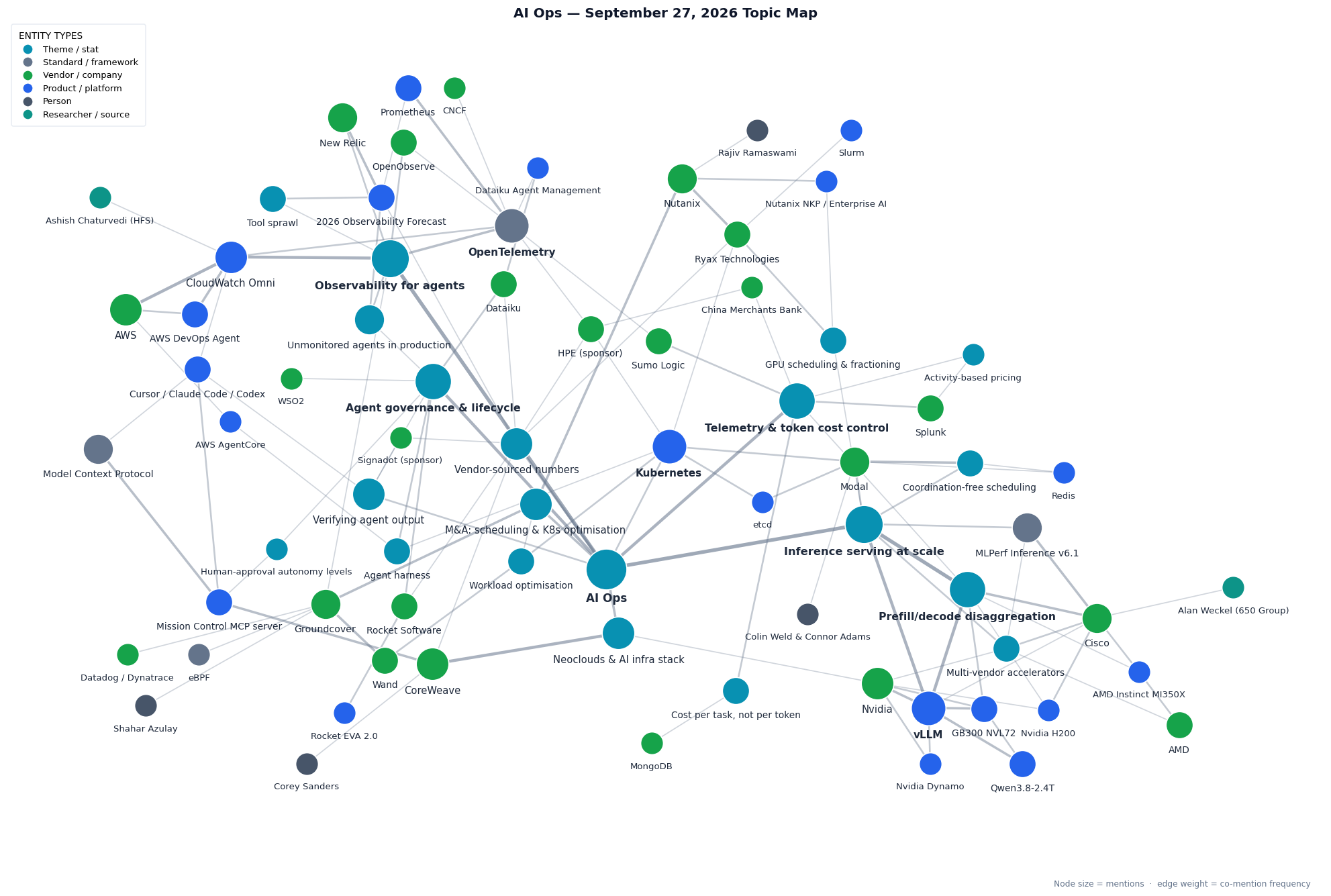
This week’s topic map — inference serving anchors one side, with vLLM, GB300 NVL72 and Cisco’s H200-plus-MI350X MLPerf submission meeting at prefill/decode disaggregation, and Modal’s coordination-free scheduler pulling away from Kubernetes and etcd. Observability for agents sits opposite, joining CloudWatch Omni, OpenTelemetry, Prometheus, OpenObserve and New Relic’s Forecast; the Nutanix–Ryax and Groundcover–Wand deals bridge the two through GPU scheduling and workload optimisation; CoreWeave’s Mission Control MCP server links the Model Context Protocol to AI coding tools; and a vendor-sourced-numbers node ties together the sponsored and contributed rows.
View interactive topic map →
Article index
24 articles, grouped by sub-theme. Seventeen are from this week’s coverage window (September 20–27); seven are longer-form foundational reads on the beat. Sponsorships, press releases, contributed posts and author affiliations are named in each group.
Inference serving as a systems problem
Disaggregation, heterogeneity and scale-out: the common thread is splitting prefill from decode and building schedulers that avoid central coordination. The vLLM post acknowledges Nvidia engineers as contributors, so it is vendor-plus-project content; the Cisco item is a vendor blog whose baseline Cisco defined itself; the Kubernetes inference-cost piece is sponsored by HPE.
Observability absorbs the agent layer
Agent traces, token usage and evaluations are moving into the same platforms that hold logs, metrics and traces. The OpenObserve item is a Business Wire press release, not VentureBeat reporting; the Observability Forecast is a vendor-commissioned survey announced on New Relic’s own blog; the OpenTelemetry–Prometheus piece is sponsored by HPE, and its outage-cost figures are the New Relic survey re-cited, not independent data.
Telemetry and token cost control
Three angles on the same bill: route telemetry to cheaper tiers, change what the platform charges for, and measure AI spend per task rather than per token. The Sumo Logic headline promises cost cuts the article does not quantify. The Splunk pricing item predates this week’s window and runs as foundational context. The CIO piece is a contributed column by MongoDB’s Field CTO for AI, and its loop arithmetic is illustrative.
Agent governance, lifecycle and harnesses
Who can see the agents, who approves what they do, and what wraps the model at runtime. The Dataiku survey was commissioned by Dataiku; Rocket’s ROI figure is Rocket’s own analysis; the life-cycle column is written by WSO2’s VP of AI, and WSO2 sells an agent manager. The harness article is a mechanism explainer with no performance data.
Verifying agent output before it hits production
Three longer reads on testing, evaluation and verification for agent-generated work. The 2,000-PRs piece is sponsored by Signadot and written by its CEO; Signadot sells the verification tooling it argues for, and the author himself calls the headline figure an outlier.
Consolidation: M&A for GPU scheduling and Kubernetes optimisation
Two tuck-ins, terms undisclosed on both. The Nutanix–Ryax report is by Chris Mellor of Blocks & Files. In the Groundcover story Groundcover is the buyer and Wand the target, and the capability is continuous workload optimisation rather than provisioning.
Neoclouds and the AI infrastructure stack
CoreWeave twice and a market taxonomy. The TechTarget row is the product news. The SiliconANGLE row is theCUBE sponsored coverage previewing CoreWeave Fully Connected 2026 (30 September–1 October), so nothing from that event has been announced yet; its figures mix CoreWeave’s own reporting, Nvidia claims and an unnamed survey. The InfoWorld piece is an opinion column.
Detailed write-ups
1. vLLM splits prefill from decode on GB300 NVL72, and publishes the recipe
vLLM Blog · September 21, 2026
The vLLM team ran prefill/decode (PD) disaggregated serving of Qwen3.8-2.4T on an Nvidia GB300 cluster connected via NVLink72, and the headline is two numbers from two different scenarios: 5,000 total tokens per second per GPU when tuned for throughput, and 180 generated tokens per second per user when tuned for latency, both at an input/output length of 8192/1024. In the team’s words: “In high throughput scenario vLLM achieved 5000 total token throughput per GPU, and 180 generated tokens per user in the low latency scenario.” Do not read those as one configuration delivering both at once.
The model shape explains why this is a systems exercise. As stated, it has 92 layers — 69 GDN linear-attention layers plus 23 full-attention layers — with a mixture-of-experts block in every layer (92 × 512 experts). The KV cache is about 759 MiB per request, and each GB300 carries 279 GB of GPU memory. The team evaluated TP4DP2+EP, TP2DP4+EP, TP4DP4+EP, TEP8 and TEP16 layouts; decode ran on configurations such as 1×TEP8 or 1×TP4DP4+EP, and prefill on one to four endpoints of 8–32 GPUs each. Accuracy under the served configuration was 95% on GSM8K.
The part that makes this more useful than a benchmark claim is the tooling: srt-slurm v1.0.98, Nvidia Dynamo 1.2.0 and the AIPerf benchmarking utility, with reproducible recipes published in Nvidia’s srt-slurm-recipes GitHub repository. Two gaps to note before you cite it. The post gives no comparison against aggregated serving or another engine, so it does not tell you what disaggregation bought; and it does not name the KV-transfer mechanism. Nvidia engineers are acknowledged contributors, so treat it as vendor-plus-project work — credible, reproducible, and not independent.
Sources: vLLM Blog (PD serving of Qwen3.8-2.4T with vLLM on GB300 NVL72) — https://vllm.ai/blog/2026-09-21-qwen38-pd-serving
2. Cisco runs prefill on Nvidia and decode on AMD in one MLPerf submission
Cisco Blogs · September 21, 2026
Cisco submitted to MLPerf Inference v6.1, Server scenario, on the mixture-of-experts GPT-OSS 120B model using two Cisco UCS C885A M8 servers — one with eight Nvidia H200 GPUs, one with eight AMD Instinct MI350X GPUs — joined by a Cisco Silicon One G200-based Ethernet fabric. The H200 group handled prefill and the MI350X group handled decode: heterogeneous disaggregated serving, with vLLM, NIXL and UCCL over RDMA named as the software stack.
The result was 73,357.62 tokens per second combined, against a 70,085.48 tokens per second baseline of the two systems run standalone and summed — 104.7% of baseline, or +3,272.14 tokens per second, which Cisco calls superlinear. Keep the framing precise. The claim in the body is “the industry’s first multi-vendor accelerator submission” to MLPerf Inference, not a first multi-vendor inference cluster in general. The 4.7% gain is measured against a baseline Cisco defined itself. And the post does not say whether the entry was in the closed or open division, or that it is MLCommons-verified, so do not claim either.
The operational point is the one 650 Group’s Alan Weckel makes in the post: “AI infrastructure is no longer a single architecture or a single generation.” If prefill and decode have different hardware appetites, a mixed fleet stops being a procurement accident and becomes a placement decision — which is the same lesson vLLM’s write-up teaches on a single vendor’s hardware.
Sources: Cisco Blogs (industry’s first MLPerf Inference benchmarking across multi-vendor accelerators) — https://blogs.cisco.com/datacenter/industrys-first-mlperf-inference-benchmarking-across-multi-vendor-accelerators
3. Modal left Kubernetes behind to start a million sandboxes in under a minute
InfoQ · September 23, 2026
Modal’s rebuilt sandbox platform created 1 million concurrent sandboxes in under one minute, at 50,000 sandbox creations per second, with a median time from start to running code of under 0.5 seconds. For anyone running agent code-execution or evaluation fleets, the interesting part is why Kubernetes was not the answer: centralised, strongly consistent state; operations that scale with the number of containers and nodes; and etcd load that grows with pod and node counts, each writing multiple times, in a store that is not natively shardable within a keyspace.
The replacement design has no global coordination. Each worker is its own source of truth, a fleet of parallel scheduling servers replaces a single serialised scheduler, and workers accept or reject placement over RPC based on their free resources. Modal’s staff engineers Colin Weld and Connor Adams state the rule they designed to: “To optimize for scale, we decided that everything taking O(sandboxes) or O(nodes) load must be horizontally scalable by default.”
One shared bottleneck remains — a Redis stream for publishing worker state — which Modal says keeps the design viable to 100,000+ workers. Treat that as a stated design ceiling, not a measured run. The lesson travels further than Modal’s use case: if your agent platform creates short-lived execution environments at high rates, measure where your control plane serialises before you assume more nodes will help.
Sources: InfoQ (beyond Kubernetes at Modal: how to scale 1 million concurrent sandboxes in seconds) — https://www.infoq.com/news/2026/09/modal-scaling-sandboxes/
4. CloudWatch Omni and OpenObserve put agents in the same pane as everything else
InfoWorld · September 22, 2026
AWS CloudWatch Omni unifies agent, application and infrastructure telemetry, with automatic application topology discovery and both natural-language and SQL querying. Root-cause analysis comes from the built-in AWS DevOps Agent, which is priced separately. It supports LangGraph, CrewAI, the OpenAI Agents SDK, the Vercel AI SDK and AWS Strands; integrates with the Braintrust, DeepEval and Ragas evaluation tools; and ingests over OTLP as well as existing CloudWatch instrumentation. There are native extensions for VS Code, Kiro and Cursor, and local development works without an AWS account.
It launched in US East (N. Virginia), US West (Oregon) and Europe (Ireland), and telemetry from other regions and accounts can be centralised at no additional cost. Pricing is per GB ingested, per GB-month stored and usage-based for analytics, with analytics up to 5x the ingested log and span volume at no extra charge; no per-GB rates are given in the coverage. HFS Research’s Ashish Chaturvedi frames why the launch matters: “The blocker on enterprise agent deployment right now is rarely capability.”
The open-source counterpart this week is OpenObserve v1.0, announced by Business Wire press release rather than reported by VentureBeat. Written in Rust, it claims support for 80+ providers, frameworks and libraries for token cost and usage tracking, 1,200+ curated alerts, agent tracing with an Agent Graph, LLM-as-judge evaluation, SLO burn-rate alerts, and database and synthetic monitoring. Its only outcome claim, diagnosis going from “hours to minutes”, is a customer quote with no baseline. Underneath both sits OpenTelemetry, which graduated in the CNCF in May 2026; an HPE-sponsored New Stack piece reports Atlassian moving metrics from 100,000 hosts across 14 regions to OTel, with Prometheus v3.15 at release candidate and data-model alignment, resource attributes and naming still named as gaps.
Sources: InfoWorld (AWS launches CloudWatch Omni) — https://www.infoworld.com/article/4225120/aws-launches-cloudwatch-omni-to-unify-observability-for-ai-agents-and-applications.html · VentureBeat / Business Wire (OpenObserve reaches v1.0) — https://venturebeat.com/business/openobserve-reaches-v10-bringing-ai-observability-into-the-same-platform-as-logs-metrics-traces-and-rum · The New Stack (OpenTelemetry and Prometheus are getting along) — https://thenewstack.io/opentelemetry-prometheus-observability-interoperability/
5. New Relic’s Forecast: a quarter of organisations run agents nobody is watching
New Relic · September 22, 2026
New Relic’s 2026 Observability Forecast, run with Enterprise Technology Research, surveyed 2,575 IT and engineering leaders and practitioners worldwide, up from 1,700 in 2025; the post does not give fieldwork dates. The headline for this bulletin’s readers: 75% report deploying agentic AI, and “a full quarter of organizations” have agents in production with no monitoring at all.
The rest of the numbers frame the operational load. The average cost of high-impact outages is about $74 million per organisation per year, down from $76 million in 2025, and more than a third of organisations report high-impact outages weekly or more often. Two in three say AI generates or rewrites 50% or more of their code weekly, and 83% of leaders say observability is critical as AI adoption rises. Tool sprawl is still growing: about four observability tools per organisation in 2025, trending to five in 2026, while 50% say they prefer a consolidated platform. New Relic’s director of content marketing, Jim Young, sums it up: “AI is moving faster than the infrastructure built to watch it.”
Two cautions. This is a vendor-commissioned survey from a company that sells observability, and every figure in it argues for buying observability. And when the $74 million and 83% figures turn up elsewhere this week — they reappear in the OpenTelemetry–Prometheus piece — that is this survey re-cited, not independent confirmation.
Sources: New Relic (announcing the 2026 Observability Forecast) — https://newrelic.com/blog/observability/announcing-the-2026-observability-forecast
6. Nutanix buys GPU scheduling; Groundcover buys Kubernetes optimisation
Blocks & Files / TechTarget · September 22–24, 2026
Nutanix bought Ryax Technologies, founded in 2017 in Lyon by CEO Andry Razafinjatovo and CTO Yiannis Georgiou, whose team joins Nutanix in France. Terms were not disclosed and Nutanix calls the financial impact “not material”; Ryax had raised roughly €2.2–2.4 million in total. The product is containerised workflow orchestration with serverless CPU and GPU execution, GPU fractioning (“Intelliscale”), cost-aware scheduling and multi-site execution across Kubernetes and Slurm HPC clusters, with an open-source Python core deployed via Helm. It is going into Nutanix Kubernetes Platform and Nutanix Enterprise AI. Chief executive Rajiv Ramaswami: “Agentic AI requires a flexible architecture, simple operations and the ability to use infrastructure far more efficiently.” Ryax’s claim of up to 45% lower compute costs is its own marketing, with no stated baseline.
Groundcover, the eBPF-sensor observability vendor with a bring-your-own-cloud deployment model, is the buyer in the second deal: it acquired Wand, a Tel Aviv Kubernetes resource-optimisation startup, for an undisclosed sum. Despite the headline’s “provisioning”, Wand’s technology is continuous optimisation: it analyses how applications sharing infrastructure affect one another over time, then reallocates workloads and scales applications to prevent noisy-neighbour degradation. The stated aim is observability data driving action, not just dashboards, and the story frames it against Datadog and Dynatrace. CEO Shahar Azulay: “There’s a lot of knowledge in what the Wand team has built on how to optimize Kubernetes and cloud workloads continuously with the use of deep algorithms.” No deal value, headcount, customer count or performance figure was given.
Read together, both deals buy the step after the telemetry: deciding where a workload should run and moving it. That is the capability to ask your platform vendors about, and to ask for evidence of.
Sources: Blocks & Files (Nutanix buys Ryax in agentic AI-focused tuck-in acquisition) — https://www.theregister.com/ai-ml/2026/09/22/nutanix-buys-ryax-in-agentic-ai-focused-tuck-in-acquisition/5298096 · TechTarget (Groundcover acquisition automates Kubernetes provisioning) — https://www.techtarget.com/it-infrastructure/news/366651032/Groundcover-acquisition-automates-Kubernetes-provisioning
7. CoreWeave hands cluster operations to the coding agent
TechTarget · September 24, 2026
CoreWeave launched a Mission Control MCP server that exposes its Mission Control cluster-operations platform to AI coding tools over the Model Context Protocol, with Cursor, Claude Code and OpenAI Codex named as clients. The use case is an engineer asking the coding agent to identify infrastructure problems in a running job — the article’s example is a 100-machine training job — and to request corrective actions. Customers choose the autonomy level, including whether actions need human approval or execute automatically. No pricing or general-availability details were given. SVP of product Corey Sanders: “The MCP extension allows customers to use their existing development tools to bring that operating intelligence into the environment where they already work.”
Keep this separate from the week’s other CoreWeave row. The SiliconANGLE piece does not mention the MCP launch at all; it is theCUBE sponsored coverage previewing CoreWeave Fully Connected 2026, which runs 30 September–1 October in San Francisco and had not happened when it was published, so nothing in it counts as announced. For the wider market context, David Linthicum’s InfoWorld opinion column sorts neoclouds four ways: full-stack (CoreWeave, Nebius, Lambda), developer GPU clouds (Vultr, Runpod, Together AI), inference-first (Groq, CoreWeave Inference) and capacity builders (Applied Digital, Core Scientific).
Sources: TechTarget (CoreWeave connects AI coding tools to infrastructure intelligence) — https://www.techtarget.com/ai/news/366651173/CoreWeave-connects-AI-coding-tools-to-infrastructure-intelligence · SiliconANGLE (CoreWeave’s full-stack solution is hard on hyperscalers’ heels, sponsored) — https://siliconangle.com/2026/09/25/coreweave-full-stack-agentic-ai-fullyconnected/ · InfoWorld (the complicated AI infrastructure market) — https://www.infoworld.com/article/4221930/the-complicated-ai-infrastructure-market.html
8. The cost levers: route the telemetry, change the meter, count the task
SiliconANGLE / TechTarget / CIO / The New Stack · September 18–25, 2026
Sumo Logic expanded its Data Pipelines with live rule preview, AI-assisted rule writing, anomaly and format-shift flagging, and routing to cheaper tiers or external destinations, with OpenTelemetry-native collector management and a platform-neutral version planned. The headline promises cost cuts, but the article gives no cost-reduction percentage, no pricing and no availability date; the only numbers are company scale — about 7 exabytes ingested a day — and Francisco Partners’ $1.7 billion purchase in 2023. Chief product and technology officer Keith Kuchler: “AI has made that job harder and more expensive.” Splunk, covered as foundational context, is moving the other lever: activity-based pricing in controlled availability, with Machine Data Lake storage not charged until data is searched, against the older ingest-based and workload-based models. No price points were given.
On the inference side, MongoDB’s Field CTO for AI, Pete Johnson, argues in a CIO column for measuring cost per task or per inference pass rather than token volume. His numbers are secondary: Uber’s 84% agentic-coding adoption by March 2026, an annual AI budget exhausted in four months and then a $1,500 per employee per month cap (via Bloomberg). His worked example — a 20-step loop adding 1,000 tokens per step bills 210,000 input tokens, cut to 44,000 with prompt caching or back up to 90,000 on prefix invalidation — is illustrative arithmetic, not a measurement. An HPE-sponsored New Stack piece supplies the one attributed production figure: China Merchants Bank cut token-processing costs 60% and raised average utilisation from 35% to 60%+ across nearly 10,000 accelerator cards. Val Bercovici, quoted there, names what cost per token actually depends on: “request mix, KV cache occupancy, [and] the balance of prefill and decode.”
Sources: SiliconANGLE (Sumo Logic expands Data Pipelines) — https://siliconangle.com/2026/09/21/sumo-logic-expands-data-pipelines-to-cut-observability-and-security-data-costs/ · TechTarget (seismic shift in Splunk pricing spotlights AI data management) — https://www.techtarget.com/it-infrastructure/news/366650721/Seismic-shift-in-Splunk-pricing-spotlights-AI-data-management · CIO (the wrong million tokens) — https://www.cio.com/article/4226223/the-wrong-million-tokens.html · The New Stack (Kubernetes can run AI inference, but can it count the real cost?, HPE-sponsored) — https://thenewstack.io/kubernetes-ai-inference-costs/
9. Governing agents you did not build: Dataiku, Rocket and the harness
SiliconANGLE / InfoWorld / InfoQ · September 23–25, 2026
Dataiku debuted cross-platform Agent Management, due for general availability in October 2026 at an annual per-instance fee metered by agent count, with connectors for Salesforce Agentforce, AWS, Microsoft, Google, Databricks, Snowflake and custom environments via OpenTelemetry. Its supporting survey — a Harris Poll of 685 CIOs, 9–29 July 2026, commissioned by Dataiku — found 81% lack complete oversight of agents built outside approved systems and 84% say employees build agents faster than IT can govern them. Co-founder and CEO Florian Douetteau describes the typical answer to “how many agents do you have” as “a shrug or a guess.”
Rocket Software brought governed agents to mainframe operations with Enterprise Virtual Assistant (EVA) 2.0 and its PlanGuard security layer, “forthcoming” on consumption-based pricing. Both of its numbers are Rocket’s: a 3.2x annual ROI from its own analysis, and a single pilot in which an investigation went from about three weeks to under a day. Phil Buckellew, president of the infrastructure modernization business unit: “Today, EVA can independently orchestrate complex investigations once a user initiates a request.”
Two explainers give the vocabulary. In an InfoWorld contributed column, WSO2’s VP of AI Malith Jayasinghe sets out an agent development life cycle and an agent control plane; WSO2 sells an agent manager, and the piece has no data. On InfoQ, Trista Pan frames “Agent = Model + Harness” and compares harness-as-a-service (AWS AgentCore, whose default maxIterations is 75) with a self-managed LangChain harness using Agent Router on Kubernetes. On verification, a Signadot-sponsored New Stack piece by Signadot’s CEO describes one engineer’s 2,000 PRs a month to production — which the author himself calls “undeniably an outlier”, so read it as a workflow description, not a norm.
Sources: SiliconANGLE (Dataiku debuts cross-platform Agent Management) — https://siliconangle.com/2026/09/24/dataiku-debuts-cross-platform-agent-management-expands-cobuild-building-agent/ · SiliconANGLE (Rocket Software brings governed AI agents to mainframe operations) — https://siliconangle.com/2026/09/23/rocket-software-brings-governed-ai-agents-to-mainframe-operations/ · InfoWorld (managing the life cycle of AI agents at scale) — https://www.infoworld.com/article/4225702/managing-the-life-cycle-of-ai-agents-at-scale.html · InfoQ (the agent harness: what it is and two ways to build one) — https://www.infoq.com/articles/agent-harness-build-one/ · The New Stack (one engineer shipped 2,000 PRs a month to production, Signadot-sponsored) — https://thenewstack.io/agentic-verification-distributed-systems/
Calls to action
- Count the agents you have in production that nothing monitors. Whatever you think of a vendor survey, “a full quarter of organizations” running unmonitored agents is a claim you can check against your own estate in an afternoon. Start with agents built outside approved systems — the population Dataiku’s survey says 81% of CIOs cannot fully see.
- Reproduce before you re-architect. vLLM published its prefill/decode recipes in Nvidia’s srt-slurm-recipes repository. If you are weighing disaggregated serving, run the recipe and add the aggregated baseline the post does not include, on your own input/output lengths, before committing hardware to the split.
- Find where your execution control plane serialises. Modal hit centralised state and etcd write load long before it ran out of nodes. If your agents spin up sandboxes or evaluation jobs at high rates, measure creation latency and scheduler throughput under load and identify the single coordinator in the path.
- Price agent observability before you migrate onto it. CloudWatch Omni’s root-cause analysis runs through a separately priced DevOps Agent, and the coverage gives no per-GB rates. Ask for the rates and the DevOps Agent pricing, and check whether your agents’ regions are among the three at launch.
- Report AI cost per task, not only per token. Instrument cost per completed task or per inference pass alongside token volume, and track prompt-cache hit rate — the CIO column’s worked example shows the same loop billing 44,000 or 90,000 input tokens depending on whether the cached prefix survives.
- Set the autonomy level before you connect an agent to your clusters. CoreWeave’s Mission Control MCP server lets customers choose whether actions need human approval or execute automatically. Decide that per action class, in writing, before any coding agent can act on production infrastructure.
- Ask who measured it, every time, before a number enters a plan. This week’s sponsored and contributed rows carry most of the percentages — Ryax’s 45%, Rocket’s 3.2x, and the survey stats from New Relic and Dataiku are all sourced to the company selling the product. The numbers worth carrying out of the week are the ones with a reproducible method behind them: vLLM’s recipes and Modal’s sandbox run.
|