This week at a glance
The biggest claim of the week came from HPE. Rami Rahim, who runs HPE Networking, told The Register that 70–80% of network tickets already need no human, and that “within two to three years, we’ll have no issues that require humans.” HPE’s own product marketing was more careful. Its Marvis assistant takes autonomous action only where the customer opts in, and on other vendors’ equipment it “often operates in a driver-assist mode,” diagnosing and recommending rather than fixing. The ambition is full autonomy, but it currently works best in an all-HPE network. For any vendor selling into mixed estates, that is the opening.
The demand data tempers the vendor claims. Riverbed’s survey of 1,200 IT leaders found 90% intend to pursue autonomous IT operations, but 77% won’t let AI make operational decisions without human approval, and only 19% of IT operations are automated today. EMA’s research, reported by Network World, found enterprises running six to eight observability tools and only 17% finished consolidating them. EMA also found that organisations with centralised tool governance use AI more maturely. Spiceworks asked the people deploying network agents and got the same answer: agents are useful for finding problems, but are “not ready to run your network on their own.” One founder said the biggest failure point is the operating model around the agent, not the model itself.
The commercial moves were about where agents connect and how they are paid for. LogicMonitor made its Edwin AI callable by ServiceNow’s own agents, which puts the incident record, not the monitoring console, at the centre of the workflow. A Futurum analyst said a copilot on an observability platform is now a “parity feature” and that NETSCOUT’s real asset is the network data under it. Netskope replaced per-agent purchasing with one pool of committed credits, and Gluware partner Vandis now sells network patch automation as a recurring managed service. Capital is also moving: Elliott and Siris are exploring a sale of Gigamon at more than $2 billion, on reported ARR above $400 million. Buyers are not paying for autonomy as such. They are paying for verified data, for working inside the workflow they already use, and for commercial terms that limit their risk.
On our watch list
- LogicMonitor Elevate, Chicago, October 13–14. The theme is “Autonomous IT,” and the Autonomous IT Innovation Program has been in private preview since May. Watch for general availability, pricing, and a named customer letting Edwin AI remediate rather than only investigate.
- SolarWinds Day, October 14–15. SolarWinds is presenting “goal-oriented AI.” It is the next large monitoring incumbent to state how far it will let agents act, and whether it ties that to ServiceNow the way LogicMonitor has.
- Who bids for Gigamon, and at what multiple. Reported ARR is above $400 million and EBITDA about $170 million, against a $2 billion-plus target. A strategic buyer from observability or security would signal that network data is being folded into larger platforms. A private-equity buyer would set a price marker for network visibility software.
- Evidence behind HPE’s 70–80% figure. Rahim’s number is a claim, not a published metric. Watch for a named customer’s ticket data beyond the UK Ministry of Justice’s roughly 75% service-desk reduction cited in May, and for whether HPE’s opt-in autonomous actions extend to other vendors’ equipment.
- Whether Riverbed’s 77% starts to move. The next autonomy surveys will show whether the share of buyers requiring human approval falls. A vendor that publishes how many customers moved from approval to autonomous actions would have the first hard adoption data in the category.
- Copycats of Netskope’s credit pool. Netskope now sells SOC and NOC agents from one pool of committed credits. Watch Netskope’s next earnings call for AgentSkope consumption figures, and whether the networking incumbents move from per-device or per-agent pricing to consumption pricing.
- NETSCOUT moving from answering to acting. Futurum’s open question is whether nGenius Copilot moves from recommendations to guided remediation, and whether NETSCOUT publishes accuracy and grounding evidence. Neither has happened yet.
- More agent-to-agent links into ServiceNow. LogicMonitor’s six Edwin AI capabilities are now callable by ServiceNow agents, and NETSCOUT names ServiceNow as a downstream platform partner. Count how many NetOps and observability vendors announce similar integrations this quarter.
- The first outcome-based contracts. Brisk AI’s founder told Spiceworks he expects vendors to “put some of their economics at risk through outcome-based success fees,” and NetPilot already offers a money-back milestone. Watch for an established network-automation vendor to put a success fee in its commercial terms.
- Extreme’s fiscal Q1 results, November 4. Spiceworks reports Extreme pitches Agent ONE Coworker as recommendations with reasoning, bundled into the Platform ONE subscription. The call should show whether bundling the agent is moving Platform ONE adoption toward Extreme’s stated 50% target.
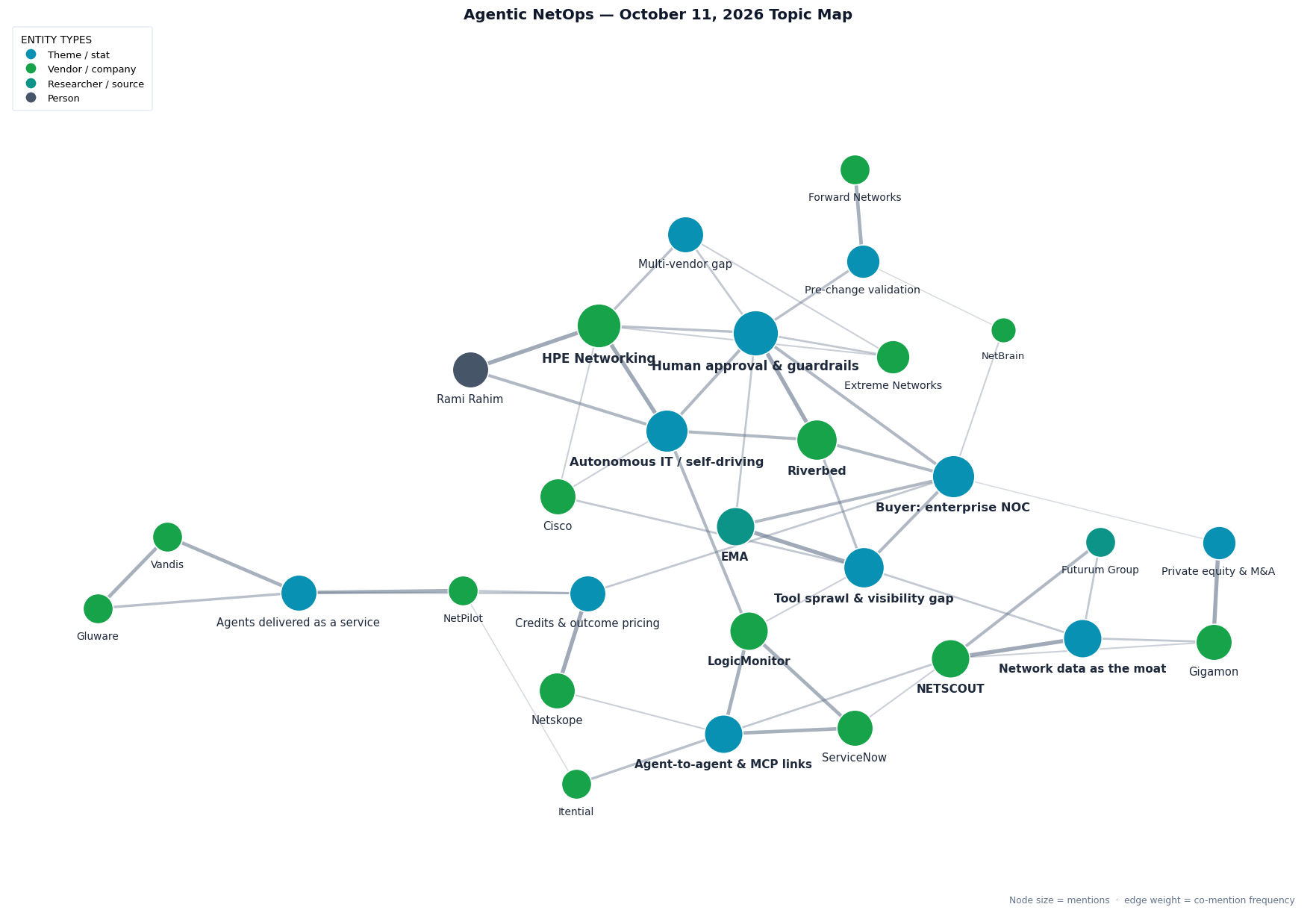
Entities and connections across this week’s 25 tracked stories. Node size reflects how often an entity appears; line weight reflects how often two appear together.
View interactive topic map →
Article index
Competitive moves: the platform incumbents
The large vendors are pitching autonomy that works best on their own equipment. HPE says most tickets already need no human and showcased its self-driving network at the 2027 Ryder Cup. Cisco says it has unified everything it sells under one management plane and that the Meraki and Catalyst brands will eventually go away. NETSCOUT spent September building a data-first case for AI, and its customer summit made the same argument.
Competitive moves: observability, ITSM and capital
The flank is moving toward the service-management workflow. LogicMonitor made Edwin AI callable by ServiceNow’s agents and is holding an event themed on “Autonomous IT.” Elliott and Siris are exploring a $2 billion-plus sale of Gigamon, the network visibility vendor Elliott took private in 2017. Seismora pitched a control plane that routes AI work by cost, latency and policy. NetBrain published a retail customer story.
How agents are bought: packaging and delivery
Vendors are changing how agents are sold as well as what they do. Netskope replaced per-agent purchasing with a shared credit pool. Vandis sells Gluware-powered patch automation as a recurring managed service. NetPilot argues for a third route besides build and buy: a vendor builds, tests and delivers the agent against a money-back milestone. Itential argues that most agent integrations expose raw endpoints rather than outcomes, and calls for public benchmarks.
| Article |
Source |
Published |
| 11. Netskope Unveils AgentSkope Marketplace, Streamlining How Teams Buy, Deploy, and Scale AI Agents |
GlobeNewswire (Netskope) |
Oct 6, 2026 |
| 12. Vandis Launches Intelligent Patch Automation Service |
PR Newswire (Vandis) |
Oct 6, 2026 |
| 13. Network AI Agents in 2026: Build, Buy, or Have It Delivered (foundational, vendor-authored) |
NetPilot |
Oct 1, 2026 |
| 14. We Gave Agents a New Protocol & Handed Them the Same Old Plumbing (foundational, Itential-authored) |
Itential |
Oct 9, 2026 |
Buyer adoption and demand signal
Buyers want autonomy but are not ready to grant it. Riverbed’s 1,200-respondent survey pairs 90% ambition with 77% insisting on human approval. EMA finds most enterprises still consolidating six to eight observability tools. A Broadband Forum survey of fixed-broadband providers names bad data (83%) and poor vendor interoperability (78%) as the main barriers. A Fierce Network podcast episode argues that agentic AI makes the network part of application performance.
The NOC operating model
The practitioners and vendor authors agree on a staged path. Agents start in a support role with their own credentials, earn approval for repeatable fixes, and gain wider scope only once they have proven reliable. Riverbed, BackBox and Forward Networks each describe a version of that path from their own product angle. TM Forum and The Fast Mode carry the same argument from the carrier side.
| Article |
Source |
Published |
| 19. AI coworkers for networking: What they can do and where they fall short |
Spiceworks |
Oct 9, 2026 |
| 20. From automated response to reasoning: Building confidence in AI-driven NetOps (foundational, vendor-authored) |
Network World |
Oct 5, 2026 |
| 21. The Path to Autonomous Network Operations (foundational, Riverbed-authored) |
Riverbed |
Oct 6, 2026 |
| 22. Every Network Change Opens A Security Gap (foundational, vendor-authored) |
Forbes |
Oct 7, 2026 |
| 23. Agentic NetOps: How AI-Powered Network Operations Are Replacing the Ticket Queue (foundational) |
The Network DNA |
Oct 1, 2026 |
| 24. Building autonomy through the digital continuum (foundational) |
TM Forum Inform |
Oct 5, 2026 |
| 25. From RAN Optimization to 5G Core: Why Agentic AI Must Think Across the Network (foundational) |
The Fast Mode |
Oct 8, 2026 |
Detailed write-ups
1. HPE says agents will soon close every ticket, but its autonomy works best on its own equipment
The Register · HPE Newsroom · Spiceworks · October 5–11, 2026
HPE made the boldest autonomy claim of any incumbent this year. Rami Rahim, the former Juniper CEO who now runs HPE Networking, told The Register that “we’re now at probably around 70 to 80 percent of all tickets don’t require human intervention,” and that “within two to three years, we’ll have no issues that require humans,” with hardware swaps the only exception. He measures success by the volume and fix time of the most common enterprise ticket, which he summarised as “the Wi-Fi sucks.” HPE is extending its self-driving network approach across its hybrid cloud portfolio. On October 5 it announced it will run the network for the 2027 Ryder Cup in Ireland, covering a 230-acre site and more than 250,000 fans.
HPE’s own product team described something more limited. Mittal Parekh, a senior director at HPE, told Spiceworks that Marvis supports both “driver-assisted” and “trusted autonomous actions,” but that autonomy is opt-in, “governed by customer-defined permissions,” and audited. Rahim said the same thing in his own words: operators turn on automated actions “feature by feature, and capability by capability,” starting with tasks as small as rebooting a switch port. Parekh also said Marvis’s visibility “is strongest across HPE Networking environments” and that on third-party equipment it “often operates in a driver-assist mode,” recommending fixes rather than making them.
HPE is making two arguments at once. Publicly, the message is that human-run network operations will soon be obsolete. In practice, it is selling incremental, permissioned autonomy that is strongest on its own equipment. That combination favours HPE in single-vendor estates and leaves an opening in the mixed-vendor networks most large enterprises run. Rahim’s 70–80% figure is his own and has not been published as a metric. The supporting evidence is still a single reference: the UK Ministry of Justice’s roughly 75% cut in service-desk tickets, which HPE cited in May.
Sources: The Register (HPE's networking boss says AI will handle all trouble tickets without humans in two years) · HPE Newsroom (HPE chosen to deliver intelligent connectivity and autonomous IT operations at the 2027 Ryder Cup) · Spiceworks (AI coworkers for networking: What they can do and where they fall short)
2. Gigamon goes up for sale, putting a price on network visibility
Reuters via KFGO · October 7, 2026
Elliott Investment Management and Siris are exploring a sale of Gigamon that could value the company at more than $2 billion, Reuters reported, citing people familiar with the matter. Bank of America and Perella Weinberg Partners are advising, and the process is in its early stages. Possible buyers include private-equity firms and strategic acquirers looking to expand in network monitoring, cybersecurity and cloud infrastructure management. All parties declined to comment.
Gigamon, founded in 2004, sells software that monitors network traffic and detects threats. It says it has more than 4,000 customers, including banks, healthcare providers and government agencies. According to the sources, annual recurring revenue exceeds $400 million and EBITDA is about $170 million. Elliott took the company private in 2017 for about $1.6 billion, and Siris bought a minority stake in 2024.
Gigamon is not a network-automation vendor, but its sale will put a price on the data layer that NetOps agents depend on. A $2 billion-plus price on roughly $400 million of ARR implies about five times ARR for a profitable visibility business. The identity of the buyer matters as much as the price. An observability or security platform buying Gigamon would continue this week’s pattern of network data being absorbed into larger platforms (see NETSCOUT and LogicMonitor below). A private-equity buyer would set a valuation marker for independent network-operations software.
Sources: Reuters via KFGO (Elliott and Siris explore $2 billion-plus Gigamon sale, sources say)
3. Riverbed: 90% want autonomous IT, 77% won’t let AI decide without sign-off
Riverbed · October 6, 2026
Riverbed’s global survey, fielded by Coleman Parkes in July, polled 1,200 business and IT decision-makers across seven countries and six industries, at organisations averaging $2.3 billion in revenue. Ambition is close to universal: 90% want agentic AI to drive autonomous IT operations, 90% expect human-supervised or highly autonomous operations within two years, and 63% have increased AI spending. The current reality is much further behind. Only 19% of IT operations are automated today, 41% say their environments are fully ready for AI, and 8% have AI-enabled operations across the enterprise.
Trust is the constraint. 77% are hesitant to let AI make operational decisions without human approval, 69% prefer human-supervised AI, and only 24% trust AI recommendations extensively with limited review. The top obstacles are security and compliance (55%), the risk of disrupting operations (45%) and lack of trust in AI decisions (39%). Data is a problem too. 96% call visibility across domains critical but only 17% have it unified, and 21% rate their data quality as excellent. “The next phase of AI is not simply more automation, but AI that enterprises can understand, trust and govern,” said Riverbed CMO Jim Gargan. A companion Riverbed blog sets out a four-step path from AI-assisted operations, through approved execution and autonomy for trusted scenarios, to predictive operations.
This is a vendor-commissioned survey covering IT operations broadly, so it is directional. But its central finding, that buyers want autonomy and still require approval, matches every other data point this week, including HPE’s opt-in model. The near-term opportunity is to sell the approval workflow and the trust-building steps, not full autonomy. The 79-point gap between buyers who say visibility matters and those who have it unified is the most direct demand signal for network data and context products.
Sources: Riverbed (New Riverbed Global Survey Finds Agentic AI is Reshaping IT: 90% Plan to Pursue Autonomous IT; Yet 77% Require Human Approval) · Riverbed (The Path to Autonomous Network Operations)
4. EMA: no one gets a single pane of glass, and governance predicts AI maturity
Network World · October 8, 2026
EMA’s survey of 356 enterprise IT professionals, reported by Network World, found organisations typically running six to eight observability tools. Only 17% have finished consolidating them, 51% are partway through and 32% are still planning. Respondents named the costs: skills and staffing (45%), integration and API work (44%), context switching that slows investigations (41%), more manual effort (40%) and alert noise (34%). 32% use AI extensively in observability, and 51% use it in selected areas.
The finding that matters commercially is about governance. 24% of organisations have fully centralised tool governance and 48% mostly centralised, and those with centralised governance reported more confidence in consolidation and more mature AI use. “No one gets a single pane of glass,” said EMA’s Shamus McGillicuddy, adding that AI can overcome data spread across many tools but not bad data or bad operations. His colleague Christopher Steffen warned that probabilistic agents may not respect deterministic controls. His example was an AI that deleted a firewall rule because it looked like a mistake, when in fact it allowed one database connection once a quarter.
For vendors, the best prospects are buyers with centralised governance: they are the ones already using AI at scale. Steffen’s firewall example is also the kind of story that makes buyers ask for policy checks and rollback before they allow autonomous change. Vendors that can show those controls in a demo will have an easier time getting past the risk discussion.
Sources: Network World (Tool sprawl, AI complicate enterprise network operations)
5. The people deploying network agents say the operating model, not the model, is the risk
Spiceworks · October 9, 2026
Spiceworks compared four vendors’ versions of “agentic” networking. Extreme claims its Agent ONE Coworker resolves issues up to 15 times faster, bundles it into the Platform ONE subscription, and pitches it as recommendations with reasoning rather than autonomous action. Zayo launched what it calls the first production MCP server for networking, through which approved agents can take authorised actions. Riverbed added AI to existing monitoring tools, with a person approving actions such as rerouting traffic, at no extra charge at launch. HPE’s Marvis runs in driver-assist mode by default and acts on its own only where the customer allows it. The article’s summary: these agents are useful but “not ready to run your network on their own – and the people building them largely agree.”
The practitioners went further. Lukasz Lazewski, CEO of LLInformatics, said agents should be treated like a new hire. They start in a support role “with no autonomy whatsoever,” get their own credentials so access can be revoked, and run alongside a recovery setup in case something goes wrong. Subodh Kumar, founder and CEO of Brisk AI, said: “The biggest failure point between an agentic AI demo and production isn’t necessarily the model, it’s the operating model around it.” He told buyers to ask what deployment and change-management support comes with the product, and said he expects vendors to “put some of their economics at risk through outcome-based success fees.”
Two points matter commercially. First, the major vendors are now offering agent capabilities as part of an existing subscription or at no extra charge, which makes it harder to charge separately for an agent. Second, buyers are starting to evaluate implementation support and risk-sharing alongside features. Vendors that can offer a staged rollout, separate agent credentials, rollback and some pricing tied to outcomes will match what these buyers are asking for.
Sources: Spiceworks (AI coworkers for networking: What they can do and where they fall short)
6. LogicMonitor connects its AI to ServiceNow’s agents
PR Newswire · SiliconANGLE · October 5–10, 2026
LogicMonitor and ServiceNow implementation partner Work4Flow are building agent-to-agent links so that ServiceNow’s AI agents can call six Edwin AI capabilities during an incident: alert metrics, insight metrics, root-cause analysis, alert summary, insight summary and diagnosis guidance. Rather than receiving a fixed data feed, the ServiceNow agent requests correlated context early in an incident and root-cause analysis as the investigation develops. Managed service provider Bell Techlogix is the named customer and plans to automate more Tier 1 work this way. The release gives no figures, pricing or date for general availability. “The real value of AI agents comes from giving them access to the right intelligence at the right moment,” said LogicMonitor chief AI officer Karthik SJ.
LogicMonitor’s Elevate conference, October 13–14 in Chicago, is themed “Autonomous IT.” Its Autonomous IT Innovation Program, covering guided investigation, user-approved response, remediation and governance, has been in private preview since May. The company bought Catchpoint in December 2025 and has connected Edwin AI to IBM watsonx and Red Hat Ansible. Chief product officer Garth Fort: “The future of IT operations is not dashboard-centric. It is AI-centric.”
This changes where the network vendor’s intelligence gets used. If the ServiceNow agent coordinates the incident and calls specialists as it needs them, the monitoring vendor’s console matters less, and what matters is whether its capabilities can be called by that agent. Network operations vendors that cannot be called this way risk being left out of incidents managed in ServiceNow. Those that can be called become part of a workflow the customer already pays for.
Sources: PR Newswire (Work4Flow / LogicMonitor) (Work4Flow and LogicMonitor Deepen Edwin AI Investigations in ServiceNow with New Agent-to-Agent Capabilities) · SiliconANGLE (Autonomous IT at LogicMonitor Elevate 2026)
7. Futurum: NETSCOUT’s copilot is table stakes, and its data is the asset
Futurum Group · Intellyx · October 6–9, 2026
Futurum’s Mitch Ashley reviewed NETSCOUT’s three September releases as a single strategy. The company first expanded its data platform, then opened its analytics to outside AI agents through MCP, and finally launched nGenius Copilot, a conversational interface, on September 29. His verdict: “a copilot for an observability platform is a parity feature in late 2026.” What lasts is the trusted operational data beneath it, derived from actual network traffic rather than sampled telemetry. NETSCOUT says its internal testing found that feeding AI its contextualised evidence cut token consumption by more than 25% compared with standard logs and metrics. “Reliable AI starts with reliable data,” said Phil Gray, NETSCOUT’s AVP of product management.
At NETSCOUT’s ENGAGE customer summit in Dallas (October 6–8), CEO Anil Singhal presented a “NETSCOUT 5.0” vision that names ServiceNow and Splunk as downstream platform partners. Futurum listed the open questions. Will the copilot move from recommending to carrying out guided remediation? Will rivals with less complete telemetry match the conversational experience before buyers look closely at data quality? And will NETSCOUT publish accuracy and grounding evidence, which it has not yet done?
A respected analyst is now saying that conversational AI on a network tool no longer differentiates on its own. Competition is moving to data quality, measured accuracy and the cost of running AI on the data. A vendor that can show its data makes agents more accurate and cheaper to run has a stronger story than one that adds another chat interface.
Sources: Futurum Group (NETSCOUT nGenius Copilot Caps a Three-Release Data-First Strategy) · Intellyx (ITOps Times) (Network data shapes an AI-ready future at NETSCOUT ENGAGE 2026)
8. Netskope sells agents from a credit pool, and others sell them as a service
GlobeNewswire · PR Newswire · NetPilot · October 1–6, 2026
Netskope launched its AgentSkope Marketplace, where customers browse, size and deploy its SOC and NOC agents from one catalogue and pay from one pool of committed credits instead of buying each agent separately. It includes a credit calculator and a usage dashboard and is available to all Netskope customers now. No prices were disclosed. “Until now, teams have typically bought agents one product at a time,” said chief product officer John Martin. A survey Netskope commissioned found 42% of security and network operations leaders had alerts or tickets go uninvestigated.
Two other launches this week sold the outcome rather than the software. Vandis, a long-established reseller and MSP, launched a recurring managed patch-automation service built on Gluware’s platform. “Customers increasingly want trusted partners that can turn advanced automation technology into an operational service,” said Gluware CRO John Donelan. NetPilot argued in a long buyer’s guide that network teams have a third choice besides building or buying: a vendor builds, tests and delivers the agent against a money-back milestone. It cites Gartner, via NTT DATA, projecting that half of organisations will run agentic NetOps with minimal human involvement by 2030.
All three are vendor-written, but they show how agents are starting to be sold. Credit pools make it easy to try new agents and shift risk toward a consumption commitment. Managed and delivered models suit buyers who lack the staff to run agents themselves, which is the skills shortage EMA measured this week. Vendors still selling per-device licences will need an answer when a buyer asks for agents on consumption or outcome terms.
Sources: GlobeNewswire (Netskope) (Netskope Unveils AgentSkope Marketplace, Streamlining How Teams Buy, Deploy, and Scale AI Agents) · PR Newswire (Vandis) (Vandis Launches Intelligent Patch Automation Service) · NetPilot (Network AI Agents in 2026: Build, Buy, or Have It Delivered)
Calls to action
- Make multi-vendor autonomy the contrast with HPE. HPE’s own product team says Marvis often drops to driver-assist on other vendors’ equipment. In accounts with mixed estates, show what your agents can verify and act on across vendors, and put a named customer result next to it.
- Lead with the approval workflow, not autonomy. 77% of Riverbed’s respondents require human sign-off. Show buyers an approval tier, a pre-authorised tier for repeatable fixes, separate agent credentials and an audit trail, and give them a plan for moving between tiers.
- Make sure ServiceNow’s agents can call your capabilities. LogicMonitor now exposes six Edwin AI functions agent-to-agent inside ServiceNow. Check that your diagnosis and change-validation functions can be called the same way, and brief your ServiceNow partners before Elevate sets the comparison.
- Prepare a consumption and an outcome-based offer. Netskope sells from a credit pool, and buyers interviewed by Spiceworks are asking for success fees. Have a consumption option and an outcome-linked option ready for the next large renewal, so pricing doesn’t become the reason to switch.
- Publish accuracy and cost evidence for your AI. Futurum calls copilots a parity feature and is asking vendors to show accuracy and grounding. Measure and publish your agents’ accuracy and the token cost per resolved incident before a competitor sets the benchmark.
- Target buyers with centralised tool governance. EMA links centralised governance to more mature AI use. Prioritise those accounts this quarter, and use EMA’s firewall-rule example to explain why policy checks and rollback come before autonomous change.
|