This week at a glance
This was the week the incumbents put numbers and channel strategy behind autonomy. HPE said its self-driving network now resolves an estimated 70–80% of potential issues without an operator, and that customers authorised about 10,000 autonomous actions in 90 days. It also confirmed that Aruba Central and Juniper Mist will stay separate platforms sharing one AI engine, and that on November 1 all 60,000 HPE partners get the combined portfolio. Cisco took a different line: it wants to be the “Switzerland” of enterprise AI, the neutral layer above whichever models win, and it is offering partners its Cloud Control platform as the base for managed services. With IDC showing Cisco growing WLAN revenue more than three times as fast as HPE and Juniper combined, both are now competing for the channel as much as for the product.
The monitoring and automation specialists answered with agents of their own. SolarWinds launched Avior, with assistive, approval-based and fully autonomous modes, giving a large installed base of network monitoring customers a route to agentic operations. LogicMonitor presented a governed “Autonomous IT” model at Elevate, and NetBox Labs pitched its open-source inventory as the context layer agents should consult before they act. All three default agents to read-only or human approval. Cisco’s Omdia survey shows why: 84% of NetOps leaders expect an AI-led operating model within a year, but nearly all require guardrails before AI acts.
The buyer evidence pointed the same way. Ørsted now pushes 60–70% of its firewall changes through in about ten minutes by pre-approving low-risk categories and keeping human review for everything else, using open-source tools rather than a commercial platform. And the cost of agents became a buying issue: Gartner and Forrester told TechTarget that agents are unbundling the software seat, and Cisco launched a product to track and forecast AI token spend. For a vendor competing in enterprise NetOps, the week’s message is that autonomy is now assumed. Buyers will choose on proof of safe action across mixed estates, on how the product reaches them through partners, and on what each resolved incident costs.
On our watch list
- HPE’s partner program merger, November 1. All 60,000 HPE partners get the combined Aruba and Juniper portfolio. Watch for incentives tied to Marvis-led operations and for partners that also sell third-party NetOps tools being asked to standardise.
- Third-party evidence for HPE’s autonomy figures. The 70–80% fix rate and 10,000 actions in 90 days are HPE’s own data from its own equipment. Watch for a named customer publishing results, and for whether trusted actions extend to non-HPE devices.
- Avior pricing and SolarWinds’ permanent CEO. Avior is in guided onboarding with no price, and SolarWinds has had an interim CEO since September 30. Watch for commercial terms, the next agents (database agent later this quarter), and how Avior fits with April’s SW1 platform.
- Cisco’s next quarterly results. Watch for Cloud Control adoption figures, partner-led managed services built on it, and whether campus and branch growth continues to outpace HPE’s.
- Realised results from LogicMonitor’s federal deal. The 182% ROI and nine-month payback are projections. A named customer reporting actual figures, or general-availability dates and pricing for the Autonomous IT model, would move it from pitch to proof.
- NetBox Labs’ commercial traction. Watch for general availability and pricing of NetBox Agents and Validation, and for a funding round, which would show how much investors value the source-of-truth layer for agents.
- Who matches SolarWinds’ autonomous mode. SolarWinds, HPE and LogicMonitor all now offer some form of autonomous action. Count which network automation and observability vendors announce an equivalent mode with rollback this quarter.
- Consumption pricing in network agents. After Netskope’s credit pool and Cisco’s Tokenomics, watch for the first established NetOps vendor to price agents per action or per resolved incident rather than per device.
- Nokia’s campus edge sale closing in the first half of 2027. Aurelius plans to grow the unit as a standalone company. Watch whether it moves into AI-driven industrial operations, which would add another competitor in plant and campus networks.
- The next autonomy surveys. Cisco’s 84% and last week’s Riverbed 77% human-approval figure set the baseline. Watch whether the next round of research shows buyers relaxing approval requirements, or whether explainability demands harden.
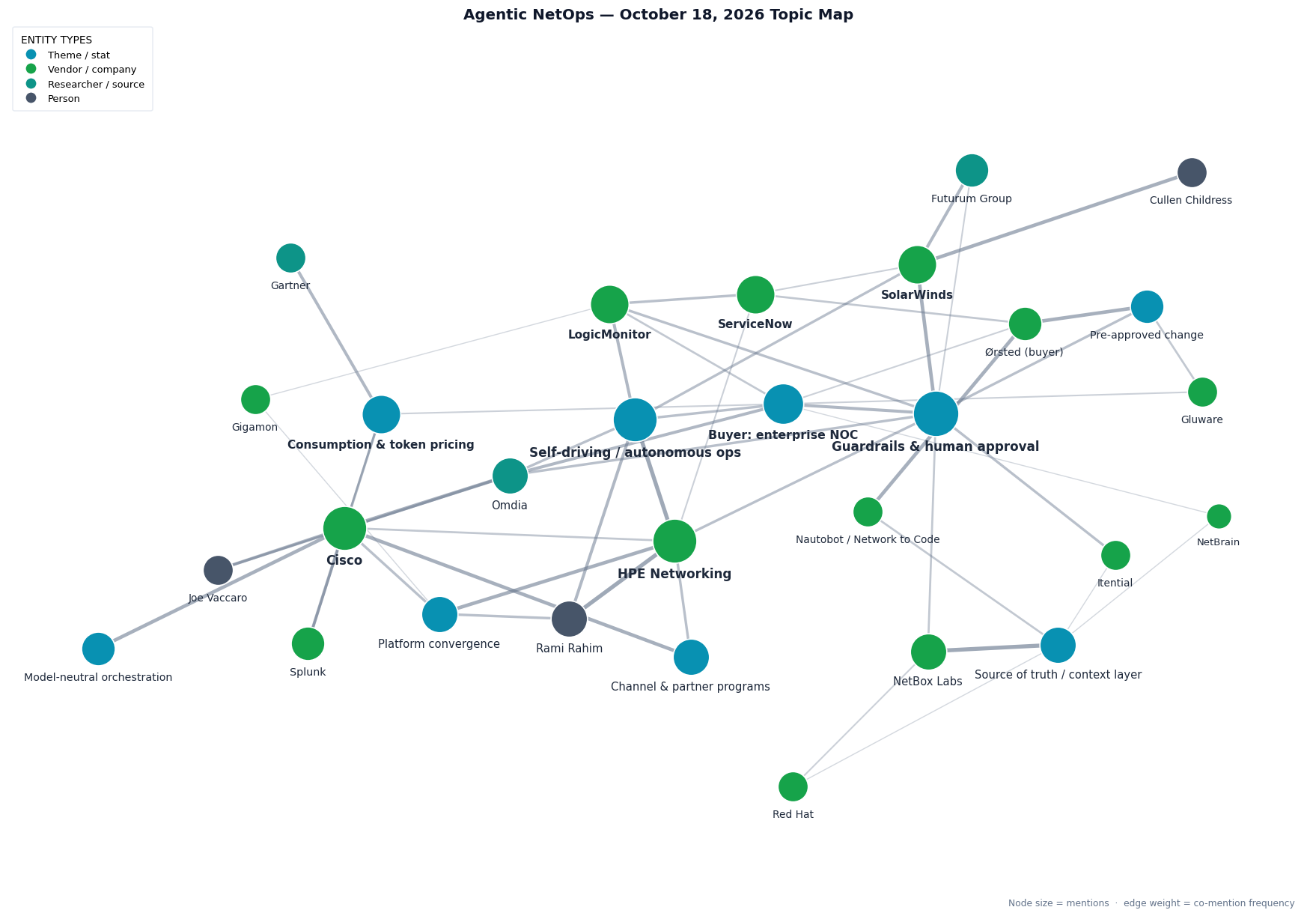
Entities and connections across this week’s 26 tracked stories. Node size reflects how often an entity appears; line weight reflects how often two appear together.
View interactive topic map →
Article index
Competitive moves: the platform incumbents
HPE and Cisco used the week to explain how they will sell AI-run networks. HPE published its first hard usage figures for autonomous fixes and said it will keep Aruba Central and Juniper Mist as two platforms sharing one AI engine. Cisco pitched itself as the neutral layer between competing AI models and agents, with Cloud Control as the base partners build managed services on.
| Article |
Source |
Published |
| 1. HPE’s self-driving network fixes 70–80% of issues on its own: Rahim |
Fierce Network |
Oct 12, 2026 |
| 11. HPE won’t merge Aruba and Mist, but is combining tech |
Fierce Network |
Oct 14, 2026 |
| 17. Aruba, Juniper, and Mist under one roof: the high-level takeaway |
Tech Field Day |
Oct 15, 2026 |
| 26. Inventor of AI Ops for enterprise Bob Friday explains why agentic AI will finally make self-driving enterprise networks a reality (foundational) |
Wi-Fi NOW |
Oct 18, 2026 |
| 19. Cisco Wants To Be The ‘Switzerland’ Of Enterprise AI |
CRN |
Oct 16, 2026 |
| 12. Cisco’s AI Play: Turn Security, ROI Challenges Into Partner Growth |
CRN |
Oct 14, 2026 |
| 6. WebexOne 2026 takeaways for network engineers |
Network World |
Oct 13, 2026 |
| 3. Modern retail networks are secure, simple, and ready for what’s next |
Cisco Blogs |
Oct 12, 2026 |
Competitive moves: challengers, specialists and deals
The monitoring and automation specialists answered with agents of their own. SolarWinds launched Avior with three autonomy levels, LogicMonitor set out a governed “Autonomous IT” model at Elevate, and NetBox Labs pitched its source of truth as the context layer agents need. 650 Group sized the deep observability market, and Nokia agreed to sell its enterprise campus edge unit to Aurelius. NetBrain published its R13 webinar recap.
Buyer adoption and demand signal
Cisco’s Omdia survey says 84% of NetOps leaders expect an AI-led operating model within a year, yet almost all require guardrails first. The named-buyer evidence came from Ørsted, which now pushes most firewall changes through in about ten minutes, and from LogicMonitor’s customer awards. Gluware took its automation into hospital medical-device patching.
| Article |
Source |
Published |
| 10. Survey finds why 84% of enterprises are adopting AgenticOps |
TechTarget |
Oct 14, 2026 |
| 20. NetOps Is Already Deploying Agentic Autonomy – Trust Will Decide How Far It Goes (foundational, Cisco-authored) |
Cisco Blogs |
Sep 23, 2026 |
| 14. Costco, Cleveland Clinic, NTT Data, and Bell Techlogix Show What AI-Powered Observability Can Actually Deliver |
LogicMonitor |
Oct 15, 2026 |
| 2. Ørsted builds compliance into automation, speeds firewall changes |
Network World |
Oct 12, 2026 |
| 15. Gluware extends automation to medical device patch management |
Gluware |
Oct 15, 2026 |
Pricing and the cost of running agents
Gartner and Forrester say agents are breaking seat-based software pricing, and Cisco is selling a tool that tracks and forecasts AI token spend by team and user.
The NOC operating model: earning trust
Four vendor authors made the same case from different angles: let the AI reason, but keep execution on fixed, validated, auditable paths, and show measurable outcomes to keep executive support.
| Article |
Source |
Published |
| 21. Probabilistic Automation Doesn’t Have to Feel Like a Leap of Faith (foundational, BackBox-authored) |
BackBox |
Oct 5, 2026 |
| 23. Why Determinism Is the Key to Safely Running AI Agents in Network Operations (foundational, Itential-authored) |
Itential |
Oct 13, 2026 |
| 22. Outcome-Oriented Network Automation (foundational, Gluware-authored) |
Gluware |
Oct 12, 2026 |
| 24. Advancing NetOps-as-Code: Strategic momentum, enhanced security, and multimode automation (foundational, Red Hat-authored) |
Red Hat |
Oct 14, 2026 |
Detailed write-ups
1. HPE puts numbers on autonomy and says it will keep two platforms
Fierce Network · Tech Field Day · Wi-Fi NOW · October 12–18, 2026
HPE gave its first usage figures for autonomous network fixes. Rami Rahim, who runs HPE Networking, told Fierce Network that the self-driving network now resolves an estimated 70–80% of potential issues without an operator and tells IT afterwards. HPE arrives at that figure by logging each autonomous fix. Sujai Hajela, who runs campus and branch, said customers authorised about 10,000 self-driving actions across HPE’s cloud platforms in the last 90 days, and that healthcare and other regulated industries are moving more slowly. Changes that touch regulatory compliance still need explicit customer approval and a rollback option, and incidents involving an active attacker are out of scope. Bob Friday, HPE’s chief AI officer and the founder of Mist, said customers switch on trusted actions one at a time from a defined list, and that use is growing at double-digit rates month on month.
Two days later Rahim set out the portfolio plan. Aruba Central and Juniper Mist will stay separate management platforms. “They never converge into one platform. They don’t need to,” he said. HPE is instead sharing what sits around them: Marvis becomes the common AI engine, new access points and switches connect to either platform, and the sales teams have already merged. On November 1 the Aruba and Juniper partner programs combine, giving all 60,000 HPE partners the full portfolio. Before the deal only about 10% of those partners overlapped.
The market context explains the urgency. IDC’s second-quarter figures, cited by Fierce, show enterprise WLAN revenue up 23.2% year on year, with Cisco growing 27.2% to a 39% share while HPE and Juniper together grew 7.5% to 17.2%. HPE is answering with an autonomy story and a much larger channel rather than a single platform. For vendors that work across HPE and Cisco estates, two things matter. HPE’s autonomy metrics are its own and come from its own equipment. And 60,000 partners will soon be selling Marvis-led operations into accounts where third-party tools are already in place.
Sources: Fierce Network (HPE’s self-driving network fixes 70–80% of issues on its own: Rahim) · Fierce Network (HPE won’t merge Aruba and Mist, but is combining tech) · Tech Field Day (Aruba, Juniper, and Mist under one roof: the high-level takeaway) · Wi-Fi NOW (Inventor of AI Ops for enterprise Bob Friday explains why agentic AI will finally make self-driving enterprise networks a reality)
2. SolarWinds enters agentic network operations with three levels of autonomy
Network World · Futurum · October 14–16, 2026
SolarWinds launched Avior, a set of goal-driven AI agents that act as well as advise, across its on-premises and SaaS products. The first is a network engineering agent that groups alerts into incidents, finds and fixes configuration drift, audits devices against policy, schedules configuration backups, tracks capacity and flags stale assets. Customers choose one of three modes: assistive, human approval for each action, or fully autonomous within limits they set. SolarWinds lists risk tiers, audit trails, automatic rollback and least-privilege access as guardrails. Avior connects to ServiceNow and to other tools through MCP. It is available now through a guided onboarding program, with database, IT administration, SRE and security agents due between late this quarter and early 2027. Pricing was not disclosed.
“Nobody’s going to let these agents just go do stuff unless they feel like they’re in control,” said Cullen Childress, SolarWinds’ interim CEO and chief product officer. Futurum noted that the launch comes two weeks after CEO Sudhakar Ramakrishna left, names one reference customer (Radiology Partners) without results, and does not mention SW1, the platform SolarWinds announced in April. Its analyst called the starting point sensible, because five of the six launch tasks have a known good state and can be checked and undone. He named Dynatrace, Datadog, ServiceNow and PagerDuty as rivals building agentic operations, and said SolarWinds’ advantage is depth in hybrid and self-hosted networks.
SolarWinds has a very large installed base in network monitoring, so Avior brings agentic operations to many mid-market and enterprise NOCs through a tool they already own. Its first use cases are configuration hygiene and compliance, which overlap with what specialist network automation vendors sell. Futurum’s advice to buyers is to require approval on every action and measure accuracy for a quarter before granting more autonomy. Vendors competing for those accounts should be ready with accuracy evidence of their own.
Sources: Network World (SolarWinds launches Avior AI agents to automate network operations) · Futurum (SolarWinds Avior: Goal-Driven Agentic AI for Hybrid IT Ops)
3. Cisco pitches itself as the neutral layer for enterprise AI, and gives partners the services play
CRN · Network World · Cisco Blogs · October 12–16, 2026
Cisco spent WebexOne arguing that it does not need to win the AI model race. Executives stressed support for third-party models, bring-your-own-LLM and agent-to-agent interoperability, so customers can use Google, Anthropic or OpenAI underneath. “Cisco is going to be Switzerland when it comes to working with a lot of players,” said Snorre Kjesbu, who runs Cisco Collaboration. Cisco told CRN its opportunity is the networking, security, observability and management layers that sit on top of whichever models win. A Long View Systems partner summed it up: “They want to be the overseer of AI.”
The channel is how Cisco plans to sell it. Alex Pujols, who leads partner solutions engineering, told CRN that Cloud Control, Cisco’s unified agentic platform across networking, security, collaboration and observability, is the base on which partners should build managed services. Cisco’s partner survey found 25% of partners already earn more than half their revenue from AI and 55% expect to within five years. It also found customer awareness of AI security fell from 35% to 29%, and fewer than half of partners see customers exceeding ROI expectations. Pujols said token costs are introducing a variable expense most enterprises have not learned to budget for. At WebexOne, Cisco also claimed an AI agent uses 450% more bandwidth than a person doing the same task, a vendor figure analyst Zeus Kerravala passed on without verification.
Cisco’s message is that buyers and partners should not have to bet on one model, and that whoever runs the infrastructure under the agents takes the recurring revenue. That puts Cisco in direct competition with multi-vendor NetOps platforms for the role of neutral operations layer, while Cloud Control still works best across Cisco’s own products. Independent vendors can make the stronger neutrality claim across mixed estates, but Cisco is putting a services margin in front of its partners to adopt Cloud Control first.
Sources: CRN (Cisco Wants To Be The ‘Switzerland’ Of Enterprise AI) · CRN (Cisco’s AI Play: Turn Security, ROI Challenges Into Partner Growth) · Network World (WebexOne 2026 takeaways for network engineers) · Cisco Blogs (Modern retail networks are secure, simple, and ready for what’s next)
4. Cisco’s survey: 84% expect AI-led network operations within a year, almost all want guardrails
TechTarget · Cisco Blogs · September 23 – October 14, 2026
A Cisco-sponsored survey by Omdia of more than 1,000 IT and NetOps leaders found that 84% expect to move to an AI-led operating model within 12 months and 95% say their current AIOps tools cannot keep up. The average organisation receives more than 4,000 monitoring alerts a day, about half of them network-related. Cisco calculates that clearing that backlog by hand would take roughly 100 specialists. “The math of a human team no longer works,” Joe Vaccaro, Cisco’s SVP for network platform and assurance, told TechTarget.
Adoption is further along than earlier surveys suggested. In Vaccaro’s September blog on the same data, 75% of organisations had deployed AI for network operations, more than half run agents that act in production, and 80% are comfortable giving AI a high or fully autonomous role. The conditions are firm, though. 69% require detailed explanations of what an agent did, and nearly all require at least one guardrail before AI acts. “The guardrails are not an optional step,” Vaccaro said.
The numbers are Cisco’s, and Omdia belongs to the same company as TechTarget, which published the interview. Even so, the direction matches Riverbed’s and EMA’s research from last week: buyers have accepted that agents will do the work, and the purchase decision now turns on explainability and control. The vendor that can show why an agent acted, and stop it when needed, has the easier sale.
Sources: TechTarget (Survey finds why 84% of enterprises are adopting AgenticOps) · Cisco Blogs (NetOps Is Already Deploying Agentic Autonomy – Trust Will Decide How Far It Goes)
5. LogicMonitor sells “Autonomous IT” as a governed operating model
theCUBE Research · LogicMonitor · October 14–15, 2026
At its Elevate conference in Chicago, LogicMonitor presented an Autonomous IT operating model that combines its Envision monitoring platform, its Edwin AI agent and Catchpoint’s digital-experience data. The model rests on five elements: an enterprise data foundation, unified context, AI for governed action, an integrated experience, and trust and governance controls. Agents get read-only access by default, and the right to make changes is authorised separately. theCUBE Research’s Paul Nashawaty said “visibility has become necessary but insufficient as an enterprise operating capability.”
LogicMonitor called a US federal agency its largest customer win to date. The agency’s business case projects 182% ROI over three years, more than 170,000 hours saved a year, 70% less downtime impact and a nine-month payback. These are projections, not results. Its customer awards named Costco, Cleveland Clinic, Markel and managed service provider Bell Techlogix, which reported 85% alert compression. Partner awards went to NTT DATA, AHEAD, WWT, Red Hat, AWS and CDW. No general-availability dates or pricing were given.
LogicMonitor is positioning for the same buyer as network-automation vendors: the enterprise that wants agents to act but will only allow governed action. Its route in is the large-enterprise monitoring contract, with ServiceNow integration and a strong partner bench. theCUBE is LogicMonitor’s paid media partner for Elevate, and the ROI figures are projections, so the proof point to watch is a named customer reporting realised results.
Sources: theCUBE Research (LogicMonitor Moves Beyond Alerting with Governed AI and a Context-Driven Model for Autonomous IT) · LogicMonitor (Costco, Cleveland Clinic, NTT Data, and Bell Techlogix Show What AI-Powered Observability Can Actually Deliver)
6. NetBox Labs pitches its source of truth as the context layer for agents
Network World · October 13, 2026
NetBox Labs, the company behind the open-source NetBox infrastructure database, used its first conference to move from documentation tool to agent platform. It launched design templates (in public preview), ready-made analytics, pre-built agents for change review, compliance, data quality and data import, a fully managed MCP server so customers’ own agents can query NetBox, and a validation service that checks proposed changes against rules before they run. Agents are read-only by default, and any change goes onto a branch for an architect to review. NetBox also became the native source of truth for Nvidia’s configuration manager and added an official Grafana plugin.
“What we’ve always known is that Netbox is a context layer for agents and infrastructure,” said CEO Kris Beevers. “This is infrastructure, and so if an agent does the wrong thing, it breaks the company.” The company says more than 10,000 organisations use NetBox. It gave no pricing or general-availability dates beyond the design preview.
Every agent vendor this week said agents need trusted context about the network before they can act. NetBox Labs is betting that the open-source inventory many enterprises already run becomes that context, with its own agents and validation added on top. That puts it in the path of commercial NetOps platforms that model the live network themselves. Red Hat’s Ansible collection for NetBox, with 88 modules, shows how deeply it is already wired into automation workflows.
Sources: Network World (NetBox Labs adds network design templates and AI agents to streamline infrastructure operations) · Red Hat (Advancing NetOps-as-Code: Strategic momentum, enhanced security, and multimode automation)
7. Ørsted shows what buyers automate first: pre-approved, low-risk change
Network World · Gluware · October 12–15, 2026
Danish energy company Ørsted gave one of the clearest buyer accounts of the year. Its firewall change requests used to be checked by hand, sent to a change advisory board and passed to a separate implementation team, a loop that could take days or weeks. Ørsted chose Nautobot, the open-source platform from Network to Code, over commercial and open-source alternatives, and built validators that model its network zones and policies. Requests arrive through ServiceNow. About 60–70% are now pre-approved low-risk flows that go live in about ten minutes, including peer review. Anything else still goes to the change board and takes days.
“If it doesn’t fit into this low-risk, pre-approved request type, then we need to ensure it goes to CAB. It cannot be optional,” said João Soares, Ørsted’s lead IT security consultant. His advice to other buyers: “You need to start small, but think big,” and “treat it like a real product.” In the same week Gluware extended its automation to hospital medical-device patching, matching vulnerabilities to affected devices and running fixes through the hospital’s own approval and audit process.
Ørsted’s results come from deterministic automation and policy, not AI agents. That is the point for sellers: the buyers getting results today define which changes are safe in advance, automate those completely, and keep human review for the rest. Ørsted also chose an open-source platform over commercial products. Vendors selling agentic NetOps need to show they fit that pattern of pre-approved change categories, built-in compliance checks and ServiceNow as the front door.
Sources: Network World (Ørsted builds compliance into automation, speeds firewall changes) · Gluware (Gluware extends automation to medical device patch management)
8. Agents are breaking seat-based pricing, and AI cost control is becoming a product
TechTarget · Zawya (Cisco release) · October 13–15, 2026
TechTarget reports that agentic AI is unsettling the way enterprises buy software. Microsoft pairs Copilot seats with usage billing for agentic work, Salesforce prices Agentforce actions in Flex Credits, SAP meters AI Units, and Anthropic charges Claude Enterprise customers a per-user fee plus usage. “Traditional software budgets fund access. Agent budgets delegate spending authority to software,” said Gartner’s George Brocklehurst. Forrester’s Tracy Woo said consumption-based pricing is coming “for every model and AI SaaS provider, at least in part.” Their advice to CIOs is to compare the cost of completing a workflow rather than unit prices, and to let central IT own the platform and controls while business units own consumption.
Cisco is already selling the cost-control tool. A Cisco release republished in the Middle East adds Tokenomics to Splunk Agent Observability. It tracks AI token costs as they occur, attributes them to teams and individual users, gives one view across AI coding assistants such as Claude Code and Codex, forecasts spending before the billing period ends, and helps route work to the cheapest suitable model. It is available in Cisco Cloud Control and in Splunk’s on-premises and cloud products.
Last week Netskope moved to credit pools for its agents. This week two major analyst firms said the seat is being unbundled, and Cisco built AI spend management into its operations platform. Buyers of network agents will soon ask what each resolved incident costs and who pays for it. Vendors with per-device licences need a consumption option they can explain in those terms.
Sources: TechTarget (AI agents are changing the math on software spending) · Zawya (Cisco release) (Cisco highlights how AI Tokenomics can help organizations manage AI costs at scale)
Calls to action
- Brief partners before HPE’s November 1 program merger. 60,000 HPE partners will be pitching Marvis-led operations. Give your shared partners a multi-vendor story they can sell alongside it, and identify accounts where HPE and Cisco equipment sit side by side.
- Prepare a head-to-head on SolarWinds Avior. Its first agent covers configuration drift, compliance audits and backups. Prepare a comparison for sales on depth across vendors, change validation and published accuracy, since Futurum is telling buyers to measure accuracy for a quarter.
- Answer Cisco’s neutrality claim. Cisco now calls itself the neutral layer for enterprise AI. Put your multi-vendor coverage and independence from any one equipment vendor at the front of your positioning in Cisco-heavy accounts.
- Package a pre-approved change offer. Ørsted gets most changes live in ten minutes by pre-approving low-risk categories and routing through ServiceNow. Offer buyers a ready-made set of pre-approved change types, compliance checks and an approval path for everything else.
- Lead with explainability. 69% of Cisco’s respondents want detailed explanations of agent actions and nearly all want guardrails. Make sure every demo shows why the agent acted, what it checked first and how to roll it back.
- Price per outcome as well as per device. Gartner says agent budgets delegate spending authority to software. Have a cost-per-resolved-incident view ready for the next large renewal.
|