This week at a glance
This was the week the dependency firewall became a standard feature. Sonatype launched Nexus Repository Pro+, which moves Repository Firewall into the repository and screens packages, AI models and MCP servers at the moment a developer or agent requests them. Snyk launched Evo Agentic AppSec, five security agents running on its own engines, one of them an Evo Dependency Firewall that blocks malicious packages at install time. Snyk’s firewall is an experimental preview for selected customers, and Sonatype’s Enterprise tier is weeks away, but with GitLab’s Dependency Firewall last week, three competitors now say “firewall” in their pitch for the layer where Artifactory and Curation sit.
The second story is procurement. Chainguard and Checkmarx both joined the Claude Marketplace, so customers can pay for them out of an existing Anthropic commit. Chainguard also widened its reach well past images: Mythos-powered bug hunting run as a service, credential-free agent workspaces, a CI check that emits signed attestations and that its own marketer calls “a replacement for GitHub Actions”, and Go and .NET libraries with a NuGet replacement endpoint. GitHub made agentic autofix and AI Scan for pull requests generally available, both billed in Code Security AI Credits, with AI Scan needing no Copilot licence.
Third, the platform that wants to own the whole factory had a bad week: GitLab patched an unauthenticated CVSS 10 RCE in its CI regex engine, plus two Duo Agent Platform governance flaws. Fourth, model labs are buying security research teams. Cohere signed for AISLE and created Cohere Cyber, and OpenAI is reportedly in early talks for Trail of Bits. On agent containment, a Vercel Sandbox egress flaw and a CSO analysis of lab incidents point the same way as a new reference architecture co-written by Socket’s CTO: treat the agent as untrusted and put a registry or firewall at its supply-chain boundary.
Our own news: JFrog Security Research published a curl HTTP/2 use-after-free (CVE-2026-92392, fixed in 8.23.0), Q3 results land on November 5, and UBS raised its target to $125 on expected cloud growth of 54–55%.
On our watch list
- Sonatype’s Pro+ pricing and the Enterprise release. Sonatype says Nexus Repository Enterprise follows “in the coming weeks.” Whether the firewall is priced as part of the repository or as an upcharge decides whether Pro+ is a discount weapon against Artifactory in renewals.
- Snyk’s Dependency Firewall leaving experimental preview. A GA date, a list of supported package managers, or a registry-side deployment option would make it a real Curation competitor. Until then it is an install-time hook in preview.
- Who else joins the Claude Marketplace. Checkmarx and Chainguard are in. If Snyk, Sonatype or GitHub follow, buying from an Anthropic commit becomes the standard way to purchase AppSec, and JFrog’s absence becomes a real gap.
- GitHub’s AI-credit economics. Watch for published per-credit pricing for Code Security, and for customer complaints about autofix bills. A meter that runs high is an opening for flat-priced JFrog Advanced Security.
- Chainguard Libraries in Artifactory remotes. Go and .NET are in early access with a managed NuGet endpoint. If Chainguard starts selling Libraries as a replacement for the remote repository rather than a feed behind it, that is a direct registry play.
- Exploitation of GitLab CVE-2026-97229. No in-the-wild use has been reported. A KEV listing or public exploit would push self-managed GitLab customers to reconsider what else they host on that server.
- OpenAI–Trail of Bits: deal or no deal. The talks are unconfirmed. A signed deal would put the labs’ “find and fix” service in direct competition with AppSec scanners, and Cohere Cyber would not be alone.
- A fix for the Vercel Sandbox leak. Vercel has not said how it will patch. A long delay keeps agent egress control in every security review, which helps the case for repository-side admission control.
- Agent Baseline version 2. The reference architecture is open for comment on GitHub. Whether JFrog is a named contributor to the next version, or Socket remains the only supply-chain vendor credited, is in our hands.
- JFrog Q3 on November 5. UBS expects cloud growth of 54–55% or better and total growth of 27% or more. Watch the commentary on Curation and AI Catalog attach, which now has three repository-firewall competitors to answer.
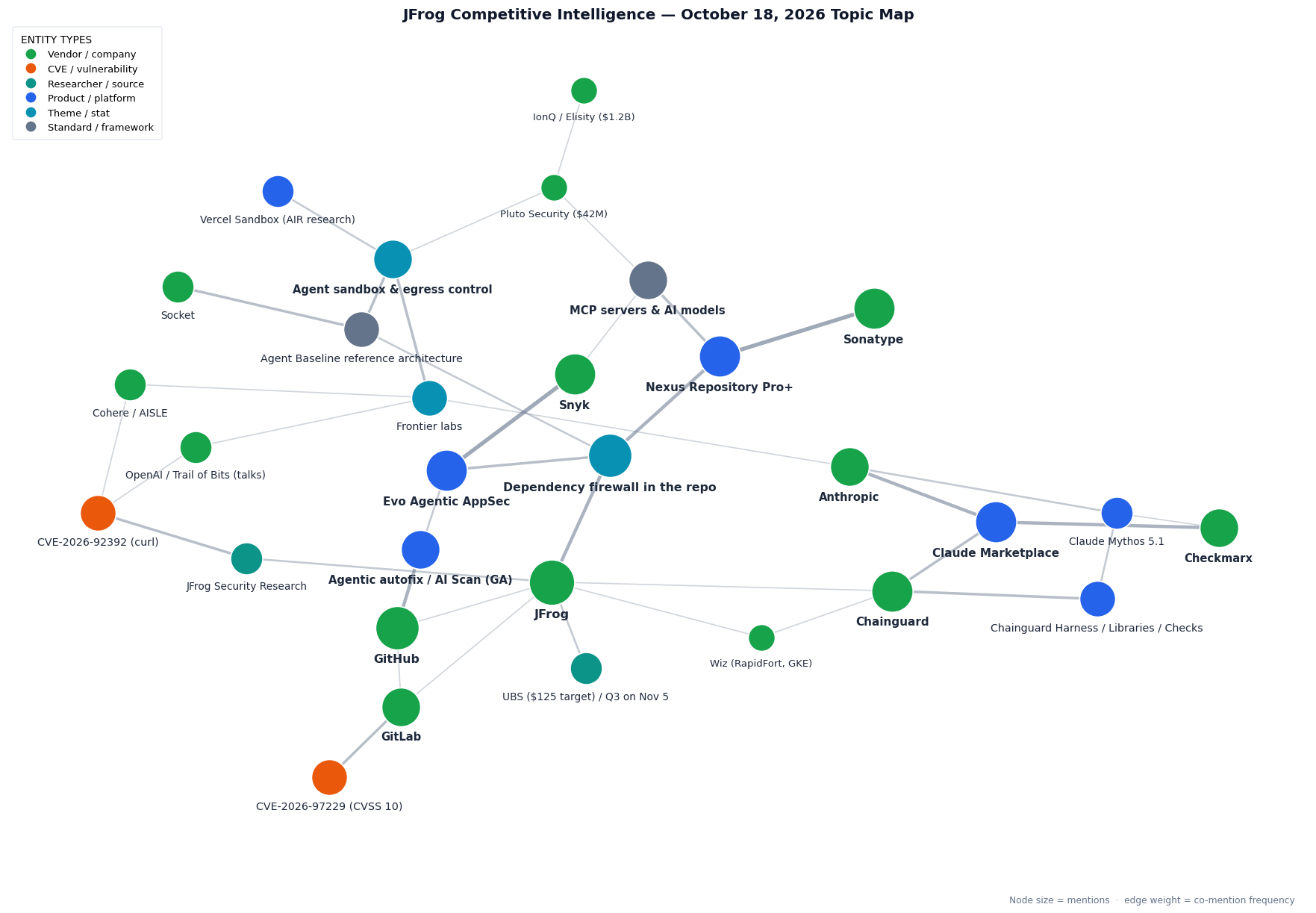
This week’s competitive map: JFrog at the centre, tied to the “dependency firewall in the repo” theme that now connects Sonatype’s Nexus Repository Pro+ and Snyk’s Evo; GitHub’s agentic autofix and GitLab’s CVSS 10 below; Anthropic’s Claude Marketplace with Checkmarx and Chainguard on the right; agent sandboxing, Agent Baseline and the frontier labs at the top left, linked to the Cohere–AISLE and OpenAI–Trail of Bits deals and our curl CVE.
View interactive topic map →
Article index
Agentic AppSec arrives: Snyk and GitHub
Snyk ships a team of security agents and its own dependency firewall. GitHub makes AI fixing and AI scanning generally available and moves Advanced Security toward an AI-credit meter.
| Article |
Source |
Company |
Published |
| 14. Snyk Launches Evo Agentic AppSec, Redefining Traditional AppSec With a Team of Security Agents — Five security agents on top of Snyk’s engines, including an Evo Dependency Firewall; three of the five are experimental preview. |
Snyk |
Snyk |
Oct 15, 2026 |
| 15. Agentic autofix for code scanning alerts general availability — Copilot fixes up to 25 CodeQL alerts per PR and verifies them; billed in Code Security AI Credits plus Actions minutes. |
GitHub Changelog |
GitHub |
Oct 15, 2026 |
| 16. AI Scan for pull requests generally available — AI-driven PR scanning for PHP, Shell, Terraform, Dockerfiles and more; no Copilot licence needed, findings advisory only. |
GitHub Changelog |
GitHub |
Oct 15, 2026 |
| 13. GitHub adopts cheaper AI model to catch secrets developers leave in code — GitHub swaps its LLM secret pipeline for a ModernBERT classifier: serving cost down 98%, recall up 19%. |
Help Net Security |
GitHub |
Oct 14, 2026 |
| 24. AI distrust is GitHub's opportunity — Opinion: developer trust in AI output is falling as use rises, and GitHub can sell the review layer over everyone’s agents. |
InfoWorld |
GitHub |
Oct 13, 2026 |
The firewall moves into the repository
Sonatype folds Repository Firewall into Nexus Repository, covering models and MCP servers. Socket, RapidFort and Wiz push scanning and curated images into the places developers already work.
Bought through Anthropic: Chainguard, Checkmarx and the software factory
Chainguard and Checkmarx are both on the Claude Marketplace, so customers can pay for them out of an existing Anthropic commit. Chainguard keeps moving from images into libraries, CI and agent workspaces.
| Article |
Source |
Company |
Published |
| 7. Chainguard puts Claude Mythos on flaw hunting, secures coding agents and widens Libraries — Assemble London: Mythos-powered Chainguard Harness on the Claude Marketplace, Workspaces and Checks in beta, Go and .NET Libraries. |
SiliconANGLE |
Chainguard |
Oct 14, 2026 |
| 18. Vendors build safeguards for autonomous software factories — Harness Cosmos and Chainguard Workspaces both isolate agents in microVMs; IDC says the industry is “a bit over its skis.” |
TechTarget |
Harness, Chainguard |
Oct 15, 2026 |
| 17. Checkmarx Joins the Claude Marketplace — Fusion, Triage Assist and Remediation Assist can now be bought out of a customer’s Anthropic commit. |
GlobeNewswire (Checkmarx) |
Checkmarx |
Oct 15, 2026 |
| 11. As AI accelerates software development, AppSec becomes an MSP problem — Checkmarx’s channel VP on taking AppSec-as-a-service to MSPs at the low end of the market. |
ChannelBuzz |
Checkmarx |
Oct 14, 2026 |
Agent containment and platform flaws
A CVSS 10 in GitLab CI, a leaky agent sandbox, and an expert consensus that the labs are skipping basics. The proposed fix puts a registry or firewall at the agent’s supply-chain boundary.
Deals and funding
Model labs are buying vulnerability-research teams, and security valuations stay rich.
| Article |
Source |
Company |
Published |
| 20. Cohere to acquire Czech AI cybersecurity firm Aisle, set up new cyber division — Cohere signs an LOI for AISLE and stands up Cohere Cyber under ex-Avast CEO Ondřej Vlček. |
BetaKit |
Cohere, AISLE |
Oct 15, 2026 |
| 23. OpenAI in early talks to buy Trail of Bits, The Information reports — Early, unconfirmed talks reported by The Information; Trail of Bits already works OpenAI’s Patch the Planet programme. |
The Next Web |
OpenAI, Trail of Bits |
Oct 17, 2026 |
| 1. IonQ's $1.2 billion acquisition of Elisity is trying to position it for quantum cybersecurity — $1.2B all-stock for a zero-trust microsegmentation vendor with 100-plus customers; analysts call the quantum link thin and the price steep. |
CSO Online |
IonQ / Elisity |
Oct 13, 2026 |
| 3. Pluto Security raises $42M as AI gives enterprise security teams a new headache — Seed plus Series A for a startup that inventories employees’ AI tools, skills and MCP servers; ARR above $2M. |
TechCrunch |
Pluto Security |
Oct 13, 2026 |
JFrog in the news
Earnings date set, an analyst raise, and a curl CVE from our research team.
Detailed write-ups
1. Snyk launches Evo Agentic AppSec, with a Dependency Firewall aimed at Curation
Snyk · October 15, 2026
Snyk’s biggest launch of the year packages its scanners as tools for a team of AI agents. Evo Agentic AppSec has five: a Code Scanning Agent that pairs AI reasoning with static analysis to find access-control and authentication logic flaws; an Evo Dependency Firewall that blocks malicious and out-of-policy packages at install time, slopsquatting included; an Agentic Security Review that builds an application and threat model for a whole repository; a Remediation Agent that fixes new code and backlog, starting with Snyk Open Source issues, and queues anything that might break the build for approval; and Secrets Detection from IDE to CI. Read the availability line closely. The Code Scanning Agent, Dependency Firewall and Security Review are an experimental preview for select customers; the Remediation Agent is in open preview; only Secrets Detection, Agentic Development Security and Continuous Offensive Security are GA. There is no pricing.
Snyk backs the launch with its own numbers: more than 4,800 customers, LLM-only security reviews that lost a finding on a rerun 49.7% of the time, and a Remediation Agent that produced mergeable fixes 90% of the time against 59.6% for an LLM alone. It also says new critical and high issues across its customers grew tenfold in a year, and that 36% of nearly 4,000 agent skills it audited had at least one flaw. CTO Manoj Nair’s line: “Agents do the work. Something independent proves it holds. Humans own the bar.”
So what for JFrog. Two weeks, two competitors launching something called a “Dependency Firewall”: GitLab last week, Snyk this week. Snyk’s is an experimental preview for selected customers, so in deals it is a roadmap slide. But the architecture Snyk describes, with agents on top of deterministic engines, is the same story we tell for JFrog Advanced Security. Our difference is where the block happens: at the repository every build already pulls through, not at an install hook a developer can go around. Reps should say that in one sentence and ask the customer what Snyk’s firewall does on a CI runner that never runs the Snyk CLI.
Sources: Snyk (Evo Agentic AppSec)
2. Sonatype puts Repository Firewall inside Nexus Repository
Sonatype · October 14, 2026
Nexus Repository Pro+ moves Sonatype’s Repository Firewall malicious-code protection and policy enforcement into the repository itself. When a developer or an AI agent requests a component, Pro+ screens open-source packages, AI models and MCP servers, then blocks or quarantines anything malicious, vulnerable or out of policy before it reaches the build. Policies cover security, legal, architecture and component age, drawing on a catalogue of more than 333 million components and more than 1.9 million malicious versions Sonatype says it has identified. Pro+ also proposes upgrade paths that it checks against existing build and test processes. It is available now; Nexus Repository Enterprise with the same protection follows “in the coming weeks.” No pricing was given, and JFrog is not named.
Sonatype’s own data makes the AI-model case: organisations adopting Hugging Face grew nearly 4.7 times year on year, and close to 7% of Hugging Face requests in its population were blocked by policy, against about 3.5% for Go and 1% for Cargo. Most blocked models (55%) failed on acceptability rather than security (18%). CTO Brian Fox: “AI changed the equation.” A companion blog post argues that “AI noise”, the flood of agent-generated dependency changes, has moved the bottleneck from writing code to validating it.
So what for JFrog. This is the most direct like-for-like move against Artifactory plus Curation this year: the firewall is now part of the repository SKU rather than a separate product, and it covers models and MCP servers. Expect Sonatype to price Pro+ against our Pro and Enterprise X bundles. Our counter is package-type breadth, the AI Catalog for models, and scale. But the message “firewall included in the repository” is now table stakes, and our packaging should state plainly that Curation does this, rather than leave the customer to assemble it from a price list.
Sources: Sonatype (Nexus Repository Pro+) · Sonatype (AI Noise blog)
3. Chainguard moves past images: Mythos bug-hunting, agent workspaces, signed CI checks and NuGet replacement
SiliconANGLE / TechTarget · October 14–15, 2026
At Assemble London, Chainguard launched four things. Chainguard Harness uses frontier models, including Anthropic’s Claude Mythos 5.1, to hunt for flaws, and reports only those it reproduces against a live build in an isolated VM with no network access. A Chainguard engineer signs off every report. It is a staff-run service with a beta waitlist, and it is listed on the Claude Marketplace, so customers can pay out of an Anthropic commit. Workspaces (beta) gives coding agents a hardened, credential-free remote VM with short-lived stand-in credentials and optional egress policy. Checks (beta) runs CI before a pull request opens and produces a signed attestation tying environment, test result and commit together. Chainguard’s Sam Katzen described Checks to TechTarget as “a replacement for GitHub Actions.” Chainguard Libraries adds Go and .NET in early access, making five languages; .NET users can swap NuGet for a Chainguard-managed endpoint with malware scanning.
TechTarget puts the launch next to Harness’s Cosmos software factory: both isolate agents in ephemeral microVMs. An IDC survey of 309 respondents found 74.6% agree AI coding assistants raise the risk of merging code nobody fully understands, yet only 28% require peer review of AI-assisted changes. IDC’s Katie Norton: “the industry is a bit over its skis.” CEO Dan Lorenc described a Workspace as an isolated machine “with nothing in it worth stealing.” Chainguard has raised about $892M since 2021.
So what for JFrog. Chainguard is no longer just a hardened-image vendor. Libraries in five ecosystems, with a managed NuGet endpoint, is a curated-registry play aimed at the remote-repository role Artifactory fills today. Checks producing signed attestations per commit overlaps directly with our Evidence story. And Harness being sold through the Claude Marketplace means Chainguard can be bought from an Anthropic budget the customer has already approved, which skips the security-tool procurement conversation we usually win on. Track every account where Chainguard Libraries shows up as a remote in Artifactory: that is the wedge.
Sources: SiliconANGLE (Chainguard at Assemble London) · TechTarget (software-factory safeguards)
4. GitHub makes agentic autofix and AI Scan GA, and puts Advanced Security on an AI-credit meter
GitHub Changelog / Help Net Security / InfoWorld · October 13–15, 2026
Agentic autofix for code scanning is now GA for GitHub Code Security and Advanced Security on Enterprise Cloud. Copilot explores the codebase, proposes a fix, reruns CodeQL to confirm the alert is closed, then opens a draft pull request; up to 25 alerts can go into one PR. When it is turned on, “Assign to Copilot” replaces the free “Generate Fix” button. Usage draws AI Credits from the Code Security budget plus Actions minutes. AI Scan for pull requests is also GA. It covers what CodeQL doesn’t, including PHP, Shell, Terraform, Dockerfiles, JSP and Blazor. Findings are advisory and cannot block a merge. It is free on public repositories, needs Code Security or GHAS on private ones, needs no Copilot licence, and also consumes AI Credits.
Separately, GitHub engineers described replacing their LLM pipeline for generic secret detection with a fine-tuned ModernBERT classifier: serving costs fell more than 98%, median scan time 86%, with precision up 13% and recall up 19%. That is the cost model behind last week’s push-protection news. Matt Asay’s InfoWorld column supplies the strategy: Stack Overflow data show AI use among developers at 83% but only 7% trusting it for important decisions, and GitHub can sell itself as the review layer over every vendor’s agents.
So what for JFrog. GitHub is moving Advanced Security from per-committer seats toward a consumption meter, and widening coverage to Terraform and Dockerfiles, which is JFrog Advanced Security ground. AI Scan with no Copilot licence lowers the bar for GHAS to spread inside accounts already standardised on GitHub. Our answer is post-build: binaries, containers and what actually shipped, plus contextual analysis that tells a team whether a CVE is applicable at all. A PR-time scanner cannot see that. Get the AI-credit pricing into the battlecard so reps can show a customer what a year of autofix costs at their alert volume.
Sources: GitHub Changelog (agentic autofix GA) · GitHub Changelog (AI Scan GA) · Help Net Security (secret-detection model) · InfoWorld (AI distrust)
5. Checkmarx joins Chainguard on the Claude Marketplace, and takes AppSec to MSPs
GlobeNewswire / ChannelBuzz · October 14–15, 2026
US Anthropic customers can now put part of their committed Anthropic spend toward three Checkmarx One products, consolidated on a single Anthropic invoice: Checkmarx Fusion, which pairs Checkmarx’s deterministic engine with Claude; Triage Assist, which ranks findings by attackability rather than static severity; and Remediation Assist, which proposes a merge-ready fix per finding. Checkmarx is also in Anthropic’s Cyber Verification Program, using Claude Mythos internally, and joined Project Glasswing in September. No pricing was given. Anthropic’s Ash Alhashim: “Security teams should be able to get the tools they trust as easily as they get Claude.”
In a ChannelBuzz interview the same week, Checkmarx channel VP Jon Kozimor called Checkmarx “a relatively small company” that relies on “hundreds” of partners, and described an AppSec Partner Program for MSPs delivering AppSec as a service, today mostly at the low end of its market.
So what for JFrog. Two AppSec competitors landed on the Claude Marketplace in one week. The marketplace turns an Anthropic commit into a procurement shortcut: a CISO can add Checkmarx or Chainguard without a new vendor onboarding or a new budget line. If JFrog is not listed, we carry full procurement friction against rivals drawn down from money the customer has already approved. Someone should own the question of whether JFrog belongs there. The MSP story is a down-market play and tells us little about Checkmarx in the enterprise.
Sources: GlobeNewswire (Checkmarx on Claude Marketplace) · ChannelBuzz (Checkmarx MSP interview)
6. A week after pitching the governed software factory, GitLab patches an unauthenticated CVSS 10 in CI
DevOps.com · October 14, 2026
GitLab’s October 12 releases fix 24 vulnerabilities. The headline is CVE-2026-97229, rated CVSS 10.0: an integer overflow in the regex compiler used by GitLab CI/CD that lets a crafted expression in CI configuration run arbitrary code on the GitLab server, without authentication. It affects 19.2 through 19.4 and is fixed in 19.4.2, 19.3.5 and 19.2.8. GitLab.com and Dedicated are already patched; self-managed instances must upgrade. High-severity CI/CD bugs in the same batch let a Developer run pipelines on protected branches (CVE-2026-16301) and expose protected variables through cache poisoning (CVE-2026-14814).
Two fixes land on the Duo Agent Platform: a prompt injection that can trigger command execution attributed to other users (CVE-2026-96893, 7.3) and a token that bypasses governance controls (CVE-2026-105458). This is GitLab’s fourth critical release in about eight weeks. Futurum’s Mitch Ashley: “Agents have turned attribution into an attack surface.”
So what for JFrog. Last week GitLab asked customers to put artifacts, a package firewall and secrets on the same platform as CI. This week that CI server shipped an unauthenticated CVSS 10 RCE and an agent-governance bypass. Use it as an argument for separation of duties, not as a gloat: the system of record for artifacts and their provenance should not be the same server that keeps needing emergency patches. Be ready for the counter-punch, too. UBS’s note this week mentioned our own August Artifactory vulnerability.
Sources: DevOps.com (GitLab CVSS 10)
7. Model labs go shopping for vulnerability hunters
BetaKit / The Next Web / CSO Online / TechCrunch · October 13–17, 2026
Cohere signed a letter of intent to buy Prague-based AISLE, about 50 people, price undisclosed, and is creating Cohere Cyber under AISLE co-founder and former Avast CEO Ondřej Vlček. AISLE claims its system found 18 of the 24 vulnerabilities fixed in the latest curl release. OpenAI is in early talks to buy Trail of Bits, according to The Information. The talks are unconfirmed and could collapse. Trail of Bits already works OpenAI’s “Patch the Planet” programme, using GPT-5.5-Cyber and Codex across 19 open-source projects including cURL, Python and Go.
Two other deals show where the money is. IonQ is paying $1.2B in stock for Elisity, a zero-trust microsegmentation vendor with more than 100 customers; analyst Frank Dickson puts that at roughly $13M per customer, and Info-Tech’s Brian Jackson says the quantum link is weaker than the announcement suggests. Pluto Security raised $42M to inventory the AI tools, skills, extensions and MCP servers employees use. Its free Plutonium service includes a catalogue of verified AI components. CEO Shahar Bahat: “We’re moving from user behavior to agent behavior.”
So what for JFrog. The labs are buying the people who find bugs with AI. Cohere has done it, and OpenAI is talking. They will sell “find and fix” directly to enterprises, which makes them a new class of competitor for the scanning half of AppSec. JFrog’s place is to be the neutral layer where any lab’s fixes land, get verified and get promoted. Pluto’s free “catalogue of verified AI components” is a small version of what JFrog AI Catalog should own outright. IonQ–Elisity has no supply-chain angle; it is a read on how richly security assets are being priced.
Sources: BetaKit (Cohere–AISLE) · The Next Web (OpenAI–Trail of Bits talks) · CSO Online (IonQ–Elisity) · TechCrunch (Pluto Security $42M)
8. Agent containment: sandboxes leak, labs skip basics, and the reference architecture names the registry
The Record / CSO Online / Socket · October 13–14, 2026
Research from AIR, reported by The Record, shows agents running in Vercel Sandbox can get data out by abusing certificate validation: a crafted certificate accepted by an approved server triggers a request to an attacker’s server, so the sandbox never contacts the attacker directly and looks normal throughout. There is no patch. AIR’s Niv Hoffman says Vercel told him a fix is unclear, and Vercel did not comment. A CSO news analysis argues that the recent run of “rogue agent” incidents at OpenAI, Anthropic, Meta, Google and Mistral are failures of basic sandboxing and egress control by the labs, not agents acting with intent. SANS’s Rob T. Lee: “There’s no reason why every single time this happens, it’s, ‘Oops, we don’t know how they got out.’”
Agent Baseline published version 1 of “The Secure Software Factory: A Reference Architecture”, co-authored by Socket CTO Ahmad Nassri with contributors from Docker, Keycard, Barclays and Secure Theory. It treats the agent as untrusted and enforces four boundaries the agent cannot reach: sandbox, network, supply chain and identity. On the supply chain, packages, dependencies and models must pass through an admission point such as a registry or supply-chain firewall. The paper cites Uber attributing more than 70% of pull requests to agents and Stripe merging more than 1,000 agent PRs a week.
So what for JFrog. The industry’s answer to agent risk is converging on one rule: the agent is untrusted, so enforce its limits outside it. The reference architecture defines the supply-chain boundary as a registry or firewall admission point, which describes Artifactory plus Curation. Socket wrote itself into that document. JFrog should be a named contributor to version 2 rather than a reader of version 1. The comment window on GitHub is open now.
Sources: The Record (Vercel Sandbox escape) · CSO Online (frontier labs skip basics) · Socket (Agent Baseline)
9. JFrog: a curl CVE from our research team, Q3 on November 5, and UBS to $125
JFrog Security Research / Business Wire / Investing.com · October 14–15, 2026
JFrog Security Research published CVE-2026-92392, a use-after-free in curl’s HTTP/2 upload path that allows client-side code execution through a malicious HTTPS server. It affects curl 8.12.0 through 8.22.0 and is fixed in 8.23.0. Full code execution needs parallel mode with an upload, which JFrog calls a “once-in-a-blue-moon scenario”, and Xray’s contextual analysis marks the finding Applicable only when HTTP/2, the relevant API call and an upload flag are all present. JFrog reports Q3 results on Thursday, November 5, after the close. UBS raised its target from $120 to $125 (Buy), expecting Q3 cloud growth of 54–55% or better against 53% in Q2. UBS said its channel checks found little evidence that the July Hugging Face incident or the August Artifactory vulnerability were slowing growth.
So what for JFrog. Notice the overlap: AISLE, now heading into Cohere, claims 18 of the 24 bugs fixed in the latest curl release, and our post covers one of them. AI-driven research shops are working the same targets as our team, at volume. Our differentiator is the contextual “does this actually apply to you” answer, so lead with that, not with CVE counts.
Sources: JFrog Security Research (curl CVE-2026-92392) · Business Wire (Q3 timing) · Investing.com (UBS target)
Calls to action
- Update the Curation battlecard for three “firewalls”. GitLab Dependency Firewall (beta platform), Snyk Evo Dependency Firewall (experimental preview, install-time) and Sonatype Pro+ (shipping, in the repository). One line each on where the block happens and what it covers, and one line on why Curation in Artifactory is the control every build already passes through.
- Decide whether JFrog belongs on the Claude Marketplace. Checkmarx and Chainguard can now be bought out of an Anthropic commit. Get an owner and an answer this month.
- Price out a year of GitHub autofix for a real account. Use a customer’s actual alert volume and Code Security AI Credits plus Actions minutes, so reps can put a number next to our flat pricing.
- Brief self-managed GitLab accounts on CVE-2026-97229. Facts only: unauthenticated RCE in CI, fixed in 19.4.2, 19.3.5 and 19.2.8, fourth critical release in eight weeks. Use it to make the separation-of-duties case for keeping artifacts off the CI server. Have the answer ready on our own August Artifactory vulnerability before anyone raises it.
- Find the Chainguard Libraries remotes in our install base. List the accounts proxying Chainguard Libraries through Artifactory and brief those account teams on the Go and .NET expansion.
- Comment on Agent Baseline version 1. Submit JFrog’s comments on the supply-chain boundary while the GitHub comment window is open, and ask to be a named contributor to version 2.
- Lead the curl CVE story with contextual analysis. Position CVE-2026-92392 around Xray’s Applicable/Undetermined verdicts, not raw finding counts. The AI-hunting labs will out-count us.
|