This week at a glance
The week’s most useful number for anyone selling autonomous network operations was a small one. TechTarget reported that 51% of organisations in Cisco’s Omdia survey run agentic AI in production, but only 18% let agents carry out fixes. EMA found just 13.2% have agents acting on what their network monitoring tools flag. Buyers are testing agents as advisers first, and the few acting in production, at Danfoss for example, run on a handful of sites. Autonomy is widely adopted as an aim but not yet as a practice, and the vendors that can move customers from recommendation to action will take the category.
The proof points that did arrive came from the platform incumbents. ServiceNow told HPE’s investor day that moving its network onto Juniper Mist cut incident volume by 90% and patching from up to 3,000 hours a year to fewer than 60, with no added staff, and it is aiming for a fully autonomous network by 2028. HPE also won the Miami HEAT’s arena with a mixed Aruba and Juniper design. Extreme said 41% of its Platform ONE customers used its Agent ONE assistant in the first month. Cisco went the other way on price: it told partners on the eve of its Partner Summit that networking and security software list prices rise by a mid-single-digit percentage on November 7.
The independents spent the week positioning around ServiceNow and around trust. LogicMonitor made its Edwin AI callable by ServiceNow’s own agents, Selector introduced a root-cause agent that acts only with human approval, and Itential released skills that let AI coding tools run existing automations. Running agents also turned into a cost issue. Splunk found 57% of organisations already pay more to monitor their infrastructure than the infrastructure itself costs, and Bank of America raised its price targets on Datadog and Dynatrace on the expectation that AI usage will lift observability spend. For an enterprise NetOps vendor, the message is that buyers want evidence of safe action, a place in the ServiceNow workflow, and a clear answer on what agents will cost them in licences and in telemetry.
On our watch list
- Extreme’s fiscal first-quarter results, October 28. Watch for whether management puts revenue or subscription figures behind Agent ONE’s first-month adoption, and for timing on Operator mode, the version that acts, which is promised for the first half of 2027.
- Cisco Partner Summit, starting October 26. Partners arrive two days after learning of the price rises. Watch how Cisco pairs the increase with new margin, managed-services or AI incentives, and how solution providers handle quotes for deals in flight.
- Cisco’s price increases taking effect November 7. Watch whether HPE, Extreme or the software specialists use the rise in competitive deals over the next two quarters, and whether Cisco extends it beyond networking and security software. Splunk is excluded for now.
- Cisco’s fiscal first-quarter results, expected around November 11. The date is estimated, not confirmed. Watch for software growth, any comment on pricing and demand, and adoption figures for Cloud Control and its agents.
- The share of agents that act. 18% of Omdia’s respondents use agents for remediation and 13.2% of EMA’s let them act on alerts. The next survey that shows those figures rising is the real signal that the category is moving from advice to action.
- ServiceNow’s path to a fully autonomous network by 2028. Watch for interim milestones and for whether ServiceNow, now both a reference customer and the platform many NOCs use for tickets, packages what it learned as a product or service.
- Results from HPE’s arena deployment. Futurum wants post-season ticket volume, repair-time and user-experience figures. Publishing them would give HPE third-party evidence for its self-driving claims. If it publishes nothing, the claims still rest on HPE’s own data.
- Who else plugs into ServiceNow’s agents. LogicMonitor’s agent-to-agent link is awaiting ServiceNow certification. Count how many monitoring and network automation vendors announce the same this quarter, and whether ServiceNow starts charging for that access.
- Observability earnings this quarter. Bank of America is betting AI usage lifts Datadog and Dynatrace. If their results confirm usage-driven growth, expect more network vendors to move toward consumption pricing. If buyers are cutting telemetry instead (38% already have), expect pressure on monitoring budgets.
- Commercial terms for the new specialist agents. Selector’s Loom and Itential’s skills arrived without customers, pricing or availability dates. Watch for named deployments, which would show whether specialists can win the root-cause and execution role against the platform vendors.
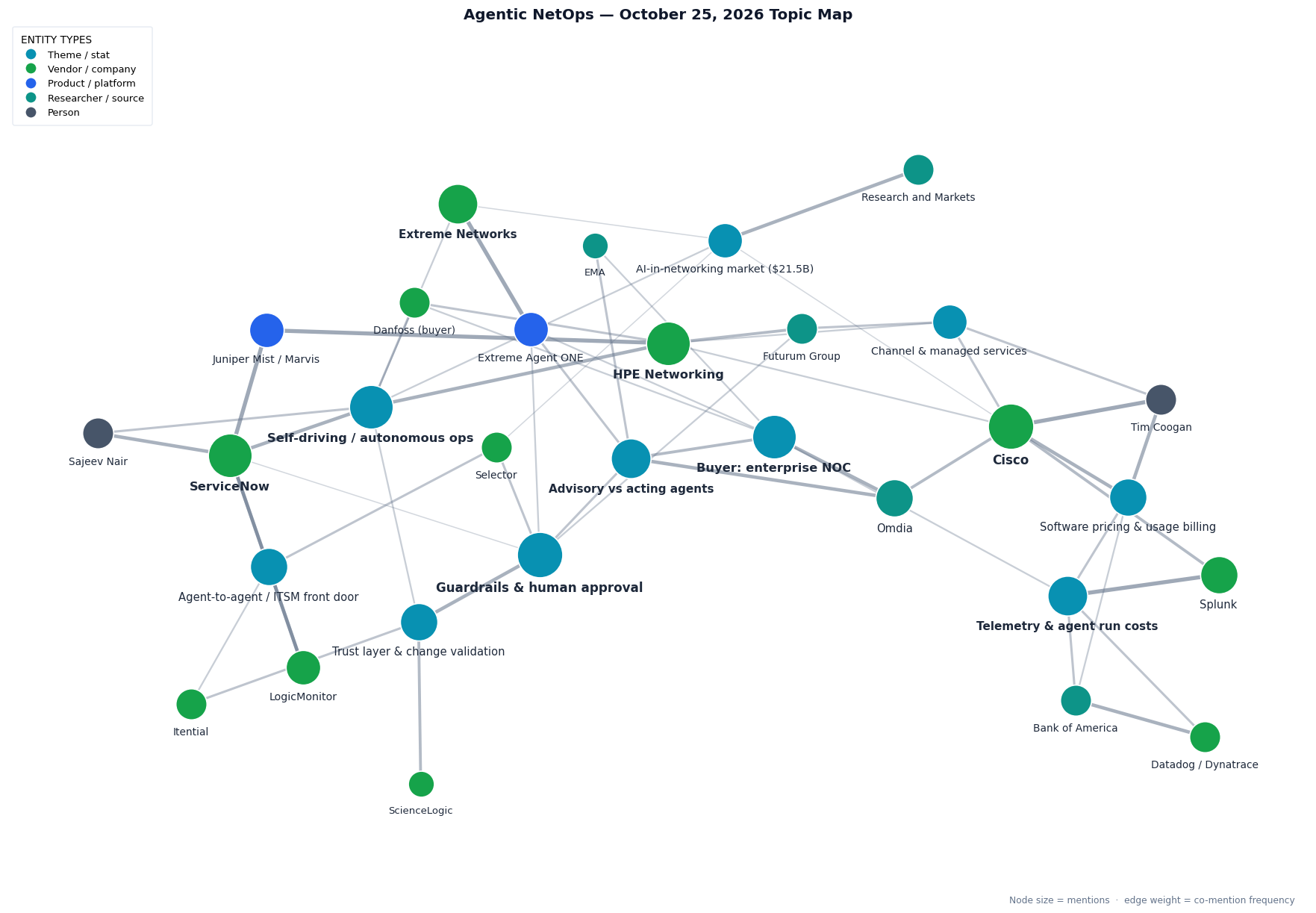
Entities and connections across this week’s 21 tracked stories. Node size reflects how often an entity appears; line weight reflects how often two appear together.
View interactive topic map →
Article index
Buyer adoption and proof points
Most enterprises are using network agents to advise, not act: only 18% of Omdia’s respondents let agents remediate. The clearest proof points came from the incumbents: ServiceNow’s 90% incident reduction on HPE Mist, HPE’s mixed Aruba and Juniper arena win, and Extreme’s first-month adoption figures for Agent ONE.
Competitive moves: pricing, platforms and partnerships
Cisco is raising list prices on networking and security software from November 7. Extreme wants to run AI on spare capacity in the switches and access points customers already own. LogicMonitor connected its AI to ServiceNow’s agents, and Selector and Itential each packaged new agents for root cause and day-to-day operations.
The cost of running agents
Splunk’s survey says agents generate several times more monitoring data than the systems they replace, and 57% of organisations already pay more to observe their infrastructure than to run it. Bank of America expects that usage to lift observability vendors, and TechTarget set out how to bring network spending under FinOps discipline.
Market sizing & analyst view
Research and Markets puts AI in networking at $8.4 billion this year and $21.5 billion by 2032, a broad figure that spans equipment makers and software specialists. TechTarget’s explainer sets out where rule-based automation still beats AI-native approaches.
The NOC operating model: trust, validation and autonomy levels
Verizon and Ericsson both argued that automation is not autonomy and that the business case depends on how often a task recurs. Five vendor authors made the enterprise version of the case: agents need a governance layer, independent validation before changes run, and controls that stop them from overwhelming the systems they manage.
| Article |
Source |
Published |
| 3. Verizon pushes autonomous networks toward the customer |
Fierce Network |
Oct 20, 2026 |
| 4. Ericsson’s Karlsson: Don’t confuse AI automation with network autonomy |
Fierce Network |
Oct 20, 2026 |
| 21. What is a trust layer and why is it so important for agentic AI? (foundational, ScienceLogic-authored) |
SDxCentral |
Oct 23, 2026 |
| 20. You Can Vibe Code. You Can’t Vibe Validate. (foundational, Gluware-authored) |
Gluware |
Oct 23, 2026 |
| 16. Jev Decision Models for Network Changes (foundational, Itential-authored) |
Itential |
Oct 20, 2026 |
| 18. Agentic Denial of Service Attack: The Emerging AI Risk Hiding in Plain Sight (foundational, Infoblox-authored) |
Infoblox |
Oct 20, 2026 |
| 19. The Network Config Automation Checklist Every NetOps Team Should Use (foundational, BackBox-authored) |
BackBox |
Oct 21, 2026 |
Detailed write-ups
1. Buyers are deploying agents as advisers, and few yet let them act
TechTarget · October 21, 2026
TechTarget asked what “agentic AI in production” means in enterprise networks, and the answer is less than the headline numbers suggest. Cisco’s survey of 1,000 IT and NetOps leaders, run by Omdia, found 51% use agentic AI in production, but that figure includes agents that only give advice. Just 18% use agents to carry out fixes and 17% for updates and changes. “Most use cases are not to take actions,” said Omdia analyst Jim Frey. EMA’s mid-year survey of 356 IT professionals put the share with agents acting on alerts from their network monitoring tools at 13.2%.
The named buyers fit that pattern. Danfoss, the Danish industrial manufacturer, runs HPE-based network agents in production at 20 or 30 of its hundreds of sites, where they isolate nodes, provision capacity and handle overloads. They also surfaced problems the team had not been getting to, such as overloaded access points. “We have realized all the things that we don’t get to,” said CIO Sune Tornbo Baastrup. Furniture retailer Room & Board uses Cisco’s AI assistant with Meraki to summarise and sort alerts but is “not at the point yet where we’re doing agent-based remediation.” Payments company Repay runs an AI reliability agent that does not act on its own.
The gap between using agents and trusting them to act is where the category’s revenue will be decided. Buyers have accepted agents that advise. The next sale is the one that lets agents change the network, and that requires evidence the agent was right before it acted. Cisco sponsored the survey and Omdia belongs to the same company as TechTarget, but EMA’s independent figure points the same way.
Sources: TechTarget (IT leaders test the waters of autonomous network operations)
2. ServiceNow becomes HPE’s showcase for the self-driving network
Fierce Network · Futurum · October 21, 2026
ServiceNow gave HPE the kind of customer result the category has lacked. Speaking at HPE’s Networking Investor Day, Sajeev Nair, who runs information systems management at ServiceNow, said moving network operations onto HPE Juniper Mist cut network incident volume by 90%. Patching fell from 2,000–3,000 hours a year to fewer than 60, troubleshooting went from hours to minutes, and the network team did not grow while the company did. ServiceNow is now aiming for a fully autonomous network by 2028. “When you flip the switch, the light has to come on,” Nair said. Fierce also cited the UK Ministry of Justice reporting about 75% fewer service-desk tickets after switching on HPE’s automated actions.
The same day, Futurum’s Tom Hollingsworth assessed HPE’s new contract with the Miami HEAT. The arena gets Aruba access points with Juniper switching, delivered and run by managed partner CSPi. Hollingsworth said the mixed design shows HPE now sells Aruba and Juniper as one business “and isn’t forcing customers into one camp.” He was also sceptical: the early model is AI assistance with engineers in the loop, and “that’s a long way from saying the network runs itself.”
ServiceNow is a strong reference because it also runs the ticketing many enterprise NOCs use. HPE is pairing its autonomy claims with marquee customers, a sports-venue campaign and managed partners. The numbers are self-reported at an HPE investor event, and they come from an all-HPE network. Vendors working across mixed estates need customer results of their own, measured as incident volume, hours saved and headcount held flat.
Sources: Fierce Network (ServiceNow cuts network incidents 90% with HPE Mist AI) · Futurum (HPE Self-Driving Network Comes to the Miami HEAT’s Kaseya Center)
3. Cisco raises networking and security software prices on the eve of its Partner Summit
CRN · October 24, 2026
Cisco told partners and distributors on Saturday that list prices on its software, and on a small number of hardware products, rise on November 7. CRN reports the software increases are concentrated in networking and security and average a mid-single-digit percentage. Cisco did not say which hardware is affected or by how much. Splunk products are excluded. Channel chief Tim Coogan called it “more of a rebalancing across the portfolio,” reflecting market dynamics, Cisco’s investment in innovation and the value it delivers.
Standard price protection applies. Coogan said the biggest effect will be on deals already in progress, and partners need updated quotes in front of customers before pricing expires. The notice landed two days before the 2026 Cisco Partner Summit opens in Canada.
A price rise on networking software from the largest vendor in the market changes the conversation in Cisco-heavy accounts over the next two quarters. It tests how much pricing power Cisco’s AI and platform messaging has bought it. It also gives HPE, Extreme and the independent NetOps vendors a cost argument at renewal. Leaving Splunk out suggests Cisco is protecting its observability business, where it competes on usage-based pricing.
Sources: CRN (Exclusive: Cisco To Raise Prices On Software, Select Hardware In Portfolio ‘Rebalancing’)
4. Extreme puts adoption numbers behind its network agent
Business Wire (Extreme Networks) · Network World · October 21–22, 2026
Extreme Networks published first-month figures for Agent ONE Coworker, the assistant built into its Platform ONE. It says 41% of Platform ONE customers used it for daily tasks, users responded to 98% of its critical alerts, engagement was about ten times that of its earlier chatbot, and customers saved an estimated 1,000 hours of troubleshooting. 58% of support cases opened through the agent arrived with all the evidence support needed. Hill College fixed a wireless outage in about 20 minutes. “Extreme Platform ONE is like having two or three more network engineers on staff,” said CIO Kevin Rocha. Coworker is available to all Platform ONE customers. Operator mode, in which the agent acts, is due in the first half of 2027.
A day later Extreme previewed Exchange zones, which run AI applications and agents locally at branch sites. They use Extreme servers, customer servers and spare processing capacity on the switches and access points customers already own. Models run locally by default, and cloud inference happens only when customer policy allows it, with every use logged. Extreme gave no availability date. “Conversational AI only helps when people already know what to ask,” said Nabil Bukhari, Extreme’s CTO.
Extreme is using its installed base as the distribution channel: an agent switched on for existing customers, and a plan to sell AI capacity on hardware they have already paid for. Its numbers are its own, and the agent still advises rather than acts. But a 41% usage rate in the first month is a benchmark rivals will be asked to match, and Extreme reports quarterly results on October 28.
Sources: Business Wire (Extreme Agent ONE Coworker Saves Customers 1,000 Hours in First Month of Availability) · Network World (Extreme wants to use idle network compute capacity for local AI)
5. LogicMonitor makes its AI a service that ServiceNow’s agents can call
LogicMonitor · October 19, 2026
LogicMonitor released an Edwin AI agent that works inside ServiceNow’s Now Assist and agent workspace. Through an agent-to-agent link built with ServiceNow specialist Work4Flow, ServiceNow’s own AI agents can call on Edwin during an investigation to correlate events, find the root cause with supporting evidence, assess the impact on services and suggest a fix. ServiceNow certification is under way. LogicMonitor gave no availability date, pricing or customer figures. Managed service provider Bell Techlogix is the named customer.
“The real value of AI agents comes from giving them access to the right intelligence at the right moment,” said Karthik Sj, LogicMonitor’s chief AI officer. Tim Wheeler, Bell Techlogix’s chief AI officer, said agent-to-agent links will “give teams better context at the point of action.”
This is a change in how monitoring vendors reach the buyer. Instead of asking NOC teams to open another console, LogicMonitor is offering its analysis as a service to the agent that already sits in front of the ticket. If ServiceNow’s agents become where incidents are worked, specialist vendors will compete to be the source they call for diagnosis. The open questions are how ServiceNow certifies and charges for those connections, and how many rivals follow.
Sources: LogicMonitor (LogicMonitor Embeds Edwin AI Intelligence in ServiceNow with New Agent-to-Agent Capabilities)
6. Specialists package agents for root cause and day-to-day operations
Selector · Itential · October 23, 2026
Selector introduced Loom, the root-cause agent in its Foundry platform. Loom groups alerts from routers, firewalls, cloud gateways and applications into one incident, separates the cause from the knock-on symptoms, maps how far the problem spreads, and links each finding to the data behind it. It then passes its findings to other Foundry agents that open the ticket and write status updates. Loom recommends fixes but acts only after an engineer approves. Selector says it collects data from more than 300 sources. It named no customers and gave no pricing or availability date.
Itential released Operator AI Skills, an open-source pack that lets AI coding assistants such as Claude Code, Codex, GitHub Copilot and Cursor run and troubleshoot a customer’s existing Itential automations within that user’s permissions. Its headline use is a morning report of failed jobs, stuck approvals and running tasks, with the option to retry a failed step. It is one of three skill packs, alongside builder and administration packs.
The two releases show how specialists are competing with the platform vendors. Selector is selling a team of cooperating agents with human approval built in. Itential is making its automation reachable from the AI tools engineers already use rather than from its own interface. Both are vendor blog posts with no customer evidence, so for now they show which way the specialists are heading, not what buyers are adopting.
Sources: Selector (Meet Loom) · Itential (What Failed Overnight? Put Itential Operator AI Skills to Work)
7. Agents are making it more expensive to watch the network
Network World · Finimize · TechTarget · October 20–23, 2026
Splunk’s State of Observability 2026 survey of 2,050 IT operations and engineering staff in ten countries found that 57% of organisations pay more to monitor their infrastructure than the infrastructure itself costs. 60% say unexpected billing spikes are a bigger problem than consistently high bills, 55% cannot accurately control their AI spending, and 38% have already cut monitoring coverage or retention to save money, which leaves gaps when troubleshooting the network. “A production agent emits 4-5x more data as telemetry,” Kamal Hathi, who runs Splunk at Cisco, told Network World. Splunk did not measure how much of the increase so far comes from agents.
Investors are betting on the same trend. Bank of America raised its price targets on Datadog (to $335 from $305), Dynatrace ($78 from $65) and Elastic ($114 from $108), arguing that more AI activity automatically produces more logs, metrics and traces, and that usage-based pricing turns that into revenue. It cut UiPath and flagged application-layer AI vendors as most exposed to estimate cuts. TechTarget’s guide to network FinOps advises bringing cloud and on-premises network spending into one view, with costs charged back to their owners.
For NetOps vendors the cost works both ways. Agents need richer data, and buyers are already trimming what they collect to control bills. A vendor that can show its agents work from existing data, or reduce monitoring spend, has a cost argument that observability vendors priced on usage cannot easily make. Splunk is a party to that argument, so the survey figures should be read accordingly.
Sources: Network World (AI agents drive up telemetry costs, complicate network observability) · Finimize (BofA Sees AI Lifting Infrastructure Software’s Fortunes) · TechTarget (How network FinOps can control connectivity and cloud costs)
8. A $21.5 billion forecast, and where rules still beat AI
GlobeNewswire (Research and Markets) · TechTarget · October 20–21, 2026
Research and Markets sized AI in networking at $8.38 billion in 2026, rising to $21.52 billion by 2032, a 17% compound annual growth rate. The scope is wide: management, optimisation, security, automation and orchestration software plus professional and managed services, across data-center, cloud, wireless, SD-WAN and campus networks, for service providers as well as enterprises. Data-center networks hold the largest share, cloud networks grow fastest, and Asia Pacific is the fastest-growing region. The 35 vendors profiled range from equipment makers such as Cisco, HPE, Arista and Extreme to software specialists such as Forward Networks, Selector, NetBox Labs, ScienceLogic and SolarWinds.
TechTarget’s explainer on AI-native networking and traditional automation is a useful counterweight. It says rule-based automation is predictable but needs constant upkeep, while AI-native systems adapt to networks where fixed rules break down. In the AI model, administrators set guardrails, approvals and tuning instead of writing the logic themselves. “As it stands today, traditional automation holds the advantage when control and predictability are critical,” it concludes, and it recommends using both.
The forecast is a paid-report press release and includes telecom and data-center categories, so it is not an enterprise NetOps software number. What it does show is that analysts now put equipment vendors and independent software specialists in the same market. Buyers are being told to combine deterministic automation with AI rather than choose one, so vendors that offer both will fit the way enterprises are being advised to buy.
Sources: GlobeNewswire (Artificial Intelligence (AI) in Networking Market: Global Forecast to 2032 – AI Workloads Push Networks to Run Themselves, Fueling a $21 Billion Market) · TechTarget (AI-native networking vs. traditional network automation)
Calls to action
- Use Cisco’s November 7 price rise in renewals now. Identify Cisco-heavy accounts with networking software renewals in the next two quarters and put a total-cost comparison in front of them while partners are re-quoting deals in flight.
- Report how often your agents act, not just how many customers use them. Buyers now know 51% “in production” means 18% remediating. Publish the share of recommendations your customers approve and the share executed automatically, with accuracy.
- Get into ServiceNow’s agent workflow. LogicMonitor has made its AI callable by ServiceNow’s agents. Check what it takes to certify an agent-to-agent connection, and make sure your diagnosis can be called from where the ticket is worked.
- Build a ServiceNow-style reference. HPE’s strongest point this week was a customer quoting incident volume, patching hours and flat headcount. Ask your best mixed-vendor customer for the same three numbers.
- Brief sales on Extreme’s adoption claims. Expect the 41% first-month usage and 1,000 hours saved in competitive deals. Note that both are Extreme’s own figures and that its acting mode does not arrive until 2027.
- Add telemetry cost to the business case. With 38% of organisations already cutting monitoring coverage to save money, show buyers how your agents work from data they already collect and what that saves against usage-priced observability.
|