This week at a glance
A week after attackers spoiled the stock in around 700 French supermarkets by switching refrigeration into defrost, the story is now about exposure and responsibility. Forescout’s Vedere Labs counted 12,976 internet-exposed refrigeration control services on 6,017 IP addresses in 99 countries, and found that 80% of the Danfoss AK-SM 800A StoreView interfaces it saw run firmware older than the fixed 4.3.1 release. The Record explains why Europe’s new Cyber Resilience Act does not help much here: it makes manufacturers report exploited flaws even in end-of-life products, but the duty to fix only runs during a support period the manufacturer sets. The Paris prosecutor has about ten complaints, roughly 700 estimated victims and no claim of responsibility. A CSO contributor’s verdict: the party that decides whether a controller is exposed is rarely the party that eats the loss.
On the vulnerability side, Siemens confirmed that its own validly signed Software Center installer was bundled with malicious DLLs in ClickFix attacks (CVE-2026-110936, fixed in 4.0.9.8). CISA’s October 22 bulletin went out under a Known Exploited Vulnerabilities headline but actually carried 19 new ICS advisories and one update, 17 of them for Siemens products including WinCC, S7-1500 web servers, RUGGEDCOM and Desigo building controllers. An earlier batch covered Hitachi Energy RTU500 and MicroSCADA, WAGO and Moxa.
The rest of the week was about capacity and rules. Accenture, Dragos and SANS launched a $10M foundation that will give up to 500 small US water, power and gas utilities free OT monitoring, hardware and training. Frenos tested ten AI models on almost 17,000 OT attack tasks: the strongest frontier models produced a workable attack plan about 90% of the time but were inconsistent from run to run. EU funding for inverters from “high-risk” suppliers ends on November 1, and US rules on foreign grid equipment are tightening. The Coast Guard’s NVIC 02-26 sets out how ports and vessels should meet the MTSA cyber rule before plans are due on July 16, 2027. NCC Group counted a 23% quarterly rise in ransomware with industrials the most targeted sector, and insurer Resilience reports that ransomware is about 9% of energy claims but about 70% of losses.
On our watch list
- Attribution in France, and whether it spreads. No group has claimed the supermarket attack and no ransom has been asked. CSO cites Sekoia reporting cases in Spain, Portugal, Poland, Germany and Belgium. Watch for confirmed incidents outside France and for the access path the attackers used.
- Whether the exposed count falls. Forescout’s figure of 12,976 exposed refrigeration services is a baseline. A repeat scan in a few weeks will show whether owners outside France, and Carel pCOWeb and Copeland Site Supervisor users, are taking interfaces offline.
- Who pays for unsupported controllers. The Cyber Resilience Act’s fix obligations do not reach products placed on the market before December 11, 2027 or past their support period, and the revised Product Liability Directive is not retroactive. Watch whether retailers, insurers or refrigeration contractors end up carrying replacement costs, and whether anyone in Brussels proposes closing the gap.
- November 1 in Europe’s grid market. EU-backed grid projects stop funding inverters from “high-risk” suppliers that day. Wood Mackenzie estimates EU utilities may need to replace 4-5 GW of planned Chinese purchases through 2030. Watch for the first project re-tenders and for how the US Department of Energy writes its rule on foreign grid equipment.
- Uptake of the small-utility foundation. The Community Cyber Resilience Foundation aims at up to 500 utilities in its first phase, out of more than 50,000 that qualify. Watch how fast slots fill, which states they come from, and whether other OT vendors offer something similar.
- More from the Romulus ClickFix campaign. Siemens says none of its systems or update channels were breached. Watch whether other industrial software vendors find their signed installers being used the same way, and whether CISA adds CVE-2026-110936 to the KEV catalog.
- Independent repeats of AI attack-planning tests. Frenos and Forescout both say human judgment is still needed. Watch for tests that name the models, run with a human correcting the plan, or move from simulation to a lab plant, since any of these would change the timelines defenders plan around.
- MTSA plans ahead of July 16, 2027. The Coast Guard expects documented, observable evidence, not intent. Watch for further Coast Guard FAQs, and for how many port and vessel operators name a Cybersecurity Officer early.
- Q4 ransomware against industry. NCC Group had Qilin and The Gentlemen almost level at the top in Q3, with industrials the most hit sector. Watch October’s figures, and whether the August UK power-generator incident is ever formally attributed.
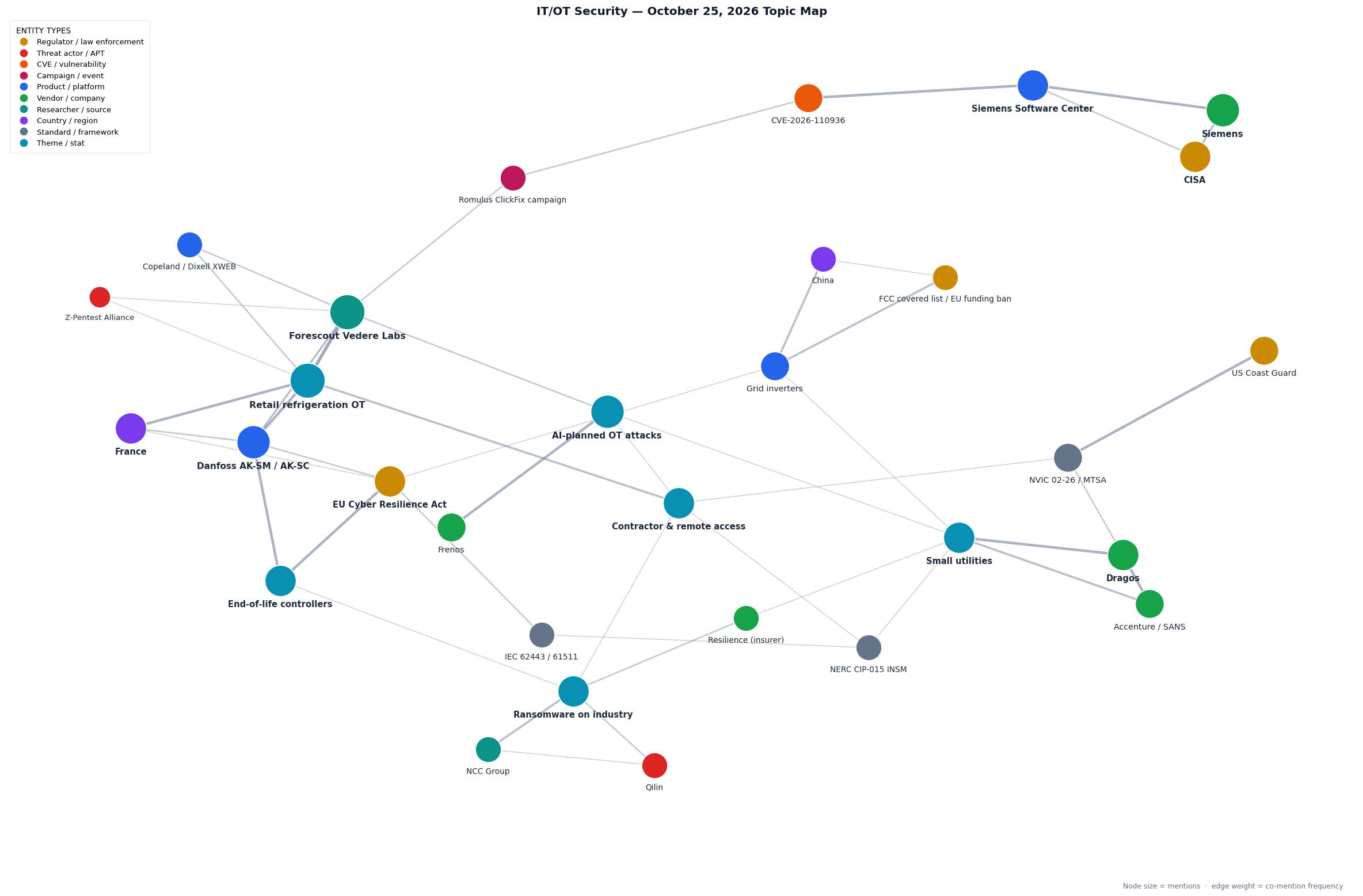
On the left, retail refrigeration OT is the main hub. It links Forescout Vedere Labs, the Danfoss AK-SM/AK-SC and Copeland/Dixell XWEB controllers, France, and end-of-life hardware, and the EU Cyber Resilience Act connects to both the Danfoss controllers and the end-of-life question. At the top, Siemens Software Center ties Siemens, CISA and CVE-2026-110936 to the Romulus ClickFix campaign, which Forescout also analysed. In the centre, AI-planned OT attacks (Frenos, Forescout) and contractor and remote access link the refrigeration story to the utilities cluster on the right, where Dragos, Accenture/SANS, the Coast Guard’s NVIC 02-26 and NERC CIP-015 meet. Grid inverters connect China and the new US and EU restrictions. At the bottom, ransomware on industry links NCC Group, Resilience and Qilin. Z-Pentest Alliance appears because Forescout tracked its earlier refrigeration claims; it has not been linked to the French attack.
View interactive topic map →
Article index
The French refrigeration attack, week two
Forescout maps nearly 13,000 exposed refrigeration services in 99 countries, The Record explains why the EU’s new product law won’t force fixes for the controllers that were hit, and a CSO contributor turns the attack into three lessons for owners.
AI and the OT attacker
Frenos ran ten AI models through almost 17,000 OT attack tests, Forescout had AI help adapt a PLC exploit to a related device, and Deloitte sets out how a connected factory should defend itself.
Advisories and exploited flaws
A signed Siemens installer used to side-load malware in ClickFix attacks, and two CISA batches that together carry 24 new ICS advisories and two updates, 17 of them for Siemens.
Utilities, grid and energy
A $10M foundation offers free OT monitoring to small US utilities, European and US power firms move away from Chinese inverters, an insurer’s claims data shows where energy losses really come from, and two vendors pitch CIP-015 monitoring.
| Article |
Source |
Published |
| 10. Accenture, Dragos, SANS Launch $10M Initiative to Defend Small US Utilities |
SecurityWeek |
Oct 21, 2026 |
| 11. EU and U.S. Power Firms Scrutinize Supply Chains for Chinese Parts |
IEEE Spectrum |
Oct 19, 2026 |
| 12. Resilience reports energy and utilities sector faces rising cyber exposure from ransomware, vulnerable OT systems |
Industrial Cyber |
Oct 21, 2026 |
| 13. Industrial Defender Unifies Endpoint Intelligence and Network Monitoring for CIP-015, Adds Risk Signal |
GlobeNewswire |
Oct 21, 2026 |
| 14. Nozomi Networks and Schweitzer Engineering Laboratories Expand Global Partnership to Advance Cyber Resilience for Critical Infrastructure |
PR Newswire |
Oct 20, 2026 |
| 15. Upstream oil and gas: Securing operations across distance, remoteness and harsh environments |
Industrial Cyber |
Oct 20, 2026 |
Maritime, standards and policy
The Coast Guard publishes its guidance for the MTSA cyber rule, Advantech and DEKRA prepare for the Cyber Resilience Act, and two essays argue for joining safety and security and for measuring resilience by outcomes.
Threat data and industry moves
NCC Group counts a 23% quarterly rise in ransomware with industrials hit hardest, Claroty surveys 2,000 operators, Indurex raises funding for safety-system monitoring, and Dispel launches session-based remote access for OEMs.
Practitioner reading
Dragos on cleaning up old worms without stopping the plant, TXOne on turning asset visibility into a plan, Forescout on remote access in data centres, SC Media on what OT detection should catch, and an interview with ICS researcher Corey Thuen.
Detailed write-ups
1. The French refrigeration attack: 13,000 exposed services, a law that won’t force fixes, and three lessons
Industrial Cyber · The Record · CSO Online · October 20-23, 2026
Forescout’s Vedere Labs went looking for the kind of controllers hit in France and found 12,976 internet-exposed service observations tied to refrigeration control systems, on 6,017 distinct public IP addresses in 99 countries and territories. They span ten product groups, including Copeland and Dixell XWEB, Danfoss StoreView, Copeland Site Supervisor and Carel pCOWeb. Many were weakly protected: only 287 of 513 pCOWeb services asked for authentication, and 3,762 Danfoss AK-SM 800A StoreView interfaces, 80% of those seen, run firmware older than 4.3.1, which is affected by CVE-2025-41451 and CVE-2025-41452. Forescout has also tracked more than 20 hacktivist claims of attacks on refrigeration systems since January, including ten claimed by Z-Pentest Alliance on a single day in April, though none of these has been tied to France. It lists supermarkets, fruit storage, wineries, food processing and hospitals as exposed sectors.
The Record looked at the legal side. The EU Cyber Resilience Act, which took effect last month, requires manufacturers to report actively exploited vulnerabilities and severe incidents even for products they no longer support. But the duty to fix flaws and ship free updates only applies during a support period the manufacturer defines, and products placed on the market before December 11, 2027 are outside it. The Danfoss AK-SC255/355 was phased out in 2016 and other lines reached end of life in 2021, so the law does not require anyone to patch them. The revised Product Liability Directive will not apply retroactively either. The Paris prosecutor’s office has received about ten complaints and estimates around 700 victims, with Intermarché, Carrefour, Monoprix, Leclerc and Coopérative U among the chains hit. No one has claimed responsibility.
Writing in CSO, OT governance consultant Sabine Frömling draws three lessons. Treat the refrigeration contractor as part of your perimeter, with every remote path, named account and log written into the contract. Treat a remote command, not a temperature reading, as the security event, because defrost is a normal function and temperature alarms fire too late. And treat unsupported controllers as a budget decision rather than a patch ticket. “The party who decides whether a controller is exposed is not the party who eats the loss when it is,” she writes.
For anyone running stores, cold storage or food processing, this week’s data turns a French incident into a global inventory problem. Expect to find these interfaces on cellular and contractor-managed connections that never appear in an IT asset list.
Sources: Industrial Cyber, The Record, CSO Online
2. Siemens Software Center: a signed installer used to side-load malware in ClickFix attacks
SecurityWeek · CISA · October 19-22, 2026
Siemens confirmed that attackers paired its legitimate, validly signed Software Center with malicious DLLs of their own. Version 3.5.8.7 did not validate the helper files it loaded from its own folder, so when the program started it ran the attacker’s code. The flaw is tracked as CVE-2026-110936 (CVSS v4 8.4) and was reported by Huntress researcher Jose Oregon. Version 4.0.9.8 fixes it, and installed copies update automatically the next time they are launched. CISA republished the advisory as ICSA-26-295-03 in its October 22 batch.
The bundles were delivered through ClickFix lures, the fake CAPTCHA and “fix this error” prompts that trick users into pasting and running commands. Siemens linked the activity to the Romulus ClickFix campaign. Forescout’s separate research on Romulus found it delivering LegionLoader and using a trojanized installer for side-loading, but SecurityWeek notes that the payloads in the Siemens bundles have not been confirmed. “No Siemens system, product or update channel was breached to our knowledge,” the company said.
The lesson for OT teams is that a trusted vendor signature on an engineering tool is not proof the package is clean. Engineering workstations are where these tools live, so make sure Software Center is updated there and that software only comes from vendor portals, never from a link in a browser prompt.
Sources: SecurityWeek, CISA (Oct 22)
3. CISA: 24 new ICS advisories in two batches, 17 of them for Siemens
CISA · October 20 and 22, 2026
CISA’s October 20 batch carried six advisories: HMS Networks PEAK-System PCAN Windows drivers, WAGO OS Linux, Moxa AIG-302 ThingsPro Edge, Hitachi Energy MicroSCADA X SYS600 and Hitachi Energy RTU500, plus an update to an earlier RTU500 advisory.
The October 22 bulletin was sent under the headline “CISA Adds 20 Known Exploited Vulnerabilities to Catalog” with KEV wording in the body, but what it lists is 19 new ICS advisories and one update. Seventeen are Siemens: Industrial Edge App Publisher, Edge Device Kit and Edge Devices; Software Center; Capital Embedded AR Classic; SENTRON 3NA COM Fuse; PSS SINCAL; SIMATIC IPCs; APOGEE, TALON and Desigo PXC/PXM building controllers; the SIMATIC S7 Webserver API and S7 PLC web server; two S7-1500 MFP products; WinCC; two RUGGEDCOM CROSSBOW advisories; and RUGGEDCOM APE1808. The others cover InterSystems IRIS for Health, the Kiloview E3 NDI encoder and an update for the Meari IoT cloud platform.
Treat the October 22 list as ICS advisories, not as a list of exploited CVEs. The Siemens set is large enough that it is worth sorting by what is reachable first: S7 web servers, RUGGEDCOM remote access controllers and Desigo building controllers exposed to corporate or vendor networks should come before isolated engineering tools.
Sources: CISA (Oct 20), CISA (Oct 22)
4. Accenture, Dragos and SANS put $10M behind small US utilities
SecurityWeek · October 21, 2026
The three companies launched the Community Cyber Resilience Foundation with about $10 million in initial cash and services. It is open to US water, wastewater, electric and natural-gas utilities with annual revenue under $100 million, which the partners say covers more than 50,000 organisations, over 97% of US utilities. The first phase will take up to 500.
Participants get free access to the Dragos Platform and the hardware to run it, with Accenture handling setup, integration and ongoing support. SANS provides ICS/OT security training so staff can run the defences themselves, and members join a peer network of utilities. The foundation builds on Dragos’s Community Defense Program, which since December 2023 has given more than 100 utilities free platform access. It also follows Accenture’s majority investment in Dragos earlier this year. “Yet many small operators lack the capacity to defend against these threats,” said Dragos CEO Robert M. Lee.
Small utilities have been the soft target in recent OT incidents, including this summer’s attacks on Minnesota water systems. If you run or advise one, the application costs little. If you sell to them, expect monitoring to become a baseline expectation rather than a premium service.
Sources: SecurityWeek
5. AI and the OT attacker: good at planning, inconsistent, still needs a human
The Register · IDC Italy · Control Global · October 20-21, 2026
Frenos, which does AI penetration testing for OT, ran ten models (six frontier, two US open-weight and two foreign open-weight, none named) through 16,980 tests between October 2025 and September 2026: 13,884 single-decision attempts, 2,520 planning attempts and 576 simulated attacks. The three strongest frontier models produced a workable attack plan against industrial systems in about 90% of attempts, but only 60%, 62.9% and 74.3% of those plans held up on every repeat. The best open-weight model, a non-US one, reached 36.2%. No human corrected the plans during testing, which a real attacker who knew the target could do. “One thing that we’ve relied on for years is security by obscurity when it comes to utilities,” former American Electric Power CISO Steve Swick said on a panel ahead of the report.
IDC Italy reviews a Forescout Vedere Labs study in which AI helped researchers adapt a known exploit for one PLC to a related device. It was not AI finding a new flaw or attacking a live plant, and researchers had to guide it throughout. IDC’s point is about speed: the gap between disclosure and a working exploit is shrinking, so compensating controls and quick mitigation matter more where patching is slow. Control Global summarises Deloitte’s advice for connected factories: agree decision owners and escalation paths before an incident, prioritise by consequence, use AI for triage with human approval for high-consequence changes and a way to switch agents off, and test how fast teams actually contain and restore.
Together with last week’s Booz Allen and Claroty results, the picture is consistent. AI lowers the skill needed to plan an OT attack and speeds up exploit work, but it still makes mistakes that a skilled human has to catch. Plan for more capable low-end attackers rather than for fully autonomous ones.
Sources: The Register, IDC Italy, Control Global
6. Grid supply chains: Europe and the US move against Chinese inverters
IEEE Spectrum · October 19, 2026
From November 1, EU-backed grid projects will no longer fund inverters from “high-risk” suppliers, although member states can still buy them with their own money. In the US, the FCC added power inverters to its covered list in July, and an August executive order moved to ban foreign inverters, transformers, battery storage, generators and related software and firmware. The concern is concrete: in 2025 the Danish industry group Green Power Denmark found hidden communication channels on circuit boards destined for inverters. India has required laboratory malware testing of foreign grid components since 2020, and Japan has required 30-day advance screening of some power equipment since 2024.
The cost is significant. Wood Mackenzie estimates EU utilities may need to replace 4-5 GW of planned bulk-power purchases from Chinese suppliers through 2030, roughly 14-18% of planned purchases. Germany’s SMA Solar, which sources about 2-4% of its supply chain from China, expects to win around 10% of Europe’s utility-scale market. “The details of the DOE rule are what are going to cause some drama,” said George Gross, emeritus professor of electrical engineering at the University of Illinois Urbana-Champaign.
For grid operators, this is now a procurement and asset-inventory job. You need to know which inverters, gateways and firmware are already installed and who can update them remotely, before the rules decide for you.
Sources: IEEE Spectrum
7. Coast Guard NVIC 02-26: how to meet the MTSA cyber rule before July 2027
Industrial Cyber · Dragos · October 14-23, 2026
The Coast Guard’s Navigation and Vessel Inspection Circular 02-26 explains how US-flagged vessels, port facilities and Outer Continental Shelf facilities should comply with the cybersecurity requirements in 33 CFR Part 101, Subpart F, under the Maritime Transportation Security Act. Cybersecurity Officer designations, Cybersecurity Assessments and Cybersecurity Plans are due by July 16, 2027. The circular includes a sample CySO designation letter and an optional risk-filtering method based on the NIST Cybersecurity Framework to identify critical IT and OT systems and how they depend on each other.
The approach is performance-based: the Coast Guard will not name products, and operators do not have to hire outside providers. Penetration testing is not required for the first plan but is expected during five-year renewal cycles, with care for OT safety. Compliance has to be backed by documentation and observable evidence. “Owner/operator intent alone is insufficient,” the circular says. Dragos’s guide to the rule’s account-security section lists its seven minimum measures, including MFA on remotely accessible OT and separate credentials for critical IT and OT systems, and suggests documenting compensating controls where those are not technically possible.
Twenty months sounds like plenty of time, but asset inventories and credential separation on vessels and terminals take longer than a plan document. Name the CySO now and start with the account-security items, which are the easiest to evidence.
Sources: Industrial Cyber, Dragos
8. Ransomware and claims: industrials most targeted, energy losses concentrated in ransomware
NCC Group · Industrial Cyber · Claroty · October 2026
NCC Group’s monthly threat pulse counted 821 ransomware attacks in September, down 26% from August, but put the third quarter up 23% on the second. Industrials were the most targeted sector, with 230 attacks in September and more than 838 in the quarter. Qilin (365) and The Gentlemen (359) were the most active groups in Q3. NCC also notes that a small UK power generator stopped operating for about four days after an August cyberattack whose details match Iranian-affiliated campaigns, though the UK government has not confirmed it. “There are clear actions around the separation of IT and OT for all critical infrastructure organisations to take,” said Matt Hull, NCC’s VP of cyber intelligence and response.
Insurer Resilience’s claims data for energy and utilities from January 2023 to September 2026 shows where the money goes. Email compromise made up 21% of the sector’s claims, against 10% across its other sectors, but only 2% of losses. Ransomware was about 9% of claims and roughly 70% of incurred losses. None of the energy claims involved manipulation of control systems. Claroty’s survey of 2,000 respondents, published earlier in the month, found 58% had suffered attacks that affected operations, 75% had at least one such incident linked to third-party access, and only 16% said IT and operational security governance was fully integrated.
For OT leaders, the numbers support spending on IT/OT separation and recovery, which limit ransomware’s operational impact, and on governing third-party access, which keeps appearing as the way in.
Sources: NCC Group, Industrial Cyber, Claroty
Calls to action
- Search for exposed refrigeration and building controllers beyond Danfoss. Include Carel pCOWeb, Copeland Site Supervisor and Copeland/Dixell XWEB, and check cellular and contractor-managed ranges. Remove public access to management interfaces and route remote service through a gateway with named accounts and MFA.
- Upgrade Danfoss AK-SM 800A to firmware 4.3.1 or later, and budget for the rest. Where controllers are past end of support, give each one an owner, a replacement date and compensating controls until it is gone.
- Alert on setpoint and defrost-schedule changes. Flag changes made outside maintenance windows or across many circuits at once, and agree who gets called at 3 a.m. and how fast changes can be reversed.
- Update Siemens Software Center to 4.0.9.8 on engineering workstations. Launch it so the update applies, check for unexpected DLLs in its install folder, and block software installs that start from browser prompts.
- Sort the October 22 Siemens advisories by exposure. Start with SIMATIC S7 web servers, RUGGEDCOM CROSSBOW and APE1808, and Desigo/APOGEE building controllers reachable from corporate or vendor networks. Also patch Hitachi Energy RTU500 and MicroSCADA X SYS600 from the October 20 batch.
- Small utilities: apply to the Community Cyber Resilience Foundation. If your annual revenue is under $100 million, the first phase has up to 500 places for free monitoring, hardware and SANS training.
- MTSA-regulated operators: name your Cybersecurity Officer now. Use NVIC 02-26’s sample letter, begin the account-security measures, and record compensating controls where MFA or separate credentials are not yet possible.
- Grid operators: inventory inverters and gateways by supplier and remote-update path. Know which devices could be affected by the new EU and US restrictions and which suppliers can push firmware to them.
|