This week at a glance
The market story this week was consolidation. Telecom Reseller set Extreme Networks’ reported sale process, with Cisco, Fortinet and NetApp named as possible buyers, alongside a run of recent deals: Belden closed its $1.85 billion purchase of RUCKUS in July, HPE has absorbed Juniper and Arista bought VeloCloud’s SD-WAN business. Fewer, larger platform vendors mean buyers will face portfolio overlap and roadmap questions, and partners will face new programmes and incentives. For an independent NetOps vendor, each deal also brings new customers who will be reconsidering their tools.
Cisco made its case to be the platform that absorbs them. Its fiscal first quarter brought revenue of $18.5 billion, up 24%, and Chuck Robbins said Splunk had moved “from being a nice-to-have to being a must-have” for watching and securing agents. At Cisco Live in Melbourne the company said agents now consume tokens at about seven times the human rate, and its services chief set a goal of showing customers that eight in ten expected outages were prevented. Cisco’s own research says 86% of network leaders prefer a single integrated platform to point tools. Cisco also said only 9% of the campus switches it sold last quarter were its new generation, so most of its installed base has yet to refresh. Kyndryl and ServiceNow are approaching the same buyers through the service desk with a packaged autonomous operations offer.
The direct field focused on safe change. Forward Networks won an award for testing agent changes against a digital twin, Itential argued that AI should never touch production directly, and LogicMonitor opened its data to outside AI assistants. Buyers took the same line. KT lets its agents run only read-only commands from an approved list, and Infoblox’s CEO warned that companies are deploying agents faster than they can govern them. Then Microsoft showed what is at stake: a Microsoft 365 outage lasting more than 30 hours, which Microsoft traced to a latent issue from an earlier network capacity upgrade exposed by a later network change. For a vendor competing in enterprise NetOps, the week’s message is that buyers want fewer platforms, proof that changes are safe, and a credible answer to Cisco’s single-platform pitch.
On our watch list
- AutoCon 6 and NautoCon in Tucson, November 16–20. The network automation community’s main event lands next week, and most of the direct field shipped little this week. Watch for funding, partnership and product-positioning news from Forward, Itential, Selector and the open-source automation community, and for how speakers describe the line between agents that recommend and agents that change the network.
- Microsoft’s post-incident report on the Microsoft 365 outage. Microsoft has promised a full review. If it confirms that a network change exposed a latent defect from an earlier capacity upgrade, expect enterprise boards to ask their own network teams how changes are tested before they go live.
- Whether Extreme’s sale process produces a bidder. Telecom Reseller notes that none of the named possible buyers, Cisco, Fortinet or NetApp, has confirmed interest. A named bidder would set off the roadmap and partner questions every recent networking deal has raised.
- Gartner’s I&O conference in London, November 16–17. Watch how Gartner analysts frame agent governance and pre-change verification for infrastructure buyers, and which automation vendors use the stage to make that case.
- Cisco Cloud Control’s international rollout and usage figures. Cloud Control is US-only today, with Australia, the EU and the UK due in February 2027 and Japan, India and Canada in May. Analyst Zeus Kerravala calls it the metric to watch and wants Cisco to disclose usage and attach rates. Disclosed adoption would show whether Cisco’s single-platform pitch is turning into customer commitments.
- How fast Cisco’s campus refresh moves. Only 9% of campus switching sold last quarter came from Cisco’s new portfolio. Each refresh is a moment when customers reconsider their operations tooling, and Cisco will try to attach Cloud Control and Splunk to it.
- Named customers for Kyndryl and ServiceNow’s autonomous operations offer. The launch named no customers. The first reference accounts will show whether service-desk-led automation reaches into network operations or stays with IT incidents.
- KT’s expansion from 70 to 280 critical equipment units. KT’s agents are read-only by design. Watch whether a larger rollout keeps that limit or moves to approved fixes, which would show how long a cautious operator waits before letting agents act.
- MSP pricing at renewal. Focus Technology and CSDNet are holding prices flat or lower at renewal while using AI to do more with fewer people. If that spreads, managed service providers will push their tool vendors for lower or outcome-based pricing.
- Huawei’s O&M Agent Research Report. Huawei launched work on an industry report on operations agents alongside claims that its agents resolve 80% of routine faults. Watch whether it becomes a reference for buyers in government, power and transport outside North America.
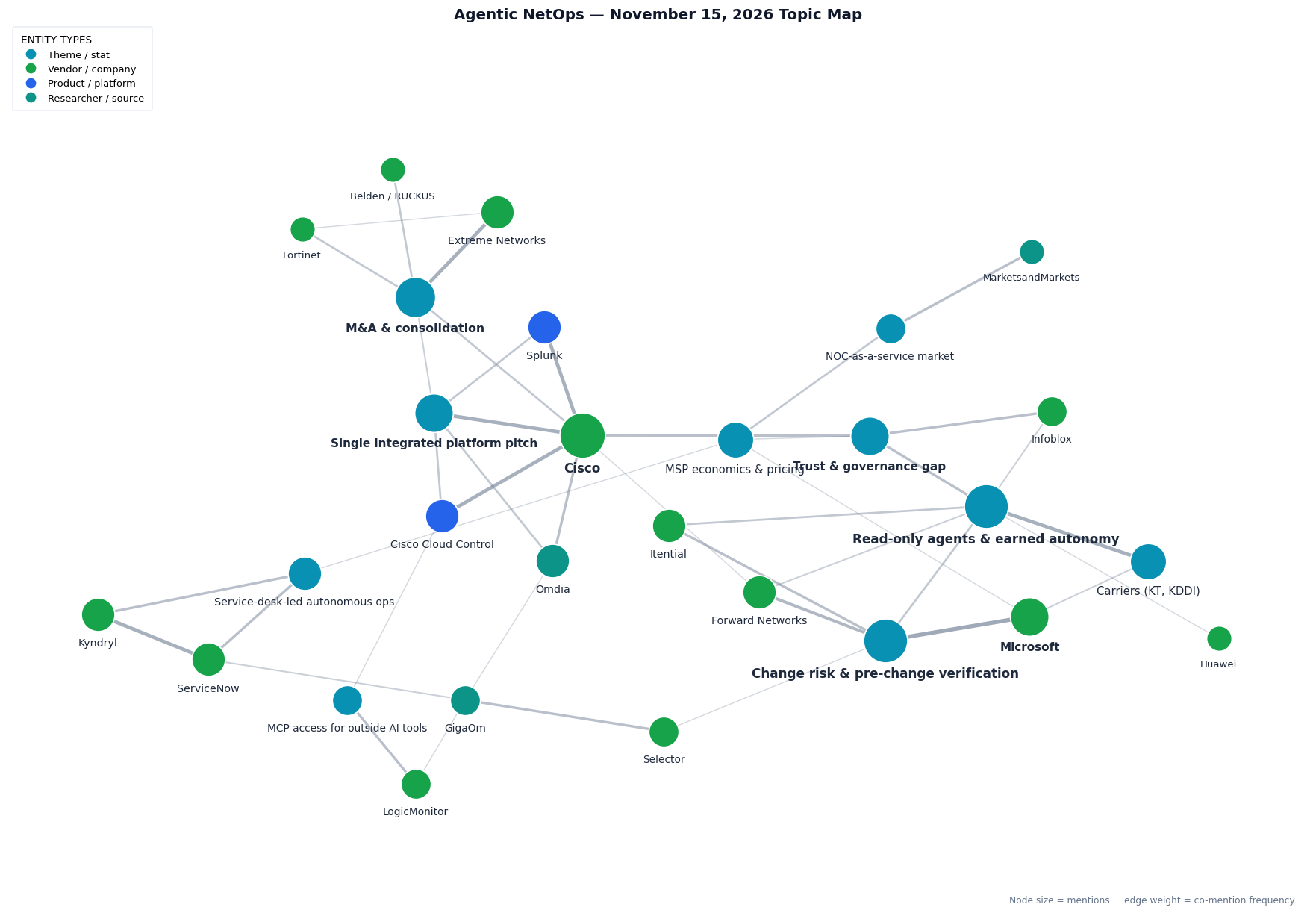
Entities and connections across this week’s 24 tracked stories. Node size reflects how often an entity appears; line weight reflects how often two appear together.
View interactive topic map →
Article index
Deal-making and the shape of the market
Extreme Networks’ possible sale is the latest in a series of networking deals. Kyndryl and ServiceNow are approaching the same buyers through the service desk, and managed service providers are cutting staff while holding their prices.
Cisco’s agentic push
Cisco had a record quarter, made its AI case at Cisco Live in Melbourne, and set out how its $15 billion services business will use agents. Its research says trust, not technology, now limits how fast customers can go.
| Article |
Source |
Published |
| 4. Cisco Live Melbourne: AI agents will break today’s enterprise network, and Cisco wants to rebuild it |
Network World |
Nov 10, 2026 |
| 12. Five thoughts from Cisco’s first quarter of fiscal 2027 |
SiliconANGLE |
Nov 12, 2026 |
| 13. Cisco CEO: Splunk Has Become A ’Must-Have’ In The Agentic AI Era |
CRN |
Nov 12, 2026 |
| 18. Cisco’s 4 pillars for achieving agentic AI transformation |
CIO |
Nov 13, 2026 |
| 1. Agentic AI demands a stronger, more assured network foundation (Cisco-authored) |
Cisco Blogs |
Nov 9, 2026 |
| 2. Cisco research: Trust, not technology, is now the speed limit on enterprise AI |
SiliconANGLE |
Nov 9, 2026 |
| 10. What Cisco is asking of IT teams in the shift from network operator to orchestrator |
diginomica |
Nov 11, 2026 |
Competitive moves in the direct field
The independent vendors focused on safe change. Forward won an award for its pre-change testing, Itential argued for governed execution, LogicMonitor opened its data to outside AI tools, and Huawei made broad claims for its operations agents. Selector published a page comparing itself with NetBrain.
Market sizing & analyst view
Omdia surveyed enterprise buyers of AI network operations tools, GigaOm rated Selector a leader in AIOps, and MarketsandMarkets sized the outsourced NOC market at $6.14 billion by 2030.
The NOC operating model: guardrails and change risk
Operators and vendors gave the same answer this week: agents start read-only and earn the right to act one task at a time. Microsoft’s outage was a reminder that people’s network changes carry risk too.
Detailed write-ups
1. Networking consolidation puts more vendors in play
Telecom Reseller · November 10, 2026
Telecom Reseller argues that Extreme Networks’ reported sale process, first reported by Reuters on November 6, is part of a wider wave of consolidation. Extreme, valued at about $3 billion, is working with an investment bank after receiving takeover interest, and sources named Cisco, Fortinet and NetApp as possible buyers. None has confirmed interest. The deal would follow Belden’s $1.85 billion acquisition of RUCKUS Networks, completed in July, which added enterprise Wi-Fi, switching and cloud-managed networking to an industrial portfolio. Arista bought Broadcom’s VeloCloud SD-WAN business in 2025, and HPE used Juniper to expand its enterprise networking line.
The article’s point is that buyers now want a broader set of capabilities from fewer suppliers, including automated network management. Each deal brings product overlap and integration work, and a Cisco or Fortinet purchase of Extreme would join different networking and security portfolios. The effect on roadmaps, pricing and customer choice would depend on how the businesses were combined. Partners face changes to programmes, incentives and support.
For an independent NetOps vendor, consolidation cuts both ways. Fewer, larger platform vendors strengthen the pitch for one integrated stack. But every merger leaves customers with overlapping tools and uncertain roadmaps, and those customers need a way to run a mixed estate while the owners sort it out. Vendors that can show they work across whichever platforms survive are well placed in those accounts.
Sources: Telecom Reseller (Networking M&A Picks Up as AI Reshapes the Market)
2. Cisco posts a record quarter and pitches one platform for agents
Network World · SiliconANGLE · CRN · CIO · Cisco Blogs · diginomica · November 9–13, 2026
Cisco reported fiscal first-quarter revenue of $18.5 billion, up 24% and its fastest growth in more than 15 years, with networking up 43% and security up 7%. It raised its full-year outlook by $2.5 billion, $1 billion of it from its core business outside the largest cloud providers. Analyst Zeus Kerravala noted that only 9% of campus switching sold in the quarter came from the new portfolio, so most of the installed base has yet to refresh, and that Cisco is growing with fewer staff than two years ago. Chuck Robbins told CRN that Splunk had become central to Cisco’s agent strategy: “Now all of a sudden, that moved from being a nice-to-have to being a must-have.” Cisco has added a 2% bonus for partners who sell into new areas, Splunk included.
At Cisco Live in Melbourne, Cisco said agents passed humans in token consumption in February and now use about seven times as many. It is bundling ThousandEyes monitoring into new Wi-Fi access points at no extra cost for eligible licences and adding a single view of agent actions to Cloud Control, which reaches Australia, the EU and the UK in February 2027. Services chief Liz Centoni told CIO that Cisco’s $15 billion, 20,000-person services business is redesigning work around agents, with a goal of showing a customer that eight of ten expected outages were prevented within a year.
Cisco’s research supports the pitch. Its September study with Omdia of 1,000 operations leaders found organisations handle about 4,100 alerts a day, 51% run agents that act in production, 99% will not let AI act without guardrails, and 86% prefer one integrated platform to point tools. A smaller qualitative study of 25 Australian organisations, released in Melbourne, found fewer than half confident their foundations are ready. “The leaders in our research aren’t scaling AI first. They’re scaling trust,” said Cisco CTO Carl Solder.
Cisco is selling one stack, from access point to Splunk to its own services team, as the safe way to run agents. Its refresh cycle gives it a reason to revisit every campus account it holds. Independent vendors should expect Cisco to argue that consolidating on one platform is the safe choice, and should have an answer ready on multi-vendor estates and on verifying change independently of the vendor that made it.
Sources: Network World (Cisco Live Melbourne: AI agents will break today’s enterprise network, and Cisco wants to rebuild it) · SiliconANGLE (Five thoughts from Cisco’s first quarter of fiscal 2027) · CRN (Cisco CEO: Splunk Has Become A ’Must-Have’ In The Agentic AI Era) · CIO (Cisco’s 4 pillars for achieving agentic AI transformation) · Cisco Blogs (Agentic AI demands a stronger, more assured network foundation) · SiliconANGLE (Cisco research: Trust, not technology, is now the speed limit on enterprise AI) · diginomica (What Cisco is asking of IT teams in the shift from network operator to orchestrator)
3. Microsoft’s 30-hour outage makes the case for testing changes
CRN · November 13, 2026
A Microsoft 365 outage that began on November 12 ran for more than 30 hours before Microsoft could give an estimate for full recovery, CRN reported. Microsoft said it was “a technical issue not related to cyber or AI / agents”, and that “the incident was introduced by an issue during an earlier network capacity upgrade that surfaced following a recent network change.” The impact went well beyond email, to Teams scheduling, Copilot’s access to work data, Defender and admin portals, device enrollment and some Cloud PC connections. Microsoft restored service gradually, apologised, and promised a full post-incident report. Partners told CRN their customers lost “millions and millions of dollars”.
The cause, as Microsoft describes it, is a common way for networks to fail: a problem introduced by one change stays hidden until a later change triggers it. No AI was involved, which matters for the market. The risk buyers are trying to manage applies to people’s changes as much as to agents’ changes.
This is the clearest demand signal of the week for pre-change verification and network change governance. Every enterprise that lost a day of email will ask how its own network changes are tested. Vendors that can show a change was checked against a model of the whole network, including earlier changes, have a timely, concrete example to put in front of buyers.
Sources: CRN (Microsoft 365 Outage: 5 Things We Know And Don’t Know)
4. The direct field sells safe change
Forward Networks · Itential · LogicMonitor · November 10–13, 2026
Forward Networks’ Forward Predict won Most Innovative AI Technology at The 2026 A.I. Awards. The product lets people or agents test a proposed change against a model of the production network before it goes live, and returns specific feedback when a change would break something. Forward says it has been deployed since May across financial services, media and technology, and that one global customer expects more than $3 million a year in benefits. It now describes itself as “the leader in safer agentic NetOps”; that is Forward’s own description, and the award is not an independent performance test.
Itential made the governance argument directly: AI recommendations should never touch production on their own, but should go through approvals, checks before and after the change, and rollback. It cites Lumen reducing more than a billion raw alerts to about 57,000 actionable events and running more than a million governed actions a year, and says autonomy should be “assigned by risk, not by ambition.” LogicMonitor took a distribution approach, opening its monitoring data and Edwin AI findings to approved outside AI assistants through MCP, with permissions and audit controls.
The independent vendors are converging on one message: they are the safety layer between agents and the network. That is also where Cisco is heading with Cloud Control. The distinction that will matter to buyers is independence: a verification layer that checks every vendor’s changes, including the platform vendor’s own. Opening data to outside AI assistants, as LogicMonitor has, also means buyers can reach operations data from tools no single vendor controls.
Sources: Forward Networks (Forward Predict Wins Most Innovative AI Technology at The 2026 A.I. Awards) · Itential (AIOps Orchestration & Integration: From Insight to Governed Action) · LogicMonitor (LogicMonitor MCP for Edwin AI: Bring Operational Context Into Your AI Workflows)
5. Kyndryl and ServiceNow package autonomous operations through the service desk
PR Newswire · November 9, 2026
Kyndryl and ServiceNow launched Kyndryl Autonomous Operations for ServiceNow, a jointly developed offer now on the ServiceNow Store. It combines monitoring, operational analysis and coordinated fixes, built on Kyndryl’s Bridge platform and ServiceNow’s AI platform and AI Control Tower. Kyndryl says Bridge is used by more than 1,400 enterprises, produces 16 million AI insights a month, includes more than 10,000 predefined runbooks and fixes, and has cut IT incidents by up to 50%; those are Kyndryl’s figures. No customers were named. “Kyndryl brings decades of operational data and engineering depth,” said ServiceNow’s Michael Park.
The offer covers IT operations broadly rather than networks. Its significance is the route to market: a large outsourcer and the leading service-desk platform are selling autonomous operations to CIOs through a channel they already buy from. Network automation vendors should expect to meet this offer in accounts where ServiceNow is the system of record. The opportunity is to integrate with it as the network specialist rather than compete with it.
Sources: PR Newswire (Kyndryl Expands Partnership with ServiceNow to Enable Trusted Autonomous Operations)
6. Analysts size the market and rate the field
Omdia · GigaOm · GlobeNewswire · November 10–13, 2026
Omdia published a survey of 135 enterprises in the US, UK, Germany and France on AI-driven network operations and automation tools, covering current adoption, trends, purchasing influences and partner choice. The findings are for subscribers only. GigaOm’s AIOps Radar named Broadcom, Dynatrace, ServiceNow, Digitate and Selector AI as leaders, and rated Dynatrace and Selector as moving fastest. GigaOm found that many products now expose their findings to outside agents but few check that a fix actually worked, that approval gates are common but rollback is rare, and that vendors price by device, data volume, event, action, agent or user. MarketsandMarkets sized outsourced NOC services at $3.73 billion in 2025, growing to $6.14 billion by 2030.
Two points matter for a NetOps vendor. Selector, a direct competitor, now has a leader rating in an adjacent category that it can use in sales. And GigaOm’s finding that checking and rollback lag behind detection matches what the vendors in this issue are selling. The Omdia survey’s data on purchasing influences and partner choice is worth reading for anyone planning 2027 sales strategy.
Sources: Omdia (AI-Driven Network Operations, Management, and Automation Survey – 2026) · GigaOm (GigaOm Radar for AIOps v7) · GlobeNewswire (NOC as a Service Market Surges to $6.14 billion at a CAGR 10.5% by 2030)
7. Managed service providers cut staff and hold prices
Channel Dive · November 12, 2026
At the Canalys Forum Americas, managed service providers described how AI is changing their economics. Boston-based Focus Technology grew 30% this year and cut 12% of its staff; its CEO said not every cut was AI-driven. It has not moved to outcome-based billing but is lowering prices for like-for-like renewals. CSDNet, which serves New York public-sector clients, plans renewals at the same or slightly lower prices and uses AI to support junior staff so senior engineers can take on higher-value work. “I think everybody in this room has heard the fear that you could one day be replaced by AI,” said CSDNet CTO Ryan Antonacci. Auvik said it is hiring young, AI-fluent staff alongside networking veterans.
Managed service providers are a growing route to the NOC market, and they are passing AI savings on to customers. That puts pressure on their tool vendors: a provider that holds prices flat while cutting staff will look for tooling priced for that model. Vendors selling through providers should expect requests for pricing tied to automated work, not to the number of devices.
Sources: Channel Dive (MSPs trim headcount as AI reshapes pricing models)
8. Operators keep agents read-only until they earn more
Microsoft Source · Intelligent CISO · Computer Weekly · ISE Magazine · November 9–12, 2026
KT, working with Microsoft engineers, built agents that analyse network alarms, identify the likely cause and present evidence, while people keep every decision. The agents can run only read-only commands from an approved list, enforced in the software rather than by instructions to the model. KT says detection time fell from more than 10 minutes to 2–3 minutes and investigation reports take about five minutes, roughly half the manual time. “An incorrect command sent to network equipment could itself cause an incident,” said Hosong Lee, who leads the development team. Coverage will grow from 70 to 280 critical equipment units.
KDDI chose Ciena’s Blue Planet, with Accenture, for a multi-year move to autonomous operations that starts with its fixed network and reaches mobile in 2028, after a six-month lab trial. A sponsored ISE Magazine piece by AEX described the same sequence in its own words: read-only diagnostics first, then automated fixes one fault type at a time on measured results. Infoblox CEO Scott Harrell warned that organisations are deploying agents faster than they can govern them: “every ungoverned agent is a new entry point attackers can exploit before anyone notices.” He also predicts that network, security and cloud teams will merge into “full-stack IT”.
Buyers are adopting autonomy in stages, starting with investigation and extending the right to act one task at a time. That shapes what sells: products that are useful in read-only mode from the first day, with permissions that can be widened task by task and evidence for each step. Harrell’s point about teams merging also suggests the buyer is changing, with network operations purchases increasingly made alongside security and cloud teams.
Sources: Microsoft Source (KT ’Meisters’ and Microsoft engineers build AI agents to spot network issues before customers do) · Intelligent CISO (Infoblox predicts AI agents will reshape business operations and cybersecurity in 2027) · Computer Weekly (KDDI modernises autonomous network across Japan) · ISE Magazine (How Regional Fiber Operators Can Use AI in the NOC Without Losing Control)
Calls to action
- Use the Microsoft outage in conversations with buyers this week. Microsoft traced a 30-hour outage to an issue from an earlier network upgrade exposed by a later change. Show buyers how your platform tests a change against the whole network, including earlier changes, before it goes live.
- Set up AutoCon 6 meetings now. The direct field is quiet ahead of Tucson, November 16–20. Book customer, analyst and partner meetings, and prepare a clear position on read-only agents and verified change.
- Prepare an answer to Cisco’s single-platform pitch. Cisco’s research says 86% of leaders prefer one integrated platform, and its campus refresh is just starting. Give sales teams a short, factual case for independent verification in multi-vendor estates, with customer examples.
- Make your product useful in read-only mode from the first day. KT, KDDI and AEX all start with agents that only investigate. Package a read-only starting point, a clear path to approved fixes one task at a time, and the audit evidence for each step.
- Give sales teams a factual answer to competitor comparison pages. Selector has published a comparison page aimed at NetBrain and holds a GigaOm leader rating in AIOps. Answer with customer evidence rather than counter-claims.
- Open your data to the AI assistants your buyers already use. LogicMonitor and Cisco now offer MCP access to operations data. Make sure buyers’ own assistants can query your platform under the same permissions and audit trail as your own agents.
- Review pricing for managed service providers. Providers are holding or cutting prices at renewal while reducing staff. Offer them a pricing model tied to automated work so your platform helps their margins.
|