This week at a glance
KubeCon North America in Salt Lake City was the week’s whole story, and its theme was agents running on, and running, Kubernetes. Red Hat shipped OpenShift 5, its first major release in seven years, with an investigating agent in OpenShift Lightspeed and a generally available MCP gateway that filters what each agent may call. New Relic previewed a Kubernetes troubleshooting agent, Dynatrace made its SRE Agent generally available, Virtana showed an “agent war room” and ControlTheory pushed analysis down to the collector. Every product draws the same line: the agent investigates and proposes, and a person approves the fix.
The second theme was seeing what the GPUs are doing. Datadog grouped model-serving pods into inference workloads, AWS launched CloudWatch accelerated compute insights at no extra charge, and Nvidia open-sourced NVKE and NVKR to run Kubernetes on GPU clusters. The CNCF graduated Kubeflow, counted 40 platforms with its AI conformance badge, and heard Uber commit to open-sourcing Michelangelo; an independent review found the badge’s test suite names only Nvidia accelerators. Underneath, money is the constraint. A VentureBeat survey found 38% of teams had a project stalled by cost overruns against 12% blocked by compute, Gartner put 2027 AI spending at $4.05 trillion with infrastructure at 59%, PayPal lifted an assistant from 43% to 95% accuracy without touching the model, and most companies that swap models say it takes weeks.
On our watch list
- MCP gateways become a product category. Red Hat’s gateway is generally available, and Network World names Microsoft Agent 365 as the rival with broader coverage. Watch which observability and platform vendors ship their own agent gateways, and whether audit trails from them become something buyers ask for in RFPs.
- The RHEL and Developer Hub MCP servers. Red Hat says the RHEL MCP server lands in the coming weeks and the Developer Hub 2.1 server goes generally available later in November. Watch whether they ship on time and with the same identity and approval controls as the OpenShift gateway.
- Incident agents earning autonomy. Dynatrace, New Relic and Virtana all start with recommend-and-approve. Watch for the first vendor to publish how many fixes customers let run without approval, and for Virtana’s general availability, planned for the first quarter of 2027.
- A conformance badge for more than one accelerator. The AI conformance test suite defines only an Nvidia configuration and relies on self-assessed checklists. Watch whether the CNCF adds other vendors’ accelerators and independent testing, and which of the 40 platforms renew as their one-year certificates expire.
- NVKE adoption. Eight partners, including Mirantis, Rafay and vCluster, say they intend to adopt Nvidia’s projects. Watch for the first production deployments and for whether SUSE’s promised NVKE management support ships.
- Uber’s Michelangelo in the open. Uber says it will open-source the platform that runs more than 5,300 production models. Watch for the code drop, its licence and whether it lands in a foundation.
- Dynatrace turning consumption into revenue. Its finance chief says customers with AI workloads consume the platform at twice the rate, while recurring revenue grows about 16%. Watch the next quarterly report for whether that gap narrows.
- Token pricing for operations agents. Gartner expects uncapped token pricing for IT-operations agents to overshoot cost expectations by more than 50%. Watch for vendors adding caps and budgets to agent pricing, and for Forrester’s prediction that a fifth of agentic workflows revert to deterministic processes.
- Model swaps getting cheaper. VentureBeat found 70% of companies that swapped a production model needed weeks of extra work. Watch whether gateways, evaluation suites and separate knowledge layers like PayPal’s bring that down in the next survey.
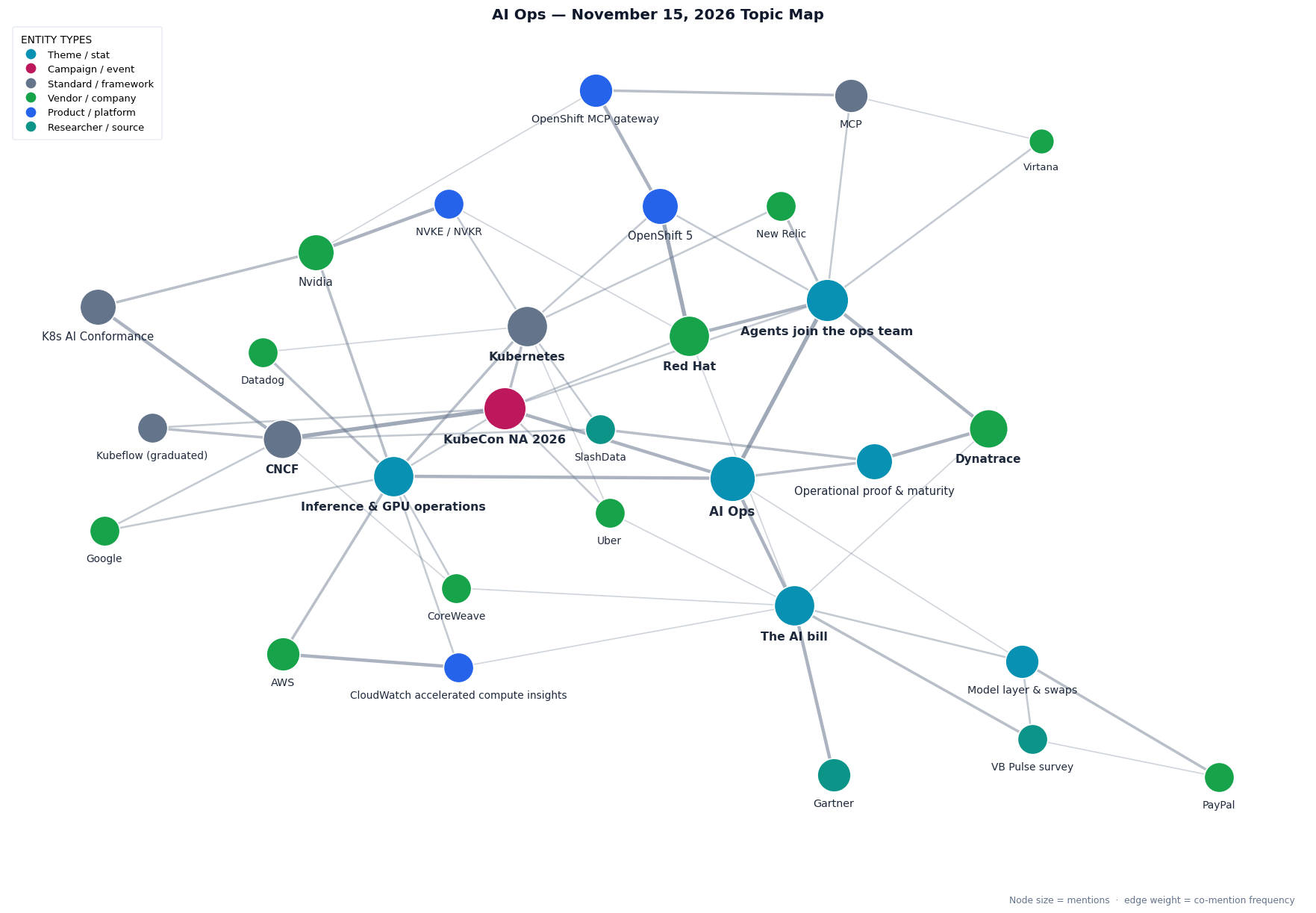
This week’s topic map. Agents joining the operations team sit at the top right with Red Hat, OpenShift 5, the MCP gateway, New Relic, Virtana and Dynatrace. Inference and GPU operations fill the left with Nvidia, NVKE, Datadog, AWS, CloudWatch, CoreWeave and Google. KubeCon, Kubernetes, the CNCF, Kubeflow and the AI conformance badge sit in the middle, and the AI bill and model layer take the bottom right with Gartner, the VB Pulse survey and PayPal.
View interactive topic map →
Article index
32 articles, grouped by sub-theme. Twenty-six are from this week’s coverage window (November 8 to November 15). Six are longer foundational reads on the beat. Sponsored coverage, vendor blogs and event coverage are labelled within each group.
Agents join the operations team
Red Hat, New Relic, Dynatrace, Virtana and ControlTheory all shipped or previewed agents that investigate incidents, and every one stops for a person before it changes anything. The Dynatrace item is vendor-published; the Jaeger item is a CNCF project post.
Running inference and GPUs on Kubernetes
Workload-level views of model servers and accelerators, and the tooling to run GPU clusters as a service. The SiliconANGLE CoreWeave segment is sponsored by CoreWeave, The New Stack piece is written by AWS staff, and the Datadog, Google, Qovery and Superlinked items are vendor-published.
| Article |
Source |
Published |
| 8. Troubleshoot Kubernetes inference workloads with Datadog (vendor blog) |
Datadog |
Nov 10, 2026 |
| 9. Expensive accelerators, no workload-level visibility: Introducing Amazon CloudWatch accelerated compute insights (AWS-authored) |
The New Stack |
Nov 11, 2026 |
| 10. Nvidia opens NVKE and NVKR to manage Kubernetes on GPU infrastructure |
TechTarget |
Nov 12, 2026 |
| 11. As AI model launches put Kubernetes inference on a deadline, CoreWeave deepens its open-source involvement (sponsored segment, presented by CoreWeave) |
SiliconANGLE |
Nov 11, 2026 |
| 12. The open AI-native stack on Kubernetes: From open models to distributed inference and agents (vendor blog) |
Google Cloud Blog |
Nov 10, 2026 |
| 13. Agents idling while they wait on humans push Kubernetes to hand back unused resources (theCUBE event coverage) |
SiliconANGLE |
Nov 13, 2026 |
| 14. Production AI Inference on Kubernetes: The 7 Things It Actually Requires (foundational, vendor blog) |
Qovery |
Nov 10, 2026 |
| 15. What I Learned in the Inference Tracks at KubeCon NA 2026 (foundational, vendor blog) |
Superlinked |
Nov 13, 2026 |
KubeCon’s scorecard
What the CNCF counted at KubeCon in Salt Lake City, and an independent look at what its AI conformance badge does and does not prove. The CNCF item is a press release; HyperFRAME is an analyst blog.
| Article |
Source |
Published |
| 16. CNCF Hits Major Milestones with Global Community Growth, Record Industry Investment and a New Generation of Projects to Build AI Systems in Production (press release) |
CNCF |
Nov 10, 2026 |
| 17. Kubernetes AI Conformance Badge: CNCF Hits 40 Platforms, Test Suite Names Only NVIDIA GPUs |
Tech Times |
Nov 11, 2026 |
| 18. KubeCon Day 3: Agentic AI, Kubeflow Graduation and SUSE’s Open Infrastructure |
Virtualization Review |
Nov 13, 2026 |
| 19. KubeCon Salt Lake City Day 2: Operating at Agent Speed, Platform Engineering and Enterprise Reality |
Virtualization Review |
Nov 12, 2026 |
| 20. Kubernetes Is Strengthening its Position as the AI Platform of Choice (foundational) |
Cloud Native Now |
Nov 13, 2026 |
| 21. Are AI Agents The Workload Kubernetes Has Been Waiting For? (foundational, analyst) |
HyperFRAME Research |
Nov 14, 2026 |
Operational proof and maturity
Surveys of how far teams trust their agents and how mature their Kubernetes estates are. The Dynatrace research is vendor-commissioned, the F5 and SlashData report is co-produced by a vendor, and the MarketBeat item is an automated recap of investor remarks.
The AI bill and the model layer
Cost has overtaken compute as the reason AI projects stall, the forecasts keep rising, and swapping a model is still weeks of work. The SiliconANGLE item is theCUBE event coverage; the InfoWorld piece is an opinion column.
| Article |
Source |
Published |
| 26. AI’s biggest bottleneck is cost: Companies blame stalled projects on overruns three times as often as on compute shortages |
VentureBeat |
Nov 10, 2026 |
| 27. Gartner Forecasts AI Infrastructure Spending to Represent 59% of Total Global AI Spending in 2027 (press release) |
Gartner |
Nov 12, 2026 |
| 28. Neoclouds face a shakeout as cloud-native software skills decide who survives (theCUBE event coverage) |
SiliconANGLE |
Nov 11, 2026 |
| 29. Swapping AI models is easier said than done: For most companies, it takes weeks, VB Intelligence finds |
VentureBeat |
Nov 12, 2026 |
| 30. PayPal says its AI assistant went from 43% to 95% accuracy without changing the model |
VentureBeat |
Nov 10, 2026 |
| 31. 10 reasons enterprise AI success hinges on platform teams in 2027 (foundational) |
TechTarget |
Nov 13, 2026 |
| 32. Cloud reports measure the wrong thing (foundational, opinion) |
InfoWorld |
Nov 13, 2026 |
Detailed write-ups
1. Red Hat ships OpenShift 5 and bids to be the air traffic controller for agents
SiliconANGLE / Network World · November 9–12, 2026
Red Hat released OpenShift 5, its first major version in seven years, as a single platform for containers, virtual machines and AI workloads, installable as an in-place upgrade from OpenShift 4. OpenShift Lightspeed becomes an agent that investigates operational problems and recommends fixes, and administrators decide whether to run them. An AI upgrade planner checks application dependencies, Kubernetes APIs and optional operators for compatibility before an update starts. Red Hat says OpenShift Virtualization is now an $800 million business, and it is offering a free year of it on qualifying three-year agreements, a pitch analysts read as aimed at VMware customers. RHEL 10.3 adds sealed images verified from the bootloader up, and RHEL gains an MCP server so AI assistants can inspect live Linux systems. “What is difficult is navigating all the things you’re running on top of Kubernetes,” said Mike Barrett, Red Hat’s general manager of hybrid cloud platforms.
The bigger move for operations teams is the OpenShift MCP gateway, generally available at KubeCon alongside an OpenShift MCP server. The gateway sits between agents and the tools they call and filters what each agent can reach based on its credentials. It bundles Nvidia’s open-source NeMo Guardrails to block prompt injection and protect sensitive data, and companies can require a person to approve any agent action that changes a system. The MCP server ties agent access to existing identity systems and Kubernetes role-based permissions with audit trails, and an agent sandbox in technology preview isolates untrusted agent code in virtual machines. Network World names Microsoft’s Agent 365 as a strong rival with broader control-plane coverage. “Everyone wants to be the air traffic controller for AI agents,” said Dell’Oro Group analyst Mauricio Sanchez.
Sources: SiliconANGLE (OpenShift 5) — https://siliconangle.com/2026/11/09/red-hat-adds-agentic-ai-operations-stronger-security-in-openshift-5-and-rhel-updates/ · Network World (Red Hat MCP gateway) — https://www.networkworld.com/article/4247825/red-hat-joins-race-to-be-air-traffic-controller-for-ai-agents.html
2. Incident agents arrive at KubeCon, and all of them ask before they act
Cloud Native Now / Dynatrace / IT Brief Asia / DevOps.com / CNCF Blog · November 10–13, 2026
New Relic previewed the Autopilot Kubernetes Agent, an extension of its Autopilot SRE agents. It runs more than 90 diagnostic detectors across Kubernetes events, object descriptions, logs and APM traces, draws on New Relic’s OpenTelemetry-based context engine, and targets noisy neighbours, resource contention, scheduling failures and ingress misconfigurations. It writes remediation code that engineers review and run themselves. “When critical Kubernetes infrastructure fails, engineers need clear answers, not just more alerts,” said chief product officer Brian Emerson. Dynatrace made its SRE Agent generally available. It starts as soon as Dynatrace opens a problem and returns the likely cause, the evidence, affected services and users, recommendations and what it ruled out, then routes the incident by ownership data to Slack, Teams, Jira or ServiceNow. Prepared fixes such as rollbacks or pull requests wait for approval, and Dynatrace advises starting with owned services and critical incidents.
Virtana showed an agentic observability platform that pulls agents from other systems into a shared “war room” over MCP and Agent2Agent, using more than 25,000 operational signals and a dependency graph to trace root cause. Customers move in stages from recommendations to approved fixes to letting agents resolve defined incident types; it is with select customers now, with general availability planned for the first quarter of 2027. ControlTheory released Dstl8 2.0, which uses a small language model on the telemetry collector to decide what to keep and now adds metrics and traces in preview, including traces of LLM calls with prompts left out. The Jaeger maintainers previewed “Ask Jaeger”, an opt-in MCP endpoint with nine trace tools, built-in diagnostic routines and views of model calls and token use based on OpenTelemetry’s GenAI conventions.
Sources: Cloud Native Now (New Relic) — https://cloudnativenow.com/kubecon-cloudnativecon-north-america-2026/new-relic-launches-autopilot-kubernetes-agent-for-ai-driven-cluster-troubleshooting/ · Dynatrace (SRE Agent, vendor blog) — https://www.dynatrace.com/news/blog/the-sre-agent-is-generally-available-investigation-and-triage-start-the-moment-a-problem-is-detected/ · IT Brief Asia (Virtana) — https://itbrief.asia/story/virtana-launches-ai-agent-war-room-for-it-incidents · DevOps.com (ControlTheory) — https://devops.com/controltheory-adds-traces-and-metrics-to-ai-platform-for-analyzing-telemetry-data · CNCF Blog (Jaeger) — https://www.cncf.io/blog/2026/11/10/jaeger-previews-ai-assisted-troubleshooting-and-genai-observability-for-opentelemetry-traces-at-kubecon/
3. Seeing what the GPUs are doing
Datadog / The New Stack / TechTarget / SiliconANGLE · November 10–12, 2026
AWS launched CloudWatch accelerated compute insights for Amazon EKS. It covers Nvidia GPUs, Trainium and Inferentia in one health view, labels each device with its pod, namespace and team, detects partitioned GPUs automatically, and estimates waste in three forms: oversized instances, training jobs using little of the hardware, and inference endpoints serving below capacity. It reports cost per token and time to first token, and carries no extra charge beyond standard CloudWatch pricing; AWS notes its cost figures are estimates, not billing data. Datadog put inference workloads into preview, grouping the pods and custom resources behind a served model for vLLM workloads on KubeRay, Nvidia Dynamo and KServe, with GPU memory and occupancy for Dynamo workloads on its paid GPU Monitoring.
Nvidia open-sourced NVKE and NVKR to help platform teams offer managed Kubernetes on their own GPU clusters. NVKE automates bare-metal provisioning, upgrades and failed-node replacement through Cluster API, and NVKR builds the signed, version-pinned images it deploys. Nvidia says a validated stack can be ready the day a new GPU generation ships, and eight partners including Mirantis, Rafay and vCluster plan to adopt it. “NVKE isn’t meant to replace OpenShift or Rancher,” said Warren Barkley, Nvidia’s vice president of AI factories. In a theCUBE segment sponsored by CoreWeave, CoreWeave said it patches vLLM and SGLang and writes its own kernels for new models, because downloading a model’s weights does not mean it will meet a deployment’s requirements.
Sources: The New Stack (CloudWatch, AWS-authored) — https://thenewstack.io/cloudwatch-accelerated-compute-insights/ · Datadog (inference workloads, vendor blog) — https://www.datadoghq.com/blog/kubernetes-inference-workload-monitoring/ · TechTarget (NVKE and NVKR) — https://www.techtarget.com/news/nvidia-opens-nvke-and-nvkr-to-manage-kubernetes-on-gpu-infrastructure/874538/ · SiliconANGLE (CoreWeave, sponsored) — https://siliconangle.com/2026/11/11/kubernetes-inference-takes-more-than-downloading-model-weights-kubeconna/
4. Kubeflow graduates and Uber opens Michelangelo as the CNCF tallies the year
CNCF / Virtualization Review · November 10–13, 2026
The CNCF said its portfolio now spans 231 projects, 32 of them added in the past year, and that the cloud native developer community reached 21.2 million. Eight companies joined as Platinum members: Adyen, Broadcom, CoreWeave, CVS, HAProxy, Nvidia, OVHcloud and Vultr. Kubeflow graduated, with more than 500 million downloads and nearly 9,000 contributors, and Agent Substrate and OpenShell joined as Sandbox projects for running agents securely. “AI teams need control over where their models run, what their agents can do, and how their systems behave in production,” said executive director Jonathan Bryce, who also said agents now generate 70% of tracked inference traffic.
On day two, Uber said it will open-source Michelangelo, its Kubernetes-native machine-learning platform, which runs more than 5,300 production models and about 45 million predictions a second. On day three, Microsoft open-sourced AgentSessions, which records model calls in an append-only, hash-linked journal so teams can replay or audit an agent session without querying the model again. CNCF head of projects Jeffrey Sica cited Anthropic data from 200,000 coding-agent sessions showing the number of autonomous actions before a person steps in rose from 10 to 21 in six months, and summed up maintainers’ AI contribution policies as “draft and review, spec and build, not YOLO-solve.”
Sources: CNCF (milestones, press release) — https://www.cncf.io/announcements/2026/11/10/cncf-hits-major-milestones-with-global-community-growth-record-industry-investment-and-a-new-generation-of-projects-to-build-ai-systems-in-production/ · Virtualization Review (KubeCon Day 3) — https://virtualizationreview.com/articles/2026/11/13/kubecon-day-3-agentic-ai-kubeflow-graduation-and-suses-open-infrastructure.aspx · Virtualization Review (KubeCon Day 2) — https://virtualizationreview.com/articles/2026/11/12/kubecon-salt-lake-city-day-2-operating-at-agent-speed-platform-engineering-and-enterprise-reality.aspx
5. What the AI conformance badge does not prove
Tech Times · November 11, 2026
Tech Times took apart the Kubernetes AI Conformance milestone. The 40-platform count is cumulative across Kubernetes versions, and only four platforms list the current v1.37 release: GKE, Kubermatic, RKE2 and Talos. The open-source test suite defines a single accelerator configuration, “nvidia”, next to a code comment reading “Add other vendors here”; other accelerators are skipped and manual evidence is expected instead. Most submissions are self-assessed checklists, certificates last a year from merge, and across submissions eight required items were marked not applicable.
The badge also says nothing about isolation strength or performance. The CNCF’s HAMi project shares GPUs through software limits that a CNCF blog post says can be bypassed, so clusters with untrusted tenants still need hardware partitioning such as Nvidia MIG. The article’s advice is to treat the badge as a starting checklist and run your own performance and isolation tests. Bryce had said the programme lets developers “retain choice across models, hardware and providers”; for now, the test suite only checks for one hardware vendor.
Sources: Tech Times (AI conformance badge) — https://www.techtimes.com/articles/330454/20261111/kubernetes-ai-conformance-badge-cncf-hits-40-platforms-test-suite-names-only-nvidia-gpus.htm
6. Cost, not compute, is now what stalls AI projects
VentureBeat / Gartner / TechTarget / SiliconANGLE · November 10–13, 2026
In VentureBeat’s October survey of 156 AI practitioners, 38% said cost overruns had delayed, cut back or cancelled an AI project in the past year, three times the 12% who blamed a shortage of compute. 79% expect their AI budget to grow, yet only 26% judge AI spending by a financial return they could defend to finance, and 56% plan to add or replace an AI compute platform within a year. Red Hat reported 40% to 70% lower effective token spend in a pilot depending on caching and routing, and Uber cut the cost of a code-cleanup task by 90% by benchmarking models. “I’m tracking not your downloads. I’m tracking the diversity,” said Mazin Gilbert, executive director of the Agentic AI Foundation.
Gartner forecast global AI spending of $4.05 trillion in 2027, up 47.5%, with infrastructure up 53% to about $2.4 trillion, or 59% of the total; AI-optimised servers alone rise from $527.6 billion to $957.2 billion. TechTarget gathered the analyst predictions that matter to operations teams: Gartner expects uncapped token pricing for IT-operations agents to overshoot cost expectations by more than 50%, and Forrester expects enterprises to move a fifth of agentic workflows back to deterministic processes in 2027 to save money, and a quarter of AI infrastructure RFPs to require non-Nvidia options. At KubeCon, analysts told theCUBE that the neoclouds without real software skills will struggle: “Without software chops, you’re dead in the water,” said Stackpane chief executive Sarbjeet Johal.
Sources: VentureBeat (AI cost bottleneck) — https://venturebeat.com/infrastructure/ais-biggest-bottleneck-is-cost-companies-blame-stalled-projects-on-overruns-three-times-as-often-as-on-compute-shortages · Gartner (AI spending forecast, press release) — https://www.gartner.com/en/newsroom/press-releases/2026-11-12-gartner-forecasts-artificial-intelligence-infrastructure-spending-to-represent-59-percent-of-total-global-artificial-intelligence-spending-in-2027 · TechTarget (platform teams in 2027) — https://www.techtarget.com/news/10-reasons-enterprise-ai-success-hinges-on-platform-teams-in-2027/874697/ · SiliconANGLE (neocloud shakeout, theCUBE) — https://siliconangle.com/2026/11/11/ai-infrastructure-clouds-face-shakeout-over-software-skills-kubeconna/
7. PayPal fixes accuracy without touching the model, while swaps still take weeks
VentureBeat · November 10–12, 2026
PayPal raised its internal data assistant’s accuracy from 43% to 95% while keeping the same model. It added a knowledge layer kept separate from the model: business definitions, query patterns, stored “golden queries” and analytical playbooks that describe how its data staff investigate a question. Procedures are stored as ordered steps rather than split into chunks, and testing grew to offline simulations, synthetic questions, multi-turn tests and model-based judging alongside human review. A smaller 8-billion-parameter model cut latency but lost accuracy, and PayPal has moved away from heavy fine-tuning because of the upkeep. “The LLM is still the same,” said Ren Zhang, PayPal’s global head of AI product, who built the system to be model-agnostic on purpose.
That design matters because swapping models is still expensive. In VentureBeat’s survey, 47% of companies had replaced a production model in the past year. Of those, 70% said it took at least a few weeks of extra engineering and 36% more than a month; only 13% said it was close to a configuration change, and 45% saw worse results or went back to the original model.
Sources: VentureBeat (PayPal accuracy) — https://venturebeat.com/orchestration/paypal-says-its-ai-assistant-went-from-43-to-95-accuracy-without-changing-the-model · VentureBeat (model swaps) — https://venturebeat.com/infrastructure/swapping-ai-models-is-easier-said-than-done-for-most-companies-it-takes-weeks-vb-intelligence-finds?ref=techtech.club
8. Teams want autonomous operations, but still check two-thirds of agent decisions
Dynatrace / MarketBeat / ITOps Times / CNCF · November 9–13, 2026
A survey of 1,202 technology leaders commissioned by Dynatrace found 87% already use AI agents for observability and IT operations, and 44% aim for fully autonomous operations within five years, against 12% who say they are there today. On average, people still verify 66% of AI-driven decisions, and only 27% address visibility into how agents decide and act. “AI can be available and responsive but not working as intended,” the report notes. Speaking at a BMO investor conference, Dynatrace’s finance chief said more than 1,100 customers running AI workloads consume its platform at about twice the rate of others, and the company said log consumption is heading toward $250 million, while recurring revenue grows about 16%.
A separate F5 and SlashData study of 445 Kubernetes practitioners found only 38% of enterprises at “enterprise-grade” Kubernetes maturity. Observability was the weakest of its four pillars, with 48% at the top tier and just 28% planning to invest there, even though 45% already serve AI models. Organisations that split platform engineering from central security reached the top tier 66% of the time, against 32% for other models. The CNCF’s own SlashData research found that how platform teams are organised shapes whether developers use a dedicated AI platform, a hybrid approach or a vendor’s.
Sources: Dynatrace (State of Observability, vendor research) — https://www.dynatrace.com/news/blog/state-of-observability-report-2026-key-insights/ · MarketBeat (Dynatrace consumption) — https://www.marketbeat.com/instant-alerts/event-dynatrace-sees-ai-customers-consuming-its-platform-at-twice-the-rate-fueling-growth-hopes-2026-11-13/ · ITOps Times (Kubernetes maturity) — https://itopstimes.com/kubernetes/report-only-38-of-enterprises-reach-enterprise-grade-kubernetes-maturity/ · CNCF (SlashData platform engineering, press release) — https://www.cncf.io/announcements/2026/11/10/cncf-and-slashdata-report-finds-platform-engineering-strategies-are-shaping-ai-infrastructure-adoption/
Calls to action
- Put agents behind a gateway before they reach production tools. Whether you use Red Hat’s MCP gateway or another, route agent tool calls through one point that checks identity, limits what each agent can call and logs every action.
- Pilot incident agents on owned, high-severity services first. Start any SRE agent on a narrow filter, compare its findings with what your responders concluded, and widen scope only once its root causes hold up.
- Keep approval on every fix. Configure rollbacks, pull requests and configuration changes proposed by agents to wait for a named approver, and record who approved what.
- Turn on workload-level GPU visibility. If you run inference on Kubernetes, enable the accelerator views your platform already offers and label pods by team so idle and underused GPUs can be traced to an owner.
- Test conformant platforms yourself. Treat the Kubernetes AI Conformance badge as a checklist, and run your own performance and isolation tests, especially for shared GPUs and non-Nvidia accelerators.
- Put a cap on agent token spend. For any operations agent priced on tokens or usage, set a budget and alert on it, and review spend weekly against incidents resolved.
- Keep business knowledge outside the model. Store definitions, approved queries and procedures in a layer your assistant retrieves from, and keep an evaluation set so a model swap is a test run, not a rebuild.
|